
12 Basic Skills of Work: Complete Chapter-by-Chapter Summary
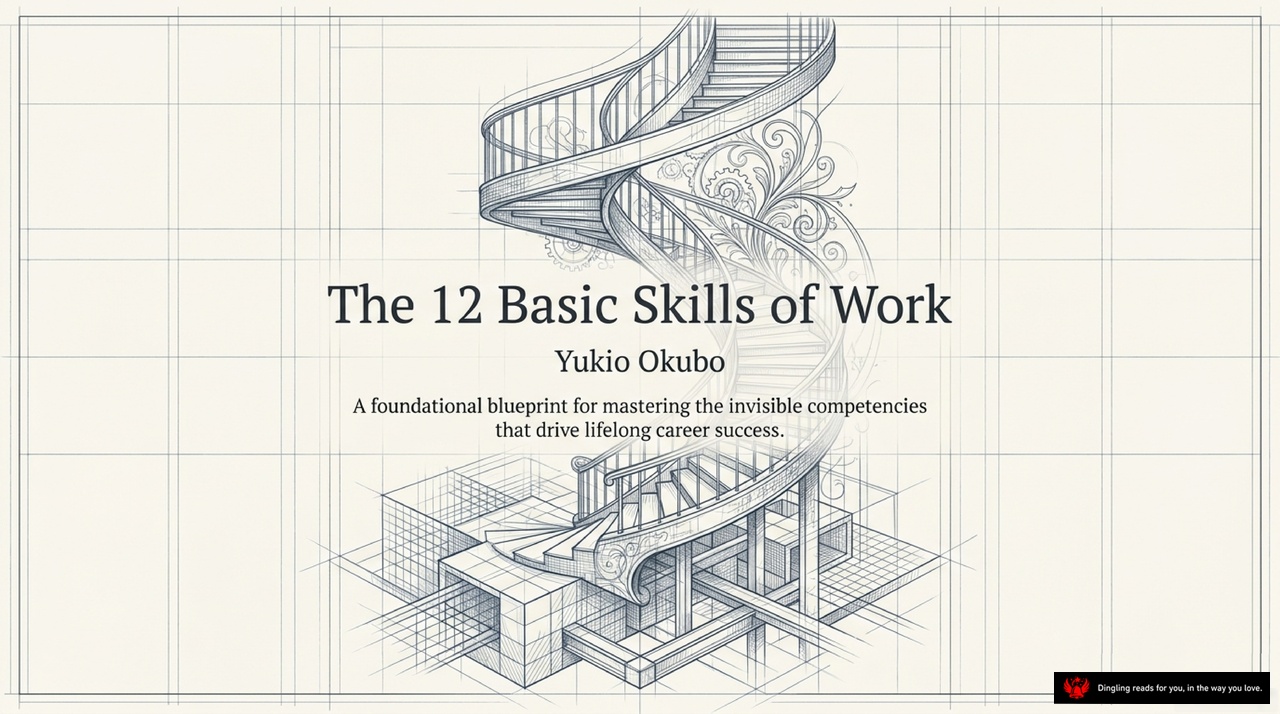
Welcome to our book club session on *The 12 Basic Skills of Work* by Yukio Okubo. Today, we're diving into the cover concept: a foundational blueprint for mastering the invisible competencies that drive lifelong career success.
Think of your career not as a straight line, but as this intricate spiral staircase shown on the cover. Many of us get stuck trying to learn surface-level tricks or obsess over the wrong things like fancy degrees or certificates, only to find they don't actually move us up the steps. The book argues that real success comes from building these 12 core skills. Instead of worrying about finding your perfect job immediately, the author suggests a "drifting" approach first—focus on growing your abilities in a supportive environment. Once you've built that solid foundation, you can confidently start climbing your specific mountain later. It's about creating your own path through experience rather than guessing at the start. Let's explore how these skills can transform your professional life.
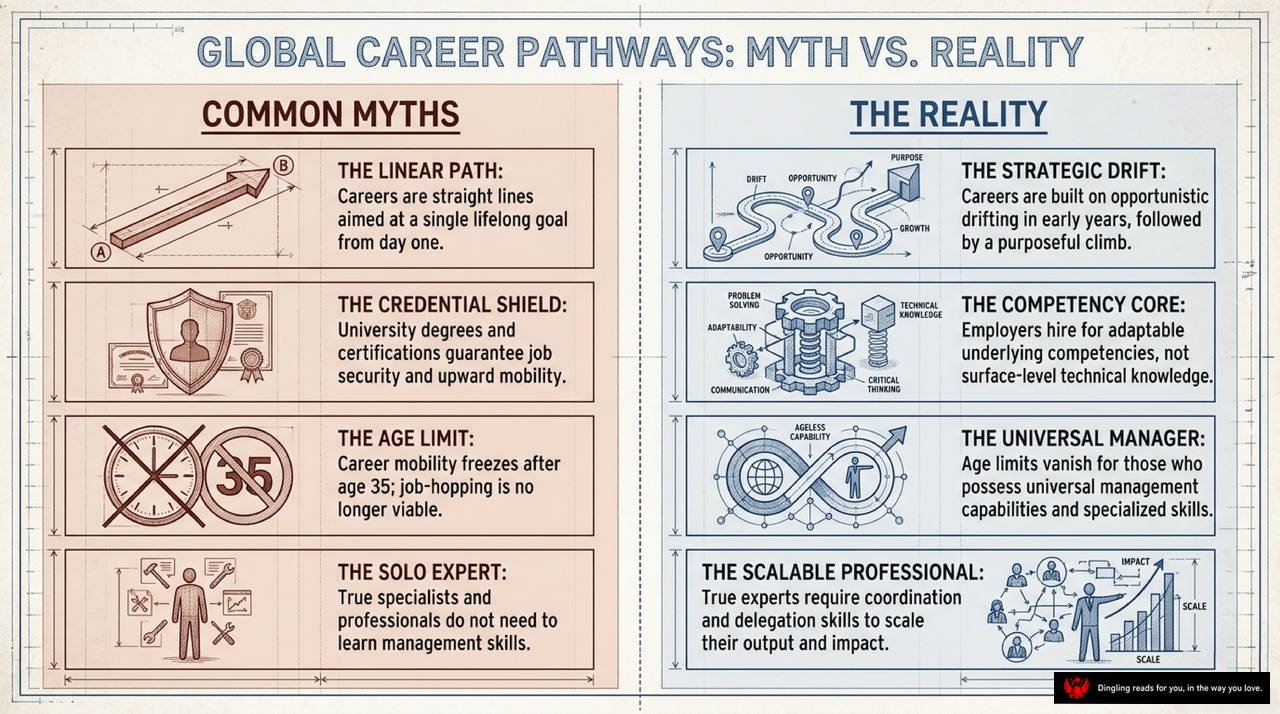
Today's slide breaks down the biggest trap in modern careers: the difference between what we think is true and what actually works. On the left, you see the "Common Myths"—the stories we tell ourselves to feel safe. We believe in "The Linear Path," thinking our career should be a straight arrow from day one. We trust "The Credential Shield," assuming degrees and certificates guarantee security. We fear "The Age Limit," thinking mobility freezes after 35, and we cling to the idea of being a "Solo Expert," believing we don't need to learn management.
But look at the right side: "The Reality." This isn't about failure; it's about a strategic shift. Your career isn't a straight line; it's a "Strategic Drift." You start by wandering through opportunities, only finding your purpose later. Employers don't hire for surface-level technical knowledge; they hire for a "Competency Core"—adaptability, problem-solving, and critical thinking. Age isn't a barrier if you build "Universal Manager" capabilities that transcend specific roles. Finally, true experts aren't solo actors; they are "Scalable Professionals" who master coordination and delegation to multiply their impact. The goal isn't to be a lone wolf who can't delegate, but a leader who builds a team.
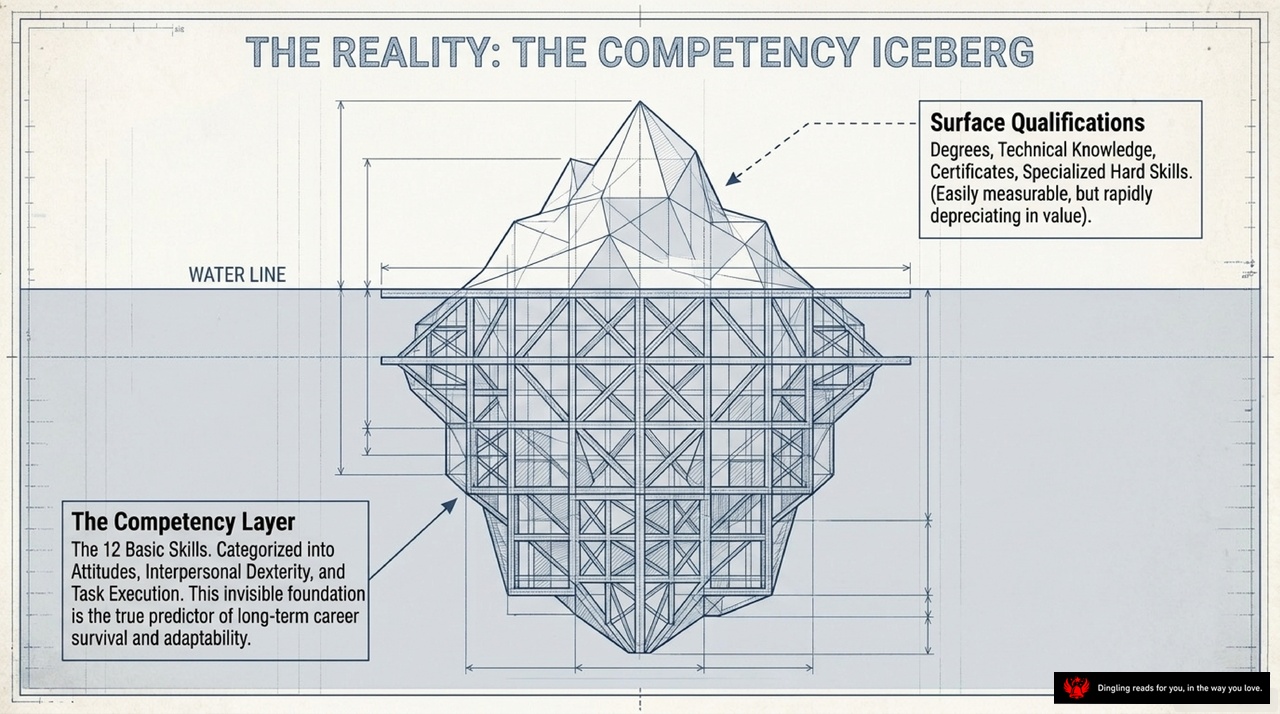
Look at this iceberg. What you see above the waterline are the Surface Qualifications—degrees, technical knowledge, and certificates. These are easily measurable, but here's the hard truth: they depreciate in value the moment you get them. They are just the tip of the iceberg.
The real game happens underwater. That's where The Competency Layer lives. This invisible foundation consists of the 12 Basic Skills, categorized into attitudes, interpersonal dexterity, and task execution. While your diploma might get you the interview, this submerged structure is the true predictor of long-term career survival and adaptability.
In today's fast-changing economy, relying solely on surface skills is a recipe for obsolescence. The companies that thrive are those that hire for the depth of character and skill you can't see on a resume. So, stop obsessing over the next certificate and start building that massive, invisible framework beneath the surface. That is where your real career value is built.

This blueprint outlines the three pillars of mastery that define a successful career. On the left, we have **Pillar I: Mastery of Self**, described as your internal engine. This is where you build your foundation through reaction, optimism, target discovery, and continuous learning. Without a strong internal compass, external success is impossible.
Moving to the right, we see **Pillar II: Mastery of Others**, or what the map calls the relational web. Here, success comes from your ability to connect. This pillar relies on affinity, context understanding, consultation, and network building. It's about how you interact with the world and leverage relationships to create opportunities.
Finally, at the bottom center, is **Pillar III: Mastery of Tasks**, the execution framework. This is where strategy meets action. It combines professional construction, teaching, delegation, coordination, and delegation to turn your ideas into reality. Notice how these three pillars are interconnected; true mastery isn't about excelling in just one area, but integrating self-mastery, relational skills, and task execution into a cohesive whole. By strengthening all three, you create a career that is resilient, adaptable, and deeply rewarding.

Look at this blueprint of "The Internal Engine." It's not just a static chart; it's a dynamic cycle that drives your career growth. Notice how the arrows flow in a continuous loop: Optimism, Reaction, Continuous Learning, and Target Discovery.
Let's break down how these pieces fit together in real life. It all starts with **Optimism**. As the slide explains, this is about strategic positive thinking—treating stress and failure not as dead ends, but as an active curriculum to extract data. When you shift your mindset this way, you naturally move into **Reaction**. This isn't about passively sitting there; it's about active engagement. You master non-verbal cues, using that simple power of a nod to magnetically draw information and trust from others.
Once you're reacting effectively, you enter the phase of **Continuous Learning**. This is where you transition from forced academic study to self-directed knowledge acquisition. You format your brain through intensive, immersive reading, turning information into true capability. And finally, this learning fuels **Target Discovery**. You generate that "animal spirit" to actively locate the gap between your ideal vision and current reality. That gap is where your true motivation and goals are born.
The beauty of this engine is that it's a cycle. Your optimism fuels your reaction, your reaction drives your learning, and your learning sharpens your target discovery, which in turn reinforces your optimism. By mastering this 4-quadrant growth cycle, you stop drifting and start building a career that is resilient, self-driven, and constantly evolving.
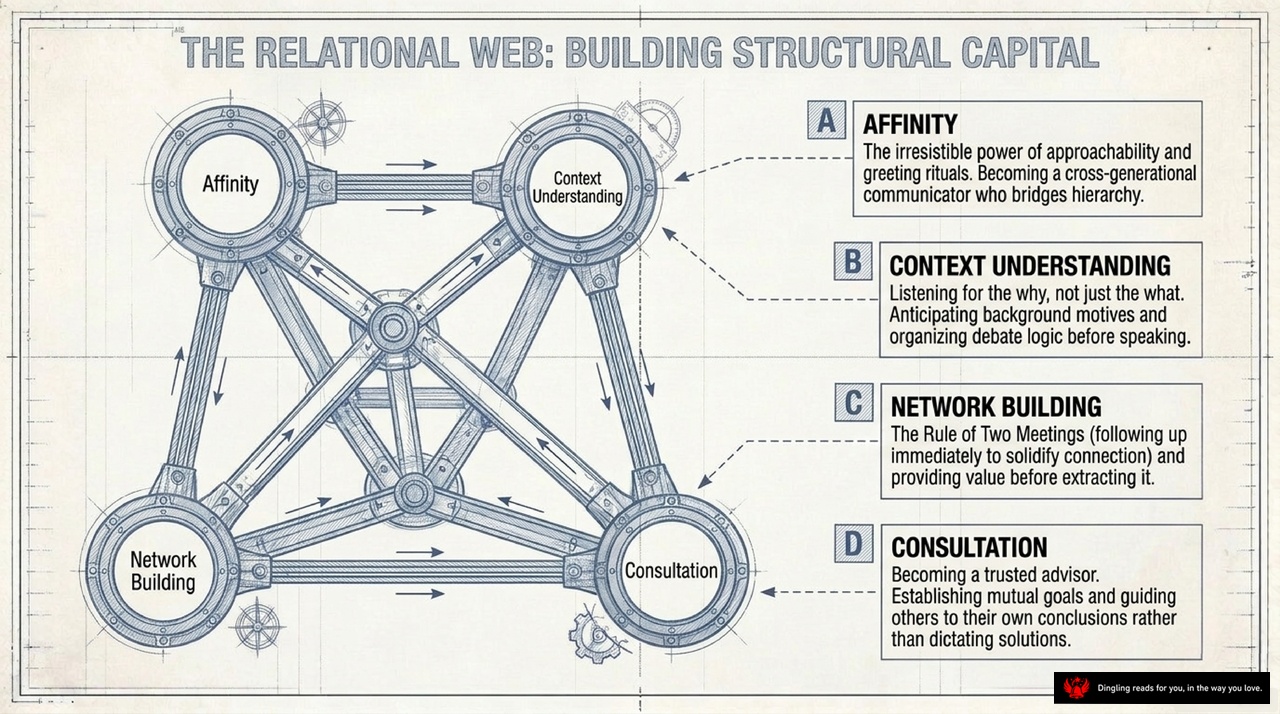
Look at this blueprint for building your career's structural capital. This isn't just about networking; it's about weaving a tight, resilient web of relationships. The diagram highlights four critical nodes: Affinity, Context Understanding, Network Building, and Consultation.
First, start with Affinity. This is the magnetic power of approachability and greeting rituals. It's about becoming a communicator who bridges gaps, whether you're talking to a senior leader or a new hire. Next is Context Understanding. This means listening for the "why" behind the words, not just the "what." You need to anticipate the background motives of others and organize your logic before you speak.
Then, move to Network Building. The rule here is simple but powerful: follow up immediately to solidify a connection, and always provide value before you ask for anything in return. Finally, aim for Consultation. Your goal is to become a trusted advisor. Instead of dictating solutions, establish mutual goals and guide others to their own conclusions.
Mastering these four elements transforms you from a passive participant into an architect of your own professional success.

Today's slide maps out the "Professional Ascent," a five-stage flowchart for your career growth. Think of this not as a rigid ladder, but as a construction blueprint for your professional life.
It all starts at the bottom with **Stage 1: Professional Construction**. Here, you merge deep theoretical knowledge with rigorous practical execution to carve out your definitive niche. You aren't just learning; you are building the foundation of your expertise.
Next, you move to **Stage 2: Delegation**. This is where you defeat the inner demon that whispers, "It's faster if I do it myself." You learn to scale your output by building structured trust and mastering phase-based handoffs, trusting others to execute parts of your vision.
As you climb, **Stage 3: Teaching** becomes your tool for influence. You utilize coaching techniques, separating critique of the task from critique of the person. You praise specifically and publicly, turning your knowledge into a catalyst for others' growth.
Then comes **Stage 4: Coordination**. This is described as the ultimate 21st-century meta-skill. Here, you balance diverse stakeholders, broker knowledge across silos, and drive unified execution. You become the glue that holds complex projects together.
Finally, at the very top, we see **Stage 1: Tetaching**. This appears to be a unique stage focused on learners attaining the "mononritty"—likely meaning the essence or spirit of the work—and conflicts to carve out their role in the definitive niche. It suggests that true mastery comes from navigating complexity and defining your unique value in the market.
The message is clear: your career is a series of deliberate steps. Start by building your expertise, learn to delegate, teach others, coordinate complex efforts, and ultimately, define your unique niche in the world.
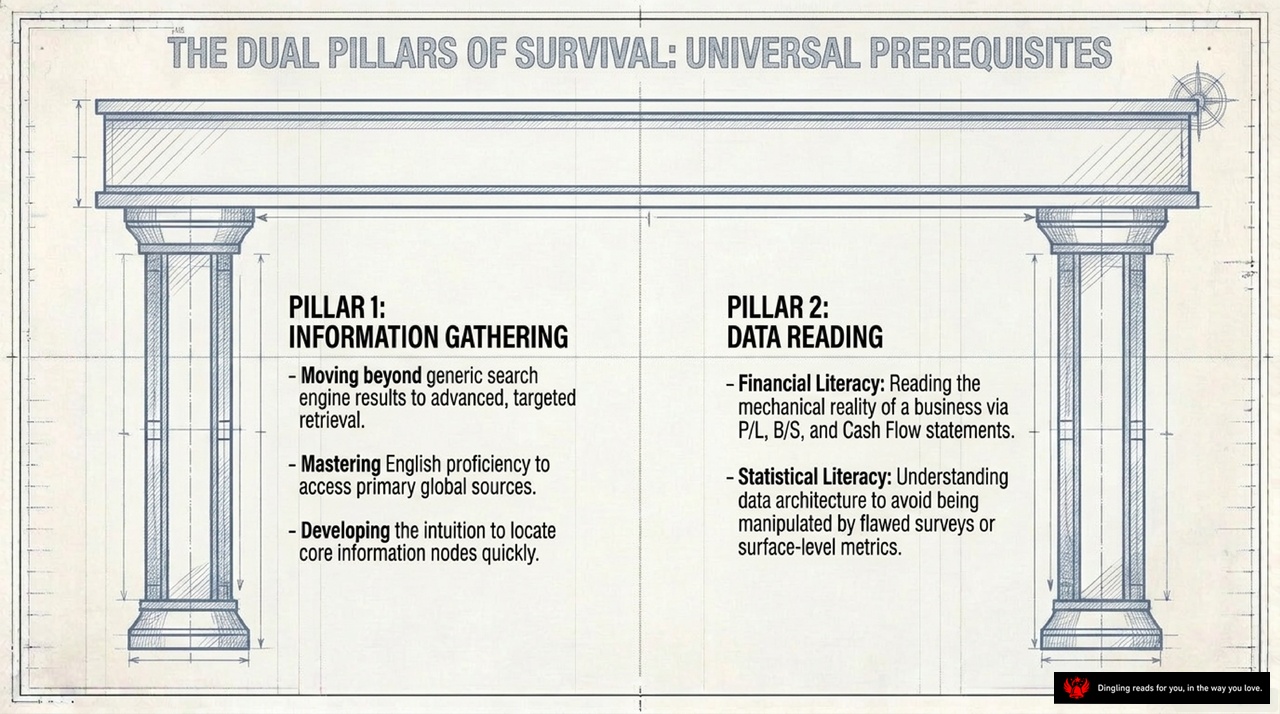
Today's slide outlines the twin pillars of survival: Information Gathering and Data Reading. Think of these as the foundation supporting your entire career structure.
First, let's look at Information Gathering. The text emphasizes moving beyond generic search results to advanced, targeted retrieval. In a world flooded with noise, this means mastering English proficiency to access primary global sources directly, rather than relying on translated summaries. It also requires developing the intuition to quickly locate core information nodes. Without this skill, you're just scrolling through irrelevant content instead of finding the insights that actually drive decisions.
On the right, we have Data Reading. This is about seeing the mechanical reality of a business, not just the surface-level marketing fluff. The slide breaks this down into Financial Literacy—reading P/L, B/S, and Cash Flow statements—and Statistical Literacy. This is crucial because many people are easily manipulated by flawed surveys or misleading metrics. True data reading allows you to cut through the manipulation, understand the underlying architecture of information, and make decisions based on hard facts rather than gut feelings or cherry-picked statistics.
Mastering these two pillars ensures you aren't just reacting to the world, but actively understanding and navigating it with precision.
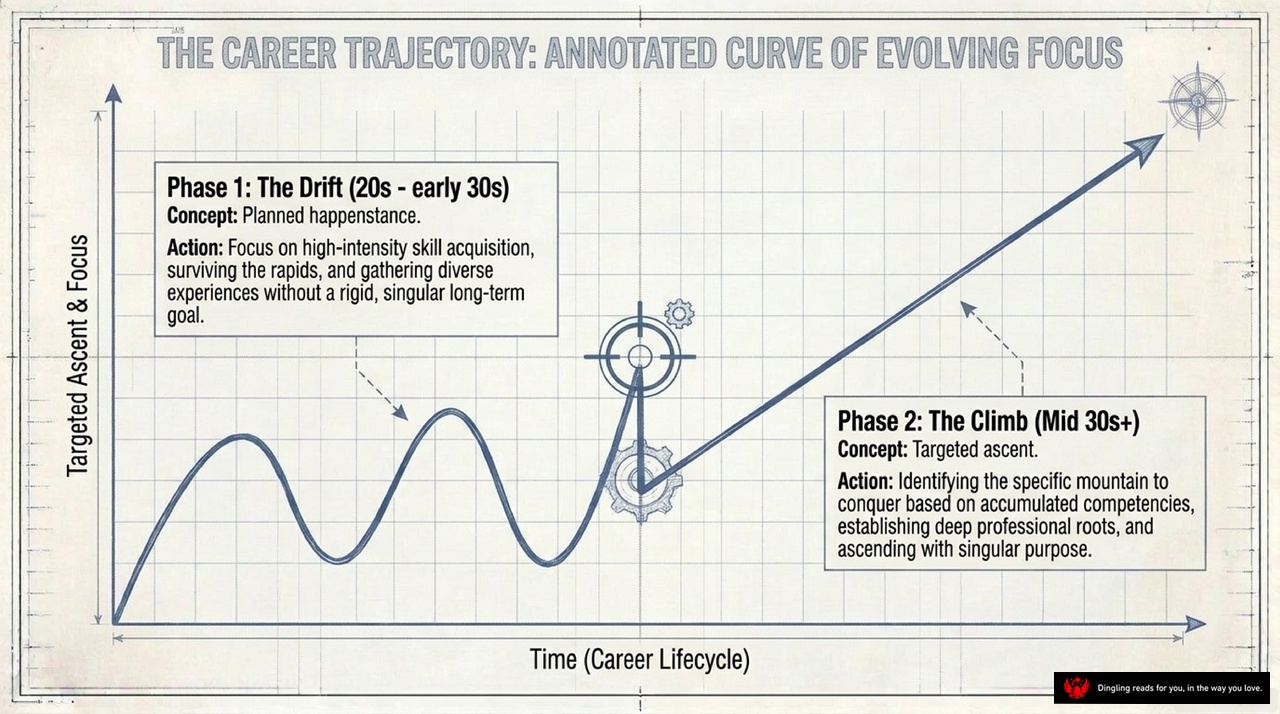
Look at this chart titled "The Career Trajectory: Annotated Curve of Evolving Focus." It maps out a two-phase path that feels surprisingly liberating.
In the first phase, labeled "The Drift" for your 20s and early 30s, the concept is "Planned Happenstance." Instead of stressing over a rigid, long-term goal, the action here is to focus on high-intensity skill acquisition. Think of it as surviving the rapids and gathering diverse experiences. The graph shows this as a winding, bumpy line, but that's the point. You aren't lost; you are gathering the diverse competencies you need.
Then, the curve pivots sharply upward into Phase 2: "The Climb," starting in your mid-30s. Here, the concept shifts to "Targeted Ascent." Now that you have those accumulated skills and deep professional roots, you identify the specific mountain you want to conquer. The action becomes singular and purposeful, represented by that straight, upward arrow aiming for the peak.
This visual perfectly captures the book's core advice: don't try to figure out your entire life's purpose before you start. Start with the drift to build your skills, then switch to the climb once you're ready. It's the ideal career design—first gathering the tools, then building the tower.

Look at this logic flowchart. It maps out a powerful strategy for navigating career risks: Adult Experimentation. The core concept here is simple but profound: career pivots carry huge risks, so you must test them through low-stakes adult internships before making a full commitment. Instead of jumping blindly into a new path, treat your career like a series of safe experiments.
The chart breaks this down into three practical methods. First, Side-Hustles. This allows you to test the viability of an independent business without ever abandoning the security of your corporate job. It's the perfect way to validate an idea with zero risk. Second, Telecommuting Trials. If you're wondering if a remote, self-directed life fits your personality, try it out for a bit. This helps you discover if the isolation matches your psychological profile before you move your whole life online. Finally, Dispatch or Contract Work. Think of this as a "dating" phase for your career. You work with a company or industry temporarily to see if you click, effectively testing the waters before you decide to "marry" that specific career path.
By using these low-stakes experiments, you stop gambling with your future and start engineering it with confidence.

Look at this blueprint of your career. It shows that reaching the top isn't about chasing the highest salary or the fanciest title. The real destination is finding an unshakable alignment with your work. Think of it as three overlapping rings that must intersect to create your true career anchor.
First, look at Ring 1: Can Do. This is where your refined competencies and strengths meet. You need to know what you are actually good at. Then move to Ring 2: Want to Do. This represents the alignment between your core values and your internal desires. It's about doing work that feels right for who you are. Finally, there is Ring 3: Should Do. This is about solving the problems that the market and society actually need solved. It's your contribution to the world.
When these three circles overlap, you find your career anchor. That is the sweet spot where your skills, your passions, and the world's needs all line up perfectly. If you only focus on one ring, you might be skilled but unfulfilled, or passionate but ineffective. But when you align all three, you stop climbing a ladder blindly and start walking toward a destination that feels like home. That is the ultimate goal of your professional journey.

True career success isn't about stacking up prestigious degrees or clinging to rigid, five-year life plans. It's built on a much more resilient foundation: twelve adaptable human competencies that span self-mastery, relational intelligence, and task execution. Think about it—imagine if your current title, company, and credentials were stripped away tomorrow. Would your underlying skills be strong enough to rebuild your career from scratch? That's the real test.
The old idea of a straight-line career path is a myth. Instead, you should aim for a "drifting" phase early on, where you explore and build those core skills without the pressure of a fixed destination. Once you've gained enough experience and clarity, perhaps around age 30, you can switch to a "mountaineering" mode and climb your chosen peak with purpose. This approach allows you to adapt to an unpredictable world, ensuring that no matter what happens, you have the essential tools to succeed and thrive in any role you choose.