
2666: Complete Chapter-by-Chapter Summary

Welcome to the world of Roberto Bolaño and his enigmatic masterpiece, *2666*. Imagine a vast, sun-scorched desert where the sky turns a bruised purple at dusk, and a single palm tree stands defiantly beside a small, shimmering pool of water. This isn't just a landscape; it's the haunting setting for one of the most monumental explorations of human evil ever written. The story converges on a fictional desert city called Santa Teresa, a place where violence becomes a mundane part of daily life, and strangers vanish without a trace. As we dive into this narrative, we're not just reading about a city; we're witnessing a descent into a nightmare where the line between reality and fiction blurs, inviting us to confront the darkest corners of the human condition.

The Architecture of a Masterpiece isn't just a title; it's the story of how a literary legend was born from a plan that almost didn't happen. Imagine a 1,100-page manuscript, originally designed by Roberto Bolaño as five separate books, meant to be released one per year to secure his children's future. But fate had other plans. After Bolaño passed away, his heirs and literary executor looked at those five parts and saw something else entirely. Instead of five distinct novels, they recognized a single, monumental structure. They realized that the profound thematic interconnections between the parts only worked as a unified whole. So, they made the bold decision to publish it as one massive volume. This final execution preserved the work's literary integrity, turning what could have been five separate stories into one unforgettable masterpiece. It's a perfect example of how sometimes, the greatest art comes not from following the original blueprint, but from listening to the deeper rhythm of the work itself.

Santa Teresa isn't just a city on a map; in Bolaño's world, it's the epicenter of reality, a fictionalized version of Ciudad Juárez that acts as a black hole for human cruelty. As the diagram shows, this single point pulls in forces from every corner of the globe. On one side, you have European academia and exiled intellectuals, while on the other, American journalism and the heavy weight of WWII history. All these disparate threads converge here.
This convergence creates a perfect storm. We see the cold detachment of academic research clashing with the raw, urgent reporting of journalists like Sergio Gonzalez, who arrives to find a city drowning in unsolved femicides. Meanwhile, the ghosts of the past linger; the trauma of war and the displacement of intellectuals seem to have found a new home in this desert landscape. It is a place where the past refuses to stay buried, and where the cruelty of the modern world is laid bare, forcing every character who steps into its orbit to confront an ultimate darkness that no amount of knowledge or history can fully explain.

Part I: The Part About the Critics. Welcome to the illusion of literature versus reality. Look at this tower built entirely of books, standing alone in a vast, empty desert. This image perfectly captures the fate of four European academics: Pelletier, Morini, Espinoza, and Norton. They constructed their entire lives around the elusive German author, Benno von Archimboldi. But when their search led them to Santa Teresa, Mexico, they were completely incapable of processing the visceral horror of the murders unfolding around them. Instead of facing the bleeding reality, they retreated into academic abstraction and petty love triangles. This slide proves art's impotence when confronted with true chaos. They chose the safety of theory over the danger of life, proving that sometimes, the illusion of literature is just a shield against the terrifying truth.

Welcome back to our deep dive into Roberto Bolaño's *2666*. Today, we are shifting gears from the literary critics to the gritty, terrifying reality of Santa Teresa itself. Look at the image: a desolate desert landscape under a blood-red sky, with an open geometry book hanging on a line—a symbol of the intellectual detachment that is about to be shattered by violence. This is Part II: The Part About Amalfitano, and it is a case file on exile and the descent into madness.
The core theme here is stark. We have Amalfitano, an exiled Chilean professor living in Santa Teresa, trying to teach geometry in a city that feels more like a graveyard than a university. He hangs a geometry book outside his house, mimicking Duchamp's readymades, hoping it might "learn real life," but instead, it becomes a totem of his unraveling mind. As femicides escalate around him, Amalfitano succumbs to paranoia. He begins hearing voices—mysterious, mocking voices that question his sexuality, his desire to flee, and the betrayal of his own curiosity. He becomes obsessed with the safety of his daughter, Rosa, and his mental decay mirrors the psychological rot of the city itself.
The violence is relentless. From January to December, the city is a slaughterhouse. Women are found in garbage dumps, burned in their homes, or mutilated in public parks. The police are incompetent, the journalists are indifferent, and the legal system is a joke. We see the rise of Klaus Haas, a German-American accused of these crimes, and the chaotic, desperate attempts to find justice. The city is a "Gypsy camp" of despair, where American tourists get drunk in flower beds while women disappear into the desert.
Ultimately, this section shows us that in Santa Teresa, the only thing that remains is the silence of the victims and the screaming of the guilty. Amalfitano's isolation is no longer just personal; it is the fate of everyone in this cursed place.

Welcome to Part III: The Part About Fate. This isn't just a chapter title; it's the core tension of the entire story. The theme here is stark and brutal: witnessing horror and the inability to speak.
Our protagonist, Oscar Fate, a Black American journalist for *Black Dawn* magazine, is sent to Santa Teresa to cover a relatively light story—a boxing match. But he accidentally stumbles into the horrific, systemic reality of murdered women. Despite his desperate attempts to report on these femicides, his editors refuse the story. They silence him.
Fate's journey highlights a global, societal indifference to marginalized suffering. It forces us to ask a difficult question: When the world is so broken, do we have the right—or the power—to speak? The image of the shattered typewriter symbolizes this fracture. It's not just about the act of writing; it's about the violence done to the truth when the world refuses to listen. We are watching a man try to type the unspeakable, only to be broken by the silence around him.

Welcome to Part IV: The Part About the Crimes. Today, we're diving into the core theme that shatters any illusion of safety: The Normalization of Cruelty.
Look at this board. These aren't just crime scenes; they are a systematic catalog of over 100 women who were raped and murdered between 1993 and 1995. From the East Dump in January to Highway 45 in August, Bolaño strips away all literary metaphors here. He presents these atrocities with a cold, police-report precision that is far more terrifying than any fictionalized horror.
This section exposes rampant police corruption, deep-seated societal misogyny, and the terrifying industrialization of violence. Notice how the locations shift from industrial parks to desert canyons, and how the victims range from pregnant teenagers to American tourists. The sheer scale and the indifference with which these bodies are found reveal a society where cruelty has become routine. It's not a series of isolated tragedies; it's a machine that grinds down human life without a second thought.
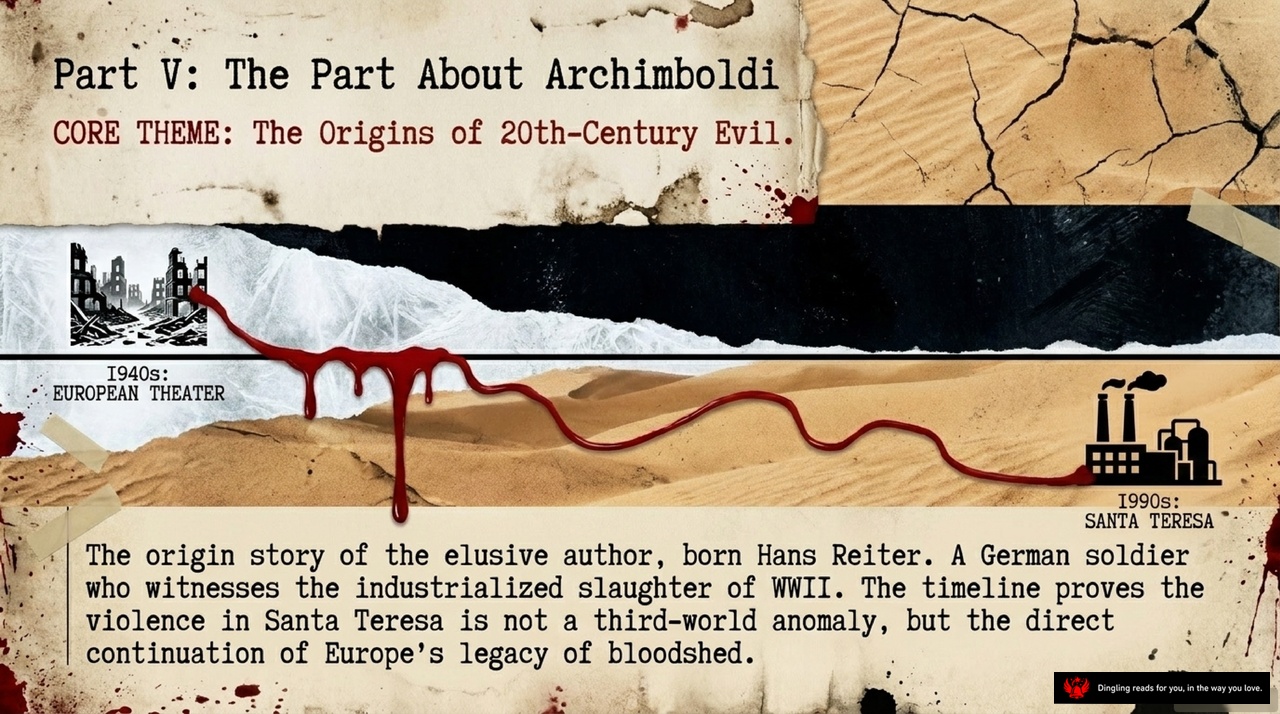
Part V: The Part About Archimboldi. Here, we confront the core theme that reshapes our understanding of modern horror: The Origins of 20th-Century Evil.
Look at this timeline. On the left, we have the 1940s European Theater, marked by the ruins of war and the industrialized slaughter of WWII. On the right, the 1990s in Santa Teresa, Mexico. A red line connects these two eras, flowing from the blood-soaked streets of Europe to the arid, violent landscapes of the desert. This visual proves a terrifying truth: the violence in Santa Teresa is not a third-world anomaly. It is the direct continuation of Europe's legacy of bloodshed.
The story of the elusive author, born Hans Reiter, anchors this connection. As a German soldier, he witnessed the horrors of the war firsthand. His life becomes the bridge between these two worlds. When we trace his journey from the European theater to the remote town of Santa Teresa, we see that the darkness in the Americas was seeded in the ashes of Europe. The violence in Santa Teresa isn't a new invention; it is the inherited ghost of a continent that learned how to kill on an industrial scale. This is the chilling reality Archimboldi exposes: evil doesn't disappear; it travels, it evolves, and it waits for a new soil to take root.
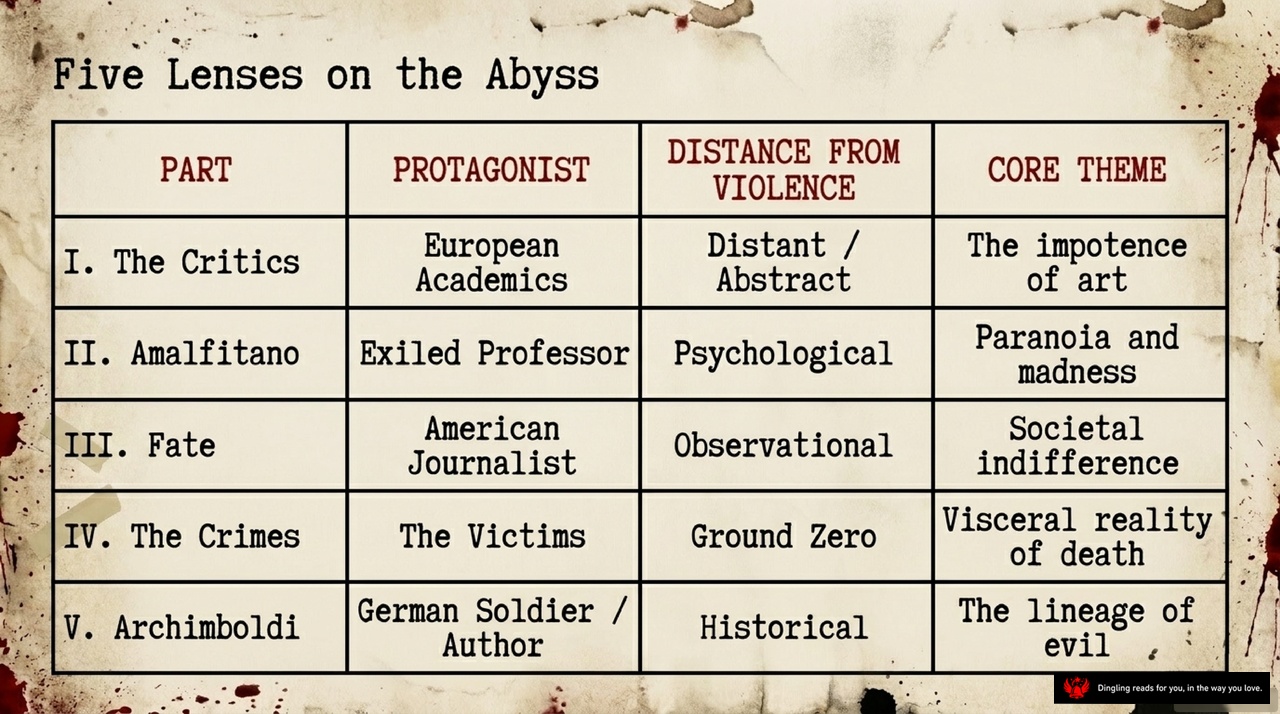
This slide breaks down the book's narrative into five distinct lenses, each offering a unique vantage point on the abyss of violence. We start with **Part I: The Critics**, where European academics view the violence from a distance, treating it as an abstract concept and ultimately concluding that art is impotent against it.
Then we move to **Part II: Amalfitano**, shifting to an exiled professor living in psychological turmoil. Here, the distance is internal; the core theme becomes paranoia and madness as he grapples with his own unraveling mind.
**Part III: Fate** brings in an American journalist who adopts an observational lens. From this perspective, the violence isn't personal but systemic, revealing a terrifying societal indifference to the suffering around him.
The narrative then plunges into **Part IV: The Crimes**, placing us at ground zero with the victims. This is no longer about theory or observation; it is the visceral reality of death, stripping away all abstraction to show the raw, physical horror of the crimes.
Finally, **Part V: Archimboldi** pulls back to a historical lens through the eyes of a German soldier and the author himself. This final view traces the lineage of evil, connecting the past to the present and suggesting that the roots of this violence run deep in history. Together, these five lenses construct a complete, multi-dimensional map of the abyss.

Bolaño delivers a devastating critique of the literary world, exposing the failure of the intellectual when faced with the visceral reality of human cruelty. While academics write papers and debate poetry, they remain blind to the slaughter happening right outside their windows. High Art and Academia are exposed as fragile illusions, utterly defenseless when forced to confront the bleeding reality of human suffering. In this stark contrast, true human horror emerges not from theory, but from the raw, unfiltered violence that dismantles all pretenses of cultural refinement.
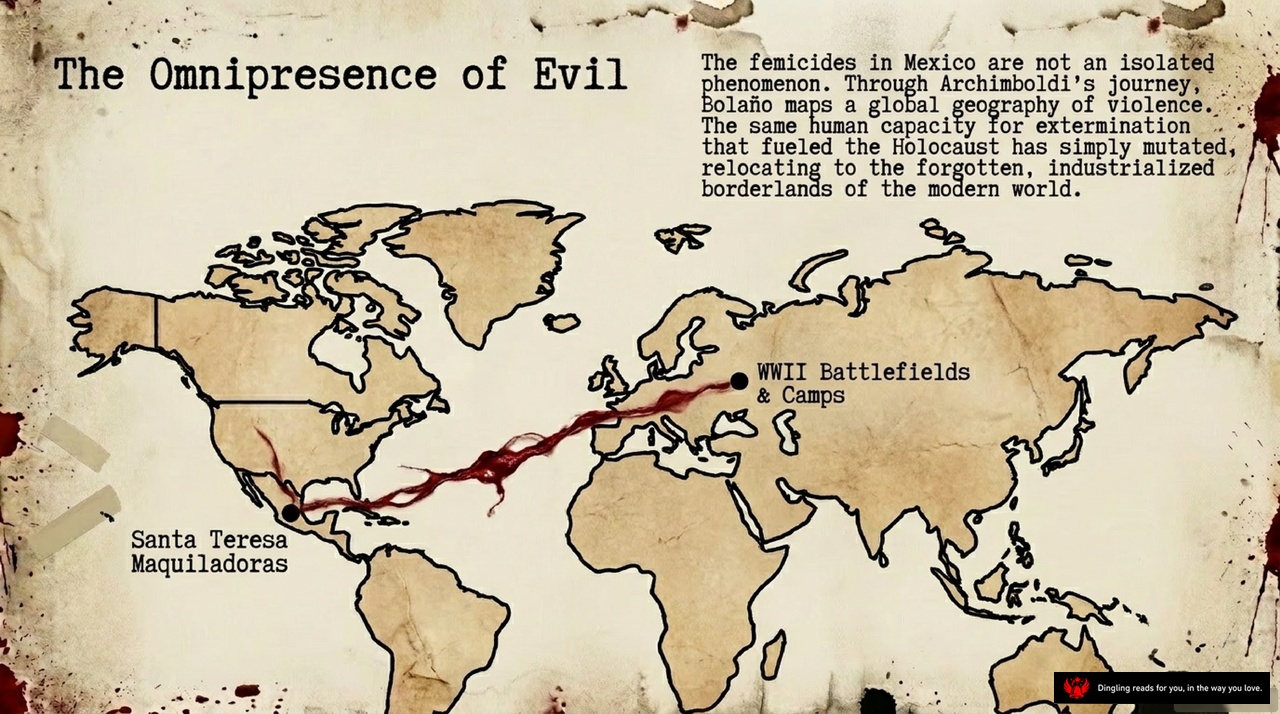
The map on this slide tells a terrifyingly simple truth: evil has no geography. The title, "The Omnipresence of Evil," isn't just a phrase; it's the central argument of the book. Look at the red vein connecting the map's two points. On the left, we see "Santa Teresa Maquiladoras"—the factories in Mexico where women are disappearing. On the right, we see "WWII Battlefields & Camps." The text explains that the same human capacity for extermination that fueled the Holocaust has simply mutated. It hasn't vanished; it has relocated. It has moved from the industrialized battlefields of the 20th century to the forgotten, industrialized borderlands of the modern world.
This isn't about isolated incidents. The femicides in Mexico are not a unique tragedy for one nation. Through the journey of the author, Bolaño maps a global geography of violence, showing us that the machinery of destruction is portable. The same tools, the same logic of dehumanization, are now operating in a new context, proving that the darkness we thought was confined to history is, in fact, everywhere.
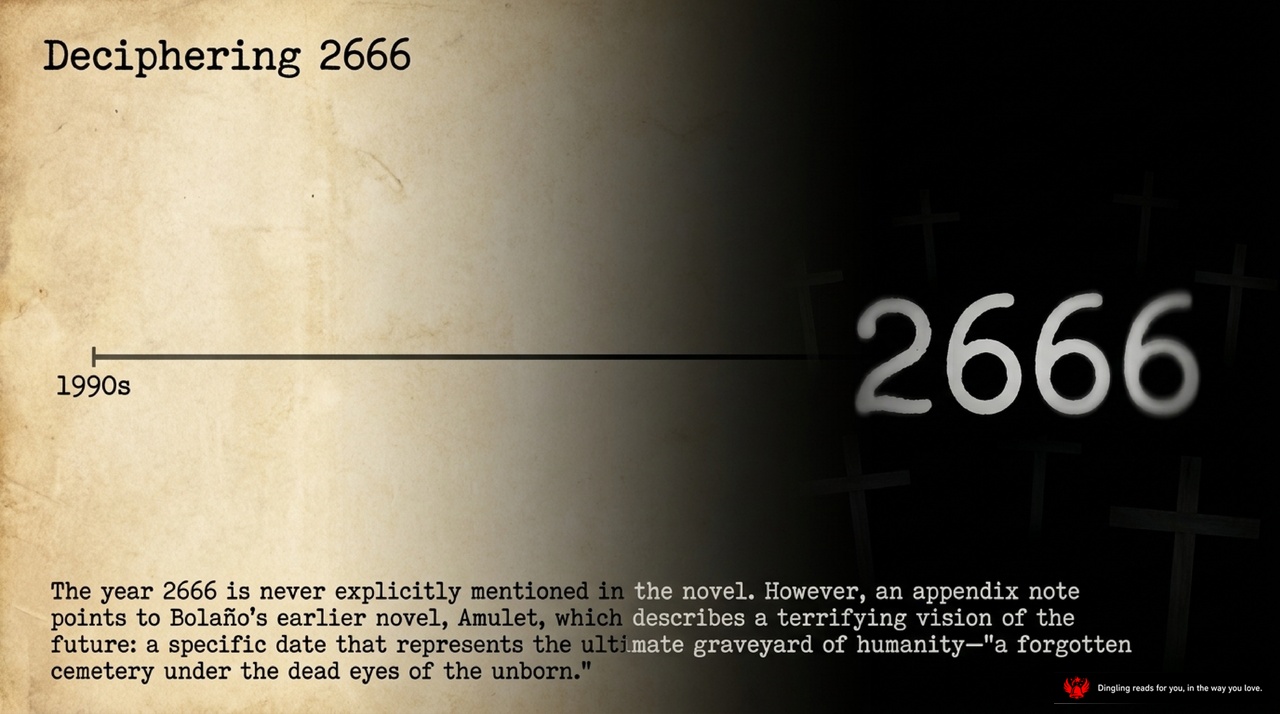
The year 2666. It's a number that haunts the end of this novel, appearing on timelines and in the shadows of the future. But here's the twist: the word "2666" never actually shows up in the text itself. It's a ghost in the machine. However, an appendix note reveals the secret. It points back to Bolaño's earlier work, *Amulet*, which paints a terrifying vision of that specific date as humanity's final graveyard—a forgotten cemetery watched over by the dead eyes of the unborn.
So, while the book doesn't say it out loud, the shadow of 2666 looms large, representing an ultimate end where the living are erased and only the memory of the dead remains. It's a chilling reminder that sometimes, the most important dates are the ones we never get to see.
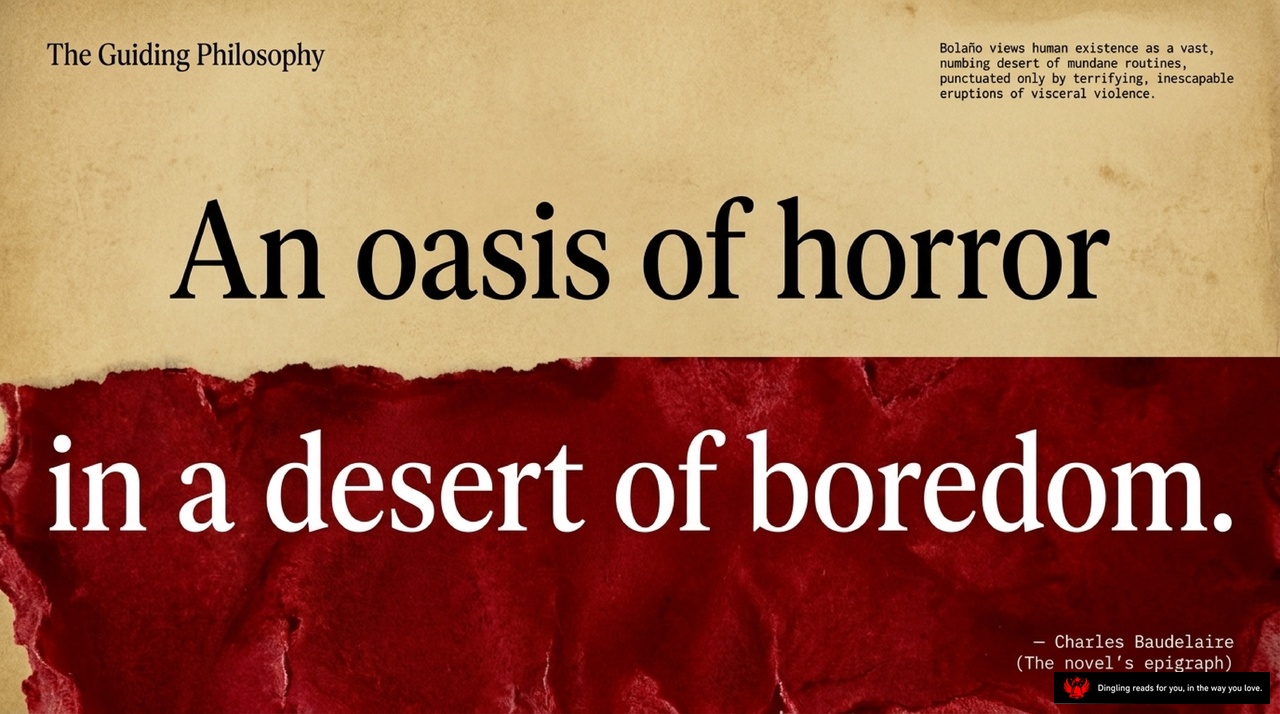
The slide presents a stark contrast: a parched, beige desert labeled "mundane routines" versus a jagged, blood-red tear revealing an "oasis of horror." This visual metaphor perfectly encapsulates Bolaño's guiding philosophy. He didn't see human existence as a grand narrative, but rather as a vast, numbing desert of boredom, punctuated only by terrifying, inescapable eruptions of visceral violence.
This is the core tension driving the story of Santa Teresa. For the characters, especially the journalist Sergio, this city isn't just a backdrop; it's a living nightmare. The slide highlights the relentless cycle of crime—the women disappearing, the bodies piling up in the garbage dumps, the churches desecrated by the "Confessor." It's not a mystery to be solved; it's a force of nature, a constant, grinding horror that erodes the soul.
Bolaño suggests that in this desert of boredom, where life feels repetitive and meaningless, the only thing that feels real is the violence itself. It's an "oasis" precisely because it breaks the silence, even if that silence is filled with screams. The characters are trapped in this cycle, unable to escape the shadow of the desert, unable to find redemption in the blood. It's a brutal reminder that sometimes, the only way to feel alive is to witness the end of life.

The image presents a stark, gritty reality: a crime scene tape fraying into nothingness, symbolizing a mystery that refuses to be solved. This visual perfectly captures the core argument of the slide—The Necessity of the Open Ending. Unlike traditional detective stories where the killer is always caught and justice is served, Bolaño deliberately leaves the narrative unresolved. Why? Because a neat resolution would simply be a lie. In the real world of Santa Teresa, violence isn't an anomaly waiting to be fixed; it's a permanent, unending systemic condition. The crimes in the novel—from the dismembered bodies to the "Confessor" desecrating churches—aren't puzzles with answers. They are symptoms of a rotting society where the police are incompetent, the rich are corrupt, and the poor are disposable. By refusing to tie up the loose ends, Bolaño forces us to confront the uncomfortable truth that some things never get solved, and sometimes, the only honest ending is to walk away into the dark, just like the protagonist Hans, who eventually disappears into the Mexican desert, leaving his story unfinished forever.

2666 is Roberto Bolaño's ultimate testament: a relentless autopsy of a world where literature offers no salvation, and human cruelty operates as a continuous, inescapable loop. Think about that for a second. We often read books looking for a rescue mission, hoping the story will pull us out of the dark. But Bolaño refuses to give us that easy exit. Instead, he forces us to stare directly into the abyss.
In the novel, this "abyss" isn't just a metaphor; it's the literal landscape of Santa Teresa, Mexico. We see it in the endless, unexplained disappearances of women, the bodies piling up in the trash heaps, and the systemic indifference of a society that has lost its moral compass. It's the brutal reality of the serial killings, the corrupt police, and the apathy of the press. Art, in this world, cannot save us from the abyss. The characters try to write, to investigate, to love, but the cruelty keeps coming back, a repeating cycle that no amount of intellectual effort can break.
So, if art cannot save us from the abyss, what is the purpose of staring into it? That is the haunting question at the heart of the book. Maybe the purpose isn't to fix the world, but to witness it. To refuse to look away when the horror is right in front of us. To acknowledge that while we might not be able to stop the loop of cruelty, our act of witnessing—our refusal to be silent—is the only dignity we have left. It's a terrifying, necessary gaze.