
A Canticle for Leibowitz: Complete Chapter-by-Chapter Summary

Welcome to today's reading session on *A Canticle for Leibowitz* by Walter M. Miller Jr. This sweeping sci-fi epic tracks a monastic order's desperate, centuries-long mission to preserve human knowledge across the cyclical rise and self-destruction of civilization. The cover art beautifully captures this duality: on one side, the ornate, ancient script and floral borders represent the timeless, spiritual tradition of the monks; on the other, the circuit boards and atomic mushroom cloud symbolize the fragile, destructive power of modern science that they strive to protect. From the desert ruins where a young novice discovers the lost blueprints of a forgotten genius, to the final flight into space carrying the last embers of our world, this story is a profound meditation on faith, memory, and the relentless cycle of history.

Picture this: a 20th-century nuclear holocaust that annihilates global civilization. The survivors suffer from terrifying radiation mutations, known as Fallout. Enraged by the destruction, humanity turns against science and learning. Mobs lynch scientists and burn books, establishing a dark age where Simpleson is a badge of honor. But amidst this chaos, Isaac Edward Leibowitz, a former weapons engineer, secretly smuggles books in kegs to the desert. He finds a monastic order to blindly preserve the Memorabilia before he is martyred.
This is the story of the Flame Deluge and the desperate struggle to keep knowledge alive. In the aftermath of the nuclear apocalypse, society collapses into what we call "The Simplification." People reject complex science, viewing it as a dangerous lie that led to their suffering. They burn libraries and destroy technology, believing that ignorance is safety. It's a terrifying cycle where progress becomes the enemy, and survival means forgetting everything that once made us human.
But hope flickers in the darkness. Leibowitz, realizing that humanity has lost its way, dedicates his life to saving the seeds of our future. He works tirelessly, hiding away in the desert, protecting the very documents and blueprints that could one day help us rebuild. He knows that without these records of our past—our science, our history, our mistakes—we are doomed to repeat them forever. His mission is not just to preserve books, but to preserve the possibility of redemption itself.
As we see in this image, the contrast is stark. On one side, the fiery destruction of the Flame Deluge, where civilization burns under the weight of its own hubris. On the other, the quiet determination of a man in a cave, guarding the fragile remnants of human wisdom. It's a powerful reminder that even in the darkest times, the choice to protect knowledge is the most revolutionary act of all.

Welcome to the next chapter of our journey into the cyclical nature of history. As we turn the page, we move from the quiet, hopeful days of the monastery to a time of intense intellectual collision.
This slide illustrates the critical confrontation between the monks and the secular scholar, Tadeo. You see here the clash of two worlds: on one side, the monks guarding their ancient texts with a mix of reverence and fear; on the other, Tadeo representing the modern scientific mindset, eager to unlock the secrets hidden within those pages.
The diagram highlights the core conflict: the monks believe these documents are sacred relics meant to be protected until humanity is ready, while Tadeo sees them as raw data that should be studied immediately to accelerate human progress. He is frustrated that the monastery is acting as a barrier to knowledge, not a sanctuary for it.
Notice the central tension in the wheel: the monks view the texts as a divine trust, whereas Tadeo views them as tools for invention. When Tadeo discovers that his own brilliant theories were actually rediscovered ancient formulas, his admiration turns into resentment. He realizes that centuries of monastic isolation have merely delayed humanity's potential, and he blames the monks for hoarding what should belong to all of us.
This moment marks a pivotal shift in the "Wheel of History." It shows us that the gap between faith and reason isn't just a difference of opinion; it's a fundamental disagreement about the purpose of knowledge. Will we guard the past to protect the future, or will we exploit the past to fuel our present? As we move forward, this unresolved tension will soon be shattered by the forces of war, proving that even the most careful guardians cannot stop the inevitable cycle of destruction.

Welcome to the final chapter of our journey, where the story of civilization reaches its most dramatic and heartbreaking conclusion.
As we look at this slide, we see the ultimate fate of the Abbot Zachary and the very last act of the Order of Saint Leibovitz. The image captures a moment of absolute silence amidst the chaos of the end of the world. Above, the mushroom cloud rises—a dark, red pillar of smoke that signals the end of human history on Earth. It is the "fire of Satan," the result of human arrogance and the nuclear arms race that we saw building up in the previous chapters.
But look closely at what remains below. The Abbot Zachary, the last leader of the order, is not shown running away. Instead, he is depicted kneeling in the ruins of the cathedral, surrounded by the debris of the explosion. He has made a choice that defines his character and the entire legacy of Leibovitz. In the face of a dying world, he refuses to abandon his duty. He is seen holding the consecrated hosts, the physical body of Christ, protecting them with his own life. He understands that while the world may end, the spiritual and cultural core of humanity must survive.
This image also highlights the tragic irony of the era. The very technology that was supposed to save humanity—the nuclear weapons—has instead destroyed it. The advanced scientific knowledge that the Order spent centuries preserving, the complex blueprints and formulas of Leibovitz, are now rendered useless as the planet burns. The "Great Simplification" has come full circle, but this time, there is no return to a simpler past. The civilization has collapsed completely.
Yet, even in this total destruction, there is a glimmer of hope. Look at the spaceship in the background, or the figures preparing to board it. These are the survivors, the last of the faithful and the knowledgeable. They are carrying the very things that were destroyed on Earth: the Bible, the scientific texts, the philosophy, and the faith. They are not just escaping the physical planet; they are escaping the cycle of self-destruction that has plagued humanity for thousands of years.
The narrative brings us to a profound realization: the survival of the human species depends not on the power of our weapons, but on the preservation of our wisdom and our moral compass. The Order of Saint Leibovitz, through its centuries of struggle, has achieved its ultimate goal. They have ensured that the seeds of civilization will be planted in a new world, far away from the ruins of Earth.
As we close this chapter, we are left with a powerful question: Can humanity learn from its mistakes? The story of Zachary, of the burning city, and of the exodus to the stars is a warning and a promise. It is a warning that without humility and restraint, we will destroy ourselves. But it is also a promise that as long as we keep the light of knowledge and faith alive, we can rebuild, learn, and perhaps one day, thrive again.
The journey from the desert of the 26th century to the stars of the future is complete. The Order has kept the flame burning, even when the world went dark. And now, that flame travels on, into the unknown, carrying the hope that one day, humanity might finally find a way to live together in peace.

Look at this striking contrast between "The Original" and "The Replica." On the left, we see a precise, modern electrical schematic—a clean blueprint of resistors, capacitors, and inductors, representing the pinnacle of human engineering. On the right, we see its faithful copy: a medieval manuscript where those same components are reimagined as mystical relics. The resistor becomes a "Dormeter andandormonio"; the inductor transforms into an "Inductor seraphim."
This visual juxtaposition captures a profound truth about the Dark Ages. As the text at the bottom explains, Brother Francis spends fifteen years applying gold leaf to these schematics, believing them to be a mystical relic. He faithfully replicates the shape of the components without understanding a single concept of electricity. This is the essence of faith without comprehension: the physical vessel of knowledge is preserved with religious devotion, while its actual meaning is entirely lost.
In that era, the *what* was revered, but the *why* was forgotten. The complex logic of the circuit was replaced by the ornate beauty of the angelic drawing. It serves as a powerful metaphor for how history often treats wisdom not as a tool to be used, but as an artifact to be worshipped. We are left with a beautiful, golden lie, preserving the memory of genius while discarding the power of understanding.

In the 20th century, the world stood on the brink of a self-inflicted apocalypse. As the "Artifact Pipeline" illustrates, humanity had reached a critical point where our own scientific achievements became the very tools of our destruction. We had moved from the era of Original Science, where physics and electronics promised a brighter future, straight into The Flame Deluge—a global annihilation where knowledge itself turned into a lethal liability.
Faced with the certainty of extinction, the only logical path forward was Blind Preservation. In the 26th century, monks realized that the only way to survive was to stop trying to understand the technology and instead hide it. They smuggled and copied texts verbatim, treating complex equations as magical incantations to be memorized and guarded, not dissected. This was a deliberate act of ignorance, a strategic retreat into the dark ages to ensure that the secrets of the atom would never be rediscovered until humanity had truly learned humility.
Centuries later, in the 32nd century, Secular Rediscovery began. Scholars slowly deciphered the monks' archives, finally understanding the math behind the "magic." They realized the true power of the lost technology, but by then, the world had changed. The final stage, Weaponization, arrived in the 38th century. The State seized this reclaimed knowledge to build new nuclear arsenals, leading inevitably to the next Deluge. This cycle proves a tragic truth: without wisdom to guide our power, our greatest inventions will always destroy us.

Welcome to Era 2: Fiat Lux, or "Let There Be Light." Imagine a monastery deep in the desert, where the air is thick with dust and silence, but suddenly, the darkness is broken. Brother Kornhoer, a monk who dared to look beyond tradition, has successfully built a pedal-powered electrical generator. Using ancient blueprints that seemed like magic to everyone else, he has created the first artificial light in 1,200 years. As the monks gather around, their faces illuminated by that brilliant, crackling blue arc, it marks the dawn of a new Renaissance. Humanity is slowly piecing together the meaning of the Memorabilia, the lost knowledge of the ancients.
But this light brings more than just illumination; it signals a shift in power. Enter Thon Taddeo, a brilliant secular scientist arriving at the abbey. His presence is a quiet revolution, signaling that the Church's monopoly on knowledge is finally ending. While the monks marvel at the machine, a deeper conflict begins to brew between faith and reason, between those who want to protect the past and those who believe the future demands we use it. This moment of light is not just about seeing in the dark; it is about the terrifying and exhilarating realization that the old world is over, and a new, uncertain one is just beginning.

The Church and the State stand on opposite sides of a crumbling wall, each guarding a different truth about what it means to be human. On one side, Dom Paulo represents the ancient wisdom of the Church. He sees himself as the protector of memorabilia—precious artifacts and texts that must never be lost. For him, knowledge is dangerous if it isn't paired with moral responsibility. He fears that progress without ethics is suicidal, and he worries the State will weaponize our deepest secrets before humanity is spiritually ready to handle them.
On the other side stands Thon Taddeo, the pioneer of the new enlightenment. He views science as a neutral tool, a force to be unleashed at any cost. He believes truth must be uncovered, regardless of the consequences. To him, how the State uses science is not the scholar's concern; it is the scholar's duty to reveal it. His greatest fear is that the Church will suppress discovery simply to maintain its grip on ignorant populations.
This clash defines the entire story. It is the battle between those who believe we must wait for wisdom to grow, and those who believe we must rush forward to find it. The Church sees the State as a threat to our soul, while the State sees the Church as an obstacle to our progress. As the world burns around them, these two forces—the guardian of the past and the pioneer of the future—are forced to confront the terrifying question: are we ready to unlock the secrets of the universe, or will our greed destroy us before we can even ask the right questions?

Welcome to the final chapter of our journey through the three great eras. As we look at this matrix, we see the full arc of human history: from the post-apocalyptic wasteland of the 26th century, through the reawakening of the 32nd, to the high-tech standoff of the 38th.
In the first era, *Fiat Homo*, the world is a "savage, post-fallout wasteland." Here, knowledge isn't a tool for progress; it's a sacred relic, blindly preserved by figures like Brother Francis, who treats texts as holy objects rather than living ideas. It's a time of simplification and mobs, where the past is a tomb to be guarded.
Fast forward to the 32nd century, *Fiat Lux*. This is the "Emerging Renaissance," a time of warring empires and the rediscovery of electricity. Knowledge becomes active again. Figures like Dom Paulo are no longer just keepers; they are deciphers and provers of theory. They actively seek to understand the world, moving from blind preservation to scientific inquiry.
But the final column, *Fiat Voluntas Tua*, the 38th century, brings a terrifying twist. It is "highly advanced" and "space-faring," yet it stands on the brink of a "global nuclear standoff." Here, knowledge has been weaponized. The monastic figure, Dom Zerchi, is no longer protective or humble; he is fierce and rigid, desperate to prevent the end by controlling the very science that could destroy it.
The lesson is clear: knowledge without wisdom becomes a weapon, and faith without understanding becomes a relic. We must choose the middle path—using our intellect to serve our humanity, not our destruction.

Era 3: Fiat Voluntas Tua—Thy Will Be Done. This is the moment Lucifer falls. Look at this vision of the 38th century. Humanity has surpassed the technology of the 20th century. Starships travel the galaxy, and cities are pristine. But look at the right side of the image. That mushroom cloud. That is the inevitable relapse. Tensions between the Asian Coalition and the Atlantic Confederacy boil over, and nuclear detonations are reported.
This is Dom Zerchi's despair. The current Abbot realizes the monks' 1,200-year mission to save civilization has only provided humanity with the tools to incinerate itself a second time. We see the full cycle: from the utopian heights of the 20th century's technology to the ashes of our own making. The era of "Thy Will Be Done" is not a promise of salvation, but a warning of our inevitable return to chaos unless we learn from the past.
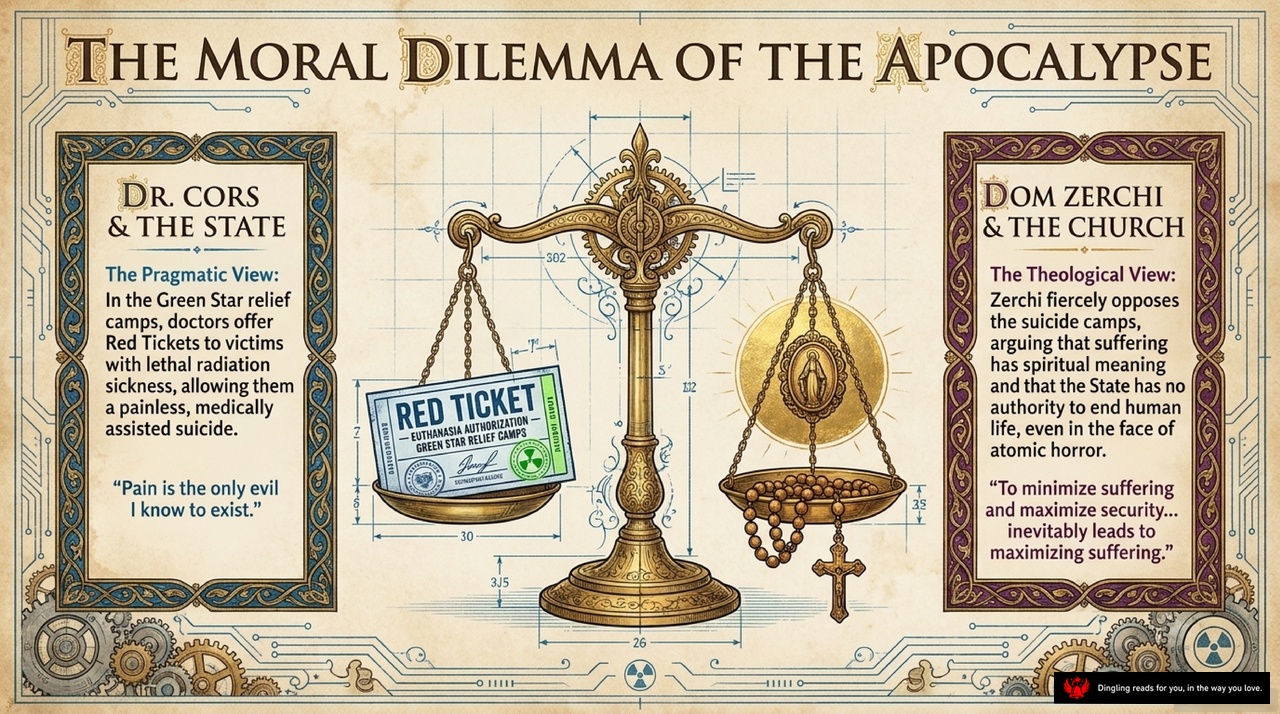
Look at this scale in the center. It perfectly captures the crushing weight of the moral dilemma facing our world. On one side, we have Dr. Cors and the State, representing the pragmatic view. They offer "Red Tickets"—authorization for euthanasia in the Green Star relief camps. Their philosophy is stark and cold: "Pain is the only evil I know to exist." To them, suffering is a medical error to be corrected, and a painless, medically assisted death is the ultimate act of mercy for victims of lethal radiation sickness.
On the other side, we see Dom Zerchi and the Church, holding the theological view. This is where the conflict truly ignites. Zerchi fiercely opposes the suicide camps, arguing that suffering has profound spiritual meaning. He believes that the State has absolutely no authority to end human life, even in the face of atomic horror. His stance is uncompromising: "To minimize suffering and maximize security... inevitably leads to maximizing suffering."
This image illustrates the core tragedy of our story. The State seeks to eliminate pain through death, while the Church believes that enduring pain is the path to spiritual redemption. We are left staring at this balance, wondering which side holds the truth when the apocalypse arrives.

The image before us captures a profound moment of transformation, illustrating the concept of the "Two-Headed Mutant" as a powerful metaphor for renewal. On the left, we see the stark contrast between the past and the future: the silhouette of the old, corrupted world crumbling in ruins, while a radiant, innocent figure rises above, symbolizing a new beginning. The text at the bottom, "The Old Dies, The New Is Born," sets the stage for this dramatic shift.
On the right, the slide breaks down this transformation into three key stages. First, "The Death of the Old": Mrs. Grales represents humanity's scarred history, burdened by sin and destruction, ultimately perishing as the nuclear bombs fall. This is the necessary clearing of the ground, a painful but essential step.
Next, we see "The Immaculate Rebirth." From the ashes emerges Rachel, the dormant second head. She is innocent, untouched by original sin, and free from the pain that plagued the old world. She represents the potential for a fresh start, unburdened by the past's mistakes.
Finally, the slide describes "The Last Sacrament." In a pivotal moment, the dying Dom Zerchi attempts to baptize Rachel, but she refuses his rites. Instead, she administers the Eucharist to him. This act is symbolic of a new, unfallen species taking the mantle of the Earth from the ashes of humanity. It signifies that the future isn't about repeating the old rituals in a broken world, but about creating something entirely new.
This visual narrative reminds us that true renewal often requires the complete death of the old to make space for the new. It challenges us to consider what parts of our own history we must let go of to embrace a truly fresh beginning.

Quo Peregrinatur: The Next Loop. Look at that blueprint of the spaceship soaring away, leaving behind a planet consumed by fire. This isn't just an escape; it's a desperate attempt to break the cycle of human self-destruction.
As the nuclear war reaches its climax, the Church initiates its final protocol: The Exodus. A secret spacecraft is launched toward the Centauri colonies, carrying monks, children, and the entirety of the Memorabilia on microfilm. They flee the Flame Deluge to preserve knowledge among the stars.
But here lies the haunting question that lingers in the void: Will the colonies eventually build their own nuclear weapons, taking the cycle of self-destruction to a galactic scale? The image of the mushroom cloud looms over the fleeing vessel, a stark reminder that humanity's greatest threat always comes from within. This endless loop challenges us to ask: Can we truly learn from our past mistakes, or are we doomed to repeat them across the galaxy?

Synthesis: The Burden of Knowledge. Look at this scale. On one side, we have technological capability—the gears, the machinery, the sheer power to build. On the other, moral evolution—the scroll, the wisdom, the ethical maturity required to wield that power safely.
This slide captures the central tragedy of our story. The Albertian Order of Leibowitz succeeded brilliantly at its mission: they saved the information. They archived the blueprints, the formulas, the history. But as the text reminds us, saving information does not equal saving wisdom. The variable of morality is the missing link. While scientific truth is a constant that can be stored and retrieved, human ethics must be painfully relearned by every generation. History shows that morality continually fails to keep pace with technology.
This leads us to the ultimate warning: Civilization is a machine that humans know how to build, but often lack the spiritual maturity to safely operate. We have the tools to destroy ourselves, but we haven't yet evolved the character to use them for good. The burden of knowledge is heavy, and without the corresponding burden of wisdom, it is a weight that crushes us all.

The fires of the Flame Deluge have returned, consuming the Earth once more. The monks preserved the blueprints of civilization for twelve hundred years, shielding the flickering light of science through the darkest of ages. Yet, the moment humanity reclaimed its lost power, it chose to wield it for its own annihilation. The wheel of history turns, leaving only ash, the indifferent ocean, and a small ship carrying the same perilous knowledge into the cold void of space.
If we rebuild the exact same machine, why do we expect a different fire?