
A Short History of Chinese Philosophy: Complete Chapter-by-Chapter Summary

Welcome to our exploration of *A Short History of Chinese Philosophy* by Fung Yu-lan. This book invites us on a dialectical journey, tracing how a civilization sought to unite the transcendent and the mundane into a single, coherent way of life. Unlike Western traditions where philosophy and religion often walk separate paths, Chinese thought has always treated them as deeply intertwined. For the ancient Chinese, philosophy wasn't just an intellectual exercise; it was the very foundation of education and daily life, starting from childhood with texts like the *Four Books*.
What makes this tradition unique is its core spirit: resolving the tension between entering the world and transcending it. Chinese philosophy doesn't choose between being fully worldly or completely otherworldly. Instead, it aims for the ideal of "inner sage, outer king." This means cultivating a spiritual state that aligns with the universe while simultaneously engaging deeply in social affairs and human relationships. It's about finding a balance where one can be a spiritual master without retreating from the responsibilities of society. This approach reflects a profound belief that true wisdom is found not in escaping reality, but in understanding and harmonizing with it. As we delve deeper into this rich tradition, we'll see how this unique blend of the sacred and the practical shaped everything from governance to art, creating a legacy that continues to inspire.
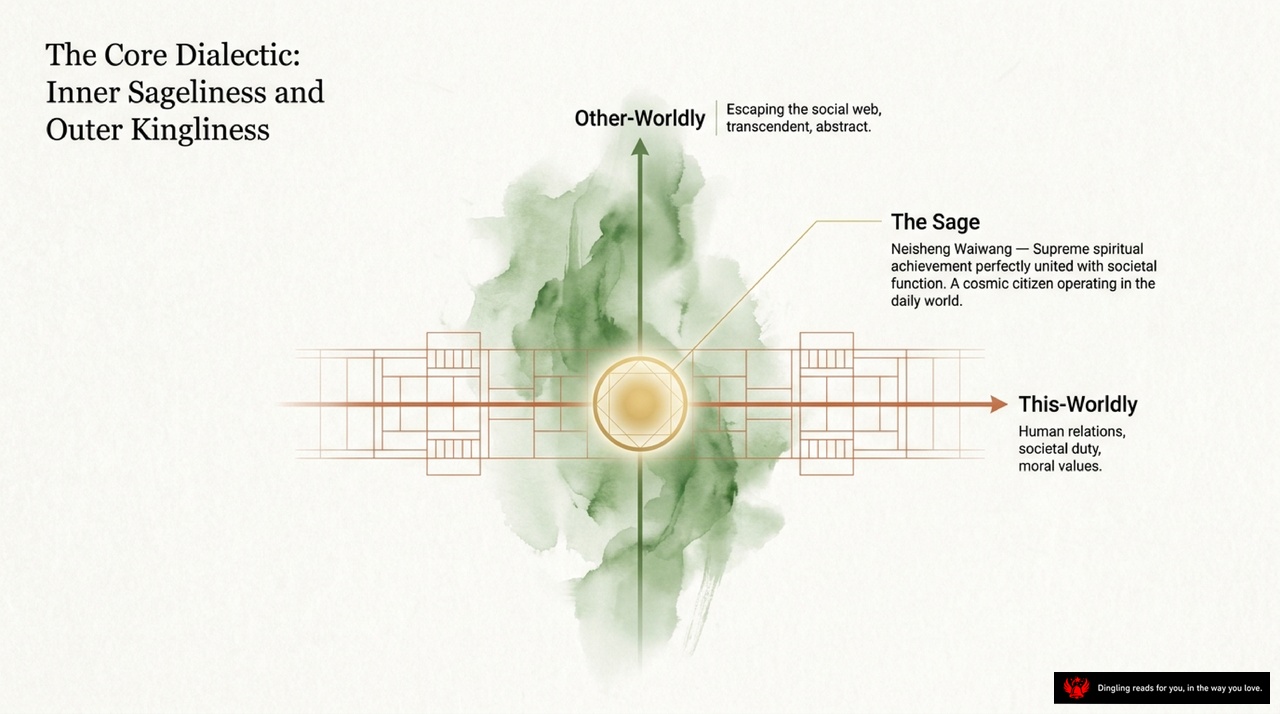
The Core Dialectic: Inner Sageliness and Outer Kingliness.
Look at this diagram. It captures the very heart of the Chinese philosophical tradition: the tension and unity between the inner sage and the outer king. On the vertical axis, we see the "Other-Worldly"—the realm of escaping the social web, becoming transcendent, and touching the abstract. On the horizontal axis lies the "This-Worldly"—grounded in human relations, societal duty, and moral values.
At the intersection of these two worlds stands "The Sage." The text defines this figure perfectly as the "Neisheng Waiwang"—the Supreme spiritual achievement perfectly united with societal function. Imagine a cosmic citizen who operates fully within the daily world. This isn't about choosing between spirituality and society; it's about integrating them. The sage achieves a state where their inner spiritual cultivation aligns seamlessly with their outer political and social responsibilities.
Unlike Western traditions that might separate the sacred from the secular, Chinese philosophy insists that true greatness requires both. You must refine your inner self to reach a state of oneness with the universe, yet you must also actively participate in governing affairs and managing human relationships. It is a dual path: becoming a sage within, while acting as a king without. This balance allows for a life that is both deeply spiritual and profoundly practical, resolving the ancient dilemma of whether to withdraw from the world or engage with it.

Look at this flowchart. It perfectly captures the DNA of Chinese thought, rooted in our agrarian past. Because China is a continental nation, survival has always depended on the land, the seasons, and the family unit. This unique soil gave rise to two distinct but complementary perspectives. On one side, we have the Landlord's view, which focuses on social order, hierarchy, and moral duty—this is the foundation of Confucianism. On the other, we have the Farmer's view, which looks at the unnamable forces of nature, simplicity, and natural cycles, giving us Daoism.
Connecting these two is a core observation from farming life: Reversal is the movement of the Dao. Farmers know that all extremes inevitably revert to their opposites. This insight became the philosophical principle of "Wu Ji Bi Fan," or the idea that things turn into their opposite when pushed to the limit. It's why the Middle Way is so important in Chinese culture. This balance between the social order of Confucianism and the natural order of Daoism allowed Chinese thinkers to find a perfect equilibrium between engaging with the world and transcending it, creating a unique philosophical tradition that is deeply practical and profoundly wise.
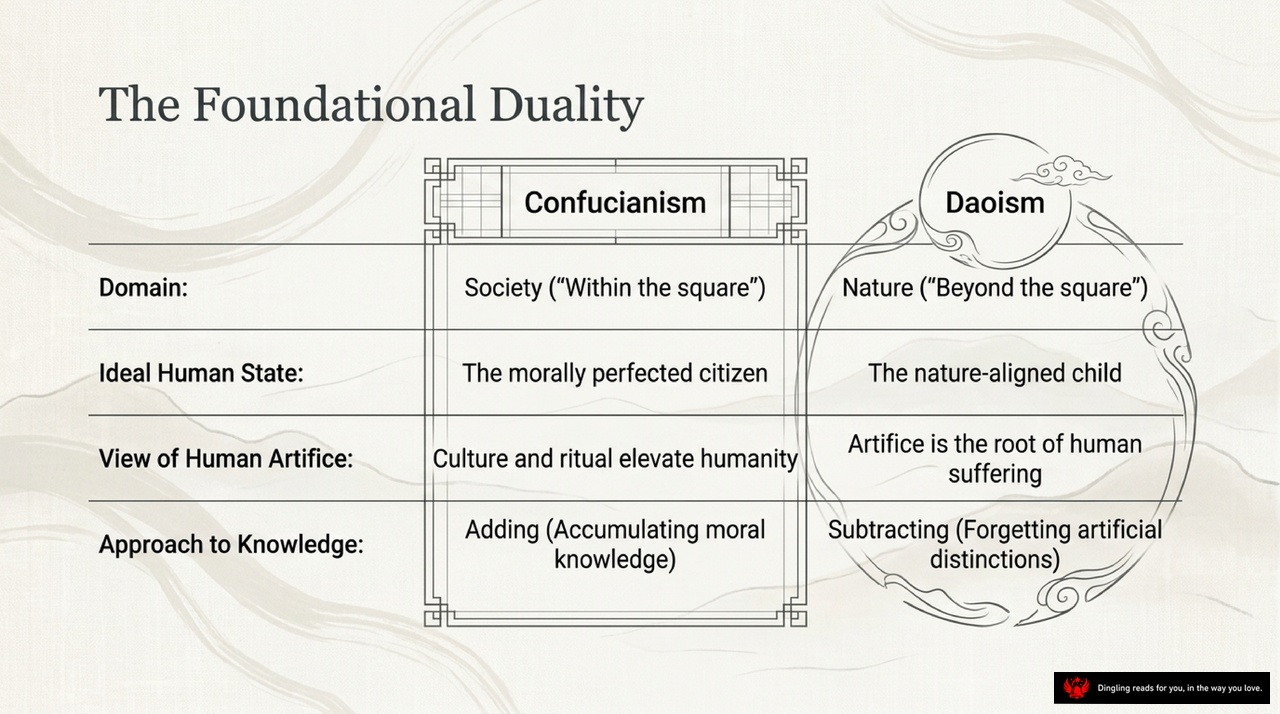
Today's slide, "The Foundational Duality," captures the very heartbeat of Chinese philosophy: the dynamic tension between Confucianism and Daoism. Think of it not as a battle, but as a perfect, complementary balance that has defined the Chinese worldview for millennia.
On the left, we see Confucianism, framed as a square, representing society—"Within the square." Its goal is to create the morally perfected citizen. For Confucians, culture and ritual are the tools that elevate humanity, and their approach to knowledge is one of "adding"—accumulating moral wisdom through study and practice. It is the path of the engaged individual, navigating the complexities of human relationships and social order.
Contrast this with Daoism on the right, depicted as a circle, representing nature—"Beyond the square." Here, the ideal human is the nature-aligned child, unburdened by artificial constructs. Daoism views human artifice as the root of suffering, believing that adding rules and distinctions only distances us from our true selves. Consequently, their approach to knowledge is "subtracting"—forgetting artificial distinctions and returning to a state of natural simplicity.
This duality solves the ancient problem of balancing the worldly and the transcendent. Confucianism teaches us how to live well together in society, while Daoism reminds us to find freedom and peace within the natural world. Together, they offer a complete guide to life, ensuring that we are both responsible citizens and free spirits.

Today's slide contrasts two fundamental ways humans map reality, drawing a sharp line between the "Merchant" and the "Farmer." On the left, you see "Postulational Concepts," the mindset of the Merchant. Born from marine and trade societies, this approach relies on abstract, hypothesis-driven numbers. It treats reality as something to be dissected through distinct, logical deductions that stand separate from the observer. This is the DNA of the scientific method we know today—building systems from assumptions, much like the Greek and British commercial traditions that birthed modern science.
On the right, under "Intuitional Concepts," lies the world of the Farmer. Emerging from agrarian societies, this view sees reality as a direct, un-differentiated aesthetic continuum where the observer and the observed are a single whole. Here, truth isn't found in strict definitions or logical proofs, but in suggestiveness and poetry. It mirrors the Chinese tradition, where philosophy grew from the soil of farming, emphasizing a balance between entering the world and transcending it. While the Merchant seeks to control reality through separation and calculation, the Farmer seeks to harmonize with it through intuition. Understanding this divide helps us see why Western thought often prioritizes analysis and structure, while Eastern wisdom leans toward holistic perception and moral cultivation. Both are valid maps, but they lead to very different understandings of what it means to be real.

Today's slide focuses on "The Pursuit of Methodological Rigor," highlighting a fascinating contrast between two ancient Chinese schools of thought: Mohism and the School of Names.
On the left, we see Mohism, which champions the defense of common sense. Think of it as the ultimate pragmatist's guide. Mohists evaluated actions purely based on utility—always asking, "Does this bring greater benefit and lesser harm?" To defend this practical morality, they introduced rigorous deductive reasoning, a move that was surprisingly advanced for its time.
On the right, we have the School of Names. This school took a different path, focusing on the analysis of universals. They believed in disconnecting "Names"—abstract concepts—from "Realities"—concrete objects. A classic example here is Gongsun Long's famous paradox: "A white horse is not a horse." His logic was that the universal concept of 'horse' is distinct from the specific reality of a 'white horse' because one includes color and the other doesn't.
The visual center of our slide features two interlocking gears labeled "Ming" and "Shi." In Chinese philosophy, "Ming" translates to Name, while "Shi" stands for Reality. These two gears represent the fundamental tension and relationship between language and the physical world. Mohism tried to align names with reality through utility, while the School of Names explored the logical boundaries where names might diverge from reality.
This slide illustrates a pivotal moment in Chinese intellectual history where philosophy wasn't just about abstract metaphysics, but a rigorous debate on how we name, categorize, and understand the world around us. It shows that even in ancient China, thinkers were deeply concerned with the precision of language and the logic of reasoning.

So, we've journeyed through the turbulent landscape of Chinese philosophy, from the Confucian ideal of moral order to the Daoist embrace of nature, and even the logical rigor of the Mohists. But as we stand at the end of this historical sweep, a profound transformation is waiting just beyond the horizon.
In the late Qing and early 20th century, Chinese thought faced its greatest crisis yet. The arrival of Western powers and the collapse of the old imperial order shattered the confidence in traditional wisdom. Scholars like Kang Youwei tried to revive Confucius as a divine figure to push for modernization, but the movement ultimately failed. It was the influx of Western logic and science that truly shifted the paradigm. Thinkers like Yan Fu and Wang Guowei began to see the limitations of traditional metaphysics. Wang Guowei's famous dilemma—"the lovable is not credible, the credible is not lovable"—captured the pain of an era torn between its romantic past and a harsh, rational future.
But the real breakthrough came with the introduction of Western logical analysis. For centuries, Chinese philosophy relied on what we might call the "negative method"—describing what the Dao is *not*, much like the Zen masters who used silence to point to the ineffable. While powerful, this approach lacked the precision needed to tackle modern problems. Western philosophy offered a "positive method," a way to clearly define concepts and analyze arguments. This new tool allowed scholars to revisit ancient texts like the School of Names with fresh eyes, uncovering logical structures that had been overlooked.
This intellectual shift culminated in the work of Feng Youlan. During the chaos of the Second Sino-Japanese War, while the world's top universities were fleeing to Kunming, Feng and his colleagues crafted a new vision for Chinese philosophy. In works like *New Rationalism*, he used Western logic to reconstruct core Chinese metaphysical concepts like "Li" and "Qi." He argued that the task of philosophy isn't just to add facts, but to elevate the human spirit.
Feng Youlan proposed a famous distinction between two methods: the positive method, which defines what things are, and the negative method, which reveals what they are not. He believed a complete philosophical system must start with the former and end with the latter. This synthesis led him to define the essence of philosophy as "knowledge of not knowing." It's not about accumulating data; it's about transforming our state of mind.
To illustrate this, he divided life into four realms. The lowest is the natural realm, where people act on instinct or habit without deep understanding. The second is the utilitarian realm, driven by self-interest. The third is the moral realm, where one acts for justice and the greater good. But the highest realm is the cosmic realm. Here, a person realizes they are not just a member of society, but a part of the universe itself. In this state, every action is infused with a profound, transcendent awareness.
This is where the story connects to the future. Chinese sages have always walked the path of being both in the world and beyond it. They engaged with daily life while maintaining a spiritual distance. Feng Youlan suggested that this unique Chinese approach—blending the practical with the transcendent—could offer something the West has struggled to find. As we look ahead, the challenge for philosophy is to continue this journey, to help humanity reach those higher states of consciousness, finding meaning not just in survival, but in our connection to the whole of existence.

The Grand Synthesis: Neo-Confucianism. Imagine three distinct threads weaving together to form a single, powerful fabric. Thread one is Confucianism, representing our practical ethics, social structures, and the moral duty to do our part. Thread two is Daoism, bringing in the cosmology of nature, the concept of Taiji, and the essential balance of Yin and Yang. Thread three is Buddhism, contributing the metaphysics of the mind, deep internal cultivation, and the pursuit of sudden enlightenment.
When these three traditions intertwine, they don't just sit side by side; they merge into something entirely new. On the right side of this synthesis, we see the result: A Unified Reality. This is the core of Neo-Confucianism—a philosophy that is simultaneously highly speculative and entirely grounded in daily, societal duties. It resolves the ancient tension between being in the world and transcending it. It allows a person to be deeply engaged in the complexities of social life while maintaining a spiritual connection to the cosmic order. This unified view didn't emerge overnight; it was the culmination of centuries of intellectual evolution, blending the Confucian focus on human relationships with the Daoist appreciation for nature and the Buddhist insights into the mind. This synthesis gave Chinese philosophy a unique character: one that could address the deepest questions of existence without ever losing touch with the realities of everyday life.

Let's talk about the very foundation of reality itself. In Chinese philosophy, we don't just look at the physical world; we look at the blueprint behind it. The slide illustrates this with a powerful contrast: on the left, we see the architectural structure of a traditional building—a perfect, abstract framework representing **Li**, or Principle. This is the eternal, immaterial blueprint. It's like a Platonic form; before the physical object exists, the principle of it already exists.
On the right, we see a pile of raw bricks and wood—this represents **Qi**, or Material Force. This is the temporal, physical matter that makes up the universe. It's the chaotic substance that takes form.
Think of it this way: **Li** is the design, the perfect plan, while **Qi** is the raw materials. The arrow between them shows how reality is built. The eternal, abstract principle combines with the changing, physical matter to create the world we experience. At the very top of this architecture sits **Taiji**, the Supreme Ultimate. It is the total sum and highest generalization of all Li in the universe—the source from which all principles and all matter ultimately emerge. This dual architecture of Principle and Matter is the core lens through which Chinese thinkers understand existence.

Today's slide breaks down the "Great Schism of Neo-Confucianism," a pivotal moment where Chinese philosophy split into two distinct paths: the School of Principle, led by Zhu Xi, and the School of Mind, championed by Wang Yangming.
On the left, we see the School of Principle. It views reality as dualistic, separating abstract "Li" from physical "Qi." Here, Principle is seen as an objective law existing outside the human mind. Consequently, the path to cultivation is gradual—specifically, the "Investigation of Things," which relies on external study and observing the world to understand these universal laws.
On the right stands the School of Mind. This perspective is monistic, arguing that the universe is essentially the Mind itself. It redefines Principle not as an external rule, but as a subjective conscience innate within us. The method of cultivation here is sudden: the "Realization of Innate Knowing." Instead of looking outward, you turn inward to intuit the truth that already resides in your heart.
This contrast captures the core tension of later Chinese thought: whether to seek wisdom through rigorous observation of the external world, or through a sudden awakening of the internal self.

Imagine the journey of the sage as a three-stage evolution, visualized here as a diamond ascending toward light. We start at the foundation with the Daoist Sage. This figure transcends human artifice, achieving unity with the universe by forgetting conventional knowledge and aligning with the unnamable Dao. It's about moving beyond the limits of the known to find the absolute.
From there, the path leads to the Confucian Sage. Here, the focus shifts to mastering human relations. Greatness is achieved not through escape, but through moral perfection, societal duty, and strict adherence to ritual. This sage finds the divine within the structure of daily life and social order.
Finally, we reach the Neo-Confucian Sage, the Cosmic Citizen. This is the ultimate synthesis. This sage maintains a cosmic awareness of the Supreme Ultimate while seamlessly performing the ordinary duties of daily life. They have integrated the transcendence of the Daoist with the social responsibility of the Confucian, creating a complete way of being. This evolution shows how Chinese philosophy seeks to balance the spiritual and the practical, the infinite and the everyday.

Look at this visual representation of the Epistemological Spectrum. On the left, we see a dense, intricate grid representing the Positive Method. This is the domain of science and Western philosophy, where we rely on logical analysis, define boundaries, form hypotheses, and speak directly about what is. It's a path of complex rigor, building knowledge step by step.
But to reach the profound simplicity on the right—the Negative Method—one must first pass through that dense grid. The Negative Method, rooted in Daoism and Zen, isn't about adding more definitions. It's about intuition, silence, and realizing what is *not*. It involves stripping away all those layers of definition to grasp the undivided whole.
Think of it like this: you can't see the clear sky unless the clouds have passed. The dense grid of the positive method clears the way, but the ultimate truth lies in the empty space beyond it. This spectrum illustrates the journey from analyzing the parts to understanding the unity, a core tension that runs through Chinese philosophical thought.
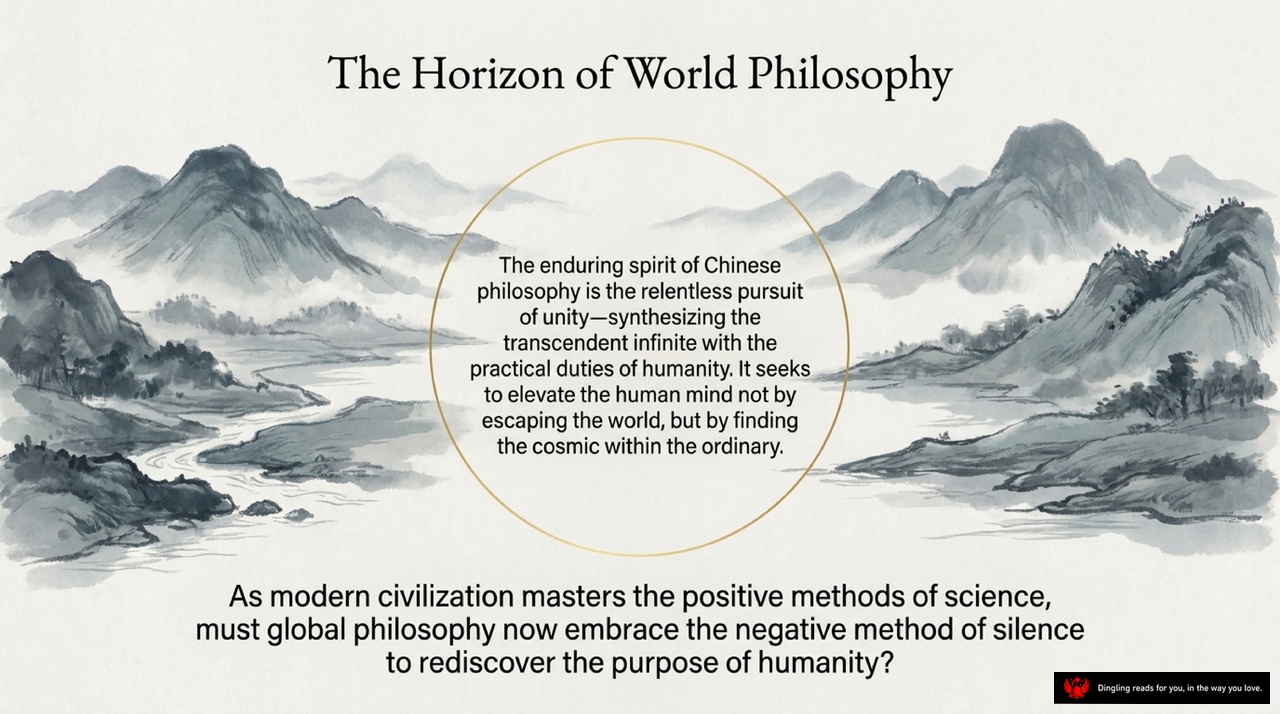
The enduring spirit of Chinese philosophy lies in its relentless pursuit of unity, seamlessly synthesizing the transcendent infinite with the practical duties of humanity. As this slide illustrates, the true goal is not to escape the world, but to elevate the human mind by finding the cosmic within the ordinary. While modern civilization has mastered the positive methods of science, we are left with a profound question: must global philosophy now embrace the negative method of silence to rediscover the purpose of humanity? This tension between the tangible achievements of science and the silent wisdom of philosophy defines the horizon of world philosophy today.