
A Theory of Justice: Complete Chapter-by-Chapter Summary
Welcome to today's session on John Rawls' masterpiece, *A Theory of Justice*. Think of this book not as a dry academic treatise, but as a structural blueprint for constructing a fair, equitable, and stable society from the ground up. Rawls begins by making a bold claim: justice is the first virtue of social institutions, just as truth is the first virtue of systems of thought. In a world where laws and institutions can be flawed, we must prioritize justice above all else, refusing to sacrifice individual rights for the sake of greater social benefits.
To build this just society, Rawls introduces a revolutionary concept called the "veil of ignorance." Imagine you are designing the rules for society, but you don't know what role you will play in it. You don't know if you'll be rich or poor, talented or not, or even what your race or religion will be. Because you are behind this veil, you cannot favor any specific group. Instead, you must choose principles that protect everyone, including the least advantaged among us. This leads to his two core principles of justice: first, that everyone is equal in their basic liberties, and second, that social and economic inequalities are only acceptable if they benefit the least fortunate and are open to all under conditions of fair equality of opportunity.
Rawls argues that when we design our society from this position of fairness, we naturally arrive at a system where freedom is paramount and where no one is left behind. This approach challenges the idea that we should simply maximize total happiness, which might leave some people behind. Instead, it asks us to build a society where justice is the foundation, ensuring that our institutions work for everyone, not just the privileged few. By understanding this blueprint, we can better evaluate the fairness of the world around us and work toward a more just future.
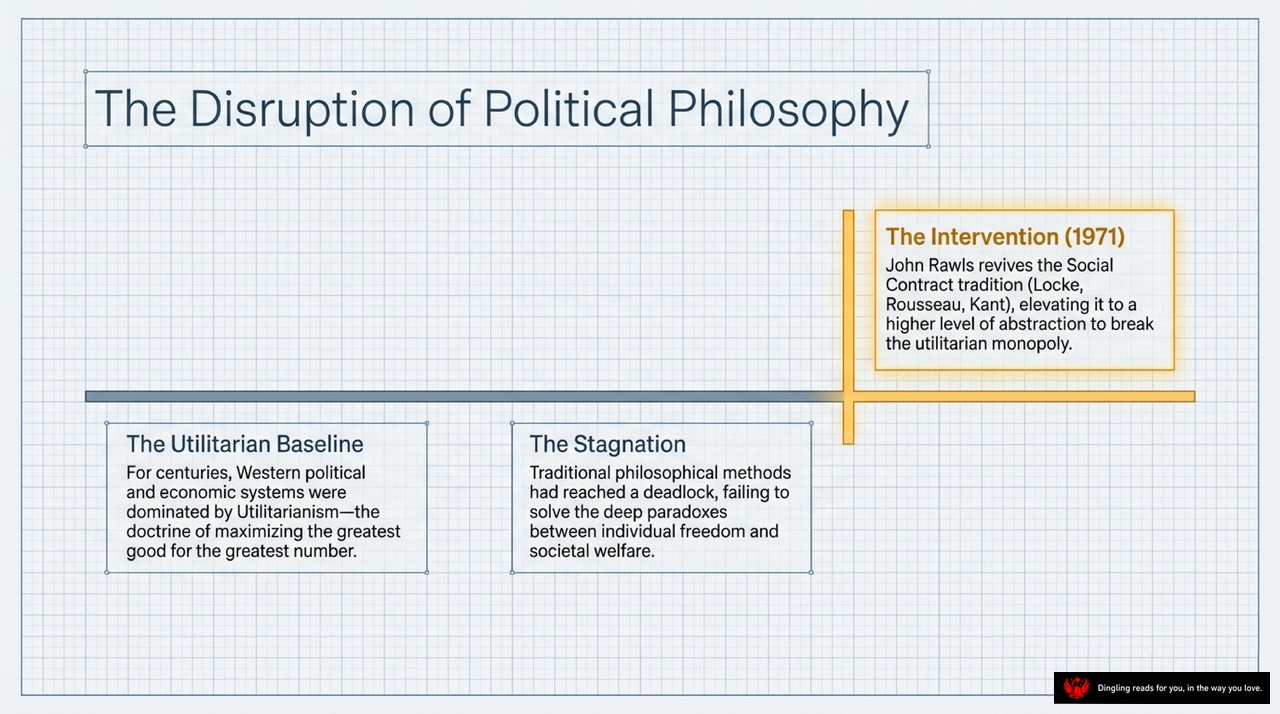
For centuries, Western political thought was dominated by a single idea: Utilitarianism. It argued that the best society is the one that maximizes happiness for the greatest number of people. For a long time, this seemed like the only logical way to build a fair world. But by the time we reached 1971, this approach had hit a wall. Traditional philosophy was stuck in a deadlock, unable to solve the deep conflicts between individual freedom and the collective good.
Then came a major disruption. In 1971, philosopher John Rawls stepped in to challenge the status quo. He revived the Social Contract tradition—drawing from giants like Locke, Rousseau, and Kant—but took it to a much higher level of abstraction. His goal was simple yet revolutionary: break the monopoly of Utilitarianism.
Rawls argued that justice isn't about calculating the greatest total good. Instead, it's about fairness. He proposed that we should imagine ourselves behind a "veil of ignorance," choosing the rules of society without knowing our own place in it. From that fair starting point, he derived two core principles: first, everyone deserves equal basic liberties; second, social and economic inequalities are only acceptable if they benefit the least advantaged members of society.
This shift was profound. It moved the conversation from "what makes the most people happy" to "what protects everyone's rights and dignity." By prioritizing individual liberty over aggregate welfare, Rawls fundamentally changed how we think about political philosophy, offering a new foundation for a just society that respects both freedom and equality.

Let's dive into the core conflict that defines modern political philosophy: the flaw of Utilitarianism.
As this slide clearly illustrates, Utilitarianism has a fatal weakness. Its core goal is simply to maximize the total aggregate welfare of everyone, treating the sum of happiness as the only metric that matters. But look at the second row: under Utilitarianism, individual rights are expendable. If sacrificing a few people benefits the many, the theory suggests that sacrifice is not only acceptable but required. This logic ignores how satisfaction is distributed; it cares only about the net sum.
Now, let's look at the middle column, Intuitionism. While it tries to balance competing principles, it relies on subjective moral intuition and lacks a supreme standard. It's variable and often leads to conflicting judgments without a clear way to resolve them.
Finally, let's focus on the highlighted solution: Justice as Fairness. This approach fundamentally shifts the paradigm. Instead of maximizing a total, its core goal is to establish fair terms of social cooperation. Crucially, it asserts that individual rights are absolute and inviolable. No amount of aggregate benefit can justify violating a person's fundamental freedom. Furthermore, its distribution logic is pre-defined by rational choice, specifically designed to protect the least advantaged. This ensures that the benefits of natural assets and social cooperation are shared fairly, rather than just dumped on whoever happens to be the majority. This is the essence of a stable and just society.
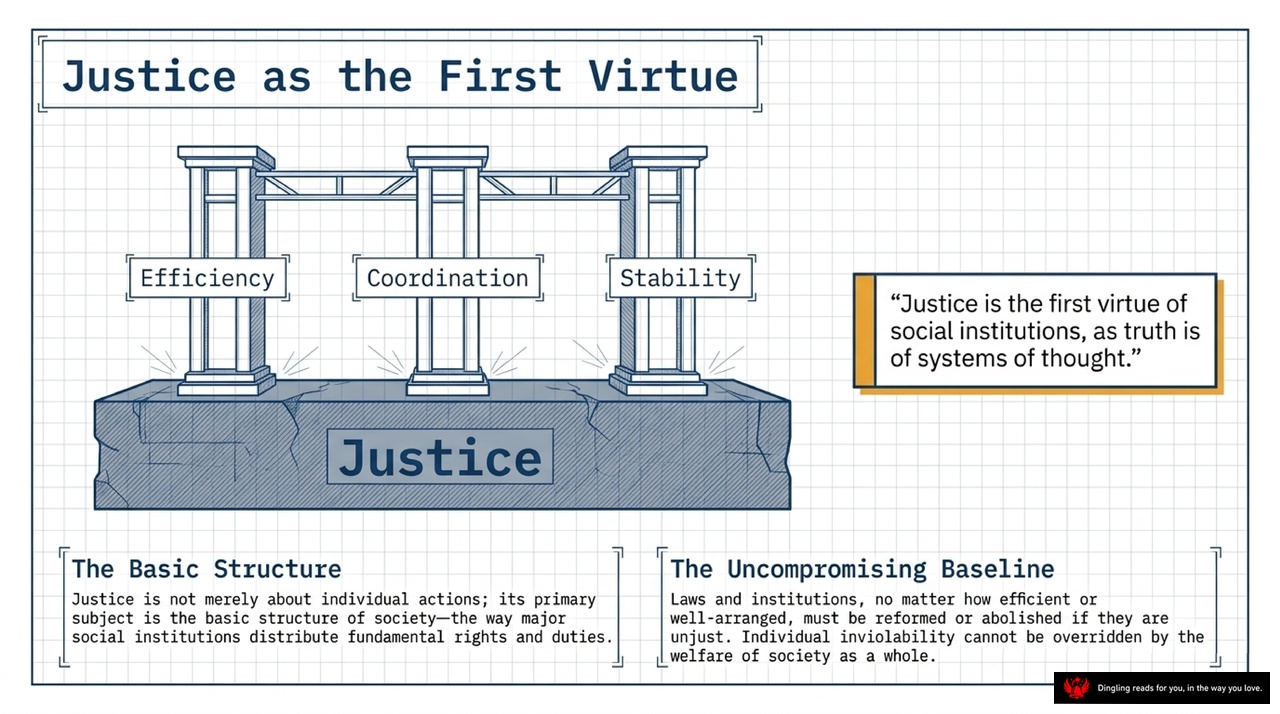
Imagine society not as a chaotic free-for-all, but as a grand architectural project where justice is the bedrock holding everything up. Look at this diagram: Justice isn't just one pillar; it's the massive foundation that supports Efficiency, Coordination, and Stability. Without that solid base, the entire structure of our society collapses.
Think of it this way: a building can be incredibly efficient, perfectly coordinated, and seem stable on the outside, but if the foundation is cracked or rotten, the whole thing is doomed to fail. That's exactly what happens when institutions aren't just. A system might be highly productive or well-organized, but if it's built on injustice, it's fundamentally flawed.
The text reminds us of a powerful truth: "Justice is the first virtue of social institutions, as truth is of systems of thought." Just as we reject a theory that lies, we must reform or abolish laws and systems that are unjust. No amount of economic efficiency or social stability can justify an unfair system. Even the collective good of society cannot override the individual's right to be treated fairly.
This slide highlights two critical points. First, justice is about the basic structure of society itself—how our laws and institutions distribute rights and duties. It's not just about individual actions. Second, it sets an uncompromising baseline: individual inviolability cannot be sacrificed for the greater welfare of the group. If a society prioritizes efficiency over justice, it loses its moral legitimacy. True social order requires that everyone accepts the same rules, creating a stable framework where cooperation thrives not because of force, but because it's fair.
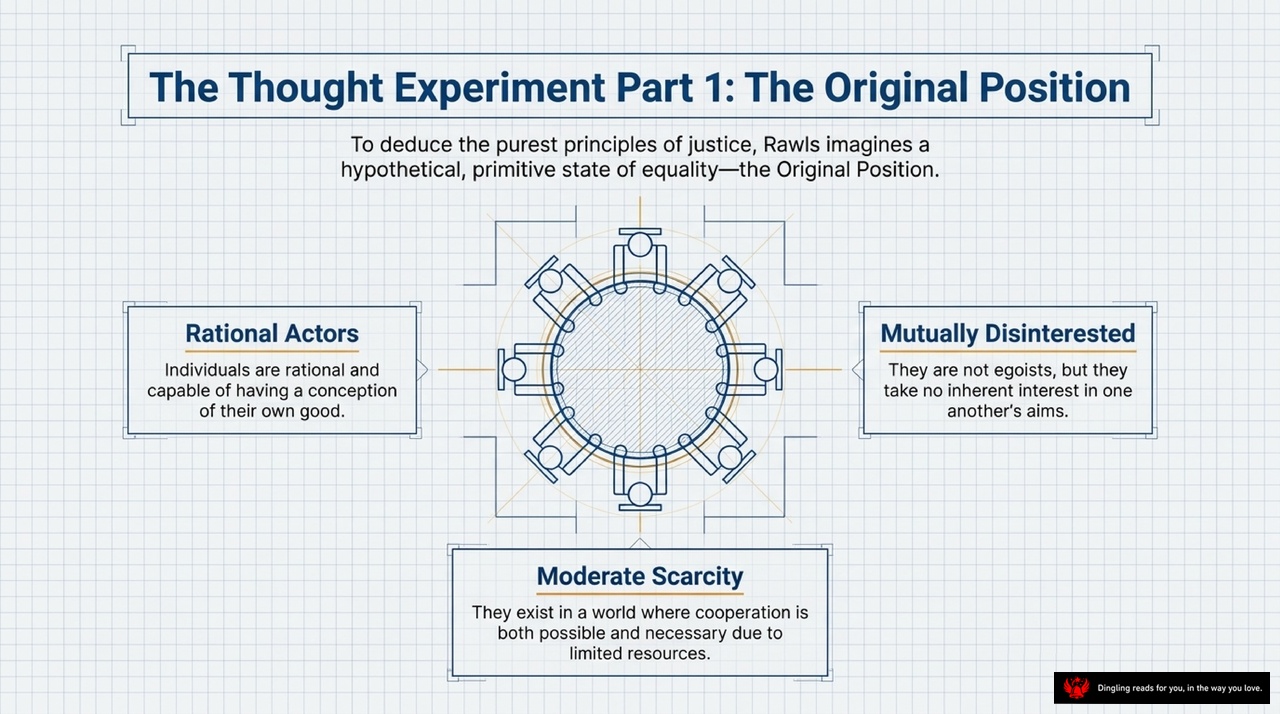
Imagine a world where we all sit behind a veil of ignorance, unable to see our own talents, social status, or even what we value most. In this "Original Position," we are rational actors who care about our own good, yet we are mutually disinterested—we don't care about your goals, just as you don't care about mine. We also know that resources are limited, creating a state of moderate scarcity where cooperation is necessary but not guaranteed.
Given these conditions, what would we choose to build a society? We wouldn't pick a system that might leave us as the least advantaged. Instead, we would prioritize a framework that protects our basic liberties above all else. Only after securing those freedoms would we agree to allow economic inequalities, but only if they somehow benefit everyone, especially the least fortunate among us.
This thought experiment reveals a powerful truth: justice isn't about maximizing the total happiness of the group. It's about ensuring that everyone has a fair shot at life and that no one is left behind. When we strip away the accidents of birth and talent, the only rational choice is a society built on equal liberty and a commitment to lift up those who struggle the most. That is the essence of the original position.

Imagine you are standing behind a thick, impenetrable curtain. On one side of this "Veil of Ignorance," you see a society divided by everything that makes us different: wealth, poverty, natural intelligence, physical strength, race, and class. But here is the twist—you don't know which side of the curtain you will be on when the rules are finally chosen.
Because you are blind to your own starting point, you cannot design a system that favors the rich, the gifted, or the powerful. You are forced to act as a purely equal moral agent. You must ask yourself: "What kind of society would I agree to, if I had no idea whether I would be the one benefiting from it or the one suffering from it?"
The result of this thought experiment is profound. Stripped of all biases and arbitrary natural lotteries, the only rational choice is to create a society where everyone starts on an equal footing. You would prioritize protecting the basic freedoms of every citizen above all else, because you might end up as the poorest person in the room. You would also ensure that any economic inequalities exist only if they actually help the least advantaged among us. This mechanism ensures that no one designs principles to favor their specific circumstances. Instead, everyone negotiates the fundamental charter of society as if they were all in the same boat, blind to their own destiny, yet united by a shared commitment to fairness.
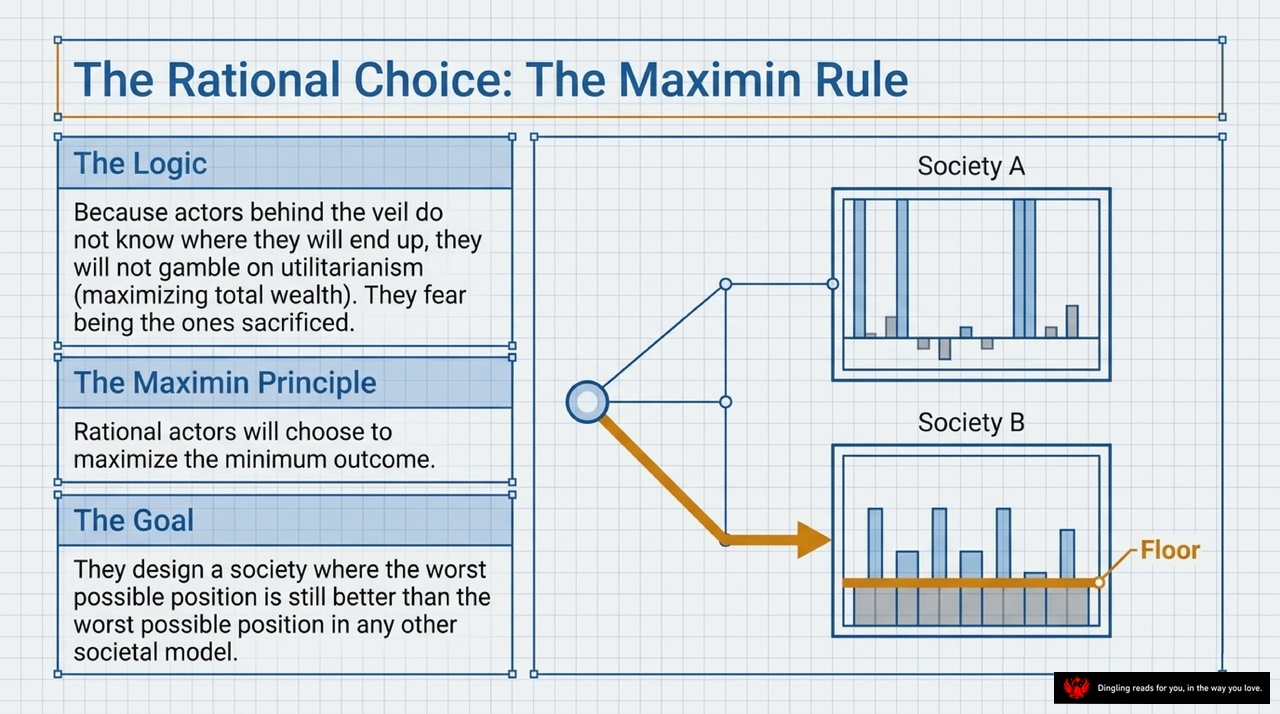
Imagine you are standing behind a "veil of ignorance," unable to see where you will land in society. Would you gamble on a system that might maximize total wealth but risk leaving you with nothing? No, a rational person wouldn't. You would fear being the one sacrificed for the greater good. Instead, you'd choose the "Maximin Rule": you design a society where the worst possible outcome is still better than the worst outcome in any other system.
Look at the chart on the right. Society A offers high peaks of wealth for some, but a deep valley of poverty for others. Society B looks flatter, with a guaranteed "floor" that lifts everyone above that dangerous line. Even if Society B has less total wealth, the rational choice is clear: you pick Society B to maximize your minimum outcome. This is the logic of the maximin principle. It's about securing a dignified baseline rather than chasing uncertain highs. By prioritizing the worst-case scenario, you ensure that no matter where life takes you, you never fall below a certain standard of justice.

Imagine justice not as a vague ideal, but as a sturdy building with two massive pillars holding up the roof of a truly just society. Today, we're looking at the blueprint.
The first pillar is the Equal Liberty Principle. Think of this as the foundation of freedom. It guarantees that everyone gets the widest possible range of basic freedoms—things like voting, speaking your mind, practicing your religion, and keeping your property. The key here is that these rights are equal for everyone and absolutely protected. You can't trade them away for economic gain or social stability. No one's freedom is less important than another's.
The second pillar is the Difference Principle paired with Fair Opportunity. This one handles the messy reality of inequality. It says that social and economic inequalities are only allowed if they actually help the least advantaged members of society. It's not about making everyone equal in every way, but ensuring that any advantage we have comes from a system that lifts up the worst-off. Plus, everyone needs a fair shot at those positions of power and wealth, regardless of their background.
Together, these two principles form the architecture of a fair society. They ensure that we have the freedom to pursue our own lives, while making sure that the structure of our society works for everyone, especially those who have the least.
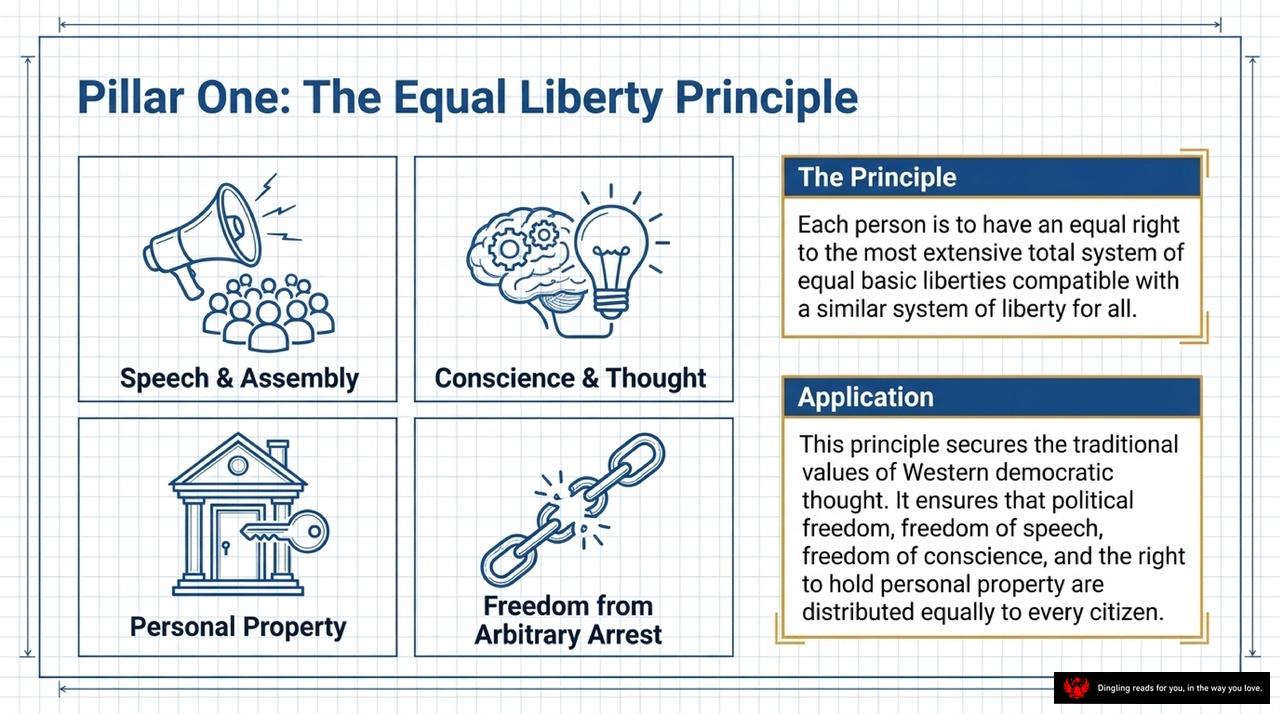
Pillar One: The Equal Liberty Principle. This is the foundation of a just society. It states that every person must have an equal right to the most extensive system of basic liberties compatible with a similar system for everyone.
Let's break down what this actually means in practice. On the left, we see four core areas of freedom. First, Speech and Assembly. This guarantees your right to speak your mind and gather with others without fear. Second, Conscience and Thought. This protects your inner world—the freedom to believe, question, and think whatever you choose. Third, Personal Property. This ensures you have the security to own what is yours. And finally, Freedom from Arbitrary Arrest. This is the guarantee that no one can be detained without cause or fair process.
Notice the logic here: these liberties are absolute. The principle of Equal Liberty demands that they be distributed equally to every citizen. You cannot trade your freedom for economic gain, and no one's freedom can be sacrificed for the greater good of the majority. This principle secures the traditional values of Western democratic thought, ensuring that political freedom, freedom of speech, freedom of conscience, and property rights are not just ideals, but rights distributed equally to everyone. It is the bedrock upon which all other social arrangements must be built.

Pillar Two: The Difference Principle. Look at this diagram. It illustrates a powerful idea: social and economic inequalities are only permitted if they satisfy two specific conditions. First, Fair Equality of Opportunity, meaning offices and positions must be open to all under fair conditions. Second, and most crucially, The Difference Principle. This principle demands that any inequality must be to the greatest benefit of the least advantaged members of society.
Visually, you can see this represented as a rising tide. Economic growth sits at the top, but notice how the benefits flow down. They don't just trickle to the wealthy; they are designed to lift the foundation. The implication is profound: natural talents and social circumstances are arbitrary. They are a lottery we didn't choose. Therefore, inequality is only just if it acts as a rising tide that lifts the lowest boats. In a truly just society, we agree that the extra benefits gained by the talented should only be accepted if they improve the life prospects of those who have the least. This ensures that no one is left behind as the economy grows.
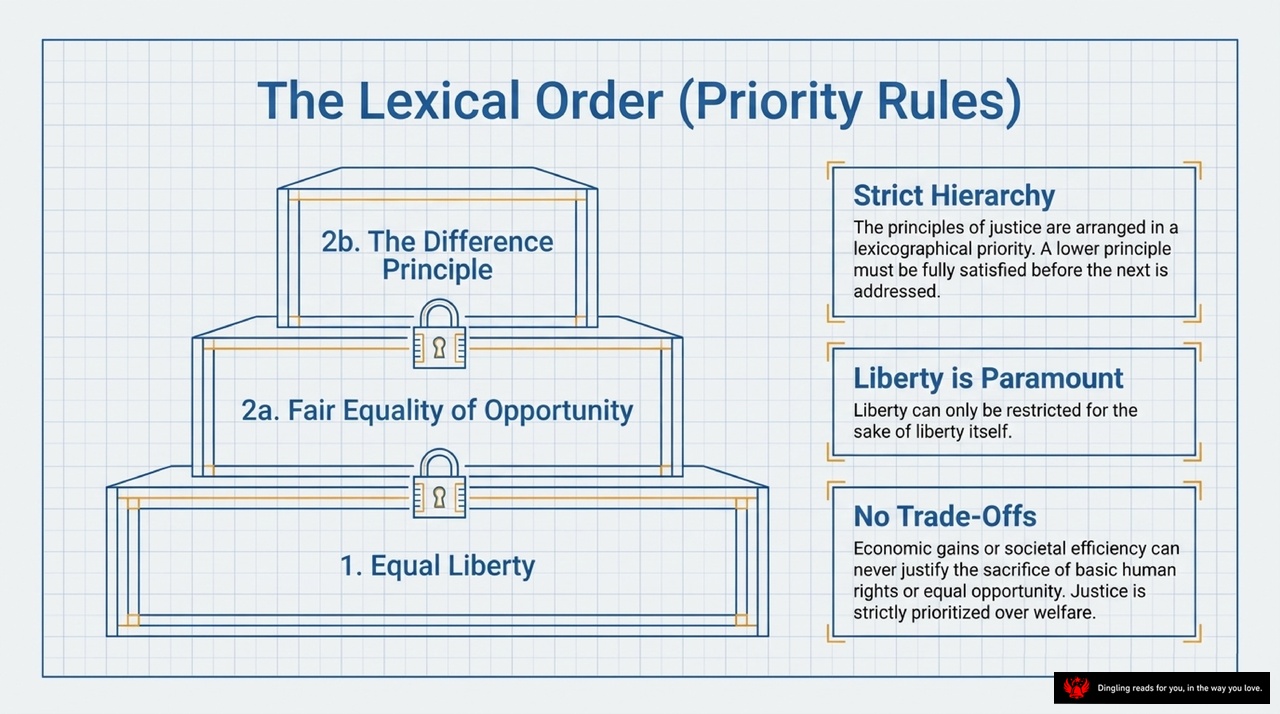
Let's break down the strict hierarchy that defines a truly just society. As you can see in the diagram, justice isn't just a mix-and-match of values; it follows a specific order. We start at the very bottom with "Equal Liberty." This is our foundation. The principle here is clear: liberty can only be restricted for the sake of liberty itself. No economic gain, no societal efficiency, and certainly no majority rule can ever justify sacrificing your basic human rights.
Moving up the stack, we reach "Fair Equality of Opportunity." Notice the lock icon? That represents a strict barrier. You cannot jump to this level until the one below it is fully satisfied. This means we must first guarantee everyone's basic freedoms before we even talk about leveling the playing field for careers and jobs.
At the top sits "The Difference Principle." Again, there is a lock. This principle, which allows for some economic inequalities, can only be addressed once both liberty and fair opportunity are secured. In fact, economic gains can never justify the sacrifice of equal opportunity. This "Lexical Order" ensures that justice is strictly prioritized over welfare. We don't trade away our fundamental rights for a richer society; we build a society where those rights are inviolable.
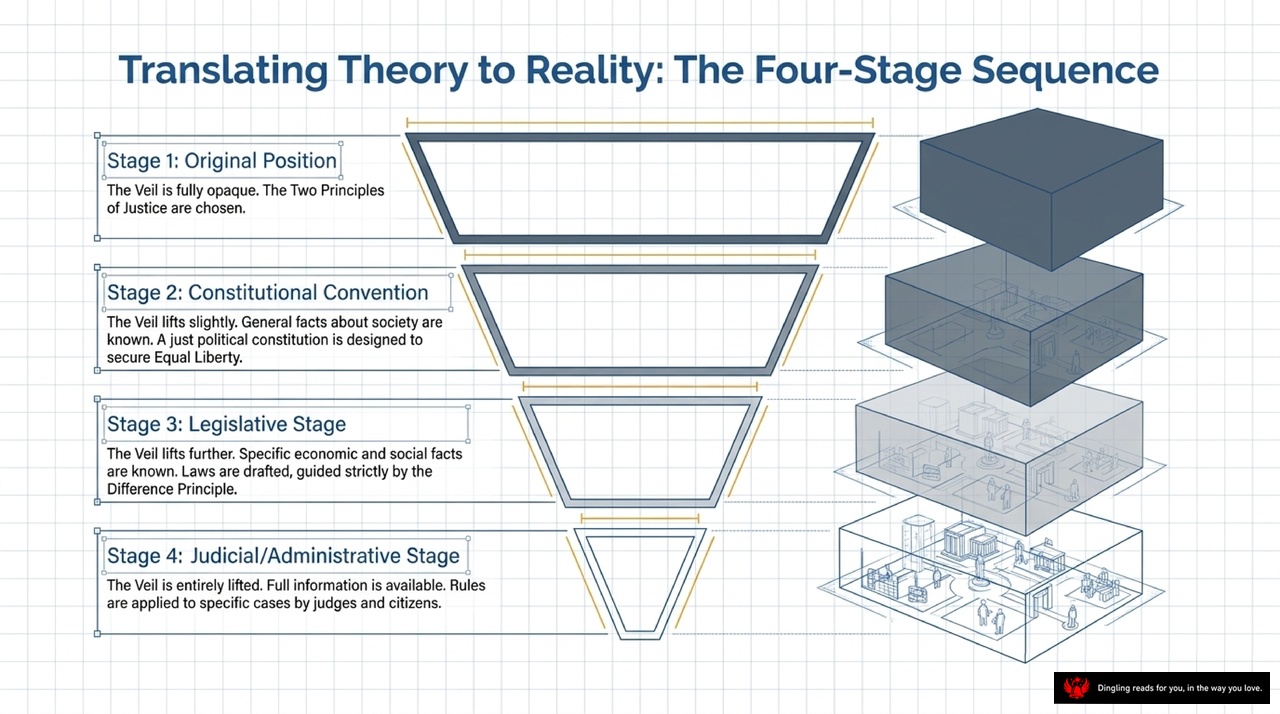
Translating Theory to Reality: The Four-Stage Sequence. Think of this not as a rigid political timeline, but as a mental map for how we move from abstract ideas to the laws we actually live by. It's a funnel, starting wide with pure theory and narrowing down to specific cases.
We begin at Stage 1, the Original Position. Here, the veil of ignorance is fully opaque. No one knows their place in society or their personal talents. In this state of fairness, we simply choose the Two Principles of Justice. It's the foundation, the agreement made before we even know who we are.
Next, we move to Stage 2, the Constitutional Convention. The veil lifts slightly. Now we know general facts about our society, but not specific details. Representatives use the principles from Stage 1 to design a just political constitution. This is where we secure Equal Liberty for everyone, creating the framework that will hold us all together.
Then comes Stage 3, the Legislative Stage. The veil lifts further. Now legislators know specific economic and social facts. They draft laws, but they are strictly guided by the Difference Principle, ensuring that any inequality benefits the least advantaged among us. This is where theory meets policy.
Finally, we reach Stage 4, the Judicial and Administrative Stage. The veil is entirely lifted. Full information is available. Judges and citizens now apply these rules to specific, real-world cases. This is where justice is enacted in daily life.
This sequence ensures that our laws aren't just arbitrary rules, but the result of a fair process that prioritizes liberty and protects the vulnerable.
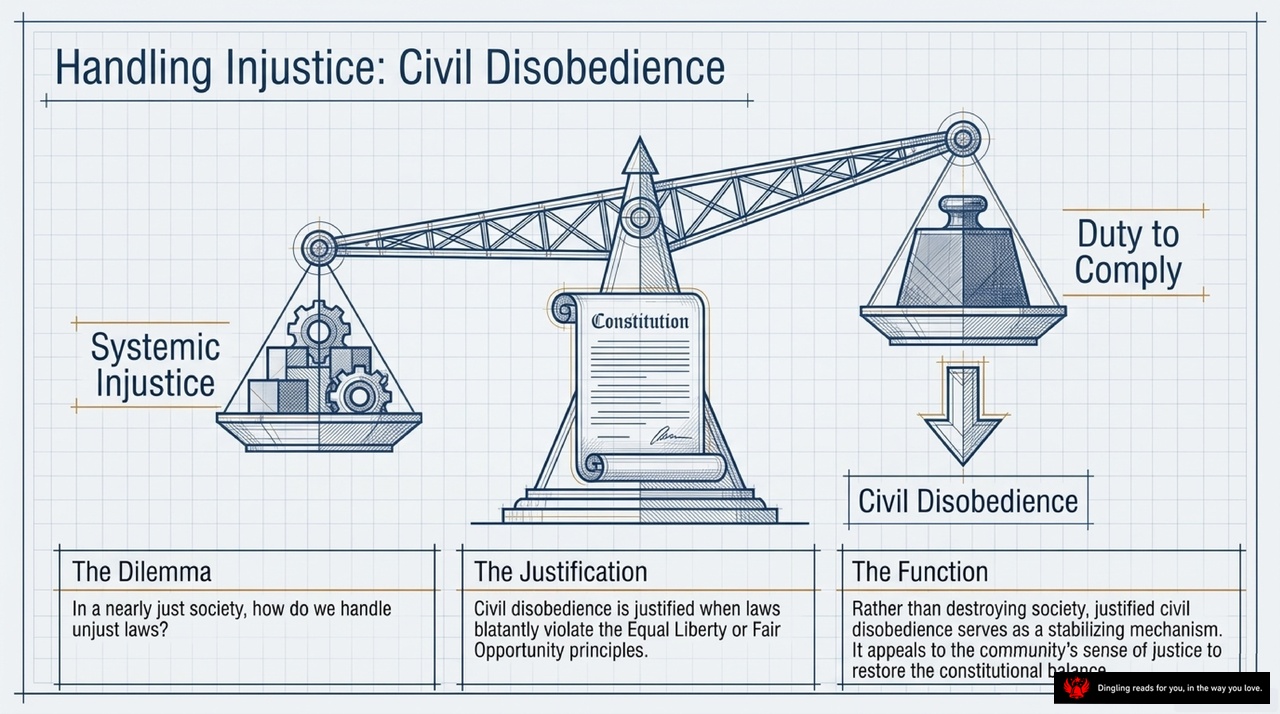
So, we hit a classic moral dilemma that almost every citizen faces at some point: How do we handle injustice? The slide breaks this down into three distinct parts. On the left, we see "Systemic Injustice"—the heavy weight of laws or institutions that blatantly violate our fundamental rights. In the center stands the Constitution, representing the "Justification." The slide tells us that civil disobedience isn't about chaos; it's justified only when laws strip away our Equal Liberty or Fair Opportunity. It's a necessary tool to restore the balance. On the right, we have the "Duty to Comply" tipping the scale downward, leading to "Civil Disobedience." This is the function: rather than destroying society, it acts as a stabilizing mechanism. By appealing to the community's shared sense of justice, it forces a correction that ultimately restores the constitutional balance. So, in a nearly just society, this isn't about rebellion for rebellion's sake; it's a disciplined response to specific, egregious violations of our core freedoms.

The Goodness of Justice: Social Stability
Look at this diagram. It illustrates a powerful, self-reinforcing cycle that explains why justice isn't just a moral ideal, but the very engine of social stability. It all starts with **Just Institutions**. When our laws and systems treat citizens fairly and guarantee their self-worth, something profound happens in human psychology.
This leads us to **Moral Psychology & Trust**. When people feel respected by the system, they naturally develop a strong sense of justice and mutual respect for one another. They stop seeing others as competitors and start viewing them as partners.
This shift in mindset creates **Generational Trust**. As the text explains, fairness is inherently stable because it doesn't require self-denial; instead, it affirms the individual while protecting the whole. This builds a cycle of trust that passes down through generations, making cooperation easier and more reliable.
Finally, this trust leads to **Social Stability**. As the slide notes, a society is truly stable when "The Right (justice) aligns with The Good (rational self-interest)." When the system is fair, it becomes in everyone's rational interest to uphold it. We don't need constant coercion because the system itself becomes the reward. This alignment creates a stable, orderly society where citizens are willing to cooperate and hold each other accountable, securing a future where justice thrives.
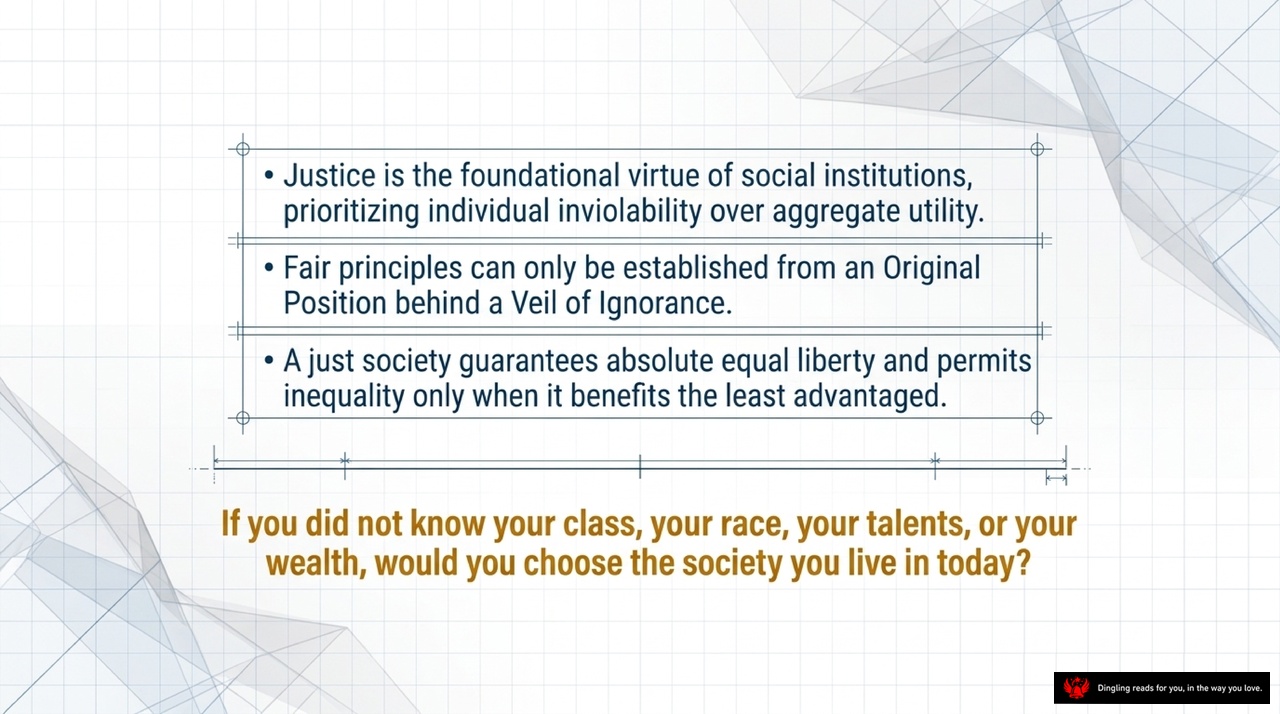
Imagine a society where the rules of the game are decided not by who has the most power or the best luck, but by what we would all choose if we were completely equal and didn't know our own place in it. This is the heart of Rawls' theory of justice.
The slide highlights three pillars that make this vision possible. First, it establishes that justice is the supreme virtue of any social institution. We prioritize the inviolability of individual rights over the total happiness of the group. Second, it introduces the "Original Position" behind a "Veil of Ignorance." This is a thought experiment where you strip away your class, race, talents, and wealth. The question posed on the slide asks you directly: If you didn't know your class, your race, your talents, or your wealth, would you choose the society you live in today?
Under these conditions, rational people would agree on a specific set of rules. A truly just society guarantees absolute equal liberty for everyone. However, it allows for some economic inequality, but only under one strict condition: when those inequalities actually benefit the least advantaged members of society. This ensures that the system works for everyone, not just the privileged few.
By designing our institutions from this fair starting point, we create a framework where fairness isn't just an ideal, but a practical reality that protects the most vulnerable among us.