
A Thousand Splendid Suns: Complete Chapter-by-Chapter Summary
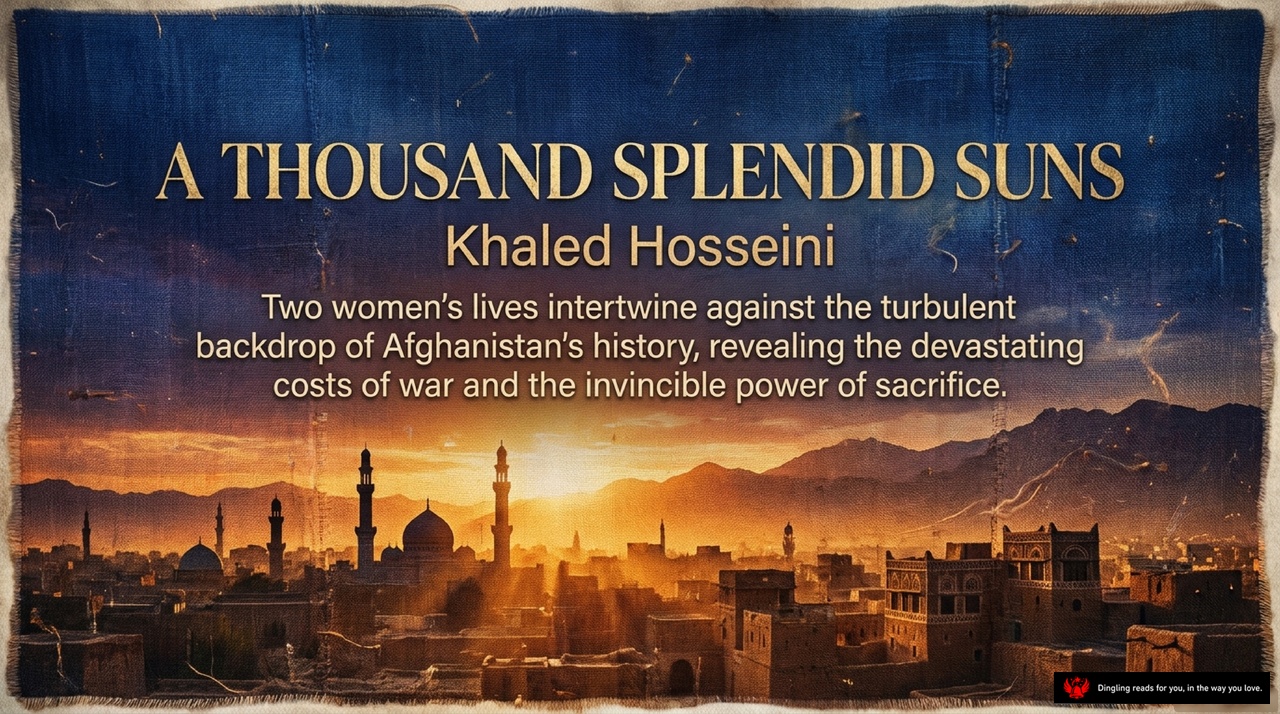
Welcome to a reading session of *A Thousand Splendid Suns* by Khaled Hosseini. This iconic novel weaves together the lives of two women, Mariam and Laila, set against the turbulent backdrop of Afghanistan's history. Their intertwined stories reveal the devastating costs of war and the invincible power of sacrifice. From the dusty mud houses of Herat to the war-torn streets of Kabul, these women navigate a world where love is often a dangerous thing, yet their resilience shines like a thousand suns, proving that even in the darkest times, hope and humanity can endure.
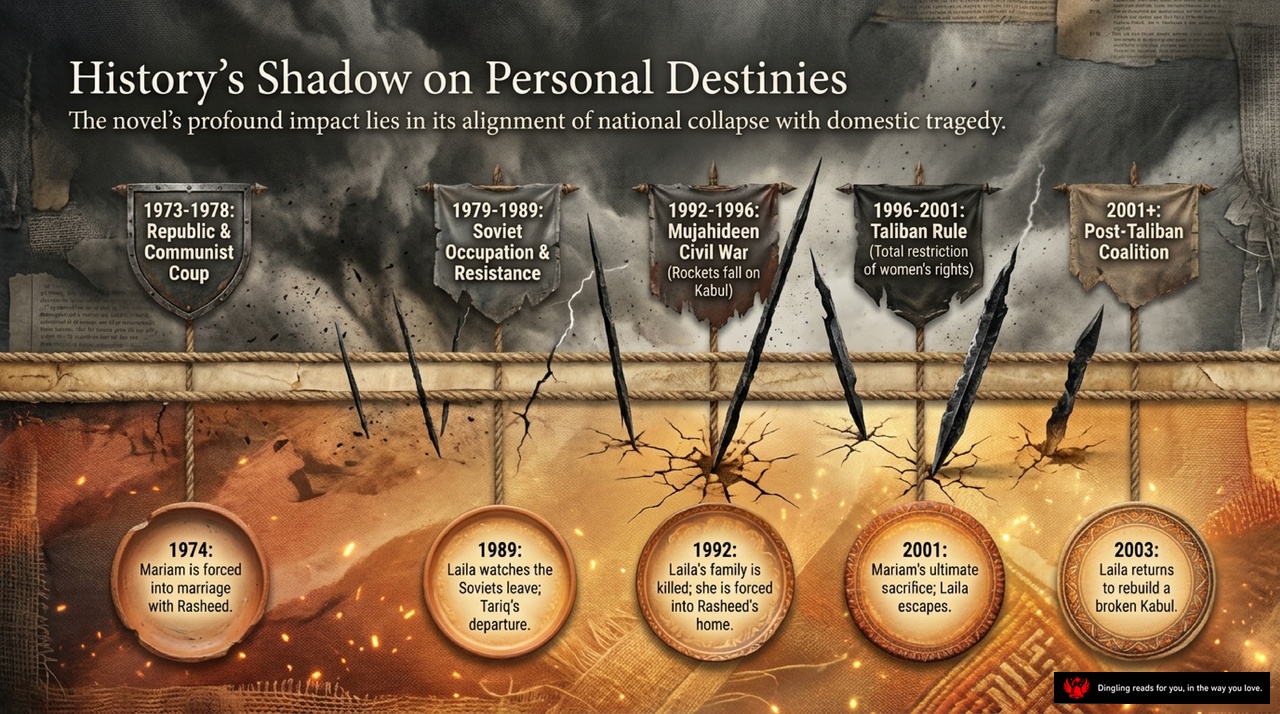
History's Shadow on Personal Destinies: The novel's profound impact lies in its alignment of national collapse with domestic tragedy. As the timeline unfolds, we see how the fall of the monarchy in 1973 and the subsequent Soviet occupation, civil war, and Taliban rule directly shaped the lives of Mariam and Laila. Mariam's forced marriage at 15, Laila's family's destruction in 1992, Mariam's ultimate sacrifice in 2001, and Laila's return to rebuild a broken Kabul in 2003—all are not just personal stories, but reflections of a nation in turmoil. From the rockets falling on Kabul to the total restriction of women's rights, the country's chaos became their private hell. Yet, amidst this darkness, their bond grew stronger, turning personal tragedy into a shared journey of survival and hope.
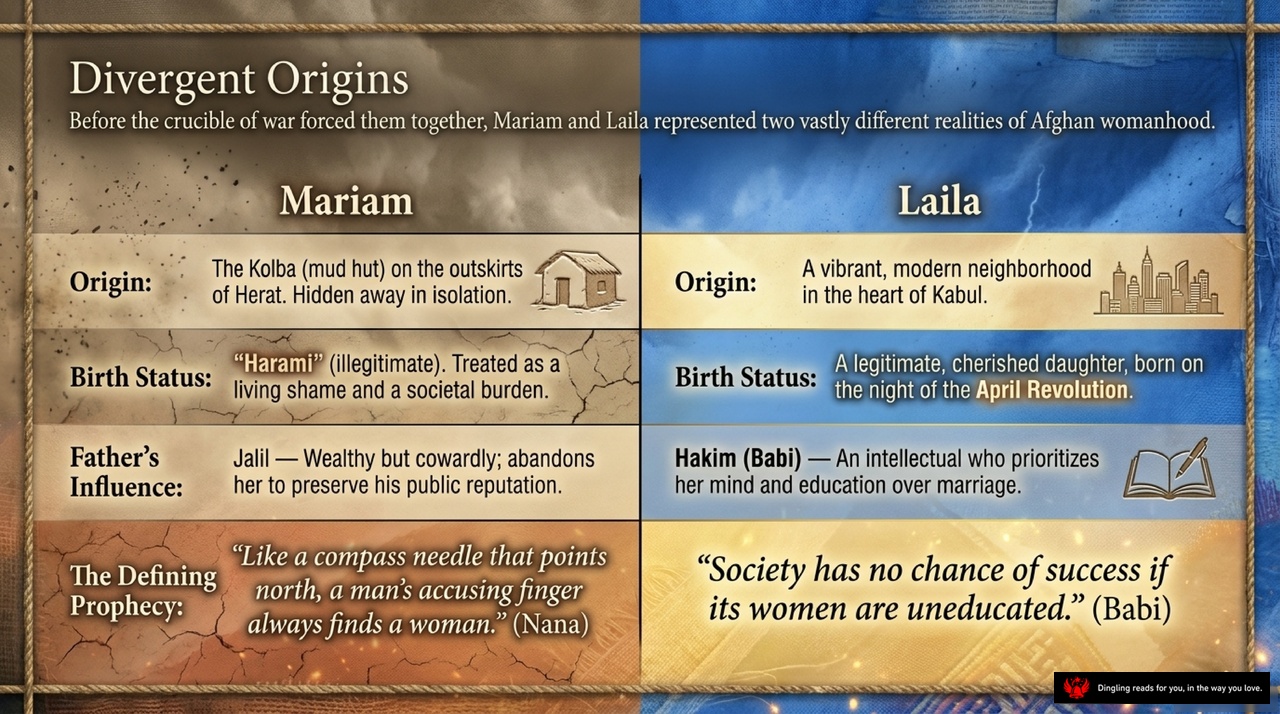
Before the war tore their lives apart, Mariam and Laila lived in two completely different worlds. Mariam was born "Harami"—illegitimate and shamed—hidden away in a mud hut on the outskirts of Herat, abandoned by her cowardly father. Her defining belief was that a man's accusing finger always finds a woman. In stark contrast, Laila was a cherished daughter of the April Revolution, born in the vibrant heart of Kabul to an intellectual father who believed society fails without educated women. While Mariam was raised to endure silence, Laila was taught to speak and dream. Yet, as the crucible of war forced them together, these vastly different realities would collide, transforming two broken women into each other's greatest strength.
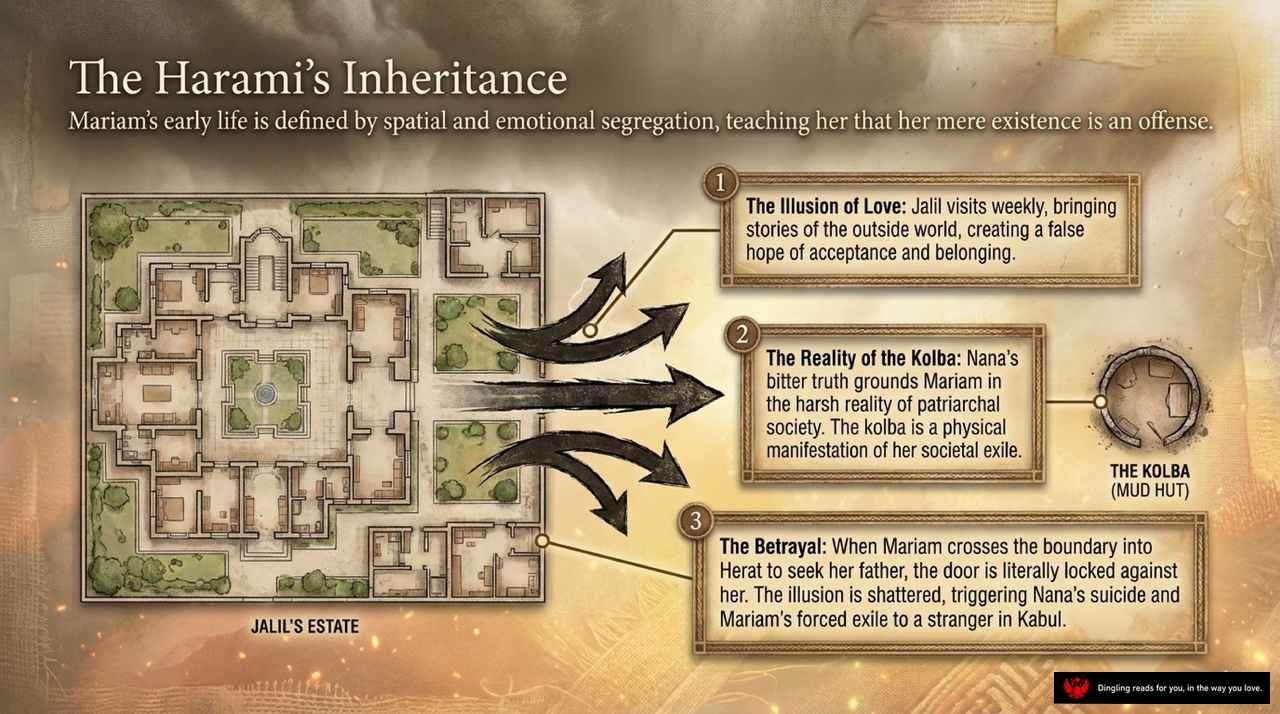
Look at this map of Jalil's estate. It represents the gilded cage of Mariam's early life, defined by what the slide calls "spatial and emotional segregation." For Mariam, mere existence felt like an offense. Her world was split into three distinct realities, visualized here by these three arrows.
First, we see "The Illusion of Love." Every Thursday, Jalil would visit, bringing stories of the outside world—talking about the cradle of Persian culture and the happy date trees of Herat. He created a false hope of acceptance, making Mariam believe she belonged in that glittering house. But it was all a performance.
Second, we have "The Reality of the Kolba." This arrow points to the mud hut where her mother, Nana, raised her. Nana's bitter truth grounded Mariam in the harsh reality of a patriarchal society. The kolba wasn't just a house; it was a physical manifestation of her societal exile. It was the only place where Mariam was safe, even if it was isolated.
Finally, the third arrow points to "The Betrayal." This is the moment everything shattered. When Mariam crossed the boundary into Herat to seek her father, the door was literally locked against her. Jalil was not there. The illusion was destroyed, triggering Nana's suicide and Mariam's forced exile to a stranger in Kabul.
This slide perfectly captures the tragic arc of her life: from the false promise of a father's love, to the harsh reality of her mother's sacrifice, culminating in the devastating betrayal that sent her into the dark.

A Future Stolen. Laila was born into an era of progressive ideals, where the possibility of female empowerment was nurtured, only to be dismantled by war. This slide captures the three pillars that shaped her destiny: The Intellectual Father, The Shadow of the Martyrs, and The Anchor of Love.
Her father, Babi, instilled the belief that her mind was her greatest asset, fostering dreams of university and global travel. He famously said, "Marriage can wait, education cannot." This stood in stark contrast to the reality of her mother, Fariba. Consumed by grief for her sons fighting the Soviets, she left Laila emotionally orphaned but highly independent. Her mother's sacrifice became the bedrock of Laila's strength.
Finally, we have Tariq. He represents true equality, protection, and unconditional love. Their bond stands in stark contrast to the transactional marriages surrounding them. While the world around them crumbled into chaos and violence, Tariq offered a sanctuary of truth. Together, these three forces—her father's vision, her mother's resilience, and her partner's love—defined a life where love was not a commodity, but a revolutionary act against the stolen future.

The Domestic Frontline isn't just a metaphor; it's the brutal reality Rasheed builds inside his own home. As the civil war rages outside, destroying Kabul, he constructs a parallel dictatorship within these four walls, turning a family into a battlefield of control and fear.
Look at the arrows converging on Rasheed's Household. This is where the true violence happens. First, we see Weaponized Dependency. Laila's entire survival hinges on marrying a hostile stranger because her parents are dead and Tariq is presumed gone. She has no choice but to submit to this new master.
Next, consider The Burqa as a Prison. What started as an optional garment becomes a mandatory tool of erasure. Rasheed enforces it not out of religious piety, but as a mechanism of absolute ownership and silencing. It strips Laila of her identity, hiding her from the world and from herself.
Finally, there is The Divide and Conquer Strategy. Rasheed intentionally pits the women against each other. He weaponizes Mariam's infertility against Laila's youth, cultivating a toxic, distracting hostility. By keeping them fighting, he ensures they never unite to challenge his power. In this domestic prison, Rasheed rules with an iron fist, proving that sometimes the most dangerous war is the one fought right inside your own home.

From Rivals to Allies, this slide captures the most profound transformation in the narrative: the forging of an unbreakable bond between two women taught to hate each other. It all begins with shared suffering. The mutual physical and psychological abuse inflicted by Rasheed dissolves their rivalry. Pain becomes the common language that bridges their generational and cultural divide.
Then comes the Midnight Tea. The simple act of sharing tea, chores, and whispered secrets in the dark marks the birth of their alliance against their oppressor. It is in these quiet moments that their hearts finally align. Finally, there is A Surrogate Motherhood. Mariam, who believed she would never have a child to love, finds her ultimate purpose. She becomes a fierce protector and surrogate mother to Laila and her daughter, Aziza. Through this journey, they move from enemies to the closest of friends.
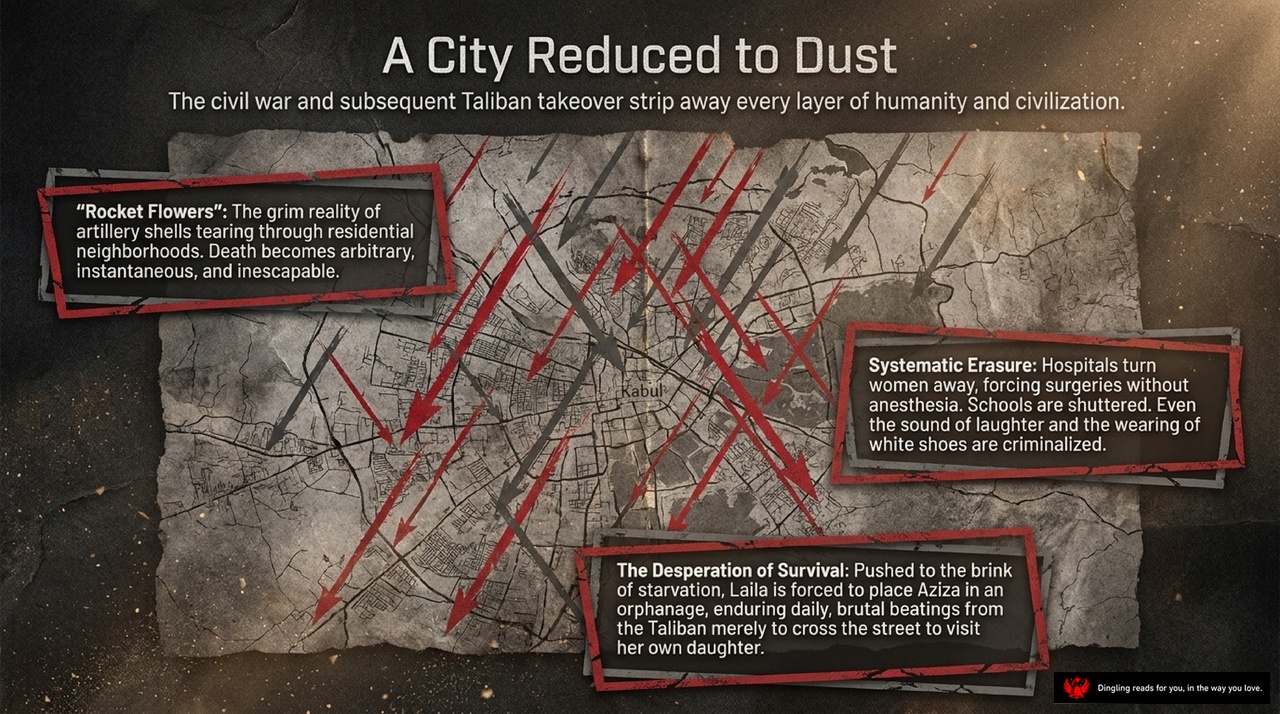
Look at this map of Kabul, labeled "A City Reduced to Dust." It's not just a city anymore; it's a graveyard of humanity. The red arrows slicing across the map represent the relentless violence of the civil war and the Taliban takeover, stripping away every layer of civilization.
First, look at the "Rocket Flowers." This isn't a poetic term; it's the grim reality of artillery shells tearing through residential neighborhoods. Death becomes arbitrary, instantaneous, and inescapable. There is no warning, only the sudden loss of life in your own home.
Then, see the "Systematic Erasure." This is the slow, cruel death of society. Hospitals turn women away, forcing surgeries without anesthesia. Schools are shuttered. Even the sound of laughter and the simple act of wearing white shoes are criminalized. The Taliban isn't just killing people; they are erasing the very idea of a normal, joyful life.
Finally, look at "The Desperation of Survival." This is where the story of Laila and Mariam truly converges in tragedy. Pushed to the brink of starvation, Laila is forced to place her daughter, Aziza, in an orphanage. She endures daily, brutal beatings from the Taliban merely to cross the street to visit her own daughter. This is the ultimate cost of the war: mothers separated from their children, families torn apart, and hope replaced by survival at any price.
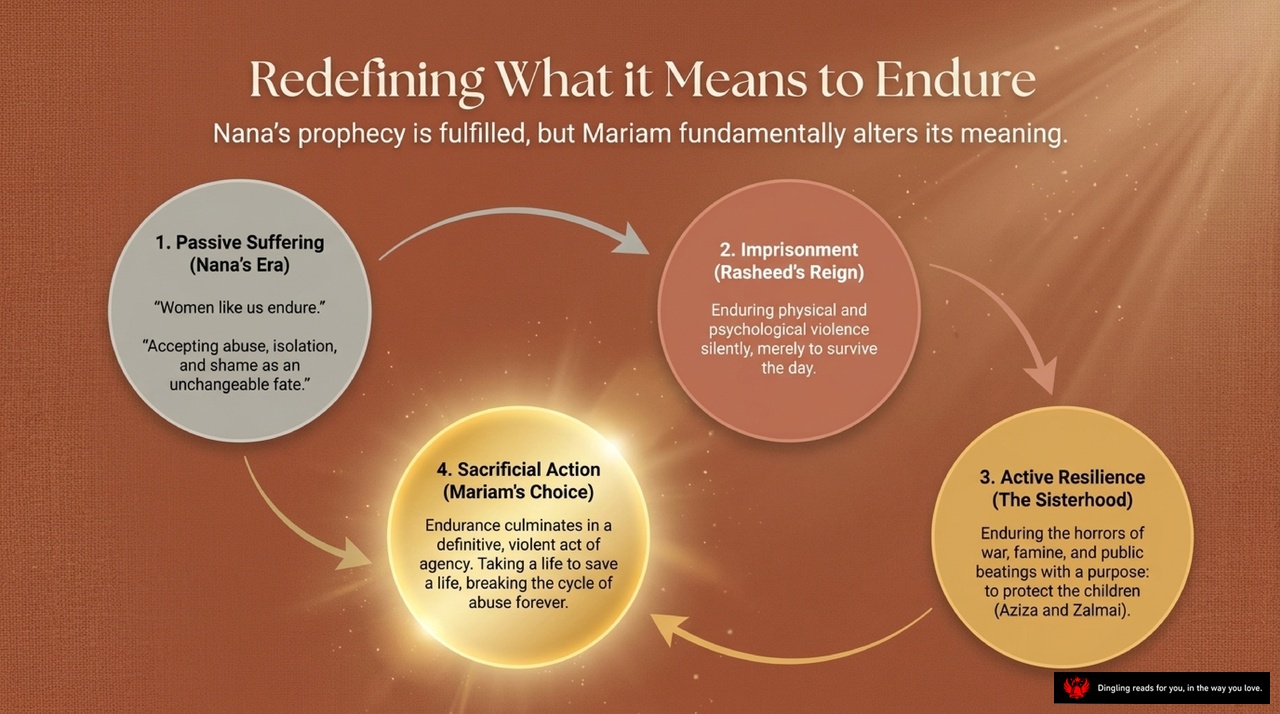
Redefining what it means to endure. Nana's prophecy is fulfilled, but Mariam fundamentally alters its meaning.
In Nana's era, endurance was defined by passive suffering. Women like us endure, accepting abuse, isolation, and shame as an unchangeable fate. It was about enduring physical and psychological violence silently, merely to survive the day, much like Mariam did under Rasheed's reign.
But Mariam's journey leads to a different path. Through the sisterhood, she discovers active resilience. Enduring the horrors of war, famine, and public beatings with a purpose: to protect the children, Aziza and Zalmai. This endurance culminates in a definitive, violent act of agency. Taking a life to save a lives, breaking the cycle of abuse forever. Mariam transforms from a victim of endurance into an architect of her own destiny.

When Tariq returns and Rasheed attempts to murder Laila, Mariam realizes that endurance is no longer enough. This moment marks her final act of agency. By killing Rasheed, Mariam claims ownership of her destiny for the very first time. She rejects victimhood and takes control of her own narrative. She turns herself in, taking full responsibility to ensure Laila and Tariq can escape to safety. Walking into the stadium, Mariam feels no regret. She has transformed her identity from an unwanted "harami" into a beloved mother, savior, and martyr. As the quote says, "For a life with an illegitimate beginning, this was a legitimate end."

In the ruins of a war-torn Kabul, a new chapter begins not with destruction, but with the quiet resilience of planting roots where nothing should grow. Despite finding safety in Murree, Laila realizes that peace without purpose is a betrayal of the sacrifices made for her. This realization drives her back to the heart of the tragedy to fulfill her father Babi's dream of an educated Afghanistan and to honor Mariam's ultimate gift of life.
Armed with Jalil's belated inheritance money, Laila and Tariq restore the orphanage, actively replacing bullets with books. They transform a place of brokenness into a sanctuary of hope, proving that even in the most desolate landscapes, growth is possible. Mariam is not buried in an unmarked grave; she lives on in the walls of the orphanage, in the laughter of the children, and in the heart of Laila. Their story reminds us that legacy is not defined by the past, but by the future we build together.

Today's slide, "The Meaning of the Splendid Suns," explores the heart of our story through a powerful metaphor. It draws from a 17th-century poem mourning the beauty of Kabul, using the title as the ultimate symbol for Afghan women. The poem asks, "One could not count the moons that shimmer on her roofs, Or the thousand splendid suns that hide behind her walls."
These "suns" represent the women of Afghanistan—hidden behind mud walls, concealed beneath the fabric of the burqa, and suppressed by patriarchal oppression. Yet, as the slide reminds us, their resilience, their capacity to love, and their radiant inner light can never be extinguished. This theme echoes through every character we've met: Mariam, hidden and abused, finds her own sun in Laila; Laila, broken by war and forced into a loveless marriage, finds her own sun in Mariam. Together, they prove that even when the world tries to bury them, these women shine with an unquenchable brilliance.

The journey of Mariam and Laila serves as a profound testament to the resilience of the human spirit. Even amidst the darkest crucibles of war, systemic oppression, and unimaginable loss, they forged unbreakable bonds of love. Their story proves that true endurance is not merely the capacity to suffer, but the profound courage to sacrifice oneself so that others might step into the light. Through their shared struggles—from the shadows of a tyrant's home to the ruins of a bombed city—they found redemption in each other. Now, as we reflect on their sacrifice, we are left with a powerful question: What will you do with the light that others have sacrificed the dark to give you?