
A Treatise of Human Nature: Complete Chapter-by-Chapter Summary

Welcome to our deep dive into David Hume's *A Treatise of Human Nature*. This book isn't just a philosophical text; it's a groundbreaking anatomical exploration of the human mind itself. As the title suggests, Hume dissects how our very reality and morality are constructed from the ground up. He argues that it all starts with experience, driven by our passions and united by a fundamental human capacity for sympathy.
Hume begins by breaking down our mental perceptions into two distinct categories: impressions and ideas. Impressions are the vivid, forceful sensations we feel directly—like pain, heat, or sudden emotions—while ideas are the fainter, weaker copies we form when we think or remember. He establishes a crucial rule: all ideas come from impressions. You can't have the concept of red without first seeing the color red. This simple yet powerful insight dismantles the old idea that humans are born with innate knowledge, proving instead that our understanding is built entirely from our lived experiences.
From there, Hume explores how these ideas connect. They don't float in isolation; they link together through resemblance, spatial proximity, and most importantly, cause and effect. It is this chain of causality that allows us to move from one thought to another, forming the foundation of our reasoning. When these ideas combine, they create complex concepts like space and time. Hume challenges the notion that space and time are infinitely divisible, arguing that our minds are limited and can only imagine them as made of finite, indivisible parts.
But perhaps the most revolutionary part of his work is his take on causality and belief. Hume argues that we don't actually see a "necessary connection" between cause and effect in the world. Instead, our belief in it comes from habit. When we repeatedly see one event follow another, our mind forms a habit of expecting it again. This psychological tendency is what creates our sense of certainty and belief. It's not logic proving the future will match the past; it's our own nature, shaped by experience, that makes us trust it.
Finally, we arrive at the heart of human social life: sympathy. Hume reveals that our moral judgments aren't derived from cold reason, but from emotion. We call something "good" or "bad" based on whether it produces feelings of pleasure or pain in us and others. Through sympathy, we can share the feelings of others, feeling their joy or suffering as if it were our own. This shared emotional resonance is the glue that holds society together and forms the basis of our morality, justice, and love. Hume shows us that we are not rational machines, but feeling beings whose minds are constantly shaped by the flow of experience and the connections between us.

Mapping the Science of Man: Meet the Architect of Modern Thought. On this slide, we spotlight David Hume, the towering figure of the Scottish Enlightenment. Think of him not just as a philosopher, but as the ultimate architect of human understanding. His masterpiece, *A Treatise of Human Nature*, isn't just a book; it's the blueprint for how we actually think, feel, and reason.
Hume's core premise is radical yet simple: all human knowledge must be grounded in a rigorous, experimental Science of Man. He stripped away the arrogance of pure rationalism, proving that our minds are shaped by experience, not abstract logic. This shift laid the groundwork for utilitarianism and even woke Immanuel Kant from his "dogmatic slumber."
But Hume's legacy goes deeper. He dismantled the idea that we can know the world through reason alone, championing experience instead. He showed us that our beliefs, our moral judgments, and even our sense of causality are built on habits and feelings. In a world obsessed with cold logic, Hume reminded us that to understand the human mind, we first have to understand the human heart.

Today, we're diving into the very architecture of human nature. Think of it as a grand temple, supported by three essential pillars: Understanding, Passions, and Morals.
First, let's look at the foundation: Understanding. This pillar represents the limits of our knowledge. It's about how we perceive reality, form ideas, and often fall into the illusion of cause and effect. We see the world through a lens that isn't always perfect, shaping our understanding before we can even reason about it.
Next, we have the engine of our actions: Passions. This is where the real driving force lies. It's about how our impressions turn into emotions and why reason often becomes merely a slave to passion. Our feelings don't just happen; they are the primary drivers that push us to act, often overriding our logical calculations.
Finally, standing atop these two, is the edifice of Morals. This represents the rules of society. It explores how individual feelings and sympathy construct the artificial conventions of justice and government. Our moral compass isn't just about cold logic; it's built on our ability to empathize with others, creating a shared framework for how we live together.
In short, human nature is this delicate balance between how we see the world, the emotions that drive us, and the social structures we build to keep order.

The Anatomy of Perception breaks down how our minds actually work, revealing that we don't come with pre-installed ideas. Instead, everything we think is built from raw experience. The slide illustrates this with a clear split: on the left, we have "Impressions," which are vivid, sensory, and immediate—like the searing pain of a burn or the sudden surge of anger. On the right, we see "Ideas," which are faint, recalled copies of those original impressions, used for reasoning and memory. A key takeaway here is that you can't form an idea of something you've never experienced; a person born blind simply cannot imagine color because they've never received the initial impression. Once these ideas form, they connect through relationships like similarity, proximity, and cause and effect. It's fascinating how these links allow us to move from one thought to another, forming complex concepts and even beliefs, proving that our entire mental architecture is constructed from the ground up through experience.

Have you ever stopped to think about why you instantly feel a pang of sympathy when you see a stranger crying, or why you admire a talented friend even if they aren't related to you? In David Hume's philosophy, the answer lies in a single, powerful mechanism: **Sympathy**.
This slide breaks down how sympathy acts as the very foundation of our moral sense. Hume argues that human minds are not isolated islands; they are connected by a natural tendency to share the feelings of others. When we observe someone else's emotion—whether it's joy, sorrow, or anger—our imagination allows us to convert that observation into a real feeling within ourselves. It's not just intellectual agreement; it's an emotional transfer.
Look at the first section on the left. Hume explains that this "sympathetic" connection is what allows us to understand the value of others. For instance, we admire a beautiful house not just because it looks nice, but because we can imaginatively share the owner's happiness and comfort. Similarly, we respect a wealthy person not merely for their gold, but because we can feel the security and pleasure that wealth brings them. Without this ability to resonate with another's experience, moral judgment would be impossible.
Moving to the center, Hume tackles a common objection: "Why do we praise a virtuous person from two thousand years ago just as much as our neighbor?" After all, sympathy usually fades with distance. Hume's brilliant counter-argument is that we don't rely on immediate feeling alone. Instead, we form a "steady general point of view." We step back from our own temporary emotions and judge character based on universal standards. This is why we can consistently call a historical hero "good" even though we can't feel their pain today.
Finally, look at the right side regarding the sources of moral distinction. Hume categorizes the roots of our moral feelings into four main areas. First, a trait is virtuous if it is **useful to others**—like honesty or justice. Second, if it is **useful to the person themselves**, like intelligence or industry. Third, if it is **agreeable to others**, such as wit or kindness. And fourth, if it is **agreeable to the person themselves**, like a sense of humor or self-esteem.
Crucially, Hume insists that morality isn't about calculating right and wrong like a math problem. It's about the feelings these traits evoke in us and those around us. If a character trait brings pleasure and admiration through our sympathetic connection, we call it "virtue." If it brings pain and resentment, we call it "vice." So, the next time you judge someone's character, remember: you are essentially feeling their joy and sorrow through the bridge of human connection.

The Illusion of Cause & Effect: We often think we can see the hidden forces driving the universe, but David Hume reveals a stunning truth: causality isn't a fact we observe; it's a habit of the mind. Look at this diagram. In Phase 1, we see object A followed by object B. We notice they are close together, A happens before B, and this sequence repeats constantly. This is what we actually see—just a constant conjunction. But what we *don't* see, as the slide highlights, is any necessary connection or secret power transferring energy from A to B. There is no invisible glue holding them together in reality.
This is where the breakthrough happens. Hume argues that necessity exists only in our minds, not in the physical world. When we repeatedly see A followed by B, our imagination gets trained. We develop a psychological habit of expecting the future to resemble the past. Once we've seen fire burn wood a thousand times, the moment we see fire again, our mind automatically and irresistibly jumps to the idea of burning wood. This mental leap *is* what we call causality. We mistake our own internal feeling of expectation for an external force in the world. So, the "cause" isn't out there pushing the effect; it's the habit of our own mind projecting a necessary link onto two events that are simply connected by time and repetition. We are the ones creating the illusion of cause and effect.
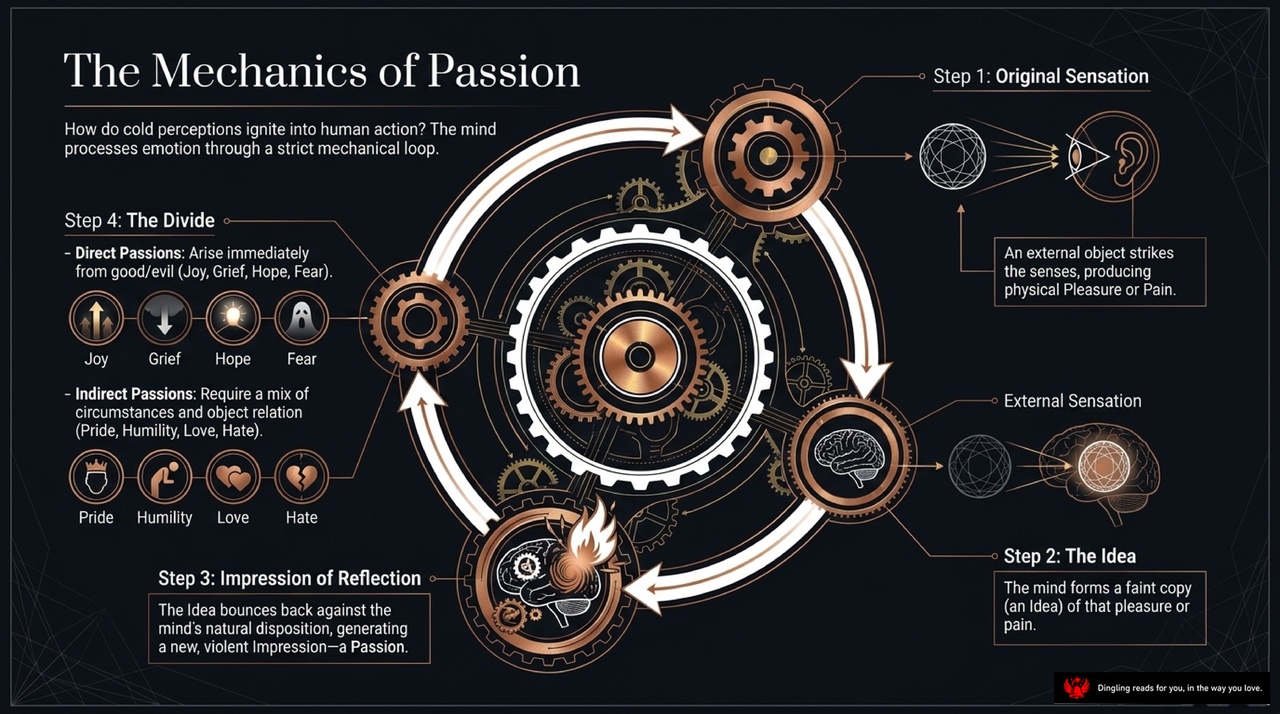
So, how does a cold, distant observation of the world actually ignite into the burning heat of human action? The answer lies in a strict mechanical loop that our minds run every single second. Think of it as a gear system. It all starts with **Step 1: Original Sensation**. When an external object strikes your senses, you don't just register data; you feel a physical pulse of pleasure or pain. That raw hit is the spark.
But the engine doesn't stop there. In **Step 2: The Idea**, your mind instantly creates a faint copy of that sensation. It's like a ghost of the original feeling, bouncing around your thoughts. Then comes the crucial engine: **Step 3: Impression of Reflection**. Here, that idea bounces back against your mind's natural disposition, generating a new, violent impression. That is where the gear shifts into high gear, turning a simple idea into a full-blown Passion.
Finally, we hit **Step 4: The Divide**. This is where the system sorts the fuel. On one side, you have **Direct Passions**. These are immediate and raw, arising straight from good or evil. They are the basic emotions: Joy, Grief, Hope, and Fear. No complex thinking needed, just a direct reaction to the world. On the other side, you have **Indirect Passions**. These require a mix of circumstances and object relations. They are more complex, built on things like Pride, Humility, Love, and Hate. While the direct ones are simple reactions, the indirect ones are the result of our mind weaving together ideas, circumstances, and our own self-image to create those deeper, driving forces that actually move us through life.

Imagine your emotions not as random storms, but as a precise, four-quadrant map. David Hume gives us exactly that: "The Geometry of Human Emotion." He constructs a brilliant, almost mathematical matrix to show how our indirect passions work based on two simple variables: who is involved, and how it feels.
On the vertical axis, we have the sensation itself—either pleasure or pain. On the horizontal axis, we have the object of our focus: either "The Self" or "The Other."
When pleasure hits the Self, we get Pride. This is triggered when an agreeable object—like wealth, beauty, or virtue—is directly linked to our own identity. It's the feeling of saying, "That is me." Conversely, when pleasure hits The Other, we experience Love or Esteem. This is directed outward; we feel joy because agreeable qualities like talent or power belong to someone else.
Now, flip the axis to pain. When pain strikes the Self, we feel Humility. This happens when a disagreeable object or a failure is inextricably linked to who we are. It's the sting of personal failure. Finally, when pain is directed at The Other, we feel Hate or Contempt. This arises when we see disagreeable or painful qualities residing in another person.
So, Hume's geometry reveals that every complex emotion boils down to this simple equation: Is the feeling good or bad, and is the target me or someone else?

Reason is, and ought only to be the slave of the passions. This bold declaration by David Hume flips the script on everything classical philosophy taught us. For centuries, thinkers believed that reason must govern emotion, acting as the master of the human mind. But Hume argues the exact opposite: reason is not the driver of action; it is merely a navigator. Think of it this way—reason can calculate probabilities, deduce mathematical truths, and map out cause and effect, but it can never motivate you to move. You only act because you desire a specific outcome, like pleasure, or fear another, like pain. Passion is the only real engine. Logic cannot fight a passion; the only way to overcome one passion is with a stronger one. So, while reason serves and obeys our emotions, guiding us on the journey, it is the passions that actually make the car move.

Have you ever tried to mathematically prove that a crime is wrong? You'll find it impossible. David Hume argues that morality isn't something we judge with cold logic; it's something we feel. It's a "secondary quality," much like color, sound, or heat. These things don't exist in the universe itself; they exist only in our human perception of pleasure and pain.
Consider the famous "Oak Tree Analogy." A sapling grows and eventually destroys its parent tree. The physical cause-and-effect is identical to a child murdering a parent. Yet, we only call the human act a crime. Why? Because the tree doesn't feel guilt. Morality is not a fact of the world; it's a sentiment in our hearts.
When we look at the "Moral Sense," we see that the crime itself doesn't exist in the objective facts of the murder. You only find the vice when you turn your reflection inward and feel a deep sentiment of disapproval. Hume believes that virtue brings us pleasure, while vice brings us pain. This emotional response is the very origin of our moral judgments.

Sympathy: The Mirror of the Mind. If morality is based on subjective feeling, why isn't it entirely random? The answer lies in the psychological mechanism of sympathy.
Imagine this network of connected nodes. It represents how our minds actually work. When we observe an emotion in another person—like seeing tears of grief—we don't just intellectually understand their pain; our mind forms an idea of it, and because all humans share a similar mental architecture, that idea transforms into a vivid impression. We literally feel their pain. This is the mechanism of emotional contagion.
Sympathy is the gravity of the social world. It pulls us out of our isolated selves, allowing us to agree on moral standards by sharing the pleasure of virtue and the pain of vice. Without this ability to mirror each other's feelings, morality would be just a collection of random, disconnected opinions. But because we can transmit and share our internal states, we build a shared moral reality.

Not all good deeds come from the same place. David Hume makes a crucial distinction that changes how we see human virtue: he splits it into two camps—Natural Virtues and Artificial Virtues. On the left, you see Natural Virtues like benevolence, meekness, generosity, and charity. These spring from our biological instincts and natural sympathies. Every single act of kindness feels good on its own, regardless of society, though their scope is naturally limited to family and close friends.
Now look to the right at Artificial Virtues: justice, property, and fidelity to promises. These aren't innate; they are entirely created by human convention and agreement. Here's the twist: a single act of justice might seem useless or even harmful in isolation, but as part of a rigid system, it saves society as a whole. These virtues have universal scope because they were engineered to fix the natural deficiencies of our limited generosity. In short, while natural virtues flow from our heart, artificial virtues are the clever structures we built to keep our society from collapsing.

Justice isn't a cosmic law written in the stars; it's a brilliant, artificial tool we engineered to solve a very specific crisis. Look at the equation on the slide: human selfishness plus limited generosity, combined with the scarcity of resources, creates a constant state of conflict. Nature gave us infinite desires but only finite goods. Without a solution, society would simply collapse into a war for unstable property.
So, how did we survive? We forged a new convention: Justice. To stabilize our possessions, we mutually agreed to respect Property and Promises. But here is the crucial twist—we don't do this out of some abstract, cosmic goodness. We do it out of enlightened self-interest. By agreeing to these rules, we create a stable environment where everyone can actually enjoy their own property. Justice is the invention that turns our natural chaos into social order.

Imagine a spiral diagram where the center is labeled "Self & Family," expanding outward to "Society & Justice," and finally to "Government & Law." This visual perfectly captures the core argument of today's slide: we create government not because we are naturally good, but because we are fundamentally flawed.
The slide introduces a concept called "The Distance Defect." It argues that human imagination is deeply flawed because we consistently prioritize short-term, immediate temptations over long-term, abstract public goods. We are wired to care about ourselves and our families first. But when we expand our view to society, the emotional connection weakens, and our selfish impulses take over. We would naturally break the rules if we could get away with it.
So, how do we solve this? The slide proposes "The Artificial Magistrate." Since we cannot change human nature, we must change our circumstances. We invent government—a machine designed to force our short-term actions to align with our long-term survival. We elect neutral magistrates, kings, and ministers whose immediate personal interest is now tied to executing justice. By making the ruler's success depend on the law, we create a system where it becomes in everyone's self-interest to follow the rules.
Ultimately, as the slide concludes, we invent political obedience not out of moral duty, but to save ourselves from our own psychological biases. We need an external force to override our internal desire for short-term gain, ensuring that our individual interests eventually serve the greater good.

David Hume challenges the idea that our deepest moral convictions are cosmic truths rooted in pure reason. Instead, he reveals a stark but beautiful reality: we are creatures driven by habit, bound by passion, and connected through profound, shared sympathy. In his view, reason is merely the map, while feeling is the engine that actually moves us.
Consider this: if our highest societal laws and moral beliefs are not divine commands, but simply artificial conventions born from human feeling and biological necessity, does that make them fragile illusions? Or does it make them our most brilliant, courageous inventions?
Hume argues that moral distinctions come from our emotions, not our logic. When we observe a character trait, we don't just analyze it; we feel it. Virtue brings us pleasure and sparks pride or love, while vice causes pain and triggers disgust. But here is the key mechanism that binds us all together: sympathy. It is the invisible thread that allows us to transfer our own feelings onto others. We feel the joy of a stranger's success or the pain of a distant stranger's suffering as if they were our own.
This shared emotional capacity is what gives value to both natural virtues, like kindness and courage, and artificial ones, like justice. Justice isn't a natural law of the universe; it's a human invention created to solve our selfishness and ensure social order. We praise it because, through sympathy, we recognize its benefit to society. Even our respect for wealth and power stems from our ability to imagine the happiness those things bring to their owners. Ultimately, Hume teaches us that morality isn't about cold calculation; it's about our capacity to care, to connect, and to feel the world together.