
Addicted to Thinking: Complete Chapter-by-Chapter Summary

Welcome to today's session on "Addicted to Thinking," a concept popularized by Takashi Saito. The core promise here is transformative: we aim to shift deep thinking from a burdensome chore into a joyful, unstoppable habit.
Imagine your mind not as a maze of abstract worries, but as a structured system ready for innovation. True thinking isn't just "worrying" or spinning your wheels in anxiety; it's about producing tangible results. While simple tasks might be automated by AI, complex problem-solving remains uniquely human. Think of it like a driver who constantly scans the road for the optimal route versus one who blindly follows the crowd. The former saves time and money; the latter doesn't.
To master this, you must embrace the joy of thinking. Just as athletes train their bodies, you can train your brain to find pleasure in the process. When you solve a difficult problem or generate a fresh idea, your brain releases beta-endorphins, creating a natural high that makes you eager to think more. History's greatest creators, from Balzac to Dostoevsky, often thrived under pressure, turning their struggles into masterpieces. By adopting this mindset, you don't just work harder; you think deeper, creating a life where curiosity and creativity drive your success every single day.
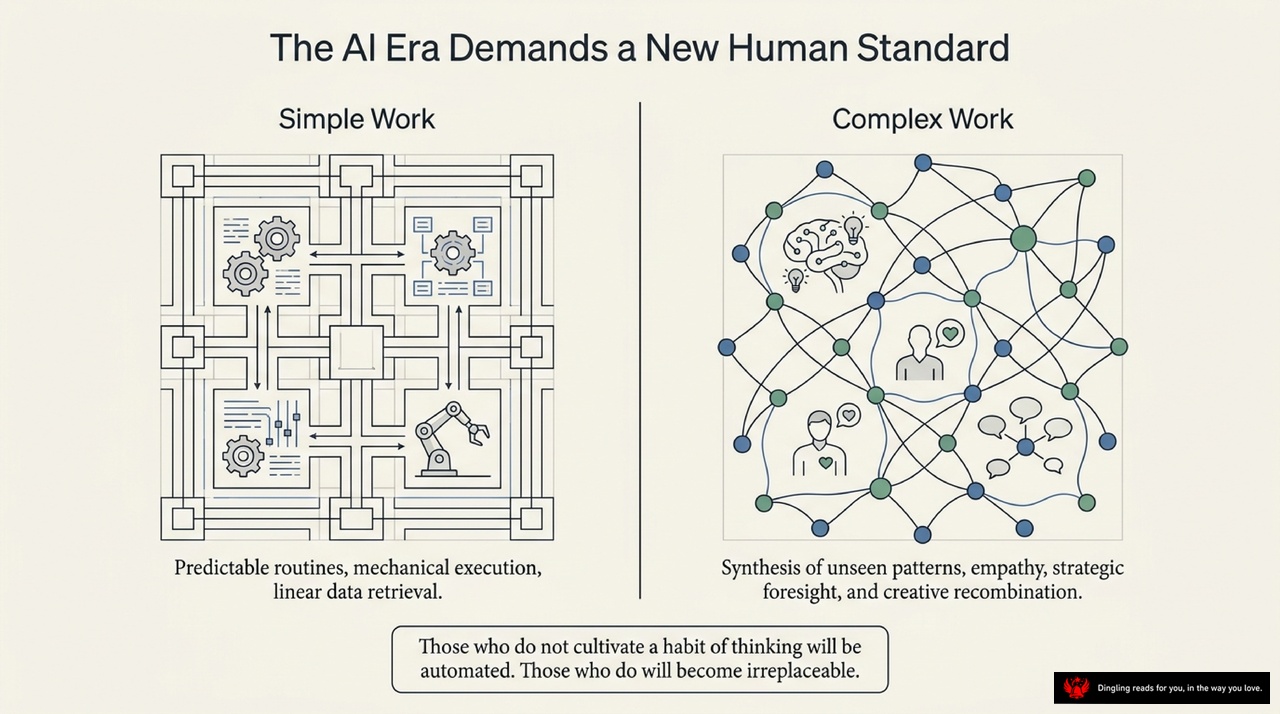
The AI Era Demands a New Human Standard. Look at this split: on the left, we have Simple Work—predictable routines, mechanical execution, and linear data retrieval. This is exactly what automation thrives on. On the right lies Complex Work: synthesizing unseen patterns, practicing empathy, exercising strategic foresight, and engaging in creative recombination. These are the skills that keep us irreplaceable.
Here is the hard truth at the bottom: those who do not cultivate a habit of thinking will be automated. Those who do will become irreplaceable.
Think about it this way: simple tasks are becoming commodities, handled by algorithms and robots. But the ability to connect dots, understand human nuance, and innovate in uncertain situations? That requires a human mind that is actively engaged. If you're just waiting for instructions or repeating what you've seen before, you're building a career that AI can easily replace. But if you are constantly asking "why," challenging the status quo, and weaving together diverse ideas, you are building a career that is uniquely yours.
The future doesn't belong to the fastest calculators; it belongs to the deepest thinkers. Don't let your job become a series of automated tasks. Instead, lean into the complex. Embrace the challenge of creating something new. Because in a world where machines can do everything else, your unique ability to think deeply is your greatest asset.

Have you ever felt trapped in a mental loop, replaying the same worries over and over with zero progress? That's what we call the illusion of thought. On this slide, we're breaking it down into two distinct states: Worrying versus True Thinking.
Look at the left side. Worrying is depicted as a tangled knot, driven by anxiety. It's a circular loop that leaves you emotionally drained with no forward momentum. You're stuck focusing on the past and things you can't control. Science backs this up; brain scans show that worrying actually reduces blood flow to the prefrontal cortex, the part of your brain responsible for planning and decision-making.
Now, look at the right side. This is True Thinking. It's shown as a target with an arrow hitting the bullseye. Unlike worry, true thinking follows a linear progression driven by curiosity. It doesn't just consume energy; it generates it, leading to actionable output. The key difference? True thinking focuses on solutions and the future. It requires active, structured engagement rather than passive rumination.
The takeaway is clear: stop letting your brain run in circles, and start aiming for the target.

Think of your brain not as a passive receiver, but as a high-performance engine that runs on a specific fuel: the endorphin flywheel. This cycle transforms the struggle of deep thought into pure, addictive joy. It all starts with a **Challenge**—confronting a complex problem or constraint that pushes your limits. From there, you enter a state of **Deep Thought**, engaging in structured focus to navigate the difficulty.
When you finally achieve a **Breakthrough**, landing on a novel insight or solution, your brain releases beta-endorphins. These are incredibly potent, scientifically proven to be 6.5 times more powerful than morphine. This biological reward triggers a sense of **Addiction**, where thinking itself becomes pure joy. Unlike the frustration of struggling without results, this cycle creates a self-sustaining loop where the act of thinking becomes as compelling as any other habit. Once formed, this flywheel means you don't just think to solve problems; you think because it feels good, driving you to tackle the next challenge with even greater intensity.

Building Cognitive Endurance isn't just about thinking harder; it's about training your brain like a muscle. Imagine your mind as an athlete: you don't start with a marathon; you start with a sprint. That's exactly what the first step, "The 15-Second Rule," is all about. It's a simple but powerful drill: speak or write your raw thoughts on any subject for exactly 15 seconds without stopping. This builds that initial cognitive muscle, getting you used to the flow of ideas before they even form.
Once you've got that momentum, take it to the next level with "The 30-Minute Sprint." This is where you really work. Carry a Thinking Notebook and dedicate blocks of 30 minutes in ambient environments—like a quiet coffee shop or a park bench—to record the trace of your thoughts. Crucially, don't just make a to-do list; dig deep into the ideas themselves. This dedicated time allows your brain to focus intensely, turning scattered thoughts into structured insights.
Finally, unlock the power of "The Unconscious Catalyst." By physically writing your thoughts down, you aren't just recording them; you're assigning a specific task to your subconscious mind. Once you step away, your brain doesn't stop working. It continues to solve these problems even while you sleep, often bringing back brilliant solutions when you wake up. This three-step process—starting small, sprinting deep, and letting your subconscious take over—transforms how you approach challenges, turning passive worrying into active, creative problem-solving.

Active Consumption: The 3-Color Framework. Imagine your reading process not as passively absorbing information, but as actively sculpting it with three distinct colors. Think of the book in front of you as a canvas where you apply these layers to transform raw text into your own knowledge.
First, grab your red pen. This is for "The Core." These are the purely objective facts—the absolute non-negotiables. You are looking for the author's central thesis, the single most critical piece of information that holds the entire argument together. Be ruthless here; use sparingly. If you can't explain the book's main point using only red highlights, you haven't found the core.
Next, switch to blue. This marks "The Structure." These points are objective but secondary. They are the supporting data, the summaries, and the logical scaffolding that holds up your red core. Without the blue structure, your red core has nothing to stand on. It's the difference between a headline and the evidence that proves it.
Finally, reach for the green pen. This is where "The Spark" lives, and it is purely subjective. This is where your original thinking begins. It's the wild connections you make, the ideas that fascinate you personally, and the inspiration that jumps out specifically for you. Reading without a pen is passive; the green pen is where you stop being a consumer and start being a creator. By layering these three colors, you move from simply reading words to building a framework of understanding that is uniquely yours.
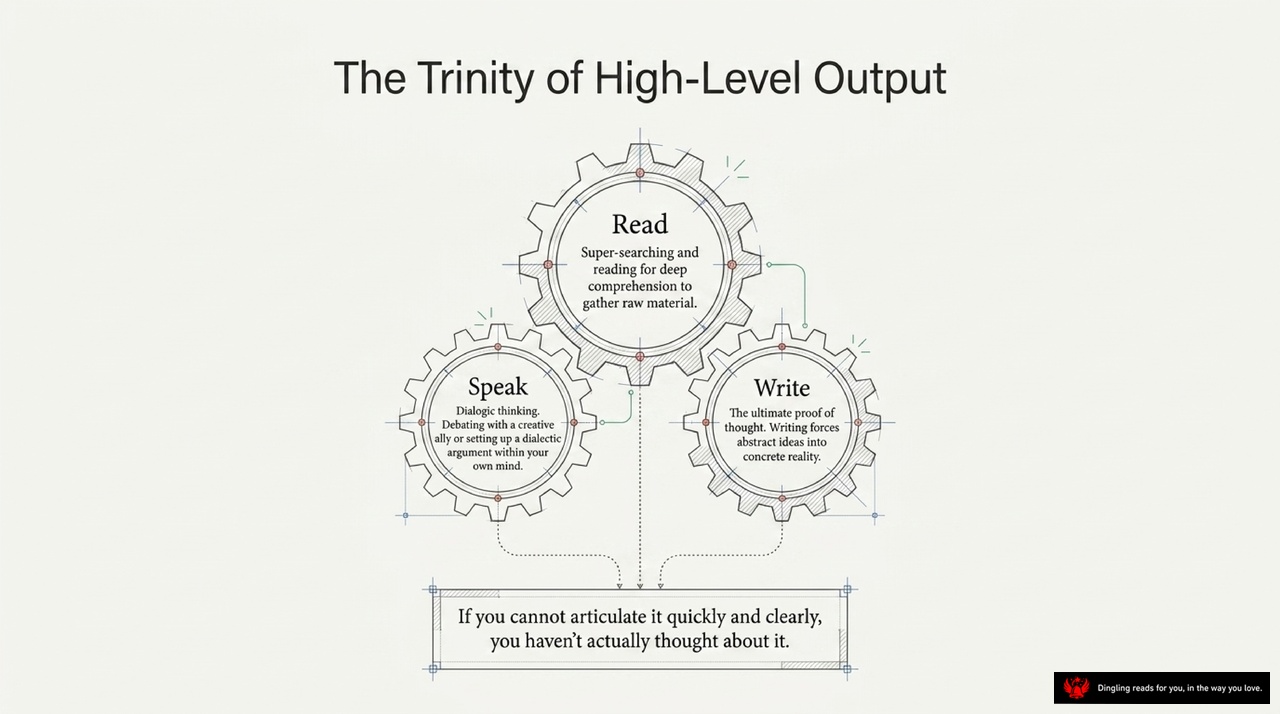
Think of high-level output not as a solo act, but as a perfectly synchronized machine. Imagine three interlocking gears, each driving the other. The first gear is **Read**. It's about super-searching and diving deep into materials to gather the raw fuel for your ideas. Without this input, your engine runs dry.
But reading alone isn't enough. That's where the second gear, **Speak**, comes in. This is about dialogic thinking—debating with a creative ally or arguing with yourself to sharpen your thoughts. It forces abstract ideas to collide and evolve.
Finally, the third gear is **Write**. This is the ultimate proof of thought. Writing forces your fuzzy, abstract concepts into concrete reality. If you can't articulate an idea quickly and clearly, you haven't actually thought about it yet.
When these three gears—Read, Speak, and Write—mesh together seamlessly, they create the trinity of high-level output. It's the only way to turn raw information into true innovation.

Think deeply at 100% capacity all day? That's a myth. Breakthroughs actually happen at the intersection of extreme focus and complete surrender. This is the architecture of flow, a rhythm we need to master to unlock our true potential.
Look at this cycle. On one side, we have High Tension. These are the moments of artificial constraints—hard deadlines, public speaking, or the pressure of a one-minute pitch. It's the peak where stress spikes. But you can't stay there forever. If you do, you burn out.
So, the smart move is to deliberately drop into Deep Relaxation. Think coffee shops, saunas, or simply stepping away to activate your parasympathetic nervous system. This isn't just about doing nothing; it's about physical detachment from the pressure. It's the necessary reset button.
The magic happens when you oscillate between these two states. You push yourself to the limit, then you surrender completely to rest. It's in that valley of deep relaxation that your brain processes the chaos from the peak, turning raw stress into innovative insights. You cannot think deeply at maximum capacity all day. To create something truly great, you must learn to swing between the tension of the challenge and the freedom of total surrender.

Look at this image. It's a glass of whiskey with ice, but instead of just sitting there, a pair of sunglasses is suspended right over it, as if it's the only thing holding the drink together. The title above says "Shattering Preconceptions." This visual perfectly captures the core idea of this chapter: we often wear invisible "sunglasses" of our own making. These are our biases, our common sense, and our deep-seated prejudices. They filter our reality, making us stop looking when we assume we already know what something is.
Think about it. Why do we insist that a meeting *must* happen in a boardroom? Why do we believe that a good leader must have a specific look or style? We stop observing because we're trapped behind these preconceptions. The text tells us that true thinking requires us to strip away the obvious and see the world as if for the very first time. It's about phenomenological observation—looking at the whiskey not as "drinks," but as a mixture of liquid, ice, and light, without letting our assumptions dictate what we see.
In a fast-paced world where AI is taking over routine tasks, the ability to break these mental barriers is more critical than ever. While machines can handle simple, repetitive work, humans thrive on complex problems that require us to question the status quo. As the book suggests, we need to actively reject the "common sense" that holds us back. Whether it's rethinking how we work, how we communicate, or how we solve problems, the goal is always the same: take off those sunglasses. By daring to see things differently, we unlock the original essence of any situation and find creative solutions that no one else could have imagined. That is the power of shattering preconceptions.

Have you ever wondered how groundbreaking innovations actually happen? Do we need to invent everything from scratch? The answer is a resounding no. Today, we're unlocking the secret formula for creativity, and it's surprisingly simple: The Algebra of Creativity.
Think of it like this: $y = f(x)$. Here, $x$ represents an existing concept—something that already exists in our world. $y$ is the breakthrough innovation you're aiming for. But what transforms the old into the new? That's $f$, a transformative function. You don't need to create something from nothing; you just need to apply a new function to an old variable.
Let's look at a real-world case study to make this concrete. Take the humble act of singing in front of strangers. That's our $x$. On its own, it can be intimidating and awkward. But what if we apply a specific function? Imagine we use "Box-ification"—the function of isolating the experience in a private booth. Suddenly, that scary activity transforms into $y$: The Karaoke Box. It becomes a massive cultural phenomenon, a safe space for everyone to express themselves.
This logic applies everywhere. Whether you're trying to improve a product, streamline a workflow, or spark a new trend, ask yourself: What is my existing concept, and what new function can I apply to it? By mastering this algebra, you stop chasing the impossible and start engineering the extraordinary.

Imagine a funnel overflowing with infinite choices. Without any pressure, the ideas just scatter and get lost. But look at what happens when we clamp down on that funnel with a "constraint." Suddenly, the chaos transforms into a focused stream of innovation.
The core concept here is simple yet powerful: infinite resources actually kill creativity. When we have everything we need, our brains stop working hard. It's only when strict rules force us to invent brilliant workarounds that true brilliance emerges.
Think about sports. Soccer forces brilliance simply because you cannot use your hands. Or consider storytelling; a hero is only compelling if they have a fatal flaw. In business, a "zero budget" isn't a dead end; it's the ultimate creative brief.
So, what is the action? Stop waiting for perfect conditions. Introduce artificial constraints to your mundane tasks to force innovation. By limiting your choices, you don't restrict your potential; you unlock it.

When you feel stuck, the best way to break through isn't to push harder in the same direction; it's to change the game entirely. Imagine a simple, powerful question: "What if...?" This isn't just a casual thought; it is the ultimate catalyst for your mind.
Let's play with this question. Ask yourself, "What if this product entirely disappeared from the world?" Suddenly, you're forced to rethink your entire business model. Or try shifting your physical perspective: "What if I became a deep-sea fish?" By altering your viewpoint, you see problems from angles you never noticed before. You could also ask, "What if we applied a totally unrelated industry's standard to this?" Maybe the way a restaurant manages freshness could revolutionize your supply chain.
The core principle here is simple but profound: when you are stuck, alter one fundamental reality of your situation to bypass mental blocks. Don't just stare at the wall; imagine the wall doesn't exist. As the slide reminds us, imagination is the highest form of thought. Allow your mind to play. By daring to imagine scenarios that don't exist yet, you unlock the creative solutions that waiting and worrying never could.

Welcome to the anatomy of a thinking addiction. Think of it not as a four-step process, but as a self-sustaining engine that drives high-level innovation and deep joy. At the very center lies the core reward: the profound satisfaction of creating something new.
It all starts with the **Trigger**. This is where unrelenting curiosity meets self-imposed constraints. It's the moment you decide to stop accepting the status quo and challenge yourself with a specific problem. Without this spark, the rest of the cycle never ignites.
Once triggered, you move to **Capture**. Here, you grab your "Thinking Notebook" and your three-color pens. This isn't just about taking notes; it's about externalizing your thoughts so they don't fade away. You're documenting the raw material of your mind before it escapes.
Next is the **Incubate** phase. This is where the magic happens in the background. You engage in "30-minute tension sprints" to push your brain, followed by periods of ambient relaxation. It's in these quiet moments that your subconscious connects the dots, turning scattered ideas into coherent insights.
Finally, you reach **Output**. This is where you make your thinking visible and useful. Whether through writing, dialogic speaking, or applying a "y=f(x)" recombination method, you transform abstract thoughts into tangible results. This output then feeds back into your curiosity, triggering the cycle again.
When you master this loop, thinking stops being a chore and becomes an addiction—a healthy, rewarding habit that fuels your creativity every single day.

True thinking isn't a burden; it's the ultimate source of human joy, a defense against obsolescence, and the engine of all innovation. When you learn to capture your thoughts, balance your mental tension, and playfully recombine ideas, thinking becomes an exhilarating addiction.
In a world engineered to command your attention and automate your routines, will you let machines do your living, or will you dare to think for yourself?