
Adventures of a Bystander: Complete Chapter-by-Chapter Summary

Welcome to today's session on "The Spectator," a profound exploration by the legendary Peter Drucker. In this book, Drucker challenges us to rethink our role in the world. He argues that while many people stand on the stage of history, believing they are actors or even the audience, the true power lies with the "spectator." These are the quiet observers positioned on the side, like firefighters backstage who can see the entire stage without being seen. Unlike the crowd whose reactions are merely a reflection of the performance, the spectator's thinking acts like a prism, refracting light to reveal the essential nature of things from a completely new angle.
Drucker shares that this unique perspective wasn't just an intellectual choice but a personal awakening. He recalls a pivotal moment at age 14 in Vienna during a republican parade. While marching at the front with a red flag, he felt a strange sense of isolation amidst the celebration. Watching the crowd from the side, he realized he didn't belong to the group; he was a spectator. This realization, rooted in his childhood experiences during wartime Vienna, became the foundation of his entire life's work. He understood that by observing the world objectively, one could gain insights that active participants often miss. This book is not a biography or a history of the era, but a collection of key concepts and insights derived from this unique vantage point.
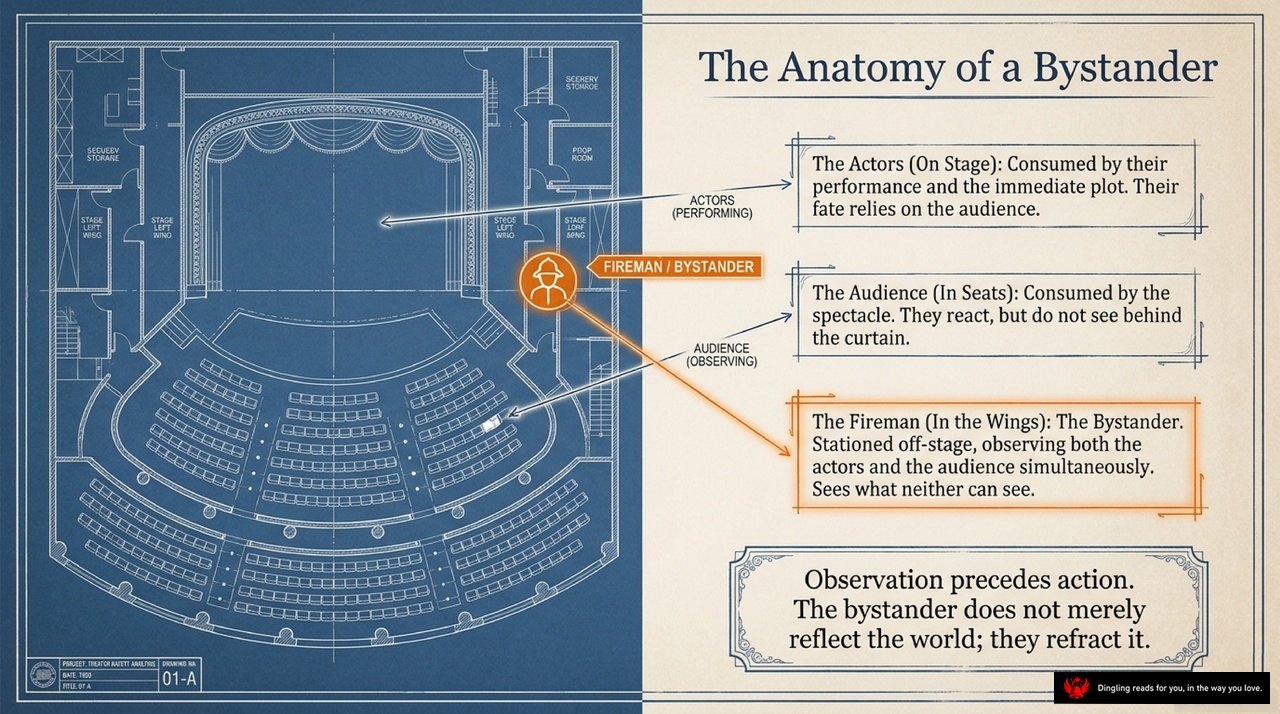
Look at this blueprint of a theater. It maps out the hidden roles that make the show work. We have the actors on stage, consumed by their performance, and the audience in the seats, lost in the spectacle. But look at the wings, right off to the side. That's where the real observer lives: the Fireman or the Bystander.
Unlike the actors or the audience, the bystander sees everything simultaneously. They watch the performance without being blinded by it, and they watch the audience without getting swept up in their reaction. They see what neither group can see alone.
This is the core of my philosophy. Observation precedes action. The bystander does not merely reflect the world like a mirror; they refract it like a prism. They take the raw light of reality and split it into new, clearer colors, allowing us to understand the true nature of things.
This wasn't just a theory for me; it was a life lesson learned at age eight. During a Christmas party in wartime Vienna, I defended a restaurant owner who was being falsely accused of price gouging. While everyone else was angry, I saw the truth in the facts. That moment of seeing what others missed defined me as a bystander.
So, how do you become a better observer? Don't just watch the surface. Watch the actors and the audience, but also watch how they interact. Look for the patterns, the contradictions, and the truths hidden in plain sight. Just like my grandmother, who could calm a Nazi youth with a polite remark or get four passports in an hour, the power lies in seeing the whole picture, not just your part of it.

Imagine a sea of identical uniforms marching in perfect lockstep, a powerful symbol of conformity that defined the political rallies of Vienna in November 1923. For a 14-year-old Peter Drucker, this scene wasn't just a parade; it was a mirror reflecting a terrifying expectation of total uniformity, a state the Germans would later call "Gleichgeschaltet." But while the crowd moved as one, a single figure broke the pattern. Drucker stepped out of the marching line simply to avoid a puddle on the street. In that split second of disobedience, he didn't just step on wet ground; he shattered the trance of the crowd. Walking home alone, he realized a profound truth: he did not belong to that synchronized mass. This moment of epiphany marked his first conscious choice to be an observer, a silent bystander who sees the stage from the wings rather than playing a role on it. It was the birth of his lifelong philosophy—that true understanding comes not from blending in, but from the courage to stand apart and see the world with fresh, unfiltered eyes.
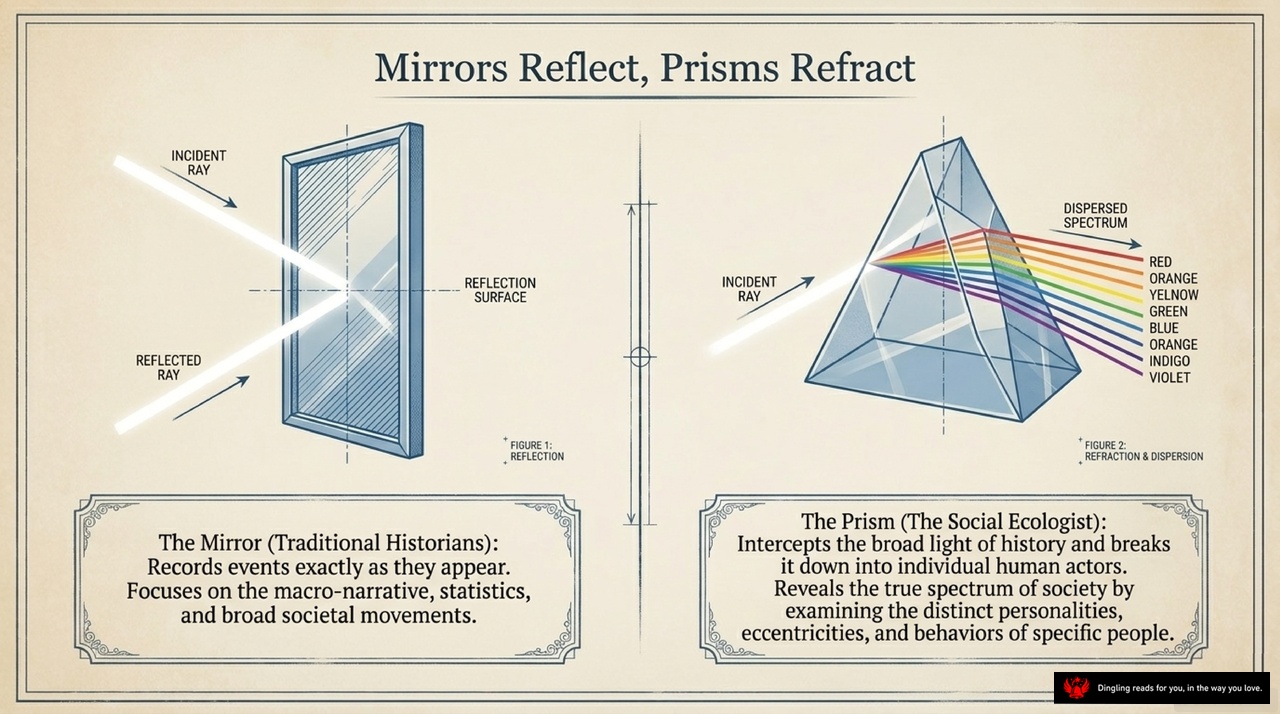
Look at this diagram: "Mirrors Reflect, Prisms Refract." It's a perfect metaphor for how we see the world. A mirror gives us a flat, exact reflection of what's on the surface—just like traditional history that records events as they appear, focusing on big statistics and broad movements. But a prism? A prism intercepts that single beam of light and breaks it down into a full spectrum of colors. That's the role of the social ecologist. Instead of just looking at the macro-narrative, we need to use the prism of individual human actors. We have to look at the distinct personalities, eccentricities, and specific behaviors of real people to reveal the true spectrum of society. As the author notes, while traditional historians act like mirrors, the true observers are more like those firefighters backstage who see what the audience misses. They don't just reflect the stage; they reframe the entire play, showing us the rich, complex, and often hidden details that make up the real story of our lives.

Look at this spectrum of the 20th century. On the far left, we have the "Extreme Left," defined by central control and uniformity. Here, the state dictates identical thought, action, and structure. It's a monolithic block, rigid and unyielding.
Moving to the center, we find the "Middle," which the slide calls "The Myth of the Perfect Society." This represents the utopian pursuit that, as history has shown, repeatedly fails and inevitably collapses back into central control. It's the dangerous belief that a flawless society can be engineered.
Finally, on the far right, stands the "Extreme Right," or what we call "The Tolerable Society." This isn't about chaos, but about resilience. It is decentralized, experimental, and localized. Society is sustained not by a single ruler, but by a multitude of independent, diverse organizations with different structures and goals.
This visual perfectly captures the book's core argument: the middle path of seeking a perfect, centralized utopia is a dead end. The only sustainable future lies in the diversity and decentralization of the right side—a world where many small, adaptable parts work together rather than one giant, brittle whole.

The slide contrasts two very different visions for society: The Polanyi Pursuit, aiming for a perfect, frictionless world, and Drucker's Pragmatism, which accepts a tolerable but free society. Polanyi believed that to create a truly just society, we must take land and labor out of the market, treating them as social goods rather than commodities. He sought a realm of intellectual purity and absolute harmony, rejecting the harsh realities of capitalism and communism alike. However, history proved this path leads to disillusionment, often relying on coercion or slavery to force that impossible utopia.
In contrast, Drucker's approach embraces the "tolerable society." It acknowledges that friction, market alienation, and imperfection are the necessary price for individual liberty. Instead of chasing a grand, unattainable utopian good, we choose the lesser evil of a pluralistic society of diverse organizations. This isn't about giving up on morality; it's about recognizing that a free world is messy, complex, and far more resilient than a perfectly engineered one. True wisdom lies not in eradicating all evil, but in navigating the trade-offs that make freedom possible.
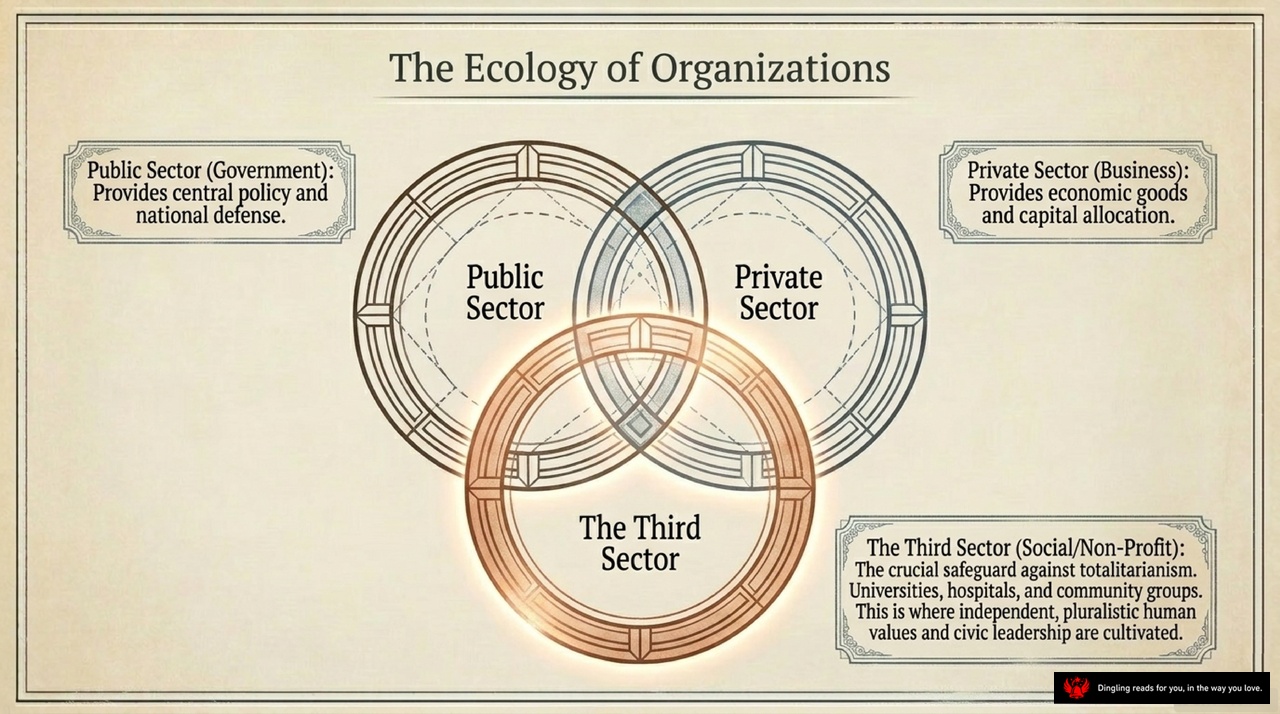
This slide maps out what we call "The Ecology of Organizations," a framework that reveals how the modern world actually functions. It's not just about business; it's about the dynamic tension between three distinct sectors. On the left, we have the **Public Sector**, or government. Its primary role is straightforward: providing central policy and national defense. It sets the rules and ensures security, creating the stage upon which society operates.
Opposite that, on the right, sits the **Private Sector**, or business. Here, the focus shifts to economics. This is the engine of resource allocation, responsible for producing goods and services while driving capital flow. It's the realm of efficiency and profit, where innovation often takes root.
But the most fascinating part of this diagram is the glowing circle at the bottom: **The Third Sector**. This represents the social and non-profit world—universities, hospitals, and community groups. The text on the slide calls this the "crucial safeguard against totalitarianism." Why? Because this is the independent space where pluralistic human values and civic leadership are cultivated. While the government controls the rules and the private sector controls the money, the Third Sector controls the culture and the conscience of society.
When we look at these three overlapping circles, we see that a healthy society needs all three. If you remove the Third Sector, you lose the check on power and the incubator for new ideas. If you remove the Private Sector, you lose the engine of progress. If you remove the Public Sector, you lose the foundation of order. This triad is the true ecology of our organizations, balancing control, profit, and purpose to keep society alive and evolving.

Community is built on individuals, not abstractions. Look at this image: on the left, we see a grandmother connecting with specific people like Olga and Paula, forging a real community through acute attention to their unique lives. On the right, we see the opposite—a rigid hierarchy reducing everyone to faceless boxes labeled "The Masses." This visual perfectly captures the core danger of Nazi ideology, which viewed people merely as abstract proletarian tenants requiring standardized, bureaucratic solutions. It completely disregarded individual dignity, treating human beings as interchangeable parts in a machine.
But the grandmother's practice offers the antidote. True community is forged only when we see the person, not the category. As the slide reminds us, disrespecting individual uniqueness is the first step toward the gas chamber. We saw this in history when a simple act of kindness, like a grandmother using an umbrella to correct a rude waitress or defending a restaurant owner against false accusations, could dismantle hate. In contrast, those who chose silence or indifference became complicit in evil. The lesson for leadership today is clear: effective management begins with seeing the person, not the category. When we treat people as unique individuals rather than abstract masses, we build a society that is not only more humane but also more resilient against the forces of tyranny.

Have you ever assumed your customers are acting irrationally when they simply refuse to buy what you've built? That is the Merchant's Fallacy. It's the belief that the problem lies with the customer, when in reality, the issue is often with the merchant's own blind spots.
As the diagram illustrates, this myth begins with a Merchant Assumption, often triggered by internal chaos like misassembled umbrellas or button inventories. When a company pushes a product nobody wants, they label the customer irrational. But look at the Market Reality on the left: the customer isn't being difficult; they are just being rational. They are buying for themselves, not for the company's agenda.
The solution lies in Uncle Henry's Axiom: there are no irrational customers, only lazy merchants. This leads to a Pragmatic Shift. When behavior doesn't match your expectations, the merchant must walk out of the office and look at the storefront through the customer's eyes. Rationality is defined by the user, not the creator. If you stop trying to dictate the market and start listening to it, you stop chasing ghosts and start building value.

Imagine a machine where every gear is perfectly aligned, a system so flawless that even the youngest, most foolish clerk in the office cannot understand it. In such a "perfectly aligned system," a fraudster can present a scheme where every question receives an unnaturally perfect answer. But here lies the ultimate stress test: if the plan is so perfect that no one can grasp it, the plan will inevitably fail.
This is the core of what we call "Accounting for the Fools in the System." The principle is simple yet profound: every system must be designed assuming it will ultimately be executed by fools. We cannot ignore human fallibility; instead, our systems must accommodate it. Real human endeavor is inherently messy, and honest men don't always look like the polished characters in our diagrams. If we build a system that relies on perfect logic and zero errors, we are building a trap for ourselves.
True resilience comes from designing for the "pebble" in the gears—the unexpected, the confused, the imperfect human element. By acknowledging that our colleagues, leaders, and even we ourselves are fallible, we create systems that can withstand the chaos of reality rather than shattering under the slightest pressure. A system that works for the fool is the only one that will truly last.

Look at this diagram: "Technology as the Anatomy of Work." It breaks down technology into three distinct pillars: Engineering, Media, and Work. Each represents a different lens through which we've understood technology's role in human life.
First, we have Engineering, labeled as Tools. This perspective belongs to Buckminster Fuller, the Transcendentialist. He saw technology not just as machines, but as an expression of cosmic harmony and geometric perfection. To Fuller, the universe itself was a design waiting to be understood and replicated.
Second, we have Media, labeled as Information. This is Marshall McLuhan's domain, the Media Prophet. He famously argued that the medium is the message. He didn't care so much about what the machine said, but rather how the machine itself changed us. He viewed technology as the extension of our human sensory organs, fundamentally altering how we perceive the world.
Finally, we have Work, labeled as Social Bonds. This view comes from Peter Drucker, the Social Ecologist. He moved beyond the machine or the message entirely. He saw technology as a profound sociological concept that alters human relationships. For Drucker, the assembly line wasn't just a machine; it was a fundamental redesign of how we interact, organize, and live together.
Together, these three pillars show that technology is far more than just tools. It is the very anatomy of our work, shaping our senses, our social structures, and our understanding of the universe itself.

Look at this slide: "The Evolution of the Executive." It maps a dramatic shift in leadership from the "Owner-Boss" to the "Professional Manager." On the left, you see the old guard, like early Henry Ford. Their power came from wealth and ownership, their structure was centralized and dictatorial, and they ruled based on personal whims and direct command. It was a world of the individual hero.
But on the right, we see the new paradigm: the Professional Manager, exemplified by Alfred Sloan at General Motors. Here, power shifts from ownership to competence and objective methodology. The structure moves from dictatorship to federal decentralization, giving autonomous divisions the freedom to operate. The core metric changes entirely from the boss's personal mood to tangible results like market share, defined responsibilities, and institutional longevity.
This transition isn't just about organizational charts; it's about a fundamental change in how we view responsibility. At the bottom, the slide highlights "Sloan's Iron Law": "With power comes responsibility. If you do not want to be responsible, you have no right to the power." This simple truth defined the modern era. It meant that leaders were no longer chosen just because they owned the company, but because they could manage it effectively. It was the moment management became a distinct profession, separating the art of running a business from the privilege of owning it, and laying the groundwork for the complex corporate world we live in today.

Empowering the Unlikely: The Dreystadt Method. Look at this slide. On the left, we see the traditional way of doing things: blueprints, technical manuals, and complex assembly procedures. But for a specific group of workers in WWII Detroit, this approach was a failure. The challenge was building high-precision bombsights with illiterate, marginalized labor—former prostitutes who had been pushed to the edge of society. Standard management logic said they were incapable of such precision.
But Dreystadt saw the problem differently. Instead of relying on written manuals that these workers couldn't read, he discarded the assumption that they needed to be taught like engineers. He practiced true managerial empathy, stepping into their shoes to understand the exact physical constraints of the work. He realized that the barrier wasn't their intelligence, but the complexity of the instructions.
So, he invented a system innovation: a simple visual Red/Green/Yellow light system. Red meant stop, green meant go, yellow meant caution. This allowed ordinary people to achieve extraordinary, highly complex results without needing a degree. The result? Flawless precision output. This proves that management isn't just about controlling people; it's the technology that allows ordinary individuals to reclaim their dignity and achieve the impossible.
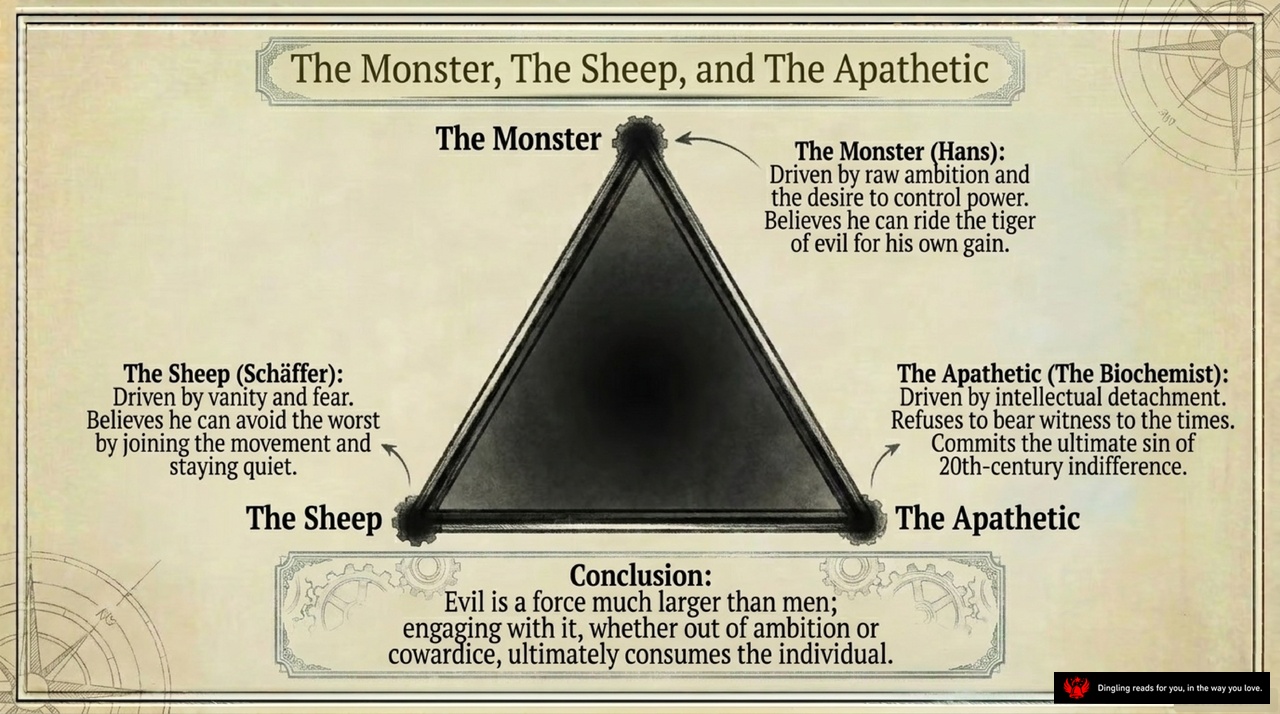
Look at this triangle. It's a stark reminder of the three archetypes of evil that define our darkest times: The Monster, The Sheep, and The Apathetic.
On the top point, we have The Monster, represented by Hans. He is driven by raw ambition and an insatiable desire to control power. He believes he can ride the tiger of evil, using it as a tool for his own gain. He thinks he is the master of the situation.
On the left, we have The Sheep, embodied by Schaffer. His motivation is a mix of vanity and fear. He doesn't want to lead, nor does he want to fight. He believes the smartest move is to join the movement and stay quiet, hoping that by blending in, he can avoid the worst of it.
On the right, we have The Apathetic, represented by The Biochemist. This is perhaps the most dangerous of all. Driven by intellectual detachment, he refuses to bear witness to the times. He commits the ultimate sin of the 20th century: indifference. He chooses to look away, pretending the horror isn't his problem.
The conclusion at the bottom drives the point home: Evil is a force much larger than any single man. Whether you engage with it out of ambition like the Monster, or out of cowardice like the Sheep and the Apathetic, the result is the same. Ultimately, evil consumes the individual. It doesn't matter which corner of the triangle you stand in; the monster always wins.
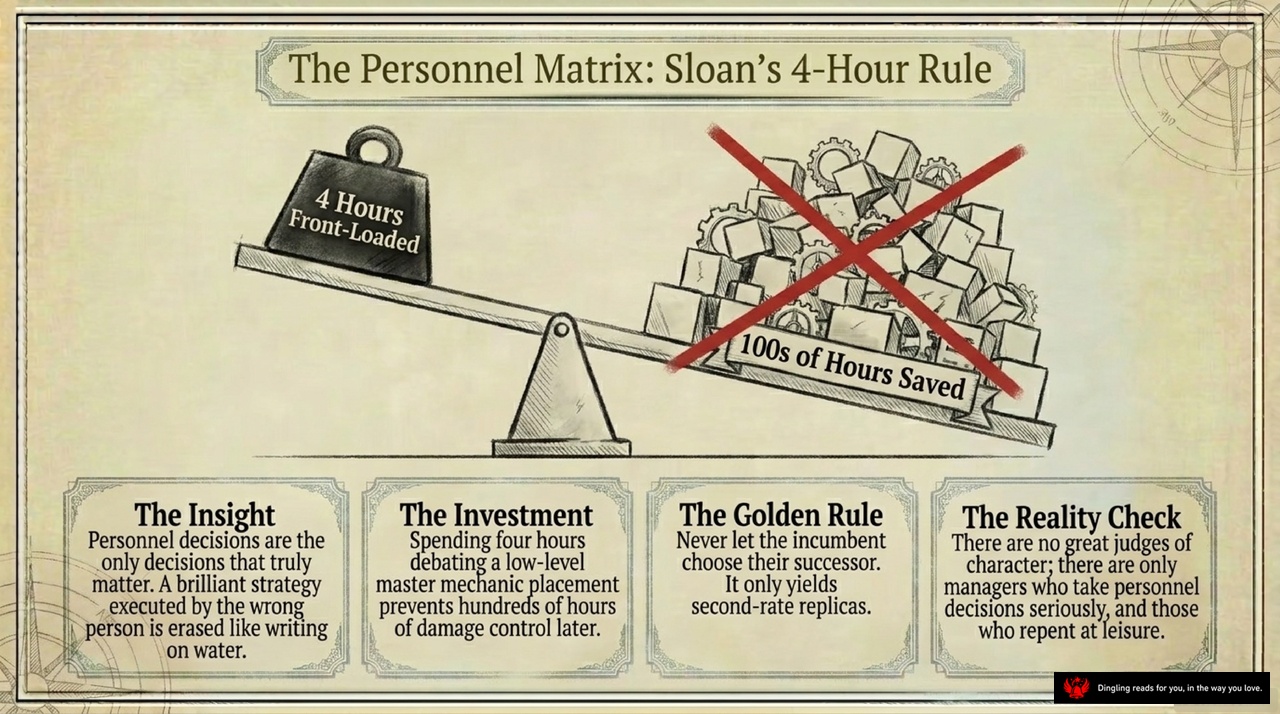
Look at this seesaw. On one side, a single weight labeled "4 Hours Front-Loaded." On the other, a massive pile of gears and blocks marked "100s of Hours Saved," which is crossed out with a big red X. This visual perfectly captures the essence of Alfred Sloan's "4-Hour Rule," a cornerstone of modern management that we often overlook but cannot afford to ignore.
The insight here is profound: personnel decisions are the only decisions that truly matter. As the slide states, a brilliant strategy executed by the wrong person is erased like writing on water. Imagine spending hundreds of hours perfecting a product or a marketing campaign, only to have it fail because the leader in charge simply lacks the vision or the character to steer it correctly. That is a catastrophic waste of resources.
Sloan's Golden Rule is simple yet ruthless: never let the incumbent choose their own successor. If a manager picks their replacement, they will inevitably choose someone who is a second-rate replica of themselves, ensuring mediocrity. Instead, the decision must come from a higher authority, someone who can objectively evaluate the true potential of candidates without the bias of personal loyalty or the fear of disruption.
This is the ultimate investment. Spending just four hours debating the placement of a key leader—perhaps even a low-level master mechanic in a critical role—prevents hundreds of hours of damage control later. It saves the organization from the slow, agonizing decline that comes from bad leadership. The reality check is stark: there are no great judges of character; there are only managers who take personnel decisions seriously and those who treat them as an afterthought.
In a world where talent is abundant but leadership is scarce, the cost of getting the wrong person in the wrong seat is far too high. Don't wait until the crisis hits. Front-load those four hours now, make the hard call, and secure the future of your organization.

Look at this blueprint: it illustrates the genius of federal decentralization, using General Motors as the perfect example. At the center sits "Corporate Policy," acting as the steady anchor, while brands like Chevrolet, Buick, and Cadillac radiate outward as independent units. This structure grants "Local Autonomy," allowing each division to function as its own profit center with total freedom over internal operations and market tactics.
Think of it as combining the best of two worlds. You get the immense resources and stability of a massive enterprise, yet you retain the agility, experimentation, and accountability of a small business. This model was a deliberate safeguard against bureaucratic paralysis. By letting the car brands compete fiercely yet cooperate strategically, GM didn't just survive the Great Depression; it thrived. It proved that a giant corporation could think like a fleet of nimble startups, balancing scale with speed. This is the power of a well-designed organizational structure—turning potential chaos into a powerful engine for innovation and growth.
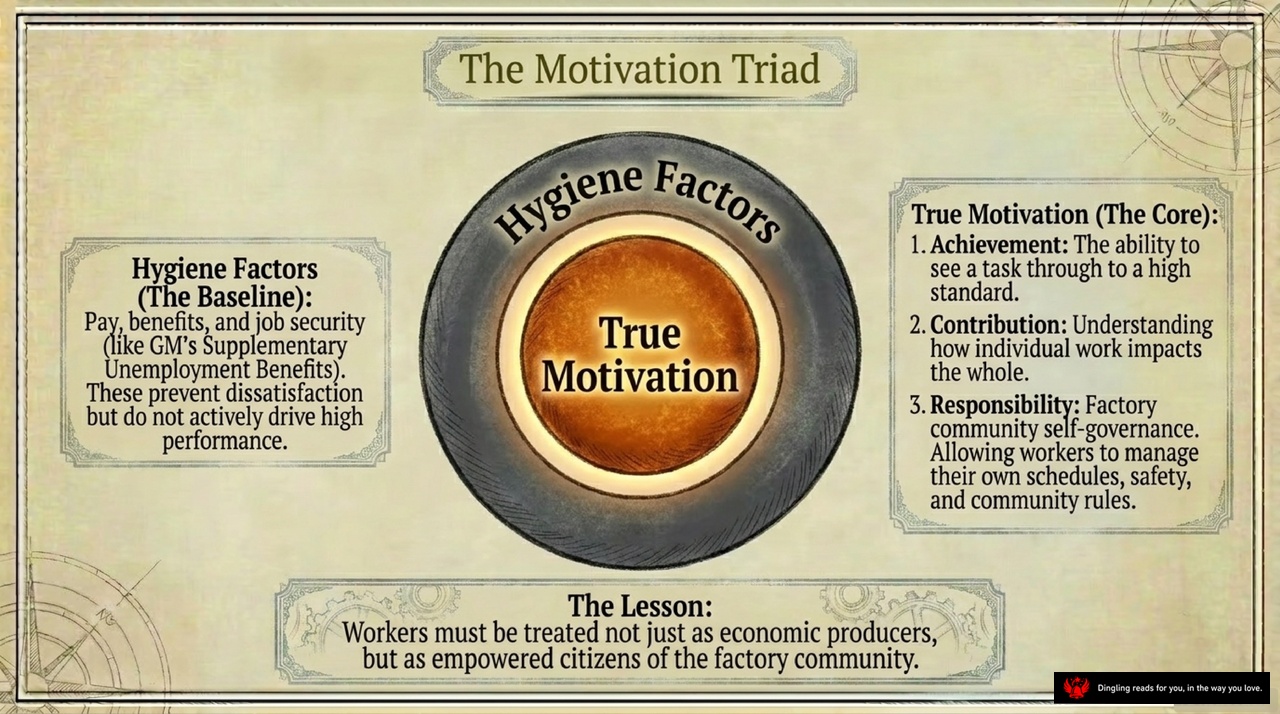
Look at this diagram: The Motivation Triad. It breaks down what actually drives people, separating the baseline from the true engine of performance.
On the left, we have Hygiene Factors—the baseline. Think of pay, benefits, and job security. The slide mentions GM's Supplementary Unemployment Benefits as a prime example. These are essential, but they only prevent dissatisfaction. They keep the lights on; they don't actively drive high performance. Without them, you fail, but with them, you're just neutral.
Now, move to the center and the right, where True Motivation lives. This is the core. It's not about money anymore; it's about the human spirit. First, there's Achievement: the ability to see a task through to a high standard. Second is Contribution: understanding how your individual work impacts the whole. And finally, Responsibility: allowing workers to manage their own schedules, safety, and even community rules, effectively practicing self-governance.
The lesson at the bottom is crucial. Workers must be treated not just as economic producers, but as empowered citizens of the factory community. If you want to unlock that inner drive, you have to stop managing employees and start empowering them.
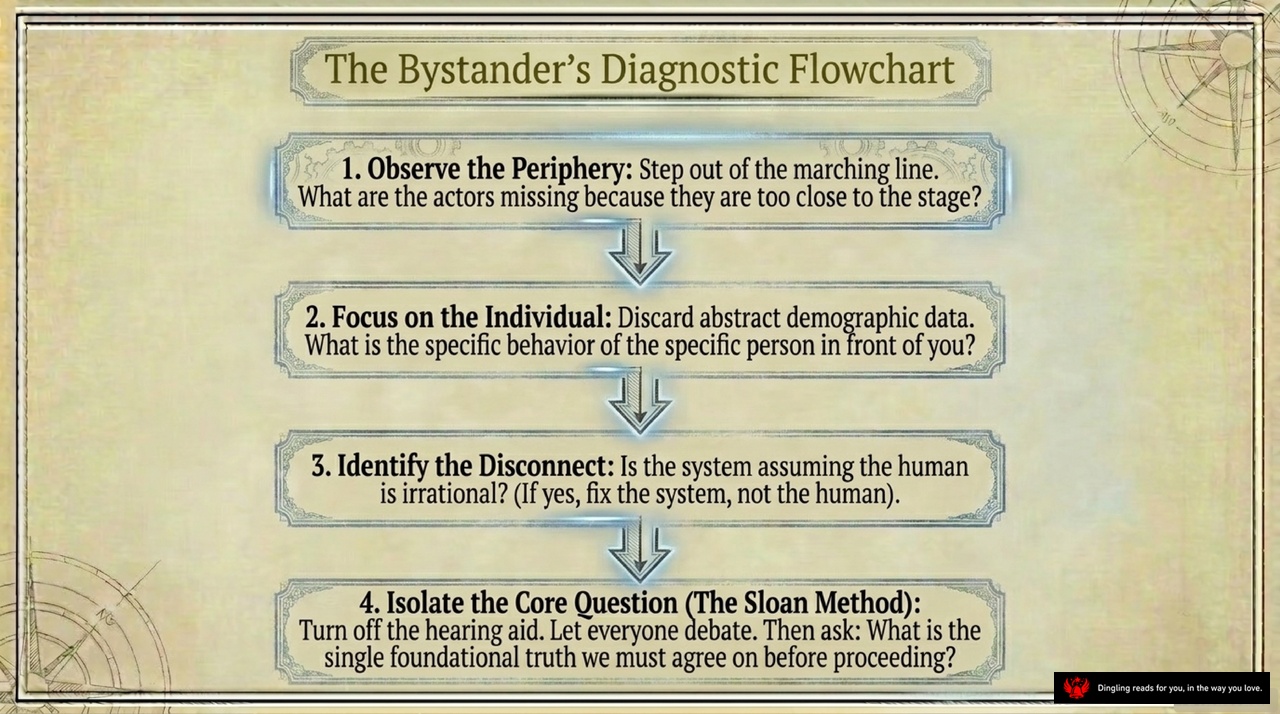
Welcome to the final step of our diagnostic framework: The Sloan Method. This is where we move from gathering data to finding the single, foundational truth that everyone must agree on before we can proceed. Think of it as turning off your hearing aid in a noisy room. When the constant chatter of debate, ego, and conflicting agendas stops, the real signal finally becomes clear.
In this phase, we stop trying to convince others and instead ask the most critical question: What is the one core principle that, if we all agreed on it, would make our disagreement irrelevant? This isn't about finding a compromise or a middle ground; it's about isolating the fundamental truth that underpins the entire problem. As we've seen throughout our journey, whether we were analyzing the complexities of corporate management with Alphonse Sloan, or navigating the moral ambiguities of history, the path forward always starts with a shared reality.
By asking, "What do we absolutely have to agree on?", we strip away the noise of political posturing and personal bias. We force ourselves to look past the symptoms—the arguments, the data points, the emotional reactions—and find the root cause. This is the moment where a chaotic debate transforms into a constructive dialogue. It requires courage to silence the room and ask for that one thing, but it is the only way to ensure that our next steps are built on solid ground rather than shifting sand. This is the essence of true leadership and clear thinking.
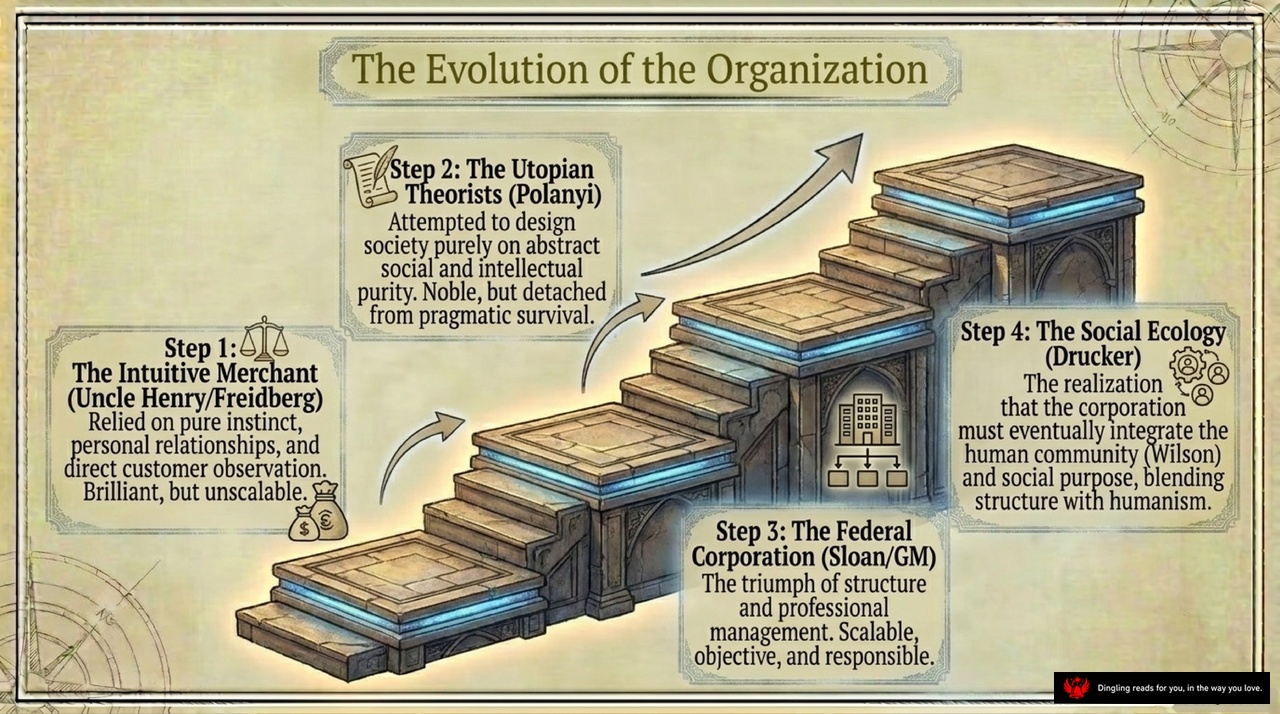
Look at this staircase. It maps the evolution of the organization, moving from the intuitive merchant to the utopian theorist, then to the federal corporation, and finally to social ecology. Let's walk through these steps together.
It all starts with the intuitive merchant, like our Uncle Henry. This was the era of pure instinct, personal relationships, and direct observation. It was brilliant, but fundamentally unscalable. You couldn't build an empire on charm alone.
Then came the utopian theorists, represented by Polanyi. They tried to design society based purely on abstract social and intellectual purity. It was a noble dream, but dangerously detached from the harsh realities of pragmatic survival.
Next, we reach the federal corporation, championed by Sloan and General Motors. This was the triumph of structure and professional management. It was scalable, objective, and responsible. It worked, but it risked losing its human touch.
Finally, we arrive at social ecology, the vision of Drucker. This is the realization that the corporation must eventually integrate the human community. It blends the social purpose of Wilson with humanism, merging rigid structure with genuine humanity.
This isn't just a history lesson; it's a roadmap for how we must evolve. We can't stay in the past, nor can we chase perfect abstractions. We must build organizations that are both efficient and deeply human.
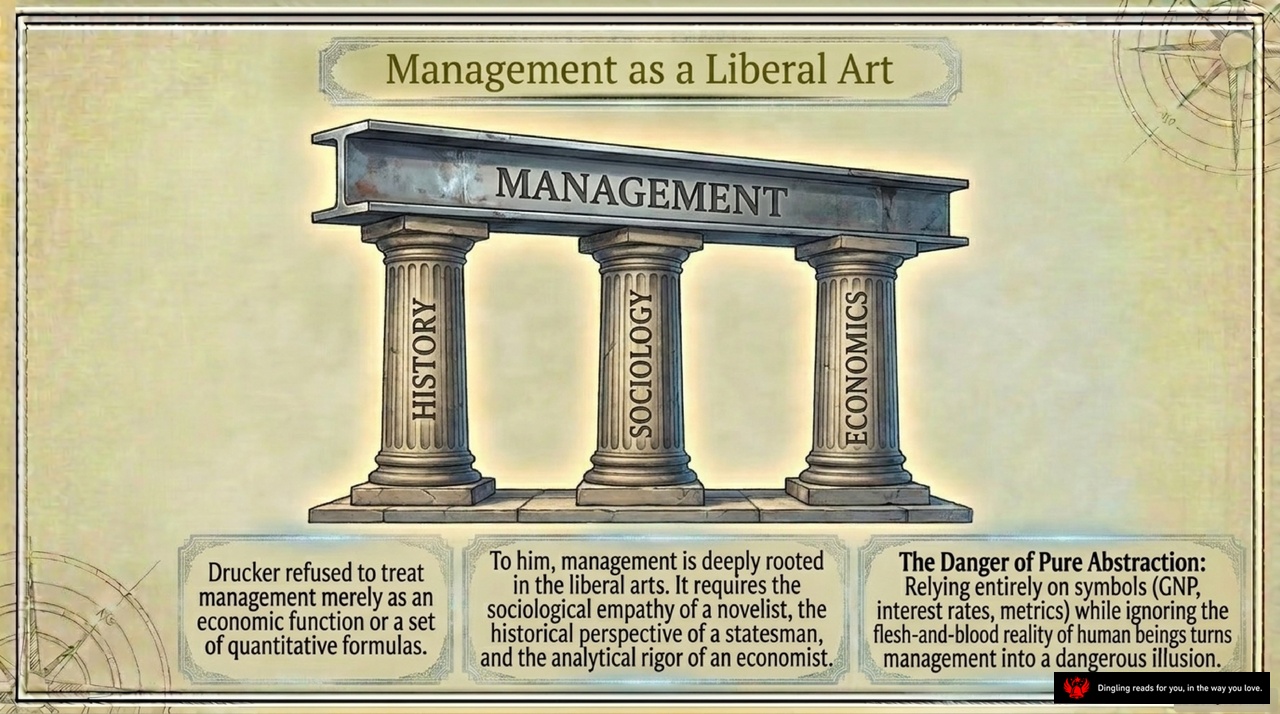
Management is often mistaken for a mere technical skill, a set of formulas to maximize efficiency, but Peter Drucker saw it as something far more profound: a liberal art. As this slide illustrates, true management rests on three pillars: History, Sociology, and Economics. Drucker refused to treat management simply as an economic function or a collection of quantitative metrics. To him, it required the sociological empathy of a novelist to understand human behavior, the historical perspective of a statesman to see long-term trends, and the analytical rigor of an economist to navigate complex systems.
The danger of pure abstraction is real. Relying entirely on symbols like GNP, interest rates, or raw data while ignoring the flesh-and-blood reality of human beings turns management into a dangerous illusion. You cannot manage a company by managing numbers alone; you must manage the people behind them. By integrating these disciplines, Drucker laid the groundwork for modern management theory, proving that effective leadership is deeply rooted in the liberal arts, balancing the hard data of economics with the soft wisdom of history and sociology.

Imagine society not as a monolith, but as a kaleidoscope of individual stories, each with its own unique color and shape. In this complex tapestry, the leader's role isn't to force everyone into a single, uniform mold. Instead, the true leader acts as a prism. Just as a prism takes a single beam of white light and refracts it into a spectrum of vibrant colors, a great leader takes the diverse, varied strengths of different individuals and aligns them toward a shared, tolerable, and free society.
Look at the image: a beam of light labeled "Organizational Structures & Historical Forces" hits the center. This represents the rigid constraints of the past, the established hierarchies, and the weight of history that often tries to dictate how people should behave. But when that light hits the prism of leadership, it doesn't get blocked or distorted. It explodes into a multitude of silhouettes—families, individuals, communities of all kinds—radiating outward in a spectrum of possibility.
The core message here is profound: society is ultimately composed of a multitude of individuals and their stories. The ultimate role of the leader is not to suppress these differences to create an illusion of unity, but to recognize the unique capacities of diverse individuals. By granting them autonomy and creating the right conditions, a leader can transform the raw energy of history and structure into a powerful, inclusive force. This is the enduring light of the prism—turning the limitations of the past into the boundless potential of the future.