
Aesthetic Theory: Complete Chapter-by-Chapter Summary

Welcome to our deep dive into Theodor W. Adorno's *Aesthetic Theory*. Today, we are standing at the entrance of one of the most challenging yet rewarding landscapes in 20th-century philosophy. As this slide introduces us, Adorno offers a profound exploration of how art survives, resists, and reveals truth within the labyrinth of a commodified world.
In a society increasingly dominated by mass culture and industrial logic, where everything is reduced to a product for consumption, Adorno asks a radical question: Can art still be free? He argues that yes, it can, but only by becoming an autonomous entity that stands in critical opposition to the very system that tries to swallow it. This book isn't just about beauty; it is a battle cry for the soul of humanity, revealing how art acts as a sanctuary of truth against the crushing weight of social falsehood. We are about to navigate this complex terrain together, uncovering how Adorno redefines the purpose of art not as decoration, but as a necessary, painful, and vital form of resistance.
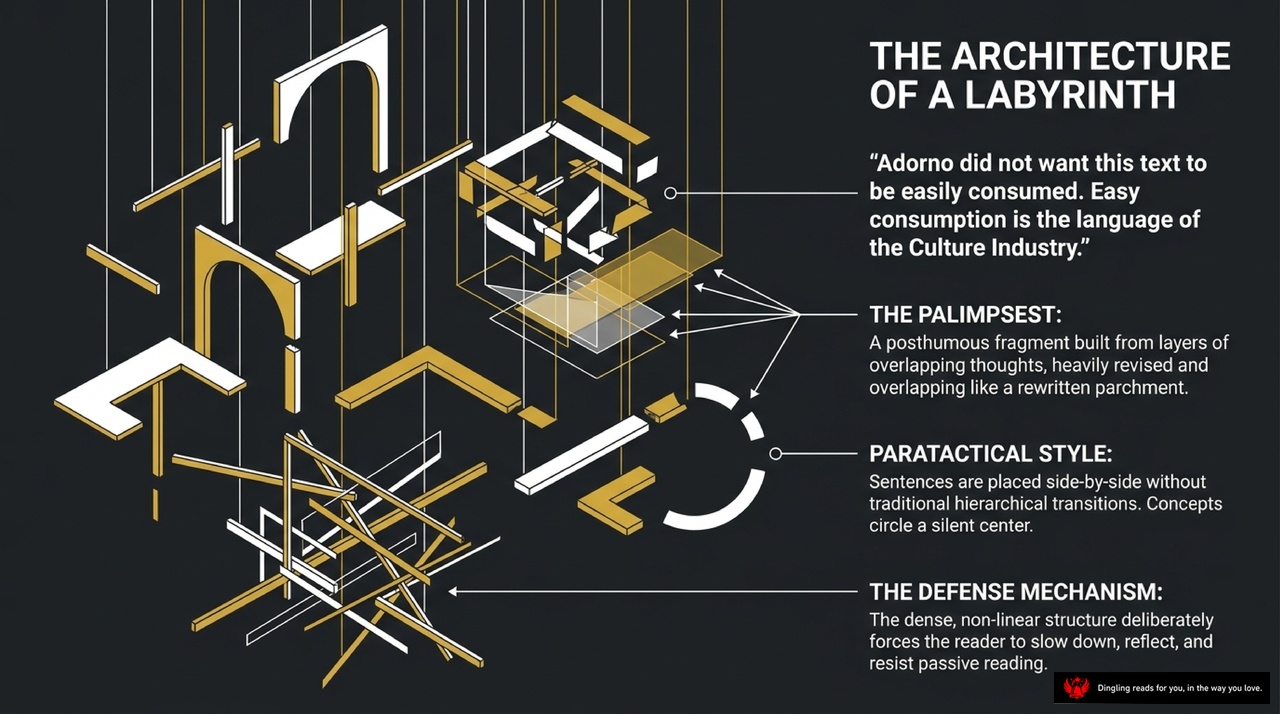
Look at this intricate, suspended structure on the left. It looks like a chaotic tower of letters and architectural fragments, hanging in mid-air without a clear floor or ceiling. This visual perfectly captures Adorno's description of his own writing: "The Architecture of a Labyrinth."
Adorno explicitly stated he did not want his text to be "easily consumed." He believed that easy consumption is simply the language of the Culture Industry. To resist this, he designed his prose like a palimpsest—a posthumous fragment built from layers of overlapping thoughts, heavily revised and rewritten like an ancient parchment.
This leads to his unique "Paratactical Style." Notice how the text on the right breaks down into distinct, disconnected blocks. In Adorno's work, sentences are placed side-by-side without traditional hierarchical transitions. There are no smooth bridges connecting one idea to the next. Instead, concepts circle around a silent center, forcing the reader to do the work of connecting the dots themselves.
Finally, this dense, non-linear structure serves as a defense mechanism. It deliberately forces the reader to slow down, reflect, and resist the urge to passively skim. It's a trap, but a liberating one. By navigating this labyrinth, you aren't just reading about art; you are experiencing the very act of critical thinking that Adorno championed.
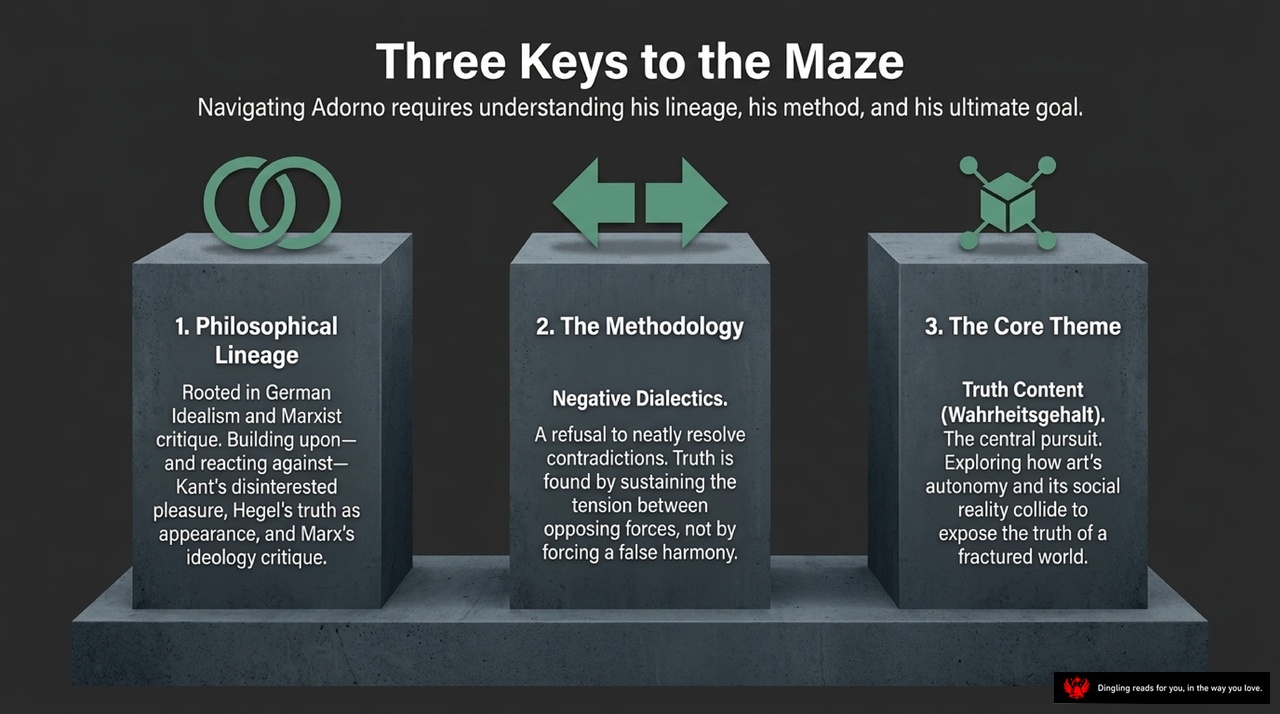
To navigate Adorno's dense maze, we need to hold onto three specific keys: his philosophical lineage, his unique methodology, and his core thematic obsession.
First, look at the foundation. Adorno didn't work in a vacuum; he was rooted in the heavy soil of German Idealism and Marxist critique. He built upon and reacted against giants like Kant, Hegel, and Marx. He took Kant's idea of disinterested pleasure and Hegel's concept of truth as appearance, but he fused them with Marx's sharp ideology critique to create something entirely new.
Second, observe the method. This is where it gets tricky. Adorno invented "Negative Dialectics." Instead of trying to neatly resolve contradictions or force a false harmony, he refused to do that. He believed truth isn't found by smoothing things out, but by sustaining the tension between opposing forces. He wanted to keep the friction alive because that's where the real insight lies.
Finally, focus on the core theme. Adorno was obsessed with "Truth Content," or *Wahrheitsgehalt*. This is the central pursuit of his entire project. He was exploring how the autonomy of art—its ability to stand apart from society—collides with social reality. By letting these two forces crash into each other, art exposes the fractured truth of our world. It's not about escaping reality, but using the artwork's independence to reveal the cracks in the system we live in.
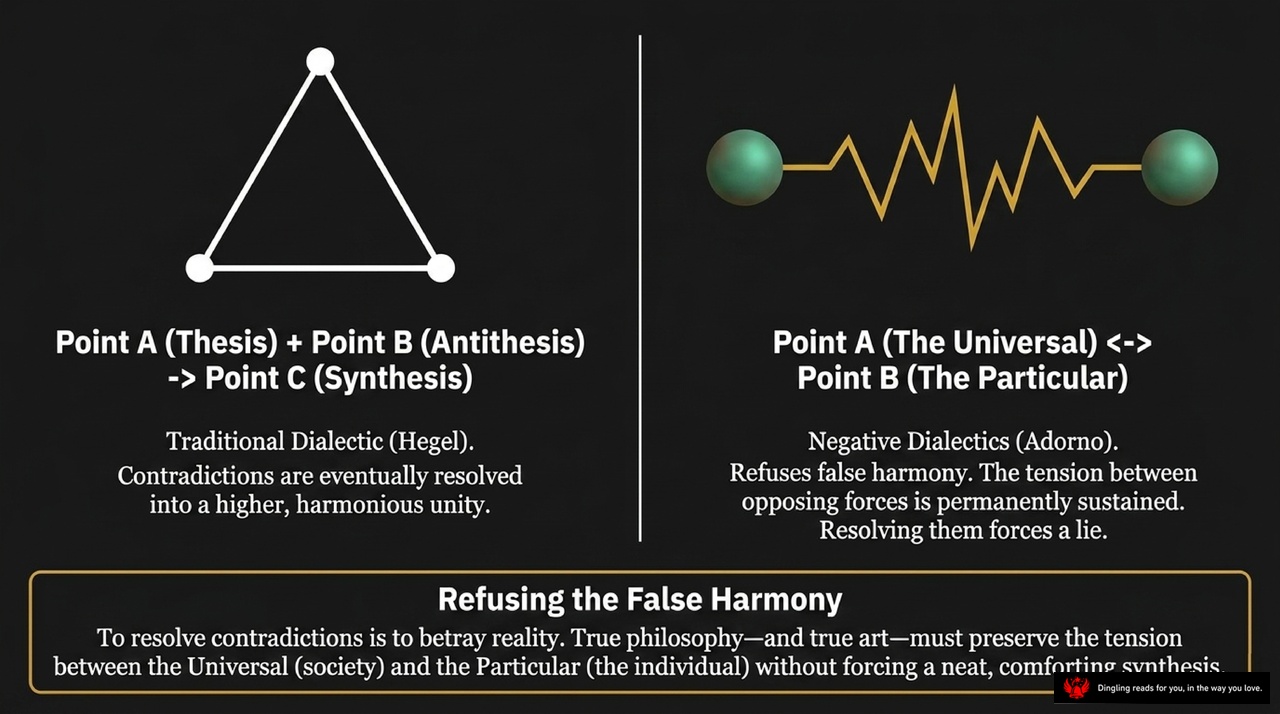
On the left, you see a triangle representing the traditional dialectic of Hegel. Point A, the Thesis, meets Point B, the Antithesis, and they fuse into Point C, a Synthesis. It's a neat, harmonious resolution where contradictions are swallowed up to create a higher unity. But look at the right side. This is Adorno's Negative Dialectics. Here, Point A, The Universal, and Point B, The Particular, are connected not by a smooth line, but by a jagged, vibrating tension. Adorno refuses this false harmony. He argues that resolving these opposing forces forces a lie. The tension between society and the individual must be permanently sustained, not smoothed over.
This slide captures the core of his philosophy: Refusing the False Harmony. To resolve contradictions is to betray reality. True philosophy—and true art—must preserve the tension between the Universal and the Particular without forcing a neat, comforting synthesis. In a world obsessed with answers and resolution, Adorno insists that the unresolvable conflict is where the truth actually lives.

The slide you see here breaks down Adorno's core strategy: the "Posture of Immanent Critique." Instead of attacking society from the outside with foreign ideals, Adorno enters the system itself to expose its internal contradictions. He looks at the gap between what society promises—freedom, individuality, happiness—and what it actually delivers: repression, conformity, and alienation.
This approach rejects "External Critique," which Adorno views as dogmatic because it judges a system using standards it doesn't belong to. Instead, Adorno enters the labyrinth of modern capitalism to show how it fails its own promises. By opposing philosophical fundamentalism, he uses the system's own logic to reveal its cracks. This is how Critical Theory works: not by standing apart, but by diving deep to show that the system is already breaking down from within.
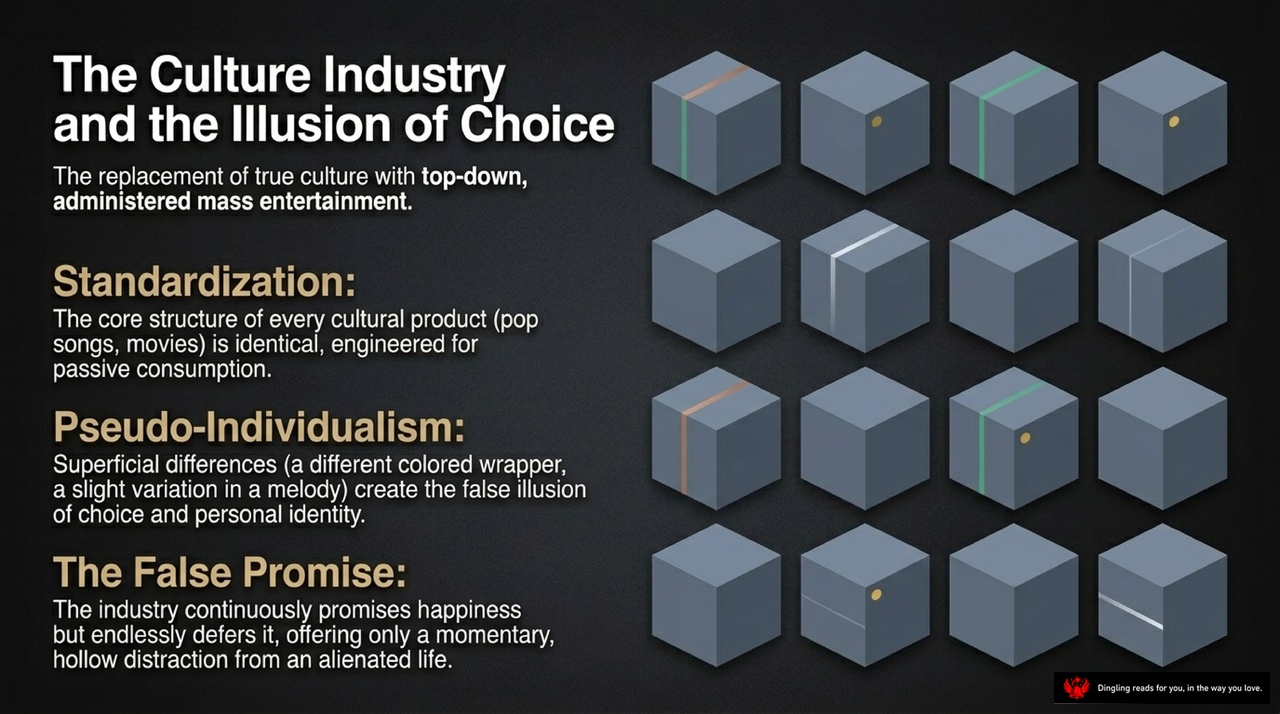
The Culture Industry promises you a world of endless choices, but what you're really getting is an illusion. Look at these boxes on the slide—they look different, right? Maybe one has a green stripe, another a gold dot. That's what Adorno calls "pseudo-individualism." It's a clever trick. The core structure of every pop song, movie, or bestseller is identical, engineered for passive consumption. The industry uses superficial differences, like a different colored wrapper or a slight variation in melody, to create the false feeling that you have a choice and a unique identity.
But this isn't about freedom; it's about standardization. Every cultural product follows the same formula, designed to be easily digestible and safe. This leads to the false promise at the heart of the slide: the industry constantly promises happiness, yet it endlessly defers it. It offers only a momentary, hollow distraction from an alienated life. Instead of genuine culture that challenges us, we get top-down, administered mass entertainment. It's a system that replaces true cultural experience with a standardized product, convincing you that you're choosing freely while actually just selecting from a menu of identical options.
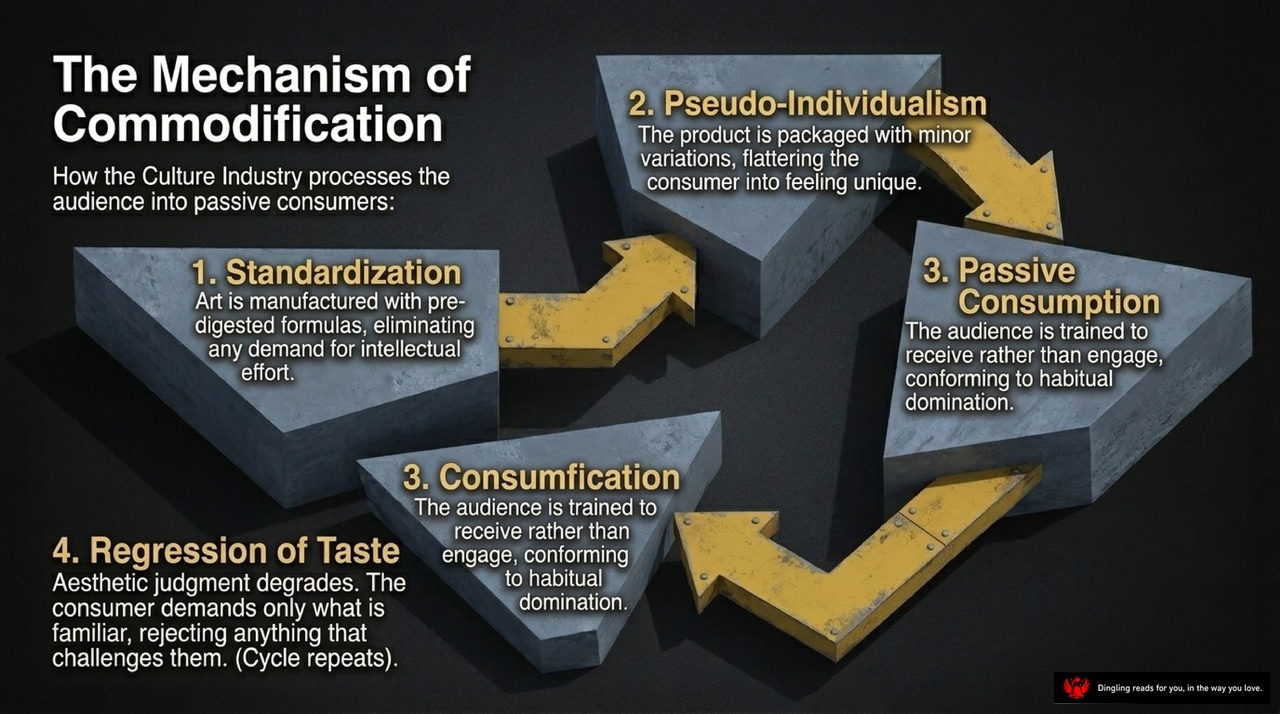
The culture industry doesn't just sell products; it manufactures a specific kind of human being. It starts by stripping art down to pre-digested formulas, eliminating the need for any real intellectual effort. Once you've accepted that art is just a standardized product, the industry then packages it with minor variations, tricking you into feeling like a unique individual when, in reality, you're just consuming the same formula in a different skin. This is pseudo-individualism.
But the real trap is what happens next. The audience gets trained to receive rather than engage. You stop asking questions and start conforming to habitual domination, passively accepting whatever is fed to you. This passive consumption leads to a final, devastating result: the regression of taste. Aesthetic judgment degrades because the consumer demands only what is familiar, rejecting anything that challenges them or feels uncomfortable.
It's a cycle that repeats endlessly. The industry ensures you only want the safe, the known, and the easy, effectively destroying the very capacity for critical thought that art was meant to cultivate.
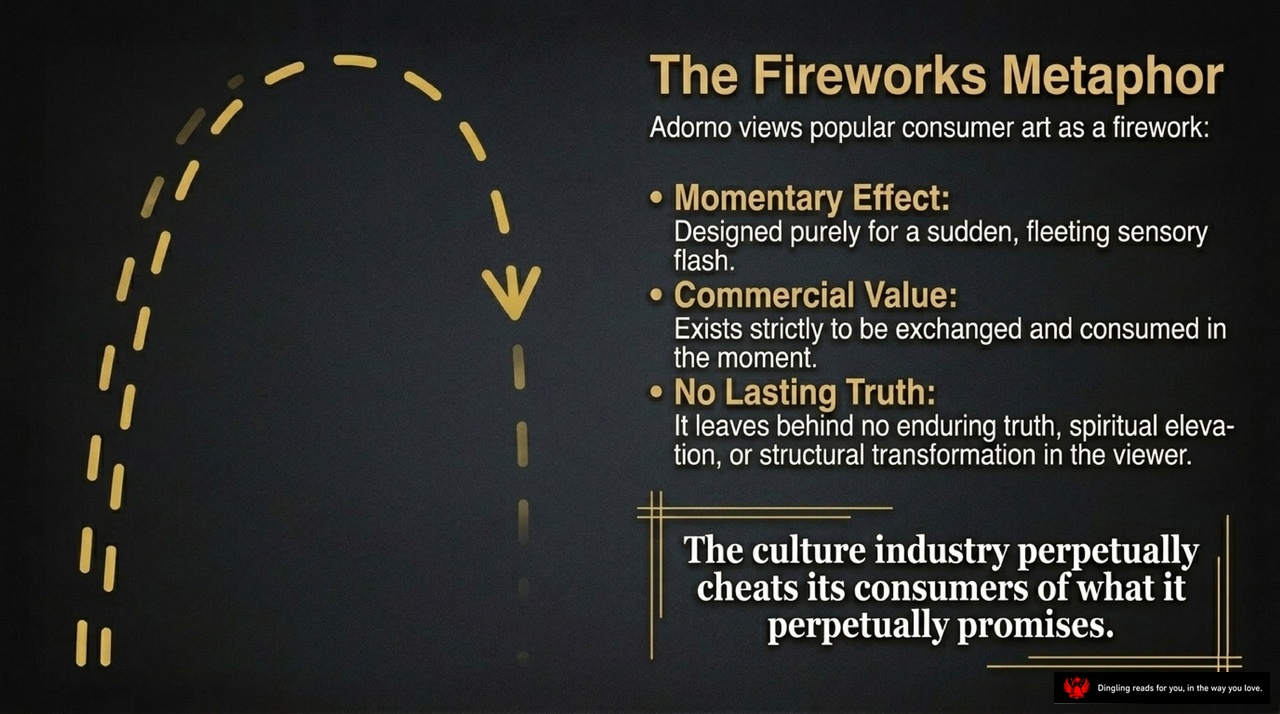
The slide you're looking at is titled "The Fireworks Metaphor," and it's a powerful way to understand how Theodor Adorno views the culture industry. Imagine popular consumer art not as a masterpiece meant to last, but as a firework.
Adorno's argument is that these cultural products are designed for a momentary effect—a sudden, fleeting sensory flash that burns out just as quickly as it begins. They exist strictly for commercial value, meant to be exchanged and consumed in that very instant. Unlike traditional art, which might offer lasting truth or spiritual elevation, these fireworks leave behind nothing. No enduring meaning, no structural transformation for the viewer.
The slide drives this home with a stark conclusion: "The culture industry perpetually cheats its consumers of what it perpetually promises." It promises deep connection or escape, but delivers only a brief, hollow explosion of distraction. This isn't just about bad art; it's about a system that sells you a temporary high while keeping you disconnected from reality.
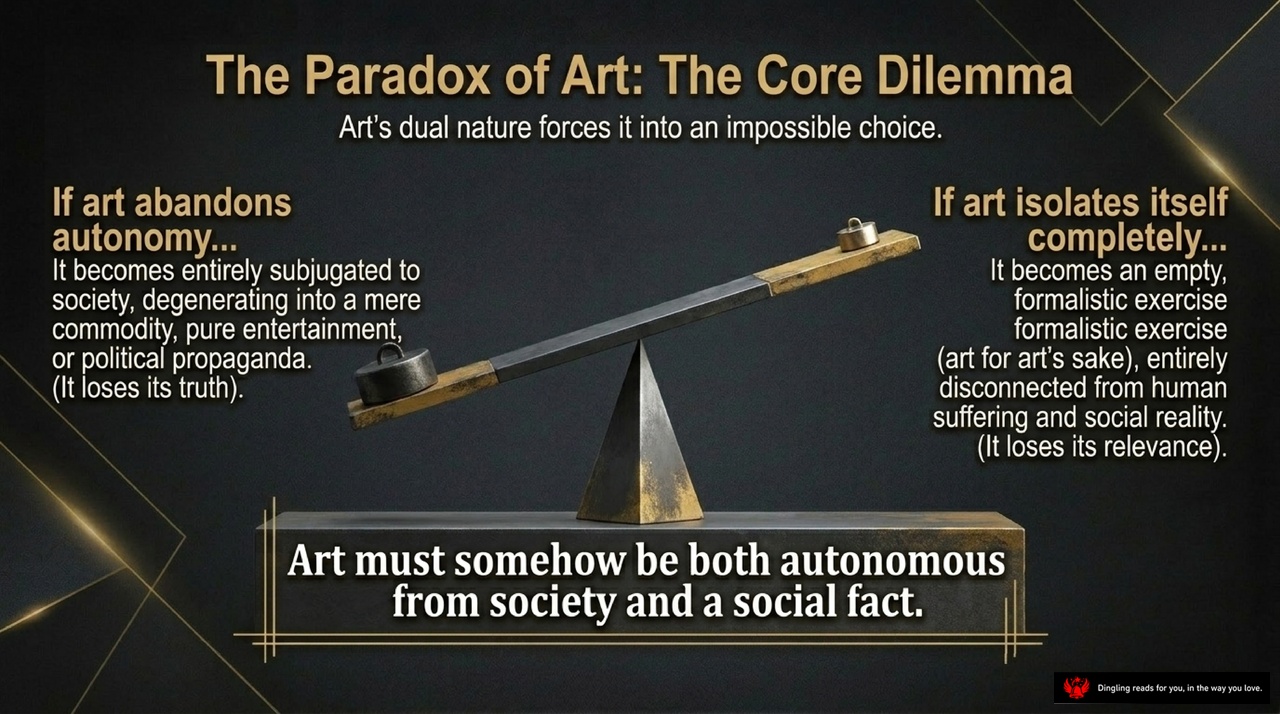
The image presents a stark, impossible choice for art, visualized as a seesaw teetering between two dangerous extremes. On one side, if art abandons its autonomy, it sinks into mere entertainment or political propaganda, losing its truth. On the other, if it isolates itself completely, it becomes an empty, formalistic exercise, disconnected from human suffering and losing its relevance. This is the core dilemma: art must somehow be both autonomous from society and a social fact.
Adorno addresses this tension by arguing that art's truth isn't found in simple imitation or moralizing. Instead, it emerges from the work's internal contradictions and its relationship with reality. He suggests that art's "truth content" is revealed not by what it says, but by how it fails to match the comfortable lies of our world. When art breaks its own form or seems absurd, it isn't failing; it is exposing the absurdity of society itself.
Think of it this way: a perfectly polished, happy painting might just be a mask for a broken world. But a fractured, unsettling piece of modern art—like a distorted portrait or a chaotic symphony—forces us to confront the discomfort of reality. It refuses to offer easy answers or comforting illusions. In doing so, it becomes a critical force. It doesn't just reflect society; it questions it. By maintaining a distance from the status quo while still engaging with it, art creates a space where we can think freely. This delicate balance between independence and social engagement is what gives art its power to challenge us and reveal truths we might otherwise ignore.

Think of art not as a static object, but as a kite caught in the wind. This is the core tension Adorno explores: the delicate dance between autonomy and social fact. The kite itself represents art's autonomy—its need to fly free, catch the wind, and resist the crushing gravity of the administered world. It demands its own independent laws, refusing to be just another commodity on the shelf. But you can't have a kite without a string. That string is the social fact. It's society providing the anchor, the context, and the very tension that allows the kite to fly in the first place. Without it, the kite is just a piece of paper.
Adorno warns us of the danger of cutting that string. If you sever the connection to society, the kite flies away into pure abstraction and gets lost. It becomes meaningless noise, disconnected from the human experience that gives it weight. Conversely, if you violently reel the string in, pulling the kite down, it crashes to the ground and becomes a mere object, stripped of its spirit and critical power. True art lives in that tension. It must stay grounded enough to be understood and relevant, yet soar high enough to critique the world and offer something new. It's not about choosing one side over the other; it's about maintaining the delicate balance where the string holds the kite aloft, allowing it to reveal truths that the ground-bound world cannot see.
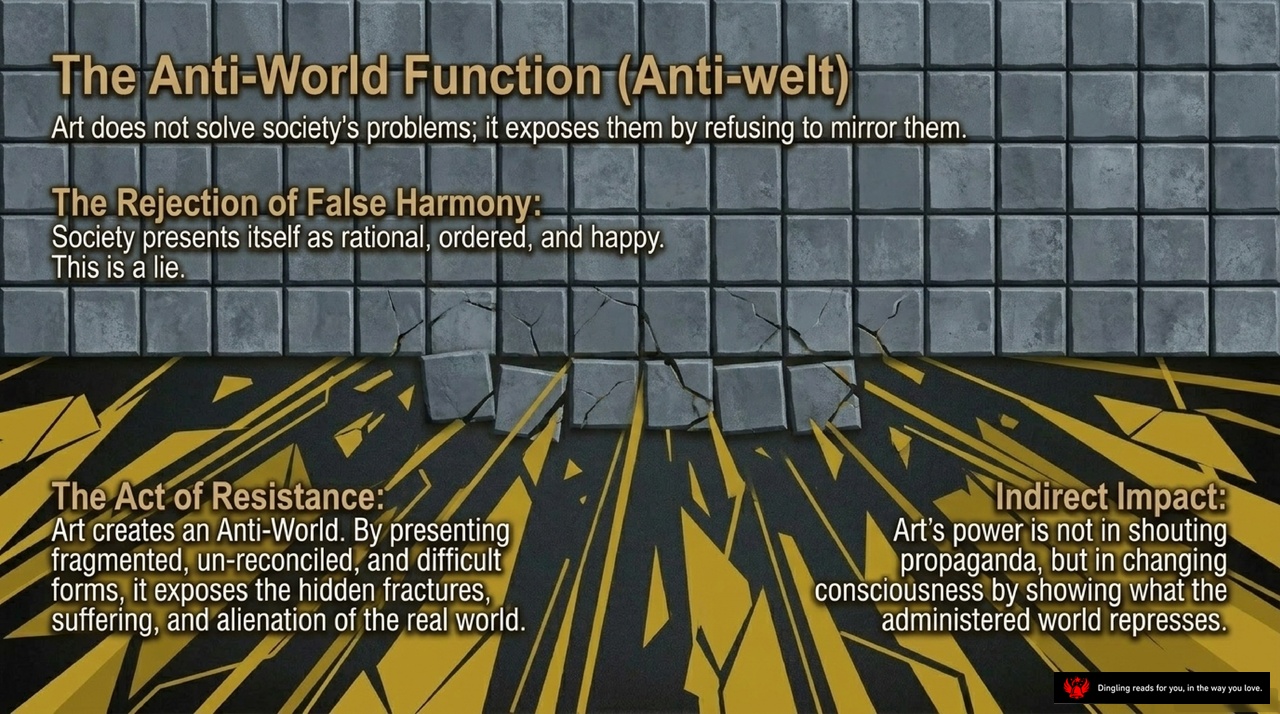
Art isn't here to fix society's problems; it's here to expose them by refusing to simply mirror what we see every day. This slide captures the core of Adorno's radical idea: the "Anti-World Function." Think of it as a deliberate rejection of the false harmony our society sells us—the lie that everything is rational, ordered, and happily resolved. In reality, our world is fractured, and art must be too.
That's why Adorno argues that art creates an "Anti-World." Instead of smoothing over the cracks, it presents fragmented, difficult, and unresolved forms to show us the hidden suffering and alienation we usually ignore. It's an act of resistance. And here's the most important part: art's power isn't in shouting propaganda or telling us what to think. Its true impact is indirect. By showing us what the managed world tries to repress, art changes our consciousness and forces us to wake up to the reality beneath the surface.
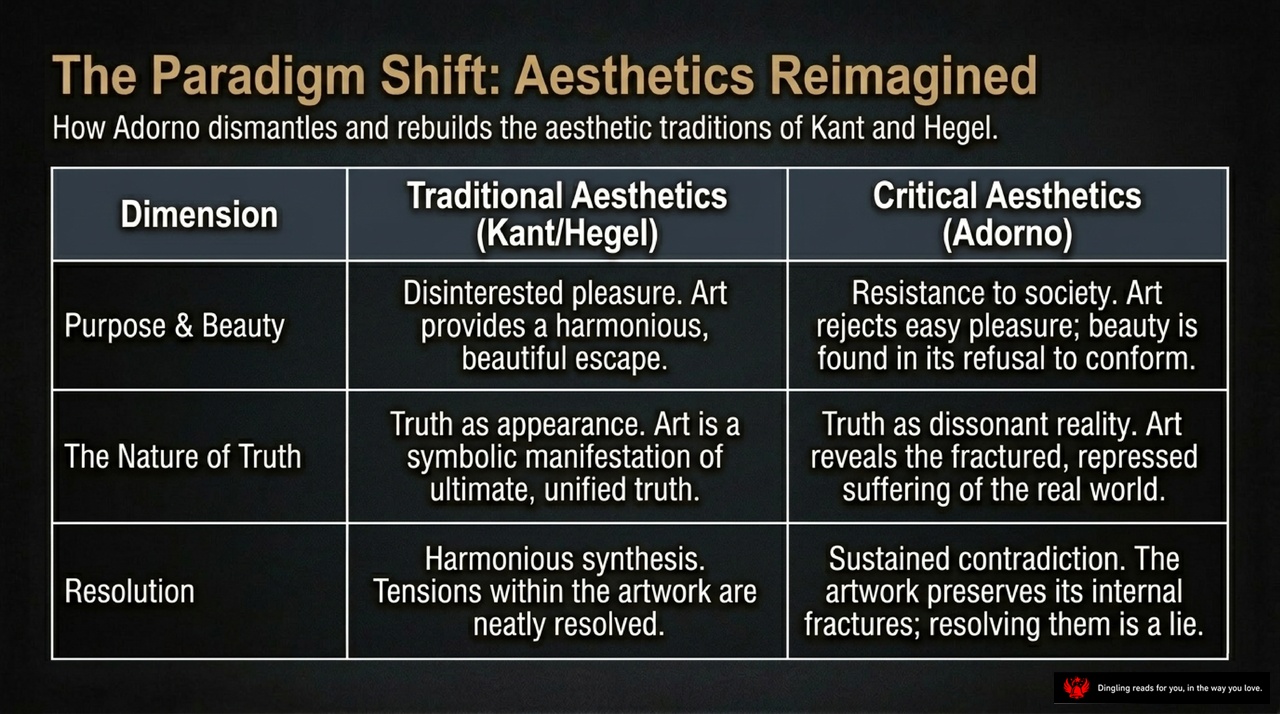
Today's slide maps out a radical shift in how we understand art, contrasting the old guard of Kant and Hegel with Adorno's critical approach. Let's break down this paradigm shift.
Traditionally, thinkers like Kant and Hegel viewed art as a source of disinterested pleasure—a harmonious escape where truth appears as a unified, beautiful illusion. They believed art resolved all internal tensions into a perfect synthesis, offering a safe, orderly reflection of a rational world.
Adorno dismantles this entire framework. For him, art isn't about easy pleasure or harmonious escape; it is an act of resistance against society. Beauty, in his view, isn't found in conformity but in the refusal to conform. Where traditional aesthetics saw truth as a polished appearance, Adorno argues that truth is found in dissonance. Art reveals the fractured, repressed suffering of the real world rather than hiding it behind a pretty facade.
Finally, look at the resolution. Traditional aesthetics sought neat resolutions, smoothing over contradictions. Adorno insists that the artwork must preserve its internal fractures. To resolve them would be a lie. True art sustains contradiction, keeping the tension alive to challenge our comfortable illusions. This is the core of his critical aesthetics: art as a mirror that shows us the cracks in reality, not a window into a perfect dream.
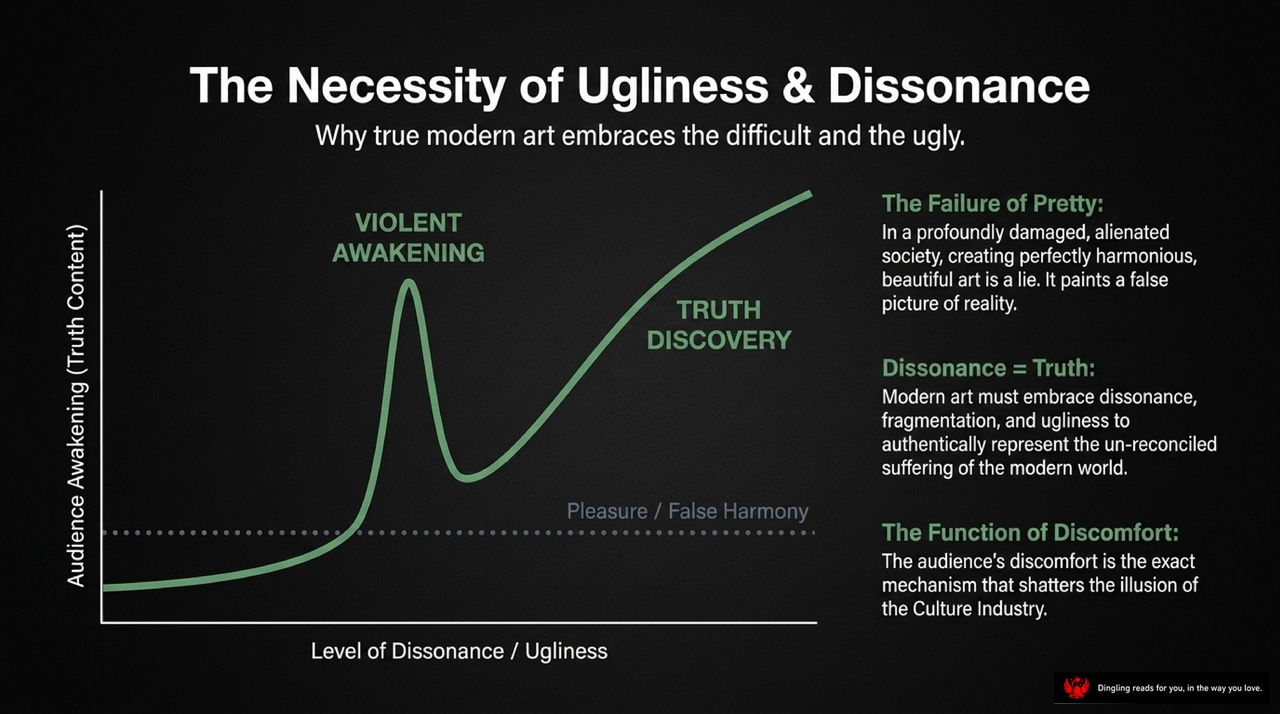
In today's fractured world, we are often told that beauty lies in harmony, in the smooth, the pleasant, and the perfectly resolved. But Adorno argues that this kind of "pretty" art is actually a lie. When society is deeply damaged and alienated, creating art that looks perfectly harmonious just paints a false picture of reality. It comforts us with illusions instead of showing us the truth.
Look at this graph. As the level of dissonance and ugliness in art increases, the audience's awakening to truth also rises. This isn't a gentle slope; it's a violent awakening. Modern art must embrace fragmentation and ugliness to authentically represent the un-reconciled suffering of our time. Dissonance isn't a mistake; it equals truth.
Think about the function of this discomfort. The audience's unease is the exact mechanism that shatters the illusion of the culture industry. When we feel disturbed by a piece of art—by its harsh sounds, its broken forms, its refusal to be pretty—that discomfort wakes us up. It breaks the spell of false happiness and forces us to confront the real, difficult truths of our existence. True modern art doesn't hide behind a smile; it looks us in the eye and says, "This is what it really looks like."
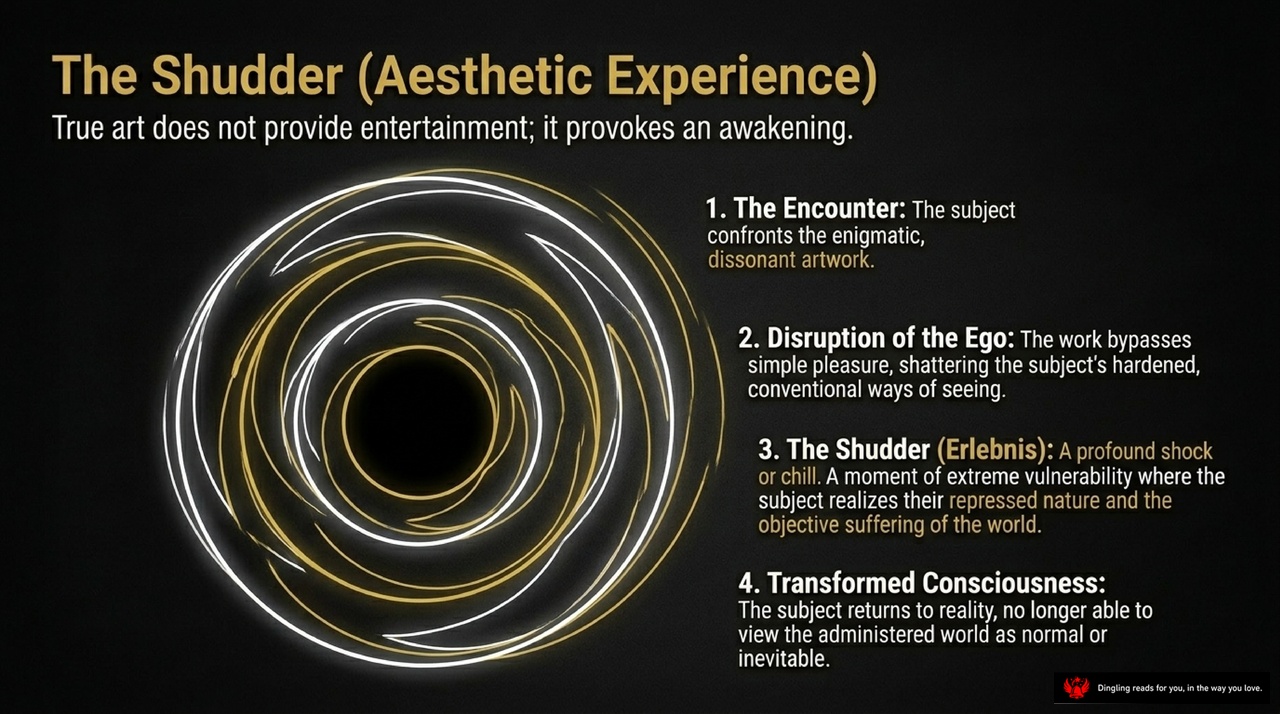
True art isn't about giving you a comfortable time; it's about waking you up. Think about that moment when a piece of art hits you so hard you actually feel a shiver—a deep, physical chill. That's what Adorno calls "The Shudder," or *Erlebnis*. It's not entertainment; it's an awakening.
The process starts with an encounter. You face an artwork that feels enigmatic and dissonant, something that doesn't fit your usual expectations. This immediately disrupts your ego. The art bypasses simple pleasure and shatters your hardened, conventional ways of seeing the world. You can't just look away or pretend everything is fine.
Then comes the shudder itself. It's a moment of extreme vulnerability where you realize your own repressed nature and confront the objective suffering of the world. Finally, your consciousness transforms. When you return to reality, you can no longer view the managed, administered world as normal or inevitable. You see the cracks. That's the power of true art: it doesn't just decorate life; it changes how you see it forever.
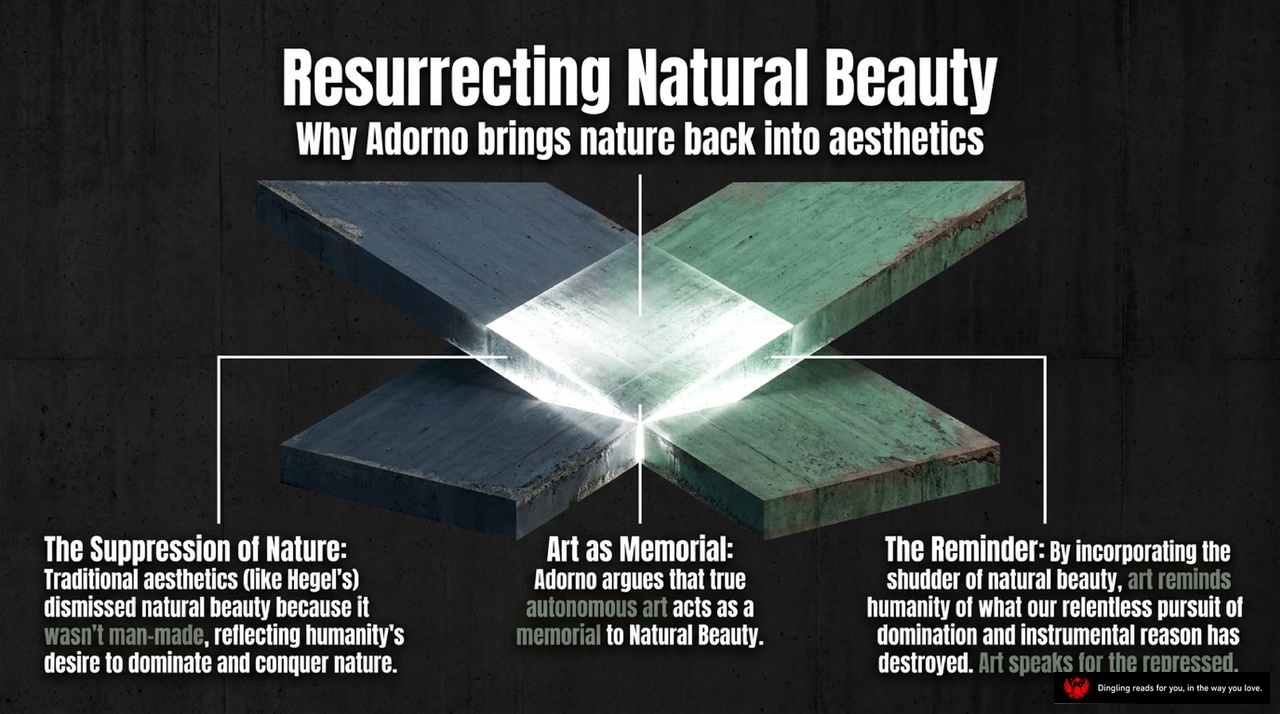
Resurrecting Natural Beauty: Why Adorno brings nature back into aesthetics.
Look at this striking X-shape in the center. It represents the collision between human dominance and the raw power of nature. On the left, we see "The Suppression of Nature." Traditional aesthetics, like Hegel's, dismissed natural beauty simply because it wasn't man-made. They saw nature as something to be conquered, reflecting humanity's relentless desire to dominate.
But in the middle, Adorno offers a radical shift: "Art as Memorial." He argues that true autonomous art acts as a sacred monument to Natural Beauty. It doesn't just copy nature; it remembers it.
And on the right, we find "The Reminder." By incorporating that shudder of natural beauty, art reminds us of what our pursuit of domination has destroyed. It speaks for the repressed. Art isn't just decoration; it's a warning and a rescue mission, bringing nature back into our aesthetic experience so we can finally see what we've lost.
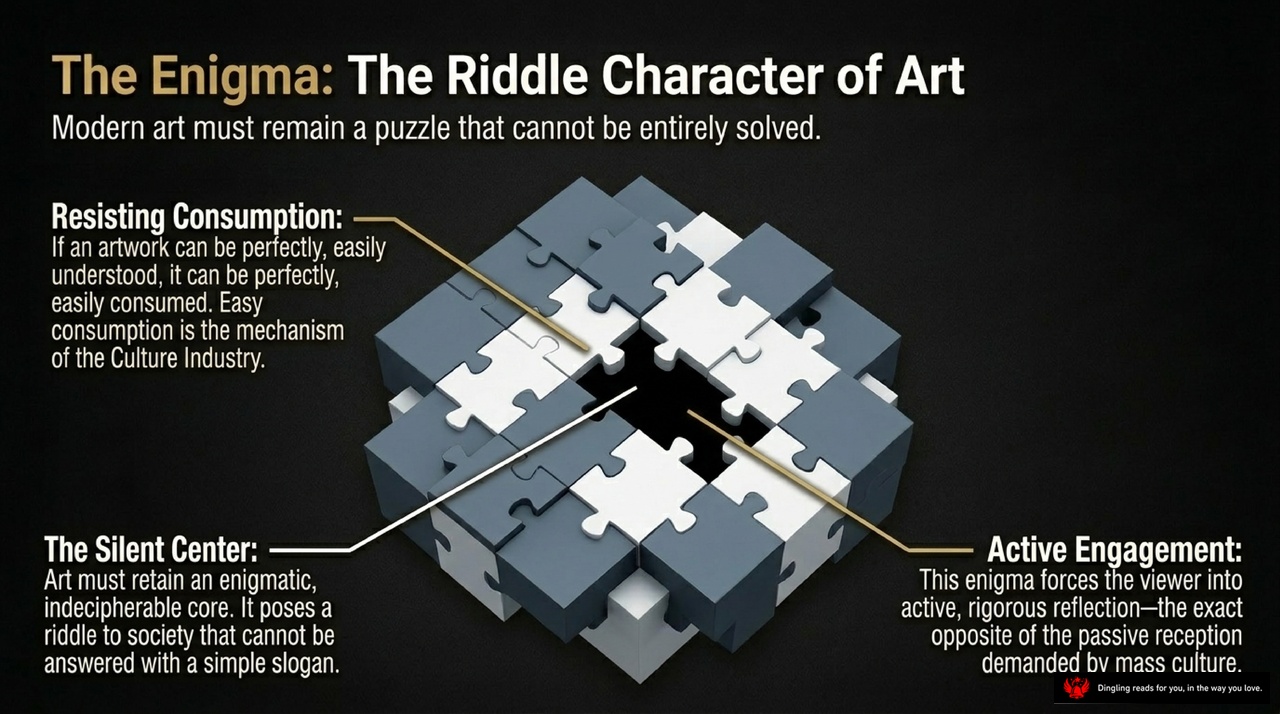
Welcome to the puzzle. Today's slide, titled "The Enigma: The Riddle Character of Art," captures the very heart of Adorno's argument. It reminds us that modern art must remain a puzzle that cannot be entirely solved. Why? Because the moment an artwork is perfectly understood, it becomes perfectly consumable. And easy consumption is exactly what the culture industry thrives on.
Look at the three key points here. First, "Resisting Consumption." If art is too easy to digest, it gets swallowed by the market like any other product. To survive, art must refuse to be easily understood. Second, we have "The Silent Center." True art must retain an enigmatic, indecipherable core. It poses a riddle to society that cannot be answered with a simple slogan. It refuses to give you a quick fix or a comforting moral. Finally, this leads to "Active Engagement." This enigma forces the viewer into active, rigorous reflection. This is the exact opposite of the passive reception demanded by mass culture. Instead of letting art do the thinking for you, a real masterpiece demands that you do the work. It challenges you to look deeper, to question reality, and to engage your mind rather than just your eyes.

Can art survive in a world that is entirely administered? This slide asks a heavy question, and the visual metaphor of the beam shattering into sparks perfectly captures the crisis. We are seeing the shrinking space for truly autonomous art as the commodified world expands. But we also see the threat of assimilation: even the most rebellious avant-garde art is in constant danger of being absorbed, packaged, and sold by the culture industry. So, what is the only hope? Art's survival depends on its relentless capacity for self-reflection, its refusal to provide false comfort, and its dedication to remaining a dissonant anti-world.
Adorno argues that in a society dominated by the logic of exchange and administration, art faces an existential threat. The culture industry produces standardized cultural goods that dull our senses and replace critical thinking with passive consumption. It turns art into a commodity, stripping it of its unique truth content. If art simply mirrors society or offers easy entertainment, it ceases to be art; it becomes just another product.
However, Adorno insists there is no hope in compromise. True art must resist this totalizing force. It must remain "dissonant," refusing to harmonize with a broken world. This resistance is not just aesthetic; it is political and philosophical. By maintaining its autonomy and exposing the contradictions of reality, art becomes a site of truth. It does not offer solutions or comfort; instead, it forces us to confront the absurdity and suffering of our condition. In this way, art survives not by escaping society, but by standing in critical opposition to it, keeping a spark of human freedom alive in an increasingly administered world.
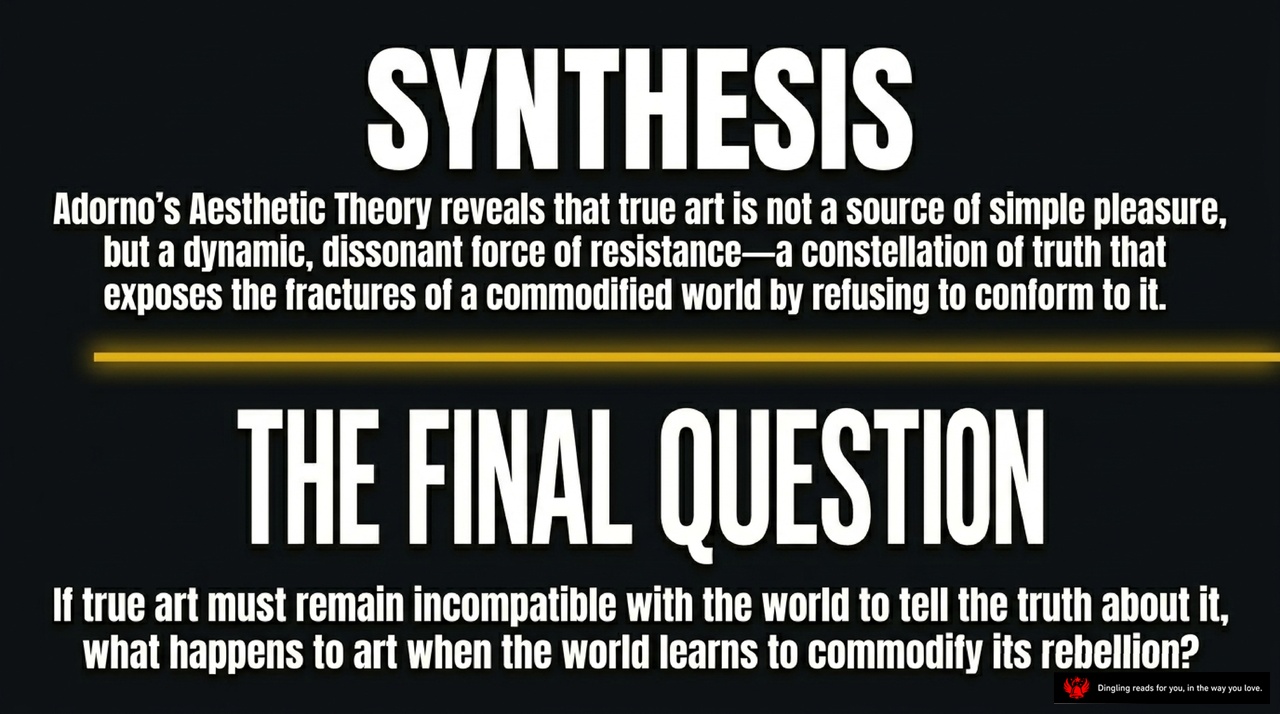
Synthesis. Adorno's aesthetic theory reveals that true art is not a source of simple pleasure, but a dynamic, dissonant force of resistance—a constellation of truth that exposes the fractures of a commodified world by refusing to conform to it. Now, we arrive at the final question: If true art must remain incompatible with the world to tell the truth about it, what happens to art when the world learns to commodify its rebellion? When the very act of resisting becomes a product to be sold, when the shock of the avant-garde is packaged into a lifestyle trend, does the critical edge of art dull? Or can art find a new way to speak truth to power even when that power has mastered the language of dissent? This paradox challenges us to rethink the very nature of artistic autonomy in a fully integrated capitalist society.