
Americana: Complete Chapter-by-Chapter Summary
Welcome to a deep dive into Don DeLillo's *Americana*, where we peel back the glossy surface of corporate America to reveal the nightmare humming beneath. This presentation isn't just about a book; it's a visual deconstruction of a man trapped in a world of images.
Meet our subject: David Bell, 28 years old, described here as "The Hollow Man at the Top." He's handsome, Greek-classic in his features, and obsessed with how he looks to others. But beneath that polished exterior lies a desperate search for identity. He's a man who defines himself by his reflection, terrified of being just another face in the crowd.
The story begins in a New York Christmas that feels less like celebration and more like a fever dream. The streets are a boiling pot of cheap lights and choking steam, where the Salvation Army's music sounds like a dirge for a child. David navigates this chaos, moving from a hollow party where everyone laughs at offensive jokes to a sterile office where beauty is a currency and ugliness is punished. He's surrounded by people who are more concerned with their image than their humanity.
As the narrative shifts, we see David's fractured past. His father, an advertising legend, taught him that life is just a series of pitches and illusions. David tried to escape this by filming a documentary in a small town, but even his camera couldn't capture the truth—it only reflected his own confusion. He traveled west, chasing a sense of reality in the desert, only to find that the "truth" there was just another kind of performance.
Ultimately, David realizes that the constant chase for a perfect image is a trap. The movie he was trying to make? It wasn't about the world; it was about him. And in the end, the only real story is the quiet, messy, unscripted life we all lead behind the curtain.

On this slide, we see the brutal duality of the American experience. On the left, we have "The American Dream," defined purely by external success. Look at the protagonist: he's twenty-eight, physically perfect with a "curiously Hellenic" face, a top executive at a major network, and a master survivor who effortlessly navigates elite Manhattan society. He's won the game.
But look at the right side: "The American Nightmare." This isn't about what you lack; it's about an internal void. Despite his external triumph, he's paralyzed by unspoken corporate paranoia and completely disconnected from unmediated reality. He's so detached that he's fleeing to the American West in a battered camper, desperately using a 16mm camera to "find" a country his own network ignores.
The core thesis at the bottom ties it all together: To survive the void of the establishment, the protagonist must transform his life into a film. Why? Because in his world, the image is the only reality he understands. He's trapped in a loop where he can conquer the world, but only by turning himself into a character in someone else's movie.

Look at David Bell's profile. He's exactly 1.89 meters tall, weighing between 84 and 86 kilograms, with features described as "curiously Hellenic." But here's the twist: his survival tactic is "The Low Profile." David survives by aggressively evading categories, aiming to be neither too ruthless nor too clever. By becoming a completely blank screen, he forces his colleagues to project their own anxieties and ambitions onto him.
He even admits that when he begins to doubt who he is, all he has to do is lather his face and shave. And everything becomes crystalline and miraculous. For David, the mirror serves as his primary psychoanalyst, and this specific image defines his identity.
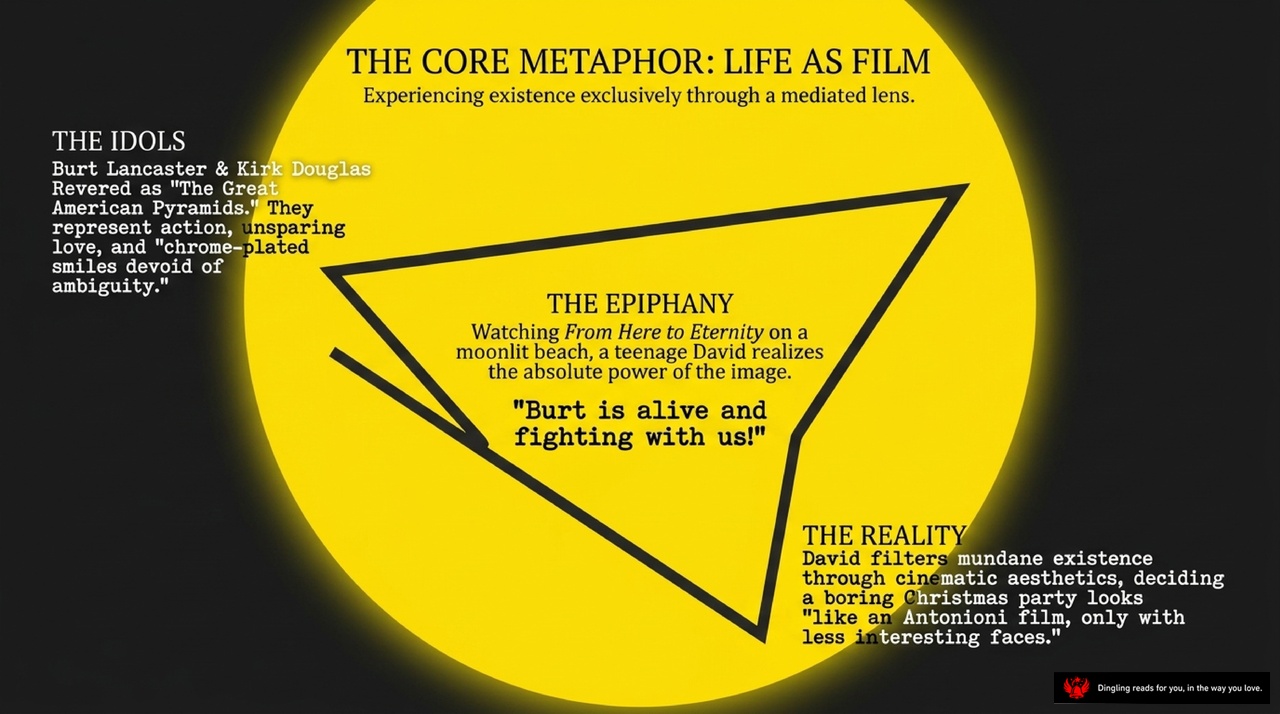
The slide breaks down a powerful metaphor: Life as Film. It suggests we experience existence exclusively through a mediated lens, much like watching a movie.
This concept is rooted in a specific moment from the book. The narrator, David, recalls watching the film *From Here to Eternity* on a moonlit beach as a teenager. He had an epiphany, realizing the absolute power of the image. He thought, "Burt is alive and fighting with us!" This wasn't just about the actor, Burt Lancaster; it was about how the image itself could feel more real and potent than reality.
This obsession with cinematic aesthetics shaped his entire worldview. He began filtering his mundane, boring existence through a cinematic lens. For example, he would look at a dull Christmas party and decide it looked "like an Antonioni film, only with less interesting faces." He didn't just see a party; he saw a scene.
This mindset led him to create idols. He revered stars like Burt Lancaster and Kirk Douglas, calling them "The Great American Pyramids." To David, they represented action, unsparring love, and "chrome-plated smiles devoid of ambiguity." They were perfect, heroic figures that he desperately wanted to emulate.
However, this reliance on the mediated lens created a disconnect. While David was busy curating his life like a movie script, seeking those perfect, action-hero images to define himself, he was missing the raw, unfiltered reality right in front of him. The slide captures this tension: the "Idols" we worship versus the "Reality" we ignore, all viewed through the filter of "The Reality" of cinematic aesthetics. We end up living a film we think we want to live, rather than the complex, ambiguous, and often boring truth of actual life.
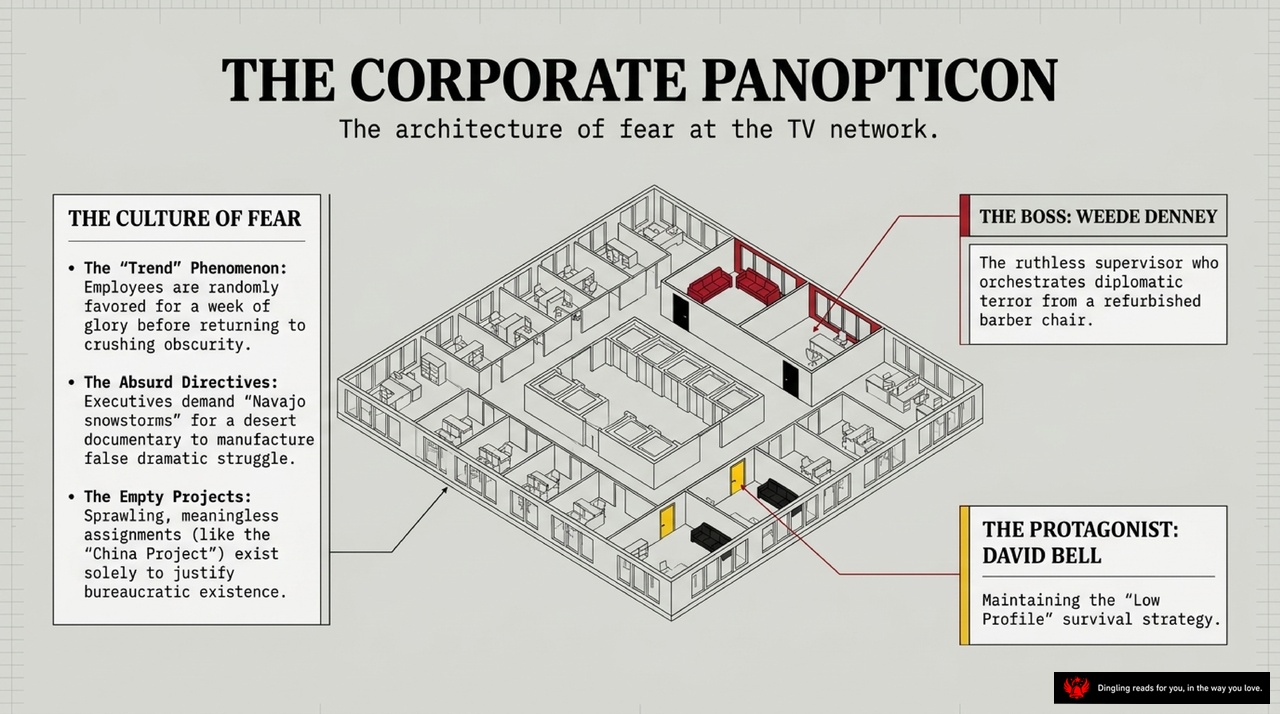
Welcome to the corporate panopticon—the invisible architecture of fear that runs this TV network. At the top sits Weede Denney, our ruthless boss, orchestrating diplomatic terror from a refurbished barber chair. Below him, the culture is defined by absurd directives and empty projects, like the "China Project," which exist solely to justify our bureaucratic existence. Meanwhile, employees are randomly favored for a week of glory before being crushed back into obscurity.
In this high-stakes environment, survival means maintaining a "low profile." That's the strategy of David Bell, the protagonist. He's the guy you see in the diagram, navigating the maze while keeping his head down. But don't think he's invisible. The network is full of ghosts. Anonymous memos from a mysterious figure known only as "Trotsky" pop up on desks, delivering sharp, cryptic warnings that keep everyone on edge. It's a place where everyone is balancing on a tightrope, terrified of the next cut or the next absurd order. This isn't just an office; it's a machine designed to keep us small, afraid, and constantly watching each other.

Welcome to the final chapter of David's journey. This slide visualizes his "Mental Darkroom"—the specific psychological strategy he developed to survive the crushing pressure of corporate life.
On the left, you see the "High Threat Environment," which represents the corporate meetings David fears most. In this world, there is only one door open, and the light is strictly regulated. He believes safety is found in minimal exposure and near-total darkness. He treats these meetings like a minefield, hiding behind a wall of professional detachment to avoid being seen or judged.
Contrast that with the right side: the "Low Threat Environment," which ironically happens to be his intimate, personal life. Here, multiple doors are open. He lets in the light, risking the "truth" that usually results in calculated, pathological lies. He uses vulnerability as a shield, pretending to be weak to feign safety, all while maintaining a facade of intimacy.
The core insight here is at the bottom: David regulates the flow of emotional and intellectual light with millimeter precision. He is constantly calculating how much of himself to reveal and how much to hide, just to survive the corporate void. It's a high-wire act of managing light and shadow, proving that in his world, the most dangerous thing isn't the darkness itself, but the moment you accidentally let too much light in.

The Intrusion of Philosophy. Welcome to the case of the anonymous employee.
Here's the anomaly: someone is breaking into the mimeograph room at night to distribute quotes from Zwingli, Lévi-Strauss, Rilke, and Charles Olson. It's a midnight ritual, a secret rebellion against the corporate grind.
But who is the suspect? Enter Ted Warburton. He's the oldest executive, the self-appointed "tribal conscience" of the network. He's dying of a rare blood disease, fighting the sterility of his life with midnight philosophy. He's the one secretly writing these memos, these fragments of wisdom meant to outlast his failing body.
Now, look at the evidence in the center. This is "The Memo Madman," codenamed Trotsky. The note reads, "Never will man be more dead in a disacious death than when death itself is immortal." It's a haunting thought from St. Augustine, stamped over the page in bold red ink.
This isn't just about philosophy; it's about the intrusion of the intellectual into a world that wants to be purely commercial. Warburton is trying to inject meaning into a system that's slowly killing him. He's using these quotes as a lifeline, a way to prove that even in a corporate death trap, the human spirit can still speak.
So, who is really the madman here? Is it the man writing the notes, or is it the entire network that forces him into this corner? That's the question we're left with.
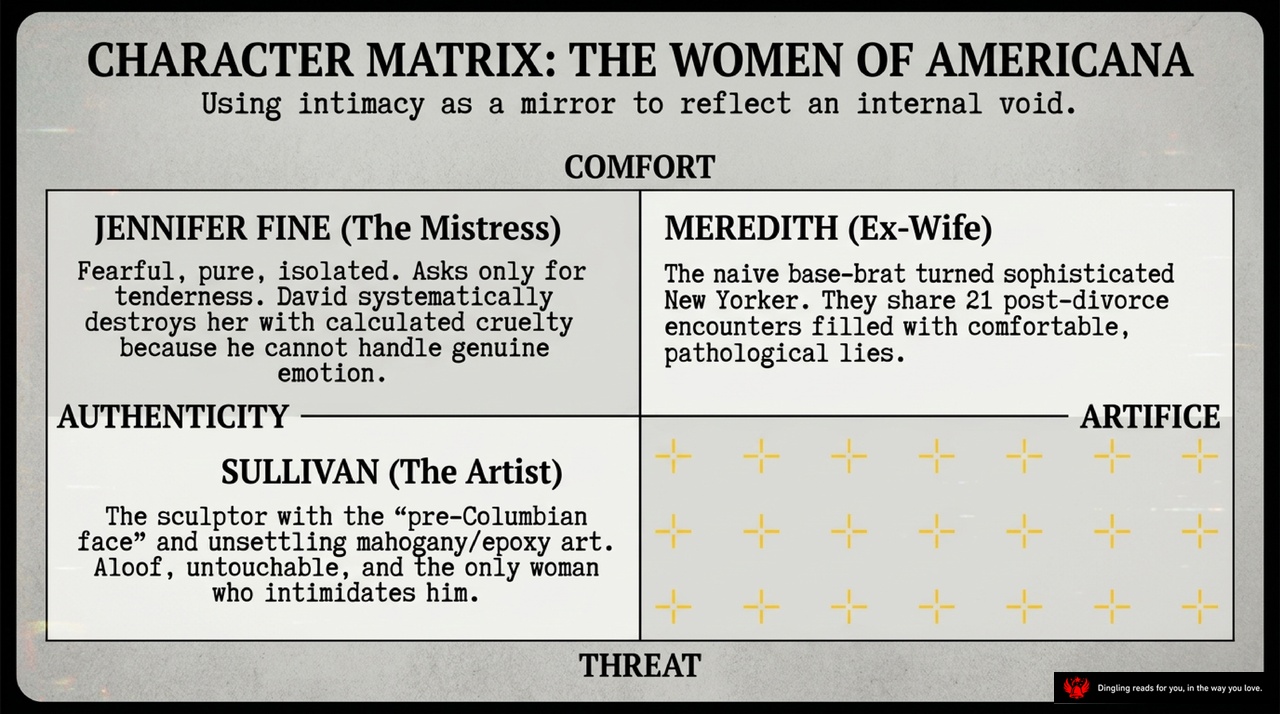
Look at this quadrant: Comfort meets Authenticity. Here we have Jennifer Fine, the mistress. She's described as fearful, pure, and isolated, asking only for tenderness. David systematically destroys her with calculated cruelty because he simply cannot handle genuine emotion. It's a tragic loop where her vulnerability becomes his weapon.
Now, look at the opposite corner: Comfort paired with Artifice. That's Meredith, the ex-wife. She's the naive base-brat turned sophisticated New Yorker. They share twenty-one post-divorce encounters filled with comfortable, pathological lies. She's the ultimate comfort zone, but it's built on a foundation of deception.
Finally, in the bottom left, we have Sullivan, the artist. She sits in the Authenticity column, but she's the only woman who intimidates him. She's aloof and untouchable, a sculptor with a pre-Columbian face and unsettling art. She's the only one who doesn't try to comfort him; instead, she threatens his ego.
This matrix isn't just about labels; it's a mirror. It reflects David's internal void. He seeks comfort from Meredith through lies, he exploits Jennifer's purity, and he fears Sullivan's raw authenticity. Every woman in his life is a reflection of a piece of himself he either wants to hide or is too afraid to face.
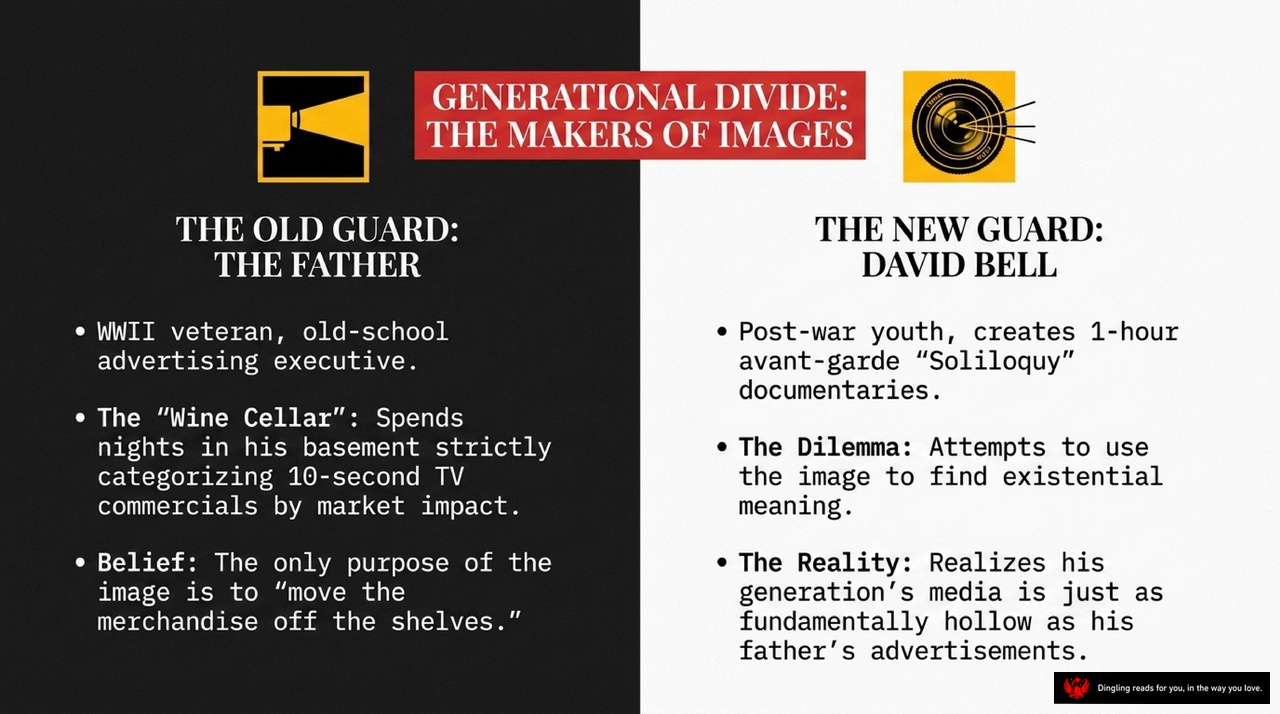
Look at this split screen. On the left, we have "The Old Guard"—my father, a WWII veteran and old-school advertising executive. He spent his nights in the "Wine Cellar," obsessively categorizing 10-second TV commercials by their market impact. His entire philosophy was cold and practical: the only purpose of an image is to move merchandise off the shelves.
On the right, we see "The New Guard"—me, David Bell. I'm the post-war youth creating avant-garde documentaries. I tried to use the image to find existential meaning, to capture the soul of the world. But here's the twist: I realized the truth. My generation's media is just as fundamentally hollow as my father's advertisements. We just swapped selling soap for selling feelings, but the emptiness underneath remained exactly the same.
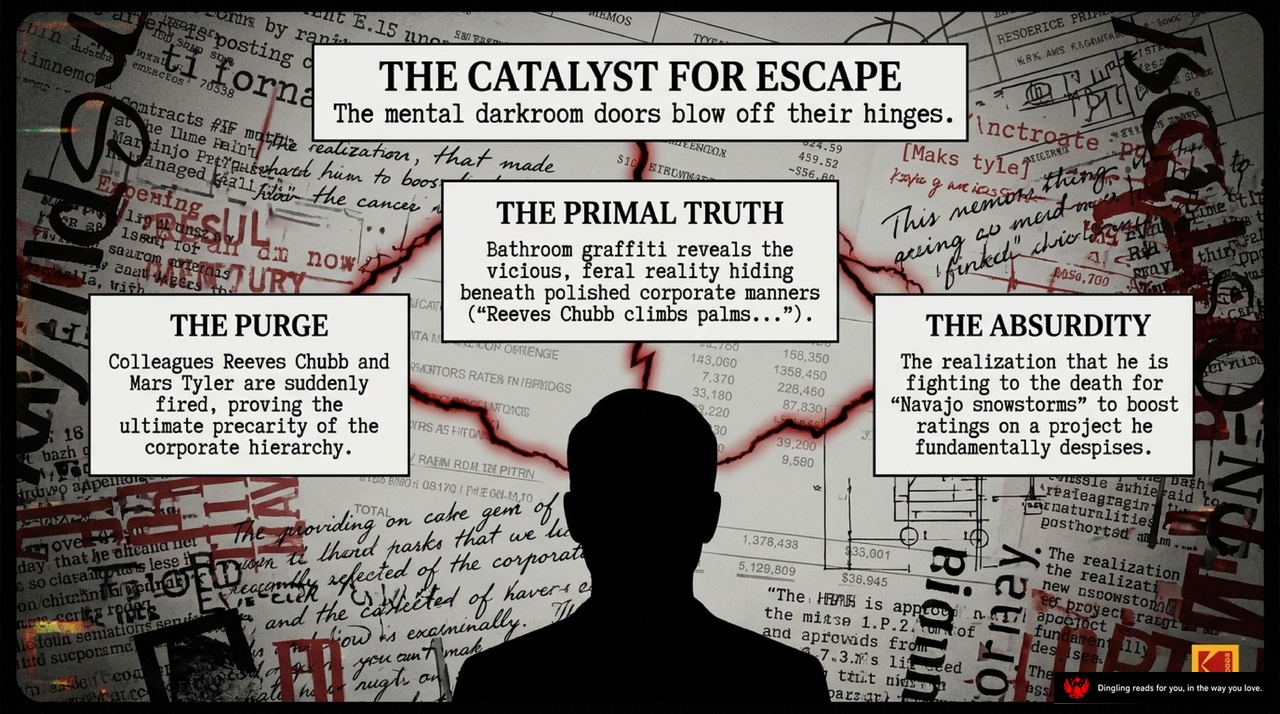
Look at this silhouette against the chaos. This slide, "The Catalyst for Escape," captures the exact moment the protagonist's reality shatters. It's not just about leaving the office; it's about the mental darkroom doors blowing off their hinges.
First, we have "The Purge." Colleagues Reeves Chubb and Mars Tyler are suddenly fired. It proves the ultimate precarity of corporate hierarchy. One day you're in, the next, you're out. It's a brutal reminder that no one is safe.
Then, "The Primal Truth." This is where the polished corporate manners peel away. Bathroom graffiti reveals the vicious, feral reality hiding beneath. As the text says, "Reeves Chubb climbs palms..." It's a glimpse into the savage, unfiltered human nature that the company tries to suppress.
And finally, "The Absurdity." The realization that he is fighting to the death for "Navajo snowstorms" just to boost ratings on a project he fundamentally despises. He's sacrificing his soul for metrics. It's a perfect metaphor for the hollow grind of modern corporate life.
This isn't just a slide; it's the breaking point. When the facade cracks, you see the truth: a world built on absurdity, where people are discarded like trash, and the only thing left is the desperate need to escape.
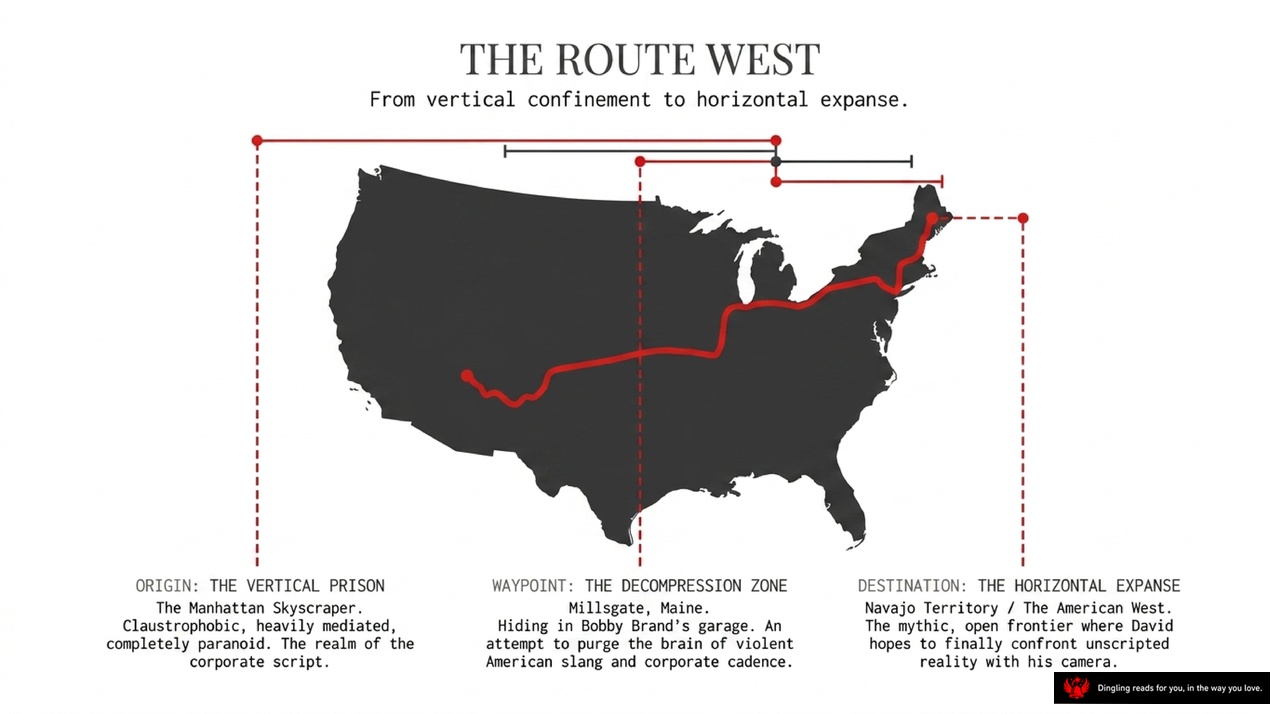
The map before us isn't just a route; it's a visual manifesto of David's entire life. It charts his desperate flight from the crushing weight of New York to the open, terrifying freedom of the American West.
Look at the starting point on the left: "The Vertical Prison." This is the Manhattan Skyscraper. It represents a world of claustrophobia, heavy mediation, and paranoia—the realm of the corporate script where David felt suffocated. He was trapped in a vertical cage, trying to survive the unspoken rules of high society.
Then, we move eastward to the middle: the "Decompression Zone." This is Millgate, Maine. It's the decompression chamber between pressure and release. Here, David is hiding in Bobby Brand's garage, trying to purge the violent American slang and the rigid corporate cadence that had defined him. It's a place of transition, a quiet pause where he could finally breathe.
Finally, the destination on the far right: "The Horizontal Expanse." This is the Navajo Territory, the mythic open frontier. This is where David hopes to finally confront unscripted reality with his camera. He's leaving the vertical confinement of the city for horizontal expanses, trading the predictable lines of corporate life for the wild, unpredictable lines of the desert.
This journey from the skyscraper to the horizon isn't just about geography; it's about shedding the skin of who he was told to be, and stepping into the messy, unfiltered truth of who he actually is.

Welcome to the final chapter of our journey. Today, we're stepping off the screen and into the heart of the American experiment, guided by the haunting vision of a 100-year-old Oglala Sioux mystic. This slide isn't just about history; it's a prophecy about where we are going.
The first section, "The Ascetic Destroyer," challenges a core American myth. We often think of ourselves as materialists, obsessed with things. But the text reveals a darker truth: we are actually ascetics who despise waste. We secretly crave the destruction of everything beautiful—our forests, our colonial history, our old homes—all in the name of brutal efficiency. We want to clear the deck, even if it means burning down the house.
Below that, we see a road stretching into an endless horizon, representing "The Megamerica." This is the ultimate American desire: a sterile utopia. It's a world of identical hotels, synthetic materials like polyurethane, and a single national university run entirely by televisions watching other televisions. It's the promise of a frictionless, safe, but utterly soulless existence.
So, as we close this book, we're left with a question: Do we want to be efficient destroyers, or do we want to find the messy, complex, human things that make life worth living? The road ahead is yours to choose.

Look at this slide, "The Road Trip Crew." These aren't just random characters; they are the eccentric exiles David has gathered to accompany him on his journey. Each one represents a different facet of the American experience, a different way of surviving the chaos.
First, we have Bobby Brand, labeled "The Penitent." He's an ex-Air Force pilot and a recovering addict, currently hiding out in a garage in Maine to write a novel. His goal is intense: he wants to become "colorless," systematically purging his brain of violent American slang. He's trying to strip away the aggression he feels defines his identity.
Then there's Jack Pike, "The Primitive." A sixty-year-old veteran obsessed with primal animal speed. He claims a cheetah runs 110 miles per hour and travels West solely to face a mountain lion in the wild, refusing the safety of zoo bars. He's seeking a raw, unfiltered connection to nature that modern life denies us.
Finally, we have Sullivan, "The Observer." She is a brilliant but intimidating sculptor who views the passing American landscape with the exact same cold, assessing eye she uses to construct her unsettling mahogany and epoxy art. She doesn't just see the world; she dissects it.
Together, these three form a strange family, a crew of broken people trying to find meaning on the open road.
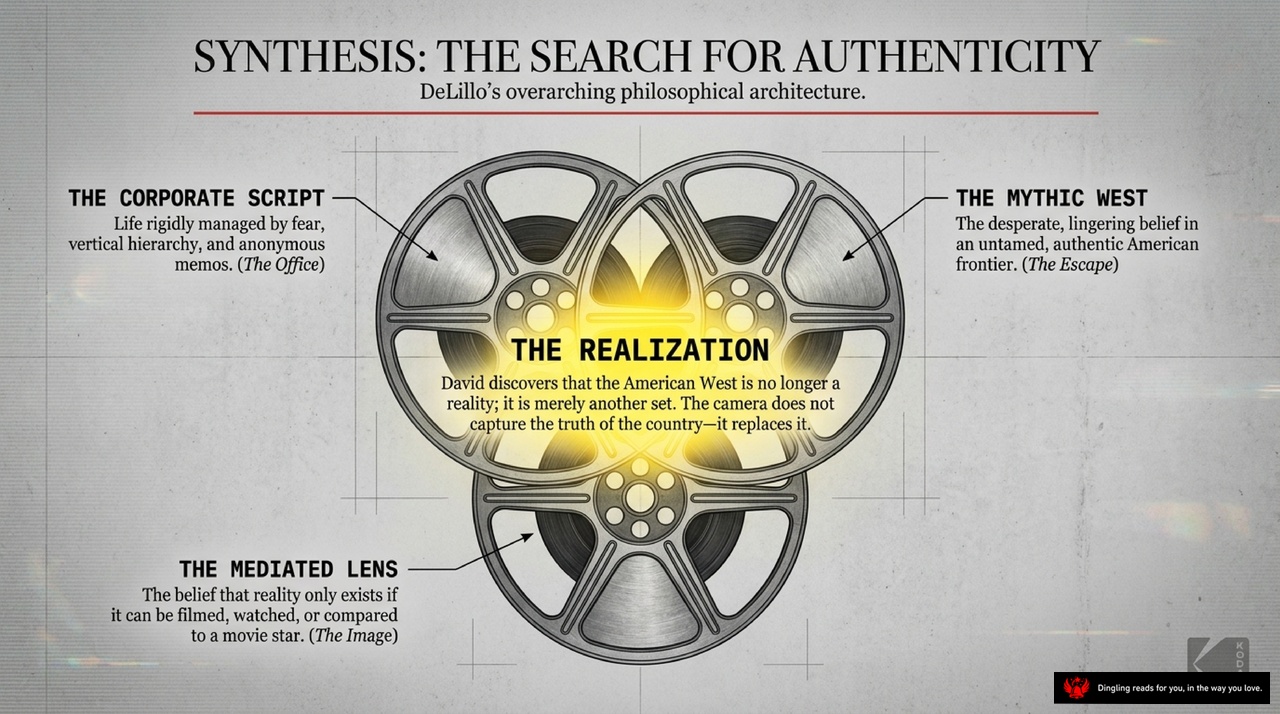
Synthesis: The Search for Authenticity. This slide maps out the core philosophical conflict driving David's journey.
On the left, we have **The Corporate Script**. This represents the suffocating reality of modern life—rigidly managed by fear, vertical hierarchies, and those anonymous memos that feel like a death sentence. It's the world of *The Office*, where authenticity is impossible because you're just acting out a role someone else wrote for you.
On the right, we see **The Mythic West**. This is the desperate, lingering belief in an untamed, authentic American frontier. It's the dream of *The Escape*, the place where you can leave the script behind and become who you're supposed to be.
In the center, connecting these two opposing forces, is **The Mediated Lens**. This is the dangerous belief that reality only exists if it can be filmed, watched, or compared to a movie star. It's the trap David falls into, thinking the camera can capture the truth.
But right in the middle, glowing bright, is **The Realization**. This is the pivotal moment where David discovers the hard truth: the American West is no longer a reality; it's merely another set. The camera doesn't capture the truth of the country—it replaces it. He realizes that in chasing the image, he's lost the substance. The search for authenticity ends when he understands that the screen is a lie, and the only way to find the real is to stop looking for it in the reflection.
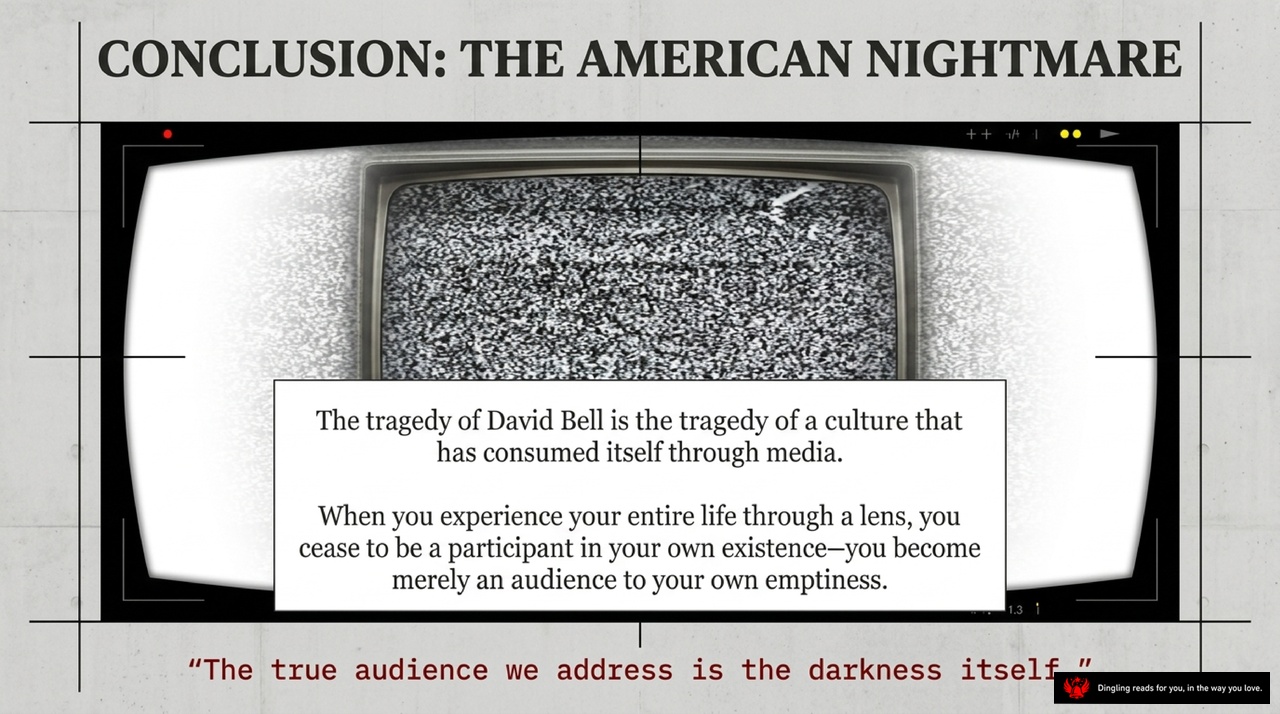
We've reached the end of our journey, and what we're left with is starkly simple, yet terrifyingly profound. As we look back at David Bell's story, we see that his tragedy isn't just his own; it's the tragedy of a culture that has consumed itself through media. When you experience your entire life through a lens, you cease to be a participant in your own existence. Instead, you become merely an audience to your own emptiness. We are all watching a movie of our lives, forgetting that we are the ones who should be living it.
The true audience we address is the darkness itself. That darkness isn't just the absence of light; it's the void inside us when we stop creating meaning and start just consuming images. We've built a world where we are constantly performing, constantly being watched, and constantly disconnected from the raw, messy reality of being human. David Bell tried to capture this truth with his camera, but in doing so, he became part of the very problem he was documenting.
So, what's the takeaway? It's a wake-up call. We need to put down the camera, both the literal one and the metaphorical one we carry in our heads. We need to stop watching and start living. We need to look up from our screens and into each other's eyes, not to judge or to capture, but to connect. Because in the end, the only thing that matters isn't how we look or what we achieve, but whether we're truly alive in the moment. It's time to turn off the screen and wake up.