
Anti-Burnout Energy Station: Complete Chapter-by-Chapter Summary

Welcome to today's session on reclaiming your life's momentum. We often think that the secret to success is sheer discipline or an endless supply of willpower, but the truth is, relying on grit alone is a recipe for burnout. The real breakthrough comes from building a sustainable system that works with your nature, not against it.
This session introduces "The Anti-Burnout Energy Station," a framework designed by an organizational behavior expert to help you overcome internal friction and flourish without exhausting yourself. Think of it as shifting from being your own harsh drill sergeant to becoming a supportive Y-type leader who trusts your natural drive.
The core of this system is understanding that energy is your most valuable resource. Instead of leaking it through constant self-criticism or endless planning, we need to create a self-reinforcing loop where small actions generate positive feedback, which in turn fuels more action. By identifying your unique energy triggers and closing those task loops, you can transform from a state of depletion into one of sustainable growth. Let's dive in and build the energy station you've been waiting for.

Stop relying on the self-discipline trap. For decades, we've been sold a lie: that success comes from sheer willpower. Look at this gauge on the left—it shows our old paradigm. It treats discipline like a battery that drains fast, driven by a harsh "Inner Drill Sergeant." We beat ourselves up, leading to burnout and lost passion. But here's the truth: high performers don't have endless discipline. They've designed a system that requires very little willpower to run.
Now, look at the new paradigm on the right. Instead of fighting yourself, you align with autonomous biological loops. You're driven by curiosity and an unconscious flow state, not fear. This creates sustainable momentum, high self-efficacy, and genuine joy. Think of it this way: a bad system is like a tyrannical instructor forcing you to march; a great system is like a comfortable home that naturally invites you to relax and thrive.
The key insight is simple but powerful: stop trying to force your way through life with grit alone. Instead, build an energy system where your interests and habits do the heavy lifting. When your system works, you don't just survive; you find a rhythm where action feels effortless, and success becomes a natural byproduct of who you are, not a struggle you endure.

Have you ever felt like you're spinning your wheels, mentally rehearsing every possible outcome of a problem without ever actually taking a step? That's what we call "Brain Idling," and it's a silent thief stealing your energy. The trap is simple: we mistake endless worrying and planning for real problem-solving. But deep down, this is just an avoidance mechanism. We're stuck in the gap between our flawless "Imagined Self"—who can solve anything instantly—and our flawed "Objective Self," who is just human.
Look at the path in front of you. When you face a challenge, you have two choices. The red, tangled path represents "Internal Friction," or overthinking. It's a dead end where you get stuck in a knot of anxiety. But the green path? That's the way to "Action." Here's the reality check: professionals produce results regardless of their emotional state. Action creates the state; the state does not create the action. You don't need to feel ready to move; you need to move to feel ready.
So, how do you know if you're stuck in the red zone or moving toward the green? Use "The Litmus Test." Ask yourself right now: "Can my current thinking be translated into an external, quantifiable result?" If the answer is no, you are leaking energy. You're just spinning your tires. Stop the overthinking, embrace the messy reality of action, and start building momentum. The only way out is through.
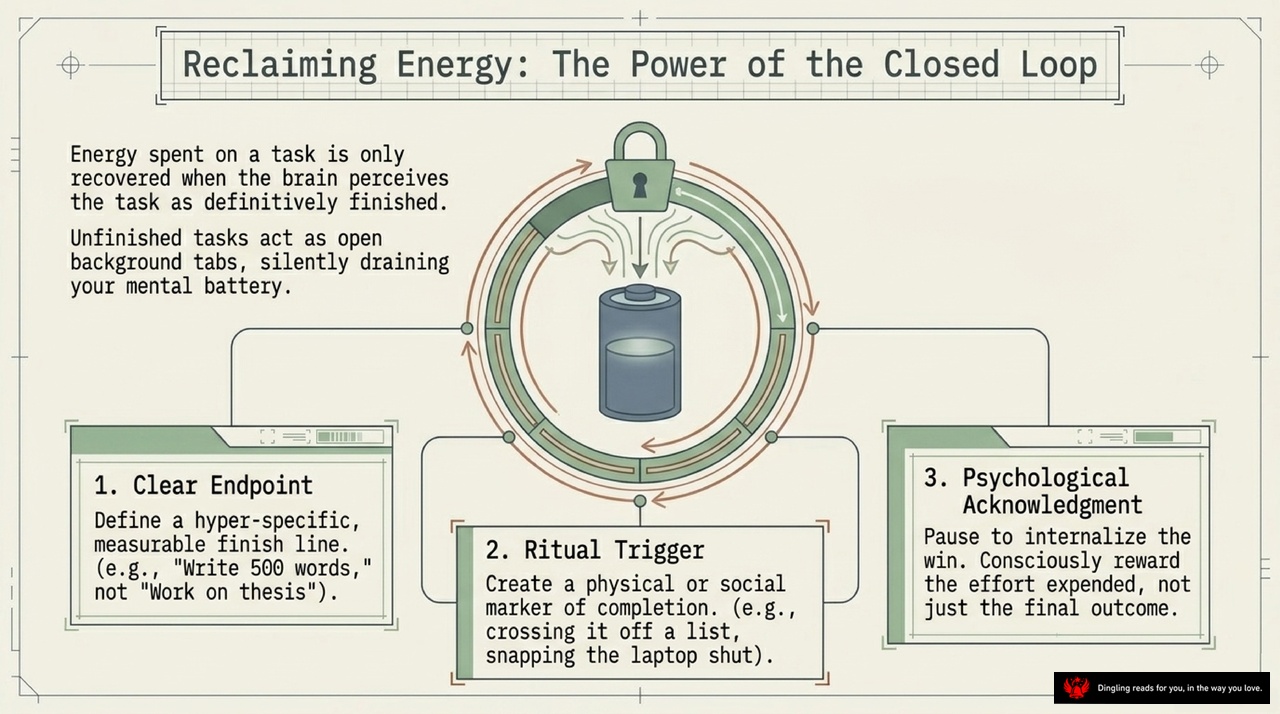
Have you ever felt that no matter how hard you try, your mental battery just won't hold a charge? You're not alone. The culprit isn't a lack of willpower; it's the fact that your brain is stuck with too many "open tabs."
Look at the diagram here. It illustrates a critical concept: **Reclaiming Energy: The Power of the Closed Loop**. The core truth is simple but profound: energy spent on a task is only recovered when your brain perceives that task as definitively finished. Until then, unfinished tasks act as open background tabs, silently draining your mental battery even when you're trying to rest.
So, how do we close these loops and recharge? The image breaks it down into three essential steps.
First, you need a **Clear Endpoint**. You must define a hyper-specific, measurable finish line. Instead of a vague goal like "work on thesis," set a concrete target like "write 500 words." Your brain needs to know exactly where the job is done.
Second, create a **Ritual Trigger**. You need a physical or social marker to signal completion. This could be crossing something off a list or simply snapping your laptop shut. This action tells your brain, "Yes, it's over."
Finally, practice **Psychological Acknowledgment**. Pause for a moment to internalize the win. Consciously reward the effort you just expended, not just the final outcome. This is the moment you actually reclaim your energy.
When you master this closed loop, you stop leaking energy into unfinished business and start building a self-sustaining cycle of momentum.

When you're stuck in a low-energy slump, the key to breaking out isn't relying on sheer willpower—it's about engineering your own momentum through what we call "micro-victories." Look at this diagram: imagine a ball rolling down a steep slide. That downward path represents the feeling of avoidance and anxiety when you face complex, long-term tasks. The steeper the slope, the harder it is to stop, and the more your energy drains away.
But here's the rule that changes everything: when your energy is in the red, abandon the "all-or-nothing" mentality. Instead of trying to climb that steep slide all at once, you need to pick the lowest-hanging fruit. Think of it as finding a small, manageable step that requires minimal effort but has a definitive end. By completing a tiny task—like writing just 300 words or organizing your desk for five minutes—you create a sense of closure. This isn't just about checking a box; it's about triggering a biological engine.
Once you take that small action and complete the task, your brain releases dopamine. This chemical reward boosts your self-efficacy, which is simply your belief that you can succeed. And here is the magic part: increased self-efficacy translates directly into higher energy for your next task. Instead of rolling down the slide into exhaustion, you are now building a staircase. Each micro-victory gives you the fuel to tackle the next one, turning a cycle of avoidance into a powerful upward trajectory. So, don't wait for a massive breakthrough. Start with the smallest possible win today, close that loop, and watch your energy naturally rise.

Your phone isn't the problem; it's just a symptom of something deeper. We aren't actually craving that glowing screen. What we're really doing is trying to self-medicate three neglected biological needs.
Let's break down what's really going on. First, look at Need 1: "I'm Tired." We think scrolling will rest our bodies, but the reality is the opposite. It overloads your cognitive bandwidth and spikes cortisol, preventing the actual recovery you need.
Next, consider Need 2: "I'm Bored." We believe infinite feeds will cure boredom, but they just spike cheap dopamine, numbing your brain's reward center and stealing away from real, grounded joy.
Finally, there's Need 3: "I'm Lonely." We assume likes equal community, but shallow digital interactions leave our social brains starving, isolated, and highly anxious.
So, stop blaming your lack of discipline. Your phone is just a tool; the real issue is that you haven't met your fundamental human needs for rest, novelty, and genuine connection.
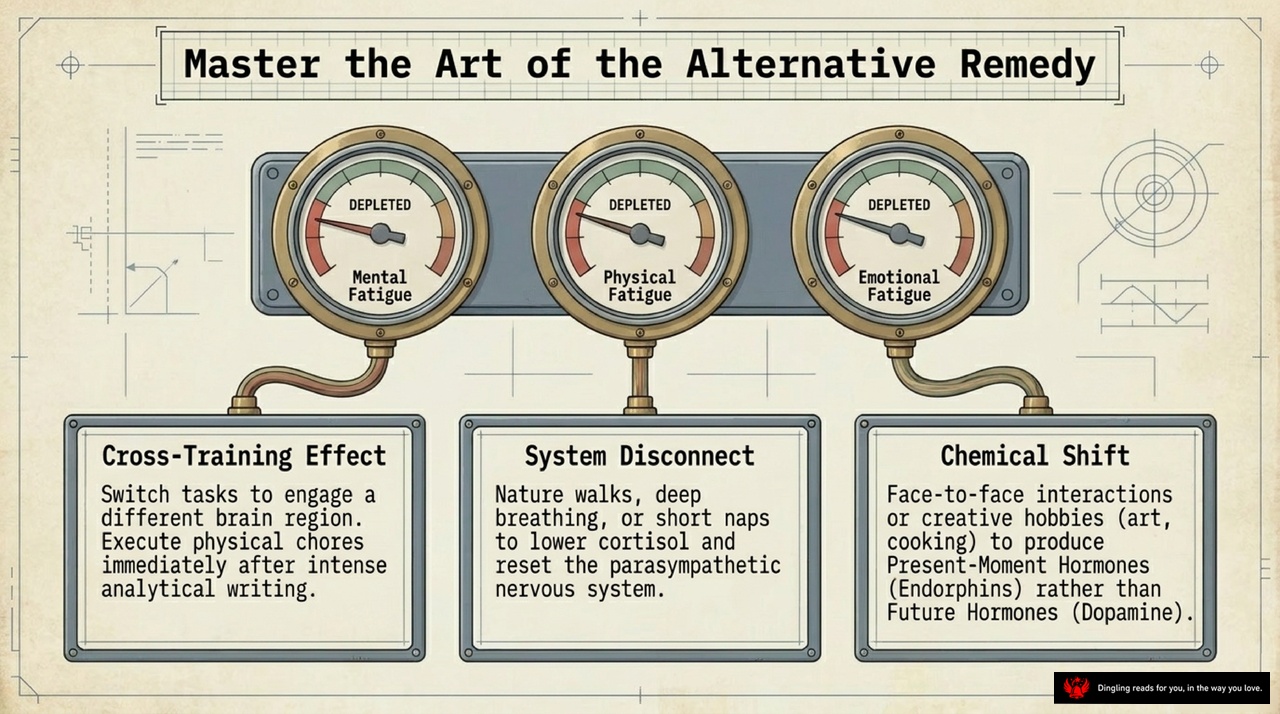
Look at these three gauges. Mental fatigue, physical fatigue, and emotional fatigue—all pointing to "depleted." This is the reality of burnout. But what if you could flip the switch and recharge them instead?
The solution lies in mastering the art of the alternative remedy. Instead of forcing your brain to work harder, we need to switch tasks to engage a different brain region. Think of it as cross-training for your mind. If you've been doing intense analytical writing, immediately switch to physical chores. This engages a completely different neural pathway, allowing your exhausted analytical center to rest while your body gets the movement it needs.
But movement isn't enough. You also need a system disconnect. When your cortisol is sky-high, you need to lower it to reset your parasympathetic nervous system. Go for a nature walk, practice deep breathing, or even take a short nap. These aren't just breaks; they are essential system resets that allow your brain to truly come back online.
Finally, we need to trigger a chemical shift. Most of us are addicted to "future hormones" like dopamine, which come from scrolling feeds and chasing the next hit. That energy is fleeting and often leaves you drained. Instead, seek out "present-moment hormones." Engage in face-to-face interactions, cook a meal, or dive into a creative hobby like art. These activities produce endorphins—feelings of genuine joy and connection that last.
By combining cross-training, disconnecting from stress, and shifting your chemistry, you stop fighting fatigue and start harnessing energy. It's not about pushing through the burnout; it's about intelligently restoring your system so you can keep going.
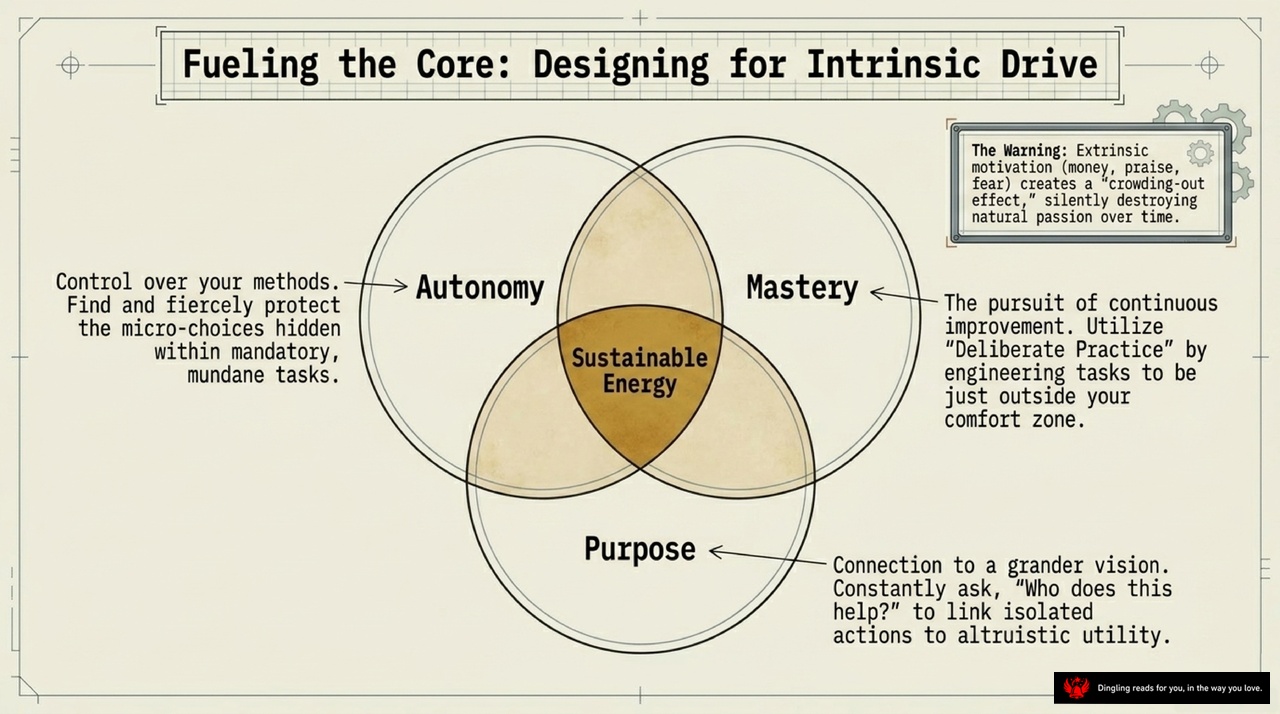
Let's talk about the invisible force that actually powers your success. Look at this diagram: it's not about willpower; it's about designing a system for intrinsic drive. The core idea here is that sustainable energy comes from the intersection of three circles: Autonomy, Mastery, and Purpose.
First, Autonomy. This is about control. It means finding the micro-choices hidden inside your mandatory tasks and fiercely protecting them. You need the freedom to choose your methods, even within the constraints of a boring job.
Next, Mastery. This is the pursuit of continuous improvement. It's not just about working hard; it's about utilizing "Deliberate Practice." You have to engineer your tasks so they sit just outside your comfort zone, forcing you to grow.
And finally, Purpose. This connects your daily grind to a grander vision. Constantly ask yourself, "Who does this help?" Linking your isolated actions to altruistic utility gives your work meaning.
But here is the critical warning in the corner: you must avoid extrinsic motivation. When you rely on money, praise, or fear, you create a "crowding-out effect." It silently destroys your natural passion over time. True, lasting energy doesn't come from external rewards; it comes from designing a life where you have the autonomy to create, the mastery to improve, and the purpose to matter.
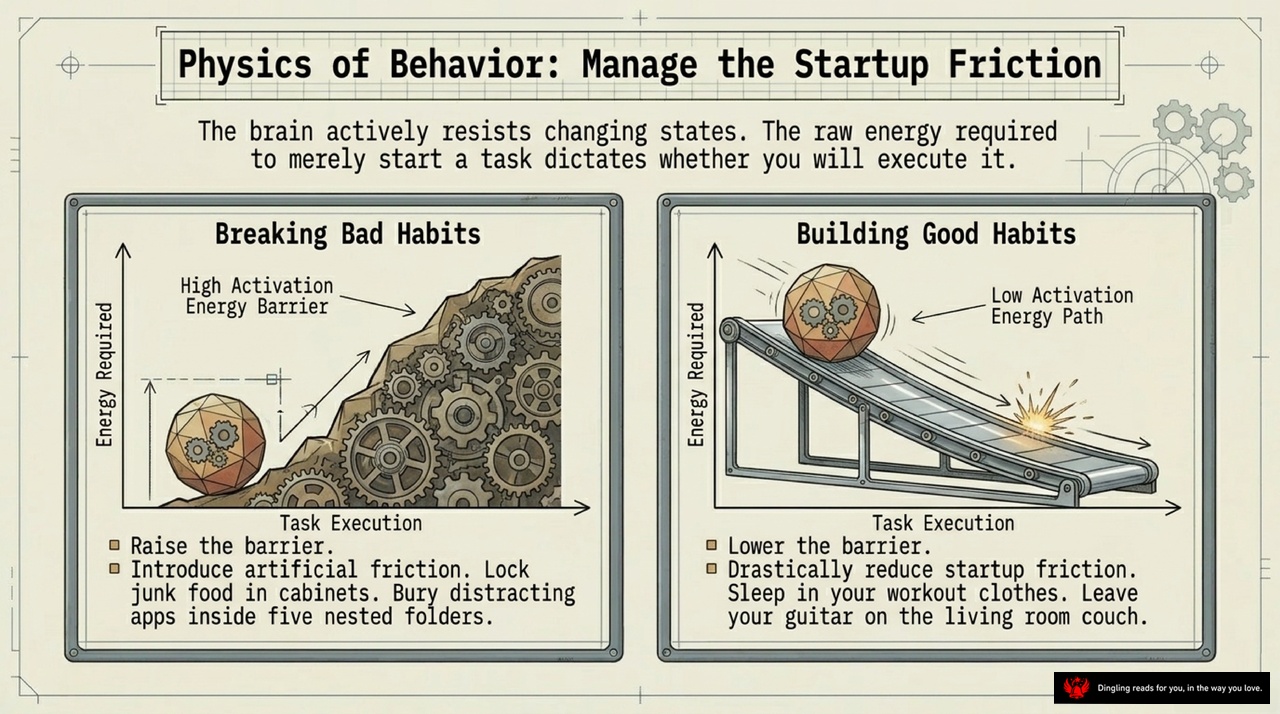
Let's talk about the physics of behavior, specifically how to manage that annoying "startup friction" that stops us from getting things done. As the slide illustrates, our brains are wired to resist changing states. The raw energy required just to start a task dictates whether we actually execute it or not.
Look at the left side: Breaking Bad Habits. Here, we see a "High Activation Energy Barrier." It's like trying to push a heavy ball up a steep hill of gears. To break these habits, we need to raise the barrier. We introduce artificial friction to make the bad behavior harder to do. Think about locking junk food in cabinets, burying distracting apps inside five nested folders, or simply making the path of least resistance lead away from the habit you want to quit.
Now, look at the right side: Building Good Habits. This is about creating a "Low Activation Energy Path." Imagine that same ball rolling down a conveyor belt. To build good habits, we must drastically reduce startup friction. We lower the barrier so the action becomes effortless. Practical examples? Sleep in your workout clothes so you don't have to decide to exercise in the morning. Leave your guitar on the living room couch so it's within arm's reach. By making the good action easy and the bad action difficult, you let physics do the work for you.
The core lesson here is simple: don't rely on willpower to overcome friction. Instead, redesign your environment so that good habits flow naturally and bad habits require too much effort to sustain. Manage the friction, and you manage your behavior.
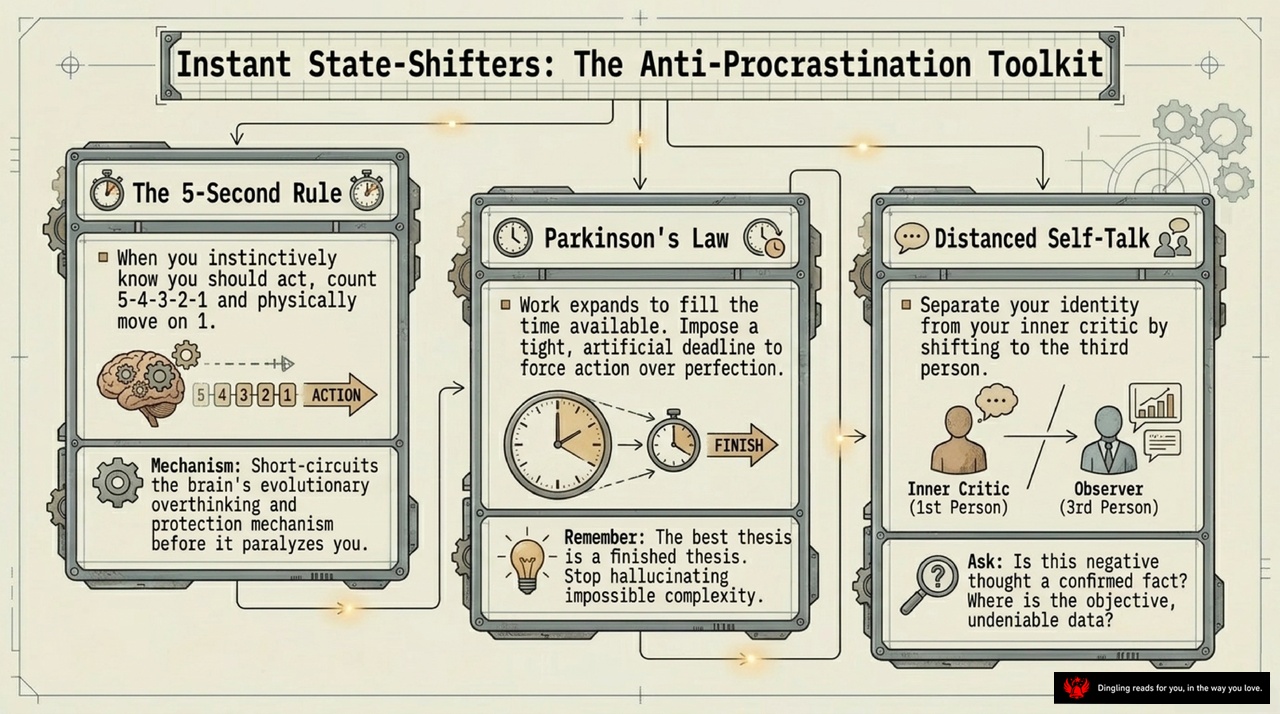
Welcome to the final toolkit in our anti-procrastination series. Today, we're moving from theory to immediate action with three powerful "Instant State-Shifters."
First, let's tackle the paralysis of overthinking with **The 5-Second Rule**. When you instinctively know you should act but your brain starts making excuses, simply count 5-4-3-2-1 and physically move on 1. This short countdown short-circuits your brain's evolutionary overthinking mechanism before it can stop you, forcing you into action.
Next, we have **Parkinson's Law**, which reminds us that work expands to fill the time available. Instead of letting perfectionism drag you out, impose a tight, artificial deadline. Remember, the best thesis is a finished one. By stopping the hallucination of impossible complexity and focusing on a clear finish line, you force action over perfection.
Finally, let's silence the inner critic using **Distanced Self-Talk**. Separate your identity from your negative thoughts by shifting to the third person. Instead of saying "I'm failing," tell yourself, "He is struggling." Ask yourself: Is this negative thought a confirmed fact, or just an emotion? Look for objective, undeniable data rather than getting lost in self-doubt.
These three tools—the countdown, the deadline, and the perspective shift—are your immediate keys to breaking free from procrastination and reclaiming your momentum.

Show Your Work to Multiply Energy. Here's the core idea: humans are biologically wired to need social reinforcement. Private victories keep you going for a moment, but external feedback creates exponential momentum.
Let's break down how to harness this. First, share the process. Stop waiting for perfection. Post your early drafts, your daily struggles, and your raw learnings with peers or online. Visibility turns your private effort into public momentum.
Next, pick low-hanging fruit. Choose the most frictionless medium to share your ideas. Maybe it's writing a quick book review or hosting a casual 10-minute mini-workshop. The goal is to get your ideas out without overthinking.
Then, reframe rejection. Treat negative feedback as objective market data for iteration, never as a personal indictment of your worth. Every critique is just a clue, not a verdict.
Finally, understand the "why." By making your work visible, you stop relying on fragile internal motivation and tap into a powerful external loop. Your ideas get seen, you get feedback, you iterate, and your energy multiplies. Don't hide your work; show it to multiply your energy.
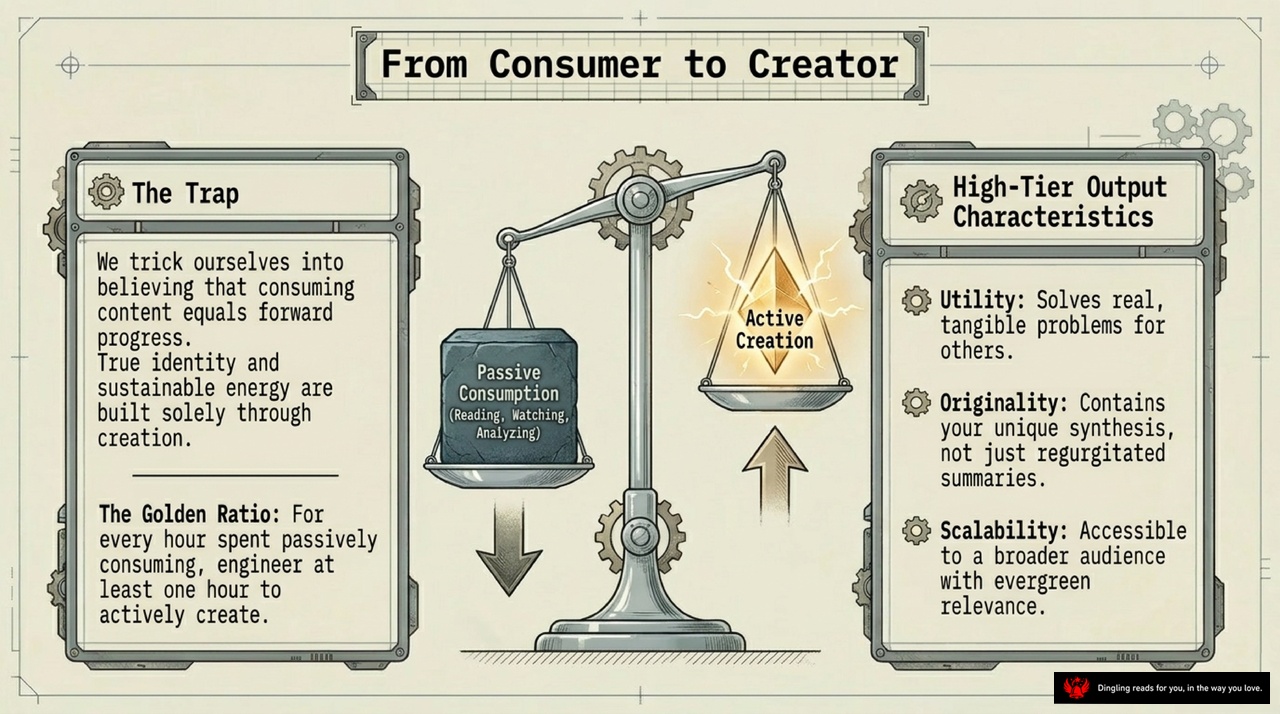
From Consumer to Creator: The Shift That Changes Everything
Look at this scale. On the left, we have "Passive Consumption"—reading, watching, analyzing. It feels productive, right? We trick ourselves into thinking that consuming content equals forward progress. But this is the trap. True identity and sustainable energy aren't built by what you take in; they are built solely through what you put out.
On the right side, we see "Active Creation." This is where high-tier output lives. It's not just about making things; it's about three specific characteristics. First, Utility: your work must solve real, tangible problems for others. Second, Originality: it needs to contain your unique synthesis, not just be a regurgitated summary of what you've read. And third, Scalability: your ideas should be accessible to a broader audience with evergreen relevance.
So, how do we move from the heavy side of consumption to the light, energized side of creation? There is a Golden Ratio you need to engineer into your life. For every hour you spend passively consuming, you must engineer at least one hour to actively create.
Why does this matter? Because passive consumption drains your energy without giving it back, while active creation creates a self-reinforcing loop of energy and identity. Stop waiting to feel ready. Start creating, and watch how your entire life shifts from being a consumer of other people's ideas to becoming a creator of your own.

The Ultimate Metric: Your Circle of Influence. Think of your life not as a fixed point, but as a series of expanding rings. At the very center is Survival—your health and stability. Moving outward, you build Skills to manipulate the world, and then expand further with Intellect by sharing frameworks that help others. This entire structure is your Circle of Influence. The core truth here is simple yet powerful: burnout and depression almost always stem from a shrinking circle of influence. When you feel like you have zero impact on your environment, that crushing feeling is what drains your energy. But your Prime Directive is to constantly fight against that stagnation. Your life's work is to expand outward, turning the uncomfortable and unknown into something familiar and controlled. Don't stay stuck in the center worrying about things you can't control; instead, focus your energy on building skills and sharing ideas that actively change your world. Every time you take action that ripples out, you aren't just working harder; you are reclaiming your energy and proving to yourself that you matter. Keep expanding your circle, and you will naturally move away from burnout and into a state of vibrant, sustainable action.

Look at this slide, "Task Separation in the Energy Valley." It perfectly illustrates the difference between how you should run your life versus how most people get trapped. On the left, under "My Business," we see a grid of organized modules. This represents your energy core. The text tells us to defend this fiercely. This is about protecting the quality of your daily output, setting clear personal boundaries, choosing how you respond to chaos, and quietly planning your exit strategy. It's about owning your autonomy.
Now, look at the right side: "Their Business." The image is chaotic, with broken pieces and lightning bolts. This is the threat. It represents micromanagers, toxic systems, and corporate rules that strip away your freedom. The advice here is simple but powerful: "Let it go." You cannot control how your boss reacts, the unfair rules of the company, or what your colleagues think of you. Trying to control these things is a waste of energy.
The core lesson here is separation. Your energy belongs to your own business—your habits, your boundaries, and your strategy. The chaos of the corporate environment belongs to "them." If you try to fix their problems or control their reactions, you leak your energy. Instead, focus entirely on the left side. Protect your output, set your boundaries, and plan your path. By separating what you can control from what you can't, you stop the chaos from draining you and start building a sustainable, high-energy system that works for you, not against you.
True vitality doesn't come from relentless self-discipline, but from honoring your intrinsic needs. Think about it: if you stop living by everyone else's exhausting standards, what incredible things could you finally build with the energy you get to keep?
The secret lies in plugging those energy leaks, engaging in meaningful action, and continuously expanding your circle of influence. When you do this, you transform internal friction into unstoppable momentum. Instead of fighting against yourself, you align with what naturally drives you, turning every small win into fuel for the next. This isn't about forcing yourself to be better; it's about creating a system where your best self simply shows up, day after day.