
Art as Experience: Complete Chapter-by-Chapter Summary

Welcome to a journey that breaks down the walls of the museum. Today, we're exploring John Dewey's revolutionary idea: "Art as Experience." Forget the notion that art is just a static object sitting behind glass, like a relic in a case. Dewey argues that the true essence of art isn't the marble or the canvas itself, but the living, rhythmic heartbeat of everyday human life.
Think about it. When a fire engine screams past, creating a moment of intense focus, or when a worker gets lost in the rhythm of their craft, or even when a mother tends to her garden with quiet joy—these aren't just random moments. They are the raw, unpolished seeds of art. They are experiences where action and feeling merge into one. Dewey believes that by stepping out of the museum and back into the flow of our daily lives, we rediscover that art is simply the refined version of these ordinary, yet profound, human moments. It's a philosophical journey reminding us that we are all artists in the making, finding meaning and beauty in the very act of living.
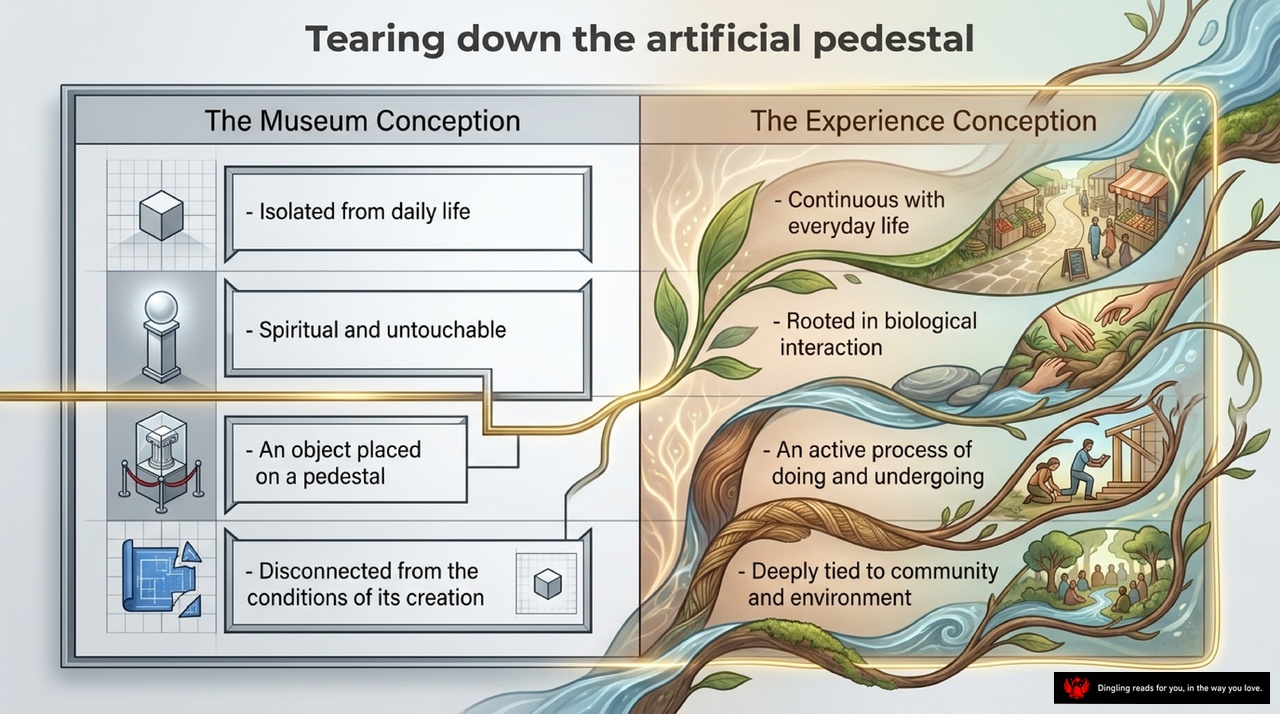
We often treat art as something sacred, locked away on a pedestal, completely separate from our messy, vibrant daily lives. But what if that separation is actually the problem? This slide challenges us to tear down that artificial pedestal and see how art and life are deeply intertwined.
On the left, we see "The Museum Conception." Here, art is isolated, spiritual, and untouchable—just an object placed on a stand, disconnected from the very conditions of its creation. It feels distant, like a relic in a glass case. But look at the right side: "The Experience Conception." This is where art comes alive. It's continuous with everyday life, rooted in our biological interactions, and deeply tied to our community and environment.
Think about it: isn't the joy of gardening, the focus of a skilled craftsman, or the rhythm of a bustling market just as artistic as a painting in a gallery? The slide shows us that art isn't about escaping life; it's about engaging with it. It's an active process of doing and undergoing, where we transform our raw experiences into something meaningful. By shifting from the museum mindset to an experience mindset, we realize that art isn't something we visit—it's something we live. It's the heartbeat of our shared human story, waiting for us to step off the pedestal and into the flow of life itself.

Art originates from the biological rhythms of living creatures, a concept that breaks down the complex process of aesthetic achievement into three distinct, yet interconnected layers.
At the very base, we have the **Base Layer**. This is where life truly begins: the organism exists in a constant state of falling out of step with its environment, struggling tirelessly to restore equilibrium. It is a cycle of imbalance and recovery, the fundamental heartbeat of existence.
Moving up, we find the **Middle Layer**. Here, raw instinct evolves into conscious interaction. It is the moment where action merges with feeling. The organism doesn't just react; it engages, transforming the struggle against the environment into a meaningful experience.
Finally, at the **Top Layer**, we reach the foundation of all aesthetic achievement. This is the biological rhythm of tension and its harmonious resolution. When that constant struggle for balance reaches a peak of clarity, it becomes art. This unacknowledged rhythm is the invisible engine driving every great artistic moment, proving that art isn't something separate from us—it is simply the highest expression of our own living rhythm.

The image before us illustrates a profound truth: the continuous loop of doing and undergoing. On the left, we see the realm of "Doing"—where the organism actively acts upon its environment, altering its surroundings and projecting its own intention. It's the blueprint, the action, the force we exert on the world. On the right lies "Undergoing"—the moment the organism receives the consequences of its own actions, registering resistance, feeling the pushback, and adapting its senses. It's the feedback, the impact, the world acting back upon us.
Look closely at that glowing center where these two loops fuse. That is where experience is born. It happens at the exact point where action and consequence merge. We are not just doers or just receivers; we are caught in this dynamic cycle. When we act, we change the world; when the world reacts, we change ourselves. This isn't just a philosophical concept; it's the rhythm of life itself. From the beat of our hearts to the way we navigate a crowded room, we are constantly balancing the energy we put out with the energy we take in. This very tension, this interplay between what we do and what we receive, is the source of all aesthetic experience. It is the engine that drives us from chaos toward a richer, more complex form of balance.
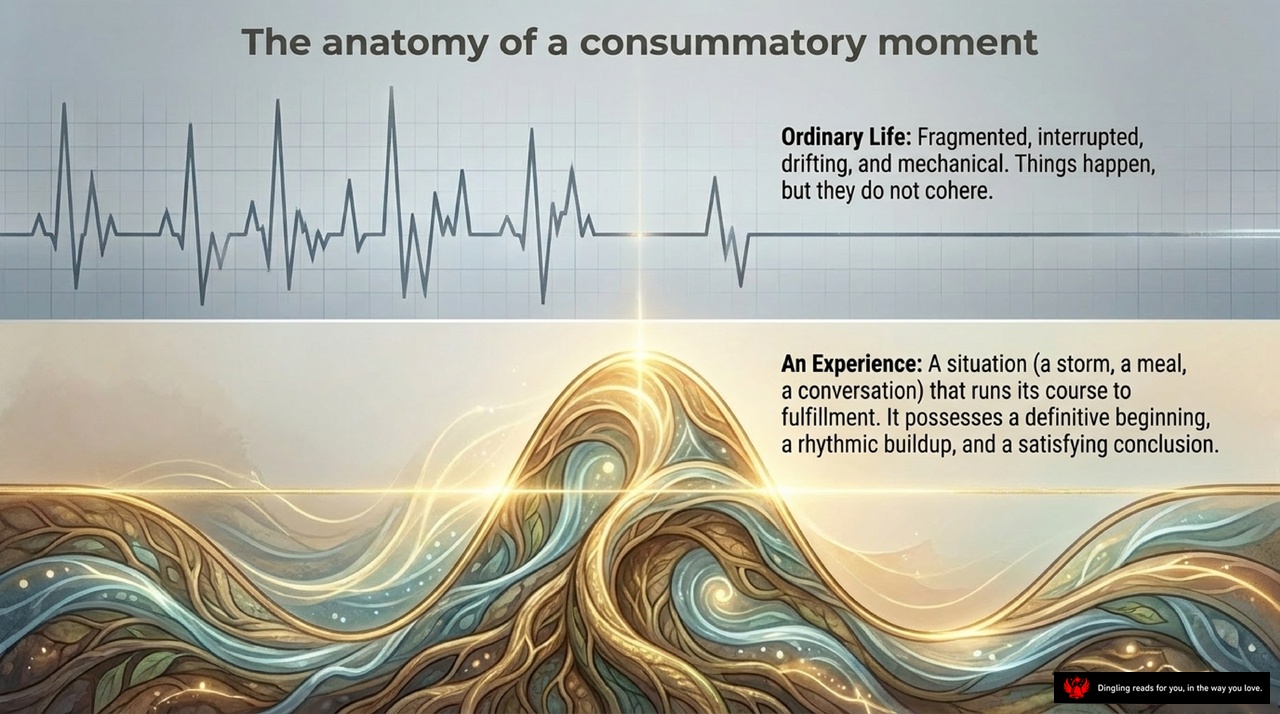
The Anatomy of a Consummatory Moment: From Fragmented Drifting to Fulfillment
Look at this split image. The top half shows a jagged, erratic heartbeat line, representing "Ordinary Life." The text describes it as fragmented, interrupted, drifting, and mechanical—things just happening without any real coherence. We often live this way, reacting to one event after another without seeing the bigger picture.
But look at the bottom half. It transforms into a flowing, golden wave, symbolizing "An Experience." This is where life finds its rhythm and meaning. The text defines this as a situation—like a storm, a meal, or a deep conversation—that runs its full course to fulfillment. It has a definitive beginning, a rhythmic buildup, and a satisfying conclusion.
This contrast captures the core of what it means to truly live. While our daily existence often feels like a series of disconnected interruptions, true experiences are complete narratives. They possess an internal logic and a sense of closure that ordinary drifting simply lacks. When we engage in these consummatory moments, we aren't just passing time; we are actively shaping a coherent story out of the chaos of life, finding that essential balance between the unpredictable nature of our world and the structured rhythm of our own human experience.
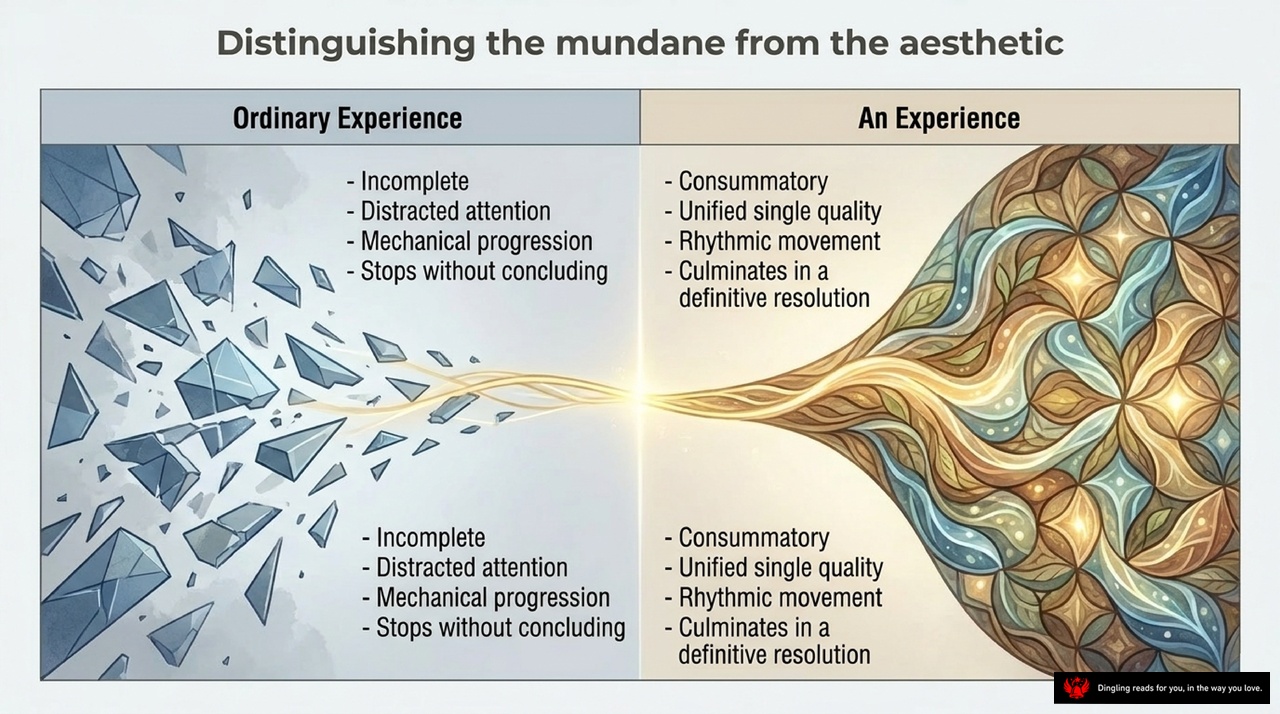
Rhythm isn't just about repetition; it's the functional order that pushes an experience toward its completion. Think of a clock ticking in a straight line—it's boring, even annoying. But in art, rhythm thrives on organic variation. A great singer doesn't just hit the metronome; they breathe with it, stretching or compressing time to serve the emotion. That freedom is the heartbeat of art versus machinery.
Look at the slide. On the left, you see "Ordinary Experience." It's fragmented, distracted, and mechanical. It starts but never truly concludes; it just stops. It's like walking through a busy city where your attention is scattered, and you never arrive anywhere meaningful.
But on the right, we have "An Experience." This is where the magic happens. It's consummatory—it has a beginning, a middle, and a definitive resolution. It moves with a unified, rhythmic quality, culminating in a sense of completion. Just like the text describes, rhythm organizes scattered sensory stimuli into a coherent whole. It's the difference between a random jumble of notes and a symphony that builds tension and releases it beautifully.
This rhythmic balance is essential. Without it, life feels chaotic; with too much rigid order, it feels dead. Art finds the sweet spot between the two. It repeats enough to feel familiar and safe, but varies enough to keep us engaged and alive. When we truly experience art, we aren't just looking at a static object; we are riding a wave of energy that moves us from uncertainty to fulfillment, restoring our inner balance in a way that ordinary moments rarely do.
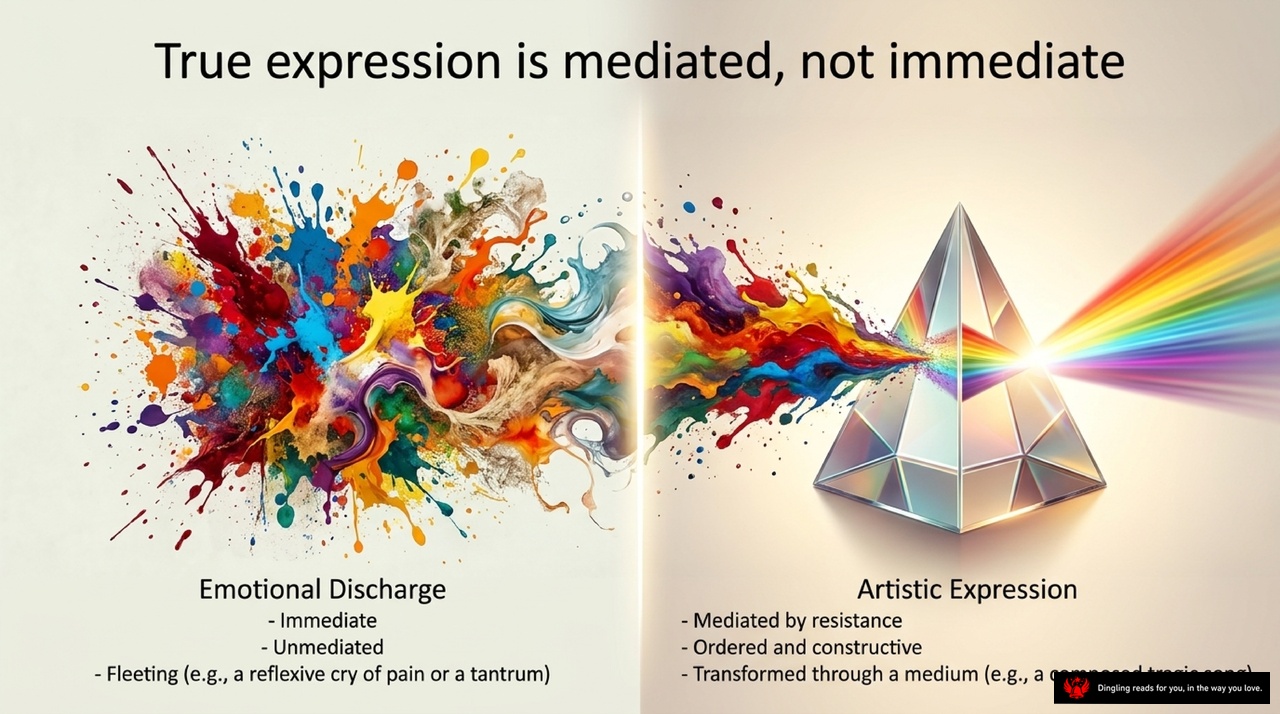
True expression is mediated, not immediate. Look at this image: on the left, we see a chaotic explosion of color—this represents emotional discharge. It's immediate, unmediated, and fleeting, like a reflexive cry of pain or a tantrum. But on the right, that same chaotic energy hits a prism. The colors don't just scatter; they are refracted into an ordered, constructive rainbow. This is artistic expression.
The text explains that true expression isn't about blindly releasing energy. It's about what happens when that impulse meets resistance. Think of it like this: when you try to push a heavy door that won't budge, that resistance doesn't stop you; it forces you to find a new way, a new shape for your effort. In art, the medium itself becomes that resistance. The paint, the stone, the sound—they push back against the artist's raw impulse. The artist doesn't just pour emotion out; they struggle with the material, shaping it until the emotion finds a form.
This is why we call it "mediated." The artist uses a medium to transform the raw, chaotic energy of life into something ordered and meaningful. It's not about escaping reality, but about engaging with it deeply enough to reshape it. Just as the prism turns a messy beam of light into a clear spectrum, art takes our scattered experiences and organizes them into something we can truly understand and feel. That struggle, that mediation, is where the real art happens.
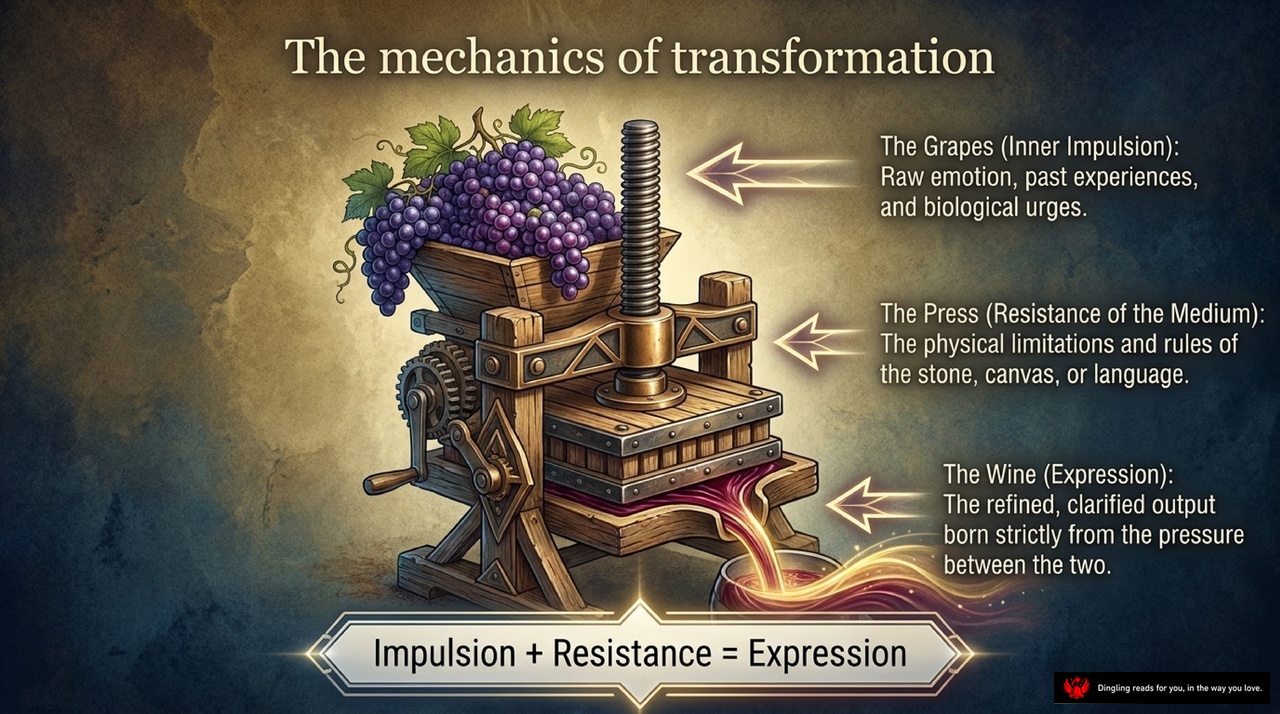
Imagine a simple wooden press, the kind you might find in an old winery. Here, we see the entire mechanics of artistic transformation laid out in three powerful steps. First, look at the grapes on the left. These represent our "Inner Impulsion"—the raw emotion, past experiences, and biological urges that churn inside us. But grapes alone don't make wine; they just sit there, unrefined and chaotic.
Next, notice the heavy wooden press in the center. This is the "Resistance of the Medium." Think of this as the physical limitations of your chosen material—whether it's the stubbornness of stone, the flow of paint on canvas, or the structure of language. This resistance isn't a barrier to be defeated; it's the necessary force that shapes your impulse. Without this pressure, your emotions remain scattered and undefined.
Finally, look at the rich, flowing wine pouring out at the bottom. This is your "Expression." It's the refined, clarified output born strictly from the pressure between the two. As the text at the bottom reminds us: Impulsion plus Resistance equals Expression.
This is the core of how art happens. It's not just about pouring out your feelings, nor is it just about manipulating materials. True expression happens only when your inner drive meets the external constraints of the medium, forcing them to fuse into something entirely new. It's the moment where raw life becomes art.
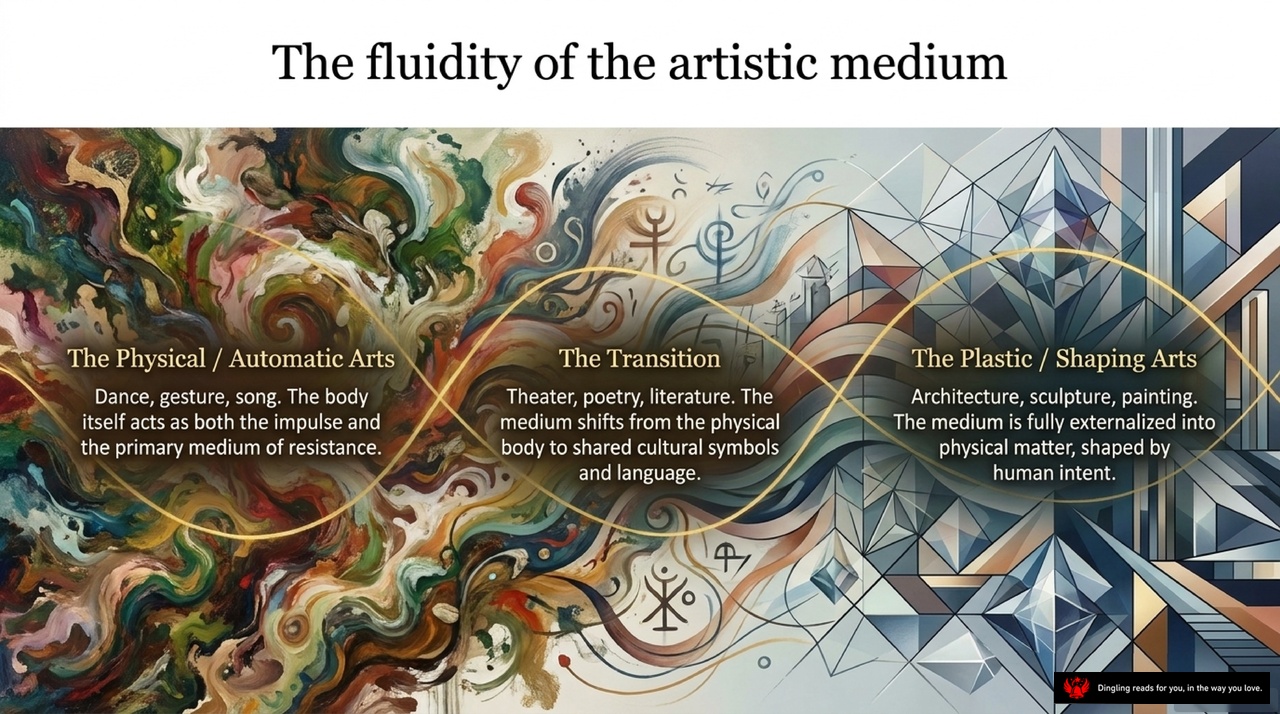
Welcome to the final chapter of our exploration into the nature of art. Today, we're looking at the profound relationship between art and civilization.
The slide in front of us captures a pivotal moment in history: the shift from the rigid "Naturalism" of the 19th century, which tried to simply copy reality, to the revolutionary breakthroughs of the early 20th century. By drawing inspiration from Egypt, Byzantium, the East, and even primitive art, artists shattered the narrow boundaries of what we thought was possible. But here is the key insight: this wasn't just about borrowing new styles or mimicking foreign forms. True transformation happens only when we internalize these different cultural attitudes, turning them into new ways of seeing. This is how art stops being a fleeting trend and becomes a bridge, allowing us to deeply understand experiences that are completely foreign to us.
Art is a universal language that transcends our verbal limitations. Think about it: music can make strangers weep together regardless of their native tongue, and a painting can convey a sense of awe that bypasses cultural barriers entirely. Yet, ironically, our modern society often treats art as an isolated entity, disconnected from the rest of life. This isolation is actually a mirror reflecting a lack of cohesion within our own society. To fix this, we need to reconnect the spiritual ideals of art with the raw, practical insights of science.
Science, once seen as the enemy of the soul, actually offers art a treasure trove of new materials. It reveals the resistance of the environment, which gives artists fresh ways to express the human struggle. This reconnection liberates the spirit from old traditions and sharpens our sensitivity to the new. Today's art might seem scattered, but it is actually expanding our visual vocabulary by including everyday objects in the realm of the beautiful.
The ultimate goal of art is not just decoration or moralizing. Its moral duty is to show us possibilities we haven't yet realized, using imagination to reshape our desires and goals. While rigid systems often limit us, art breaks those walls. It offers a liberating force, helping us escape the constraints of reality and touch a better life. More importantly, art has a unifying power. It melts together the diverse experiences of different civilizations and individuals into a shared spiritual wealth.
In the end, the liberation and unity that art provides start with our focus on imaginative experience. It is this shared, expanded vision that drives our civilization forward, proving that art is not just an escape from reality, but the very engine that helps us build a more complete human future.
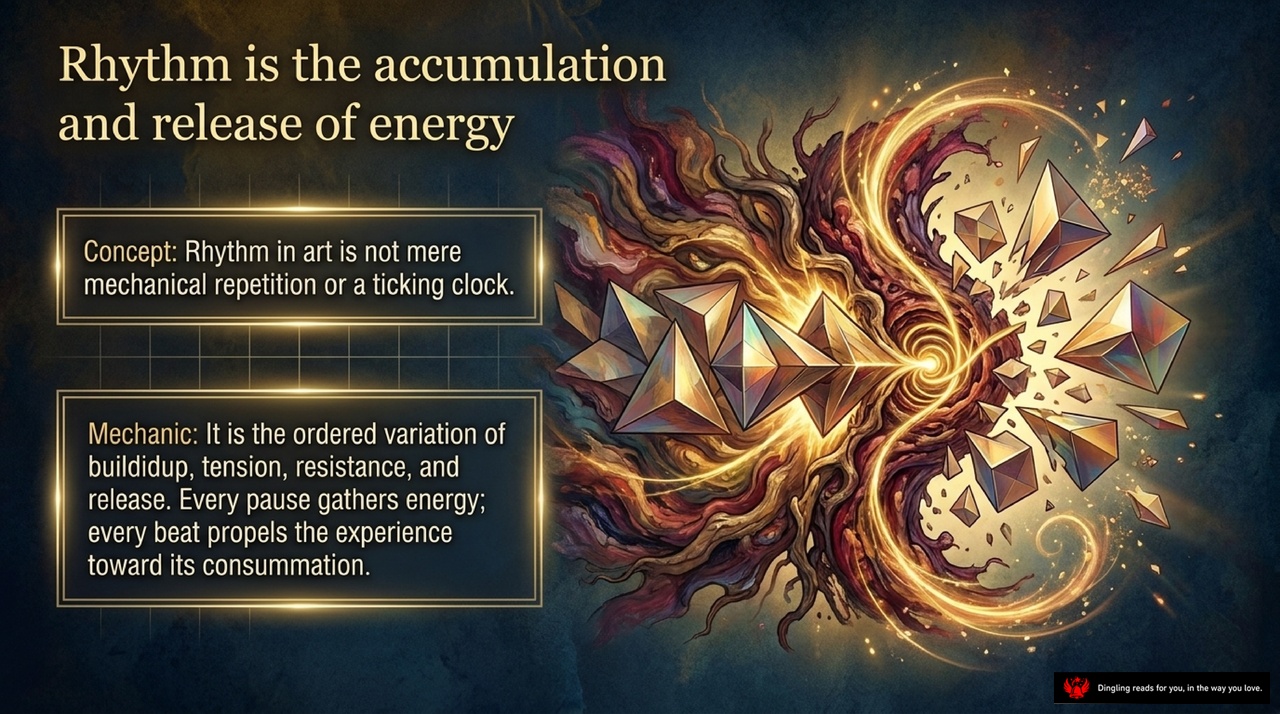
Rhythm isn't just a metronome ticking away; it's the very engine that drives our experience toward its fullest potential. Think of it as the accumulation and release of energy, a dynamic dance between order and variation. If everything were a perfect, mechanical repetition—like a clock's relentless tick—the result would be boring, even frustrating. True artistic rhythm thrives on organic variation. It's about how a repeated element, like a chorus in a folk song or a recurring motif in a painting, gains new meaning and emotional weight every single time it appears because the context has shifted.
This balance between the familiar and the new is crucial. We crave the comfort of order, but we also desperately need the spark of novelty to stay alive. Too much chaos leaves us anxious and lost, while too much rigidity makes us feel stagnant. Great art, whether it's Renoir's shifting brushstrokes or a composer's evolving melody, sits right in that sweet spot. It uses repetition to build a sense of structure and expectation, then introduces just enough variation to keep us engaged and surprised. It's not about random change; every shift serves the larger goal of pushing the experience toward a satisfying conclusion. This is the secret to making art feel alive, mirroring the natural rhythm of life itself where we constantly seek to balance stability with the thrill of the unknown.

Shattering the illusion of form versus substance isn't just an abstract philosophical debate; it's about how we actually see the world. Look at this visual journey. We start in Step 1 with two separate circles: Form and Substance. This represents the common trap where we think form is just a hollow container imposed on raw material from the outside. But the text reveals the truth: form isn't an external shell; it is simply the dynamic organization of the substance itself.
Moving to Step 2, we see these elements rotating and intersecting. This is where the magic happens. As the artist works, the material and the shape merge. The pigment isn't just paint; the stone isn't just rock. They become "formalized material," where the medium itself becomes the expression of the idea.
Finally, Step 3 shows us a unified 3D sphere representing a single perspective. Here, the illusion shatters completely. We realize that form and substance are inseparable, just like a punch where the motion and the impact are one. The text tells us that true form reaches its highest potential for clear, communicative expression when it stops being a decoration and starts being the very essence of the experience. So, next time you look at art, don't separate the shell from the core. See the dynamic energy that binds them into one living whole.
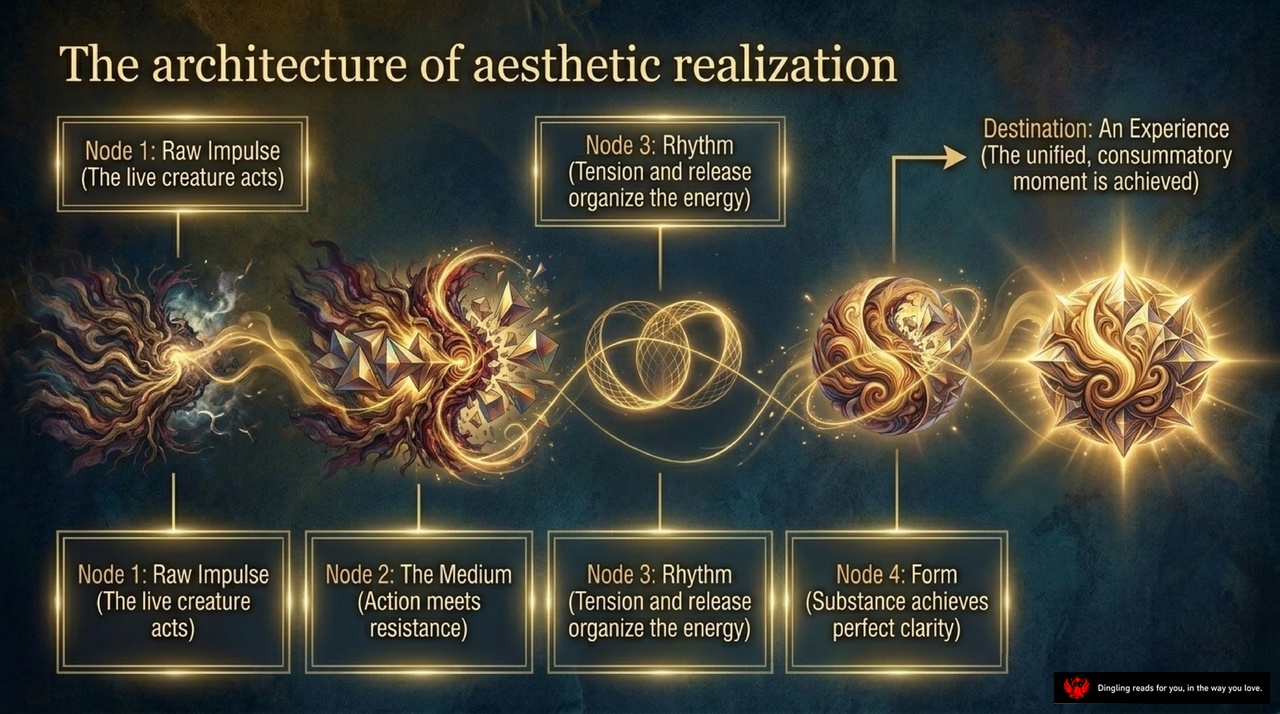
Welcome to the final node of our aesthetic architecture: **Form**. Look at this diagram. We've traveled from the raw impulse of life, through the resistance of the medium, and the organizing rhythm of tension and release, all leading us here to this brilliant, crystallized destination: **Form**.
In this slide, you see that form is where "substance achieves perfect clarity." It's the moment when the chaotic energy of life gets locked into something we can actually see and feel. But here's the thing: form isn't just a pretty decoration glued on top of an idea. Think about a punch in boxing. You can't separate the fist from the target; the motion and the hit are one single event. In art, the material—the paint, the stone, the sound—isn't just a tool we use and throw away. It becomes the substance itself. When an artist masters the medium, the clay stops being just dirt and starts being a sculpture; the color stops being just pigment and becomes the very soul of the painting.
This slide also reminds us that form is deeply rooted in nature. Look at the swirling patterns or the rhythmic flow depicted here—these aren't just artistic choices; they are echoes of how life actually works. From the ripples on a pond to the curve of a leaf, nature is constantly balancing energy, creating tension, and releasing it into a stable, beautiful shape. Great art doesn't fight this; it taps into it. It takes those raw, biological rhythms and organizes them into a structure that feels alive.
So, when we talk about form, we aren't just talking about rules or shapes. We are talking about how an artist takes the messy, conflicting forces of human experience and gives them a home. They take the raw impulse, meet the resistance of the world, and through rhythm, they forge a new reality. This is where the magic happens. It's where the invisible becomes visible, where the private becomes universal, and where the substance of our lives finally achieves that perfect, piercing clarity. This is the architecture of realization.
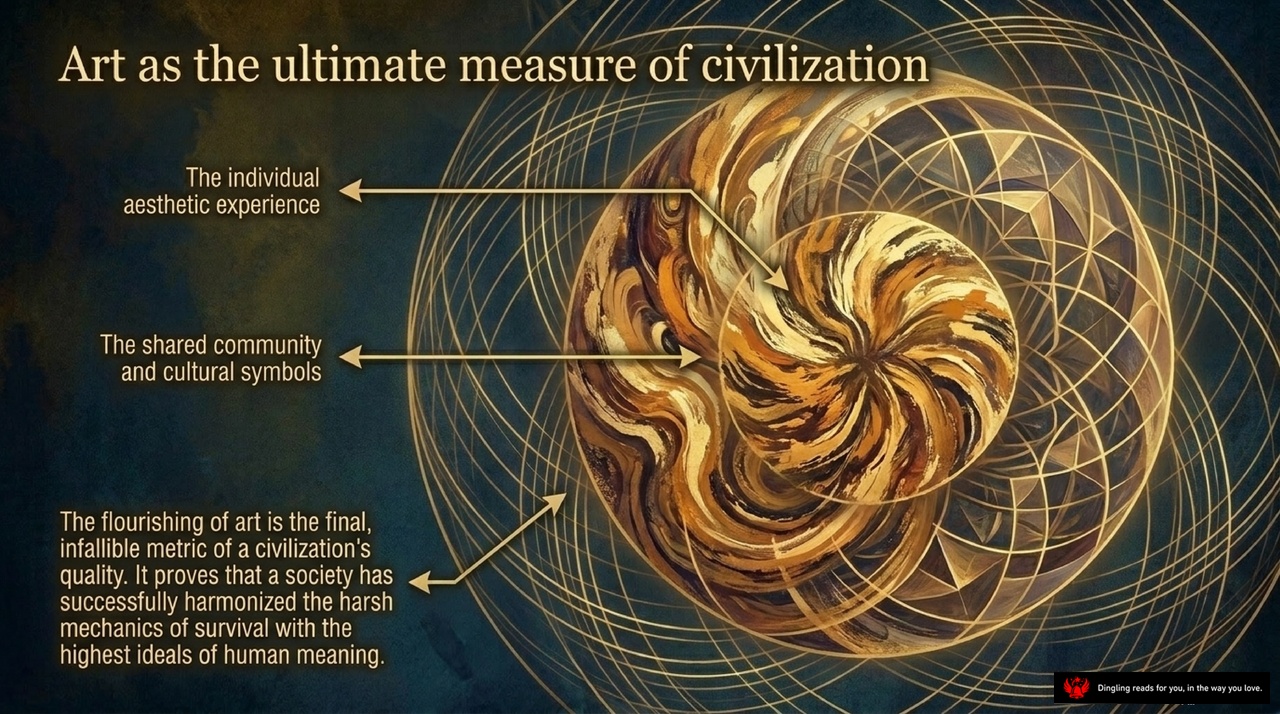
Art is the ultimate measure of civilization, not because of the museums we build or the statues we carve, but because of how a society balances the harsh mechanics of survival with the highest ideals of human meaning. As we see here, true civilization isn't just about individual aesthetic experiences or shared cultural symbols; it's about the flourishing of art itself. This flourishing proves that a society has successfully harmonized the struggle to live with the desire to understand.
Think about it: when a community can create art that resonates across generations, it means they have found a way to turn their daily struggles into something meaningful. It shows they've moved beyond mere survival to create a shared world of beauty and expression. This is the final, infallible metric of quality—a society that can't find its rhythm in the flow of life, that can't transform chaos into order, simply hasn't reached the heights of true civilization. So, let's look at how art does this, turning the raw energy of our existence into the enduring harmony of a great culture.
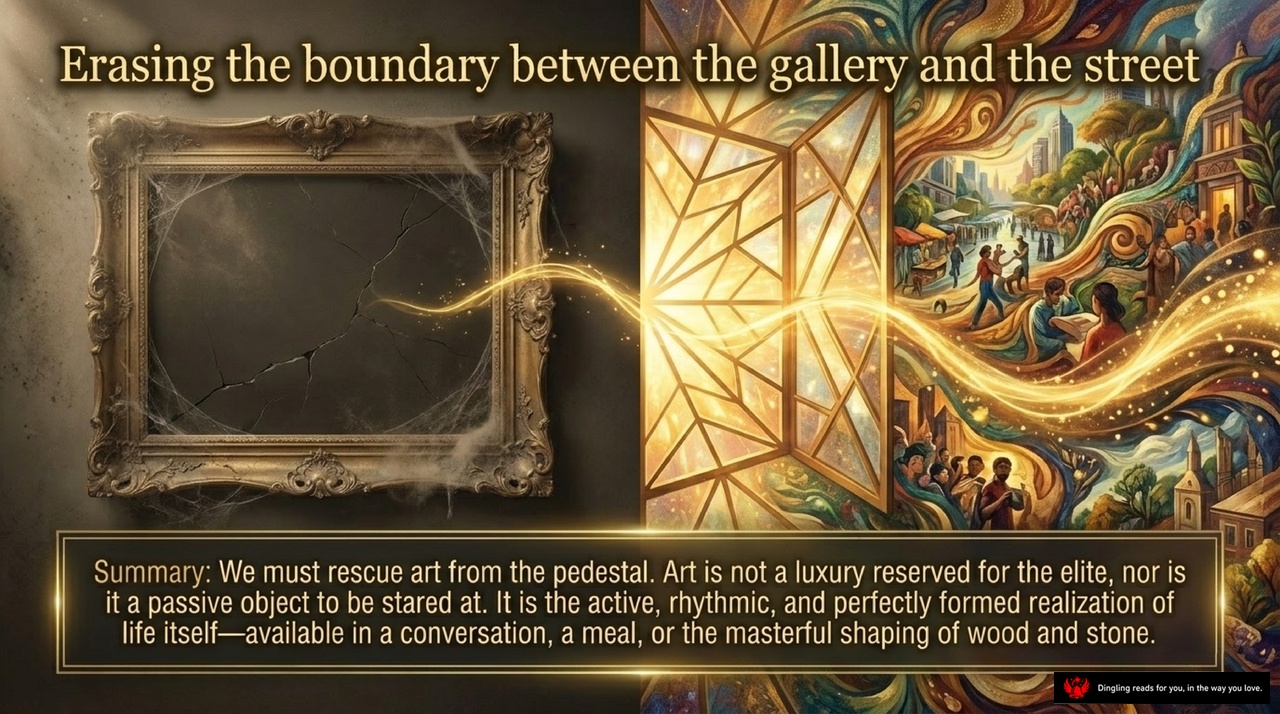
Erasing the boundary between the gallery and the street isn't just about moving art out of a building; it's about restoring art to its true nature as the active, rhythmic realization of life itself.
Look at this image: on the left, we have an old, dusty frame—representing that traditional pedestal where art is kept as a luxury for the elite, something passive to be stared at. But the golden light streaming through the window shatters that frame, transforming the scene into a vibrant street life filled with people, movement, and connection.
This visual perfectly captures the core argument we've been exploring. We must rescue art from being just a static object. Instead, we need to see it as the rhythm of our own existence. Think about the focus of a worker at their job, the care a parent shows while cooking, or the tension and release in a sudden moment of danger. These aren't just daily tasks; they are the raw material of aesthetic experience.
When we stop separating the "gallery" from the "street," we realize that art is available everywhere—in a conversation, a meal, or the masterful shaping of wood and stone. It is not a distant ideal but a shared human rhythm that connects us all, turning the ordinary into something profound and meaningful.
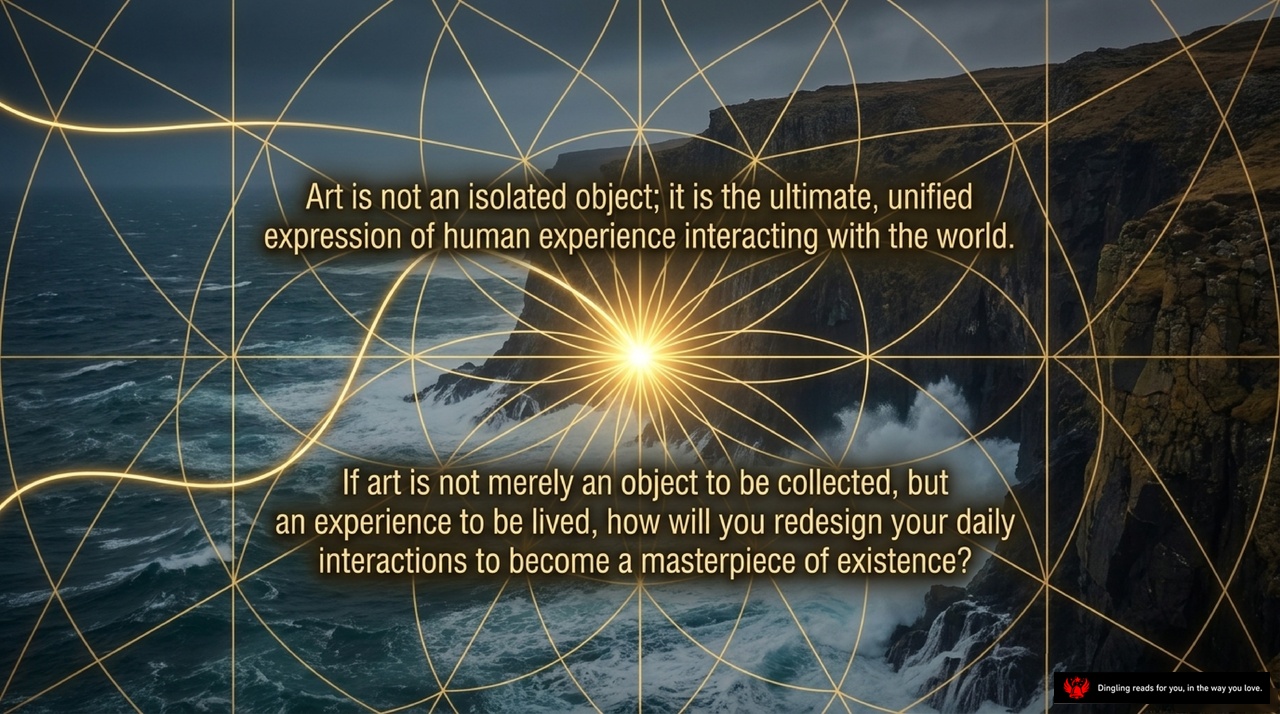
Art isn't just a statue on a pedestal or a painting hanging in a gallery; it is the ultimate, unified expression of human experience interacting with the world. When we stop treating art as an isolated object to be collected and start seeing it as an experience to be lived, everything changes. The question becomes: how do we redesign our daily interactions to become a masterpiece of existence?
Think about it this way: art is not separate from your life. It is the rhythm of your existence. Just as a living organism constantly balances between imbalance and recovery—breathing, beating, adapting—art captures that same dynamic tension. When you are fully immersed in a song, a novel, or even a moment of deep conversation, you aren't just passively observing; you are actively participating. You are feeling the balance between the chaos of the world and the order of meaning.
This is where the magic happens. By shifting our focus from the "what" of an object to the "how" of the experience, we transform the ordinary into the extraordinary. Whether it's the way light hits a wall, the rhythm of a city street, or the connection between two people, these are all artistic moments waiting to be recognized. The goal isn't to create a museum-worthy masterpiece every day, but to cultivate a mindset where every interaction is treated with the same intentionality and depth as a work of art. In doing so, we don't just consume art; we become the art of our own lives.