
Augustine: A Very Short Introduction: Complete Chapter-by-Chapter Summary

Ever wondered where so many of our Western ideas about faith, reason, and the human mind come from? Look no further than Augustine—one of history’s most influential thinkers. Henry Chadwick’s Augustine: A Very Short Introduction breaks down how this ancient figure bridged classical philosophy (like Plato) with Christian theology, creating a framework that shaped the Western mind for centuries. It’s a masterclass in understanding the roots of our modern way of thinking, packed into an accessible, engaging read. Whether you’re curious about philosophy, theology, or how ideas evolve, this book is the perfect starting point to dive into Augustine’s world.
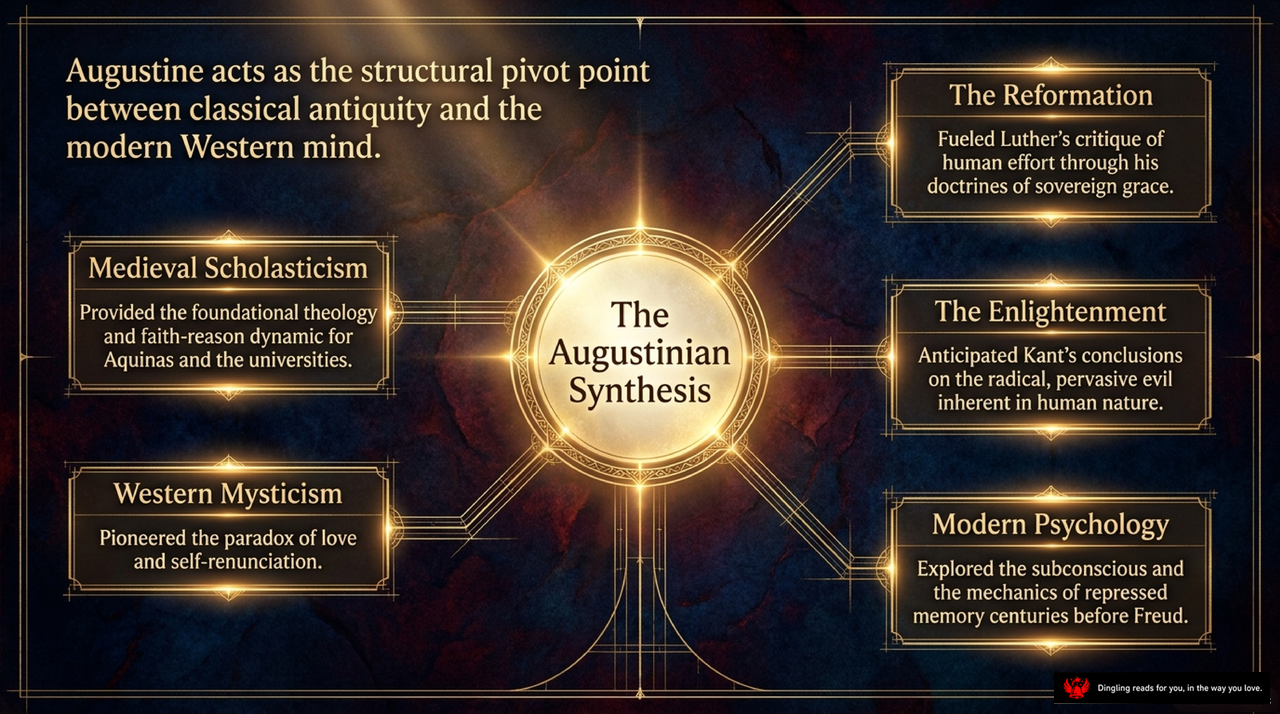
If you’ve ever stopped to think about how ancient ideas shaped the modern Western mind, Augustine is your guy. He’s the structural pivot point between classical antiquity and the modern Western way of thinking, and his work—dubbed the Augustinian Synthesis—rippled through centuries, touching everything from medieval theology to modern psychology.
Take medieval scholasticism first. Augustine’s ideas laid the foundational theology and faith-reason dynamic that thinkers like Aquinas built on. His book *On Christian Doctrine* argued that liberal arts (think logic, grammar) weren’t just school subjects—they were tools to unlock scripture’s deeper meaning, a concept that became core to university education back then.
Jump to the Reformation, and Luther’s critique of human effort directly echoes Augustine’s doctrines of sovereign grace. Luther pushed back against earning salvation through works, just like Augustine taught that grace is a gift, not something we deserve.
Even the Enlightenment got a nudge from Augustine. His take on the radical, pervasive evil in human nature anticipated Kant’s later conclusions—both wrestling with why we so often fail our own moral standards.
Western mysticism? Augustine pioneered the paradox of love and self-renunciation: to find true love (and God), you have to let go of selfish desires. That idea stuck with mystics for ages.
And modern psychology? Augustine was digging into the subconscious and repressed memories centuries before Freud. In his *Confessions*, he unpacked his own past—like stealing a pear just for the thrill—uncovering layers of motivation we now call psychological introspection.
All these threads tie back to the Augustinian Synthesis: Augustine’s one-of-a-kind mix of classical philosophy and Christian faith that shaped how we think about God, ourselves, and the world. No wonder his ideas still matter today.
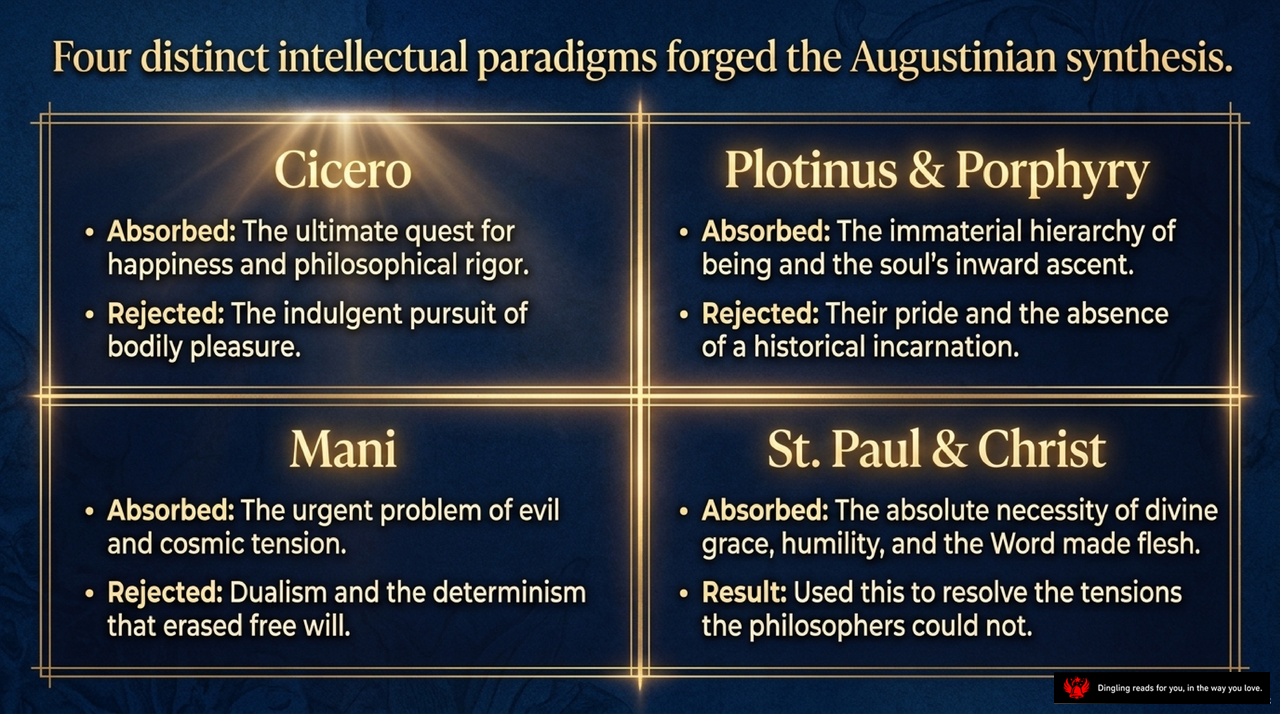
Let’s unpack the four intellectual paradigms that shaped Augustine’s groundbreaking synthesis—these were the threads he wove together, picking what made sense and leaving what didn’t to create a vision that changed Western thought.
First up: Cicero. The Roman philosopher ignited Augustine’s hunger for true happiness and taught him to think with sharp, philosophical rigor. But Augustine rejected Cicero’s leniency toward indulgent bodily pleasures—he knew those fleeting, physical joys could never satisfy the deep longing for something more lasting.
Next, Plotinus and Porphyry, the Neoplatonists. Their ideas about an immaterial hierarchy of being (a ladder from the physical to the divine) and the soul’s inward ascent toward the ultimate good struck a chord with Augustine. But he pushed back against their prideful assumption that humans could reach the divine on their own merit, and he couldn’t accept their refusal to embrace a historical incarnation—Jesus as a real, flesh-and-blood person was non-negotiable for his faith.
Then there’s Mani, the founder of Manichaeism. Augustine wrestled with Mani’s urgent focus on the problem of evil and the cosmic tension between good and evil forces. But he discarded Mani’s rigid dualism (the idea of two equal, eternal opposing powers) and determinism—he believed humans have free will to choose right or wrong, not just a preordained path.
Finally, St. Paul and Christ. This is the glue that held everything together. Augustine absorbed Paul’s emphasis on divine grace (salvation is a gift, not something we earn) and humility, plus the radical truth of the Word made flesh: God becoming human in Jesus. These ideas resolved the tensions the other thinkers couldn’t—how to bridge the divine and human worlds, how to explain evil without losing free will, and how to find true happiness beyond the physical. Augustine’s synthesis wasn’t just a mix of ideas; it was a revolution that still shapes how we think about faith, reason, and the human condition today.
After his mother Monica’s passing, Augustine left Italy and headed back to his African hometown, Tagaste. There, he gathered a group of friends to start a lay brotherhood—no strict monastery rules, no uniforms, just shared meals, shared property, and a shared hunger for God and wisdom. Every day, they’d start with prayer and reciting the Psalms (which Augustine called his spiritual anchor), then spend hours debating Cicero’s philosophy, Paul’s epistles, and Neoplatonic ideas about the divine. It was a mix of intellectual rigor and quiet spirituality.
While living there, Augustine penned some of his most formative works. On Music, for example, wasn’t just about scales or melodies—it was about how math and music reveal the universe’s hidden order. The ratios in an octave (2:1) or a fifth (3:2) aren’t just random; they’re a fingerprint of the divine order that holds everything together. He also loved how music could reach the soul—even when you’re not listening to it, you can carry a tune in your mind, which he saw as proof of the soul’s power over the body.
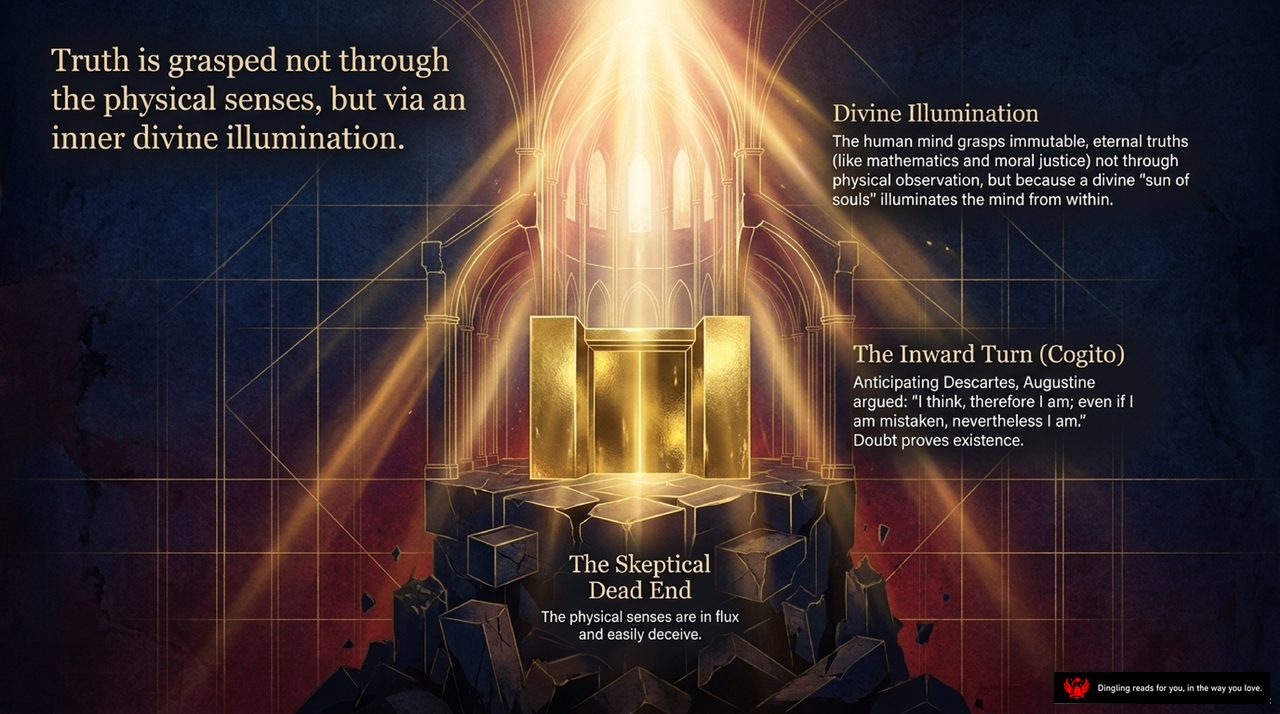
Then there’s The Teacher, a dialogue with his young, brilliant son Adeodatus (who died not long after). They explored how language often fails to convey true truth. Words are just agreed-upon sounds, but the real insight comes from the inner divine light—God’s illumination that helps us grasp eternal truths beyond what words can say.
In On True Religion, he merged Neoplatonism with Christianity: strip Plato of polytheism, and his ideas about the eternal good align with faith. This is where we first see the seeds of his later masterpiece, City of God—the idea of two “cities”: those living for earthly things and those oriented toward the eternal.
This little community in Tagaste was more than a retreat; it was a laboratory where Augustine shaped the ideas that would define Christian thought for centuries.
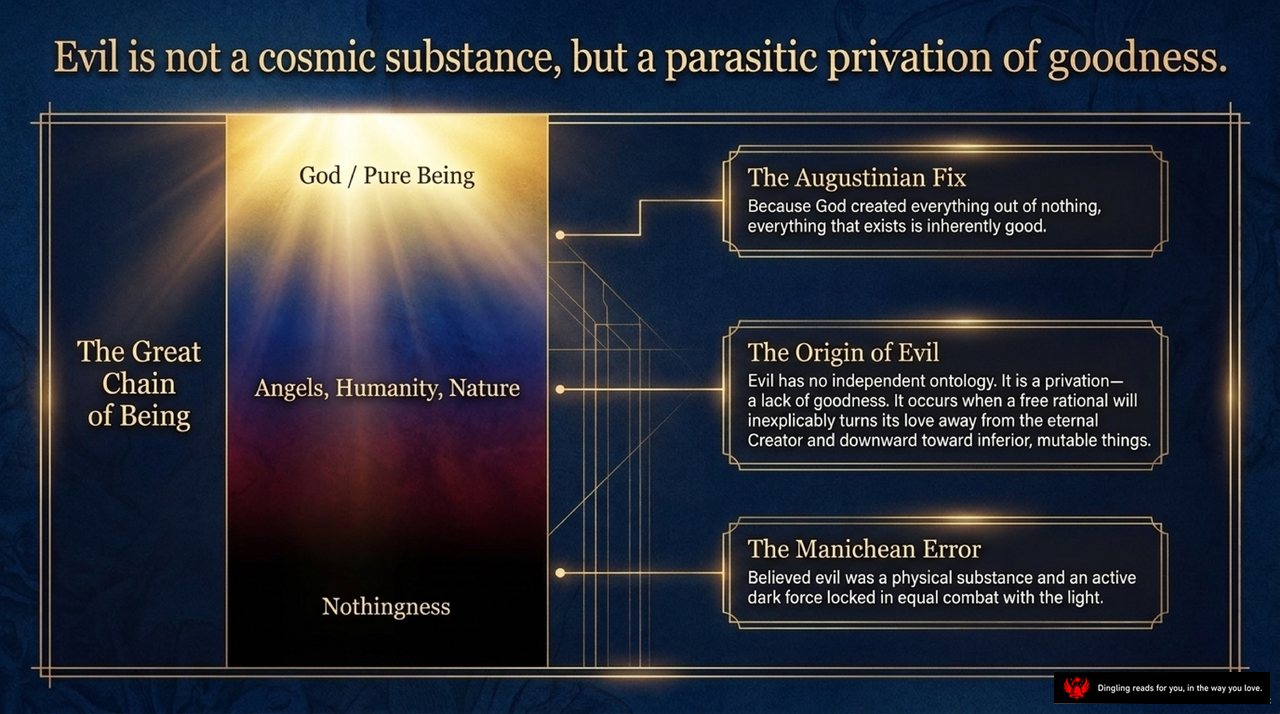
Let’s dive into this slide’s core message: Evil isn’t a cosmic substance—it’s a parasitic privation of goodness. Let’s break that down.
First, look at the Great Chain of Being here. At the top is God—pure being, perfect goodness. Then we have angels, humans, nature, all the way down to nothingness. Every step down is a little further from that pure goodness, but every existing thing is still inherently good.
Why? Because of the Augustinian Fix: God created everything out of nothing. So anything that exists has goodness because it comes from God. There’s no such thing as an inherently evil object or force.
So where does evil come in? Augustine calls it a privation—an absence of something that should be there. Think of it like a hole in a sweater: the hole isn’t a thing itself; it’s the missing part of the sweater. Or a plant that’s wilting—wilting isn’t a “bad” substance; it’s the plant lacking the water and sunlight it needs to thrive. Evil works the same way: it’s when a good thing is missing.
How does that privation happen? It’s all about free will. When a rational being—like you or me, or even an angel—chooses to turn away from God (the source of all goodness) and focus instead on lesser things—money, power, fame, or even our own selfish desires—that’s when we create that absence of goodness. Those lesser things aren’t evil on their own, but when we put them above God, we lose the goodness that should be at the center of our lives.
Now, contrast that with the Manichean Error. The Manicheans thought evil was a real, physical dark force, equal to the light of God. But Augustine says that’s a mistake. Evil can’t be a thing because God made all things good. It’s just a gap where goodness should be, caused by our free choices to turn away from the one who is goodness itself.
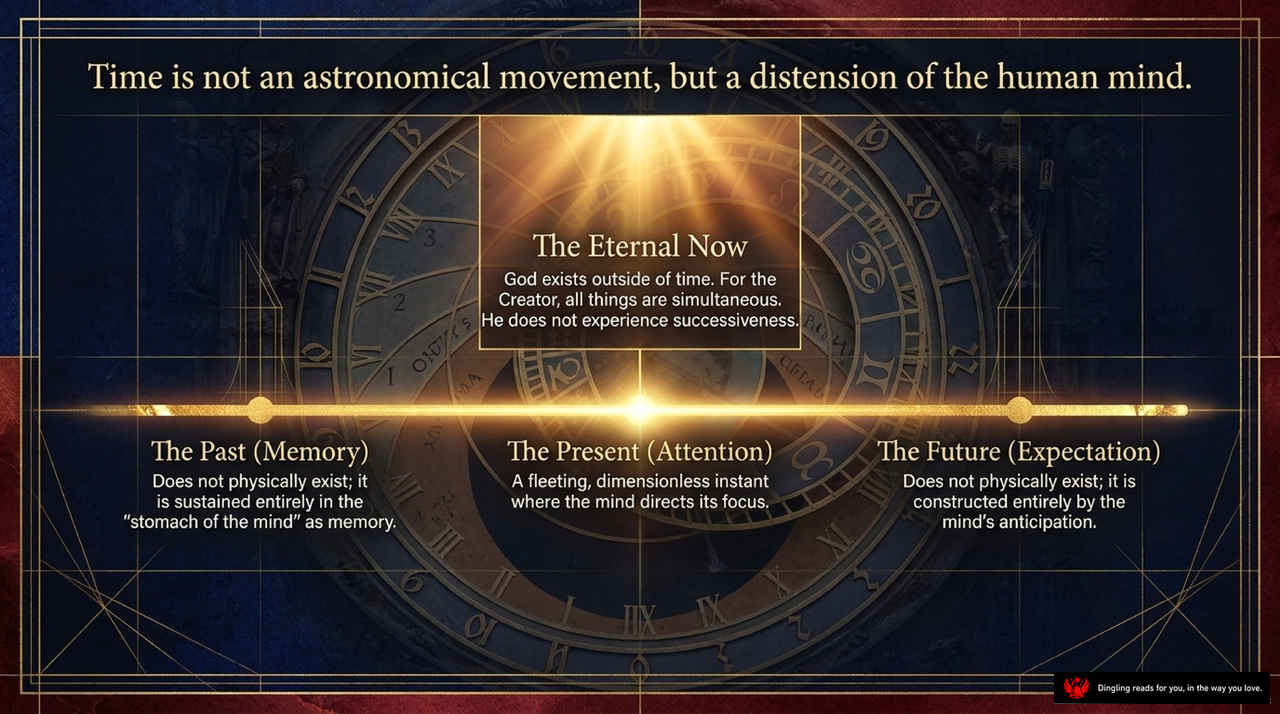
Let’s start with this core idea: Time isn’t just about planets orbiting or clocks ticking—it’s actually a distension of the human mind. Think about it: The past doesn’t exist physically anymore, right? It’s all stored in our memories, like a mental archive sustained entirely in what Augustine called the “stomach of the mind.” The future? That’s not real yet either—it’s just our minds constructing expectations of what might come. And the present? It’s this tiny, fleeting, dimensionless instant where we choose to direct our attention—here and now.
Now, let’s step beyond our human experience to the eternal now. The idea here is that God exists outside of time. For the Creator, all things are simultaneous; He doesn’t experience one moment after another like we do—no successiveness, no waiting, no looking back.
Augustine, the thinker we’re exploring, really grappled with time’s paradox. He once joked, “I know what time is until someone asks me.” It’s a relatable way to admit how tricky time is to pin down. He pushed back against the old view that time is just celestial movements (like the sun rising or moon phases). Instead, he saw time as a spiritual dimension for us—something our souls experience as we move through life’s flow.
So when we talk about the eternal now, it’s this concept that God sees every moment—past, present, future—all at once. For us, time is a linear sequence, but for Him, it’s a single, complete picture. This shifts how we think about our lives: our memories, our hopes, and the present moment we’re in right now are all part of this bigger, timeless reality that God holds in His hands. It’s a reminder that even as we move through the ticking of clocks, there’s a reality beyond time that gives our moments meaning.
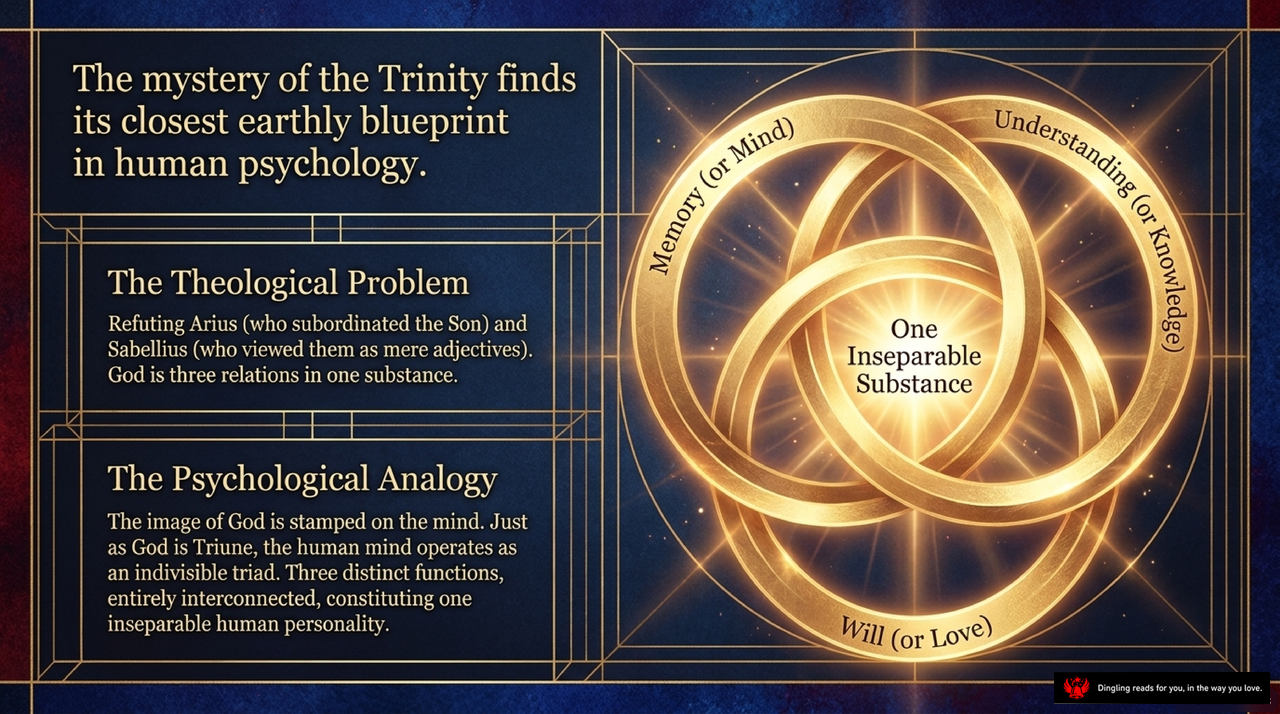
Ever wondered how the Trinity—three distinct persons in one God—could possibly make sense? Augustine thought the closest clue we have here on Earth is right inside our own heads.
Let’s start with the theological puzzle he was solving. Back in his day, two big wrong ideas muddied the waters: Arius claimed the Son was less than the Father, like a created being instead of equal. Sabellius argued the Father, Son, and Spirit were just different adjectives for God—like God switching roles, not real distinct persons. Augustine shut both down: God is one unchanging substance, but three real, relational persons.
But how do we grasp that mystery? Augustine turned to human psychology. He said the image of God is stamped on our minds. Think about your own mind: you have memory (storing what you know), understanding (making sense of it), and will (choosing to act on it). These three are totally distinct—you can remember a song without understanding its lyrics, or understand a rule without willing to follow it—but they’re not separate parts. They’re all you, one inseparable person.
That’s the analogy! Just like our minds are a triad of memory, understanding, will in one self, God is Father, Son, Spirit—three relations in one substance. It’s not a perfect match (God is way beyond human comprehension), but it’s the closest earthly blueprint we’ve got.
So next time you think about the Trinity, look inward—your own mind might just help you catch a tiny glimpse of that divine mystery.
Augustine’s take on women was full of contradictions—progressive in some ways, deeply traditional in others. He was way ahead of his time when he argued men and women are equal in soul and mind, pushing back against those who twisted Paul’s words to diminish women. He insisted the only real difference was physical, not spiritual. But then he’d frame a woman’s primary role as childbearing and supporting her husband, citing his mom Monica as the ideal loyal wife. Still, he pushed back on silly customs—like wives having to walk behind their husbands in public—calling that unnecessary and unfair.
But let’s dive into his biggest theological project: the Trinity. For over 15 years, he worked on his 15-volume *On the Trinity*. Pagans mocked the idea of one God in three persons as irrational, so Augustine used human psychology to make it relatable. He pointed to how our minds have memory, intellect, and will—all distinct yet part of one self, just like the Father, Son, and Spirit are one God. He warned these analogies weren’t perfect, but they helped people grasp the concept without making God too human.
One key stance he took was the Filioque clause: the Holy Spirit proceeds from both the Father and the Son. This later split Eastern and Western churches, but Augustine thought it was critical to maintaining the Trinity’s equality.
What’s fascinating is how he balanced faith and reason in all this. Even if his views on women feel outdated now, he was grappling with big questions—questions about identity, divinity, and how we relate to each other—that still resonate today. He wasn’t afraid to admit complexity, and that’s part of what makes his work so enduring.
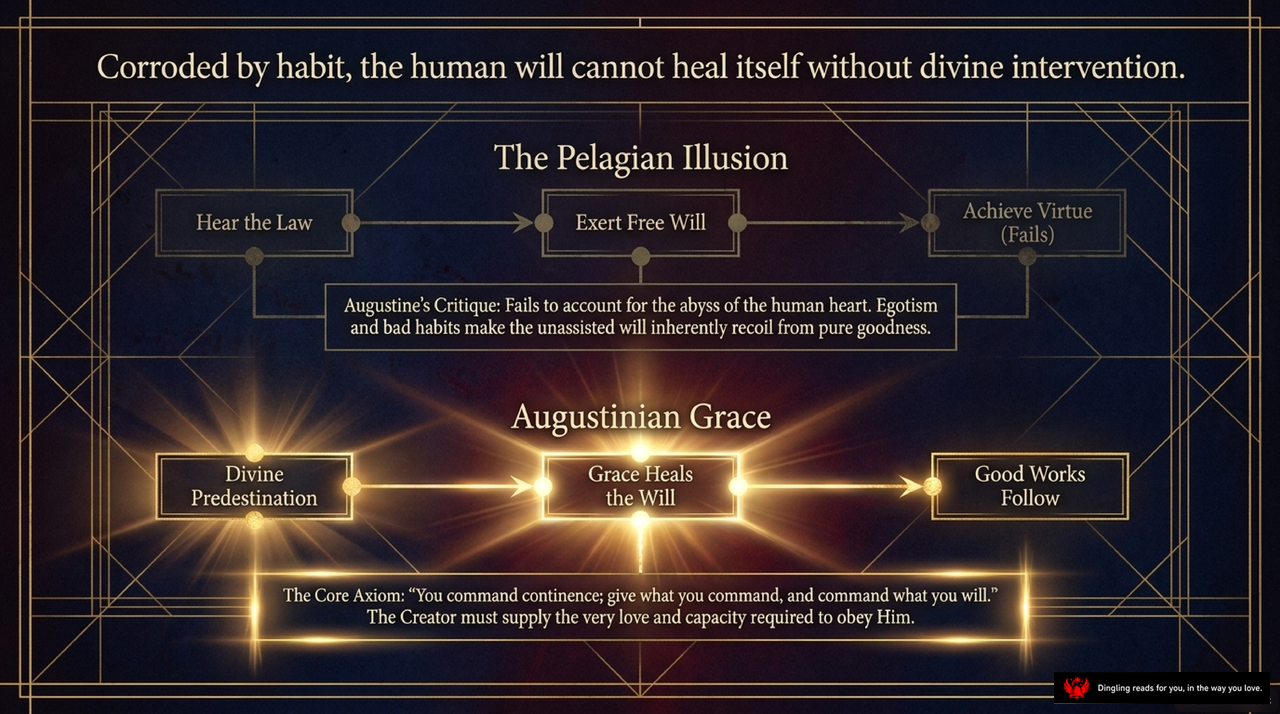
Let’s dive into two competing ideas about human nature and how we become good—starting with the Pelagian Illusion on the left. Pelagius, a British monk, argued that if we simply hear the moral law, we can use our free will to choose virtue and live rightly. He thought grace was helpful but not necessary; we have the innate ability to do good if we just decide to. But Augustine saw a fatal flaw here: this view completely misses the deep brokenness in the human heart. Our ego and bad habits are so ingrained—corroded by habit, as the slide says—that our unassisted will doesn’t just struggle to choose good; it actively recoils from pure goodness. We can’t fix ourselves on our own.
Now look at Augustinian Grace on the right. Augustine’s core point is that our will is damaged beyond self-repair. It needs divine intervention. The process starts with God’s predestination—He chooses to extend grace to some. That grace heals our will, making it possible for us to desire and do good, and then good works naturally follow.
Augustine summed this up with a powerful axiom: “You command continence; give what you command, and command what you will.” In other words, when God tells us to live a virtuous life (like being continent), He doesn’t just demand it—He gives us the ability to do it. The Creator must supply the very love and capacity we need to obey Him.
Pelagianism fails because it underestimates the “abyss of the human heart”—our natural tendency to prioritize ourselves over God. But Augustine’s view shifts the focus from our effort to God’s grace. We don’t earn goodness; God gives it to us, transforming our will so that we can finally choose what is truly good. This isn’t about us being passive—it’s about God’s active work in us, making the impossible possible. Our role is to respond to that grace, but the initiative always lies with Him. Without His intervention, our will remains trapped in its own corruption, unable to reach the goodness we were created for.
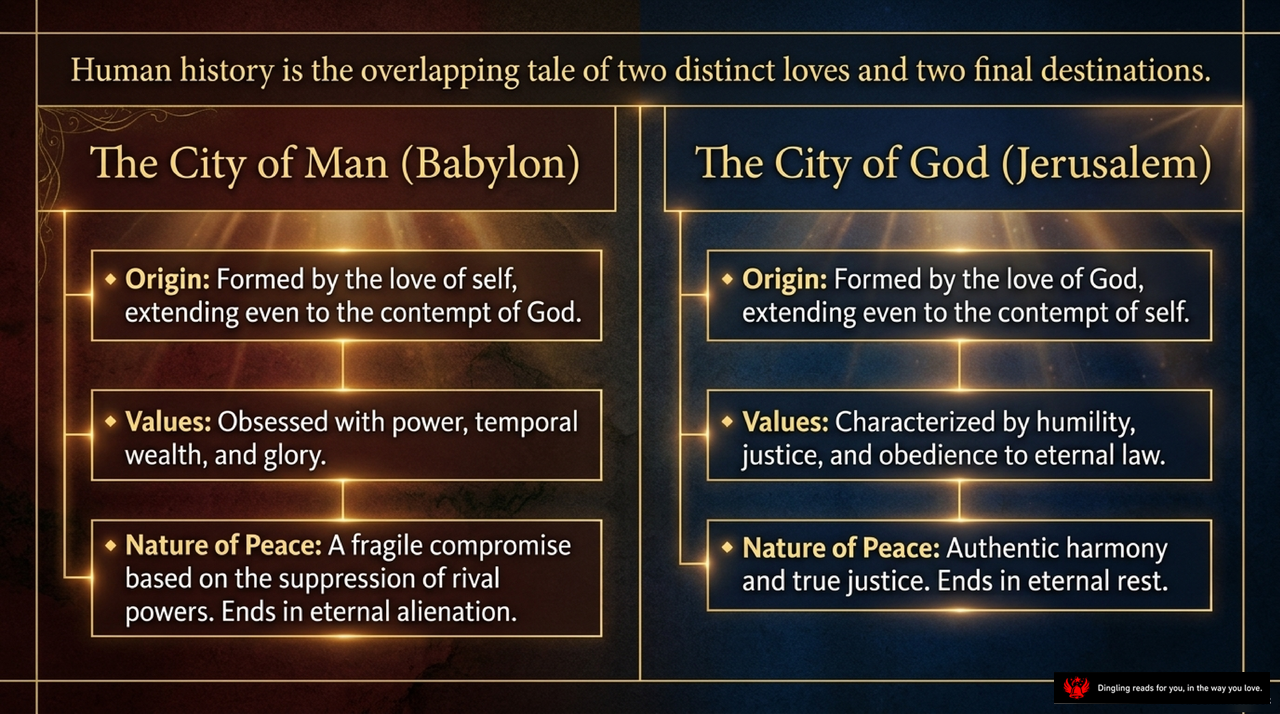
Let’s dive into Augustine’s core vision here—human history isn’t a single narrative, but two overlapping stories shaped by two very different loves, each leading to its own end.
First up: the City of Man, or Babylon as he calls it. This city is built on self-love—so strong that it can even make us disregard God entirely. Think about the cultures that prioritize power, quick riches, and momentary fame over everything else. The peace here? It’s fragile at best. It’s a compromise where we keep rival forces in check just enough to avoid chaos, but deep down, there’s always a sense of disconnection, of being alienated from what matters.
Then there’s the City of God, Jerusalem. This one’s rooted in love for God—so deep that we might set aside our own wants to follow Him. Its values? Humility, doing what’s just, and living by eternal laws that don’t shift with trends or politics. The peace here isn’t a temporary truce; it’s real harmony, the kind that comes from aligning with truth and goodness. And it doesn’t end in alienation—it leads to eternal rest.
Augustine penned this after Rome fell in 410 AD. Back then, people blamed Christians for abandoning the old gods who’d supposedly protected Rome. But Augustine argued that Rome’s fall wasn’t about gods—it was about which city you’re part of. The City of Man is fleeting, here today and gone tomorrow. But the City of God? It’s forever.
So, which love guides your choices? Are you building something that fades with time, or something that lasts for eternity? That’s the question Augustine leaves us to ponder. It’s not just about history—it’s about the story we’re writing with our own lives right now.
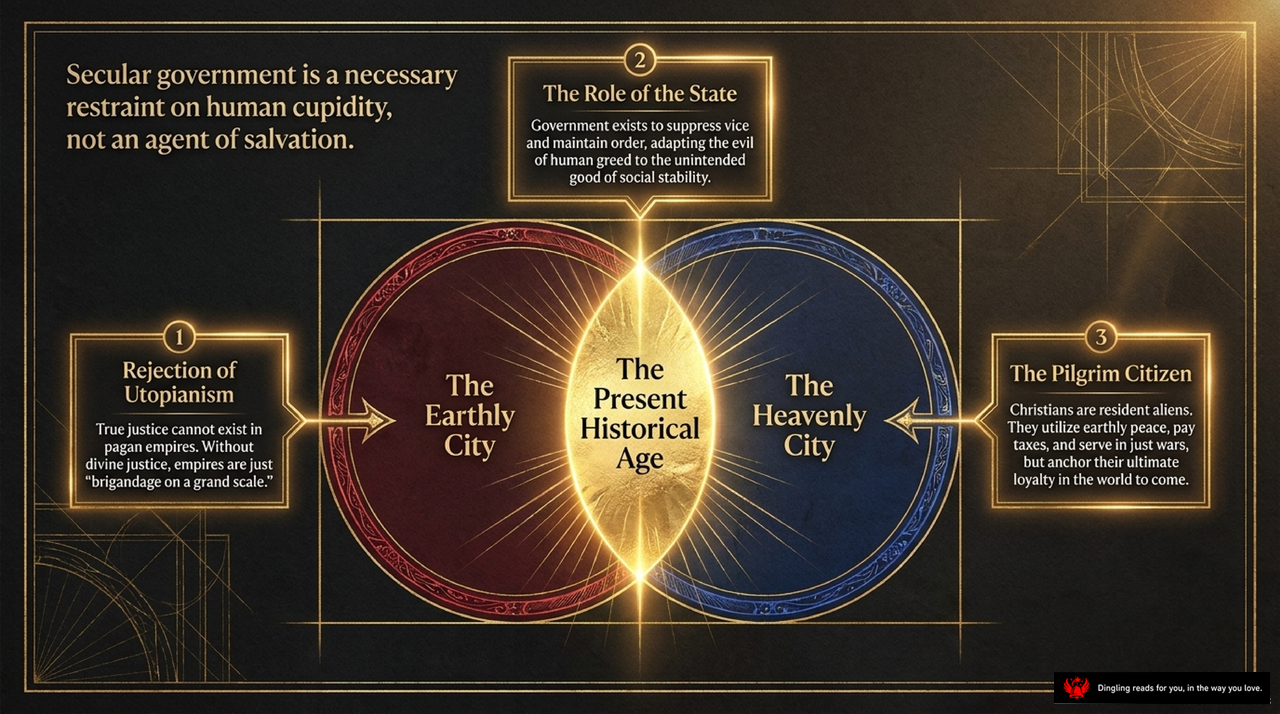
Let’s start with this core idea: Secular government is a necessary restraint on human cupidity, not an agent of salvation. What does that mean? Augustine spent a lot of time talking about how after the Fall, our human nature is broken—we’re all prone to greed and self-interest. So we need governments to keep that in check, but they can’t fix our hearts or save us.
First, let’s talk about rejecting utopianism. Augustine says true justice can’t exist in pagan empires. Without divine justice guiding things, even the biggest, most powerful empires are just “brigandage on a grand scale”—like a giant gang, taking what they want without any higher moral compass. We can’t build a perfect society here on earth because our own selfishness always gets in the way.
Then, what’s the role of the state? It’s not to make us good, but to suppress vice and maintain order. Think about it: our greed can lead to chaos, but the government uses laws and rules to turn that evil into something useful—like social stability. It’s not ideal, but it’s necessary to keep things from falling apart completely.
And for us as Christians? We’re pilgrim citizens—resident aliens in this world. We use the earthly peace the state provides, pay our taxes, even serve in just wars if we have to (like defending our families or neighbors from harm). But our ultimate loyalty isn’t to any country or government. Our true home is the Heavenly City, so we don’t put all our hope in making this world perfect. We do our part here, but we keep our eyes on the next.
So the takeaway: Government is a practical tool to manage our brokenness, but salvation comes from somewhere else. We live in this world, follow its rules, and contribute to its well-being—but we never forget that our real citizenship is in heaven. That’s how we balance being good citizens here and faithful followers of God.
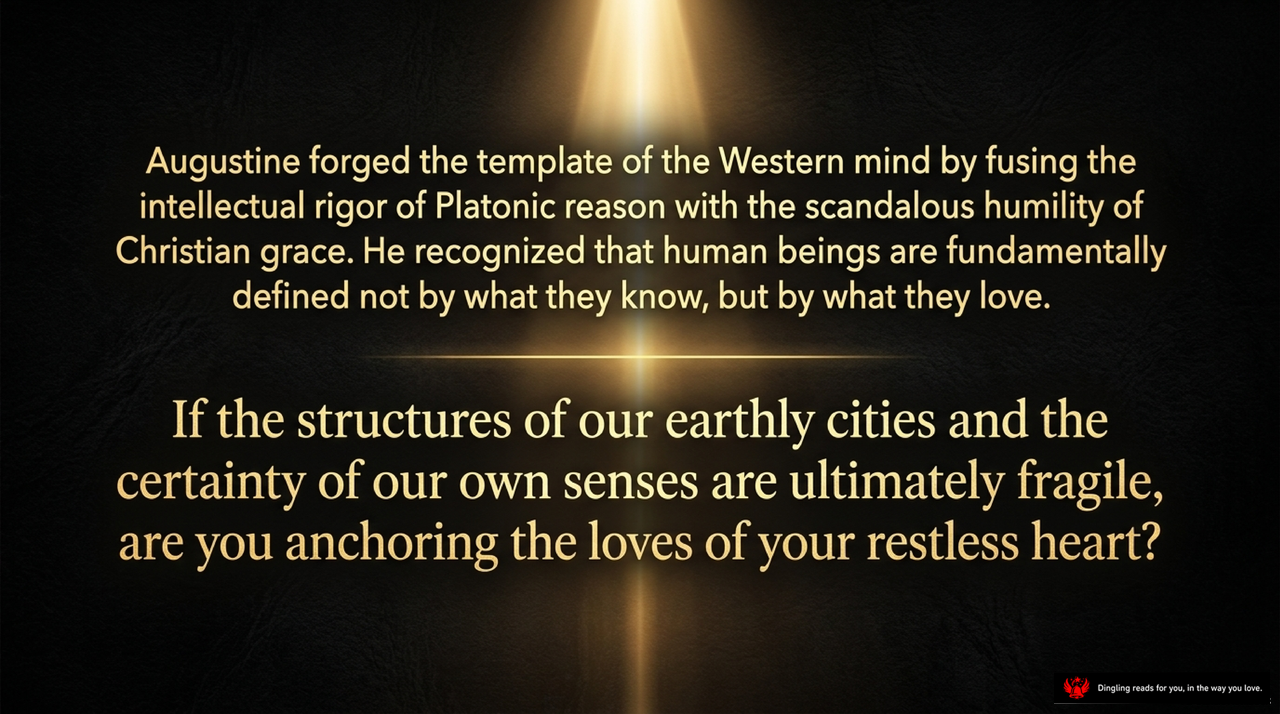
Let’s be honest—we’ve all been there. You know you should hit the gym instead of scrolling TikTok, or call your mom instead of ignoring her texts, but something pulls you the other way. Augustine understood that internal battle better than almost anyone.
This guy wasn’t always the saintly theologian we remember. He partied hard, chased after pleasure, and even stole pears just for the thrill of it (yes, really). But his life took a turn when he heard a voice saying, “Take up and read.” That moment led him to embrace Christianity, but he didn’t leave his philosophical roots behind. He wove Plato’s ideas about eternal truth with the Christian message of grace—arguing that we can’t save ourselves by our own will alone; we need God’s help to fix the broken parts of our nature.
What’s wild is how relevant this still is. Think about the pressure we feel to “hustle” our way to happiness, to be perfect on our own. Augustine would say that’s a fool’s errand. True fulfillment doesn’t come from checking boxes or climbing the ladder—it comes from turning to something bigger than ourselves.
He also talked about two cities: the City of Man, where we chase power, money, and instant gratification (sound familiar?), and the City of God, where we prioritize love, justice, and connection to something eternal. In a world where we’re constantly told to “grind” and “win,” Augustine’s take is a breath of fresh air. He’d ask: Are you investing in things that will matter 10 years from now, or just what feels good today?
And let’s not forget his thoughts on grace. He didn’t believe we could earn our way to salvation—grace is a gift, plain and simple. For anyone who’s ever felt like they’re not “good enough” to be loved or forgiven, that’s a game-changer. It means your worth isn’t tied to your mistakes or your achievements.
Augustine’s life was a mess, but it’s that messiness that makes his ideas so relatable. He wasn’t a perfect saint—he was a human being, just like us, trying to figure it out. And his legacy reminds us that even when we stumble, there’s always a chance to turn around and start again. It’s a message that feels just as urgent now as it did 1,600 years ago.