
Augustine_ A Very Short Introduction(Henry Chadwick [Chadwick, Henry],2001): Complete Chapter-by-Chapter Summary

Ever stopped to wonder where Western thought’s core ideas come from? The ones that shape how we talk about morality, faith, and the human mind? They trace back to a man who lived 1,600 years ago. This is Augustine: A Very Short Introduction by Henry Chadwick—a masterclass in how one mind bridged classical philosophy and Christian theology to form the Western way of thinking. Chadwick unpacks how Augustine’s insights still resonate today, from free will to the nature of God and humanity. Whether you’re into history, philosophy, or just curious about why we think the way we do, this book is your gateway. Let’s dive into the mind that changed Western civilization forever.
Augustine of Hippo (354-430) embarked on a transformative spiritual journey shaped by diverse influences. Born in Thagaste, North Africa, he studied rhetoric and taught in Carthage, Rome, and Milan. Initially attracted to Manichaeism, he later turned to Neoplatonism, which deepened his grasp of non-material reality. In Milan, Bishop Ambrose’s sermons and integration of Christian thought with philosophy left a lasting impression. A defining moment occurred in a garden: upon hearing a child’s voice urging "take up and read," he opened the Bible to Romans 13:13-14, leading to his conversion. In 387, he was baptized by Ambrose, alongside his son Adeodatus and friend Alypius, marking his commitment to Christian faith and future ministry. This period laid the foundation for his profound theological contributions.
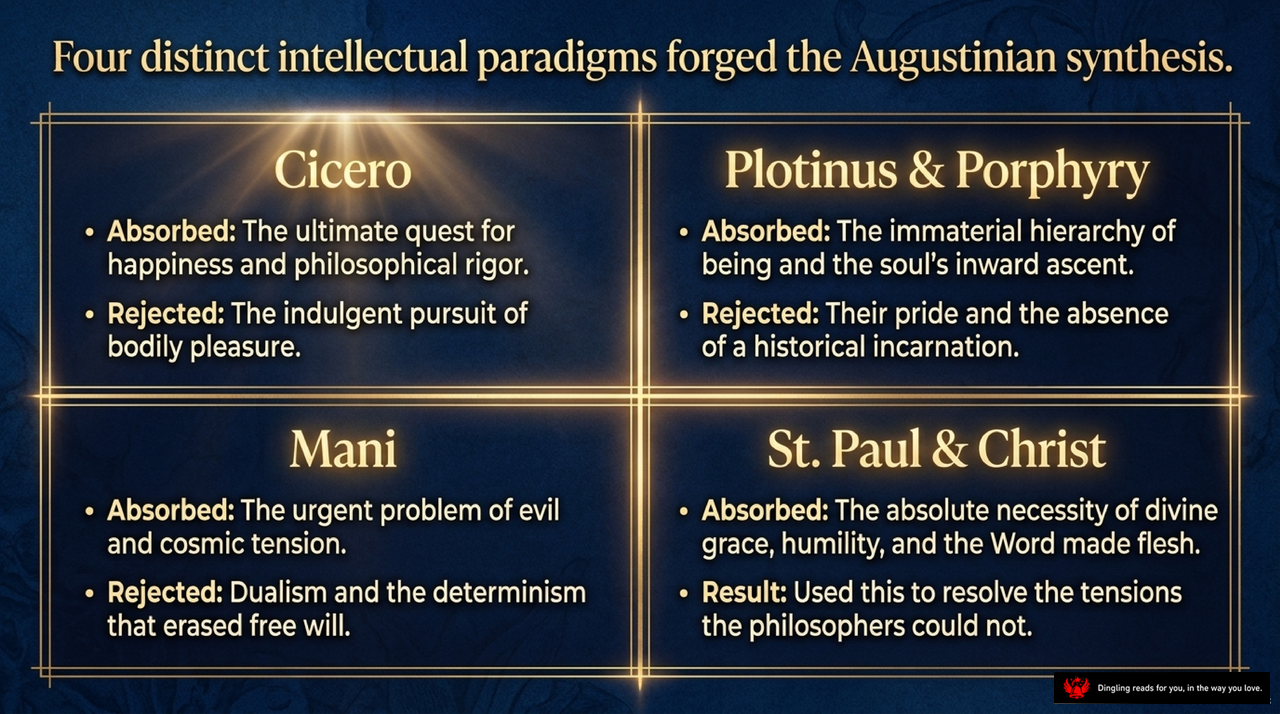
Let’s dive into the four key intellectual currents that forged what we call the Augustinian synthesis—Augustine’s unique way of thinking that shaped Western thought for centuries.
First up: Cicero. Augustine was captivated by Cicero’s focus on the ultimate quest for happiness and the rigor of philosophical inquiry. But he rejected the idea that indulging in bodily pleasures could ever lead to true fulfillment. That push-pull between seeking joy and rejecting excess would stay with him throughout his life.
Next, Plotinus and Porphyry, the Neoplatonists. Augustine took from them the idea of an immaterial hierarchy of being—how reality flows from the highest divine down to the physical world—and the soul’s inward ascent toward the divine. But he pushed back hard against their prideful belief that humans could reach the divine on their own, and their refusal to accept the Incarnation: that God actually became human in Jesus Christ.
Then there’s Mani, founder of Manichaeism. Augustine grappled with the urgent problem of evil and the cosmic tension between good and evil that Mani emphasized. But he rejected Mani’s strict dualism (the idea of two equal warring forces of light and dark) and the determinism that stripped humans of free will—something Augustine would later argue was central to our humanity.
Finally, St. Paul and Christ. This is where it all clicked. Augustine absorbed the absolute necessity of divine grace (we can’t save ourselves), humility, and the Word made flesh. And the result? Using these Christian ideas, he resolved the tensions that the other philosophers couldn’t fix.
Each of these four streams gave Augustine something crucial, but it was the Christian framework that tied them all into a coherent, life-changing worldview.
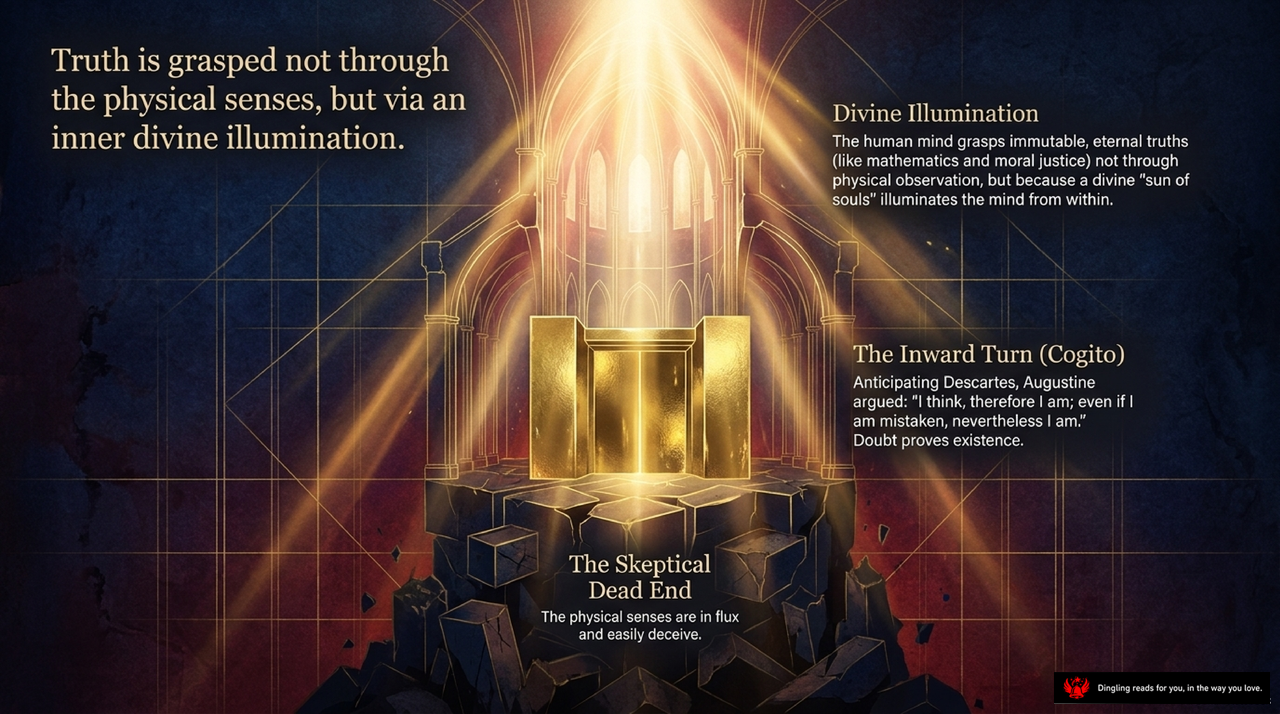
Ever wonder how we can really know anything for sure? Let’s start with the obvious: our senses lie all the time. Think about a straw in a glass of water—it looks bent, but it’s not. Or how a room feels freezing cold when you first walk in, but 10 minutes later you’re not even wearing a jacket. Augustine called this "the skeptical dead end"—trusting only what we see, hear, or touch leaves us stuck in a world of shifting, unreliable information. We can never be 100% sure if what we’re sensing is real.
But here’s the game-changer: Augustine had a moment of clarity about doubt itself. He realized that even if you doubt everything—your senses, your memories, the world around you—you can’t doubt that you’re doubting. That’s his "inward turn"—a precursor to Descartes’ famous "I think, therefore I am." Doubt proves existence: you have to be a thinking, existing being to do the doubting. That’s our starting point of absolute certainty.
So where do we go from that tiny spark? Augustine said we don’t find lasting truth through our physical senses. Instead, we get it from something deeper: divine illumination. Picture God as a sun inside your soul, shining on the truths that never change—like 2+2 always equals 4, or that it’s wrong to cheat or hurt someone. These aren’t just things we learn from school or society; they’re eternal truths that God’s inner light reveals to our minds.
As Augustine put it: truth is grasped not through the physical senses, but via an inner divine illumination. The human mind understands those immutable, eternal truths—math, moral justice—because a divine "sun of souls" lights up our minds from within. So next time you feel sure about a truth that feels universal, that’s probably that inner light at work. It’s not about what you see; it’s about what’s revealed to you from the inside out.

Let’s start with the core idea here: Evil isn’t some cosmic substance floating around the universe—it’s a parasitic privation of goodness.
Augustine pictured existence as a Great Chain of Being: at the top is God, pure being and perfect goodness. Then come angels, then humans, then nature, all the way down to nothingness. Now, here’s the Augustinian Fix: since God created everything out of nothing (ex nihilo), every existing thing has inherent goodness. There’s no such thing as a created object or being that’s inherently evil—God only makes good stuff.
But the Manicheans got it wrong. They thought evil was a physical, dark force equal to light, locked in an eternal battle. Augustine called this the Manichean Error. Evil isn’t a thing at all—it’s a lack of goodness. Think of it like blindness: it’s not a substance you have, it’s the absence of sight. A rotting fruit isn’t evil, but the rot is the loss of the fruit’s original goodness.
So where does evil come from? It starts with free will. When a rational being—an angel or a human—chooses to turn their love away from the eternal Creator (the ultimate good) and fix it on something inferior, temporary, or self-serving (like money, power, or even our own pride), that’s when evil takes root. Those things aren’t bad in themselves—they’re good parts of God’s creation—but when we prioritize them over God, we create a gap where goodness should be.
In short: Evil isn’t a cosmic enemy to fight. It’s a choice to settle for less than the perfect good we were made to seek. It’s the empty space left when we turn away from what’s truly meaningful.
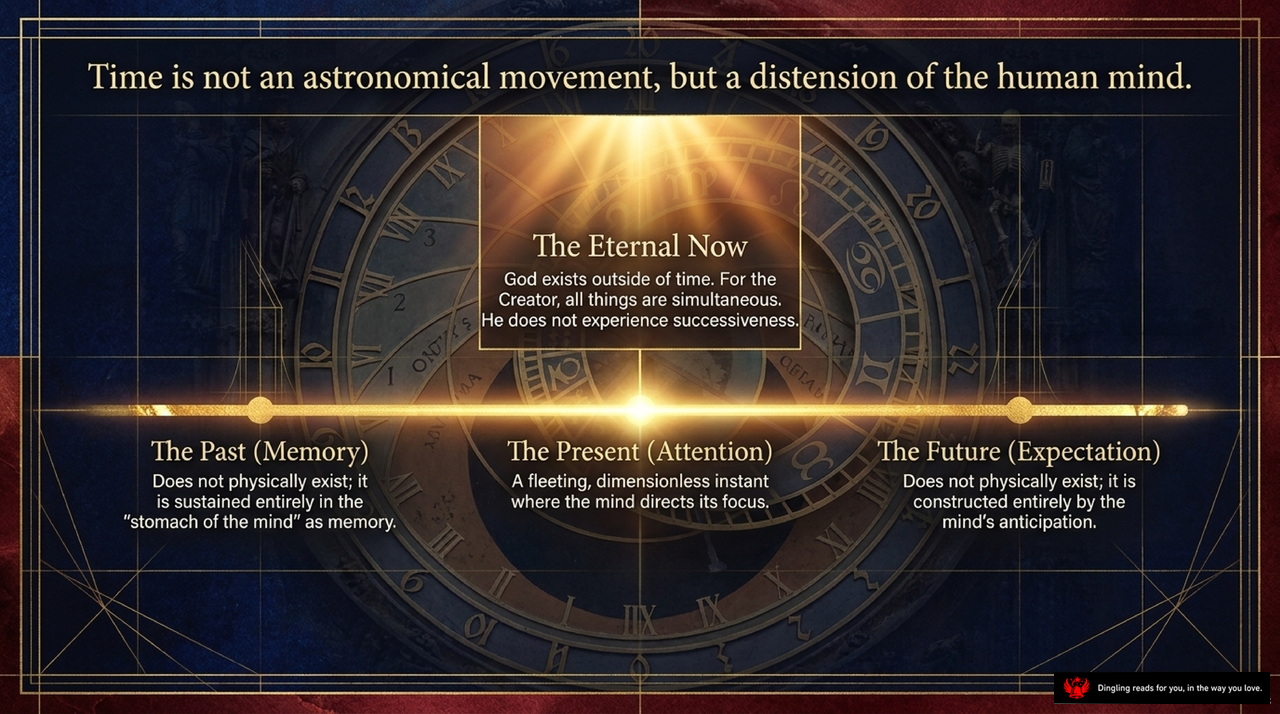
Have you ever stopped to think about what time really is? Augustine did—deeply, as he poured over the question in his Confessions. Let’s start with a bold statement from our slide today: Time is not an astronomical movement, but a distension of the human mind. That’s not just a fancy phrase—it’s a radical shift in how we see the world.
Let’s break it down. The past? It doesn’t physically exist anymore. It’s just something we carry in our memory, like Augustine says, sustained in the “stomach of the mind” as memory. The future? It’s not here yet—we build it in our heads through anticipation. And the present? Oh, it’s this tiny, fleeting, dimensionless instant where our mind chooses to focus. Blink, and it’s already the past.
But here’s the game-changer: God isn’t bound by any of this. He lives in what we call The Eternal Now. For the Creator, all things are simultaneous—He doesn’t experience successiveness. Think about that: every moment of your life, every choice you’ve made or will make, God sees it all at once. No waiting, no rushing, just an eternal present.
Augustine’s reflection on time isn’t just philosophical—it’s personal. He wrestled with how to square the passing of time (like watching his mother age, or his own youth slip away) with God’s unchanging nature. What he realized is that time is a human experience, tied to our finite minds. God, on the other hand, is beyond all that—steady, unchanging, in a now that never ends.
So next time you’re feeling overwhelmed by the past or anxious about the future, remember: time is in your mind, but God is in the eternal now. That’s a thought that can bring a lot of peace, don’t you think? It reminds us that even when our days feel like they’re slipping through our fingers, there’s a place where everything is held in perfect, unbroken presence.
Let’s talk about Augustine’s Confessions—this book isn’t just a memoir; it’s a raw, unflinching look at one man’s messy, universal fight to find meaning.
Start with a tiny, unforgettable moment: as a kid, Augustine and his friends snuck into a neighbor’s orchard and stole pears. They didn’t need them—they just wanted to rebel. For Augustine, this small act laid bare the core of human sin: choosing wrong not out of necessity, but for the thrill of breaking the rules.
Then his youth: he got hooked on Manichaeism, a religion that split the world into light and dark. It was a cop-out—he could blame his bad choices on some external “dark force” instead of taking responsibility. But cracks started to show: their wild claims about the stars clashed with what he knew about astronomy, and their top teacher couldn’t answer his philosophical questions.
Milan changed everything. He met Bishop Ambrose, whose sermons made him rethink Christianity. Then came the garden scene: he was torn between his old life and faith, pacing restlessly, when he heard a child’s voice yell, “Take up and read!” He grabbed Paul’s letters and read lines about rejecting worldly desires and putting on Christ. That was his turning point—he finally surrendered.
Not long after, his mother Monica—who’d prayed for his conversion for decades—died. Before she passed, they had a moment in Ostia where their souls felt like they were floating beyond the physical world, touching something eternal.
The later chapters dive into big ideas: memory (he calls it the “stomach of the mind,” holding our past, our desires, and our innate longing for God), time (what is time? It’s all in our heads—past is memory, future is hope, present is gone in an instant. Only God exists outside time, forever).
Augustine’s Confessions isn’t just his story—it’s yours and mine, about the fight between our flaws and our search for something bigger than ourselves. It’s a reminder that even the messiest journeys can lead to profound truth.
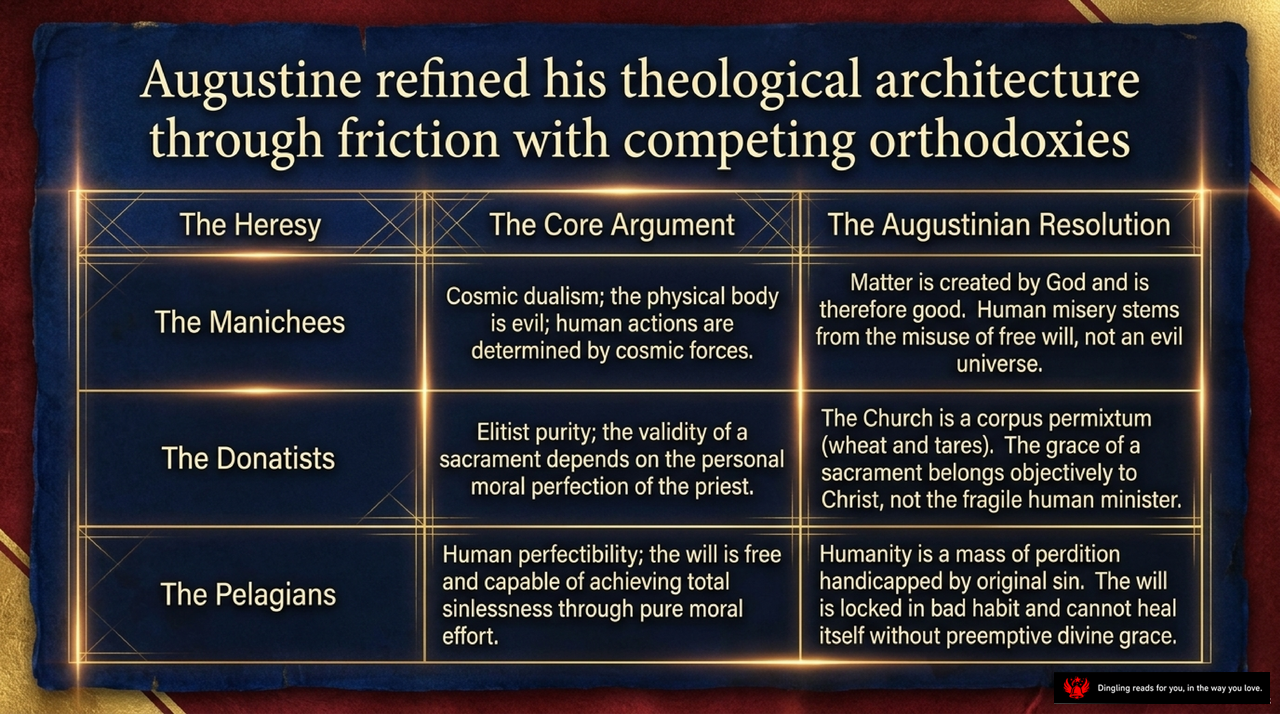
Augustine’s theological framework wasn’t forged in isolation—it took clashing with competing belief systems to refine it. Let’s break down three key debates that shaped his thinking.
First up: the Manichees. They saw the universe as a war between two equal forces—light (good) and dark (evil). To them, the physical body was inherently evil, and our actions were just puppets of these cosmic powers. But Augustine pushed back hard: he insisted matter is God’s creation, so it’s good. The real source of human misery isn’t an evil universe—it’s our own misuse of free will.
Next, the Donatists. They were obsessed with purity, arguing that a sacrament only worked if the priest was morally perfect. If a priest had sinned, their baptism or Eucharist was invalid. Augustine disagreed sharply. He described the church as a corpus mixtum—wheat and tares growing side by side. The grace in sacraments doesn’t rely on the priest’s virtue; it comes from Christ himself. Even a flawed minister can carry God’s grace because it’s not about them—it’s about Jesus.
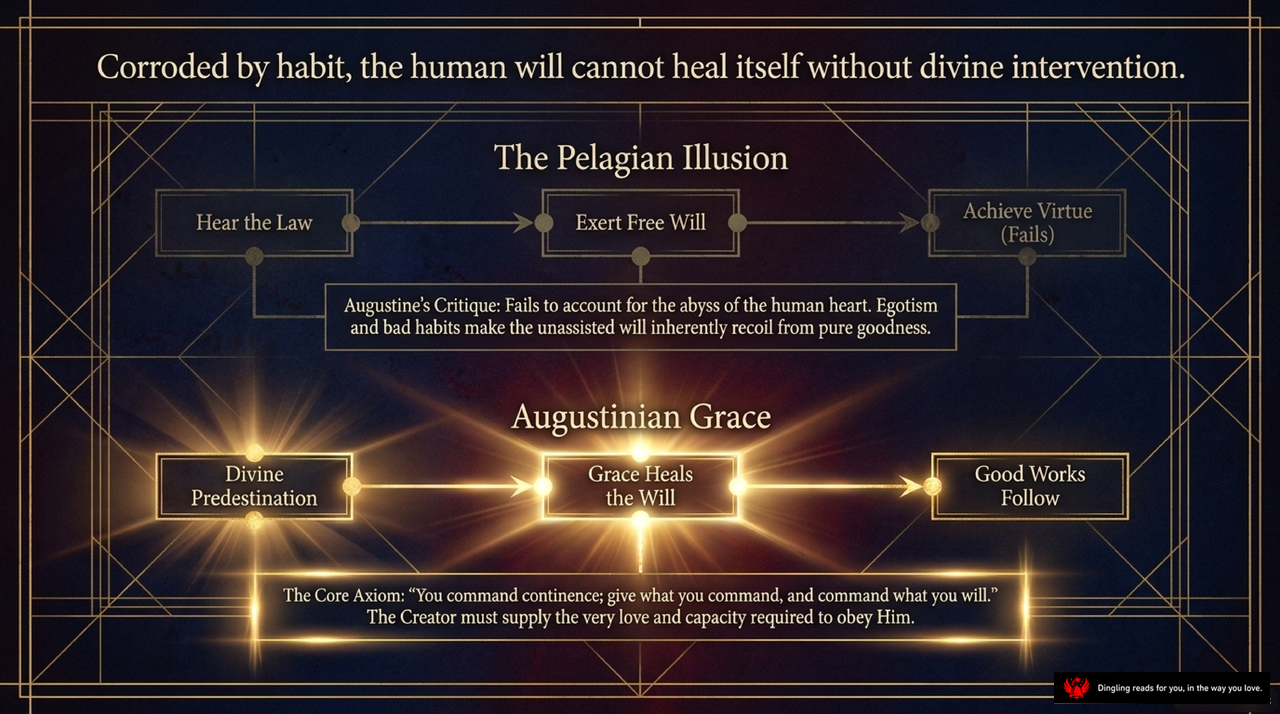
Then there were the Pelagians. They were upbeat about human nature, claiming we can achieve total sinlessness through our own free will and moral effort. Augustine thought this was naive. He believed humanity is a “mass of perdition”—handicapped by original sin. Our will is trapped in bad habits; we can’t heal ourselves without God’s preemptive grace.
Each of these conflicts forced Augustine to clarify his ideas, making his theology more robust. It’s a reminder that great thinking often comes from engaging with those who challenge us.
Let’s dive into Augustine’s take on two foundational ideas: how God created the world and the mystery of the Trinity.
First, creation. Augustine didn’t treat Genesis like a science manual—he warned that doing so would make Christians seem naive, a point even Galileo later echoed. Instead, he focused on the spiritual core: God created everything from nothing (creation ex nihilo), not just shaping pre-existing matter like a craftsman. He also proposed “seed principles”—God planted the causes for all things at the beginning, so the world unfolded over time, not appearing fully formed in an instant. This idea let him reconcile the Bible with the sense that nature develops gradually.
On gender, Augustine held that men and women are equal in soul—same capacity for reason and relationship with God—but differ in physical roles. He valued marriage as a good gift, but he also saw sexuality as carrying tension from the Fall: before Adam sinned, people could control their desires perfectly, but after, desire often overrides reason.
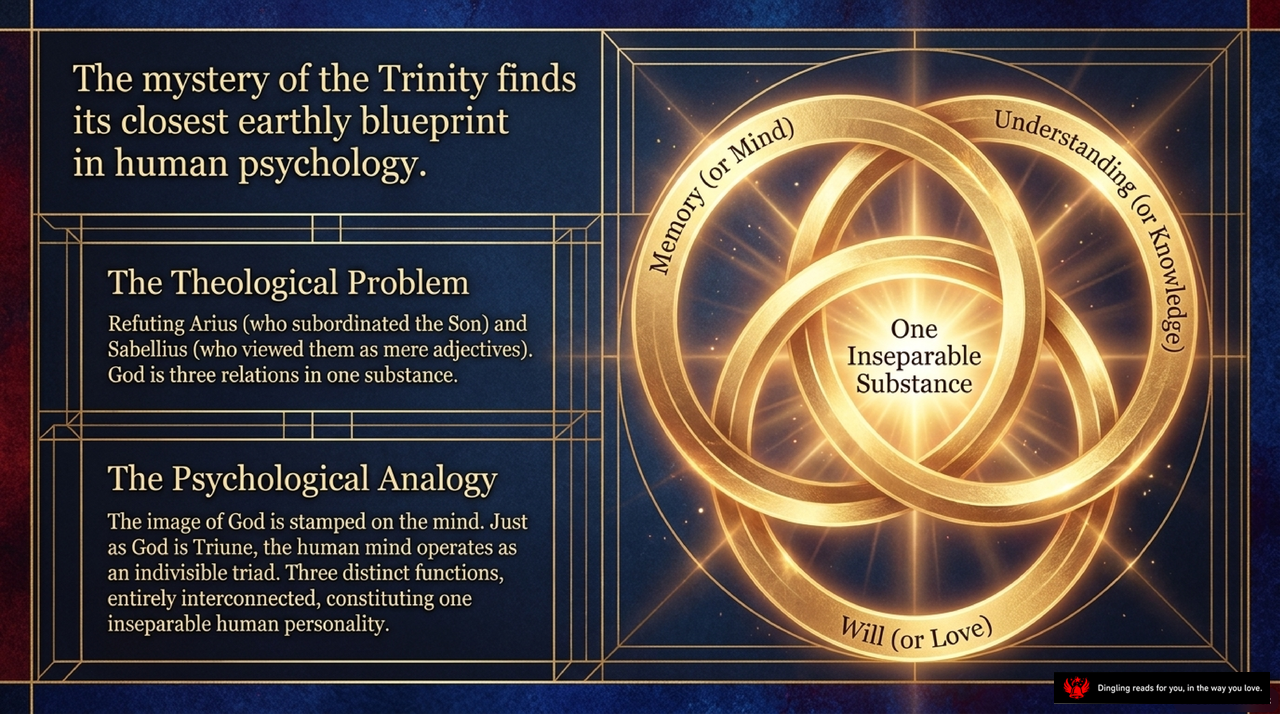
Now the Trinity, one of Christianity’s trickiest doctrines. Augustine used human psychology to make it accessible. He pointed to the mind: memory, intellect, will—three distinct functions, yet one unified mind. Or love: the lover, the beloved, and the love that binds them—three elements, but one experience of love. These analogies helped explain how God can be three persons (Father, Son, Holy Spirit) yet one being. He pushed back against heresies: Arianism, which claimed the Son was subordinate to the Father, and Sabellianism, which reduced the Trinity to just different modes of God. He also argued the Holy Spirit proceeds from both the Father and the Son—a view that later split Eastern and Western Christianity.
Augustine’s gift was bridging the divine and the human, using our own experience to grasp the mysteries of God. His ideas didn’t just shape theology—they gave people a way to connect with the sacred through the everyday.
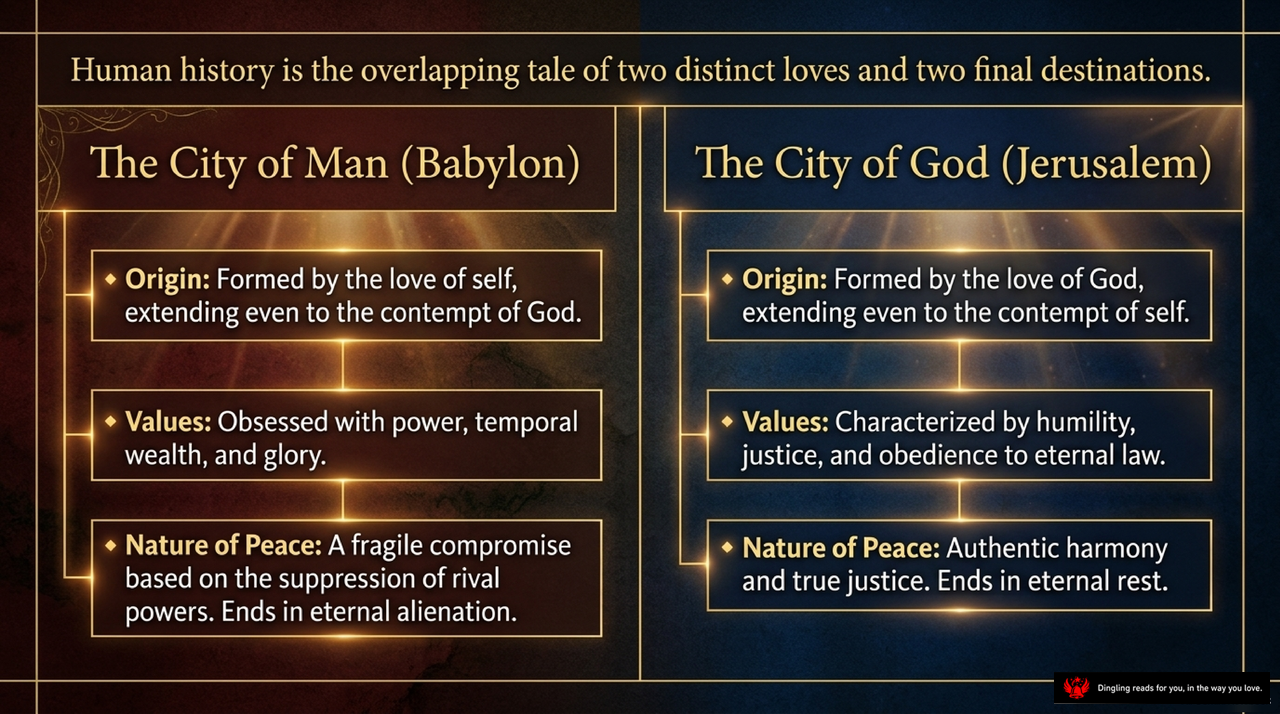
Have you ever looked at human history and wondered what’s really driving it? Augustine, in his book *City of God*, had a powerful answer: it’s the overlapping story of two distinct loves, leading to two final destinations.
Let’s break it down. First, there’s the City of Man—Babylon, as he called it. This city grows from a love of self that can go so far as to dismiss God entirely. Its values are all about the here and now: power, temporary wealth, and worldly glory. Think about how empires rise by chasing domination, or how people often measure success by their bank accounts or social status. The peace here? It’s fragile, just a truce where rivals are kept in check, not truly united. And in the end, this path leaves us feeling alienated, disconnected from something deeper.
Then there’s the City of God—Jerusalem. This one is rooted in a love for God so strong that it means putting our own desires second, even to the point of forgetting ourselves. Its values are timeless: humility, doing what’s just, and following laws that don’t change with the times. The peace here isn’t a quick fix; it’s real harmony, built on true justice. And it doesn’t end in loneliness—it leads to eternal rest, a place where we finally find our true home.
These two cities aren’t on any map. They live in our choices, our communities, and our hearts. Augustine’s message is clear: the love we choose to build our lives on—whether for self or for God—shapes not just our own future, but the entire story of humanity. Which one are you building into your life today?
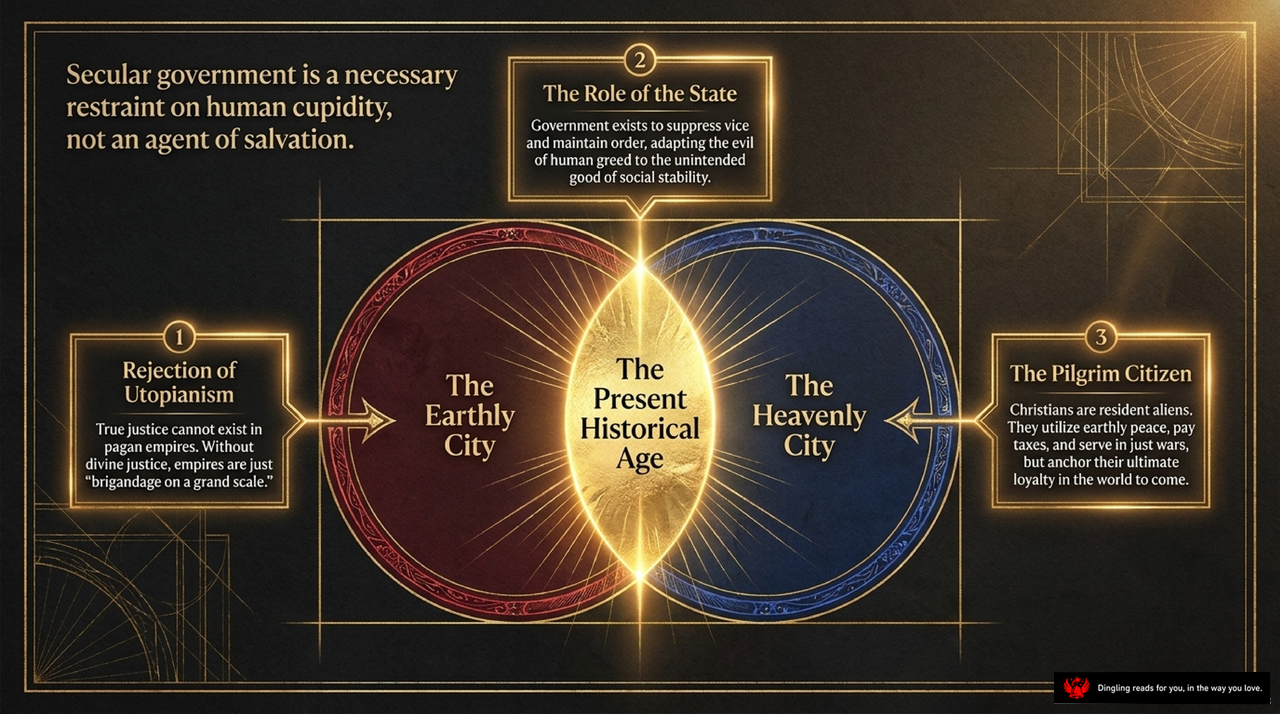
Let’s dive into how Augustine thinks we should live in this messy, in-between world. He says there are two cities overlapping right now—the Earthly City and the Heavenly City—and we’re caught in the middle of their pull.
First off, don’t hold your breath for a perfect utopia here. Augustine argues true justice can’t exist in any human-run empire (pagan or otherwise) without divine guidance. Without that higher moral compass, what’s an empire really? Just a huge gang, he calls it—“brigandage on a grand scale.” Makes sense, right? If everyone’s just chasing power or profit, even the biggest systems are just organized greed with a fancy name.
Then there’s the role of government. It’s not here to be our savior—that’s not its job. Secular government is a necessary restraint on our natural cupidity (our greedy side). Its purpose is to suppress vice, maintain order, and even turn our self-interested choices into something that kind of works—like social stability. It’s not ideal, but it’s the glue keeping society from descending into chaos.
And for us Christians? We’re like temporary residents here—resident aliens. We don’t belong fully to this Earthly City. We take advantage of the peace it provides, pay our taxes (even when we don’t love how they’re spent), and if there’s a just war (like defending our community from unprovoked harm), we’ll step up. But our ultimate loyalty isn’t to this world. It’s anchored in the Heavenly City, the eternal world to come.
So we live in this tension: we engage with the here and now, do our part to make things better, but never lose sight of where we’re headed. We play by the Earthly City’s rules, but our hearts are always set on something bigger—something eternal.
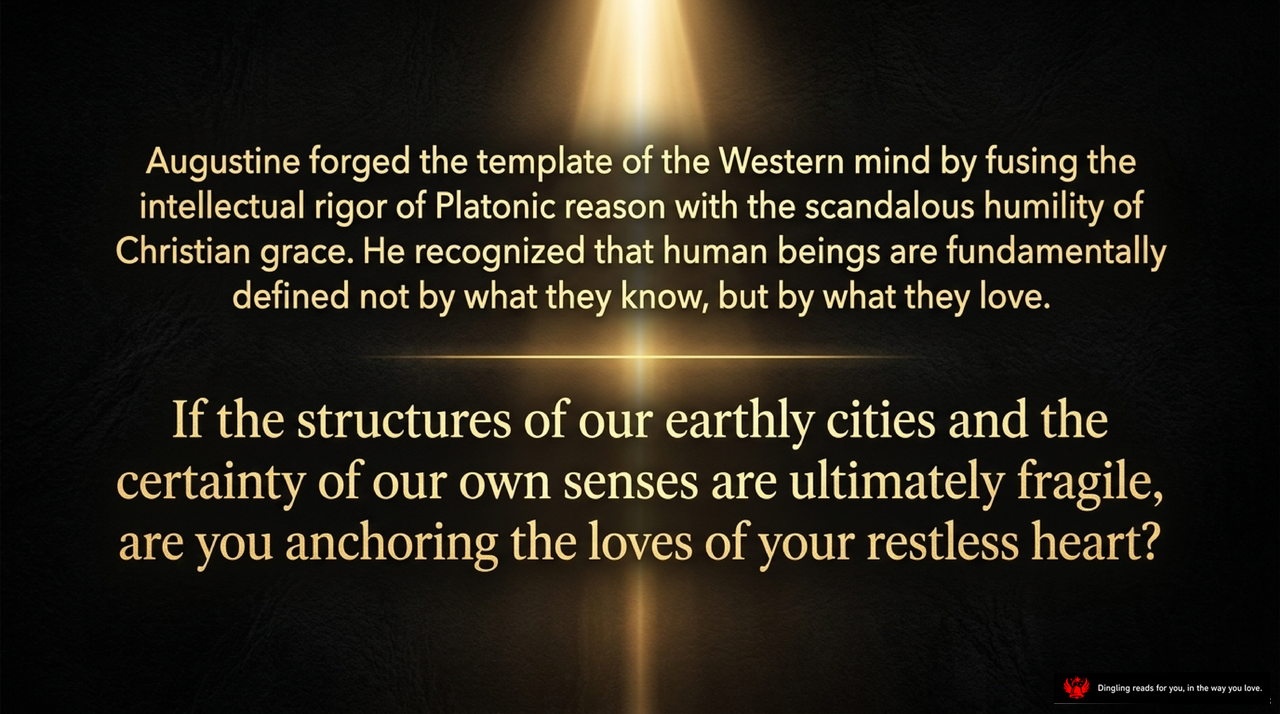
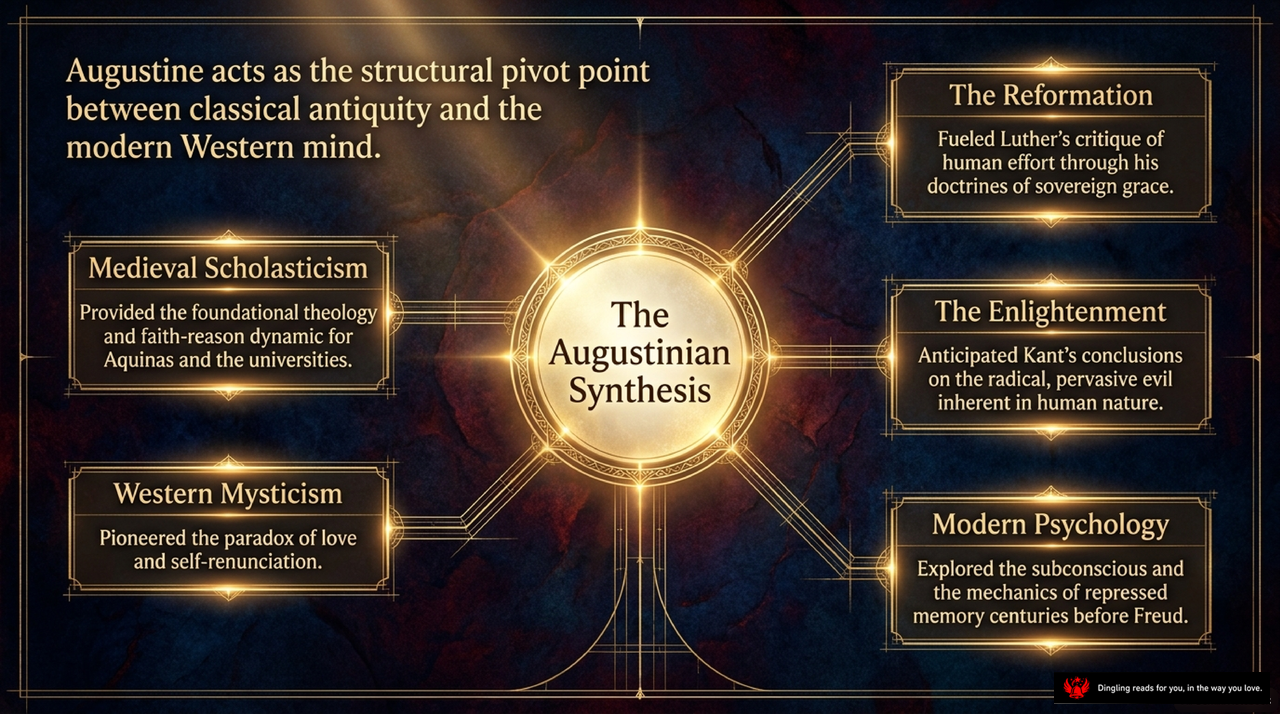
Let’s take a moment to unpack Augustine’s enormous impact on Western thought—because he didn’t just leave a mark; he forged the very template of how we think about ourselves and the world. How did he do it? By merging two powerful, even contrasting, traditions: the intellectual rigor of Platonic reason—you know, that drive to question, analyze, and chase universal truth—with the radical, almost scandalous humility of Christian grace. Grace isn’t about earning something; it’s about receiving what we don’t deserve.
But here’s Augustine’s game-changing insight: he said human beings aren’t fundamentally defined by what we know. It’s not about our degrees, our IQ, or how much we’ve mastered. No—we’re defined by what we love. The things that capture our attention, our time, our devotion—those are the things that shape who we are.
Now, think about the world around us. The cities we build, the systems we trust, even the certainty we get from our own senses—they’re all fragile. A storm can destroy a city, a crisis can shake a system, our senses can trick us. So Augustine’s question cuts to the core: If all those earthly structures and sensory certainties are ultimately fragile, are you anchoring the loves of your restless heart?
It’s a question that resonates across centuries. We’re all chasing something—success, comfort, validation—but those things fade. Augustine challenges us to ask: What’s the unshakable thing that can hold our love? What’s the grace that can calm our restless hearts? That’s the legacy he left us: a way to use our minds to find the love that lasts.