
Being and Time: Complete Chapter-by-Chapter Summary

Welcome to our deep dive into one of the most profound and challenging works in philosophy: *Being and Time* by Martin Heidegger. This book isn't just a text; it's an existential inquiry designed to shake the foundations of how we understand human existence. On this cover slide, you see the title and a crucial subtitle: "An existential inquiry into the meaning of human existence and being."
Heidegger's core argument is radical and simple yet incredibly difficult: the only being we can truly analyze is ourselves. He calls this human existence "Dasein"—literally "being-there." Unlike other things that just *are*, Dasein's essence lies in how it goes about existing. We don't define humans by a list of static traits like a machine; we define them by their possibilities, by their choices, and by the fact that they are always "to be."
Heidegger also insists that Dasein is always already "in the world." This doesn't mean we are physically inside a room like a cup holds water. Instead, it means we are engaged, involved, and dwelling within a web of meaning, tools, and relationships from the very first moment we wake up. We aren't isolated observers looking out at a universe; we are participants actively shaping our reality through our actions and concerns.
This book challenges the traditional view that we are rational animals or conscious subjects standing apart from the world. It asks us to look at the raw, messy, and authentic nature of being alive. Are we just following the crowd in our daily routines? Or can we find a way to own our existence? Heidegger's journey through this book will guide us from these fundamental questions all the way to the very structure of time itself, revealing that our understanding of time is actually rooted in who we are as human beings.

Welcome back to our deep dive into Heidegger. Today's slide, titled "The Forgotten Question of Philosophy," sets the stage for a radical shift in how we understand reality. On the left, we see "The Status Quo." For centuries, since Plato and Aristotle, philosophy has treated "Being" as a universal, empty concept—something so obvious we don't even define it. We use the word "is" constantly without realizing what it actually means. We've accepted this as dogma, treating Being as a self-evident backdrop rather than a question.
But look at the right side: "The Mission." This is where Heidegger steps in. He seeks to reawaken the *Seinsfrage*—the question of the meaning of Being. To do this, he argues we must destroy the traditional history of ontology. Why? Because that history has buried the original, hidden experience of Being itself. We can't just tweak the old definitions; we need to dismantle the framework to retrieve what was lost.
The central takeaway, highlighted at the bottom, is clear: We must destroy the traditional history of ontology to retrieve the original experience of Being. This isn't about rejecting all knowledge; it's about clearing away the fog of tradition so we can finally see the ground beneath our feet. It's time to stop taking "Being" for granted and start asking the one question that has been forgotten for two millennia.

The Ontological Difference isn't just a label; it's the fundamental split that has haunted Western philosophy for centuries. On the left, we have **Beings (Seiendes)**—the tangible entities we encounter every day: a table, a tree, a human body, or a scientific fact. These are the "what" of the universe, the things we study through empirical sciences like biology and physics, and traditional logic. We look at them as fixed objects with defined properties.
But look at the right side: **Being (Sein)**. This is the invisible condition that allows anything to exist at all. It is not an object you can hold; it is the "is-ness" itself, the invisible framework that determines why entities appear as entities. While we study Beings by cataloging them, we must study Being through fundamental ontology, asking about the very possibility of existence.
The slide's synthesis drives this home: you cannot understand Being simply by listing a massive inventory of Beings. It's like trying to understand the rules of a game by only counting the players. We need a completely new method of inquiry. As we dive into the text, we see that traditional approaches—from Descartes' "I think, therefore I am" to modern psychology and biology—have failed because they treat the thinker as just another object within the world, rather than the one who opens up the world in the first place. To truly grasp reality, we must stop treating existence as a static thing and start investigating the dynamic act of existing itself.
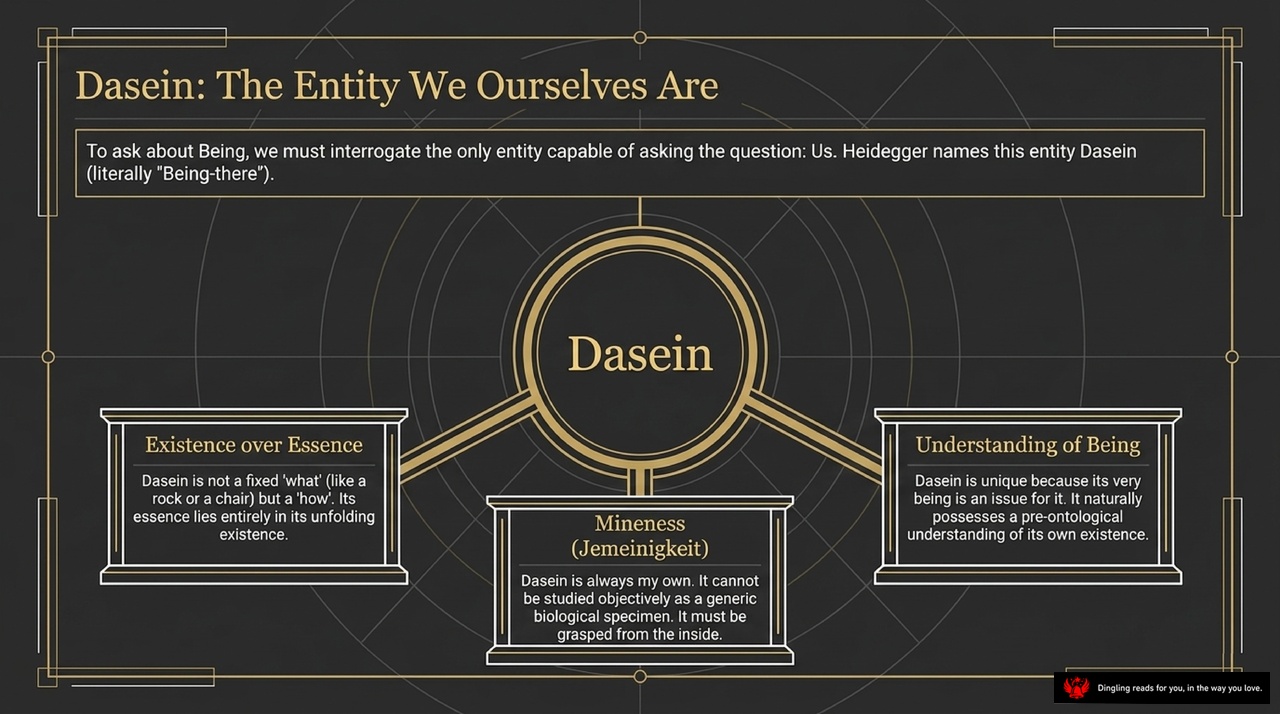
Dasein: The Entity We Ourselves Are. To truly ask about Being, we have to interrogate the only entity capable of asking the question: Us. Heidegger names this entity Dasein, literally "Being-there." But what does that actually mean? It's not a fixed "what," like a rock or a chair. Dasein is defined by its "how." Its essence lies entirely in its unfolding existence. This brings us to three core pillars. First, Existence over Essence. Dasein is not a static object; it is a process of "how-to-be." Second, Understanding of Being. Dasein is unique because its very being is an issue for it. It naturally possesses a pre-ontological understanding of its own existence. Finally, Mineness, or Jemeinigkeit. Dasein is always my own. It cannot be studied objectively as a generic biological specimen. It must be grasped from the inside. Unlike traditional science that treats humans as objects to be measured, Dasein demands we step inside our own existence to understand it. This isn't just philosophy; it's the only way to truly grasp what it means to be human.

The slide clearly contrasts two ways of understanding our place in reality: the old Cartesian view versus Heidegger's breakthrough. On the left, you see the traditional split where the isolated mind looks out at a separate physical world, creating a gap between subject and object. But on the right, we see the Heideggerian view, where "Dasein" is not separate from the world but is fundamentally "Being-in-the-world."
This shift is crucial because it challenges the idea that we are just observers standing apart from things. Instead, as the text explains, Dasein does not merely exist inside the world spatially like water in a glass. We are inherently bound up with our environment, engaged in it, and dwelling within it before we even start thinking consciously. This means our understanding of reality isn't a detached observation but an active participation. We are already "in" the world, navigating its tools, relationships, and possibilities, which forms the true foundation of how we exist.

How We Encounter the World of Things
Let's look at how we actually meet the things around us. On the left, we see the concept of "Ready-to-hand." This is what happens when we use something seamlessly, like a hammer. When we are driving a nail flawlessly, the hammer disappears into its usefulness. We don't stare at it as a wooden object with weight and texture; it just becomes an extension of our hand. It withdraws into the activity. This seamless engagement is our primary reality. We don't notice the tool until it stops working.
But look at the right side. That represents "Present-at-hand." This happens when the hammer breaks. Suddenly, it loses its usefulness and obtrudes itself as a mere physical object. Now we see its properties: it is heavy, it is made of wood, and it is broken. It stands out as an isolated thing with attributes.
Traditional philosophy and science have made a critical mistake. They treat the "Present-at-hand" view as the fundamental layer of reality, assuming that things are first just objects sitting there. They ignore the fact that practical use—the "Ready-to-hand"—always comes first. We encounter the world not by staring at isolated objects, but by engaging with them as equipment within a meaningful whole. Only when things break down do we mistakenly start seeing them as separate, physical objects. Our primary reality is always the flow of doing, not the static observation of things.

In the flow of everyday life, we often feel like we are simply reacting to the world, drifting along with the crowd. But what if this "drifting" isn't just a lack of effort, but a fundamental part of how we exist? Today, we're diving into the concept of "Falling"—a structural reality of human existence, not a moral failing.
As we've seen, our existence, or *Dasein*, is fundamentally about how we show up in the world. But there's a trap we all fall into. In our average everydayness, we don't live authentically as ourselves; instead, we live as "They" live. We read what "they" read, value what "they" value, and shrink from what "they" shrink from. This isn't just about following trends; it's about surrendering our unique possibilities to a subtle dictatorship.
This "They," or *Das Man*, acts like a neutral public opinion that levels down all individuality. It enforces averageness and strips us of personal responsibility. When we get lost in this crowd, we stop seeing the world as a network of meaningful tools and relationships. Instead, we see it as a collection of isolated objects, detached from our own concerns. We become spectators, watching life happen to us rather than actively engaging with it.
Crucially, we must understand that this isn't a psychological weakness or a simple moral choice you can just "fix" by trying harder. It is an unavoidable, structural reality of human existence. We must first lose ourselves in the public world to eventually find ourselves. This process of "Falling" is the price of admission to the human condition. It's how we initially secure our footing in a shared world before we can ever dare to stand alone and take responsibility for our own unique path.

Let's dive into the architectural blueprint of human existence. Imagine the concept of "Being-In" not as a static state, but as a living structure illuminated by three foundational pillars: Mood, Understanding, and Discourse.
First, consider **Mood** or *Befindlichkeit*. This is the ground we stand on before we even think. We never encounter the world neutrally; we are always attuned to it through how we feel. Whether it's anxiety or boredom, these moods reveal our "Thrownness"—the undeniable fact that we are delivered over to a world we did not choose. We are here, and that's the starting point.
Next, look at **Understanding** or *Verstehen*. This is the engine of our existence. Dasein doesn't just sit still; it always projects itself forward toward future possibilities. We understand the world not by staring at objects, but in terms of what we can *do* with them. It's a constant act of planning and reaching out.
Finally, there is **Discourse** or *Rede*. This is the deep articulation of intelligibility that binds everything together. It's the underlying foundation of all language, pointing out meanings and relations. Without this, our understanding and our moods would remain isolated fragments.
Together, these three structures form the "clearing" where existence becomes visible. They aren't separate parts we add up; they are the very way we disclose the world to ourselves.

Care is the ultimate being of Dasein, the single phenomenon that consolidates the totality of its structural whole. Think of it not as a static trait, but as a dynamic knot woven from three interwoven existential dimensions. First, we are already-in the past, thrown into a world without our consent, carrying the weight of thrownness. Second, we exist alongside others in the present, absorbed in the everyday world of things and public norms, often falling into the comfort of routine. Third, we are always ahead-of-ourselves, projecting toward our own future possibilities. These three strands—thrown projection and falling absorption—entangle together to form the ontological equation of Care. This isn't just about worry; it is the very structure of being human, pulling us between the gravity of our past and the openness of our future.

The Horizon of Authenticity: Being-Towards-Death. For Heidegger, death isn't just a biological event at the end of life; it's an ever-present existential orientation—the possibility of the absolute impossibility of any further existence. This isn't about fearing a distant date, but facing the very structure of our being.
When we confront this boundary, we enter a state of being-towards-death. This has four defining characteristics. First, it is ownmost: no one can die your death for you. It individualizes you entirely, stripping away the distractions of the crowd. Second, it is non-relational: death cuts you off from all worldly connections. In that final moment, no one is there to help or hinder; you stand alone. Third, it is certain: death is absolute and inescapable. You cannot avoid it. Yet, fourth, it is indefinite: it can happen at any given moment. You never know when it will arrive.
Anticipating this boundary pulls Dasein out of the comforting illusions of the 'They.' Instead of hiding in the average everydayness where everyone else decides for you, facing death forces you to take ownership. It breaks the spell of the crowd and demands that you choose your own path. This anticipation transforms death from a looming threat into the ultimate horizon that gives meaning to every other possibility you have.

The Call of Conscience & Resoluteness isn't just about feeling guilty; it's an ontological wake-up call. Imagine this: you're lost in the noisy crowd of "The They," letting the public opinion dictate your every move. That's the noise drowning out your true self. But then, the Call strikes. It's not a moral guilt trip; it's a summons for Dasein to pull itself back from that lostness in the crowd and face its own uncanny isolation.
This call leads us to a profound realization: Ontological Guilt. It's the understanding that we are the groundless ground of our own existence. We are thrown into the world, yet we are entirely responsible for our choices. There is no external script; the responsibility is ours alone.
How do we respond? Through Resoluteness. This is the authentic mode of existence. It means embracing your ownmost possibilities with a clear-eyed, silent anticipation of death. You stop looking for safety in the crowd's illusions and instead take a stand, free from the noise of others, defining your own path.
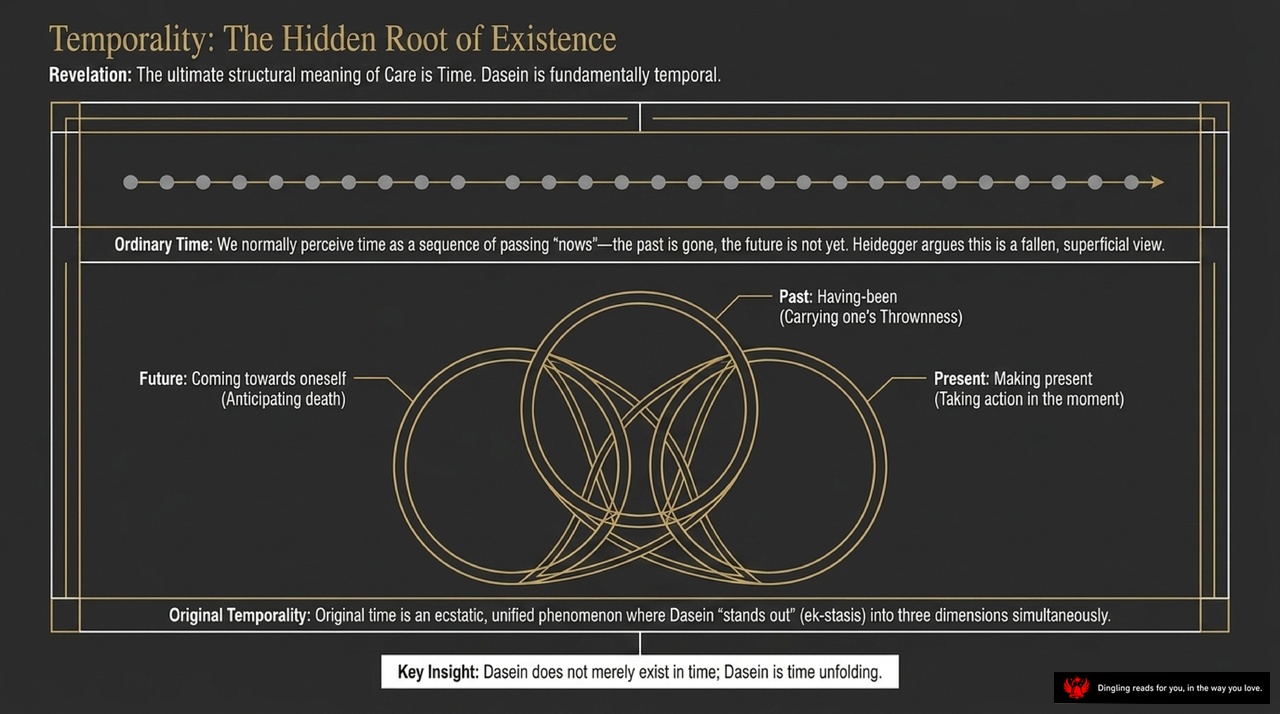
Temporality: The Hidden Root of Existence. This slide reveals a profound shift in how we understand reality: the ultimate meaning of Care is Time. We are fundamentally temporal beings.
Most of us live in what the slide calls "Ordinary Time"—a linear sequence of passing "nows," where the past is gone and the future hasn't arrived yet. Heidegger argues this is a superficial, fallen view. It treats time like a clock ticking away, but it misses the essence of our existence.
True understanding requires grasping "Original Temporality." Here, time isn't a container we sit in; it's an ecstatic, unified phenomenon where Dasein stands out into three dimensions simultaneously. Look at the intersecting circles:
The Future is about coming towards oneself—anticipating death.
The Past is "Having-been," carrying our thrownness.
The Present is "Making present," taking action in the moment.
These aren't separate chapters; they are woven together. We don't merely exist *in* time; we *are* time unfolding. This dynamic interplay is what gives our lives structure and meaning.
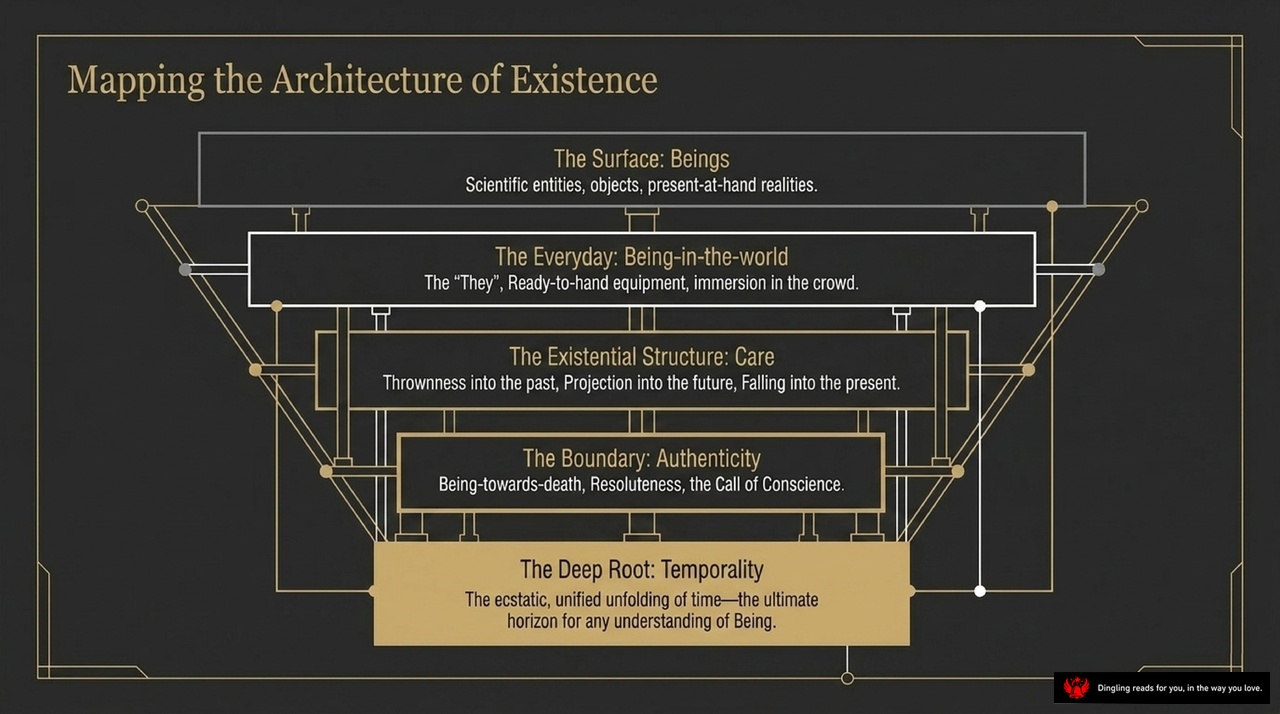
Mapping the Architecture of Existence isn't just about listing parts; it's about seeing how they connect to form a living whole. Think of this diagram as a blueprint for human reality, starting from the very foundation and rising up to the surface we navigate every day.
At the bottom, we have "The Deep Root: Temporality." This is the ultimate horizon for understanding anything that exists. It's not a clock ticking away, but the ecstatic, unified unfolding of time itself—the future, the past, and the present all happening together as the ground of our being.
Building on that root is "The Boundary: Authenticity." This is where we face the call of conscience, our resoluteness, and our being-towards-death. It's the moment we stop hiding and take responsibility for who we are.
Above that lies "The Existential Structure: Care." This is the core engine of our existence: our thrownness into the past, our projection into the future, and our falling into the present. It's the dynamic tension that keeps us alive.
Then we move to "The Everyday: Being-in-the-world." Here, we find ourselves immersed in the crowd, using ready-to-hand equipment, and often getting lost in the anonymous "They." This is where most of life happens, often unconsciously.
Finally, at the very top, we reach "The Surface: Beings." This is the realm of scientific entities, objects, and present-at-hand realities—the world we see as separate things when we step back from our own engagement with it.
This structure shows that we aren't just observers of the world; we are the ones who make the world appear. Our time, our choices, and our everyday actions are all intertwined, creating the architecture of our existence from the ground up.
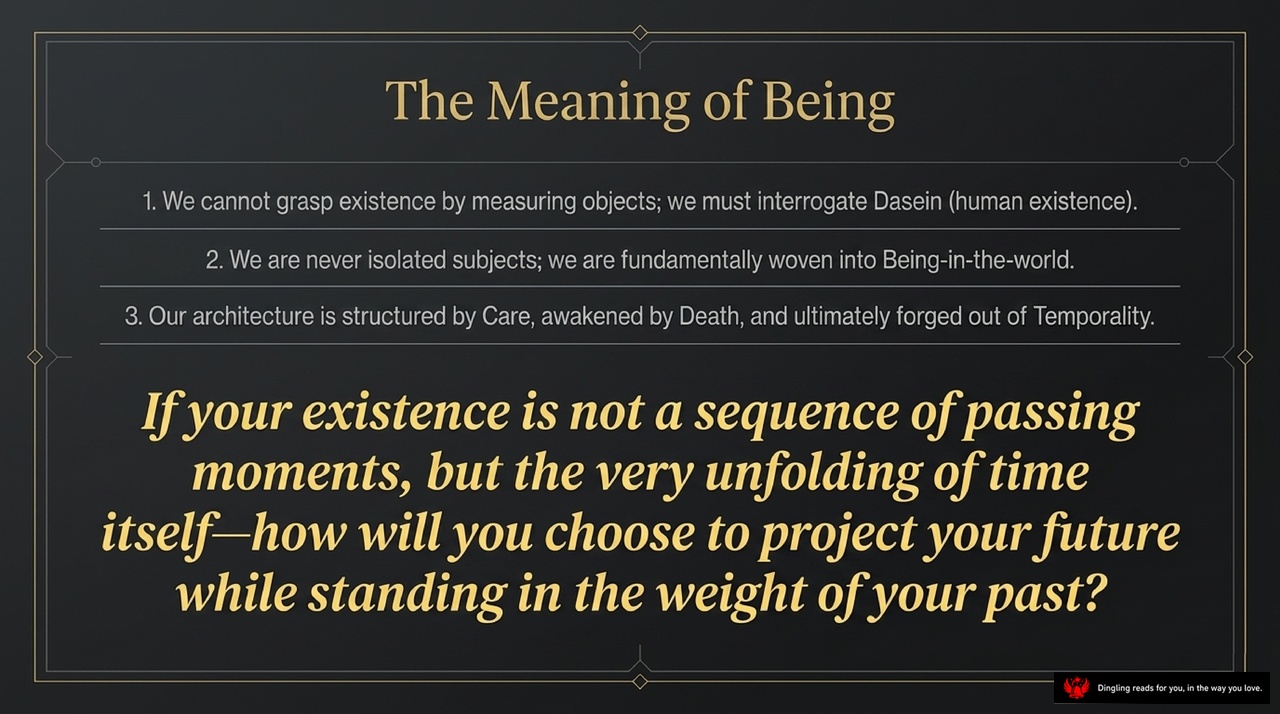
The Meaning of Being isn't about measuring objects; it's about interrogating Dasein—human existence itself. We are never isolated subjects floating in a void; we are fundamentally woven into Being-in-the-world. Our very architecture is structured by Care, awakened by Death, and ultimately forged out of Temporality.
So, ask yourself: If your existence is not a sequence of passing moments, but the very unfolding of time itself, how will you choose to project your future while standing in the weight of your past?