
Being Mortal: Complete Chapter-by-Chapter Summary

Welcome to a profound exploration of aging, death, and what truly matters at the end of life. Today, we are diving into Atul Gawande's powerful book, *Being Mortal*.
This isn't just a medical text; it is a deeply personal journey into the human experience of growing old. We will look at how our bodies inevitably change, why traditional models of care often fail us, and how we can reclaim dignity and autonomy even in our final years.
Join me as we navigate these difficult but essential conversations about life, loss, and the choices that define us.
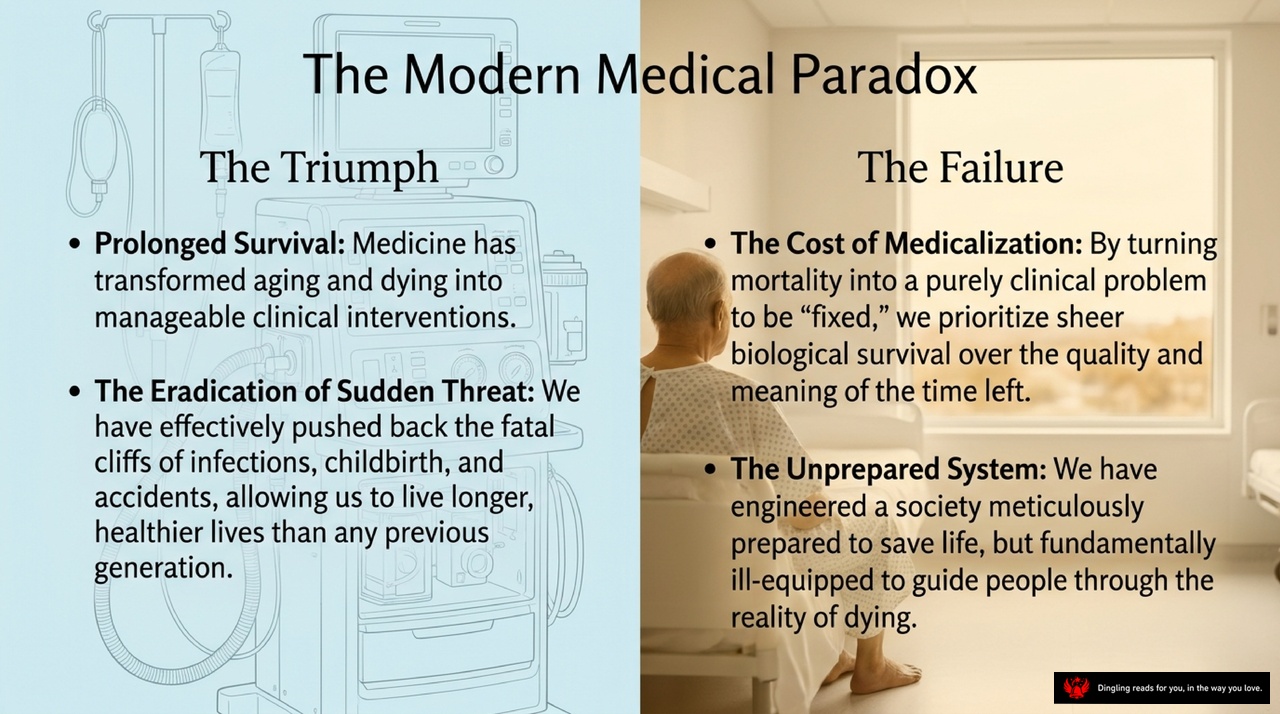
The Modern Medical Paradox presents a stark contrast between triumph and failure. On one side, we celebrate the triumph of prolonged survival. Medicine has successfully transformed aging and dying into manageable clinical interventions, effectively pushing back the fatal cliffs of infections, childbirth, and accidents. This allows us to live longer, healthier lives than any previous generation, turning what was once a sudden threat into a slow, controllable process.
However, the other side of this coin is a profound failure. By turning mortality into a purely clinical problem to be "fixed," we have prioritized sheer biological survival over the quality and meaning of the time left. We have engineered a society meticulously prepared to save life, yet fundamentally ill-equipped to guide people through the reality of dying. We celebrate the extension of life, but often at the cost of the richness of living.
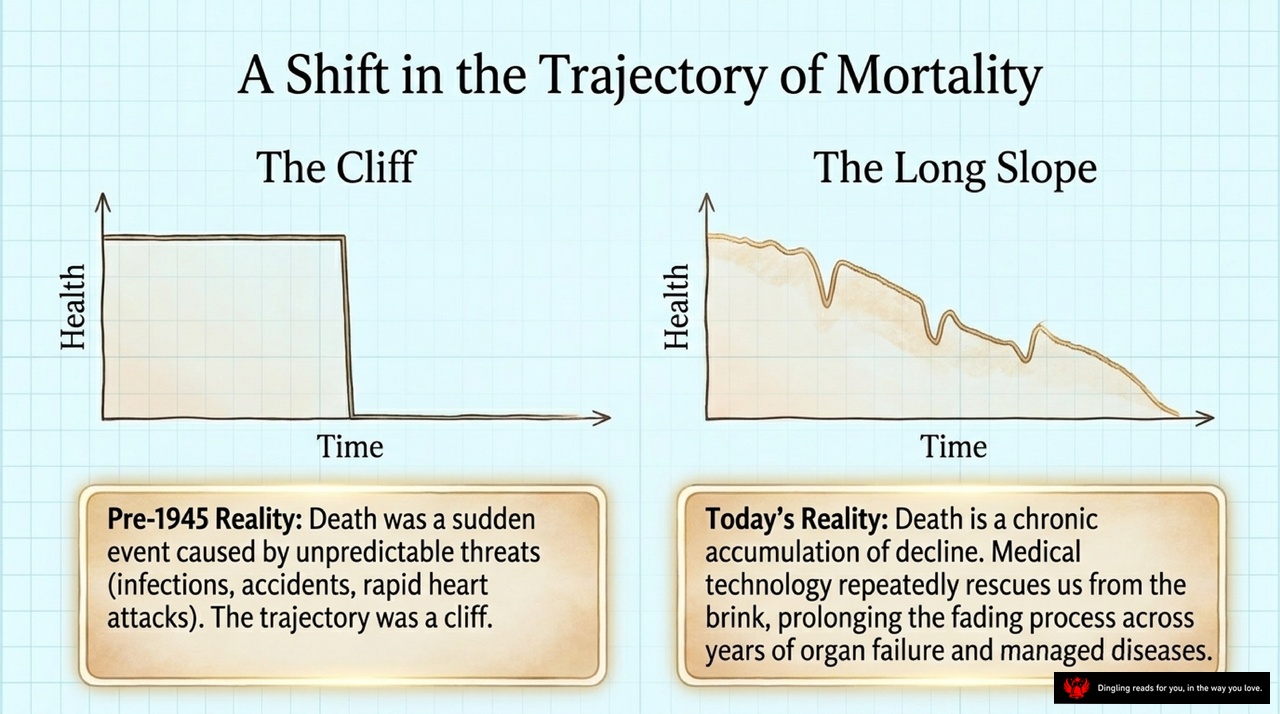
Imagine a world where death wasn't a sudden cliff, but a slow, winding slope. This slide captures a profound shift in how we experience our final years. On the left, we see "The Cliff"—the reality before 1945. Back then, death was often an unpredictable event, a sudden drop caused by infections, accidents, or a rapid heart attack. Your health was stable, then it just vanished.
But look at the right side: "The Long Slope." Today, thanks to medical technology, death has become a chronic accumulation of decline. We are repeatedly rescued from the brink, prolonging the fading process across years of organ failure and managed diseases. Instead of a sudden fall, we now face a gradual descent, filled with managed illnesses and extended lifespans. This shift changes everything about how we prepare for the end, turning a quick exit into a long, complex journey of aging and care.

Imagine a world where the body doesn't just stop working, but systematically falls apart. This isn't a sudden breakdown; it's a slow, inevitable accumulation of structural wear and tear. As geriatrician Felix Silverstone famously put it, "We just fall apart."
Look at the human body as a machine under constant stress. In the brain, pigment cells exhaust their lifespan, causing the brain to lose volume. This leads to those frustrating short-term memory gaps and diminished sensory acuity we all fear. Move down to the mouth and jaw: tooth enamel wears away irreversibly, and the jawbone loses 40% of its mass. This forces us to shift to softer diets, which ironically accelerates further decay.
Inside our bones and vessels, calcium slowly leaks from the skeletal structure into blood vessels and tissues. This causes osteoporosis and hardened, calcified arteries, making our circulatory system rigid and inefficient. Meanwhile, the heart faces its own battle. Pumping efficiency steadily declines from age 30 onward. Thickened heart walls struggle to push blood through narrowed vessels, leading to a gradual loss of power.
This is the biological reality of systemic breakdown. Aging is not a single disease we can cure; it is the gradual, unstoppable erosion of our very structure. When these systems fail, the illusion of independence shatters, leaving us with a profound sense of loss.
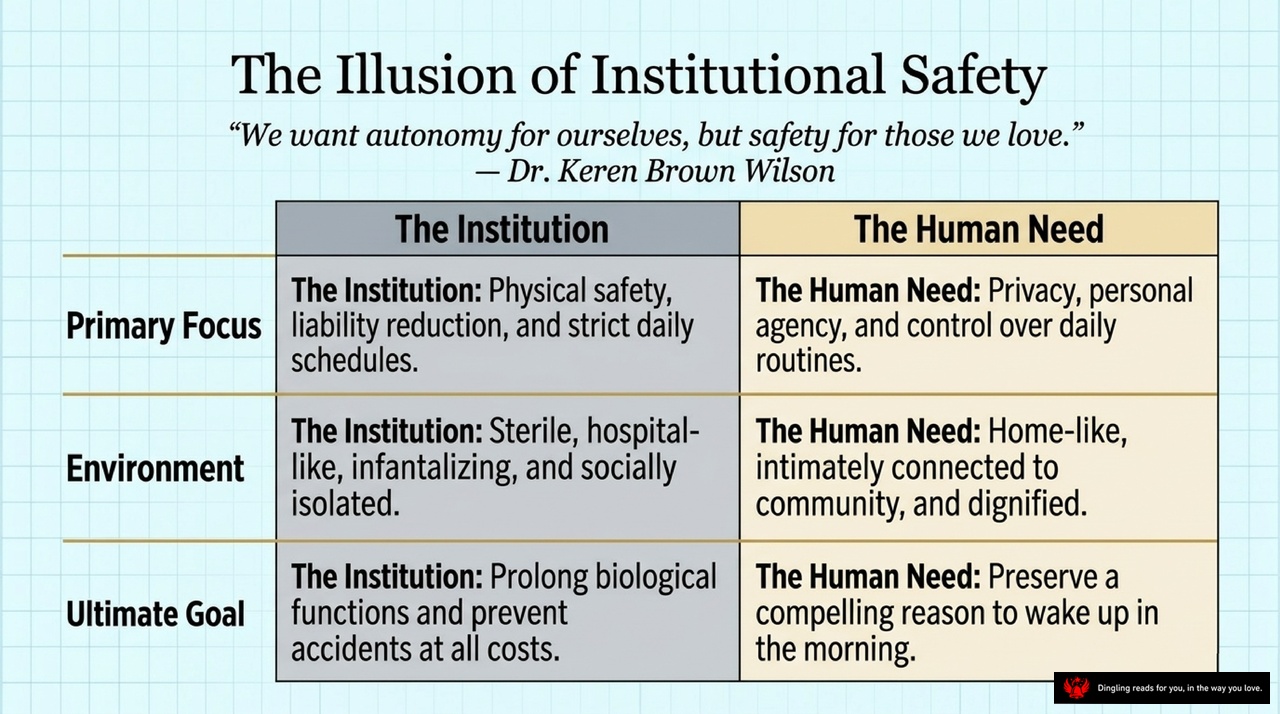
In the traditional nursing home model, safety often comes at the cost of freedom. Residents are treated like patients in a sterile hospital, stripped of their agency and dignity. Their days are dictated by rigid schedules, their movements monitored, and their choices limited to avoid any risk. This approach prioritizes physical safety above all else, creating an environment that feels more like a cage than a home.
But what if we could change that? What if we could create a living space that feels like a real home, where residents retain control over their daily lives, can keep their pets, and make their own decisions about their meals and routines? This is the vision behind "assisted living"—a model that sits between the chaos of independent living and the over-control of traditional nursing homes.
The core philosophy here is simple yet revolutionary: treat elders not as broken bodies to be fixed, but as people with needs for autonomy and dignity. Imagine a place where residents have private apartments with kitchens and bathrooms, where they can lock their doors, adjust the temperature, and even eat foods that might be risky but bring them joy. Caregivers are there to support, not to police. The goal isn't just to keep them safe from falling, but to give them a compelling reason to wake up every morning.
Of course, this ideal faces real-world challenges. Many facilities struggle to balance the need for safety with the desire for freedom. Staff often rush through tasks to meet quotas, and families, fearing for their loved ones, may push for stricter controls. Yet, when we look at successful examples, like the innovative communities that focus on small, home-like units or even bringing life into nursing homes through animals and children, we see a powerful truth: when elders feel they have a role to play and a voice to hear, they thrive. They find joy, connection, and purpose. True care isn't about removing all risk; it's about empowering people to live their lives with dignity, even as they age.

When we face the end of life, we often fear making the wrong choice. Are we extending a life filled with suffering, or are we rushing away from precious moments? This is the delicate balance between autonomy and risk that defines our final chapter.
Consider Peg, a piano teacher who, after battling cancer, found herself in a desperate hospital bed, overwhelmed by pain and incontinence. Her only desire was to end her suffering. But instead of giving up, she chose a different path: palliative care. By shifting her goal from mere survival to living with quality, she reclaimed control over her life. The care team helped her go home, fine-tuned her pain medication, and optimized her treatment. In her final six weeks, she didn't just survive; she thrived. She returned to teach her students and even hosted small concerts, surrounded by love and music.
Peg's story proves that palliative care is not about giving up. It is about redefining dignity. In our hyper-technological society, we often forget the importance of playing the role of a "dying person"—someone who shares memories, repairs relationships, and leaves a legacy. When medicine focuses too much on treatment, it can accidentally strip us of this vital role.
Peg's final act was a perfect example. Just three days before she passed, she handed her music books to her student, Hunter, whispering, "You are special." She completed her own story on her own terms. Similarly, her father, after accepting palliative care, continued to host dinners, work on projects, and watch movies with his family, filling every remaining day with shared moments.
Ultimately, the best way to say goodbye is not to fight until the very last second, but to have the courage to choose how we want to end our story. It is about finding the answer that best fits the meaning of our lives, even within our limits.

When we face the end of life, the hardest choice isn't between life and death, but between two kinds of courage. It's the bravery to look our fears in the eye and the even harder courage to act on what truly matters to us. We often get stuck in a cycle of over-treatment, trying to squeeze out every extra day, only to lose the quality of those days. But there is a better way.
Take the story of Peg, a piano teacher who was devastated by cancer and pain. Instead of fighting for a life that felt like a prison, she chose hospice care. Her goal shifted from "surviving" to "living well." With proper pain management and support, she wasn't just a patient; she was back in control. She taught her students again, played music for them, and even held a small concert. In her final six weeks, she didn't just endure; she celebrated. She left her students with a final gift—a handwritten note saying, "You are special."
This is the power of choosing dignity over desperation. It means realizing that when medicine can no longer cure us, its most important job is to help us say goodbye on our own terms. It's about ensuring our final chapters are filled with love, comfort, and the freedom to be ourselves, rather than being trapped in a machine. As we navigate these difficult times, let's remember that the best goodbye is one where we are still the authors of our own story.
When we face the end of life, we aren't just choosing between medical treatments; we are choosing the kind of story we want to leave behind. As we saw with Peg, the piano teacher who turned away from a fight for survival to embrace a final six weeks of music and connection, the most powerful medicine isn't always a pill or a surgery. It is the courage to redefine what matters when time runs out.
Peg's journey teaches us that a "good death" isn't about stopping pain by any means necessary; it's about protecting the dignity of the human experience. By shifting her focus from "living at all costs" to "living with quality," she reclaimed her agency. She didn't just wait to die; she actively curated her final chapter, teaching her students, playing her music, and sharing her love until the very last moment. This is the essence of palliative care: it's not about giving up, but about changing the goal from extending life to enriching the time we have left.
This approach requires a profound shift in how we view death. We must stop seeing the dying person as a passive patient to be managed and start seeing them as a protagonist with a story to finish. When we honor this narrative, we allow families to say goodbye with peace, and we allow individuals to pass away with their heads held high, having authored their own ending rather than having it written by a hospital chart. True courage, in the end, is the wisdom to know when to stop fighting the inevitable, and the grace to simply be human.

Navigating the Hard Conversations is about making four critical decisions when facing a health crisis. First, we must Assess Prognosis: honestly understanding our current health situation and potential trajectory. Second, we need to Identify Fears: asking ourselves what our biggest worries are if our condition worsens. Third, we must Define Trade-offs: deciding what we are willing to endure, and what is strictly off-limits, in exchange for more time. Finally, we Establish Priorities: asking if time is truly short, what is the single most important thing to you right now.
This structured approach isn't just theoretical; it has life-saving real-world impact. In La Crosse, Wisconsin, systematizing these conversations reduced end-of-life hospital costs by 50% and increased average lifespans by a full year. By moving from fear to clarity, we transform uncertainty into a plan that honors our values.

Let's talk about a truth that feels completely backwards, yet is backed by hard science: sometimes, letting go of the fight to live longer is the very thing that lets you live longer—and live better.
On this slide, we see two powerful circles. On the left, we have "The Illusion of the Fix." It warns us that clinging to toxic, aggressive treatments doesn't save us; it systematically ravages the body, accelerates organ failure, and actually guarantees the destruction of our remaining quality of life. We often think more medicine equals more time, but in reality, it can be a slow poison.
On the right, we see "The Paradox of Palliative Care." This is where the counterintuitive truth shines. Look at the Mass General Study: Stage 4 lung cancer patients who received early palliative care and stopped chemotherapy sooner actually lived 25% longer than those who fought to the very end. They experienced drastically less pain. Then look at the Aetna Study: when concurrent palliative care was offered, hospice enrollment jumped from 26% to 70%, while late-stage ICU usage plummeted by 85%.
The core message in the center is clear: Longer, Better Life. It sits right in the middle of these two concepts. The bottom line is profound: Only by not striving to live longer do patients sometimes live longer—and significantly better. We often get trapped in the "illusion of the fix," believing we must do everything to stay alive. But the data shows that stepping back, prioritizing comfort and quality over sheer extension of time, can be the most powerful medical intervention of all.

The medical system today operates on a dangerous default: the "fix-it" mentality. We are taught that doing nothing is a failure, a mistake to be avoided at all costs. But this blind optimism is actually our greatest enemy. Studies reveal a startling truth: 63% of doctors systematically overestimate how long their terminal patients will live, often by as much as 530%. We lie to ourselves and our patients, hoping that more time means a better outcome. But in reality, we are often just delaying the inevitable while causing unnecessary harm.
Take the tragic story of Sara Monopoly, a 34-year-old mother who was diagnosed with terminal lung cancer. Because her doctors viewed "doing nothing" as a failure, she was subjected to endless, futile rounds of chemotherapy. She never had the chance to say goodbye to her daughter or prepare for the end. Instead, she died exhausted, tethered to a ventilator in a hospital bed, fighting a battle she could never win. Her life was not saved by treatment; it was destroyed by the refusal to stop.
Our current medical model offers a lottery ticket with almost zero odds of winning, yet it guarantees the destruction of a patient's final days. It prioritizes the illusion of control over the reality of comfort. We cling to hope as if it were a strategy, but hope is not a plan. When we refuse to accept that some battles are unwinnable, we deny patients their dignity and their right to a peaceful, meaningful end. The true act of courage isn't fighting until the very last second; it is having the wisdom to know when to let go.

How We Measure the Value of a Life. We often think of our lives as a collection of moments, but psychology tells us there are actually two selves at work. On the left, we have the Experiencing Self, represented by this stopwatch. This part of us lives entirely in the present, evaluating existence minute-by-minute based on immediate physical pain or temporary pleasure. It's about how things feel right now.
But on the right, we have the Narrative Self, symbolized by this old book. This self evaluates life as a complete, cohesive story. According to the Peak-End Rule, a story isn't defined by its average duration or total pain, but by its highest peaks and, crucially, how it ends.
Here lies the tension. We will tolerate immense temporary pain if it preserves our overall narrative. However, ruining a person's final chapter with senseless, isolating medical suffering strips their entire story of its dignity. Think about it: would you rather have a life full of minor discomforts that ends with a peaceful, meaningful goodbye, or a life of comfort that ends in a hospital bed, alone and disconnected? The data shows that how we end matters more than how we endure the middle. Endings matter.

The Final Act of Courage isn't about fighting until the very last breath; it's about the strength to see the truth clearly. It requires the courage to confront the false promises of endless medical intervention and to accept our biological limits. It takes real bravery to look past the noise and ask the hard question: what is actually inevitable?
But seeing the truth is only half the battle. The second, often harder act is the courage to act upon that truth. This means having the wisdom to choose precisely which battles are worth fighting and knowing exactly when to let go. It's about protecting the things that truly make life meaningful—like a final conversation with a loved one or a moment of peace—rather than clinging to a futile struggle that only drains the remaining time.
As the slide reminds us, endings matter not just for the person dying, but profoundly for those left behind. When we choose to stop fighting the inevitable, we aren't giving up; we are making space for the most important part of life to continue. We trade the illusion of control for the gift of presence, ensuring that our final days are defined by connection and dignity, rather than by suffering and regret.
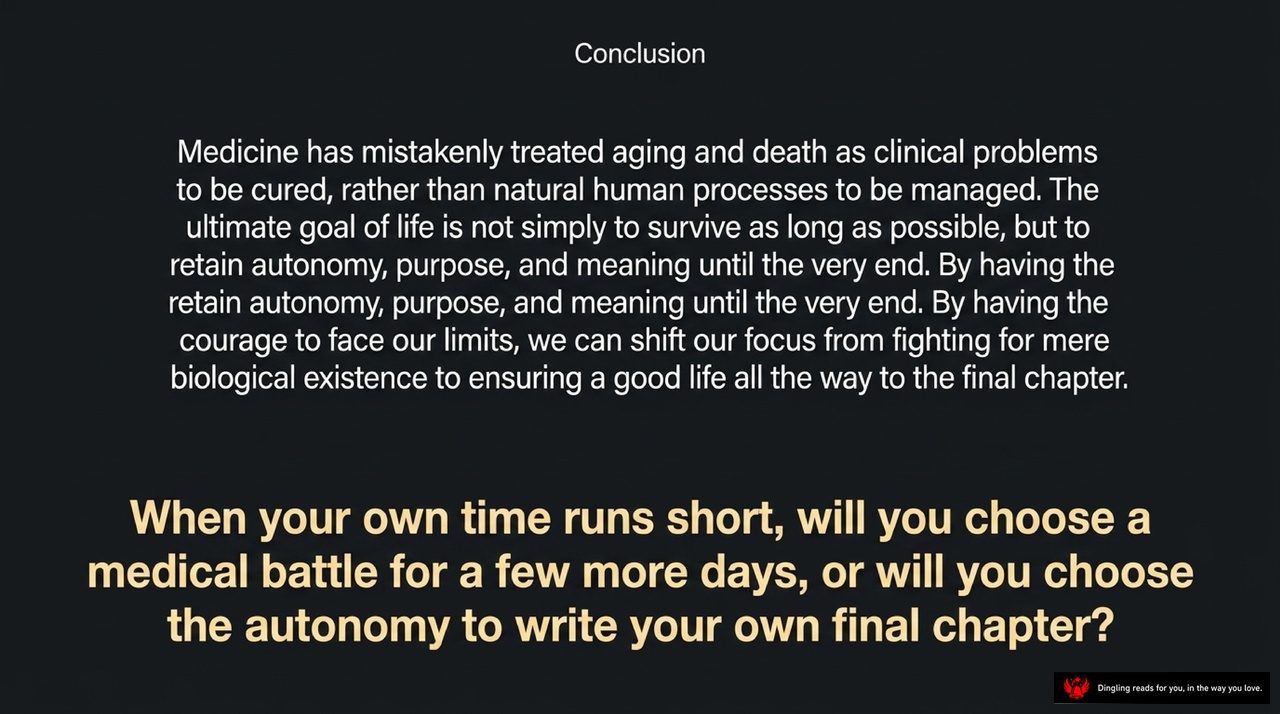
So, where does this all leave us? We've spent a lot of time talking about the fragility of our bodies and the inevitable decline that comes with aging. But here is the hard truth we need to face: medicine has made a massive mistake. It has treated aging and death as clinical problems that need to be cured, rather than natural human processes that simply need to be managed.
Think about it. The ultimate goal of life shouldn't just be to survive as long as possible at any cost. That's not living; that's just enduring. The real goal is to retain your autonomy, your purpose, and your meaning all the way to the very end.
By having the courage to face our limits honestly, we can shift our focus. We stop fighting for mere biological existence and start ensuring a good life all the way to the final chapter. So, I'm leaving you with this question: When your own time runs short, will you choose a medical battle for a few more days, or will you choose the autonomy to write your own final chapter?