
Beyond Justice: Complete Chapter-by-Chapter Summary

Welcome to *Beyond Justice*, a powerful collaboration by Zhao Hong, Chen Bi, Li Hongbo, and Luo Xiang. This isn’t just another legal textbook—it’s an invitation to rethink what justice truly means. As the title suggests, real justice goes far beyond the letter of the law. It demands something deeper: empathy. A deep, human understanding rooted in literature, history, and philosophy. Because when we strip away the cold statutes and dive into the stories of people, the struggles of communities, and the wisdom of generations, we begin to see justice not as a formula, but as a living, breathing ideal. Let’s explore what it takes to move beyond the surface and find justice that actually matters.

You know, we often think of law as a rigid system—rules, procedures, outcomes. But what if that’s only half the story? What if true justice doesn’t come from rules alone, but from something deeper, something human?
Look at this slide. It shows us three pillars supporting the roof of wisdom and true justice. The first pillar is the law itself—it gives us order, structure, instrumental logic. It’s necessary. But it’s not enough.
The second pillar is philosophy. This is where we ask the big questions: What is right? What is fair? What does it mean to live well? Philosophy gives us the moral framework, the critical thinking we need to go beyond mere compliance.
And then comes the third pillar—literature. Not just novels for entertainment, but stories that teach us empathy. Stories that show us the human cost of injustice, the dignity of the marginalized, the complexity of moral choices. Literature gives us emotional resonance. It reminds us that behind every case, every statute, every courtroom argument, there are real people with real lives.
Together, these three pillars help us escape the cage of instrumentalism—the dangerous belief that law is just a tool to be used, not a practice rooted in wisdom and humanity. When we engage with philosophy and literature, we don’t distract ourselves from the law. We deepen our understanding of it. We become better lawyers, better judges, better citizens.
Because true justice isn’t mechanical. It’s alive. And it requires all three pillars to stand tall.

So, here we are with the concept of "The Protean Face of Justice." Think about it: what if the same action—say, sacrificing one life to save five—could be seen as murder in one context, heroism in another, a tragic necessity, or even an act of divine will? That’s exactly what this slide is showing us.
In the book, we’re told that even the most rigid legal minds can arrive at completely opposite conclusions when faced with extreme moral dilemmas like the Trolley Problem or the Speluncean Explorers case. Justice isn’t a fixed formula. It doesn’t stay the same no matter how you look at it. Instead, it changes—morphs—depending on the ethical lens you use.
This is what we mean by the “protean” face of justice—shifting, adaptable, and deeply human. It’s not about finding the one right answer. It’s about understanding why the same act can wear so many different faces. And that’s where the real complexity—and the real learning—begins.

Let’s break down this moral matrix—because not all ethical frameworks agree on what to do when the trolley is heading toward five people. Some say pull the lever; others say don’t touch it at all.
Utilitarianism, rooted in Bentham’s logic, sees this as innocent. Why? Because five lives outweigh one. It’s cold math, but it’s about saving the most. Kantian Rights, though, flips the script entirely. Pulling the lever treats a person as a tool for saving others—a violation of their inherent dignity. That’s why Kant says you’re guilty.
Moral Intuitionism leans on our gut. If something feels wrong, it probably is. So pulling the lever feels like playing God, making it innocent only if you believe your instincts are right. Double Effect, from Aquinas, adds nuance: if the death is a side effect, not the goal, then it’s morally acceptable. So again, innocent.
Nietzschean Naturalism takes a darker turn. Altruism? That’s weakness. Survival and strength matter more. If pulling the lever means self-sacrifice, then you’re guilty. Fatalism says we can’t play God—we should let fate decide. So pulling the lever makes you guilty.
Finally, neuroscience suggests our brains are wired to override emotional aversion in abstract situations. In this impersonal case, logic wins—and so, you’re innocent.
Each lens gives a different verdict. The real question isn’t just what to do—but which framework should guide us.

Let’s talk about what happens when law stops caring about people.
On the left, you see “Positivism” — the idea that “Law is Law.” It’s clean, rigid, and powerful. But look at the pedestal beneath it — it’s cracked. That’s because this kind of legal thinking, when divorced from morality and human dignity, can become a weapon.
Now, on the right, we’re seeing “The Illusion of Formalism.” This is the belief that law and morality must stay separate. Sounds reasonable, right? But history proves otherwise. During the Nazi era, German jurists followed the law to the letter — and enabled atrocities. Why? Because they had no higher moral anchor. No conscience. No belief that humans must be treated as humans.
This is what Karl Radbruch called the “Radbruch Warning.” He said: if a law becomes so unjust that it denies human dignity, it’s not law anymore — it’s tyranny.
So here’s the truth: a legal system without a soul — without a commitment to justice, fairness, and humanity — isn’t protecting society. It’s destroying it.
Super-Legal Justice isn’t about blind obedience. It’s about letting humans be human. That’s the only real purpose of law.

Here is the spoken script for Slide 5:
The slide is titled "The Banality of Evil." It presents a powerful concept: that Adolf Eichmann wasn't driven by monstrous sadism, but by a chillingly ordinary trait—the complete surrender of independent thought. Look at the gears on the left. We see "Ideological Indoctrination" and "Bureaucratic Compliance" driving the machine toward "Systemic Atrocity." But notice the missing gear: "Critical Thought & Conscience." When individuals remove that gear, they blind themselves to the human consequences of their duties. This is the core of modern evil. It doesn't thrive in the passions of the wicked, but in the bureaucratic compliance of the ordinary. When the machinery of atrocity operates with terrifying efficiency, it stems from thoughtlessness.

Look at this diagram. We're not talking about some abstract philosophy here. We're talking about a survival mechanism. This is the **Hostility Containment System**.
Think of the left side, labeled **Raw Inputs**. That chaotic, burning knot represents the natural state of human conflict. It's the raw, unfiltered aggression of religious fanaticism, political enmity, mob vengeance, and deep-seated prejudice. If we let that energy flow unchecked, it consumes everything.
So, how do we stop it? We don't try to erase the anger. We build a filter. That's the middle section, **The Due Process Filter**. This is where the magic happens. Instead of letting the mob have its way, we install a series of rigid constraints: the **Presumption of Innocence**, the **Right to Remain Silent**, strict **Evidentiary Rules**, and **Public Trials**.
Notice what happens when you run that chaotic input through this filter. The chaotic, dangerous energy is transformed into the smooth, golden lines on the right—**Refined Output**. We trade our desire for absolute truth and immediate revenge for something far more valuable: **Social Order**, **Contained Hostility**, and **Civil Coexistence**.
The text at the bottom makes this brutally clear. It says, "Due Process was not born from utopian idealism; it emerged from the blood and hostility of religious and political wars." It wasn't designed to be nice. It was designed to be a quarantine. It sacrifices the satisfaction of immediate vengeance to break the cycle of violence, ensuring that society survives long enough to function.

We’re standing at a crossroads—one that separates two very different paths to justice. On the left, we see private vigilantism: the illusion of justice, where the mechanism is chaotic and blood-soaked, an attempt to eliminate evil without structure or restraint. The result? It doesn’t restore order or morality. Instead, it dehumanizes both the victim and the executioner, turning them into animals in a cycle of violence. This path breeds spiritual decay and societal collapse—no redemption, only destruction.
On the right, we have formal due process—the path to redemption. Here, the mechanism is structured, civilized, and grounded in the rule of law. It doesn’t seek to erase evil through force; it seeks to hold people accountable through reflection and consequence. The result? It treats the condemned as human beings, not monsters. By demanding accountability, it forces self-reflection, allowing for genuine repentance and the possibility of spiritual redemption before the end.
This isn’t just about legal procedure—it’s about preserving humanity in the face of wrongdoing. One path leads to chaos and despair; the other, to order and the chance for transformation.

The Anatomy of Violence isn’t just about one moment of harm—it’s a cycle, a trap that closes in on the victim from every direction. Look at this diagram: it starts with isolation and control. The abuser doesn’t just hurt the body; they cut off the mind, the support system, the very sense of self. You’re not alone, but it feels like you are. That’s how the trap begins.
Then comes the act of violence itself—physical, psychological, anything that breaks you down. But here’s what’s most chilling: it doesn’t end there. Society steps in—or rather, it steps aside. It treats abuse as a private matter, a family issue, something to be endured. That silence? That’s not passive. It’s complicity.
When the community refuses to intervene, the abuser learns there are no consequences. And that’s when escalation kicks in. The violence gets worse, not because the victim failed, but because the system allowed it to. Why do victims stay? Not because they’re weak—but because the structure around them has already decided their fate. This isn’t just personal tragedy. It’s a societal failure. And until we stop calling it “fate,” we won’t break the cycle.
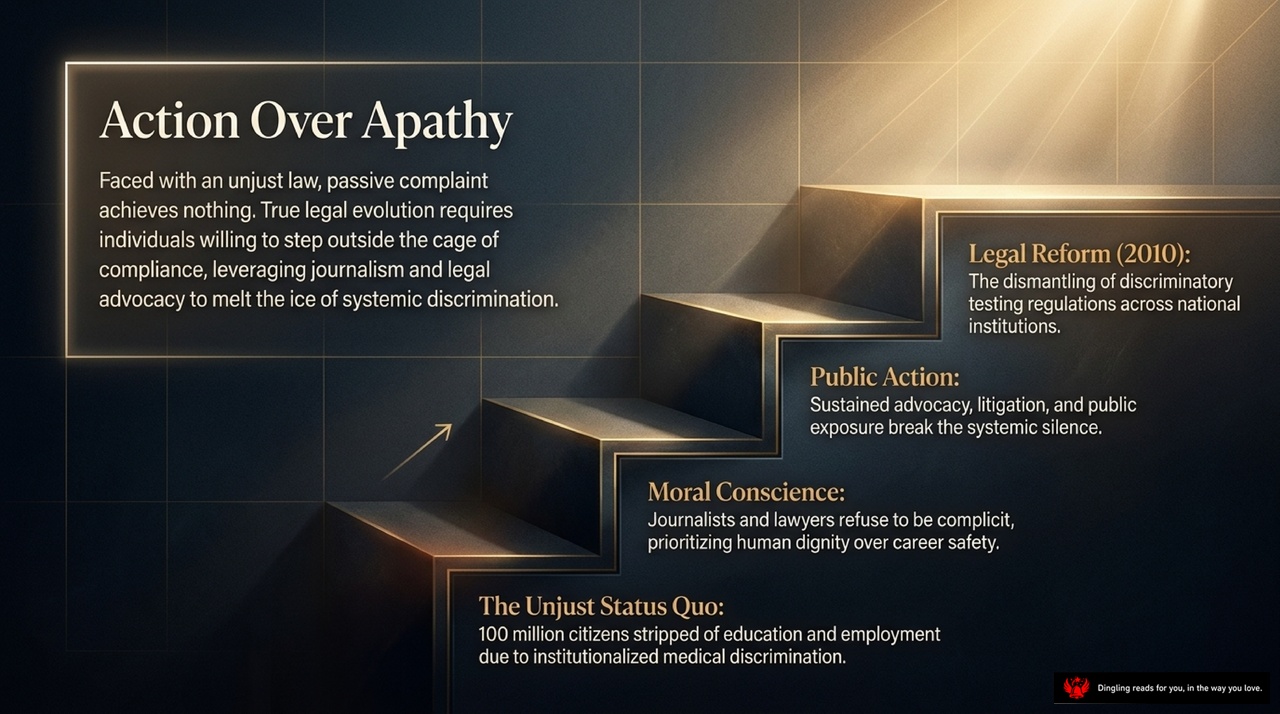
Action over apathy—this is the core message of this slide. When faced with an unjust law, passive complaint gets you nowhere. Real change starts when individuals are willing to step outside the cage of compliance and take a stand. This slide maps out the journey from systemic injustice to meaningful reform, beginning with the reality of 100 million citizens stripped of education and employment due to institutionalized medical discrimination. That’s the starting point—the unjust status quo that demands action. From there, moral conscience becomes the catalyst: journalists and lawyers refuse to be complicit, choosing human dignity over career safety. That courage fuels public action—sustained advocacy, litigation, and exposure that break the silence. And finally, it leads to legal reform in 2010, dismantling discriminatory testing regulations across national institutions. This isn’t just theory—it’s a proven path from oppression to justice, driven by people who refused to stay silent.

Here is the spoken script for Slide 10.
**Slide 10: The Fragility of Art & Morality**
We often make a dangerous mistake: we assume that if someone creates something beautiful, they must be a good person. We equate aesthetic genius with high moral virtue. But literature teaches us a much darker, more uncomfortable truth. It shows us that humanity’s capacity to create breathtaking beauty frequently coexists with deep moral cowardice and destructive dualities. Look at the image here: a golden palace standing on a foundation that is cracking apart. That is exactly what happens when we try to build a world on the illusion of perfection. Absolute perfection is an illusion. When we recognize the inevitable flaws in our heroes, our art, and ourselves, we stop pretending. That acceptance is the first necessary step toward authentic empathy. We cannot love what we think is perfect, but we can learn to understand what is human.
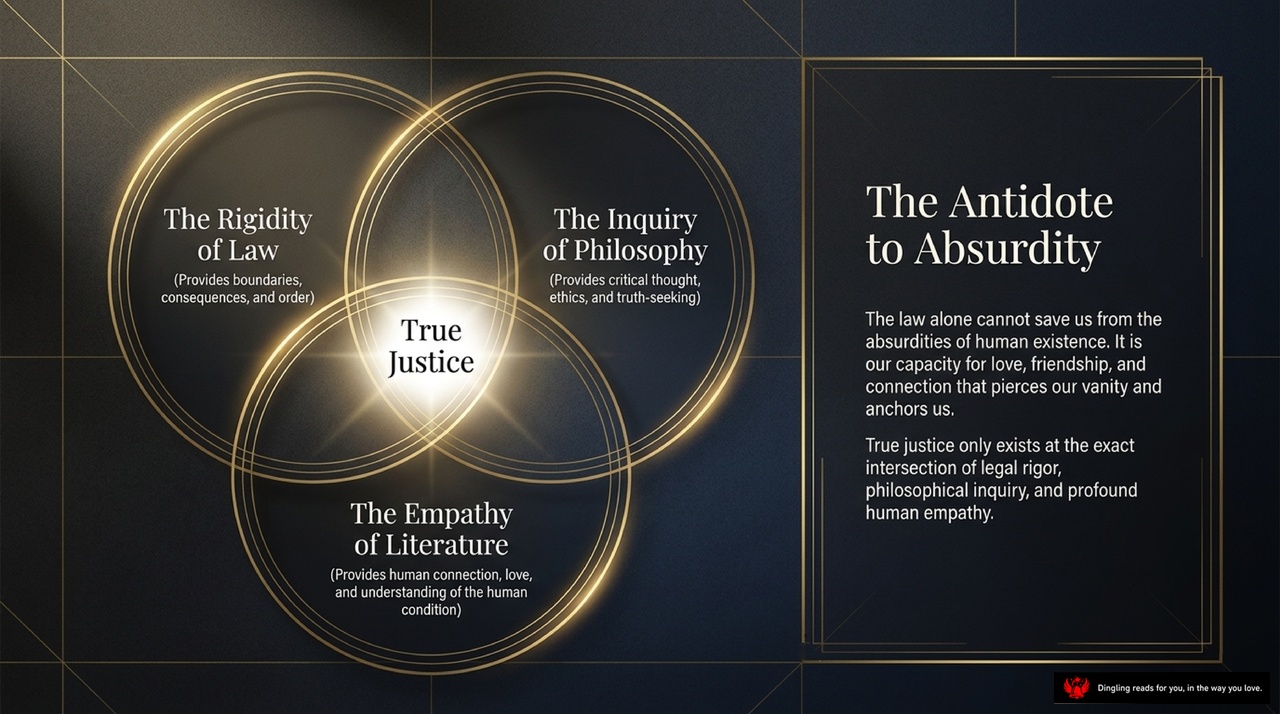
Today, we arrive at a crucial moment in our journey: the antidote to absurdity.
The slide before us reveals a powerful Venn diagram, illustrating that **True Justice** is not found in a single discipline, but at the precise intersection of three distinct forces.
First, we have **The Rigidity of Law**. This is the framework of order, providing the necessary boundaries and consequences that allow society to function. Without this structure, chaos reigns.
Second, we have **The Inquiry of Philosophy**. This brings the critical thought, ethics, and truth-seeking necessary to question the status quo and understand the nature of our existence.
Third, we have **The Empathy of Literature**. This is the human connection—the love, friendship, and deep understanding of the human condition that reminds us we are not just subjects of a legal system, but living beings with feelings.
The text on the right reminds us that the law alone cannot save us from the absurdities of human existence. We need more than just rules; we need the capacity for love and connection that pierces our vanity. True justice only exists at the exact intersection of legal rigor, philosophical inquiry, and profound human empathy. When these three forces align, we move beyond the absurd and find a path to meaning.

Here’s a polished, natural-sounding spoken summary for your slide — tailored for an American audience, with emotional resonance and conversational flow:
—
We’re all bound by laws, but what truly defines us isn’t the rules we follow — it’s our humanity. A just society isn’t about having flawless statutes or perfect systems. It’s about the courage to question authority when it goes wrong, the willingness to speak up against silence, and the belief that empathy matters more than bureaucracy. At the end of the day, it’s not about what the law says — it’s about what the human heart knows.
So here’s the real question: if true justice means looking past the letter of the law and into the messy, complicated truth of people — are you brave enough to face the shadows inside yourself? Because that’s where real change begins.
—