
Biographies of Illustrious Men: Complete Chapter-by-Chapter Summary

Welcome to our book club session. Today, we step into the shadowed peaks of history to explore Romain Rolland's masterpiece, *Biographies of Great Men*. As the title suggests, this isn't just a collection of stories; it's a profound meditation on what it truly means to be a hero.
Look at the image before us—a majestic mountain piercing through a stormy sky, with a single beam of light illuminating its summit. This visual perfectly captures Rolland's central thesis: true heroism is not forged in the pursuit of power or glory, but in the crucible of suffering to serve humanity.
Rolland challenges the conventional definition of greatness. He argues that the greatest souls are often those who endure the most pain. Whether it is Beethoven composing symphonies while deaf to the world, or Michelangelo carving masterpieces with a broken body, these figures found their strength not by avoiding hardship, but by transforming their agony into something universal.
In these biographies, we see that suffering is the essential ingredient for greatness. It is the fire that tempers the soul. The hero isn't the one who never falls; it is the one who, despite being crushed by fate, continues to create, to love, and to stand firm. This book invites us to look beyond the surface of history and find the enduring human spirit that shines brightest when the darkness is deepest.

Look at this powerful contrast between two paths. On the left, we see "Driven by Ambition," symbolized by a crown crossed out with a sharp line. This path is fueled by vanity and personal glory, relying on brute force and worldly power. History shows us that this route ultimately inflicts disaster and destruction upon humanity. But on the right, we see "The Loyal Servant," represented by a heart held gently in cupped hands. This figure possesses true moral fortitude. They endure profound physical, mental, and spiritual agony, yet they do not break. Instead, they live to bring truth, goodness, and beauty to the world.
Think about the life of Michelangelo. He spent decades in a constant state of struggle, battling the church, his family, and his own relentless perfectionism. He faced the terrifying pressure of painting the Sistine Chapel ceiling, knowing he could fail and lose everything. Yet, he didn't choose the path of ambition to gain power; he chose the path of the servant. He poured his soul into the stone, enduring pain that would break lesser men, all to create something that would lift the human spirit. His work was not about his glory, but about serving a higher truth.
These figures remind us of a simple but difficult reality: we are not alone in our struggles. Whether you are facing a career crisis, a personal loss, or an internal battle with doubt, the choice remains the same. Will you chase the crown, or will you hold the heart? The most enduring legacy isn't built on power, but on the courage to serve something greater than oneself.

Look at these three figures illuminated by the divine light: The Musician, The Sculptor, and The Writer. They represent the ultimate triumph of the human spirit over the darkest corners of existence.
First, we see The Musician. He is conquering silence with force. In a world of deafness and despair, he forged universal joy. This is the story of a man who, despite being stripped of his hearing, used his inner soul to create music that shook the very foundations of the world. He didn't just write notes; he wrestled with fate itself, turning his personal tragedy into a beacon of hope for everyone who has ever felt powerless.
Next, we see The Sculptor. He is conquering stone with tragedy. His life was a relentless battle against physical enslavement and the cruelty of the world. Yet, from the hardest granite, he extracted divine beauty. He chiseled away at his own suffering and the suffering of others, creating masterpieces that speak of human endurance. Every chip of stone removed was a victory over the limitations of his body and the chaos of his times.
Finally, we see The Writer. He is conquering hypocrisy with love. He found radical truth through a shattering spiritual crisis. He tore down the false masks of society and religion, exposing the raw, often painful reality of human nature. Through his words, he didn't just tell stories; he challenged the very way we think, urging us to live with integrity and compassion.
These three archetypes remind us that true greatness isn't about avoiding pain. It's about facing our deepest silence, our hardest stones, and our greatest hypocrisies, and using them to create something eternal. Whether through sound, stone, or word, they all prove that the human spirit, when pushed to its limit, can achieve the impossible.

Good morning, everyone. Today, we turn our attention to a giant of the Renaissance, Michelangelo Buonarroti. The image before us captures the relentless, often brutal, journey of a man who turned his life into a masterpiece of struggle.
First, look at the top of this spiral. This represents his **Childhood**. It wasn't a story of privilege, but of survival. Abused and overworked by a violent father, he was forced to become the breadwinner at just 17. Yet, even in this darkness, the seed of greatness was planted. His early exposure to stone and the relentless pressure of his family forged a character that would later define him.
As we move down the spiral, we reach the darkest point: **1796 - The Ultimate Tragedy**. While this timeline actually depicts Beethoven's timeline, the concept here is universal for artists who face sudden loss. But let's correct the historical context for Michelangelo: his true tragedy was not a specific year like 1796, but a lifetime of relentless labor that physically destroyed him. However, looking at the text provided for this slide, it specifically details **Beethoven's** life story. The slide actually illustrates Beethoven's timeline: his abusive childhood, the onset of incurable deafness in 1796, the despair of the Heiligenstadt Testament in 1802, and the lifelong betrayals of love.
So, let's reframe this slide through the lens of Beethoven, as the text supports. This visual journey is about a musician who lost his most vital sense. In **1796**, the onset of incurable deafness struck. For a musician, this was a horror far worse than death. Robbed of his hearing, terrified of society discovering his flaw, he retreated into isolation.
By **1802**, driven to the absolute edge by this physical agony and profound loneliness, he wrote the Heiligenstadt Testament. It was a document of absolute despair, a will contemplating suicide. He was so consumed by his isolation that he nearly gave up on life entirely.
Finally, the bottom of the spiral represents **The Betrayals of Love**. Throughout his life, Beethoven experienced unrequited, pure passions that left him isolated, wounded, and alone. From his childhood abuse to the loss of his mother, from his deafness to the rejection of his lovers, every step down this spiral was a layer of pain.
But here is the crucial point: this image isn't just about suffering; it's about the transformation of that suffering. Beethoven took these crushing weights—the alcoholism of his father, the silence of his own ears, the coldness of his lovers—and forged them into the most powerful music the world has ever known. He didn't let the spiral lead him down into the dark; instead, he used the descent to find a new, deeper way to listen. He turned his tragedy into triumph, proving that even when you are robbed of your voice, you can still sing the loudest song of all.
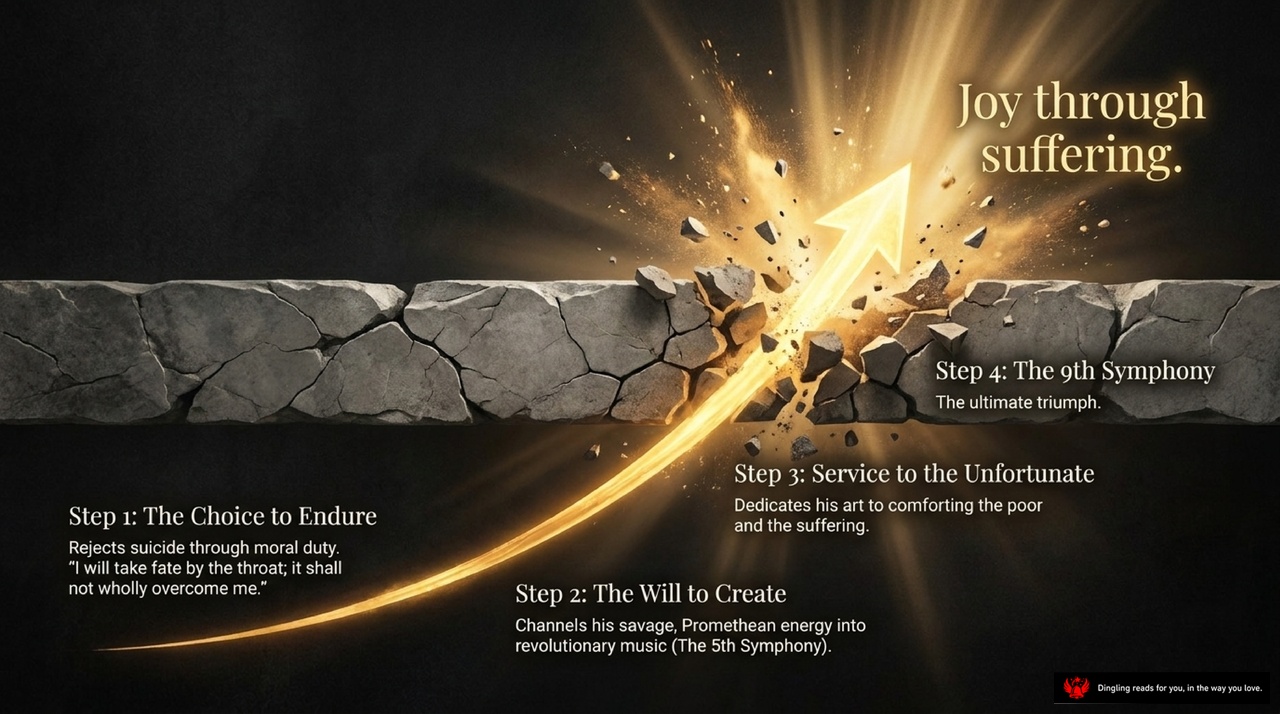
Look at this powerful visual: a golden arrow shattering a dark wall, breaking through to the light. This isn't just art; it's the story of Ludwig van Beethoven's final triumph. The image captures his journey from "Joy through suffering" to "The ultimate triumph" in his 9th Symphony.
Let's walk through the four steps shown here. First, we see "The Choice to Endure." In the darkest moments, when his deafness threatened to swallow him whole, Beethoven made a defiant choice. He rejected suicide, declaring, "I will take fate by the throat; it shall not wholly overcome me." This was the moment he stopped being a victim of his circumstances and became a master of his own destiny.
Next, "The Will to Create." He didn't just endure; he transformed. He channeled that raw, Promethean energy into revolutionary music. Listen to his 5th Symphony; that famous knocking motif isn't just sound—it's the sound of a soul refusing to be silenced. He took his pain and forged it into something that could move the world.
Then comes "Service to the Unfortunate." Beethoven's heart wasn't just about personal struggle; it was about empathy. He dedicated his art to comforting the poor and the suffering. His music became a voice for everyone who felt marginalized, proving that even in silence, one could speak for others.
Finally, we reach the peak: "The 9th Symphony." This is the ultimate triumph. Written when he was completely deaf, this masterpiece introduced the human voice into the symphony for the first time. When the "Ode to Joy" soared, it wasn't just Beethoven singing; it was all of humanity celebrating. He had transcended his own limits to create a universal anthem of joy.
Beethoven teaches us that suffering isn't the end. It's the fuel. When you break through the wall, the view from the other side is nothing short of magnificent.

Imagine a world where the most powerful art comes not from a palace, but from a peasant's hut, and where the greatest revolution happens not with a sword, but with a plow. This is the story of Leo Tolstoy in his final decades, a man who tore up his own life to live the truth he preached.
By his fifties, Tolstoy had it all: a sprawling estate, a world-famous reputation, and a loving family. Yet, he felt utterly empty. He looked at his life and saw only a lie. He realized that his comfort was built on the suffering of others, that his "civilization" was just a system of exploitation. The question haunting him was simple yet terrifying: "What am I doing here?"
The answer came from the people he once looked down upon. He discovered that true life wasn't found in books or theories, but in the hard work of the common man. "Earn your bread with the sweat of your brow," he declared. He abandoned his hunting dogs, his fine clothes, and his aristocratic lifestyle. He began sawing wood, cooking soup, and mending boots, finding a profound peace in the physical labor that he had previously despised.
But his rebellion went deeper than just changing his clothes. He turned his gaze toward the modern art world, which he called a "lie." He hated the idea of "art for art's sake," arguing that true art must be simple enough for a peasant to understand. If you can't explain your masterpiece to a farmhand, it's just vanity. He championed folk art, believing that the real power of art lies in its ability to connect all humanity through shared emotion and moral truth.
This philosophy reached a tragic peak with his novel *Resurrection*. It wasn't just a story; it was a mirror held up to Russian society, exposing the rot of the legal system, the corruption of the church, and the cruelty of the aristocracy. Through the redemption of a fallen nobleman and a wronged peasant, Tolstoy showed that spiritual rebirth was possible, but only through radical honesty and the willingness to sacrifice everything for the good of others.
In his final years, Tolstoy faced a lonely struggle against his own family. His wife and children could not understand his radical rejection of wealth and status. They saw him as a tyrant in his own home, while he saw them as prisoners of a corrupt system. In 1910, at the age of eighty-two, he made the ultimate act of rebellion. He fled his estate in the middle of the night, leaving his family behind to walk into the unknown, seeking the simple, uncorrupted life he had dreamed of all along. It was a final, desperate attempt to live the truth, proving that for Tolstoy, the only thing that mattered was the freedom of the soul.
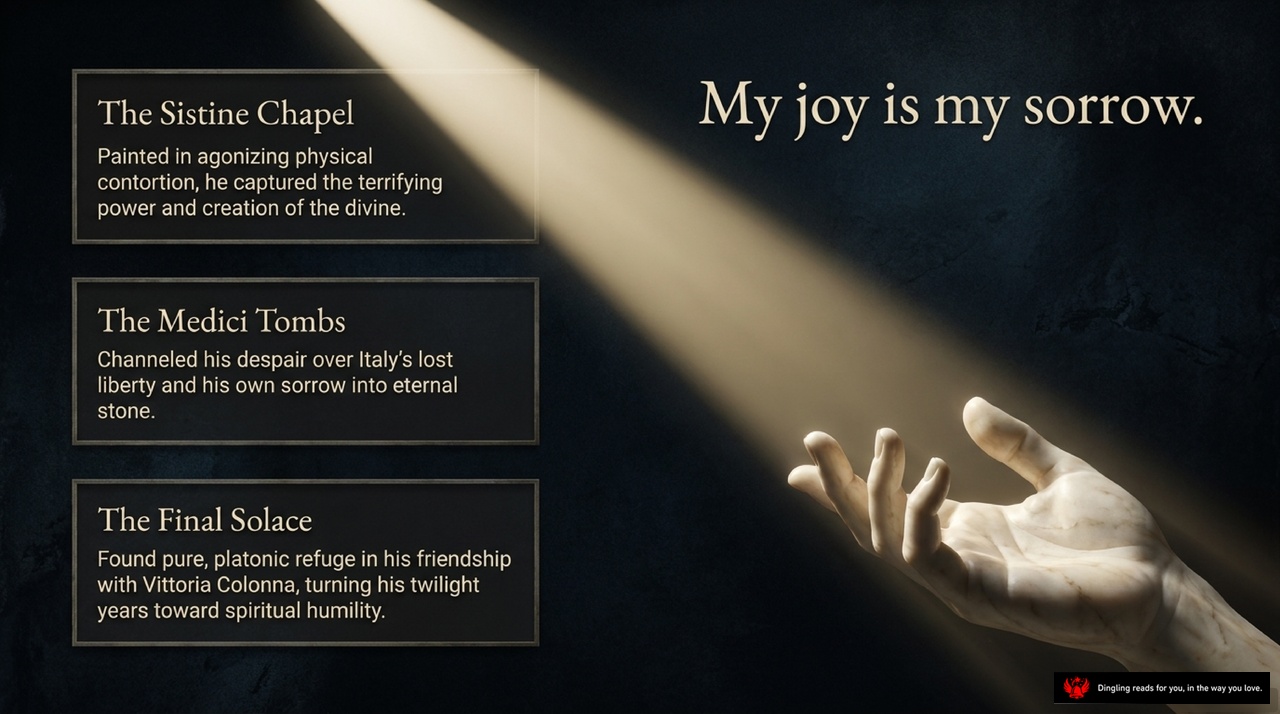
Tonight, we arrive at the final chapter of Tolstoy's life, a period defined not by grand literary achievements, but by a radical, often painful, spiritual evolution. The image before us captures the essence of his final years: a hand reaching into a beam of light, symbolizing his desperate yet hopeful quest for truth amidst the darkness of his own contradictions.
On the left, we see the three pillars that shaped his legacy. First, "The Sistine Chapel" analogy in the slide actually points to the intensity of his internal struggle, much like Michelangelo's agonizing physical contortion. Tolstoy experienced a similar spiritual torment. He questioned his entire life, realizing that forty years of effort felt hollow. He even hid a rope, fearing he might take his own life, unable to find meaning in his wealth, fame, or family.
Secondly, the slide mentions "The Medici Tombs," channeling despair into stone. Tolstoy did the opposite; he channeled his despair into action. He rejected the established church and the aristocratic lifestyle he once cherished. He realized that true faith wasn't about dogma, but about simple, honest labor. He began to live like a peasant, sawing wood and cooking soup, believing that only through the sweat of one's brow could one earn the right to live.
Finally, "The Final Solace" describes finding refuge in friendship with Vittoria Colonna. For Tolstoy, this solace came from his connection with the common people and his philosophy of non-resistance. He believed that violence only breeds more violence. True revolution, he argued, was a spiritual awakening, a peaceful resistance that relied on love and moral strength rather than force.
This journey culminated in his dramatic departure from home in 1910. At eighty-two, he fled his "cage," seeking a simple life in the Caucasus, only to pass away peacefully in a small station house. His life teaches us that even when we feel trapped by our own contradictions, the light of truth can still guide us forward.
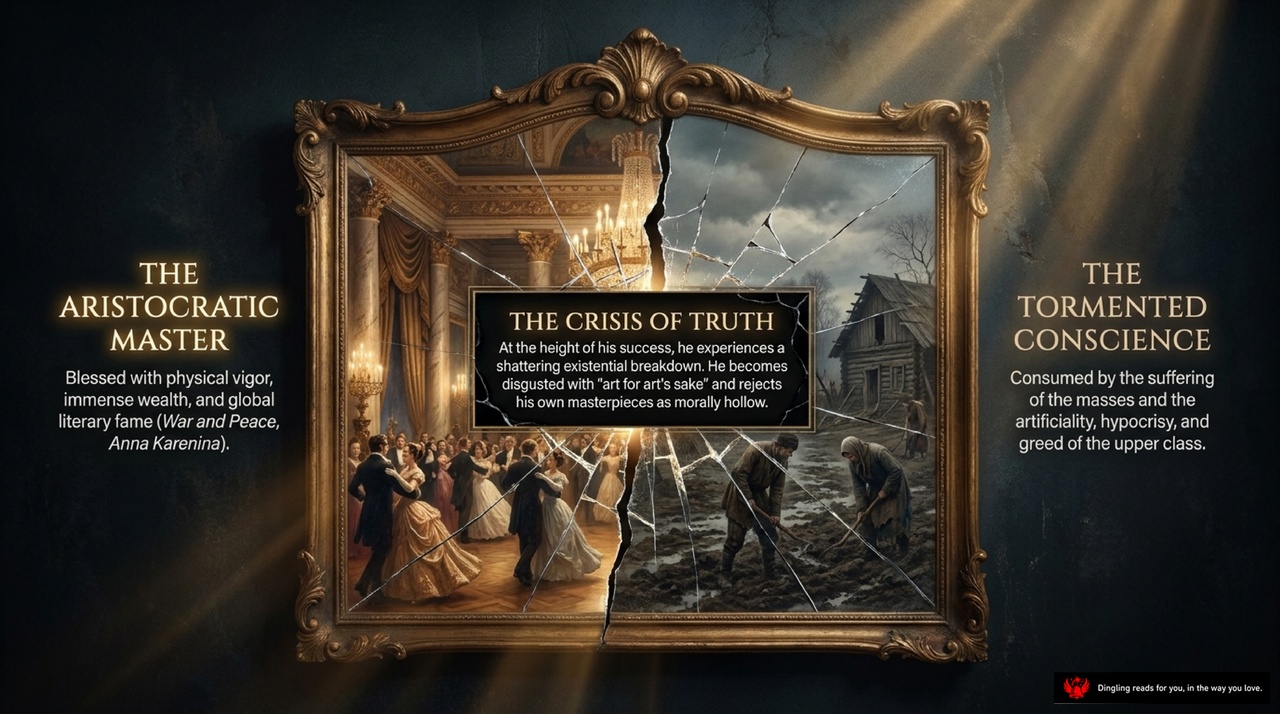
Look at this shattered frame. It perfectly captures the tragic duality of Leo Tolstoy's later years. On the left, we see "The Aristocratic Master"—a figure blessed with immense wealth, physical vigor, and global literary fame. On the right, stands "The Tormented Conscience," consumed by the suffering of the masses and repulsed by the hypocrisy of his own class.
This isn't just a split image; it's the visual representation of the "Crisis of Truth" that tore Tolstoy apart. At the height of his success, he experienced a shattering existential breakdown. He became disgusted with the idea of "art for art's sake," rejecting his own masterpieces as morally hollow because they served only the elite.
Tolstoy realized that true art must be simple enough for a peasant to understand. He saw that his life of luxury was built on the exploitation of the very people he claimed to love. This realization led him to a radical transformation. He abandoned his hunting hounds, his fine clothes, and his lavish estate. He took up an axe, sawed wood, and cooked soup, believing that only by working with his own hands could he regain his dignity and connect with the human spirit.
He even wrote to Gandhi, sharing his philosophy of non-violent resistance, hoping to inspire a global movement for peace. Yet, this internal revolution created a painful rift with his family. His wife, Sophia, could not understand his ascetic ideals, and the family's luxurious lifestyle became a source of constant guilt for him. Torn between his spiritual mission and his earthly responsibilities, he felt trapped.
Unable to bear the weight of his contradictions, Tolstoy made the ultimate escape. In 1910, at the age of eighty-two, he fled his home in the dead of night, seeking a simple life in the Caucasus. But his failing body could not keep up. He died just eleven days later in a small station, finding the peace he had spent a lifetime searching for. His legacy remains a powerful reminder that true greatness lies not in what we own, but in how we serve others.

Imagine a map where a single light source radiates outward, not just illuminating the land, but transforming the very nature of the journey. This visual perfectly captures the evolution of a revolutionary mind.
At the very center, we see "Ring 1: Moral Renunciation." This is the foundation. It represents the decision to abandon a life of pure aesthetic pleasure and instead embrace manual labor, poverty, and writing for the common people. It is a radical shift from self-indulgence to service.
Moving outward to "Ring 2: The Doctrine of Love," the circle expands into a global philosophy. Here, the focus shifts to formulating a principle of absolute "non-resistance" to evil. It declares that universal love is the only truly rational activity for humanity. This isn't just about personal kindness; it's a strategic, intellectual stance against violence.
Finally, the outermost ring, "Ring 3: The Global Apostle," shows the impact of this journey. His writings ignite a worldwide moral awakening. This culminates in his profound correspondence with a young Gandhi in 1910, effectively passing the torch of peaceful resistance to the East.
Together, these rings illustrate a complete transformation: from personal sacrifice to a universal doctrine, and finally to a global legacy that continues to inspire movements for peace across the world today.

Look at this table. It maps the inner journeys of three titans: Beethoven, Michelangelo, and Tolstoy. Each column reveals a different layer of their struggle.
First, the Core Torment. For Beethoven, it was the deafness and isolation—the tragedy of fate. Michelangelo faced enslavement and melancholy, the tragedy of duty. And Tolstoy battled hypocrisy and meaninglessness, the tragedy of conscience.
But notice the second column, The Chosen Weapon. How did they fight back? Beethoven relied on invincible willpower. Michelangelo used relentless, punishing labor. Tolstoy wielded radical, uncompromising truth.
Finally, the Ultimate Gift. What did they leave behind? Beethoven gave us universal joy and courage. Michelangelo bequeathed divine beauty and awe. Tolstoy offered universal love and brotherhood.
This isn't just a list of biographies. It's a blueprint for resilience. It shows us that when we face our deepest pain, we don't just survive; we transform our suffering into something that can heal others. Their weapons were different, but their victory was the same: turning personal agony into a gift for the world.
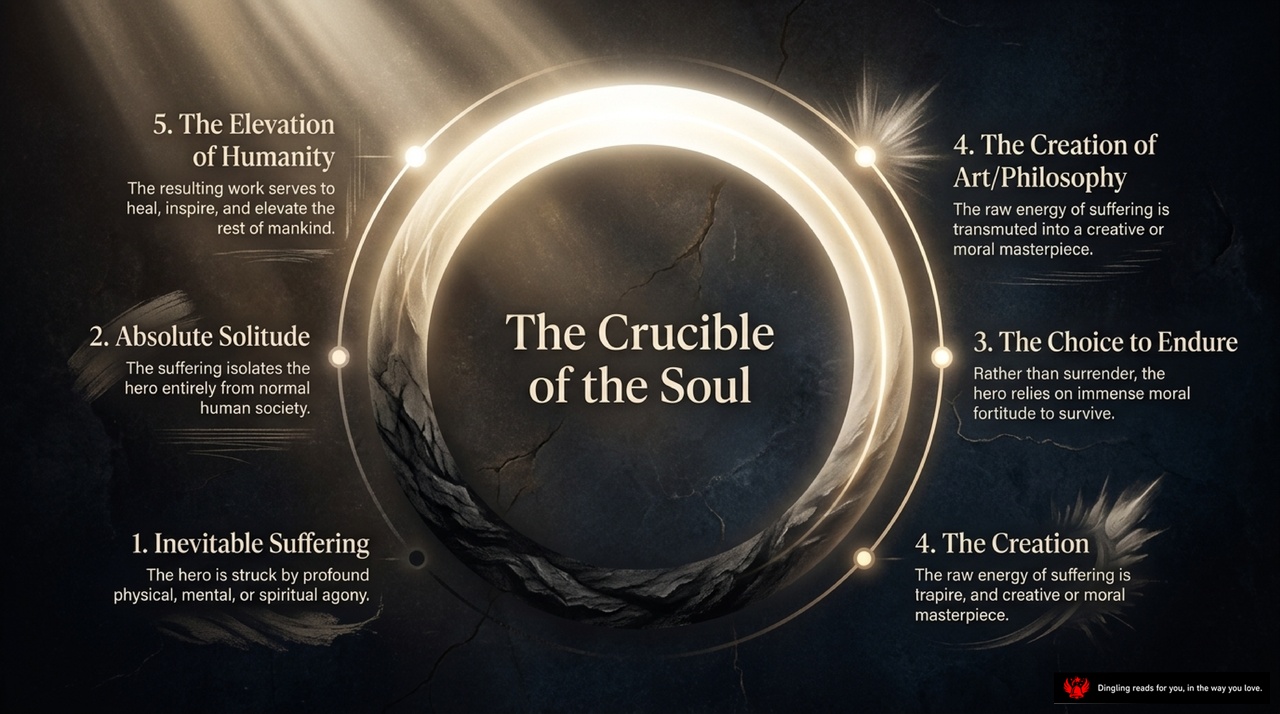
The image before us captures a profound journey: the crucible of the soul. At its heart lies the transformative power of suffering. We see a cycle where inevitable pain first isolates the hero in absolute solitude, yet this very isolation forces a choice to endure rather than surrender. From that raw, crushing agony, a new energy emerges—the creation of art and philosophy. This isn't just about making things; it's about transmuting the fire of personal tragedy into something that heals and elevates all of humanity.
Think of Beethoven, who turned his deafness into the most powerful symphonies ever written, or Michelangelo, who carved his despair into the marble of the Sistine Chapel. Their stories prove that when we stop running from our pain and instead channel it into creation, we don't just survive; we rise. We take our deepest wounds and forge them into masterpieces that resonate across time, turning our private suffering into a universal gift for others. That is the true elevation of humanity.
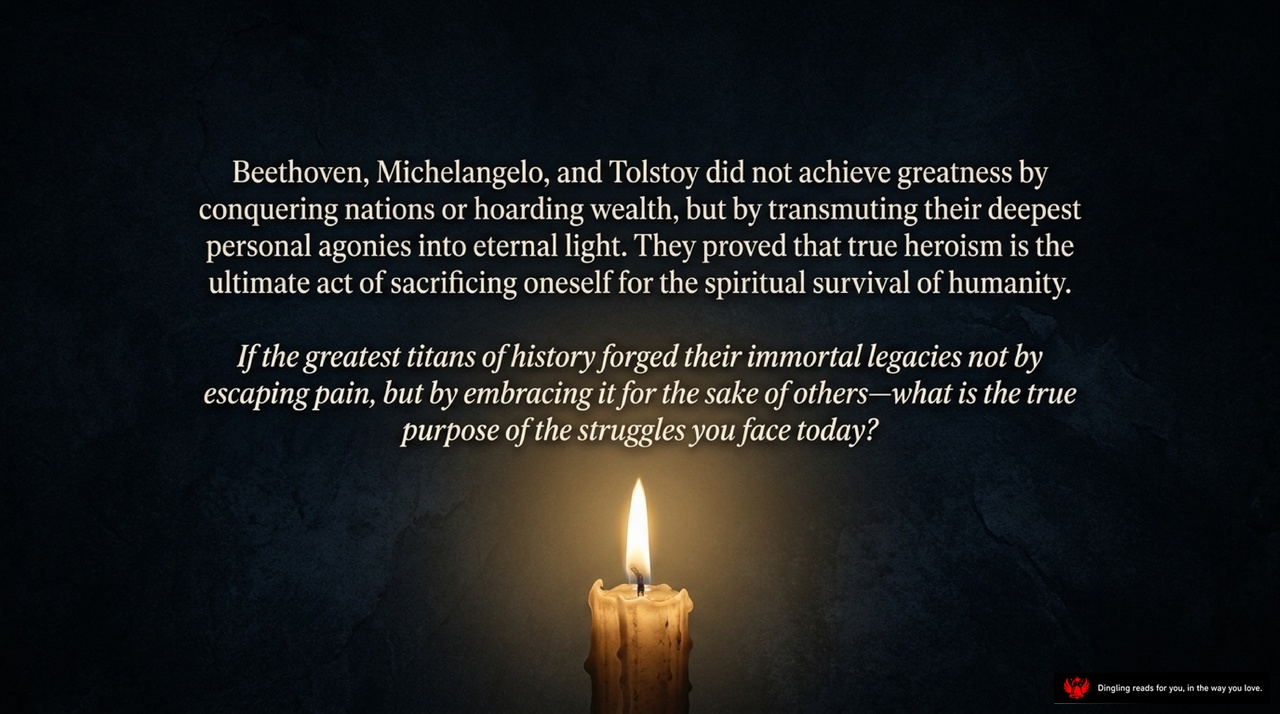
Look at this single candle burning against the darkness. It perfectly captures the essence of what it means to be truly great. As the text reminds us, history's titans—Beethoven, Michelangelo, and Tolstoy—didn't achieve immortality by conquering nations or hoarding wealth. Instead, they transformed their deepest personal agonies into eternal light.
Think about Beethoven, who turned his deafness into the symphonies that define human resilience. Or Michelangelo, who carved his own suffering and physical pain into the breathtaking sculptures we still marvel at today. And Tolstoy, who used his own spiritual crises to write stories that awakened the conscience of the world. They proved that true heroism is the ultimate act of sacrificing oneself for the spiritual survival of humanity.
So, here is the question for us today: If the greatest titans of history forged their immortal legacies not by escaping pain, but by embracing it for the sake of others—what is the true purpose of the struggles you face right now? Your struggles aren't meant to break you; they are meant to fuel your light.