
Blindness: Complete Chapter-by-Chapter Summary

Welcome to our exploration of José Saramago's haunting masterpiece, *Blindness*. This isn't just a story about losing sight; it is a terrifying descent into the fragility of human civilization when the world goes entirely white.
Imagine a city where a mysterious white blindness sweeps away everyone's vision. In this stark, all-encompassing white, the rules we rely on—the traffic lights, the social contracts, the very idea of order—shatter instantly. What remains is not chaos, but a raw, unfiltered truth about who we are when we can no longer see each other. As we turn these pages, we will journey from that first terrifying moment of blindness to the dark, desperate struggle for survival, asking ourselves a chilling question: If we couldn't see, could we still be good?

The yellow light turns green, but for this driver, the world doesn't move forward. Instead, it dissolves into a milky haze. One moment he's waiting at the intersection, the next, he's screaming, "I am blind! I see nothing but a sea of milk."
This isn't a dramatic explosion; it's a silent, inexplicable theft of sight. His eyes look perfectly normal—bright irises, white sclera—yet he is trapped in an endless white void. He covers his eyes with his fists, trying desperately to hold onto the last flicker of the red light that just vanished.
What happens next is a terrifying chain reaction. A stranger picks him up, but instead of kindness, that stranger steals his car. The driver's wife chases him, only to find her husband has lost everything. Even the doctor who examines him can find no physical cause; his eyes are healthy, but his vision is gone. And then, the horror spreads. The thief who stole the car? He goes blind too. The doctor who examined him? He loses his sight while reading medical records. And in a hotel room, a woman who just had an affair wakes up to the same white silence.
It's not an accident. It's a contagion. A white blindness that doesn't just take sight—it takes order, logic, and eventually, humanity itself.

Imagine a world where the darkness we fear most isn't the absence of light, but an overwhelming, blinding white. This slide introduces what we call "The Blindness Matrix," a framework to understand three distinct forms of this catastrophe.
First, we have Black Amaurosis, the physical kind. It's the experience of complete darkness, the total absence of light caused by biological pathology or ocular damage. This is the blindness we know, the void we fear.
But look at the center. This is "The White Sickness," an epidemiological phenomenon. Here, the experience isn't dark; it's an overwhelming, luminous sea of milk that swallows all shapes and colors. It's a suffocating brightness where nothing can be seen because everything is drowned in white. The cause? Unexplained, yet highly contagious upon eye contact. This is the terrifying, invisible virus that drives the story.
Finally, we have Rational Blindness, a philosophical state. Here, the experience is the loss of reason, empathy, and moral clarity. It's not about the eyes; it's about the mind. The cause is moral isolation and a systemic refusal to truly look at the reality of the human condition. It is the blindness of the heart and the conscience, where we choose not to see the truth because it is too painful to acknowledge.
From the physical void of black, to the suffocating glare of white, to the moral darkness of rational indifference—this matrix defines the layers of blindness that will tear this world apart.

In the heart of the quarantine zone, a new and terrifying order has taken hold. What began as a desperate struggle for food has evolved into a brutal hierarchy where power is literally in the hands of the blind. A group of armed blind men, led by a man with a gun, has seized control of the food supply. They have set up a makeshift checkpoint, demanding that every room elect two representatives to hand over all valuables—watches, jewelry, cash—in exchange for meals. It is a grim reality: no one eats unless they pay.
The situation quickly deteriorates into something far more horrific. When the women of the camp refuse to trade their bodies for food, the armed blind men escalate their demands. They begin forcing women from different rooms into their quarters, treating them as commodities. In a chilling turn of events, the women are dragged away, stripped of their dignity, and subjected to violence. One woman, unable to endure the abuse, dies right there. The silence of the camp is broken only by the screams of the victims and the cold calculations of the survivors, who realize that anger has no power against the blind.
Amidst this horror, the Doctor's wife makes a fateful decision. She tells her husband she will go. Then, another woman steps forward, sacrificing herself for her mother. But the Doctor's wife does not stay silent. She follows the women into the oppressors' room, retrieves a hidden pair of scissors, and strikes down the leader. With a cry of defiance, she leads the women in a daring escape, vowing that the blood debt will not be forgotten. Yet, the cost is high, and the path ahead remains shrouded in darkness.
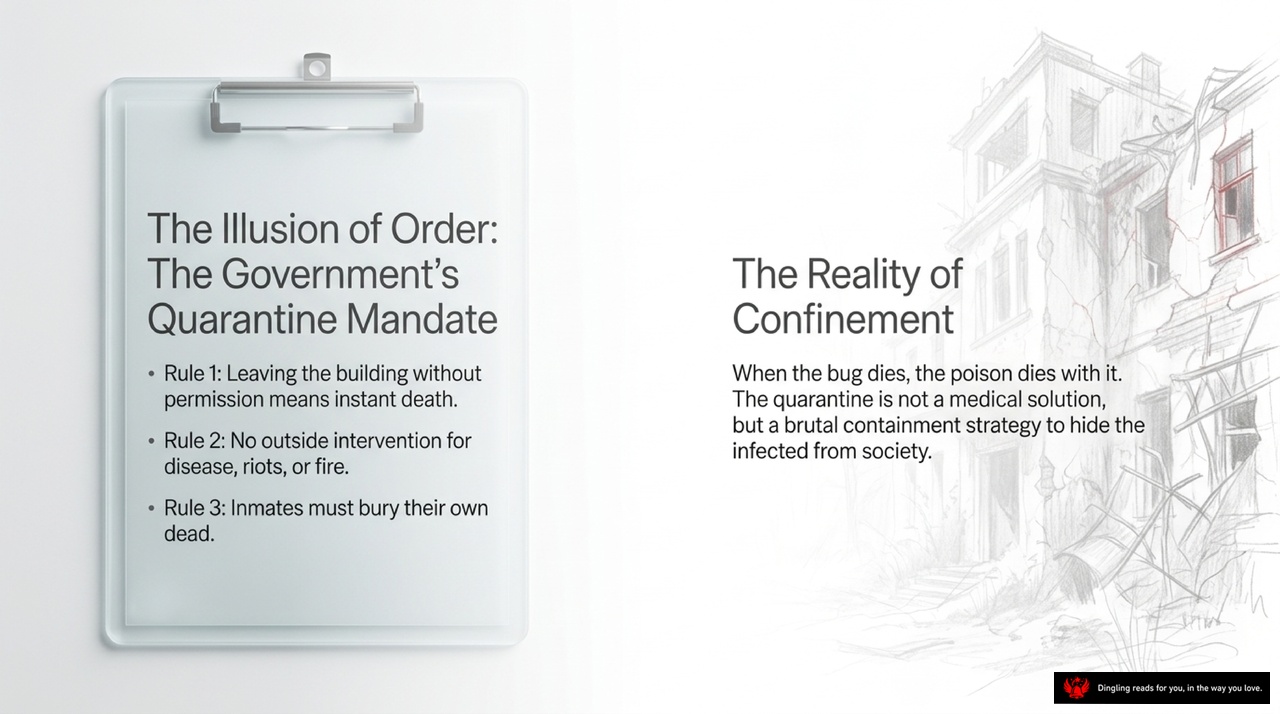
Look at this slide. On the left, we see a clipboard outlining the government's brutal quarantine rules: no leaving the building without permission, no outside help for riots or fires, and inmates must bury their own dead. On the right, a sketch of a crumbling building illustrates the reality of confinement.
The text on the right captures the core horror: "When the bug dies, the poison dies with it." This isn't a medical solution; it's a strategy to hide the infected from society.
Let's connect this to the story we just read. When the epidemic first hit, the government didn't offer care. Instead, they created a sealed zone, essentially a prison. They stripped away all external intervention, forbidding anyone from bringing in medicine or help. They even issued the chilling Rule 3: those inside must bury their own dead.
This isolation, meant to contain the virus, actually accelerated the collapse. As the blind men were locked in, without food, water, or hope, the "poison" of their despair spread faster than the disease itself. The very walls built to protect society became the cage that destroyed humanity. The government thought they were saving the world by hiding the sick, but in doing so, they allowed a slow, violent extinction to happen right in front of their eyes. The illusion of order on the clipboard was just a thin veneer over a brutal truth: in the name of safety, they chose to abandon us.
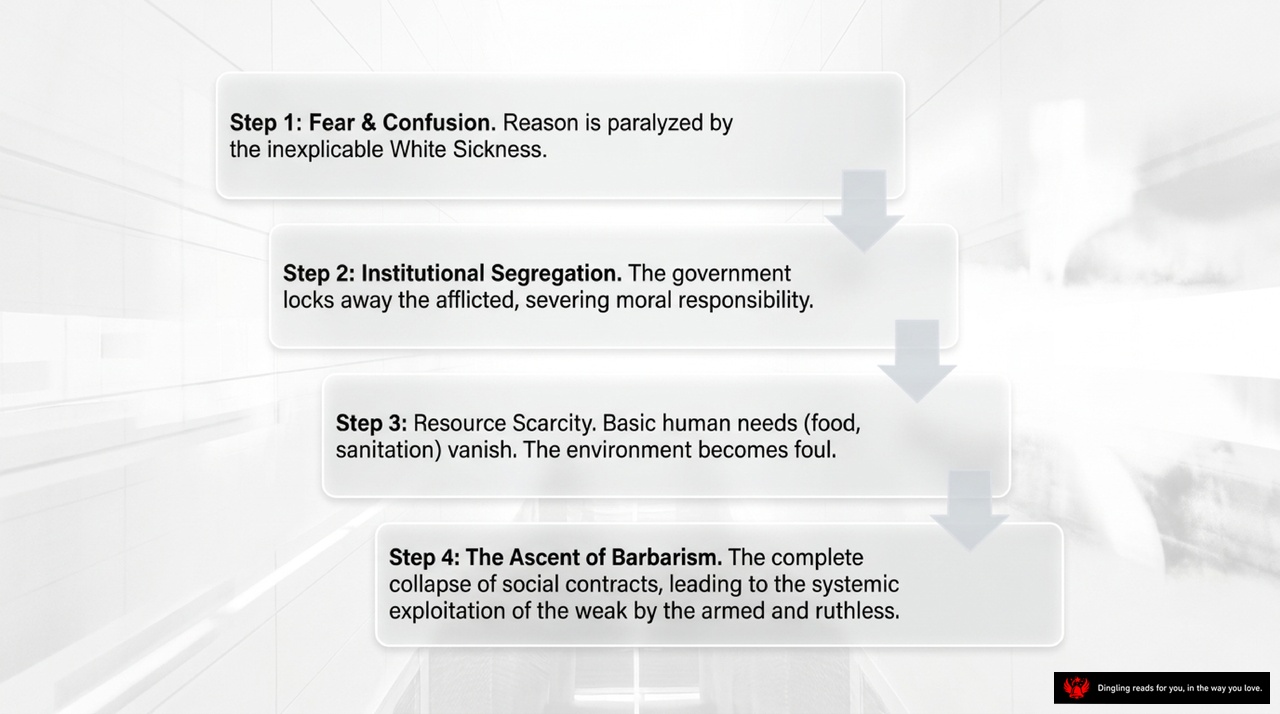
Blindness doesn't just steal your sight; it strips away the very fabric of civilization, leaving us vulnerable to our worst instincts. As the story reaches its terrifying climax, we see society collapse into pure chaos. The blind, once helpless victims, transform into a predatory horde. They seize control, hoarding food, blocking toilets, and enforcing a brutal new order where survival depends on submission. The doctor's wife watches in horror as her community devolves into a nightmare of rape, murder, and cannibalism. Even the innocent are consumed by the madness. But in this abyss of despair, a spark of resistance ignites. The doctor's wife, the only one who can still see, makes the ultimate sacrifice. She kills the leader of the blind mob to break their power, leading the women to freedom through sheer will. Yet, the end isn't a happy reunion. As the city finally begins to recover, sight returns to the blind, but the doctor's wife remains blind forever. She stands alone, watching the world she once knew come back to life, realizing that in the face of such absolute evil, the price of sanity is the loss of sight itself.

Inside the asylum, the veneer of civilization rapidly dissolves. What was once a place of care becomes a hierarchy of violence, where a gang of blind thugs, empowered by a smuggled handgun, monopolizes the meager food supply. They institute a regime of systemic exploitation and extortion, turning survival into a brutal game of power.
As the chaos deepens, a terrifying truth emerges: violence may be a primitive survival tool, but the invention of institutionalized cruelty—stripping others of their basic dignity for power—is a uniquely human failing. In this dark world, the only rule is survival, yet the cost is the very humanity we swore to protect.
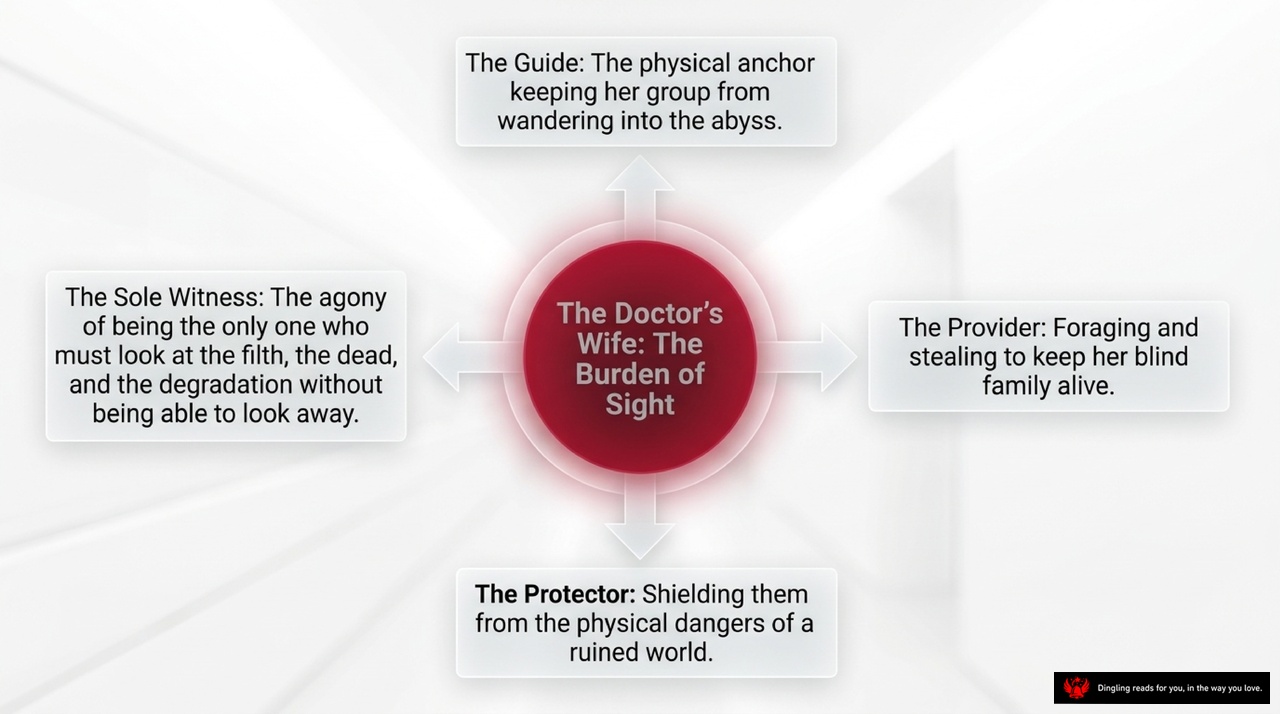
In the heart of this story lies a terrifying truth about what happens when we lose our sight. As we see it in this diagram, the Doctor's Wife becomes the embodiment of "The Burden of Sight." She is forced to become the sole witness to the filth, the dead, and the degradation of a ruined world, unable to look away. While she physically acts as the Protector, shielding her group from the dangers of the apocalypse, and the Guide, keeping them from wandering into the abyss, her true struggle is internal. She is also the Provider, foraging and even stealing to keep her blind family alive. But beneath all these roles lies the agony of being the only one who must see the horror around them while everyone else is lost in the white. This visual representation captures the heavy, isolating weight she carries as the last anchor of reality for her community.

When exploitation crosses the threshold of the unbearable, the Doctor's Wife reclaims the group's humanity through a singular act of violence, killing the gang leader with a pair of scissors. In the ensuing chaos, a fire destroys the asylum. The blind at inmates flee the gates, only to discover that the guards have vanished. The quarantine is over, because the entire world is now blind.

The City in Ruins. Imagine walking into a metropolis where the lights have gone out, the taps run dry, and the very fabric of society has unraveled into a chaotic void. This is the terrifying reality of the white blindness that sweeps through the city.
First, there is the total loss of direction. Without sight, no one can find their way home. People are forced to sleep in abandoned shops and banks, drifting like ghosts in a labyrinth they can no longer navigate. The familiar streets become a nightmare of disorientation.
Then, our primal instincts take over. Civilization crumbles, and survivors are forced to eat raw meat. The streets are no longer safe; they are patrolled by packs of wild dogs, turning the urban landscape into a jungle where only the strongest survive.
Finally, we witness the end of value. In this white void, money, beauty, and social status are instantly rendered worthless. A diamond ring is just a piece of metal; a tailored suit is just rags. The things that defined our world hold no meaning anymore. We are left with nothing but the raw struggle to breathe and survive.
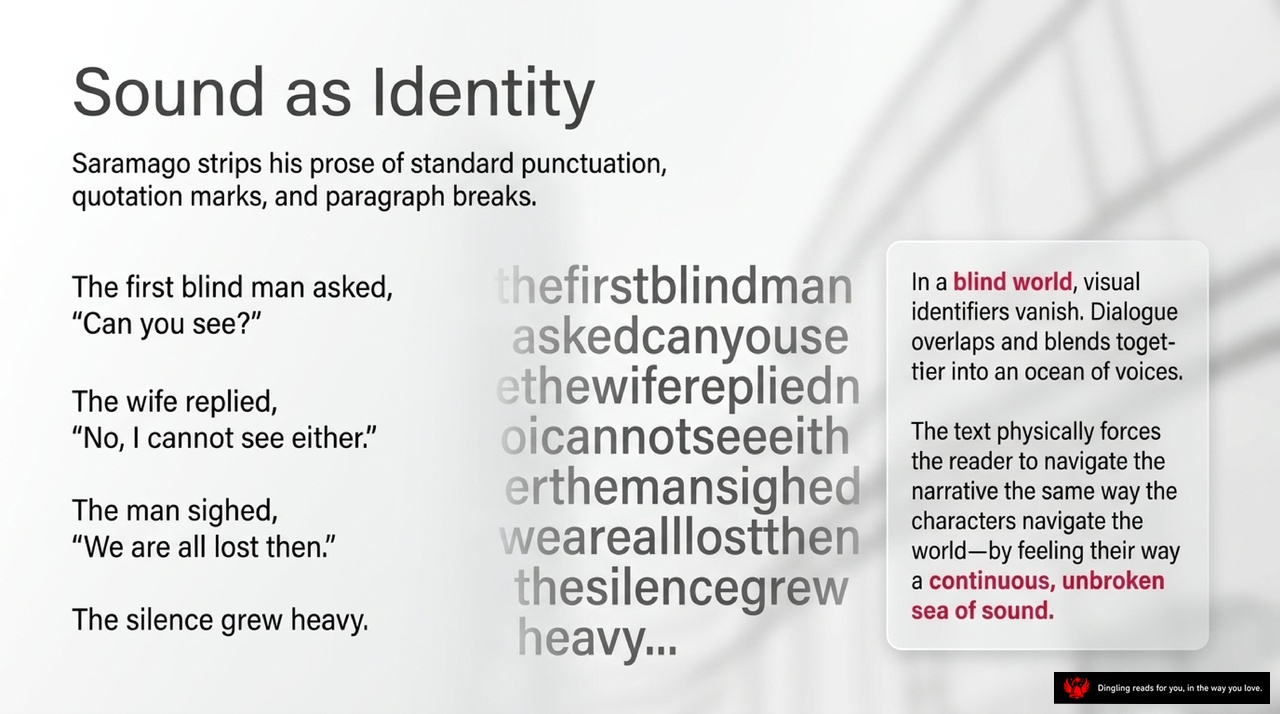
Sound as Identity. In this blind world, visual identifiers vanish, and dialogue overlaps into an ocean of voices. Saramago strips his prose of standard punctuation, quotation marks, and paragraph breaks, creating a continuous, unbroken sea of sound that physically forces the reader to navigate the narrative the same way the characters do. By feeling their way through a text without breaks, we are forced to experience the characters' disorientation firsthand. As the first blind man asks, "Can you see?" and the wife replies, "No, I cannot see either," the silence grows heavy, mirroring the overwhelming white void that has swallowed their vision. This deliberate lack of structure isn't just a stylistic choice; it is the story's heartbeat, transforming the written page into a shared, deafening silence where we all lose our way together.

Welcome to the final chapter of our journey into the blinding white. As we look at this slide titled "The Church of Blind Idols," we see a haunting image: every statue, every saint, even the divine figures in the background are covered in white blindfolds. This isn't just an artistic choice; it's the ultimate conclusion of the story we've just explored.
In the text, the Doctor's Wife makes a chilling discovery while seeking shelter in a church. She finds that someone has tied white blindfolds over the eyes of every painting and statue. It's a shocking realization: even the divine has been dragged into the darkness. The slide reminds us that in a world of absolute misery and rational blindness, God does not deserve to see.
The most profound thought here is that the ultimate act of sacrilege is realizing that heaven itself has turned a blind eye. Throughout the book, we saw how the epidemic of blindness didn't just take away sight; it stripped away empathy, morality, and reason. People turned on each other, hoarded food, and committed atrocities. The church, a place of refuge and faith, became a place of sacrilege where the very symbols of holiness were mocked and blinded.
So, what does this mean for us? It suggests that when we lose our ability to see clearly—whether literally or metaphorically—we risk losing our humanity too. The blindfold on the statues serves as a mirror for us. It asks us to consider: Are we blind to the suffering around us? Are we blind to the consequences of our actions? As we close this book, let's hope we never have to wear a blindfold, and more importantly, let's hope we never let the world blindfold us. Thank you for joining me on this intense and unforgettable journey.

The Return of the Dark. It's a counterintuitive truth, one that shatters our modern understanding of sight: we don't see because of the light; we see *because* of the darkness.
Just as the survivors hit the absolute limit of human endurance, the "White Sickness" inexplicably lifts. But here is the twist that changes everything: sight is not restored by stepping back into the blinding glare of the light. Instead, the first blind man suddenly experiences true, pitch-black darkness. He had been trapped in a "milk sea," a world of overwhelming white where nothing could be seen. Only by escaping that suffocating glare and returning to natural darkness can true vision be restored.
This moment marks the end of the nightmare. The white fog clears, revealing the black canvas of reality. It is a terrifying yet beautiful reminder that darkness isn't the absence of sight; it is the necessary condition for it. As the city wakes up from the silence of the blind, the survivors realize that to see the world again, they first had to let go of the light.
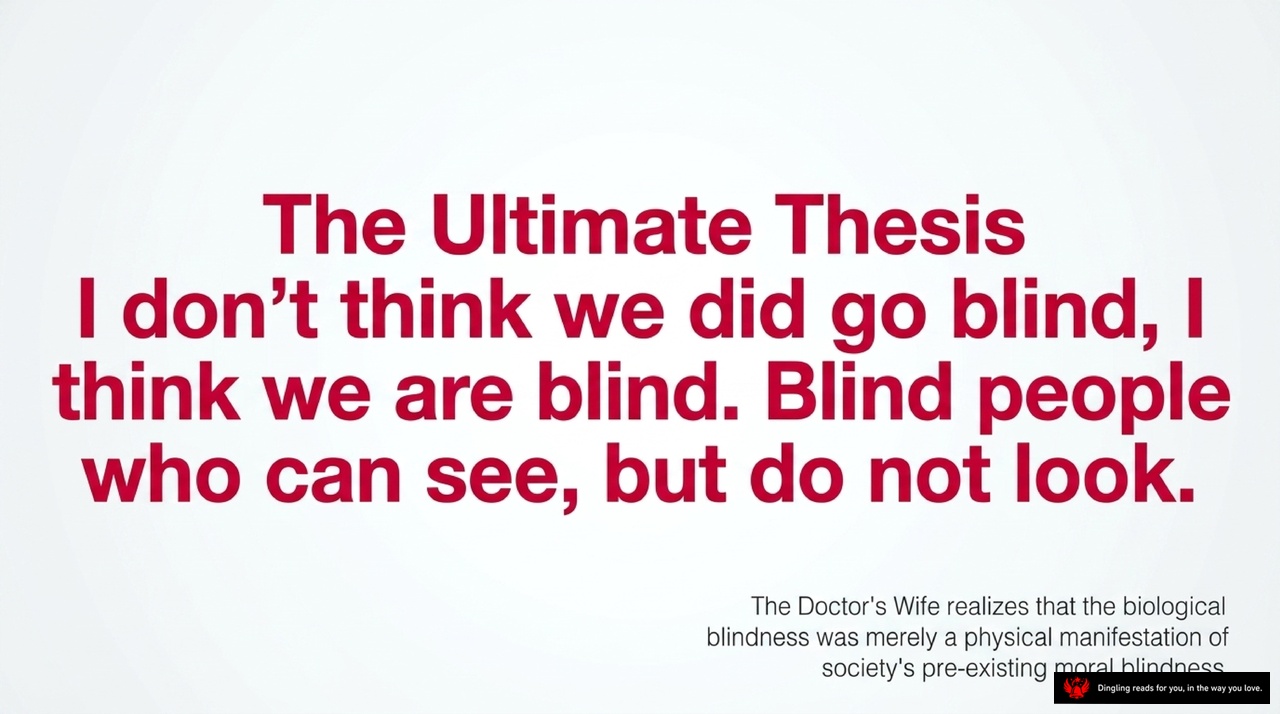
This is the ultimate thesis of the story, a chilling realization that haunts us all: I don't think we went blind; I think we *are* blind. It's not a loss of sight, but a failure of vision. We are blind people who can physically see, yet we choose not to look.
In the beginning, the doctor's wife realized this truth. She saw that the biological blindness was merely a physical manifestation of society's pre-existing moral blindness. Throughout the story, we watched as ordinary people—neighbors, drivers, even the doctor himself—succumbed to the epidemic. But it wasn't just the disease that blinded them; it was their own indifference, their selfishness, and their refusal to see the suffering right in front of them. They could see the chaos, the starvation, and the cruelty, but they looked away. They prioritized their own survival over the humanity of others, proving that true blindness isn't about what you can't see with your eyes, but what you refuse to see with your heart.

Civilization isn't built on stone or steel; it's a fragile contract, held together only when we truly see one another. But as the lights flicker back on in our city, a terrifying question lingers: when sight returns, what will we choose to look away from next?
The story of the White Sickness reveals a chilling truth. Our worst monstrosities don't arise from the dark, but from cold, blinding indifference. We saw it in the first blind man, whose blindness was an accident, yet whose neighbors offered no help, only curiosity. We saw it in the quarantine zone, where reason without empathy became its own form of blindness. Soldiers shot their own kind to protect themselves; men traded women for food; and silence became the loudest voice of all.
The city still stands, and sight has returned. But the scars of that era remain. The real test isn't whether we can see again, but whether we have the courage to stop looking away.