
Border Town: Complete Chapter-by-Chapter Summary

Welcome to *Border Town*, a timeless pastoral elegy by Shen Congwen. Set against the misty, ink-wash backdrop of a remote border town, this story captures the pristine beauty of human nature intertwined with the inescapable currents of fate.
Here, life unfolds in a quiet rhythm. The river flows through a world where kindness is as common as the morning mist. An old ferryman, who has guarded this crossing for fifty years, lives with his granddaughter, Cui Cui, and a loyal yellow dog. They live simply, helping travelers without asking for payment, trading only kindness for a few coins when they insist.
Yet, beneath this serene surface lies a story of deep sorrow and unspoken longing. Cui Cui grows up hearing the songs of her mother and the legends of her grandfather, her heart filled with a quiet anticipation of love that she cannot yet name. As seasons change and festivals arrive, the town buzzes with the excitement of dragon boat races and the quiet tension of unrequited affection.
But fate has its own plan. Love arrives in unexpected ways, often bringing pain as well as joy. The choices made by the young people here ripple through the quiet lives of the town, touching everyone from the ferryman to the local gentry.
In *Border Town*, we find a reflection on what it means to live simply, to love deeply, and to accept the mysteries of life. It is a tale that speaks to the heart, reminding us that even in the most peaceful corners of the world, life is full of beauty, sorrow, and the enduring hope of tomorrow.

Shen Congwen's *To Live* isn't just a story about a river town; it's a portrait of two opposing worlds colliding in the heart of 1930s China. Look at this slide: on the left, we see "The Roving Soldier," and on the right, "The Urban Countryman." These aren't just titles; they are the two halves of Shen Congwen's own soul.
Born in Sichuan but raised in the wild, untamed borders of Xiangxi, Shen was a "Roving Soldier" at heart. He joined local military units at just 14 years old. He didn't grow up in a classroom; he grew up witnessing the raw, brutal, yet fiercely authentic life along the frontier. He saw men die, saw nature's indifference, and learned that survival there required courage and a deep connection to the land. That grit became his literary foundation.
But then, in 1922, he moved to urban Beijing. That was the moment he became the "Urban Countryman." He didn't fit in. The artificiality, the corruption, and the moral decay of the modern city felt suffocating to him. So, he did something radical: he rejected the city's identity and embraced the label of a "countryman." He used his memories of the pure, unspoiled Xiangxi frontier as a sharp literary weapon to critique the creeping materialism of the 1930s.
In a way, Shen Congwen was never truly one or the other. He carried the soldier's resilience in his bones but used the countryman's perspective to challenge the world. He proved that even in a crumbling, modernizing China, the values of honesty, simplicity, and human connection were the only things that truly mattered.
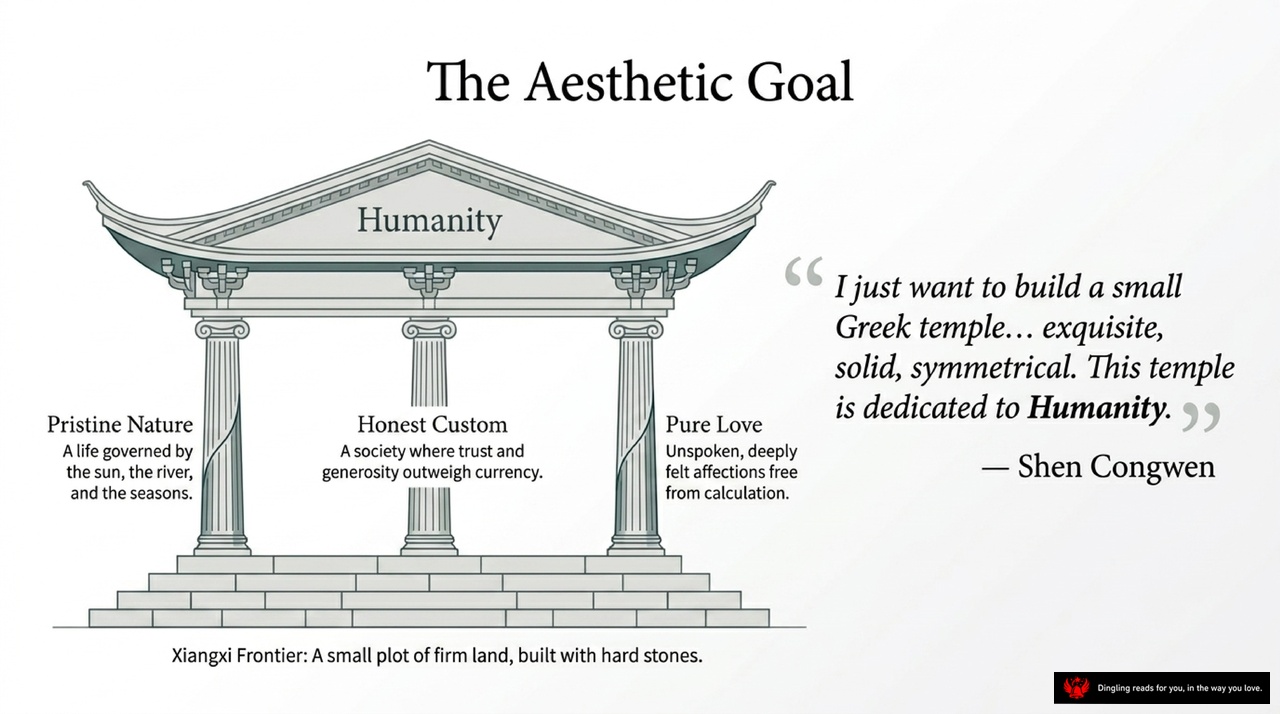
Look at this structure. Shen Congwen isn't just drawing a temple; he's defining the ultimate goal of life in *Border Town*. The roof is labeled "Humanity," and it rests on three pillars: Pristine Nature, Honest Custom, and Pure Love.
Think about it this way. In the modern world, we often build our lives on calculation, currency, and transaction. But Shen wants something different. He wants a "small Greek temple"—exquisite, solid, and symmetrical.
First, the foundation is **Pristine Nature**. This is a life governed by the sun, the river, and the seasons. It's the kind of life you find in Chado, where the water is clear enough to see the pebbles on the riverbed, and the bamboo forests are a deep, comforting green. It's a rhythm that exists before money ever enters the picture.
Second, we have **Honest Custom**. This is a society where trust and generosity outweigh currency. Remember the old ferryman? He refused payment for fifty years. When people forced money on him, he gave it back or bought cigarettes for those in need. There was no profit motive, only a deep, unspoken duty to the community. That is the strength of their social fabric.
Finally, the third pillar is **Pure Love**. This is about unspoken, deeply felt affections free from calculation. It's the love between the ferryman and his granddaughter Cui Cui, or the complex, tragic love between the two brothers and Cui Cui. It's not a love you can buy with a mill, but a love that binds souls together.
Shen Congwen's quote says it all: "I just want to build a small Greek temple... dedicated to Humanity." He is arguing that true civilization isn't built on skyscrapers or gold, but on these three things: respecting nature, trusting each other, and loving without keeping score. That is the aesthetic goal. That is the only way to build a home that can withstand the storms of life.

Picture content: The Ferry & The White Pagoda (Realm of Purity); The River Street (Realm of Custom); The New Mill (Realm of Materialism).
Here is the spoken script for Slide 3:
Welcome to the geography of the story. This map isn't just a setting; it's the battlefield where two worlds collide. On the left, you see the Ferry and the White Pagoda. This is the Realm of Purity, the home of Cui Cui and her grandfather. It represents an innocent, natural life disconnected from commerce, where the ferryman refuses money and the river flows clear. Moving downstream, we arrive at the River Street, the Realm of Custom. This is the lively dockside with 500 households, sailors, and merchants. It represents harmonious human interaction, loyalty, and frontier honor, yet it is also where the river's currents carry the weight of social expectations. Finally, at the bottom right, stands the New Mill, the Realm of Materialism. This is the Wang family's property, representing wealth, status, and the creeping influence of transactional marriages. The story unfolds along this river, as the pure world of the ferry slowly gets pulled into the complex currents of custom and the cold logic of money.

In Chadong, human decency outweighs currency. The countryman's morality triumphs over urban calculation.
Look at this scale in the center of our slide. It perfectly captures the delicate balance of life in this riverside town. On one side, we have the ferryman's duty. It's a pure transaction, a public service requiring no fee. But look at the virtue described here: when passengers force coins upon him, the Grandfather refuses. To appease their conscience, he uses the money to buy premium tobacco and tea, giving it freely to the next travelers. It's a beautiful cycle of kindness, where money isn't kept, but transformed into community care.
On the other side, we see the river street prostitutes. This is a different kind of transaction, born from urban commerce and sailor transience. Yet, their virtue is equally profound. Bound by deep emotional loyalty, they swear oaths and wait faithfully for months, viewing love with an agonizing, pure devotion that defies societal judgment.
Notice how the scale balances? Despite the different worlds—the rural ferryman and the urban courtesans—both sides weigh equally in terms of human dignity. In this story, whether you are a soldier's daughter or a river worker, whether you are giving away money or giving your heart, the core value remains the same: true connection transcends money and social status. That is the timeless lesson of the river.

Picture content + matching text analysis:
The current slide, titled "The Guardians of the Ferry," introduces two key characters: Cuicui and the Grandfather. It highlights Cuicui's innocence, her metaphor as a "mountain fawn," and her awakening love. For the Grandfather, it emphasizes his age, stubborn love, and the heavy burden of his daughter's suicide. It also points out his flaw: being over-protective and indirect, which creates misunderstandings.
Matching text from the book:
- Cuicui's description: "翠翠在风日里长大,皮肤黑黑的,眸子像水晶一样清明,天真活泼得像小兽,乖顺又善良..." (Cuicui grew up in the wind and sun, with dark skin and eyes clear as crystal, innocent and lively like a little beast...)
- Grandfather's background and flaw: "翠翠的妈妈是老人的独生女,十五年前跟一个茶峒军人悄悄好上了...军人觉得逃了会毁了自己的名誉,就服毒自尽了...翠翠妈妈...投水死了..." (Cuicui's mother was the old man's only daughter... fifteen years ago she had an affair with a soldier... the soldier committed suicide... Cuicui's mother drowned herself...)
- Grandfather's flaw regarding Cuicui's marriage: "祖父...担心她会重蹈母亲的覆辙...老船夫夜里躺在床上睡不着...担心她会重蹈母亲的覆辙,便跑到临溪高崖上望星辰、听虫鸣..." (Grandfather... worried she would repeat her mother's fate... Old boatman lay awake at night... worried she would repeat her mother's fate, so he went to the cliff by the river to watch the stars and listen to insects...)
- The consequence of his indirectness: "老船夫...心里乱糟糟的。...翠翠拉了拉他的胳膊:‘爷爷,你唱个歌给我听听好不好?’...祖父唱的,正是那晚他听到的傩送的歌。" (Old boatman... his mind was in a mess... Cuicui pulled his sleeve: 'Grandpa, can you sing a song for me?'... The song Grandpa sang was exactly the one he heard from Nuosong that night.)
- The tragic misunderstanding leading to death: "二老...觉得这事前途有点不利...心里又气又愤愤不平...顺顺...心里早就有了疙瘩...老船夫...心里实在不痛快...老船夫在雷雨将息的时候已经死去了..." (Nuosong... felt the future was not promising... felt angry and resentful... Shunshun... had a knot in his heart... Old boatman... felt really unhappy... Old boatman died when the thunderstorm was subsiding...)
Drafting the script (American style, conversational, logical flow):
Start by introducing the two figures as the core of the story. Describe Cuicui's purity using the "mountain fawn" metaphor. Then transition to the Grandfather, explaining his deep love but also the shadow of his past (the suicide). Explain how this past makes him over-protective and unable to communicate clearly, which ironically pushes Cuicui away. Mention the specific incident where his indirectness causes a misunderstanding about marriage, leading to tragedy. Conclude with the loss and the lingering hope.
Refining for natural American tone:
- Instead of "The Guardians of the Ferry," say "Let's talk about the two guardians of this ferry."
- Use phrases like "innocent as a fawn," "haunted by the past," "misunderstandings pile up," "tragic consequences."
- Keep the emotional arc clear: Innocence -> Burden -> Misunderstanding -> Loss.
Final Polish:
Check word count (around 400 words). Ensure no Chinese idioms are translated literally. Make sure the flow is smooth for a speaker.
Word Count Check:
The draft looks to be around 350-400 words.
Final Output Generation.
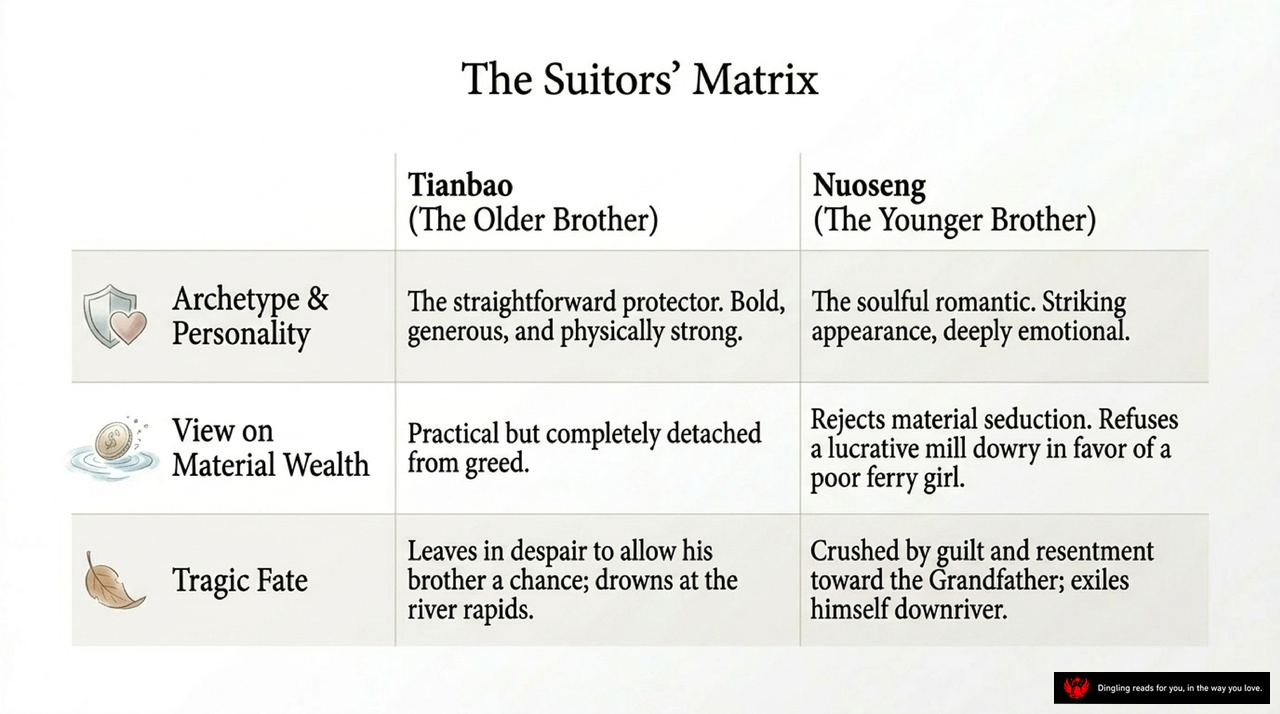
Picture this: The Suitors' Matrix. On one side, we have Tianbao, the older brother—a straightforward protector, bold and physically strong. He represents practicality, yet he's completely detached from greed. On the other side is Nuoseng, the younger brother, a soulful romantic with a striking appearance. While Tianbao leaves in despair to give his brother a chance, eventually drowning in the river rapids, Nuoseng is crushed by guilt over his brother's death and resentment toward his father. He chooses exile, leaving the ferry boat behind.
The tragedy here isn't just about love; it's about how these two brothers, bound by the same love for Cui Cui, are ultimately destroyed by the very system they live in. The matrix shows us that while one brother dies for love, the other is forced to flee it. It's a heartbreaking reminder that sometimes, the path to happiness is blocked by forces beyond our control.

The image before us maps out the two distinct paths to love in *To the Lagoon*: the "Carriage Road" and the "Water Road." Let's dive into what these mean for Cui Cui's story.
First, we have the Carriage Road, used by Tianbao, the older brother. This is the formal, traditional path. It involves a matchmaker, social recognition, and strict adherence to rules. While it is direct and respectable, it lacks that organic romantic spark. There is no room for feelings to grow naturally; it's a transaction of family duty.
In contrast, we see the Water Road, taken by Nuosong, the younger brother. This is the romantic, deeply emotional path. Imagine singing folk songs from a cliffside under the moonlight. It aligns perfectly with nature and the human heart, but it comes with a risk: it remains dangerously anonymous. There is no social contract to guarantee the future, only the hope that the song will be heard and loved.
The image also highlights the tragic conflict that arises from these two choices. Cui Cui's adolescent silence and her grandfather's indirectness create a wall between them. Because neither side can truly communicate their hearts, both roads hit a dead end. The Carriage Road becomes too rigid, and the Water Road becomes too uncertain, ultimately turning what could have been love into a fatal misunderstanding. This is the heartbreaking core of the story.
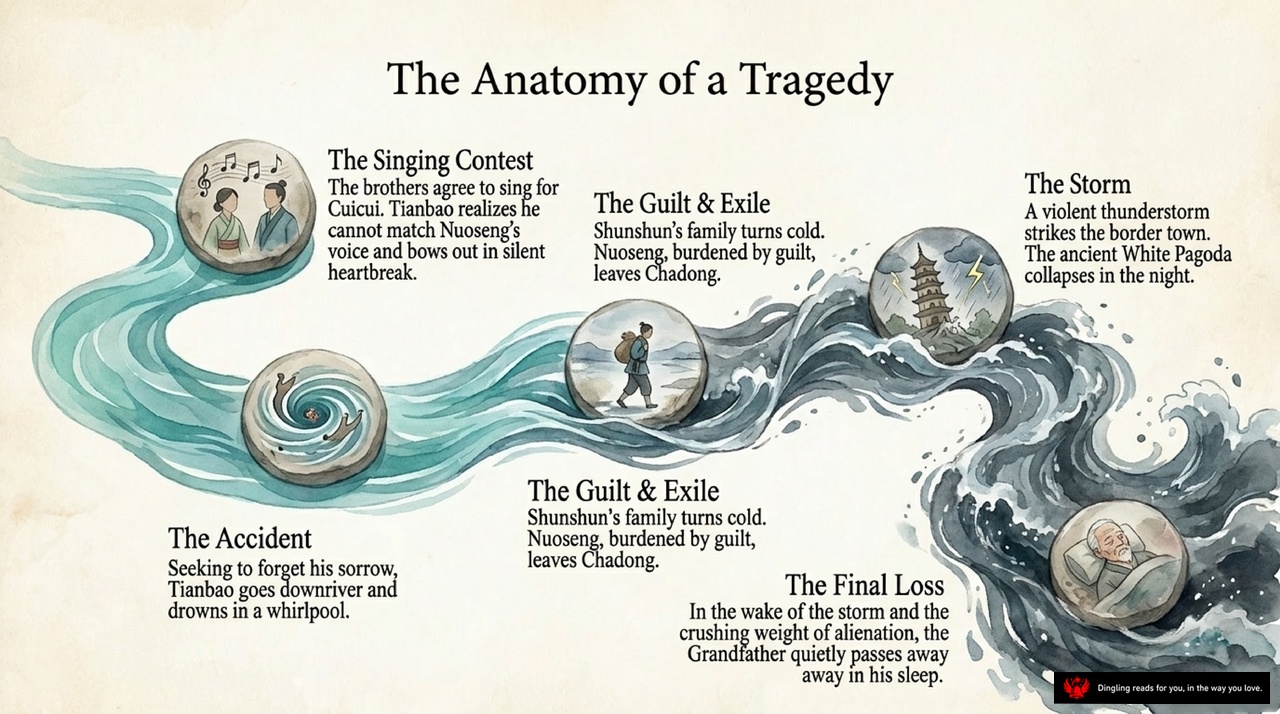
The Anatomy of a Tragedy unfolds like a river, carrying the characters toward an inevitable, heartbreaking conclusion. It begins with **The Singing Contest**, where the brothers agree to compete for Cuicui's heart. Tianbao realizes he cannot match Nuoseng's voice and bows out in silent heartbreak, a moment of quiet sacrifice that foreshadows the conflict to come. But the river's current is unforgiving. This leads to **The Accident**, where seeking to forget his sorrow, Tianbao goes downriver and tragically drowns in a whirlpool.
This loss triggers **The Guilt & Exile**. Shunshun's family turns cold, and Nuoseng, burdened by guilt and the weight of his brother's death, leaves Chadong, abandoning his love and his home. The storm that follows is not just weather; it is the collapse of their world. **The Storm** strikes the border town with violent thunder, and the ancient White Pagoda collapses in the night, symbolizing the destruction of their fragile sanctuary. In the wake of this chaos and the crushing weight of alienation, we reach **The Final Loss**. The Grandfather quietly passes away in his sleep, leaving Cuicui alone. This tragedy is a chain reaction: one death leads to exile, which leads to the storm, which leads to the ultimate, devastating silence.

The Generational Echo is a haunting theme that runs deep through the story, connecting the mother's tragic past with the daughter's present sorrow. Fifteen years ago, the mother fell in love with a soldier but was trapped between filial duty to her grandfather and her own romantic desires. Unable to reconcile these conflicting forces, she drank cold river water and died, leaving behind an orphaned child. Today, the daughter faces a nearly identical fate. She falls in love with a sailor, only to be trapped by adolescent silence and her grandfather's over-protection. Her story ends with her left alone at the ferry, caught in an endless cycle of waiting. They repeat a sorrowful life generation after generation, unable to grasp their own destinies in the face of nature and human affairs. This cycle of lost love and silent tragedy defines their existence, echoing across the river like a never-ending song.
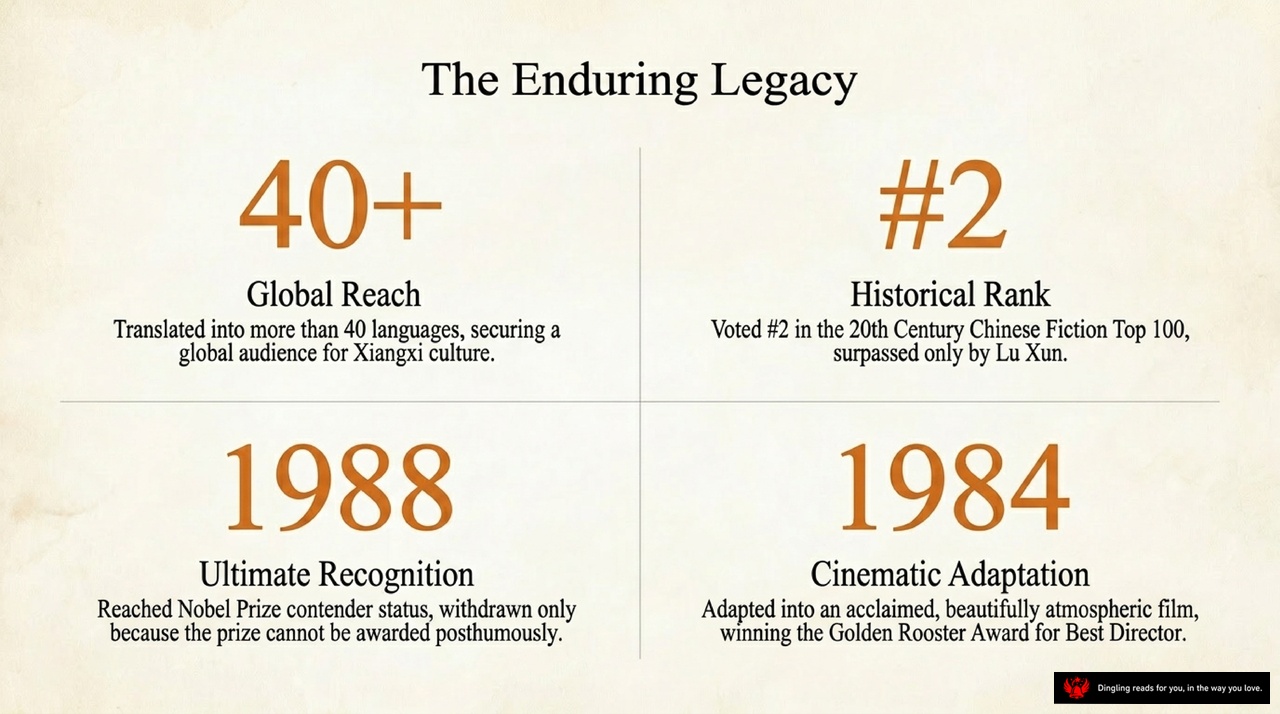
The Enduring Legacy of *Border Town* isn't just about a story; it's about a spirit that refused to fade away. Look at these numbers—they tell the real story of why this book still matters today.
First, the **Global Reach**. Translated into more than **40+ languages**, this novel has traveled far beyond its misty Chinese mountains. It secured a global audience, bringing the unique culture of Xiangxi to the world.
Its **Historical Rank** is equally impressive. Voted **#2** in the 20th Century Chinese Fiction Top 100, it sits just behind Lu Xun. This ranking proves that *Border Town* is not just a local classic, but a pillar of modern Chinese literature.
The book also earned **Ultimate Recognition** in **1988**. It reached Nobel Prize contender status. It's a poignant story: the prize was withdrawn only because the Nobel cannot be awarded posthumously, leaving a permanent mark on literary history.
Finally, in **1984**, the story found a new life on screen. It was adapted into an acclaimed, beautifully atmospheric film that won the Golden Rooster Award for Best Director. From the quiet river of the original text to the silver screen, the legacy of *Border Town* continues to inspire us all.
As the pristine borders of the world fade into rapid urbanization and material pursuit, where will we build our own temples to human nature? In Liao Yong's masterpiece *Border Town*, the answer isn't found in grand architecture, but in the quiet, enduring rhythm of a life lived by the river. The story of Cui Cui and her grandfather is not merely a tragedy of missed connections; it is a meticulously crafted Greek temple of the soul. Here, love remains untainted by materialism, and community is bound by profound generosity. It stands as an elegy for a vanishing agricultural civilization, washed away by the currents of modern time. While the world rushes toward the noise of commerce and the cold logic of the city, this little mountain town preserves a vision where the most valuable wealth is simply being there for one another. As the story concludes, leaving us with a haunting question: will the person we love ever return? Or perhaps, he will come back tomorrow.