
Born a Crime: Complete Chapter-by-Chapter Summary

Welcome to a book that changes everything you think you know about crime. Today, we're diving into *Born a Crime* by Trevor Noah.
The title itself is a shock: "Born a Crime." Why? Because in the brutal reality of apartheid South Africa, being mixed-race wasn't just a social awkwardness—it was illegal. Your parents could go to prison for five years just for loving each other. The law said black and white couldn't mix. But love, it turns out, doesn't follow a statute book.
Trevor Noah's mother was a black woman who defied every rule of her time. She refused to be a factory worker or a maid. She studied typing, broke the law by living in the city, and even faked documents to hide her son's true identity on his birth certificate. She didn't just survive the system; she rebelled against it with sheer audacity.
This book is a vivid exploration of that childhood, where systemic oppression was met with the ultimate rebellion: a mother's fierce love, the transformative power of language, and the courage to simply exist when you're told you shouldn't. It's a story about how one woman's refusal to accept the "crime" written on her son's skin changed the course of his life—and perhaps, the world.

Look at this graphic: "The Formula of Apartheid." It breaks down a terrifyingly simple equation used to engineer total control over a population. It combines three historical atrocities executed simultaneously: Native Removal, Slavery, and Segregation.
Think about this for a second. In the story, the author's mother didn't just live under these rules; she actively fought them. While the system demanded she stay in the "homelands" or work in the mines, she secretly moved to Johannesburg, illegally living in white neighborhoods and working as a secretary. She didn't just endure the "formula"; she hacked it.
Even more radical was her approach to love. In a society where interracial relationships were a felony punishable by prison, she and her father—white and Swiss-German—chose each other anyway. They had a child, but to survive the law, she had to lie on the birth certificate, forging a black father's name to hide their mixed-race son.
The system wanted to separate them by blood, by land, and by labor. But the mother's life proves that when you refuse to play by the rules, you can't be contained by the formula. Her love was the one thing the apartheid machine couldn't calculate or control.

The Apartheid regime faced a mathematical nightmare: Blacks outnumbered Whites by a staggering 5-to-1 margin in South Africa. Brute force simply wasn't enough to suppress such a majority. So, the regime's "genius" was to fracture the unity of the oppressed by convincing them that their greatest enemy wasn't the white government, but each other. They pitted the Zulu against the Xhosa. On one side stood the Zulu, proud traditional warriors who fought colonizers with spears and shields, unyielding in their spirit. On the other, the Xhosa, strategic thinkers who had learned English to outmaneuver the enemy. By turning a 5-to-1 advantage into a civil war, the system succeeded in keeping the majority divided and powerless. This illusion of numbers was the core strategy that kept a fractured majority under control for decades.

Look at this diagnostic table. It lays bare the two faces of colonialism: British Racism versus Afrikaner Racism. On the left, you see the British model of Conditional Assimilation. Their philosophy was, "If the monkey acts human, it is human." The goal? To teach English and European customs, creating a civilized but obedient lower class. They wanted to lift the monkey up into humanity.
But look at the right side. This is the Afrikaner model of Absolute Containment. Their philosophy was brutally blunt: "Why teach a monkey to read?" They didn't want to create humans; they wanted to create tools. The education goal here was "Bantu Education"—teaching only agriculture and metrics. Counting potatoes, digging trenches. They actively eradicated science and history to kill the capacity for independent thought. While the British tried to make the monkey look like a man, the Afrikaners were determined to keep the monkey exactly as it was, stripped of any power to rise. It's a chilling contrast between conditional acceptance and total containment.

In the chaotic, pulsing heart of Alexandra, the world wasn't just loud—it was a high-stakes game of survival where cash was king and trust was a luxury no one could afford. I had found my rhythm here, turning a stolen CD player into a mobile empire, mixing tracks and spinning beats for the neighborhood's wildest parties. But the streets of Alexandra operate on a cruel, invisible logic: it's a trap that promises freedom but delivers a cycle you can't escape.
I watched my friend G try to break free, only to be dragged back by the very people he was trying to leave. The neighborhood doesn't just want you; it needs you. It feeds on your fear of the unknown outside, wrapping you in a warm, suffocating blanket of familiarity. We'd laugh about our schemes, trading goods and making quick profits, but deep down, we knew the cost. We were like hamsters on a wheel, spinning fast but never moving forward. The real crime wasn't just what we stole—like that camera filled with stolen memories of white families enjoying their holidays—but the life we chose to waste. We traded our potential for a false sense of belonging, terrified that stepping out would mean losing the only home we knew. Alexandra didn't just hold us; it owned us.

Picture shows "The Trevor Anomaly" and a slider labeled "Chinese = Black" and "Japanese = White." It highlights how race was manipulated for profit—Japanese were granted "honorary White" status to secure lucrative trade deals for electronics and cars, while Chinese were lumped into the "Black" category simply because their population was too small to warrant a separate box.
This isn't just about skin color; it's about who gets to be human based on their economic value. The text calls this "The Trevor Anomaly." Born to a Swiss father and a Xhosa mother, I was a glitch in a perfectly ordered machine. In a society built on rigid racial categories, my existence was impossible. I couldn't walk down the street with my mother without her pretending to be my maid or dropping my hand if police approached.
The system demanded I be either Black or Colored, never both. But I was neither fully one nor the other. My light skin and European features made me a target for the "Colored" community, who hated my white father, while my mother's heritage and my ability to speak African languages made me an outcast among the lighter-skinned elites. I was a walking contradiction, a human error that exposed the absurdity of their entire order. I was a glitch, and that made me invisible to the machine until I couldn't be ignored anymore.
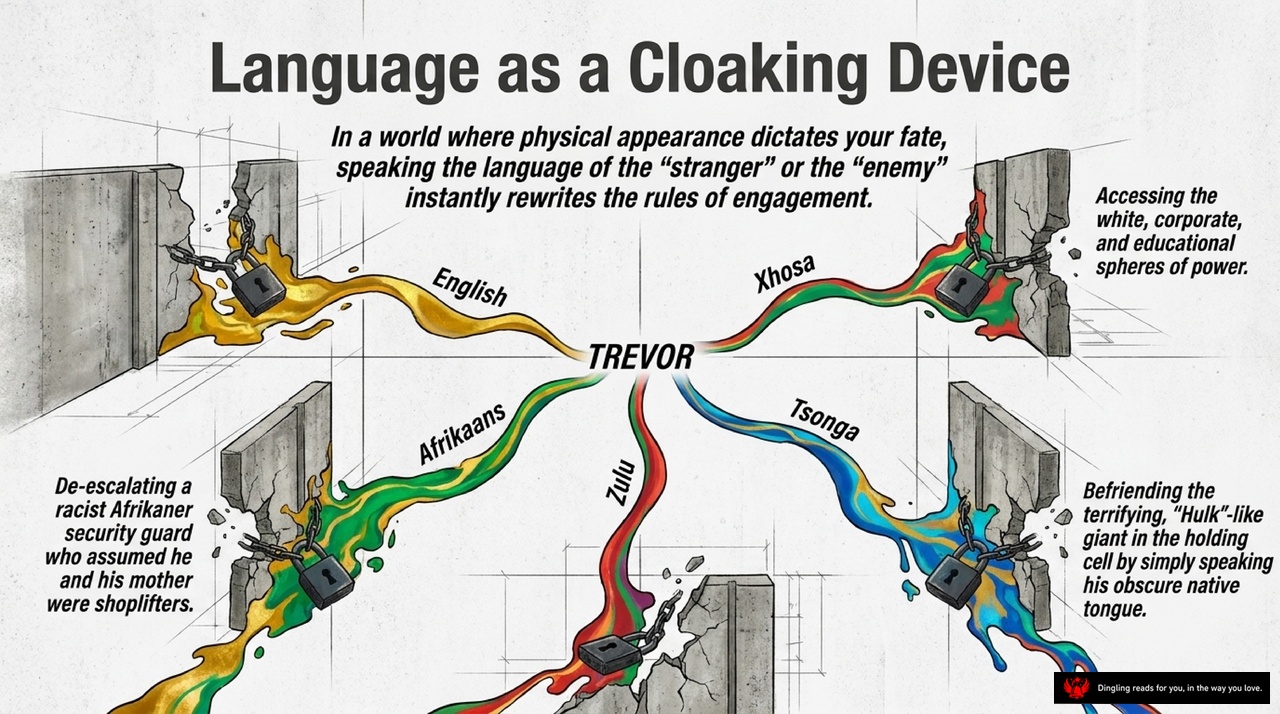
Language as a Cloaking Device. In a world where physical appearance dictates your fate, speaking the language of the "stranger" or the "enemy" instantly rewrites the rules of engagement. Look at the diagram: for Trevor, English acts as a golden key, breaking the chains on the left to de-escalate a racist security guard who assumed he and his mother were shoplifters. By speaking the language of power, he bypassed the barrier. On the other side, Xhosa and Tsonga act as keys to unlock the white, corporate, and educational spheres of power, allowing access where he would otherwise be locked out. Even the terrifying, "Hulk"-like giant in the holding cell could be befriended simply by speaking his obscure native tongue. The central point is Trevor himself, surrounded by the flowing colors of Afrikaans, Zulu, and more. These languages aren't just communication tools; they are camouflage. They allow a light-skinned boy to disappear into a crowd of dark-skinned people, or to speak as one of them without fear. In South Africa's apartheid reality, being the wrong color meant being an outsider, but being the wrong language meant being invisible. Trevor mastered this art, becoming a "language chameleon" who could switch dialects on the fly to survive, to shoplift without getting caught, or to walk away from danger. It proves that while you can't change the color of your skin, you can absolutely change the color of your world by changing the words you speak.

In this synthesis, we explore the speed of sound: how quickly race categorizes us visually, but how slowly language can rewrite that narrative in our brains. On the left, we see "Visual Categorization," labeled as a race. The image depicts rigid, cracked stone blocks forming a barrier, symbolizing how our brains instantly and involuntarily sort people based on skin color. It's a reflex, a split-second judgment that happens before we even speak.
But look at the right side: "Auditory Connection," or language. Here, the stone breaks apart, replaced by a vibrant, flowing explosion of color. This represents the unique power of language to bypass the visual cortex. As the insight notes, while race creates an immediate visual divide, language possesses the ability to rewrite that categorization directly in the brain. When we speak the same language, we bridge the gap that color creates.
The takeaway is clear: "I spoke like them, so I was them." Language doesn't just communicate; it transforms identity. It allows us to step out of the box our skin color tries to force us into. By sharing a tongue, we dissolve the walls of visual separation and find a shared humanity.

Today's slide introduces Patricia, a true rebel whose life was defined by her refusal to play by the rules of a segregated society. Look at the four key pillars that shaped her journey: her secret skill, her hidden base, her camouflage, and her guiding philosophy.
First, she mastered a forbidden skill: typing. In apartheid South Africa, this was a white-only domain. Patricia secretly taught herself, comparing her forbidden ambition to a blind person trying to learn how to drive—a desperate but necessary act of self-empowerment.
Next, she created a safe haven in a white area. She rented Apartment 203 in Hillbrow from a German expatriate, turning a hostile neighborhood into her sanctuary. To move freely through the city without raising police suspicion, she adopted a powerful disguise: wearing a maid's uniform. This simple choice allowed her to navigate a world that was otherwise closed to her.
But what drove all of this? Her philosophy was simple yet profound: "If God is with me, who can be against me?" That unwavering faith was her armor, giving her the courage to break barriers, survive danger, and ultimately, rewrite her own destiny.
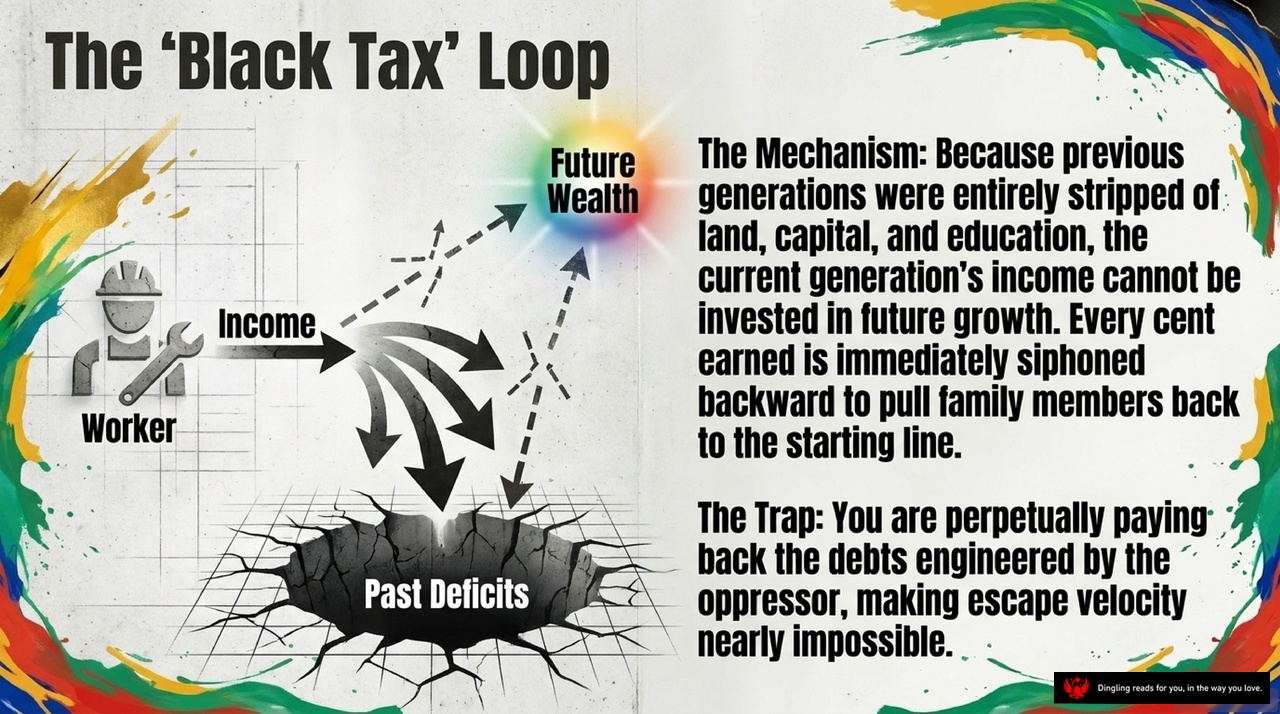
Look at this diagram illustrating the "Black Tax" Loop. It visualizes a tragic cycle where a worker's income doesn't build future wealth, but instead gets siphoned back to cover past deficits.
This isn't just an economic theory; it's the lived reality of millions. As the slide explains, previous generations were stripped of land, capital, and education. Because of this, the current generation cannot invest in growth. Every cent earned is immediately pulled backward to support extended family members, pulling everyone back to the starting line.
You are perpetually paying back debts engineered by the oppressor, making escape nearly impossible. This "Black Tax" creates a trap where you work hard, but your income is consumed by the needs of the past, leaving nothing to secure the future. It's a system designed to keep you running in circles, unable to break free from the cycle of poverty that was forced upon your ancestors.

Imagine a world where your destiny is written before you even take your first breath. On the left side of this slide, we see the rigid box the system offered: a future limited to being a factory worker or domestic help, bound by the physical edges of the Soweto township, and trained from birth to submit without question. This was the script for most black children in apartheid South Africa.
But look at the explosion of color breaking through that wall. That is the world Patricia built for herself. Instead of accepting a narrow fate, she created a universe of drive-in theaters, ice rinks, and countryside picnics—experiences usually reserved for the white elite. She turned outdated encyclopedias and donated books into portals to other dimensions, and she replaced blind obedience with relentless critical thinking, debating the very meaning of Bible verses.
Patricia's mother understood that physical boundaries could be crossed, but mental ones required a different kind of courage. She famously told her son, "Even if he never leaves the ghetto, he will know that the ghetto is not the whole world." This wasn't just a comforting platitude; it was a radical act of rebellion. By exposing her son to a world far beyond his zip code, she planted a seed that would never be choked out by poverty or prejudice. She taught him that his reality was not defined by his circumstances, but by the limits he chose to accept. True emancipation, she proved, begins the moment you realize the walls around you are made of brick, not stone.
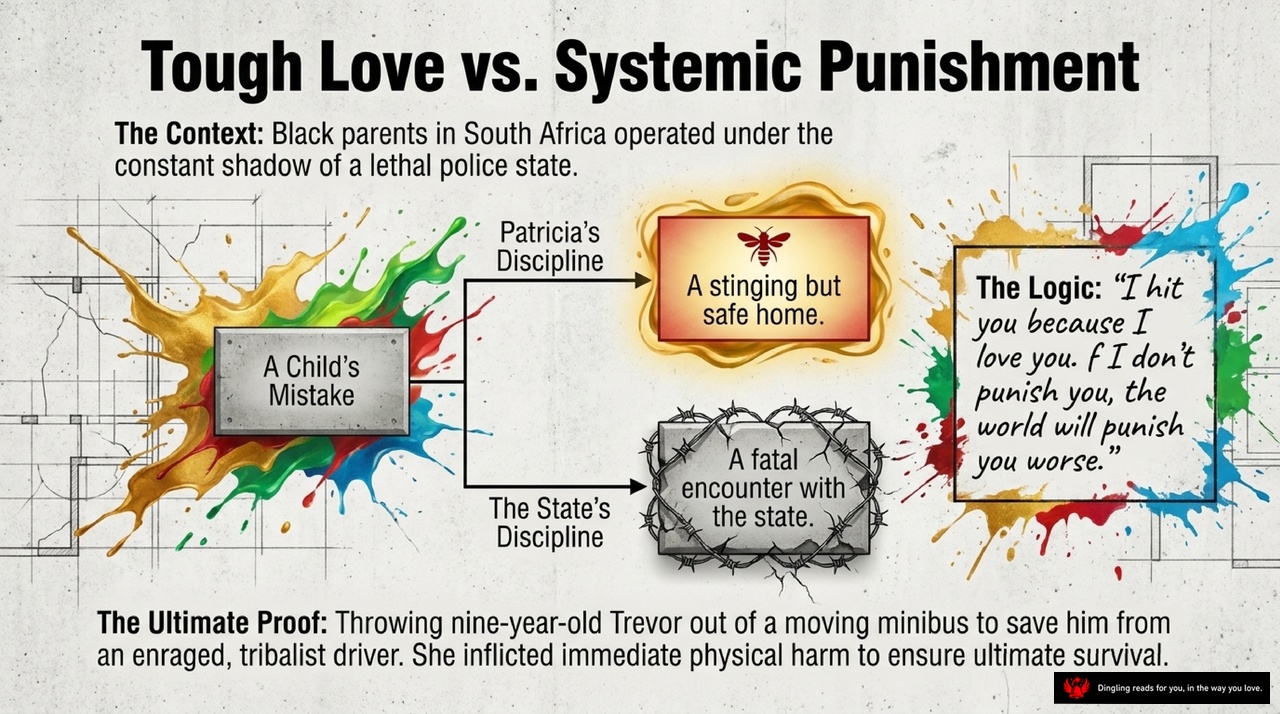
Picture this: a child makes a mistake. In a normal world, the parent's job is to correct it. But in the brutal reality of apartheid South Africa, the stakes were life and death. The slide contrasts two paths. Patricia's discipline offers a "stinging but safe home"—a painful lesson that keeps the child alive. The state's discipline, however, leads to a "fatal encounter," wrapped in barbed wire. Why the difference? Because the logic was terrifyingly simple: "I hit you because I love you. If I don't punish you, the world will punish you worse."
This wasn't just about raising kids; it was about survival training. We see this in the ultimate proof at the bottom: throwing nine-year-old Trevor out of a moving minibus. His mother didn't hesitate. She inflicted immediate physical harm—sending her son crashing onto the pavement—to save him from an enraged, tribalist driver. In that moment, she chose short-term pain to guarantee long-term survival. She was essentially saying, "My love is the only shield you have against a lethal police state." This is the definition of tough love in its most extreme form.

Look at this map of Alexandra. It's not just a neighborhood; it's a trap designed by history. Unlike the suburbs built for growth, Alexandra was static—a confined grid with zero room to expand. As the text describes, populations simply stacked on top of one another, creating a vertical density that had nowhere to go but inward.
This physical design created a powerful psychological force: gravity. The text calls it a "magnetic pull." This isn't about physics; it's about belonging. The hood generates an absolute sense of community, a place where you are never alone. But here's the catch: it demands your future in exchange. It makes it nearly impossible to leave.
We see this in the story of Trevor's friends, like G. G found a job in a clothing store, and everyone thought he had escaped. But he quit a month later. Why? Because the air in the neighborhood is thick with a specific kind of comfort. It whispers that the outside world is dangerous and confusing, while here, you are known, you are safe, and you are part of the tribe. The "cheese boys" and the street DJs, from Bonhanni to the gang members, all orbit this center. Even when money runs out or the police raid their party, the pull is stronger. It's a warm, closed cocoon that cuts off your wings.
The tragedy isn't just the poverty or the crime; it's the addiction to belonging. Trevor realizes that the gravity of Alexandra isn't just external pressure from the apartheid system or the police; it's internal. It's our own fear of the unknown. We stay not because we have to, but because we are terrified of what we might lose if we finally take the step to leave.
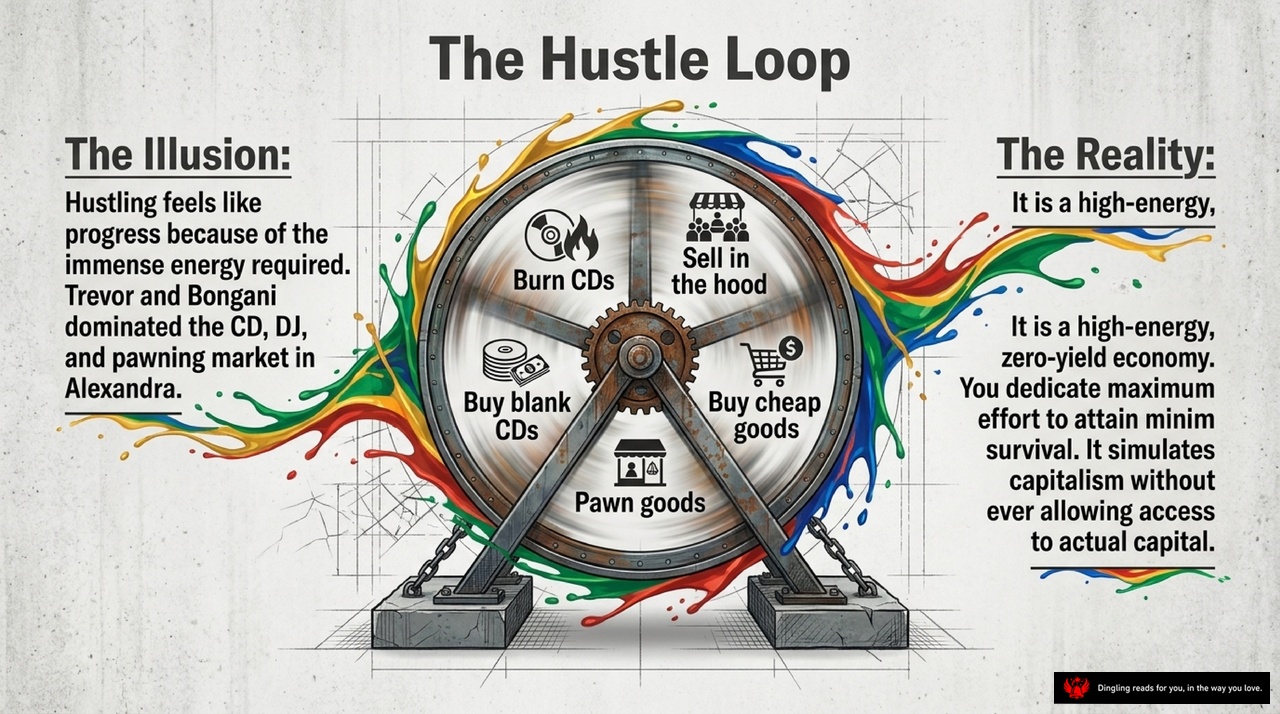
The Hustle Loop isn't just a catchy phrase; it's a trap that keeps millions of us spinning in circles, burning out without ever moving forward. Look at that wheel in the center. On the left, we see the **Illusion**: the feeling that hard work equals progress. For characters like Trevor and Bongani, hustling felt like success because they were pouring immense energy into a broken system. They dominated the CD, DJ, and pawning markets in Alexandra, convincing themselves that this high-octane lifestyle was a ladder to wealth.
But on the right, we see the harsh **Reality**. This isn't a ladder; it's a zero-yield economy. You dedicate your maximum effort just to attain minimum survival. The cycle shown on the wheel—buying blank CDs, burning them, selling them in the hood, buying cheap goods, and pawning them—is a perfect simulation of capitalism without the capital. You're running a business, but you're never building equity. You're just renting out your time and energy, over and over again.
It's a high-energy trap that feels like freedom but is actually a prison. The colorful paint splashing around the wheel represents the excitement we chase, but the heavy chains holding the wheel down represent the reality: you are locked in place. The hustle feels like progress because it requires so much energy, but ultimately, it's just a loop where you work harder to stay exactly where you started.

The Empathy Epiphany: When the Abstract Becomes Real.
We often think of crime in our neighborhoods as just a gray area—a spectrum of survival where buying a box of frozen burgers feels like a harmless hustle, almost victimless. It's easy to separate ourselves from the struggle when we can't see the faces behind the pain. But true awakening happens when that gray area shatters.
Take Trevor's story. He bought a stolen digital camera, just thinking he was making a quick buck. But then, he saw the photos on the screen: a happy family on vacation, laughing by the beach. In that moment, the illusion of a "victimless crime" collapsed. He wasn't just stealing an object; he was stealing someone's most precious memories. The cost of the hustle suddenly became unbearable because the victim finally gained a face.
This is the core truth: crime thrives on isolation. When we are segregated, we stop seeing the humanity in our victims. We become numb to their pain. But the moment we see them—really see them—the empathy kicks in, and the cycle of indifference breaks. That's the moment the illusion shatters, and real change begins.

The illusion of the patriarch is a story we all know, but rarely see laid out so starkly. On the surface, he's the charming master mechanic, the beloved "good guy" of the neighborhood. He's the one everyone trusts, the one who fixes your car and smiles at you. But peel back that colorful, public facade, and you hit a wall of private terror.
This is the story of my stepfather, Abus. To the world, he was a gentle soul, but his Tsonga name, Nisaveni, literally means "fear." That fear was the core of who he really was. Behind that charming exterior lay a deeply insecure alcoholic who demanded traditional submission. He wasn't just controlling; he was violently abusive whenever his fragile authority was challenged.
We saw this play out in our home. He tried to enforce rigid, traditional rules, like kicking our dogs out because he thought it was "African." He tried to control my mother's time, forbidding her from spending her whole Sunday at church. But the most terrifying moment came when his jealousy turned into a gun. He tried to kill my mother, believing she had stolen his life. In that moment of absolute violence, the charming mechanic vanished, leaving only the terrifying reality of a man consumed by insecurity and rage. It was a brutal reminder that the mask we wear for the world can hide a monster waiting to break through.

Systemic Complicicity. Look at this diagram. It shows a terrifying cycle: a citizen tries to seek help, but instead of finding protection, they end up trapped with the abuser because the system itself becomes the accomplice.
This isn't just theory; it's Patricia's reality. When she went to the police station to report Abel's violence, she expected justice. Instead, she encountered what we call "The Brotherhood." The officers refused to open a case. They didn't see a victim in need of rescue; they saw a friend. They treated domestic violence as a "private household matter," dismissing the abuse as something that should stay within the family.
The result? The state removes all legal protection from the victim. By enforcing a patriarchal solidarity, the system essentially tells the abuser that he is above the law. This leaves the abused completely trapped, with no way out. It's a stark reminder that when institutions fail to protect the vulnerable, they don't just stand by; they actively become part of the problem.
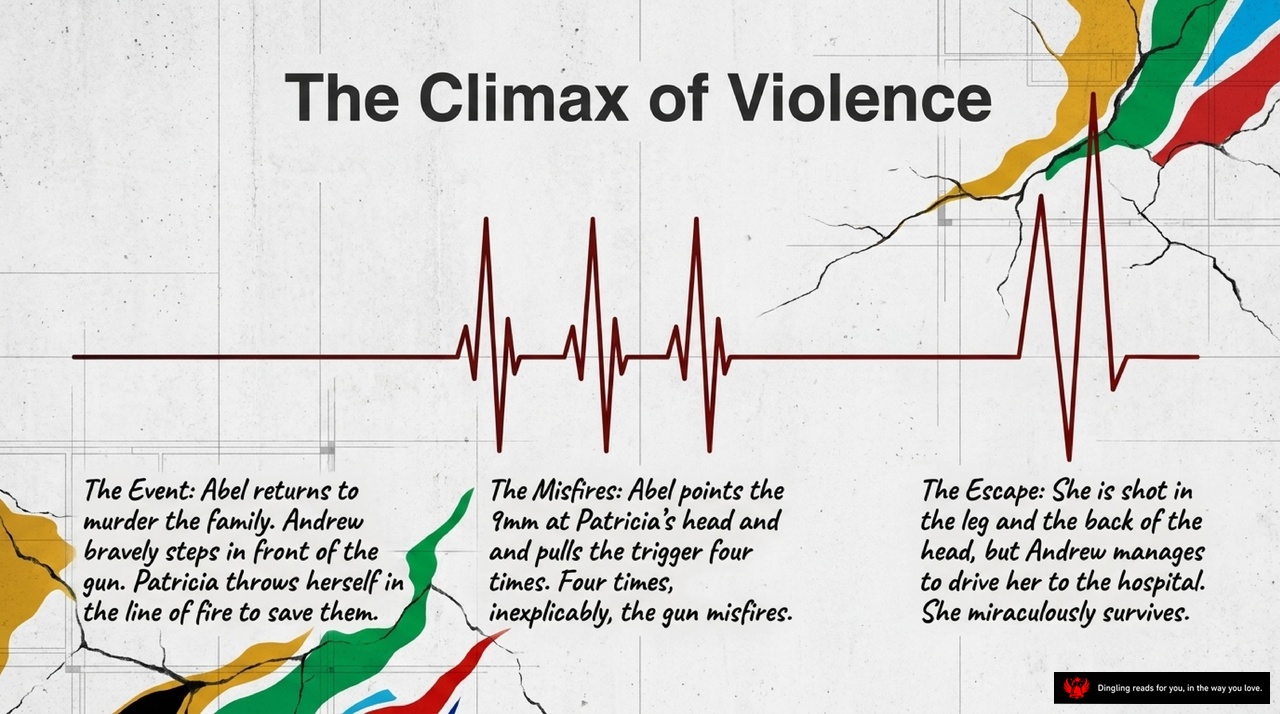
The Climax of Violence. It's the moment the story snaps from tension to tragedy, and then, miraculously, to survival.
Here, we see the event, the misfires, and the escape. First, the event: Abel returns to murder the family. Andrew bravely steps in front of the gun. Patricia throws herself in the line of fire to save them. That's the choice that defines everything.
Then, the misfires. Abel points the 9mm at Patricia's head and pulls the trigger four times. Four times, inexplicably, the gun misfires. It's a plot twist that defies logic, a moment where reality seems to pause and let the characters breathe.
Finally, the escape. She is shot in the leg and the back of the head, but Andrew manages to drive her to the hospital. She miraculously survives. This isn't just a story; it's a testament to the fragility of life and the sheer will to survive against impossible odds.

Picture content: The slide is titled "The Ultimate Resilience." It highlights a powerful story about Patricia recovering in a hospital with a bullet wound to her head and no medical insurance. The core quote reads: "My Jesus is my health insurance. He didn't come to pay the bill... but he blessed me with a son who could pay the bill." The slide concludes with the truth that the oppressive systems of Apartheid and patriarchy failed to break her spirit.
Here is the spoken script for Slide 18:
This slide captures what I call the ultimate resilience. It tells the story of my mother, Patricia, during one of the darkest moments of her life. She was recovering in the hospital after being shot through the head by her abusive husband, and she had absolutely no medical insurance. In a country like South Africa, where the system was rigged against us, that should have been a death sentence. But instead, she found a reason to smile.
She told me a profound truth that became my mantra: "My Jesus is my health insurance. He didn't come to pay the bill... but he blessed me with a son who could pay the bill." This isn't just a religious platitude; it was the literal reality of our survival. My father, Trevor, stepped up to become the provider she couldn't be, ensuring she got the care she needed.
The deeper truth here is that the oppressive grid of Apartheid and the violent shadow of patriarchy tried everything to break her mind and her spirit. They tried to crush her with poverty, violence, and systemic neglect. Yet, they failed. Her faith didn't just offer comfort; it forged an unbreakable steel in her character. She refused to let hatred define her future. Instead, she chose to let her faith and her family's love rebuild her life, proving that even when the world turns its back on you, your spirit can still rise.

Born a Crime isn't just a story about surviving apartheid; it's a masterclass on how language can dismantle the very walls that try to keep us apart. As the book reminds us, the most powerful systems of oppression rely on isolating us into neat, opposing categories—black versus white, guilty versus innocent. But what happens when you refuse to play by those rules?
Consider the power of a mother's relentless mental emancipation. My mother didn't just survive institutional oppression; she broke its chains by refusing to let it define her reality. She was a "language chameleon," seamlessly switching between Zulu, Afrikaans, English, and more. When a shop owner tried to use Afrikaans to threaten her, she instantly countered in fluent Afrikaans, turning the tables and forcing him to apologize. She taught me that speaking the language of the powerful wasn't about submission; it was about claiming your place in the room.
This freedom of expression extended to our daily lives. We were told we were criminals for being mixed-race, yet my mother used that very identity as a shield. She dressed me as a "colored" child to navigate the system, not out of shame, but as a survival strategy that allowed us to move through spaces otherwise closed to us. She showed me that the labels society tries to stick on us are just costumes we can take off.
So, here's the reflection for you: If the systems around you try to box you into categories that limit your potential, how are you using your own "language"—whether that's words, culture, or simply your perspective—to dismantle those walls today? How do you bridge the gap between yourself and the "other"? The answer lies in refusing to be defined by your circumstances and instead, defining them yourself.