
Bright Night: Complete Chapter-by-Chapter Summary

Welcome to "Bright Night," a constellation of memory and healing. Tonight, we journey into Choi Eun-young's masterpiece to visualize the matrilineal path of trauma, survival, and solidarity. Imagine standing on a quiet coast under a vast, star-filled sky, where an observatory watches over the dark waters. This is the setting for a woman's rebirth, a place where the past isn't just remembered, but actively healed. The image before us captures this essence: a night that transforms from a place of solitude into a source of profound connection. It is here, amidst the silence of the sea and the light of the stars, that we find the courage to rewrite our own stories.

Rebuilding from the Collapse isn't just about fixing a broken life; it's about finding the anchor when everything else feels like it's falling apart. On the left, we see the devastation: Ji-yeon, at 32, has just escaped a shattered marriage in a society that quickly judges divorced women. She feels like she's living in a world where the core of her life has collapsed. But on the right, there is hope. She finds her anchor in Huiryeong Observatory, a quiet coastal town where the pressure to maintain the "normal family" facade is stripped away.
The real question, as the slide asks, is how does one rebuild when the foundation is gone? The answer doesn't come from the stars she studies, but from an accidental reunion with her estranged 78-year-old grandmother, Young-ok. It turns out that while her mother tried to push her back into a traditional mold, her grandmother offered something far more vital: unconditional acceptance. In that quiet seaside town, amidst the wind and the sea, Ji-yeon finally learns that she doesn't need to be perfect to be worthy of love. She finds her strength not in escaping her past, but in embracing the unexpected warmth of a grandmother who sees her clearly. This is how she begins to put the pieces back together, one day at a time.

Tracing the Matrilineal Constellation. This isn't just a family tree; it's a gravity map of survival. As the slide shows, blood dictates our lineage, but shared survival dictates the gravity that holds us together.
Look at the map. On the left, we have the "Root"—Samcheon, the great-grandmother, and the "Survivor," Young-ok, my grandmother. On the right, we see the "Chosen" ones: Shin-woo's Aunt and Myung-sook, the former nun seamstress. These women didn't just share DNA; they shared the weight of history. They transferred generational trauma, yes, but they also forged a fierce female solidarity required to survive it.
This map tracks how pain is inherited, but how strength is chosen. From the great-grandmother's resilience in the war to the grandmother's quiet endurance, and finally to me, the protagonist, Ji-yeon, who stands as the lens through which we see it all. We are connected not just by blood, but by the unbreakable bond of women who refused to break under the pressure of time.

Escaping the Void: The Genesis of Trauma. This slide maps the harrowing origin story of Samcheon, a character whose life is defined by the brutal necessity of survival.
Phase one is The Baekjeong Box. Born into the lowest caste, a butcher's family, Samcheon is trapped from birth by societal contempt. She wears the black ribbon of her status, a constant reminder of her place in a world that refuses to see her as human.
Phase two is The Threat. The encroaching Japanese military arrives, seeking "comfort women." This isn't just an abstract evil; it is an unbearable reality that presses against her door, presenting a choice between her dignity and her life.
Phase three is The Severing. To survive, she must abandon her dying mother and board a train to Kaesong with a stranger. She must lock away her seventeen-year-old soul, spending the rest of her life as a hollow vessel of endurance.
The core insight here is profound: survival often requires the brutal severing of the self. Samcheon's trauma isn't just what happened to her; it is the act of becoming a ghost to stay alive.

In the heart of a shattered world, there was a love that refused to break. After Hiroshima, Uncle Shin-woo returned to Kaesong, not as the vibrant man he once was, but as a ghost of himself. His body bore the invisible scars of radiation—peeling skin, relentless coughing, a silence that spoke louder than any scream. The doctors delivered a cruel verdict: his lungs were failing, and time was running out.
Knowing this, Aunt Shin-woo made a heartbreaking choice. She packed their belongings and led him back to their hometown, away from the painful memories and the fading hope of a cure. When they reached the train station, the separation was absolute. She handed him eggs and sweet potatoes, the last tangible pieces of their life together, while she stayed behind, watching the train disappear into the horizon until she could no longer see him.
Back in the house, the silence was deafening. Aunt Shin-woo's letters to her became lifelines. In the first one, she painted a picture of blooming azaleas, trying to bring the warmth of spring to her grieving heart. In the second, her handwriting trembled as she confessed her nightly dreams of him, urging her not to lose hope. But the third letter, sent after his funeral, was different. It wasn't about grief anymore; it was about wisdom. She wrote about how life is like fallen leaves in the wind—some stay in the soil, others drift away, but all have lived fully. She reminded her that true friendship isn't about avoiding pain, but about witnessing each other's struggles and holding onto the memory of love long after the person is gone.
Those letters, preserved through decades of war and peace, eventually reached my grandmother's hands. Reading them now, I realize that Aunt Shin-woo didn't just survive the loss of her husband; she transformed it into a legacy of resilience. She taught her friend that even in the darkest times, a single moment of shared humanity is enough to keep the soul alive. Their bond, forged in the ashes of a broken world, proved that love can indeed transcend death.

Mom just got back from Mexico, and she's full of stories about the vibrant streets and sunsets she saw. She's even brought me gifts, like a Frida Kahlo fridge magnet and some Guadalupe prayer beads, hoping they'll help me feel stronger. But when I show her my empty medicine cabinet, she gets defensive. She thinks my struggle is just me being willful, refusing to learn from her own life. She doesn't understand that my pain isn't something to suppress; it's something I need to face. I tell her she's living for other people's opinions, not her own happiness. She leaves in a huff, leaving a bowl of warm porridge and a note that says "Be careful on the road." It breaks my heart, but I also see her fear. She's trying to protect me from the same storms she weathered, even if her methods feel suffocating.
But life has a way of giving us unexpected comfort. That night, I find a skinny, shivering stray dog huddled near the entrance of my apartment. Its eyes are full of fear, but also a desperate hope. I take it in, name him Oats, and feed it scraps of chicken and bread. He transforms from a scared creature into my shadow, my little companion who greets me at the door every evening. We spend days together, running on the beach, exploring the market, and sharing quiet moments. He fills the silence in my apartment with his presence, reminding me that I'm not alone.
But joy is fragile. Oats gets sick with distemper, and despite my desperate pleas and endless research for cures, he passes away in the hospital. Watching him take his last breath shatters me. Burying him under the trees near the observatory feels like burying a piece of my soul. Yet, in his short life, he taught me the purest form of love. His presence, even in memory, changes how I see the world. I realize that every connection, no matter how brief, leaves an indelible mark. I carry Oats's warmth with me, knowing that even in the darkest times, love can still find a way to heal.

Survival isn't just about finding shelter; it's about the brutal topography of the land you must cross. As Samcheon, her husband, and young Young-ok flee Kaesong in the dead of winter, they are forced onto a map of pure desperation. The journey from Kaesong to Huiryeong is marked by freezing rivers, starvation, and the profound trauma of abandoning everything, including their beloved dog, Ah-chun.
The map on the screen traces their harrowing path through Seoul's bombed ruins, across the Han River where the water is so cold it turns to a freezing march, and past Daegu to Huiryeong. There is no safety here, only the relentless forward motion required to stay alive. As the data point on the slide poignantly states, "Walking on ice, surrounded by the displaced, stepping over the frozen bodies of the fallen." In this landscape, survival is reduced to the simplest, most terrifying act: putting one foot in front of the other. It is a topography of survival where every step is a battle against the elements and the ghosts of the past.

Picture shows a high-walled courtyard, representing a sanctuary for refugee families. The outer wall offers protection from chaos, war, and danger. Inside, a sewing machine symbolizes economic independence, while the inner courtyard becomes a matriarchal utopia where women thrive without male domination. In Daegu, families find this unlikely refuge with Myung-sook, an ex-nun running a seamstress business behind these walls.
This imagery mirrors the narrator's journey from isolation to empowerment. Just as the courtyard shields its residents, she builds a life where she controls her destiny. The sewing machine isn't just a tool; it's a lifeline, teaching her daughter skills to survive. The inner courtyard represents a space where women support each other, free from traditional constraints.
Myung-sook's home becomes more than a shelter; it's a place of healing and growth. Here, the narrator learns that safety isn't just about physical walls, but about finding a community that values her. The high walls keep the world's pain out, allowing her to rebuild her identity piece by piece, weaving a new future from the threads of her past.

Welcome back to our journey through *The Wind Blows*. Today, we turn our attention to a pivotal moment of reconciliation: the story of Young-ok's grandmother and her long-lost cousin, Kim Hee-ji.
On the left, we see the "Daegu Sanctuary," described as a brief matriarchal utopia. This warm, golden scene captures the bond between the grandmother and Hee-ji. They weren't just relatives; they were sisters in arms. From hiding in the alleyways of Daegu to playing "Frog Family" on the streets, they shared a childhood filled with laughter and a fierce, protective love. The grandmother didn't just raise Hee-ji; she gave her a home when the world felt like it had ended.
However, the right side of our slide reveals the harsh reality: "Huiryeong: Isolation and emotional suppression." This is the grandmother's internal world. While her heart was full of love, her actions were often shaped by the fear of the outside world. She pushed Hee-ji away, not out of malice, but out of a deep-seated insecurity. She saw Hee-ji's desire to study and leave as a threat to their fragile safety, fearing that letting her go meant losing her forever. This suppression created a painful distance, leaving the grandmother feeling guilty and the young Hee-ji feeling unseen.
The text at the bottom tells us that Young-ok's sanctuary is eventually destroyed when her father forces the family to leave. But in this chapter, we see the emotional aftermath of that separation. The grandmother spent decades trying to find Hee-ji, driven by a regret she couldn't speak aloud. It wasn't until Young-ok, now an adult, used modern technology to search for her, that the search finally paid off.
The "Insight" box highlights a profound transformation: Young-ok learns to suppress her rage and sorrow, donning a "cold smile" of resignation. This coping mechanism wasn't just hers; it was a legacy passed down from her grandmother. For generations, women in this family learned to swallow their pain to protect themselves. But today, Young-ok is breaking that cycle. By finding Hee-ji and realizing that the grandmother's strictness came from a place of terrified love, Young-ok finally heals the wound. She understands that the "cold smile" doesn't have to be her permanent mask.
So, as we move forward, let's carry this lesson with us: Love is not just about keeping someone close, but sometimes, it is about having the courage to let them go and trust that they will find their way. The grandmother and Hee-ji are finally reunited, not just in memory, but in truth. Their story reminds us that even the deepest silence can be filled with understanding, and that no matter how long we are apart, the bond we share can always bring us home.

Today's slide contrasts two worlds: the patriarchal illusion and the matriarchal reality. On the left, we see the savior who demands subservience, the security that comes with conditional promises, and a "normal" family built on gaslighting. But look at the right column. Here, we find the true power of sisterhood. Shin-woo's Aunt saves Samcheon through mutual devotion without any debt or hierarchy. Myung-sook provides unconditional safety behind high walls, simply because she cares. And instead of a husband weaponizing marriage to hide his betrayal, Ji-woo offers fierce, chosen loyalty. These stories—from the grandmother and New Rain Aunt to my own friendship with Ji-woo—prove that true family isn't performed for society; it's chosen in the quiet moments of hard times. When men offer control or conditional love, women offer presence and unwavering support. That is the reality of sisterhood.

Look at this slide. It captures the core tension of Mi-seon's story: the "Disconnected Link" of Generation 3. On the left, we see the "Wall of Unhealed Trauma." Mi-seon, the casualty of her mother Young-ok's emotional suppression, built a high wall to protect herself. She resented her mother and defended her cheating ex-husband, desperate to maintain a facade of normalcy. This trauma turned inward, creating a rigid barrier that isolated her from the world.
But on the right, we see the "Radical Act of Liberation." Witnessing her friend's freedom inspired Mi-seon to finally break her own chains. In a sudden, bold move, she abandons her demanding husband and travels to Mexico—a place representing a new beginning. This isn't just a trip; it's a radical act of self-liberation.
The diagram shows how this journey transforms her. The "Trauma Barrier" between the two planets shatters, allowing her to travel from the shadow of her past to the sun of Mexico. It symbolizes her transition from being trapped by her mother's expectations to finding her own path. This shift is the defining moment for her generation: moving from silence and suppression to speaking up and choosing their own destiny.

Looking through a telescope, we aren't just peering into the void; we are traveling backward in time, catching ancient light that has finally reached our eyes. This is the essence of astronomy, and for Ji-yeon, it becomes a powerful metaphor for healing. Just as telescopes reveal the distant past, reading her aunt's letters allows her to witness the macro-scale tragedies her foremothers survived. In doing so, her own personal trauma is shrunk from an overwhelming burden into something manageable, a survivable scale. The cosmic perspective she discovers shrinks her ego, while the historical perspective shrinks her despair. By synthesizing these views, Ji-yeon realizes that while her pain is real, it is not unique, and in the vastness of human history, she finds the strength to move forward.

Let's dive into the anatomy of a letter. These fragile pieces of paper aren't just ink on old parchment; they are a bridge across time, transferring the raw, unfiltered strength of the first generation directly to the fourth.
Look at the words here: "If you get angry, just say you're angry." This isn't just advice; it's a rejection of the 'cold smile.' It's the ultimate form of resilience—emotional honesty and the refusal to suppress pain. Instead of hiding behind a mask, we choose to feel.
And then there's the quiet promise: "I know we will meet again." That is defiance against the absolute finality of war and separation. It transforms hope from a passive feeling into an active, radical choice. These letters prove that even when the world tries to break us, the human spirit finds a way to connect, to heal, and to survive.
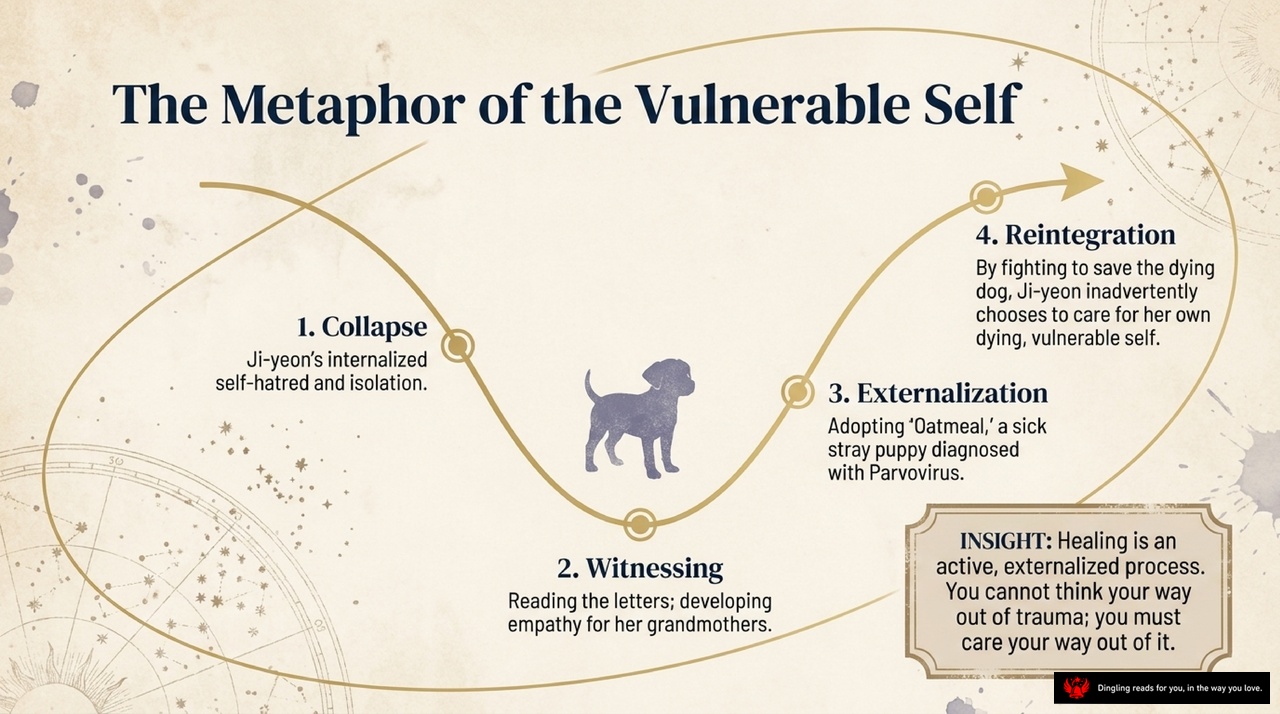
Picture this: a journey from total collapse to a surprising kind of healing. It starts with the **collapse**—a moment when Ji-yeon's internalized self-hatred and isolation finally crack open. She realizes she can't just think her way out of trauma; she has to act. That's the core of her **insight**: healing is an active, externalized process. You cannot think your way out of trauma; you must care your way out of it.
She moves into **witnessing**, reading letters and developing empathy for her grandmothers, connecting with their stories across time. Then comes **externalization**. By adopting "Oatmeal," a sick stray puppy diagnosed with Parvovirus, she projects her own pain onto another living being. Caring for this vulnerable creature becomes a mirror for her own inner struggle.
Finally, she reaches **reintegration**. By fighting to save the dying dog, Ji-yeon inadvertently chooses to care for her own dying, vulnerable self. This act of loving something else heals her own heart, proving that sometimes, to save ourselves, we first have to learn how to save others.

The Bright Night isn't just a title; it's a map of how we heal. Look at this constellation. It shows Ji-yeon's journey, but more importantly, it reveals a profound truth: time isn't a flowing river that washes us away; it's a connected web. Every star we see today is linked to the ones that came before.
In the center, we see the cycle of collapse, externalization, and reintegration. Ji-yeon learns that she is the culmination of generations of women who endured the unthinkable. Her grandmother, her great-grandmother, and even her great-great-grandmother—those women who survived war, displacement, and loss—are the starlight illuminating her present darkness. They are the ones who taught her that she is never truly alone when she is anchored by their memory, strength, and solidarity.
The takeaway is clear: we don't have to carry our burdens alone. By recognizing the women who walked this path before us, we find the courage to face our own storms. We are part of a lineage of resilience, and that connection is what makes the night bright.