
Chronicle of a Blood Merchant: Complete Chapter-by-Chapter Summary
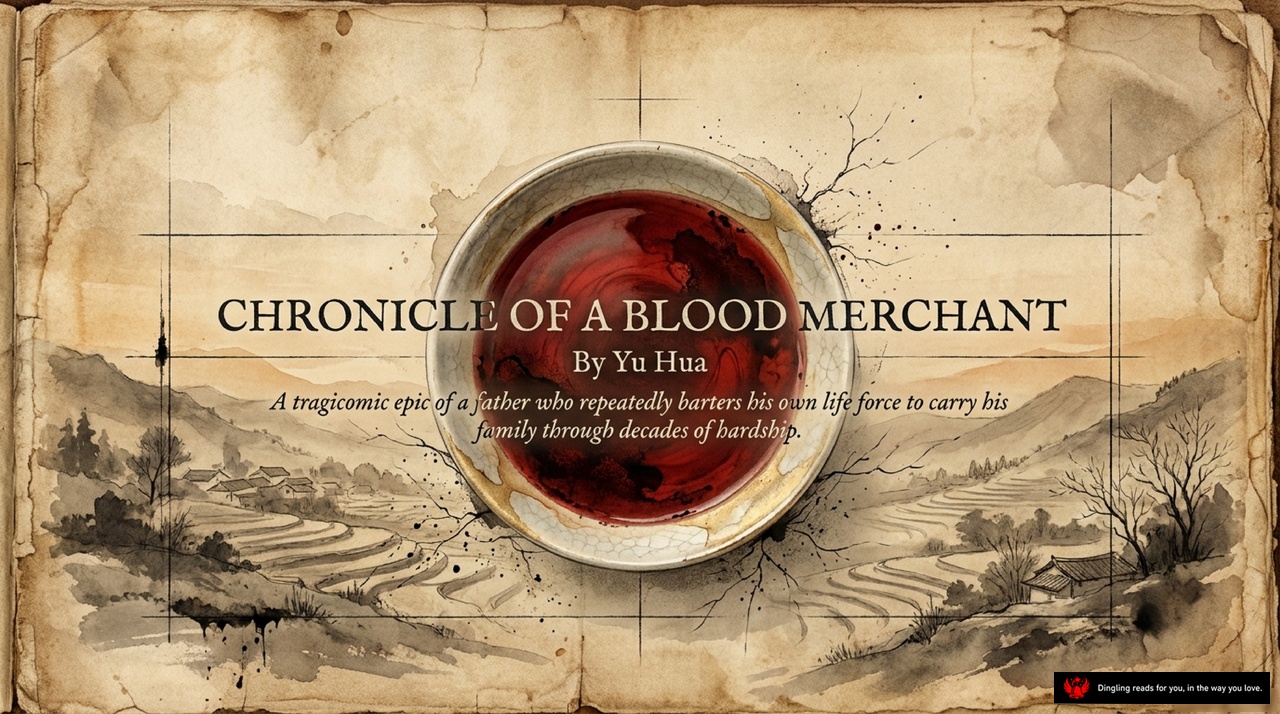
Welcome to the world of *Chronicle of a Blood Merchant* by Yu Hua. This isn't just a story; it's a tragicomic epic about a father who repeatedly trades his own life force to carry his family through decades of unimaginable hardship.
The image captures the very heart of this tale: a bowl of blood, set against a backdrop of rolling hills and a fading past. It represents the central, shocking premise of the book—a father who views his own blood as currency. In a time of poverty and crisis, selling blood becomes the only way to survive. It's a dark, desperate act that forces us to question the limits of parental love and the cost of survival.
As we turn the pages, we'll follow this father's journey, from his first terrifying sale of blood to buy a wedding, through the chaotic years of famine and political upheaval, to the final, heartbreaking moment when he is too old to sell anymore. This is a story about equality, about the struggle to live like everyone else, and about the profound, painful sacrifices one parent makes for their children. Get ready for a ride through memory, where the past comes alive again, and the price of love is written in red ink.
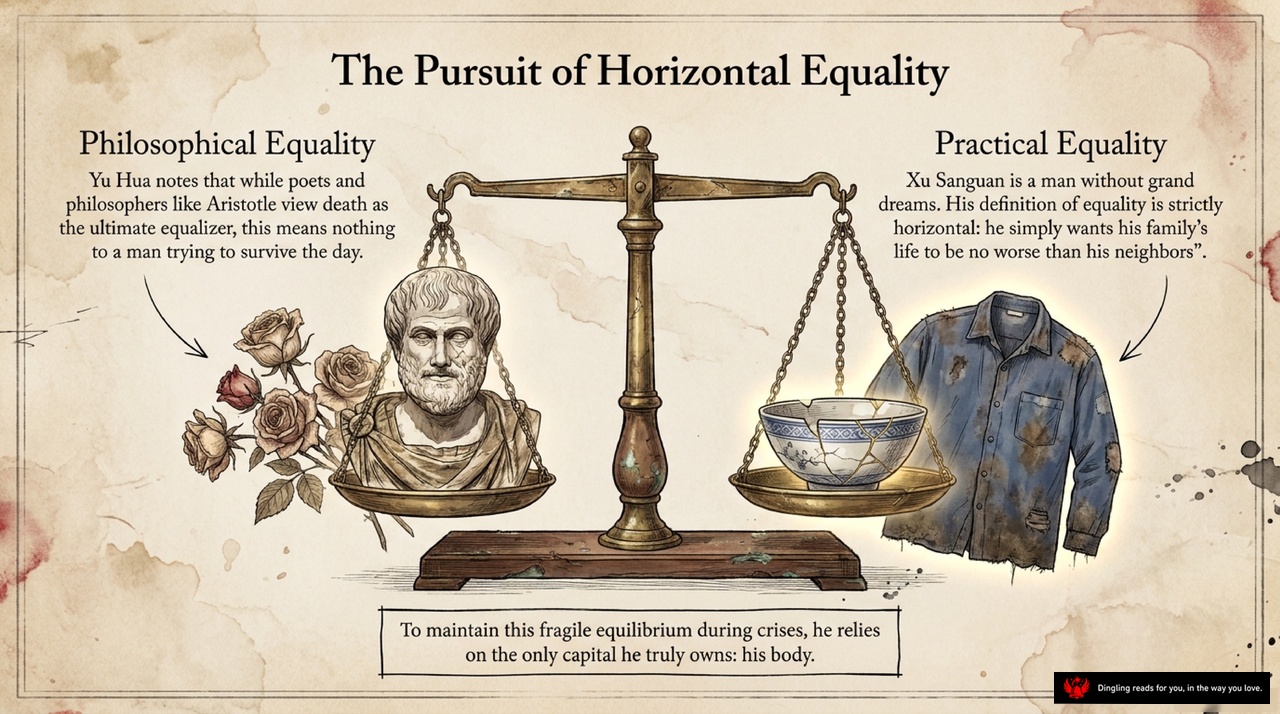
The pursuit of horizontal equality isn't about grand philosophical theories or abstract ideals of death as the ultimate equalizer. It's about something far more visceral and immediate: the desire to simply not be worse off than your neighbor.
Look at the scale in the center. On one side, we have the ideal of Philosophical Equality, represented by the ancient wisdom of thinkers like Aristotle, who viewed death as the great leveler. But as the image reminds us, this comfort means nothing to a man trying to survive the day. On the other side, we have Practical Equality, embodied by a character like Xu Sangguan. He has no grand dreams; his definition of equality is strictly horizontal. He simply wants his family's life to be no worse than his neighbors'.
This is the struggle of the ordinary person. To maintain this fragile equilibrium during crises, he relies on the only capital he truly owns: his body. In a world where resources are scarce and the gap between the rich and the poor seems insurmountable, the only way to keep up is to sell what you have left—your own health and vitality. It's a desperate, silent trade-off where dignity is exchanged for survival, all in the name of staying just one step ahead of the person next door.

Today's slide introduces a chilling concept: The Dual Economy of Survival. It breaks down how characters in the story navigate life through two very different paths. On the left, we see The Economy of Sweat. This is the path of muscle and labor. The action is simple: working daily in a silk factory or the fields. The yield? It barely prevents starvation. It's safe, renewable, and slow. This is the baseline money that keeps the family from falling into the abyss.
But look at the right side: The Economy of Blood. This is where life force becomes currency. The action is terrifying—extracting 400ml of blood with thick hospital needles. The yield is shocking: just 35 Yuan, which is equivalent to six months of hard field labor. The nature of this economy is highly dangerous and depleting. It's not for daily expenses; it's reserved strictly for major life events—marriages, debts, and saving lives.
This contrast highlights the desperate reality of the time. While sweat can sustain the baseline, blood is the only way to leap over impossible obstacles. It's a high-stakes gamble where the cost is your own life force, but the reward is survival.
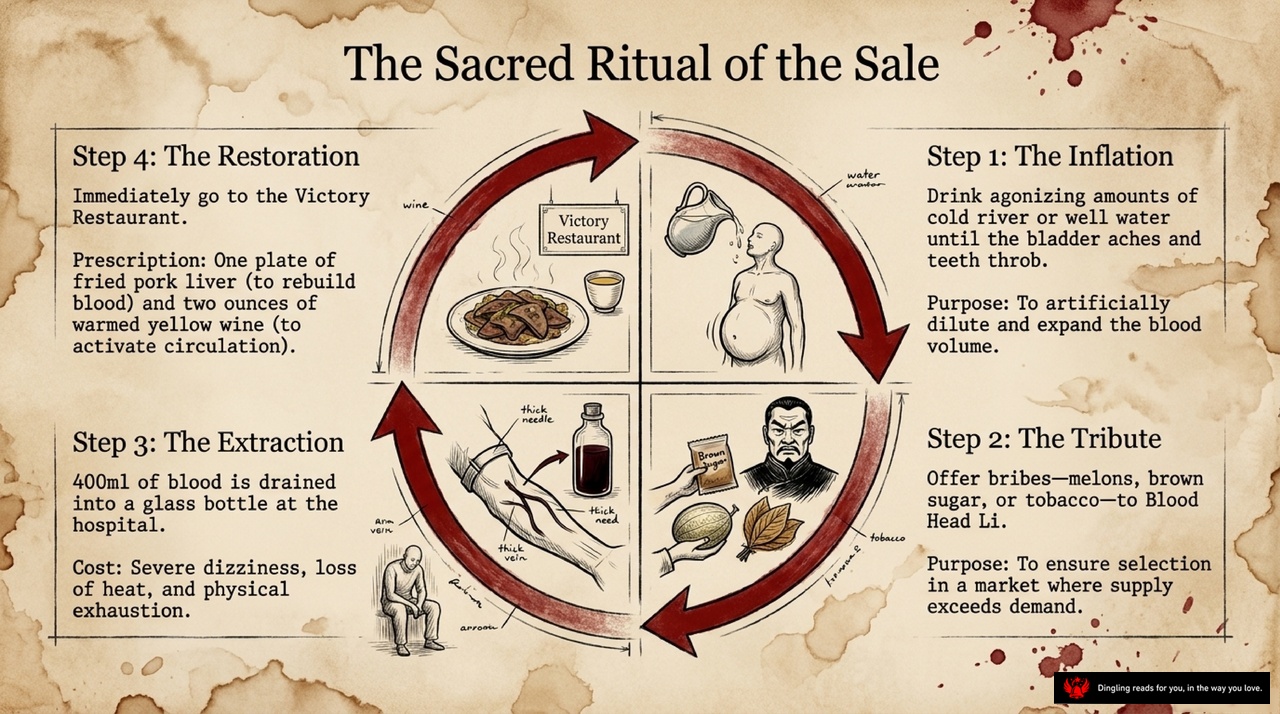
Step 4: The Restoration. Immediately head to the Victory Restaurant. The prescription is clear: one plate of fried pork liver to rebuild your blood, and two ounces of warmed yellow wine to activate your circulation. This isn't just a meal; it's the ritual that brings you back to life.

Look at this ledger. It's not just a list of transactions; it's a map of Xu Sanquan's life, drawn in blood and sweat. Phase One starts with his first sale. Why did he do it? To prove he was healthy and save enough for his wedding to Xu Yulan, the famous "Oil-Fritter Queen." The cost? He lost his stamina and stepped into a dangerous underworld. But the yield was clear: 35 Yuan.
Then comes Transaction 02. This time, the reason wasn't about love, but about shame and survival. His son, Yile—who isn't biologically his—accidentally smashed a neighbor's head. The family lost their furniture, and the debt fell on Xu Sanquan. He swallowed his immense pride and bled again, paying 35 Yuan directly to clear the debt. The human cost here is heavier: he bled to pay for another man's genetic legacy.
These two transactions set the tone. Every time life hits a wall, Xu Sanquan doesn't look for a miracle; he looks at his own blood. He treats his body like a bank account, ready to be cashed out whenever the world demands a price. This is the brutal, honest reality of his struggle.
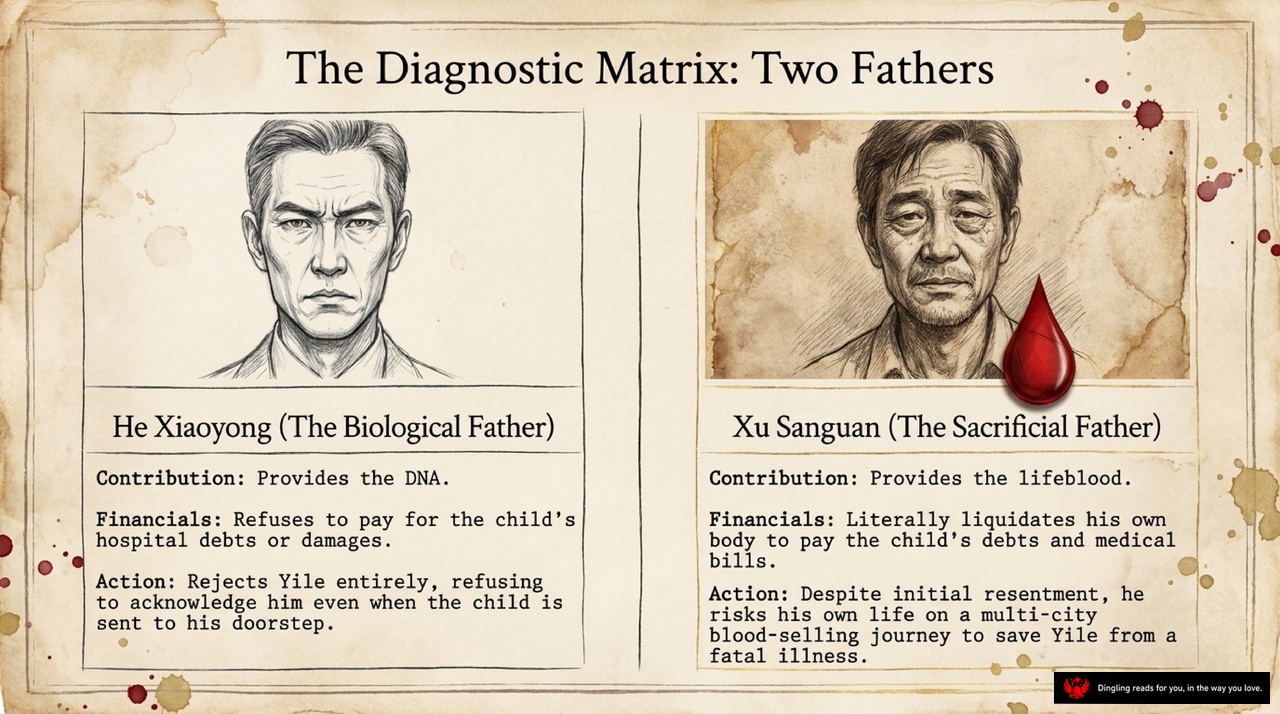
The Diagnostic Matrix: Two Fathers. This slide lays bare the most painful truth of Xu Sanguan's life: the stark contrast between biology and fatherhood. On the left, we see He Xiaoyong, the biological father. His contribution? Just DNA. Financially, he refuses to pay a single cent for the child's debts or medical bills. His action? He rejects Yile entirely, refusing to acknowledge him even when the child is sent right to his doorstep. It's a cold, transactional reality.
But look at the right side. Xu Sanguan, the sacrificial father. His contribution isn't just genetic; it's his very lifeblood. Financially, he literally liquidates his own body to pay for the child's debts and medical bills. His action? Despite initial resentment, he risks his own life on a multi-city blood-selling journey to save Yile from a fatal illness.
This isn't just a story about money; it's a story about who you choose to be. While the biological father offers nothing but silence, the adoptive father offers everything, selling his blood drop by drop until there is nothing left. This is the ultimate definition of fatherhood: not the blood you are born with, but the blood you are willing to give.
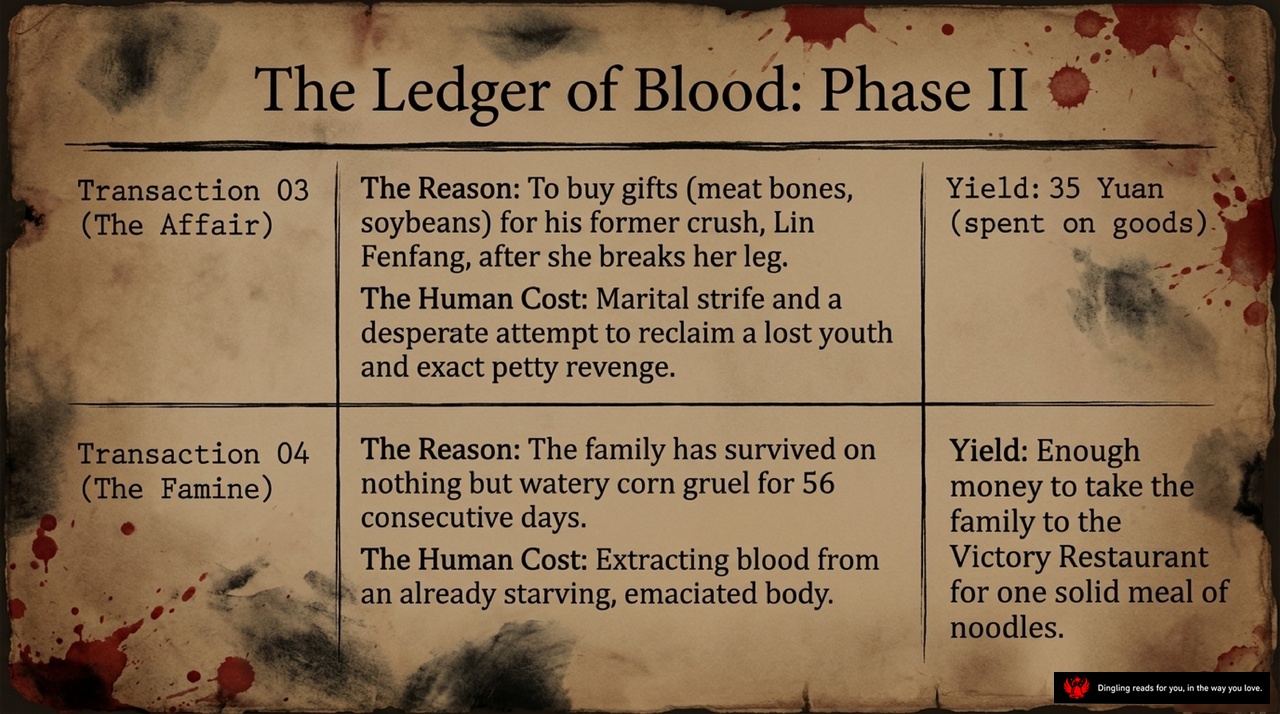
Look at this ledger, specifically Phase II. Here, we see the two most brutal transactions in Xu Sanguan's life: the affair and the famine.
First, Transaction 03: The Affair. Xu Sanguan sells his blood to buy gifts—meat bones and soybeans—for his former crush, Lin Fenfang, who broke her leg. The "yield" is just 35 yuan spent on goods. But look at the human cost: marital strife and a desperate, petty attempt to reclaim a lost youth. He literally sold his life force to chase a ghost of his past, nearly ruining his family in the process.
Then comes Transaction 04: The Famine. This is far darker. The family has survived on watery corn gruel for 56 consecutive days. The reason for selling blood here is survival. The yield? Enough money to take the whole family to the Victory Restaurant for one solid meal of noodles. But the human cost is extracting blood from an already starving, emaciated body. He sells his own vitality just so his children can eat a proper meal.
These two entries show the same pattern: Xu Sanguan sells his blood, not for luxury, but for a fleeting moment of normalcy—either to pretend he's young and romantic, or to ensure his family isn't hungry. It is the ledger of a man who traded his very life, over and over, just to keep living.

The Collateral Damage of the Trade: Blood is a depreciating asset with lethal consequences.
Look at these two case files. On the left, we have Ah Fang. His mistake? He drank excessive amounts of river water right before a sale to maximize volume. The consequence? A ruptured bladder. His body is permanently ruined; he can never sell blood again. On the right, Gen Long. His error? Selling blood too frequently without allowing the body to regenerate its reserves. The result? A fatal cerebral hemorrhage mid-meal, right after a transaction.
This is the brutal reality of the trade. It's not just about money; it's about the body's breaking point. When you push past the limit, the cost isn't just financial—it's life itself.
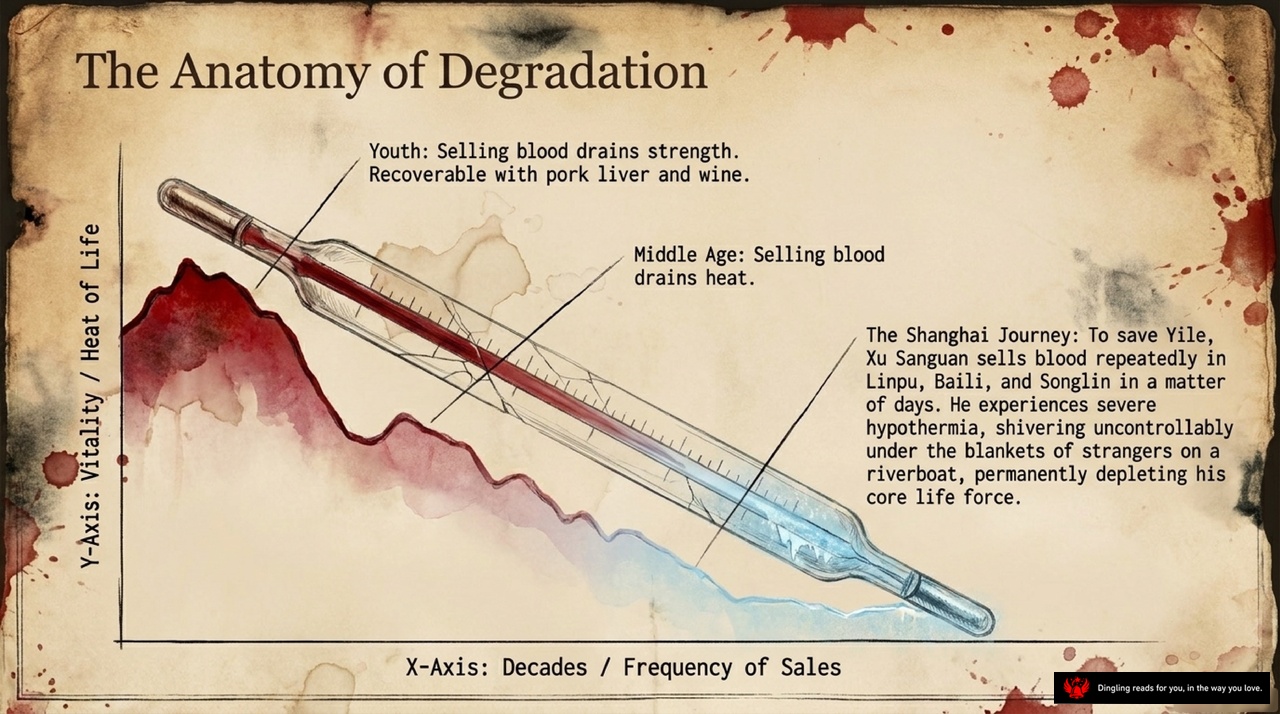
Look at this graph titled "The Anatomy of Degradation." It maps Xu Sangquan's life as a slow, inevitable decline, where every decade of selling blood drains a different part of his vitality. In his youth, the loss is just physical strength—something he could recover with pork liver and wine. But as he moves into middle age, the toll shifts; he begins to lose his internal heat, his passion, and his life force.
By the time we reach the final stage, the "Shanghai Journey," the degradation becomes permanent and catastrophic. To save his son Yile, Xu Sangquan sells his blood repeatedly in Linpu, Baili, and Songlin within a matter of days. The graph shows his vitality plummeting into the cold blue zone. He suffers from severe hypothermia, shivering uncontrollably under the blankets of strangers on a riverboat, permanently depleting his core life force.
This visual tells us that while selling blood once was a temporary sacrifice, repeated sales strip away the very essence of being human. Xu Sangquan doesn't just lose his health; he loses his warmth, leaving him cold and empty in his final years.
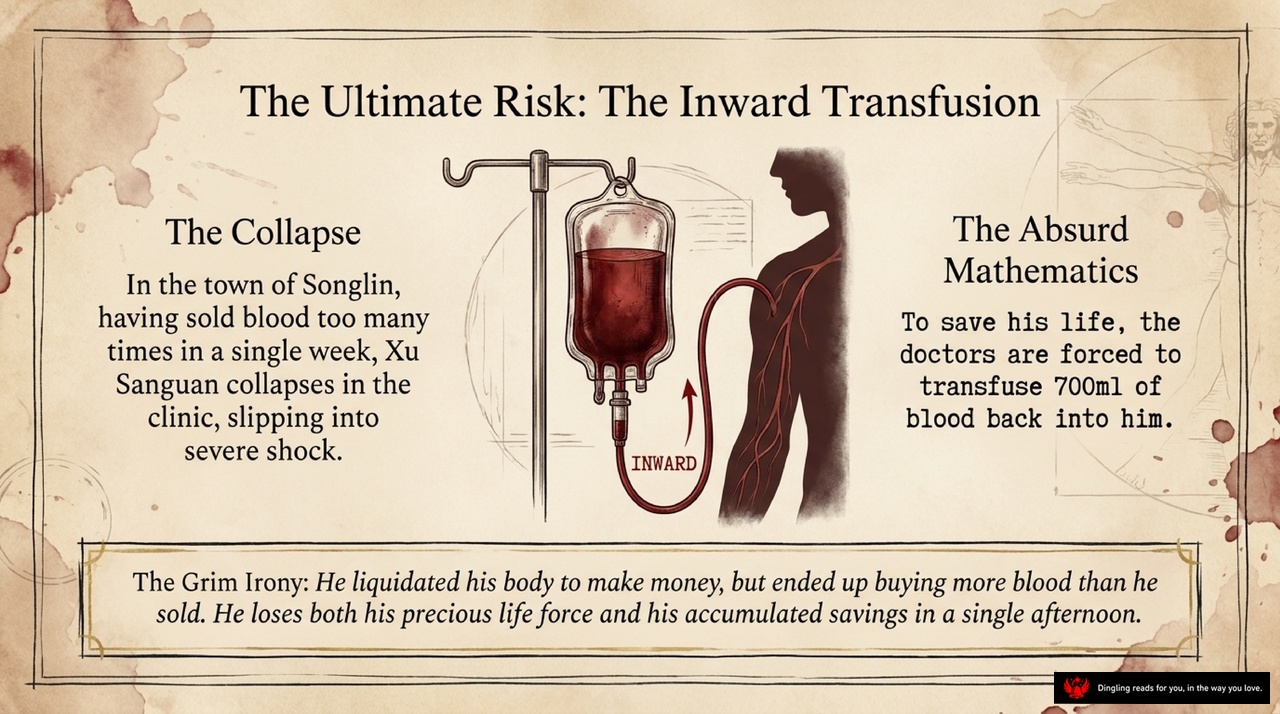
In the town of Songlin, Xu Sanguan faces his ultimate risk: the inward transfusion. After selling blood too many times in a single week, he collapses in the clinic, slipping into severe shock. To save his life, the doctors are forced to transfuse 700ml of blood back into him. It is a grim irony: he liquidated his body to make money, but ended up buying more blood than he sold. He loses both his precious life force and his accumulated savings in a single afternoon. This moment marks the tragic end of a man who spent a lifetime trying to equalize his fate with others, only to find that the very currency he traded—his blood—had finally turned against him.
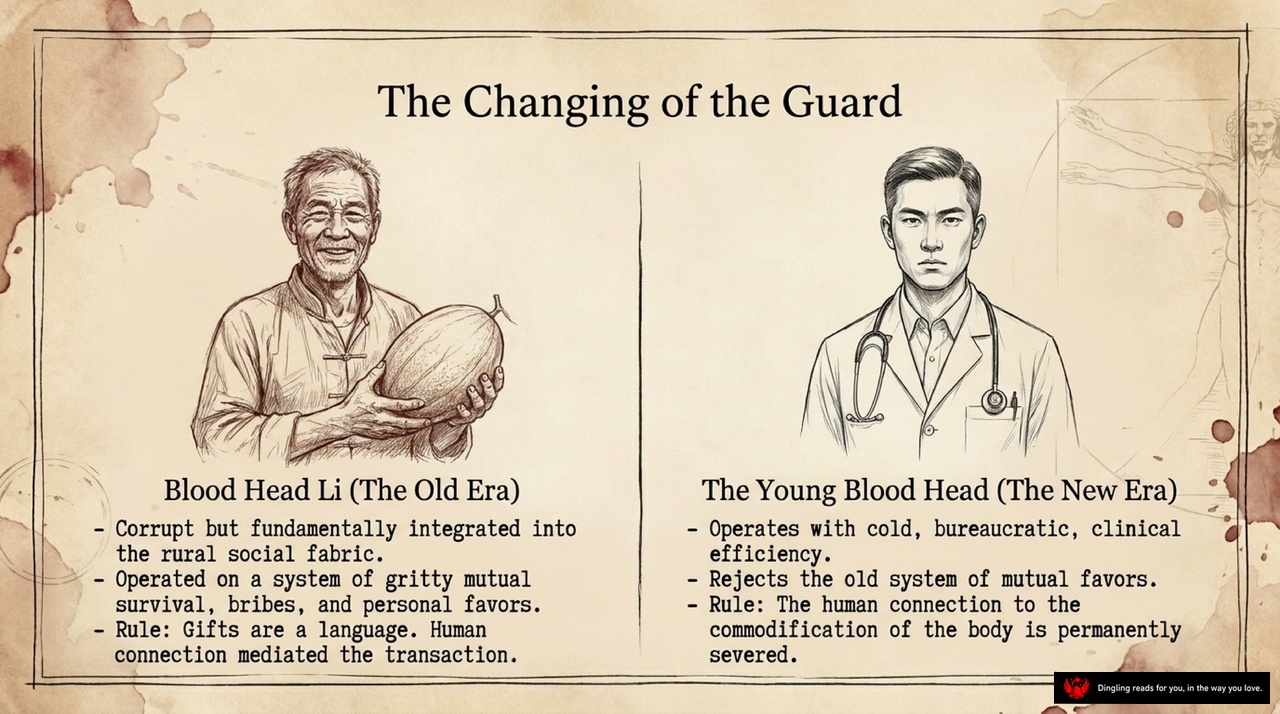
Imagine a scene where the very fabric of human connection gets torn apart by the cold light of a new era. On the left, we see Blood Head Li, the guardian of the old world. He wasn't just a businessman; he was a part of the village's social weave. He understood that a transaction wasn't just about money—it was about relationships. A melon, a few eggs, a gift of friendship; these were the currencies that made the deal work. In his time, human connection mediated every exchange.
But look to the right. This is the Young Blood Head, representing the new, clinical reality. He operates with bureaucratic efficiency, cold and detached. He rejects the old system of mutual favors entirely. His rule is absolute: the human connection to the commodification of the body is permanently severed. In his eyes, blood is just a product, and the person selling it is invisible.
This shift from the old, gritty mutual survival to this new, sterile efficiency marks a profound "Changing of the Guard." It's the moment where empathy was replaced by procedure, and where the warmth of a shared meal was swapped for the cold logic of a ledger.

In his sixties, Xu Sanguan finally sees his family prosper. After years of hard work and sacrifice, he deserves a little reward. He decides to sell his blood one last time, just to treat himself to a plate of pork liver and a cup of warm yellow wine. It feels like a rightful celebration, a final gift to himself after so many years of giving.
But the rejection hits him harder than any physical pain ever could. The young Blood Head, once a figure of authority, now looks at him with cold disdain. He tells Xu Sanguan bluntly that his blood is too old, filled with "dead blood," and useless for anything valuable. It's now only fit for a painter to use as lacquer for wooden furniture.
Xu Sanguan wanders the streets weeping, not because he lacks money. The real devastation is the realization that his absolute, fail-safe tool of survival—his own physical utility—is now completely worthless. For decades, his blood was the currency that bought food, saved lives, and kept his family afloat. Now, the world has moved on, and he is left behind, his body no longer a resource but a burden. This final refusal strips away his dignity, leaving him with a profound and crushing truth about his place in a changing world.
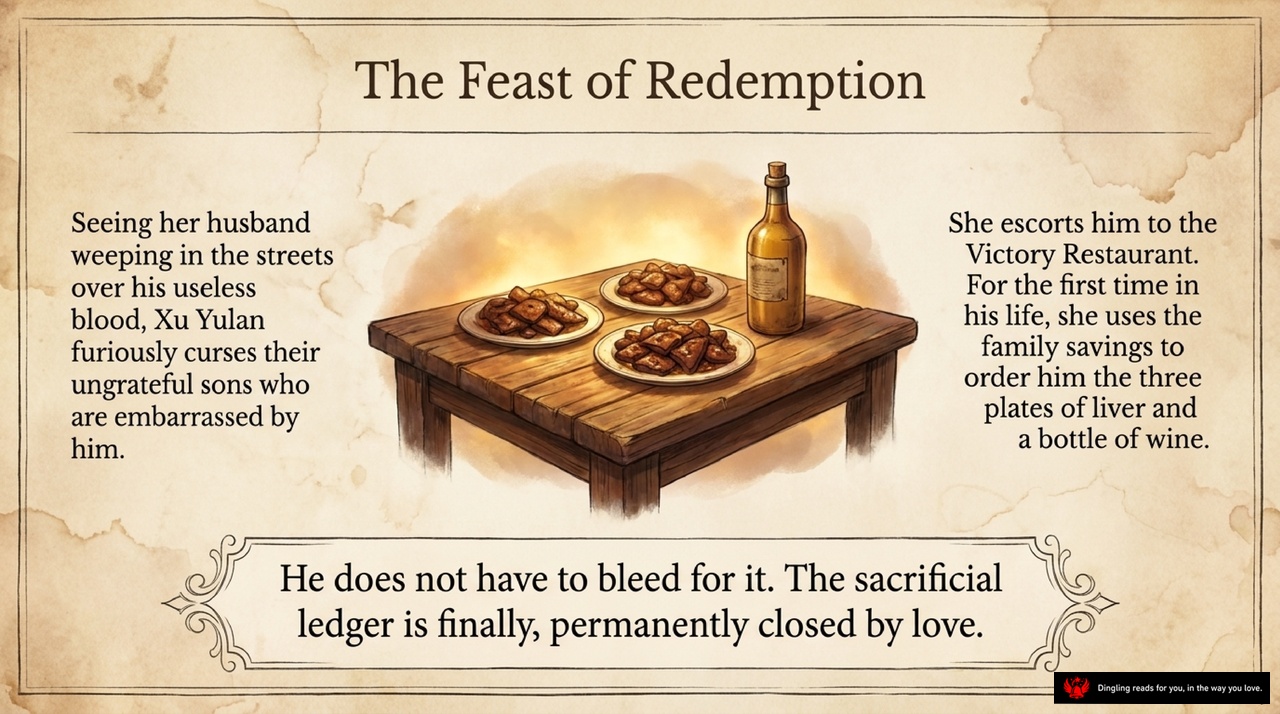
Seeing her husband weeping in the streets over his useless blood, Xu Yulan fiercely curses their ungrateful sons who are embarrassed by him. She escorts him to the Victory Restaurant. For the first time in his life, she uses the family savings to order him the three plates of liver and a bottle of wine. He does not have to bleed for it. The sacrificial ledger is finally, permanently closed by love.
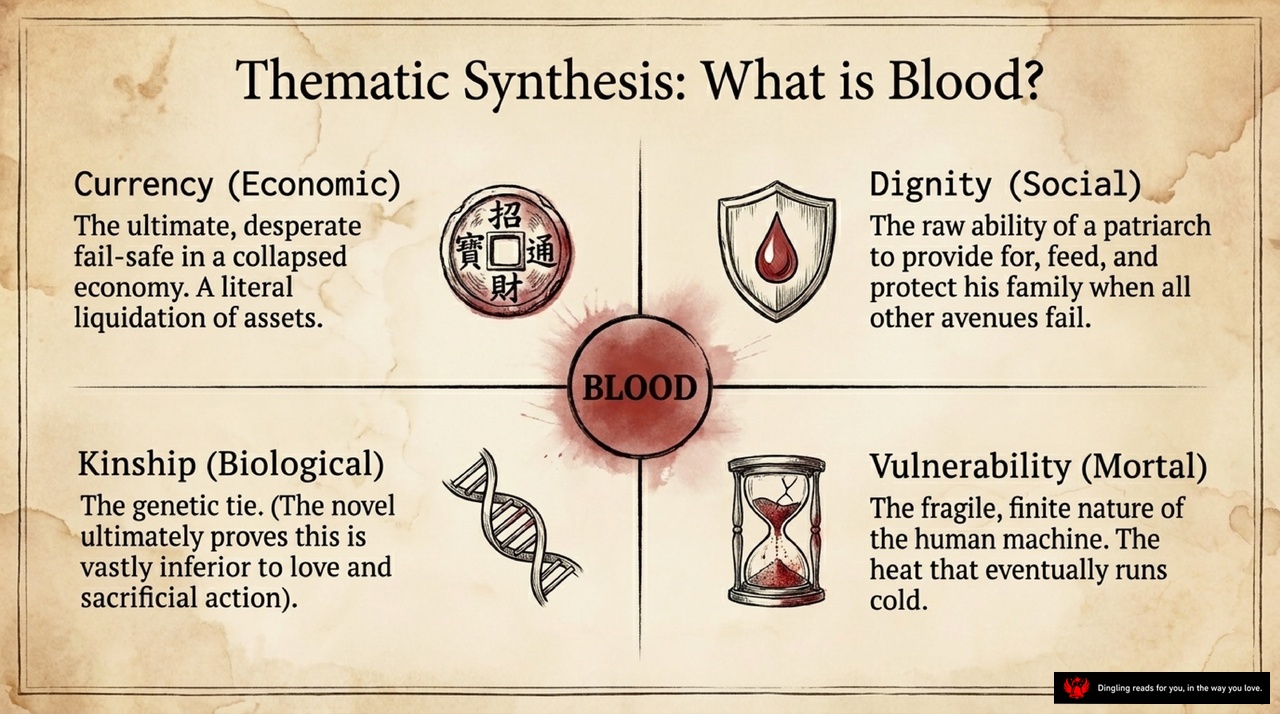
Thematic Synthesis: What is Blood?
Today we're unpacking the core of our story by asking a simple, heavy question: What is blood? In this novel, blood isn't just a red fluid; it's the currency of survival, the shield of dignity, the thread of kinship, and the timer of our mortality.
Let's look at these four dimensions. First, as **Currency**, blood is the ultimate fail-safe. When the economy collapses, it becomes a literal liquidation of assets—the desperate price a father pays to feed his family. Second, as **Dignity**, it represents the raw ability of a patriarch to provide and protect. When all other avenues fail, selling blood is the only way to maintain his role as the provider. Third, we have **Kinship**. Biologically, blood ties us together, but the story ultimately proves that genetic ties are vastly inferior to the power of love and sacrificial action. Finally, there is **Vulnerability**. Blood reminds us of our fragility; it is the finite nature of the human machine. It is the heat that eventually runs cold.
Xu Sanguan's life is a testament to all four. He sells his blood to buy a wife, to feed his sons during the famine, and to save his son's life. Yet, in the end, he realizes that while blood can save your body, it cannot buy back time or erase the past. It is the fragile, finite nature of the human machine, and the heat that eventually runs cold.

This is the final, most poignant chapter. Xu Sanguan, the man who spent his entire life selling his blood to save his family, finally faces a cruel twist of fate. He walks into the hospital, expecting to buy a little peace of mind with his own life force, only to be told by the young blood head that his blood is now too old, too "thick," to be useful. The man who once traded his very essence for his children's survival is now rejected by the very system he relied on. It's a devastating moment of irony: the ultimate sacrifice is no longer valued.
But here is where the story truly transcends tragedy into something deeply human and American in its spirit. Xu Sanguan doesn't collapse in despair. Instead, he turns to his three sons—the very people he fed with his blood. He realizes that the debt of love isn't paid back with currency, but with presence. His wife, Yu Sanyuan, sees this and immediately takes charge. She doesn't ask for money; she asks for a moment of shared dignity. They walk to the Victory Restaurant, not to buy food for the family, but to buy *himself* a meal. Three plates of stir-fried pork liver and warm yellow wine. It's a small, quiet rebellion. In a world that told him his value had expired, they prove that his value was never in his blood, but in the love he gave. It's a powerful reminder that while we can sell our bodies, we can never sell the meaning of our lives.