
Clear Joy In The Human Realm: Complete Chapter-by-Chapter Summary
Good morning. Today, we begin our journey into a world of quiet joy.
Look at this breathtaking landscape before us. Mist rolling over the mountains, soft light breaking through the dawn, and a profound sense of peace filling the air. This image captures the essence of Lin Qingxuan's masterpiece, *Clear Joy in the Human Realm*.
What does it mean to find "clear joy" in our lives? It is not about grand celebrations or material wealth. It is about the simple, unadulterated pleasure of being alive. It is the taste of fresh tea, the scent of wildflowers, or the silence between two friends. It is a joy that comes from within, untouched by the noise and chaos of the modern world.
In our fast-paced lives, we often chase after things that never satisfy us. We forget that true happiness lies in the present moment, in the simplicity of nature, and in the depth of our own hearts. Let us take a moment to breathe, to still our minds, and to rediscover that inner peace that is waiting for us all.

Look at this slide. On the left, we see "The Modern Pursuit," defined by Turbidity. On the right, "The Path of Qinghuan," defined by Clarity. This isn't just about aesthetics; it's a direct comparison of how we live, eat, connect, and think today versus how we could live.
Let's look at the environment. The modern side is drowning in endless noise, asphalt, and the relentless roar of machines. It's a constant assault on our senses. In contrast, the Qinghuan path offers pure silence, the scent of wild ginger flowers, and unpaved paths. It's a return to nature, where the air is clean and the noise is optional.
Now, look at sustenance. Our modern diet is over-seasoned, heavily oiled, and filled with artificial flavors. We are eating for excess, not for nourishment. The Qinghuan approach is radically different: the natural, subtle fragrance of spring bamboo shoots and wild greens. It's about appreciating the true, unadulterated taste of food, finding joy in simplicity rather than abundance.
Social connection is where the gap widens. We are trapped in crowded rooms, engaging in transactional networking and deafening entertainment. We are too busy to actually talk to anyone. The Qinghuan model suggests sitting silently with a friend over a single cup of tea, requiring no words at all. It's about presence and deep understanding without the need for performance.
Finally, the mindset. We are obsessed with accumulation, mistaking the accumulation of things for happiness. But the Qinghuan mindset pursues simplicity. It's about finding profound flavor in the mundane, realizing that true contentment comes from letting go, not from holding on.
This slide challenges us to ask: Are we building a life of turbidity, or are we quietly cultivating a path of clarity?
Master Wuji's Heart Prescription: A Modern Love Letter to Your Soul
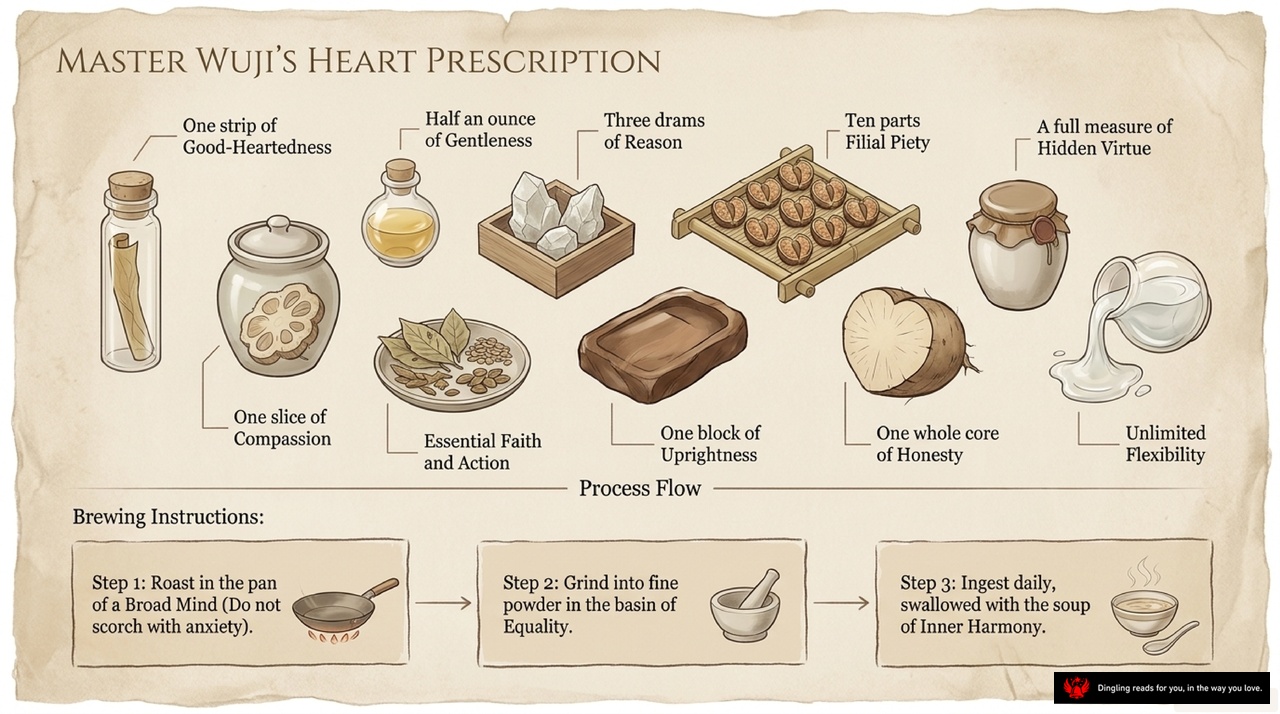
Imagine your heart as a pharmacy, and the cure for a chaotic life isn't a pill, but a recipe. Today, we're brewing "Master Wuji's Heart Prescription," a ten-ingredient elixir designed to heal the modern soul.
Look at the ingredients scattered across this parchment. It's not about chemical compounds; it's about character. We need one strip of Good-Heartedness and a full slice of Compassion to soften our edges. We need Half an ounce of Gentleness and Three drams of Reason to keep us from reacting impulsively. But the heavy lifters are Ten parts Filial Piety and One whole core of Honesty—these are the anchors that hold us steady when the world spins too fast. And let's not forget Essential Faith, One block of Uprightness, and Unlimited Flexibility. These aren't abstract concepts; they are the daily vitamins we desperately need to stop feeling broken.
But here's the twist: how do you take this medicine? You don't swallow a pill. You have to cook it yourself.
First, we roast it in the pan of a Broad Mind. Think about that. The heat shouldn't come from anxiety or rushing. We need to process our goodness with patience, letting the virtues simmer without burning out. Then, we grind it all into a fine powder in the basin of Equality. This is the hard part. We have to mix our high standards with our low moments, treating everyone and every situation with the same level of respect. No judging, no ranking. Just pure, equal understanding.
Finally, we form the pills using the six perfections—generosity, ethics, patience, diligence, meditation, and wisdom. We take one dose every day, washed down with the soup of Inner Harmony.
Why does this matter now? Because we are living in a world that sells us "more." More stuff, more speed, more noise. But Master Wuji tells us that true healing comes from "inner completeness." If we can genuinely embody these ten ingredients, if we can truly be kind, honest, and flexible, we stop needing external validation. We stop the internal war.
So, I challenge you: don't just look at this image. Start your day by checking your "inventory." Do you have enough gentleness? Is your honesty intact? Are you willing to be flexible? Your life is your pharmacy, and you are the pharmacist. Let's brew a heart that can handle anything.
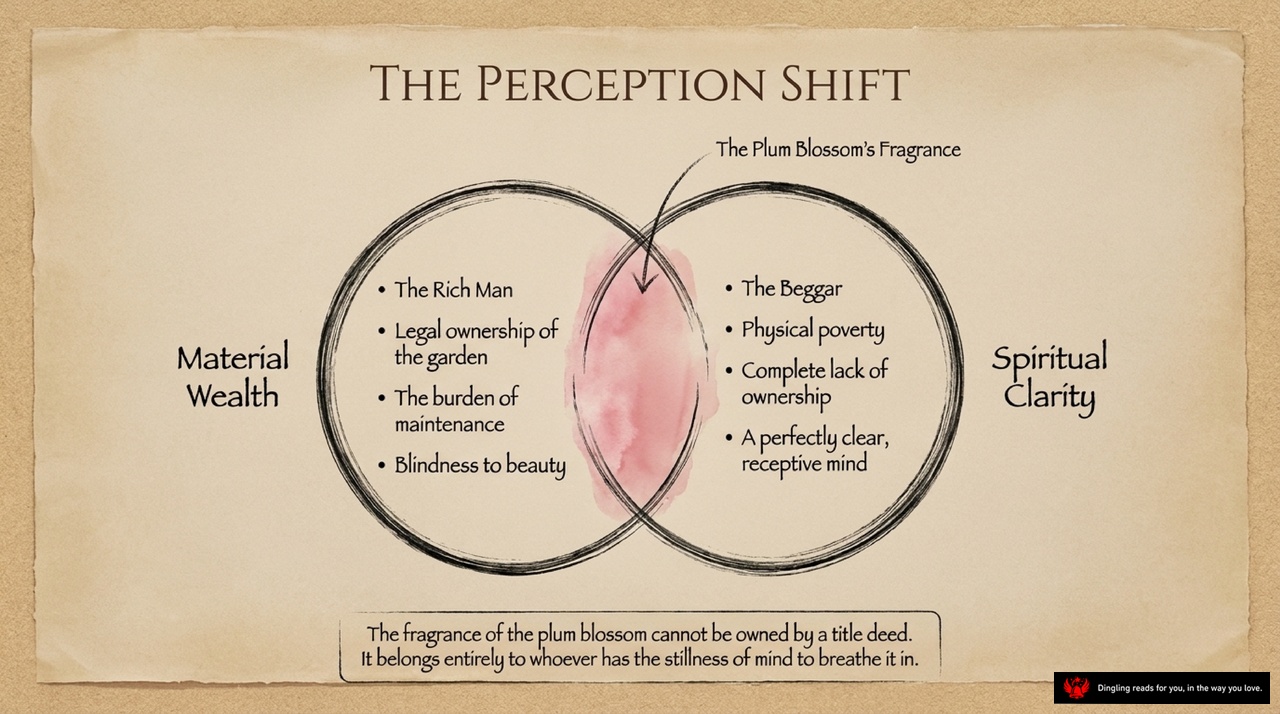
Imagine a world where the most profound wisdom isn't found in grand gestures or expensive artifacts, but in the quietest moments of our daily lives. This slide illustrates a powerful shift in perception: the difference between "Material Wealth" and "Spiritual Clarity."
On the left, we see the trap of material ownership. Think of the "Rich Man" who holds legal title to a garden. He has the land, but he also carries the heavy burden of maintenance. Worse, this focus on possession often blinds him to the true beauty of the garden itself. He owns the soil, but he misses the bloom.
On the right, we find the paradox of spiritual clarity. Consider "The Beggar." While they face physical poverty and a complete lack of ownership, they possess something the rich man never can: a perfectly clear, receptive mind. Because they have nothing to lose or protect, their heart is open to the world.
The magic happens in the intersection—the pink overlap where these two circles meet. This is where "The Plum Blossom's Fragrance" lives. As the text at the bottom reminds us, the fragrance of the plum blossom cannot be owned by a title deed. It belongs entirely to whoever has the stillness of mind to breathe it in.
This is the core lesson: true richness isn't about what you hold, but what you can perceive. A wealthy person can be spiritually bankrupt, blind to the beauty right in front of them. A person with nothing can be spiritually rich, fully experiencing the miracle of existence. The shift from ownership to perception is the key to unlocking a life of genuine freedom and joy.

Imagine holding a mirror that reflects everything perfectly—roses, filth, clouds, and green fields—without judgment. That is the essence of a soft, clear heart. But what happens when that mirror gets dirty? Suddenly, the world looks distorted. A dirty mirror sees filth where there is beauty; a broken mirror sees chaos where there is order. This is the trap we all face: our perception of reality is entirely dependent on the state of our own mind.
In our modern world, we often treat our minds like mirrors that need to be polished by external forces, by others' opinions, or by material success. But true wisdom isn't about changing the world to fit our image; it's about cleaning the mirror so we can see the world as it truly is. The text reminds us that a compassionate, soft heart is the source of all clarity. It allows us to be sensitive enough to feel the fall of a petal, generous enough to understand another's struggle, and refined enough to find joy in the smallest details.
Think about your own life. When was the last time you felt truly unburdened? When your heart was so soft that you could let go of old grudges or fears? That softness is not weakness; it is the most powerful force available to us. It is the seed of enlightenment, the spring of clarity. Just as a clear lake reflects the sky without resistance, a soft heart reflects life without distortion. So, let's choose to keep our mirrors clean. In the midst of a noisy, chaotic world, let us cultivate that inner softness. When we do, we don't just see the world better; we become the world's most gentle, healing presence.

Have you ever watched a flower, truly watched it? Or did you just glance at it, letting your own thoughts and projections bounce off its petals? Today, we're diving into the profound art of "watching flowers," a concept that transforms how we see the world and ourselves.
The slide in front of us contrasts two very different ways of observing. On the left, we have "Ordinary Observation," labeled as "Draining." Look at that eye—it's bright, intense, and pushing outward. It's projecting its own energy onto the flower, trying to grasp the external world. In this mode, we are leaking our spiritual energy, exhausting ourselves just to understand what is right in front of us. We are the ones doing all the work, and the flower remains passive.
Now, look at the right side: "Mindful Observation," or "Absorbing." Notice the shift. The energy flows in the opposite direction. Instead of the eye pushing out, the flower's essence is flowing into the observer. This is about receiving the universe. We stop trying to control or analyze and instead allow the external world to nourish our inner self. We draw in the beauty, the stillness, and the life of the flower, letting it fill us up rather than us draining it.
The text at the bottom captures this perfectly: "The art of watching flowers is not about staring hard, but about becoming still enough to let the flower's energy enter you." It's a gentle reminder that true connection isn't about forceful looking, but about quiet presence. When we stop the noise in our minds and become still, we don't just see a flower; we experience its wisdom. We move from being a consumer of experiences to a participant in life itself. So, the next time you see something beautiful, try not to stare at it. Instead, soften your gaze, breathe, and let the moment enter you. That is the secret to finding peace in a busy world.

Look at this broken porcelain spoon. It's shattered into pieces, yet the image of a lotus flower remains vivid on every fragment. This visual tells us the core theme of today: The Acceptance of Destruction.
We often fear breaking, but the journey of this spoon reveals a profound truth about life. It starts with **Phase 1: The Gathering of Causes**. Just like mud and fire temporarily coalescing to create the spoon, our lives are built from various elements that come together from the void. We hold onto things, assign them emotional value, and forget their fundamental fragility. This is **Phase 2: The Illusion of Permanence**. We act as if the spoon will last forever, but eventually, the inevitable break happens.
But here is the shift in perspective: **Phase 3: The Return to Void**. The break isn't a tragedy; it is simply the clay returning to its original state. It is the natural cycle of existence. The core takeaway is clear: Do not wait for the break to let go. Cherish the spoon completely now, while understanding that it is already broken. True wisdom lies in accepting that nothing is permanent, and finding peace in the inevitable return to the void.
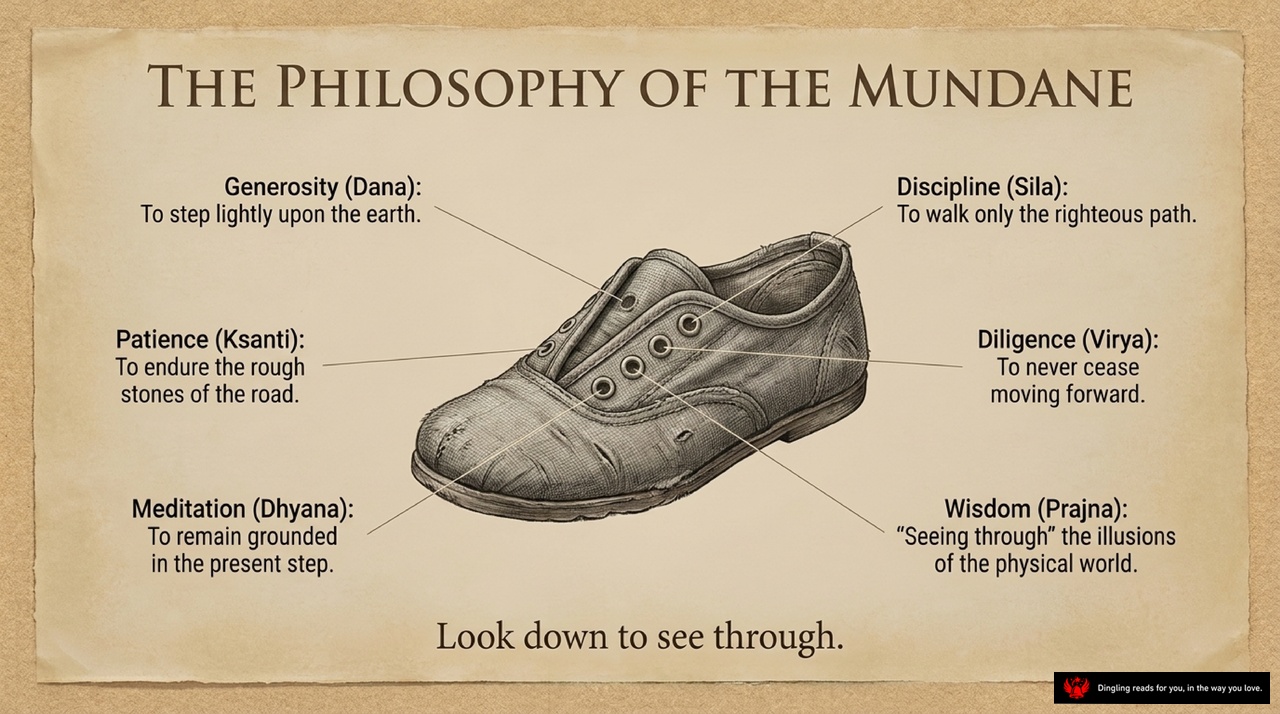
Look down to see through. This image beautifully maps the philosophy of the mundane onto a simple, worn shoe, reminding us that the path to enlightenment isn't found in grand gestures, but in how we walk our daily steps.
The shoe represents our journey through life, and each part of it embodies a core virtue. Notice the laces labeled with **Diligence** and **Discipline**. These remind us that the path is long and requires constant movement, never ceasing to advance, while walking only the righteous path. Then, look at the sole, grounding us with **Generosity** and **Patience**. True generosity is stepping lightly upon the earth, not leaving heavy footprints of ego, while patience is the strength to endure the rough stones on the road without complaint.
At the heel, we find **Meditation**, the practice of remaining grounded in the present step, and at the toe, **Wisdom**, which allows us to see through the illusions of the physical world. The text at the bottom, "Look down to see through," captures the essence perfectly. Just as we often look up for distant goals, true clarity comes from looking down at our immediate actions. When we treat every step with these six qualities, the ordinary act of walking transforms into a profound spiritual practice.

Have you ever felt that the world is drowning in a million different reflections, making it impossible to find the one thing that feels truly real?
Today's image, titled "The Locus of Truth," captures this exact feeling. It shows a single, bright moon hanging in the sky, while below, a thousand rivers and a cup of water hold a thousand different reflections. The text reminds us: "A thousand rivers hold a thousand reflections, but there is only one moon."
This is a powerful metaphor for how we experience life. The sky represents the singular, absolute truth—the unchanging reality that connects us all. But the waters below represent our endless, chaotic variations of human experience and perception. Sometimes, our minds are like turbulent rivers, swirling with anxiety, noise, and confusion. We spend all our time chasing these shifting reflections, trying to find happiness or meaning in the noise, only to feel lost.
The insight here is simple but profound: Stop chasing the reflections in the turbulent waters of the world. Instead, look up. Realize that the moon shining in your cup, in the river, and in the sky is actually the same moon. It is already shining from within your own heart.
We often forget that the truth isn't out there in the chaos; it's right here, clear and bright, waiting for us to stop the noise and simply look up.
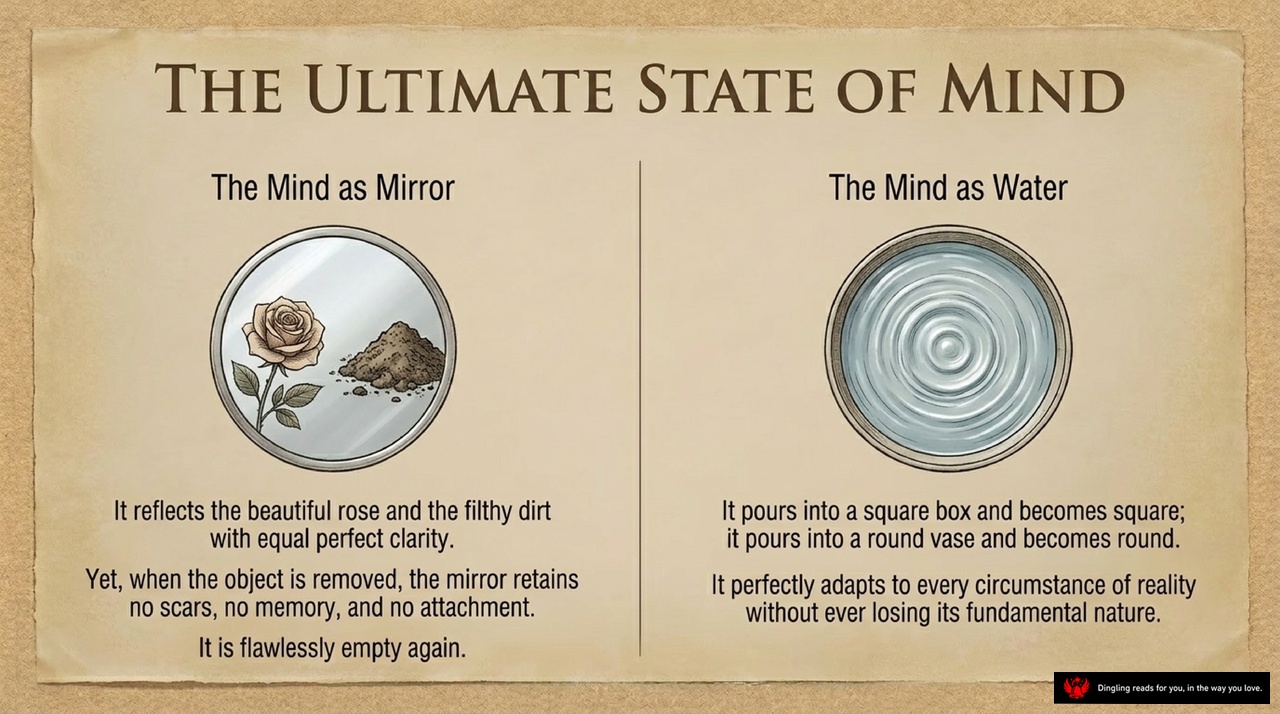
Have you ever felt that your mind is like a mirror? It reflects everything perfectly—the most beautiful rose and the filthiest dirt—with equal clarity. But here is the secret: once the object is removed, the mirror remains flawless. It holds no scars, no memories, and no attachment. It simply returns to a state of empty, perfect clarity.
Now, imagine your mind is like water instead. Water is incredibly adaptable. Pour it into a square box, and it becomes square; pour it into a round vase, and it takes on a round shape. Yet, no matter how much it changes its form to fit reality, it never loses its fundamental nature as water.
This slide, titled "The Ultimate State of Mind," presents these two powerful metaphors. In our modern lives, we often try to force our minds to be rigid like a mirror, expecting it to hold onto everything, or we let our thoughts swirl like chaotic water, reacting to every external stimulus. But true wisdom lies in realizing that our mind should be both clear and fluid. Like the mirror, it observes life without clinging to the past or judging the present. Like the water, it flows effortlessly through every circumstance, adapting without losing its core essence. By embracing this dual nature, we can find a state of mind that is both grounded and free, allowing us to navigate life's ups and downs with grace and inner peace.
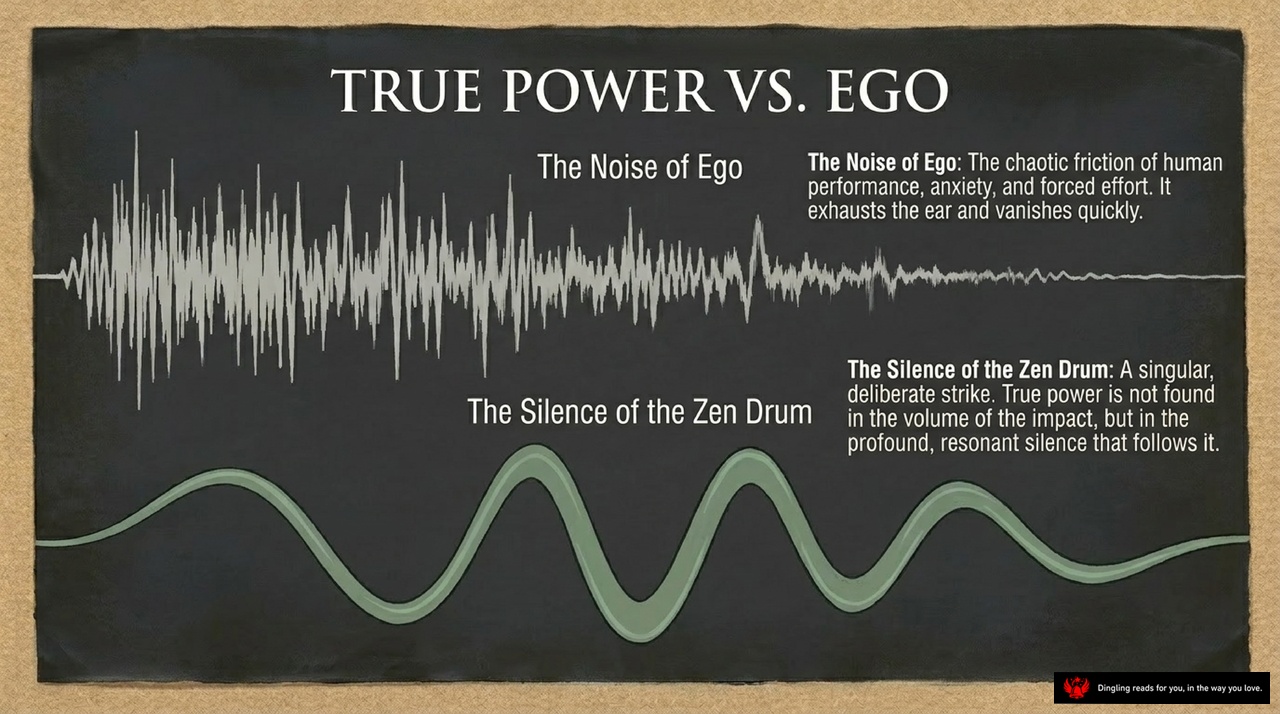
TRUE POWER VS. EGO. Look at these two waves. The top one is jagged, chaotic, and exhausting. That is the Noise of Ego. It represents the frantic friction of forced effort, the anxiety of performance, and the desperate need to be seen. It screams until it vanishes, leaving you drained and empty.
But look at the bottom wave. Smooth, rhythmic, and powerful. This is the Silence of the Zen Drum. True power isn't found in the volume of your impact, but in the profound, resonant silence that follows your action. Think about it: when you strike a drum, the sound fades, but the vibration remains. Real influence doesn't need constant noise to prove itself.
In our modern world, we are addicted to the top wave. We think power is about being loud, about forcing our way, about creating chaos. But that only exhausts us and repels others. The real secret to lasting success and peace is to master the bottom wave. It's about deliberate, singular strikes followed by a deep, intentional silence. It's the confidence that doesn't need to shout. It's the strength that allows you to stop the noise in your own head and listen to what truly matters. True power is quiet. It resonates. And it lasts.
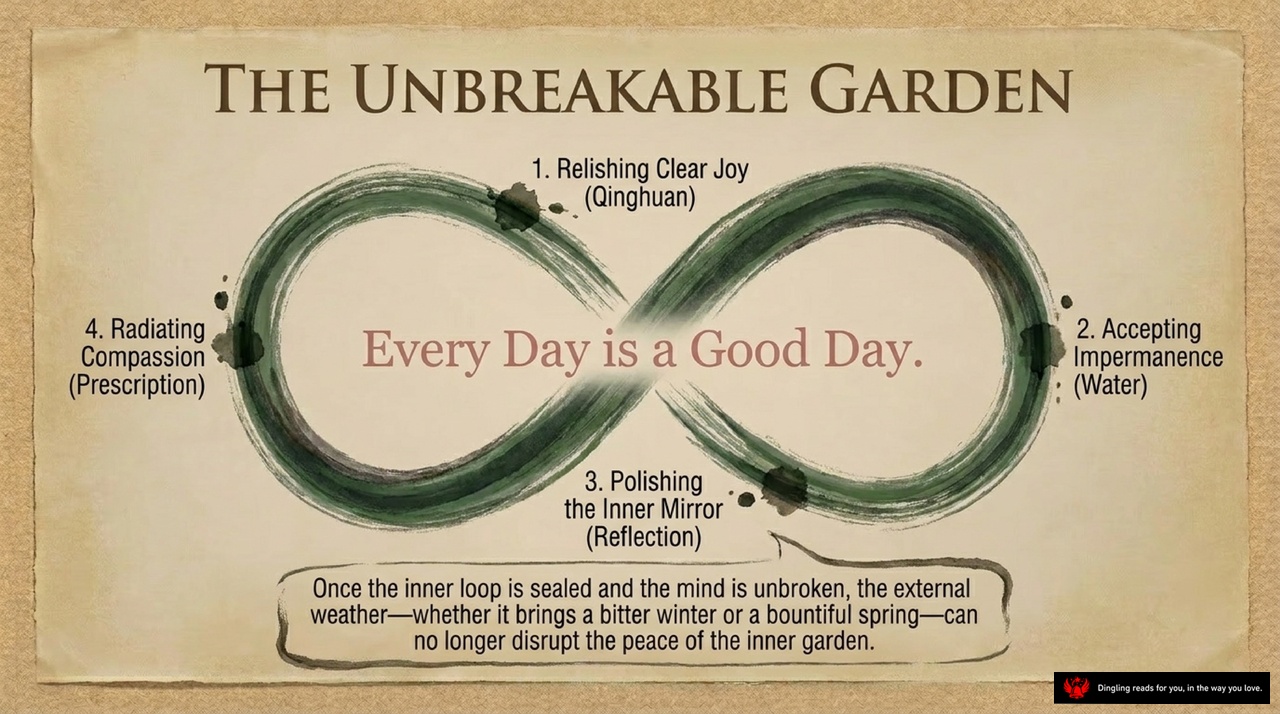
Imagine a world where the chaos outside your window—whether it's a biting winter or a bountiful spring—can no longer disrupt the peace within your heart. This is the promise of "The Unbreakable Garden," a metaphor for a mind that has been sealed and made unbreakable.
At the center of this garden lies a simple, powerful truth: Every Day is a Good Day. But how do we build this unbreakable sanctuary? The path is an endless loop of four essential practices. First, we start with Relishing Clear Joy. This isn't about grand celebrations; it's about finding deep satisfaction in the simple, quiet moments of life. It's the taste of fresh tea, the sound of birds in the wild, or the peace of a clear mind, free from the clutter of material desires.
Next, we must Accept Impermanence, symbolized by water. Just as water flows and changes shape, life is in constant flux. By embracing this flow rather than resisting it, we stop fighting reality and find freedom in the present moment.
Then comes the crucial step of Polishing the Inner Mirror. This is about reflection—clearing away the dust of our biases, judgments, and ego so we can see the world and ourselves with clarity and compassion. When our inner mirror is clean, our perception of reality transforms.
Finally, we complete the cycle by Radiating Compassion. This is the prescription for a healed life. When our inner garden is protected, our natural response to the world becomes one of kindness and empathy. We stop projecting our fears onto others and start connecting with them.
When these four elements form a sealed loop, something magical happens. The external weather, with all its storms and sunshine, loses its power to hurt us. We become the calm center of our own universe, ready to embrace whatever comes next with grace and joy.
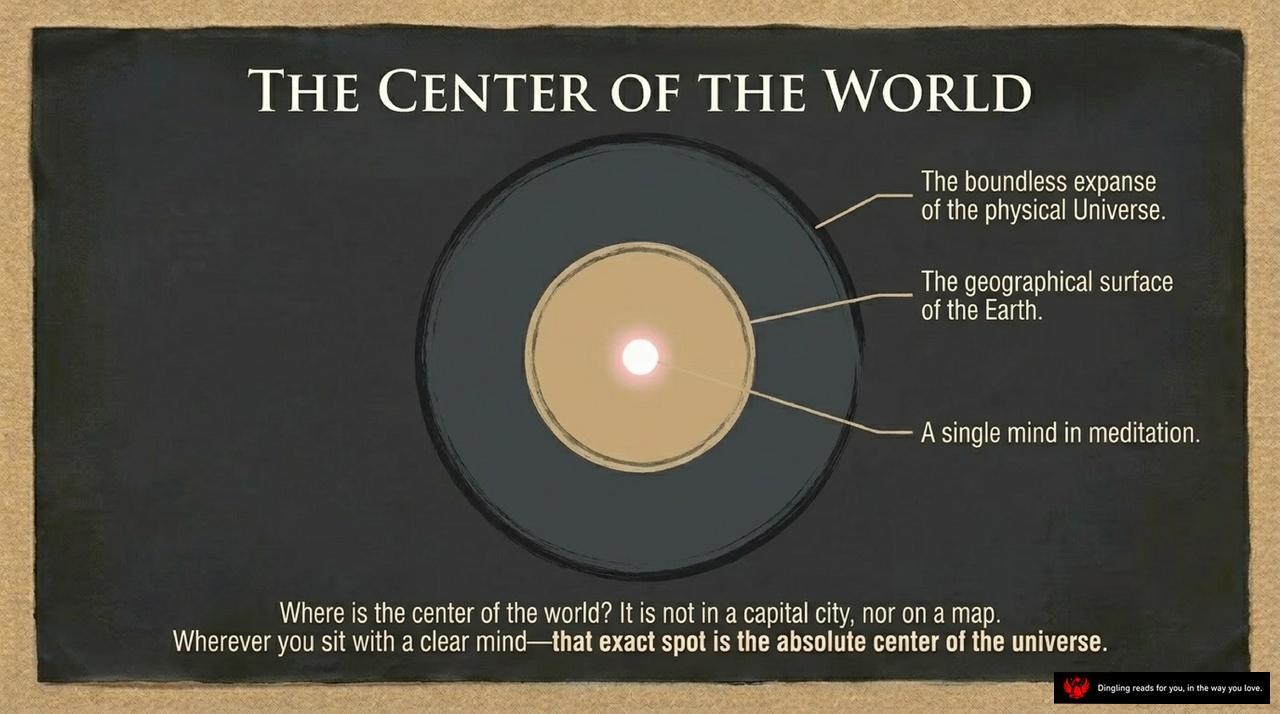
Where is the center of the world? We often look for it on maps, pointing to capitals or coordinates, but the truth is far more profound. It is not found in a city or a landmark. As the slide illustrates, the center shifts depending on your perspective. From a cosmic view, it is the boundless expanse of the physical universe. From a geographical one, it is the surface of our Earth. But from the perspective of the human experience, the true center is found within.
Imagine a single mind in meditation. That exact spot is the absolute center of the universe. When you sit with a clear mind, the noise of the world fades away, and you discover the core of existence right where you are. This realization connects us to the ancient wisdom of the "Heart Sutra," reminding us that all phenomena are empty of inherent existence. Just as the universe has no fixed center, our minds are free from fixed concepts. By letting go of our attachments and ego-driven thoughts, we find a state of pure awareness. In this silence, we realize that we are not separate from the world; we are its very center. So, stop looking outward. Turn your gaze inward. Find your center, and you will find the center of everything.
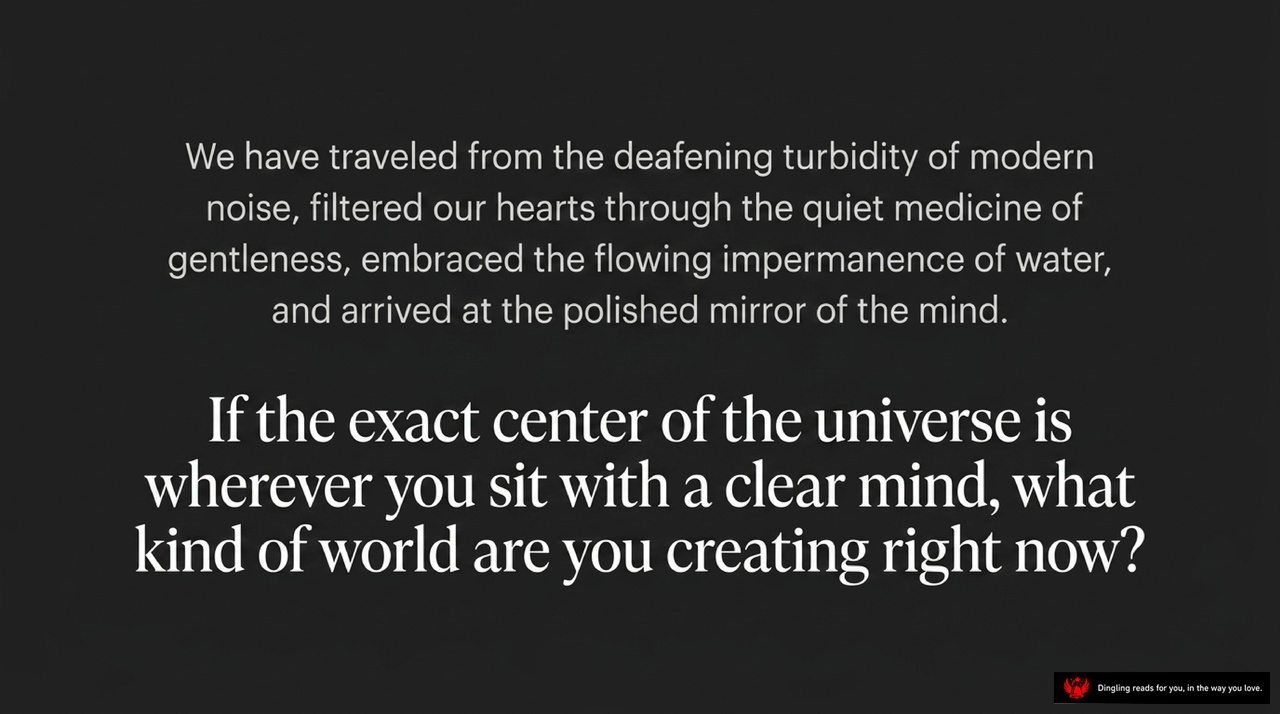
Imagine a world where the loudest sound isn't a car horn or a news alert, but the gentle rustle of a leaf. We've all traveled from that deafening, modern static to a place of quiet clarity. Think of it as filtering your heart through the medicine of gentleness, embracing the flow of life like water, until you finally arrive at a polished mirror in your own mind.
Here's a question to pause on: If the exact center of the universe is wherever you sit with a clear mind, what kind of world are you creating right now?
The answer lies in what we call "Qinghuan"—a taste for simple, quiet joy. It's not about luxury or grand gestures; it's about finding deep satisfaction in the ordinary. It's the sweet taste of wild honey, the cool breeze on your face, or the peace of watching a bird fly free. But here's the hard truth: this simple joy is vanishing.
We've lost the ability to just *be*. We're constantly chasing, constantly consuming. We've forgotten that the most profound wisdom isn't found in complex theories or expensive things, but in the silence between our thoughts and the kindness in our actions. When you stop fighting the noise and start listening to your own heart, you realize that the world you create reflects exactly who you are inside. So, take a deep breath, clear your mind, and ask yourself: What kind of world am I building with every thought I choose to keep?