
CliffsNotes on Hemingway's The Old Man and the Sea: Complete Chapter-by-Chapter Summary
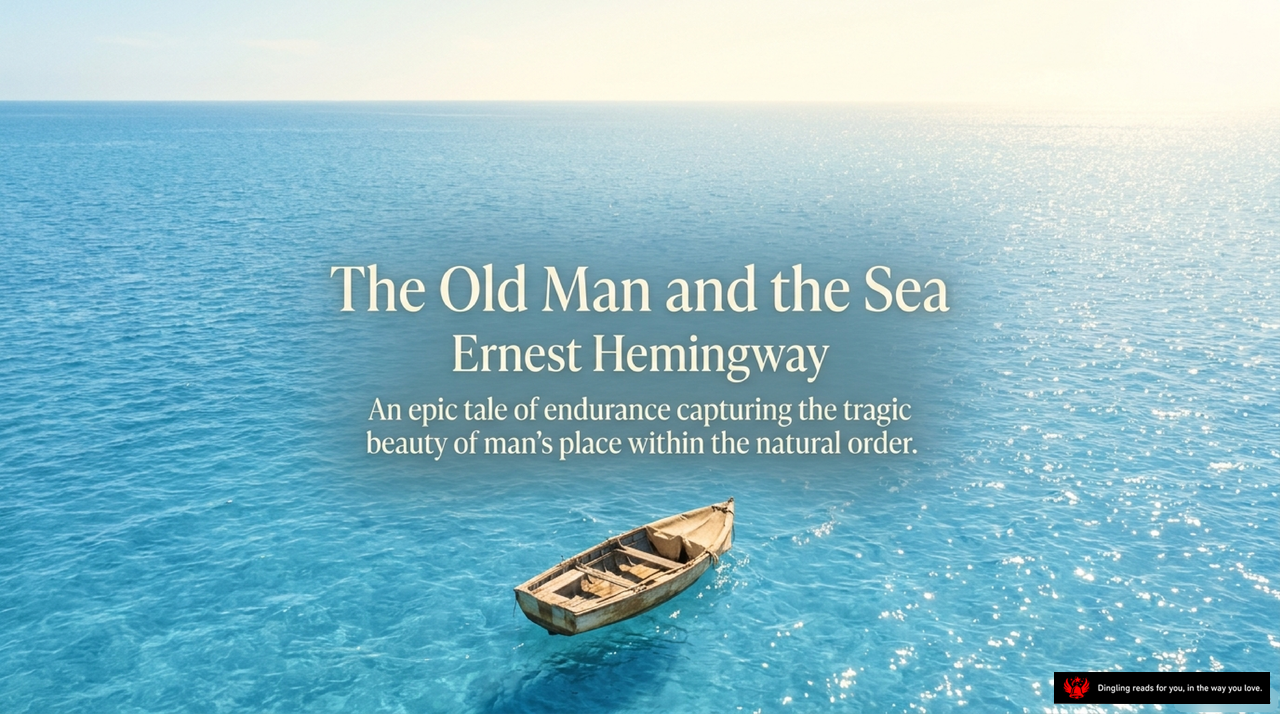
Look at this image— that tiny, weathered boat floating on the endless blue sea. It’s the perfect visual for what we’re diving into today: The Old Man and the Sea by Ernest Hemingway. This isn’t just a story about fishing; it’s an epic tale of endurance, one that captures that tragic, quiet beauty of where we fit in the natural order. Hemingway’s writing cuts straight to the heart, and we’re going to unpack every bit of that journey together. Whether you’ve read it before or are meeting it for the first time, get ready to feel the salt in the air and the weight of the old man’s struggle— it’s a story that sticks with you long after the last page.
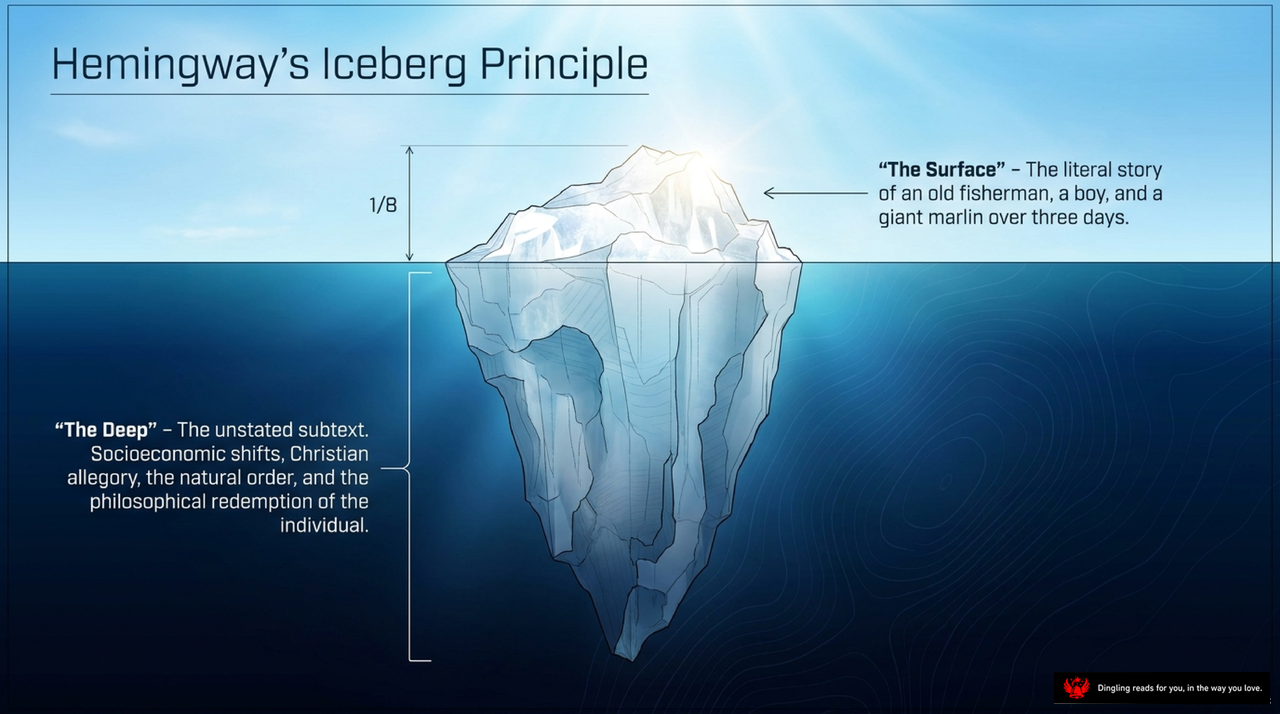
Let’s dive into Hemingway’s Iceberg Principle—because it’s not just a writing trick; it’s a way to see the hidden depth in every great story. You know how an iceberg only shows 1/8 of itself above water? The rest is submerged, holding up everything you see. That’s exactly how Hemingway approached his work.
The surface of his stories is the straightforward stuff—like the three-day journey of an old fisherman, a young boy, and that giant marlin we all remember from *The Old Man and the Sea*. But the real weight? It’s in the deep, unstated subtext below. That’s where you find the bigger ideas: socioeconomic shifts that shape the characters’ world, Christian allegories (think of the fisherman’s struggle as a quiet spiritual quest), the natural order of life and death, and even the quiet redemption of someone who refuses to give up, no matter the odds.
Hemingway didn’t spell every theme out. He let us dig for those layers ourselves. He trusted that we’d notice the little things—the fisherman’s stubborn hope, the boy’s loyalty—and connect them to the deeper truths about resilience, faith, and what it means to be human. That’s why his stories stick with us long after we turn the last page: they’re not just tales—they’re mirrors that make us think about the hidden parts of our own lives, too.
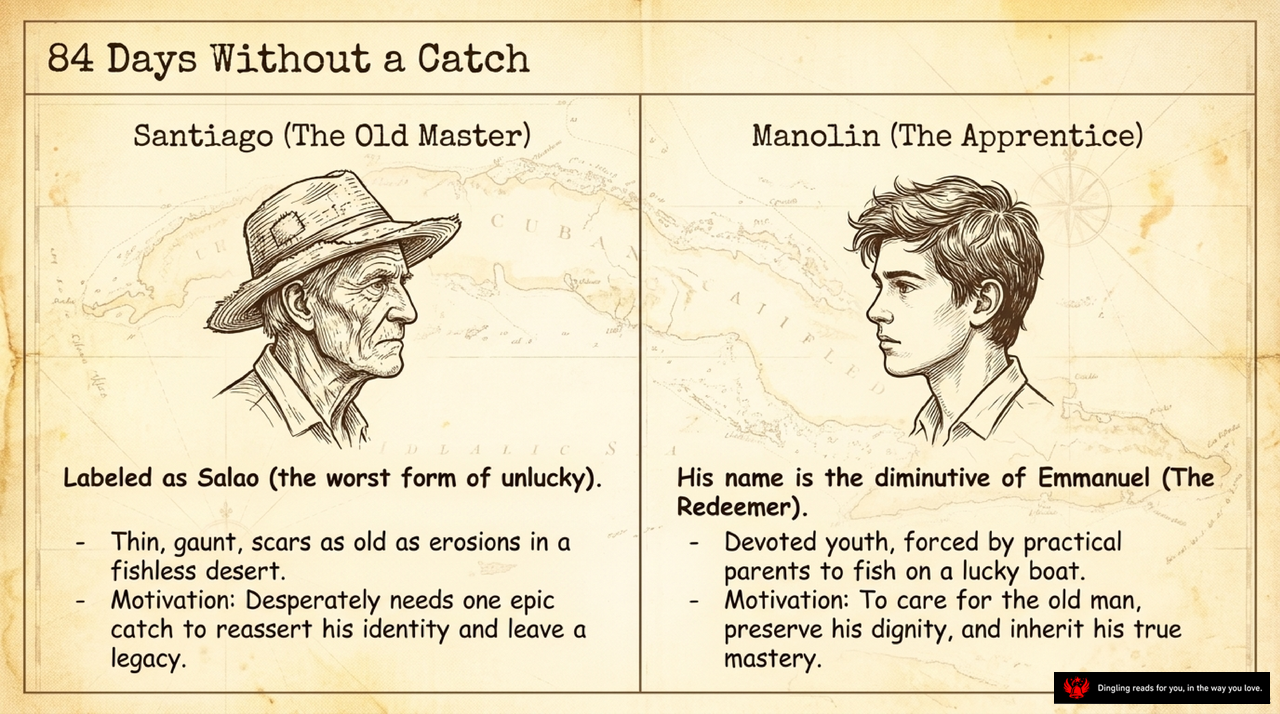
84 days without a catch—think about that for a second. For a fisherman who’s spent his whole life on the water, that’s more than a bad run; it’s a reputation killer. In Santiago’s small Cuban village, everyone’s already labeled him salao—the worst kind of unlucky you can be.
But Santiago isn’t just some old guy who’s lost his touch. Look at him: thin, gaunt, his face lined like the hull of an old boat, scars on his hands that look like erosion in a fishless desert. Those scars tell stories—of battles with marlins, of storms that almost took him under, of years and years of showing up even when the sea didn’t give back. Right now, he’s desperate for one thing: an epic catch. Not just to feed himself, but to reassert who he is—The Old Master. He wants to leave a legacy that says he didn’t go out quietly; he went out fighting.
Then there’s Manolin, the apprentice. His name’s a diminutive of Emmanuel—meaning “The Redeemer”—and that’s no coincidence. His parents, practical as they are, made him switch to a luckier boat (84 days is a long time to go without bringing home anything). But Manolin can’t stay away. He still brings Santiago coffee every morning, helps him fix his nets, sits with him and listens to his tales of the great fish he once caught. His motivation isn’t about getting lucky; it’s about caring for the old man, keeping his dignity alive, and learning the real art of fishing—the stuff that doesn’t depend on luck. He’s the one who’ll inherit Santiago’s true mastery, the lessons that go beyond just catching fish.
These two are tied together—Santiago’s fight to prove himself, Manolin’s fight to hold onto the man he admires. And those 84 days? They’re just the calm before the storm. What happens next is the stuff of legends.

Let’s dive into the socioeconomic rift in Cuban fishing culture—because it’s not just about catching fish; it’s about two totally different ways of seeing the world and making a living.
On one side, you’ve got the Traditionalists, folks like Santiago from Hemingway’s *Old Man and the Sea*. They refer to the sea as “la mar”—a feminine force: beautiful, unpredictable, subject to nature’s whims. To them, the ocean isn’t something to dominate; it’s a partner to respect. Their methodology? Exact craftsmanship—keeping lines perfectly straight, using skills passed down through generations, no fancy gadgets here. And why do they fish? It’s a spiritual vocation. They see themselves as part of the natural order, not just trying to make a quick buck.
Then there’s the younger generation—the Pragmatists. For them, the sea is “el mar”—a masculine contestant, even an enemy to conquer. They’re all about modern tools: motors, buoys, purchased tech that gives them an edge in catching more fish faster. And their motivation? Pure profit. They’re supplying shark livers to foreign industries, turning fishing into a business rather than a way of life.
This split isn’t just about age—it’s about economics and values. The Traditionalists hold onto old ways, while the Pragmatists adapt to a changing world where making money often takes priority over tradition. It’s like comparing a hand-carved wooden boat to a high-tech trawler—same ocean, but totally different approaches. You can see it in the gear they use, the words they use to describe the sea, and why they wake up at dawn to cast their lines. It’s a story of two cultures coexisting, but also pulling in opposite directions—each with their own vision of what fishing should be, and what it means to be a fisherman in Cuba today.
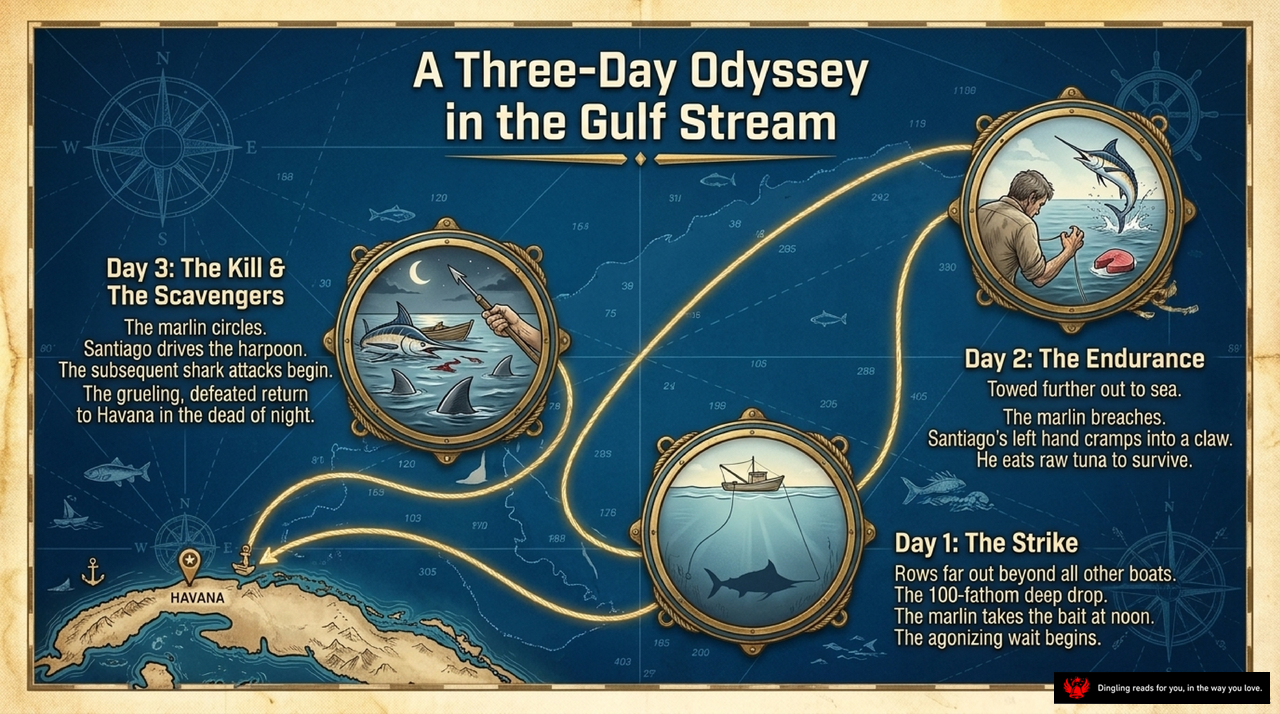
Let’s walk through Santiago’s three-day battle in the Gulf Stream, shall we? Day one starts with him rowing way beyond all the other boats—way out where the water’s 100 fathoms deep. He drops his line, and by noon, that giant marlin takes the bait. But this isn’t a quick catch; the agonizing wait begins right then.
Day two? Things get real. The marlin’s so strong it tows him even further out to sea. Santiago watches as the marlin breaches—jumps out of the water, showing off its massive size. But his left hand cramps up like a claw, and he’s got to chow down on raw tuna just to keep his strength up.
Then day three rolls around: the marlin finally starts circling, and Santiago drives the harpoon straight into it. But victory doesn’t last long—sharks catch a whiff of the blood and swarm in, attacking the marlin. By the time he makes it back to Havana in the dead of night, it’s a grueling, defeated return… but let’s be real, he never gave up. This three-day odyssey isn’t just about a fish; it’s about that fire inside you that keeps you going even when everything feels like it’s falling apart. You fight, you persist, and even if the end doesn’t look like you hoped, you walk away knowing you gave it your all. That’s the heart of this story—resilience when the odds are stacked against you.
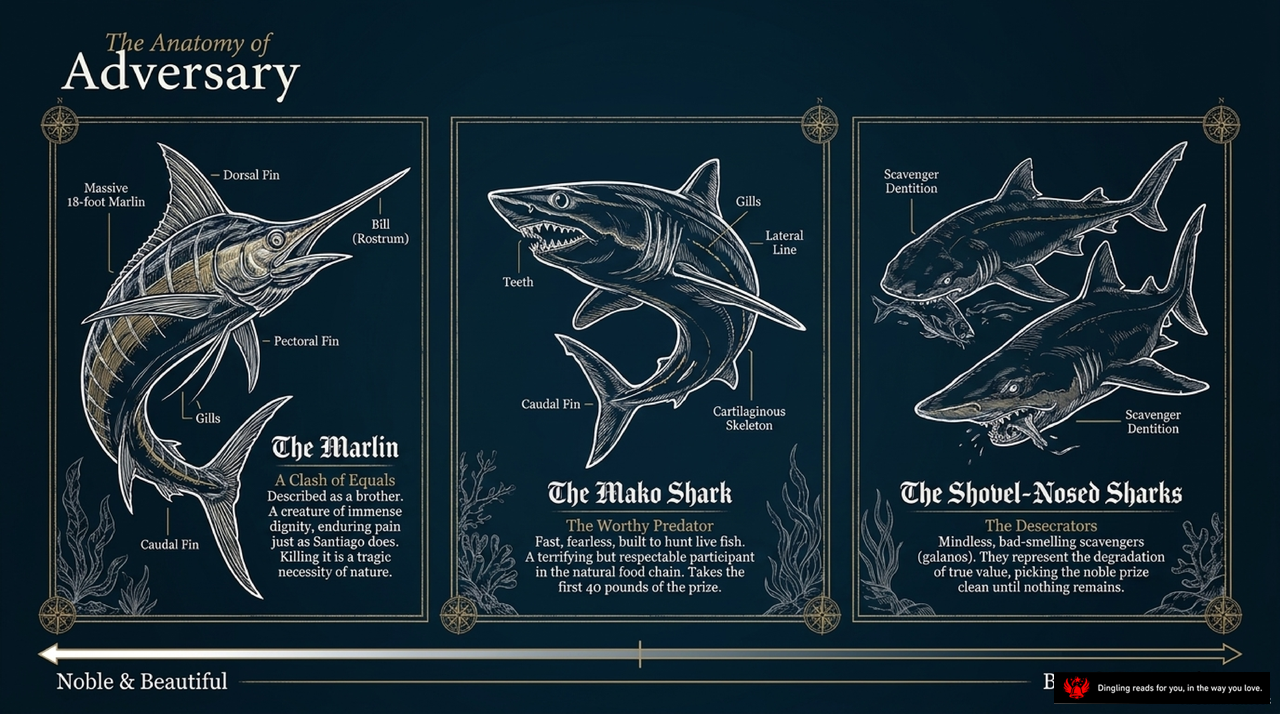
Ever stop to think about the different types of challenges life tosses your way? Hemingway nails this in The Old Man and the Sea, and this slide breaks down three key adversaries Santiago goes up against: the marlin, the mako shark, and those shovel-nosed sharks.
First, let’s talk about that massive 18-foot marlin. The slide calls it “A Clash of Equals” — and man, is that right. Santiago doesn’t see this fish as just a target; he sees it as a brother, a creature with dignity that’s enduring pain just like he is. Killing it isn’t something he’s excited about—it’s a tragic necessity. This marlin’s not just a catch; it’s a reflection of Santiago’s own grit and resolve.
Next up, the mako shark—labeled “The Worthy Predator.” Fast, fearless, built to hunt live fish—this guy’s a legit player in the food chain. He takes the first 40 pounds of the marlin, but you can’t really blame him; he’s just doing what he was made to do. He’s the kind of adversary that makes you level up because he’s fair, even if he’s super tough.
Then there are the shovel-nosed sharks—“The Desecrators.” These are the mindless, stinky scavengers. They don’t hunt; they just pick apart the noble prize until there’s nothing left. They stand for the degradation of something true and valuable. Unlike the marlin or mako, there’s no honor here—just messy, thoughtless destruction.
Each of these creatures isn’t just a fish in the ocean. They’re metaphors for the adversaries we all face: the worthy opponent that pushes us to be better, the fair competitor that tests our limits, and the mindless forces that try to tear down what we’ve worked hard for. Hemingway uses them to show that not all challenges are equal—and how we react to each tells a lot about who we are.
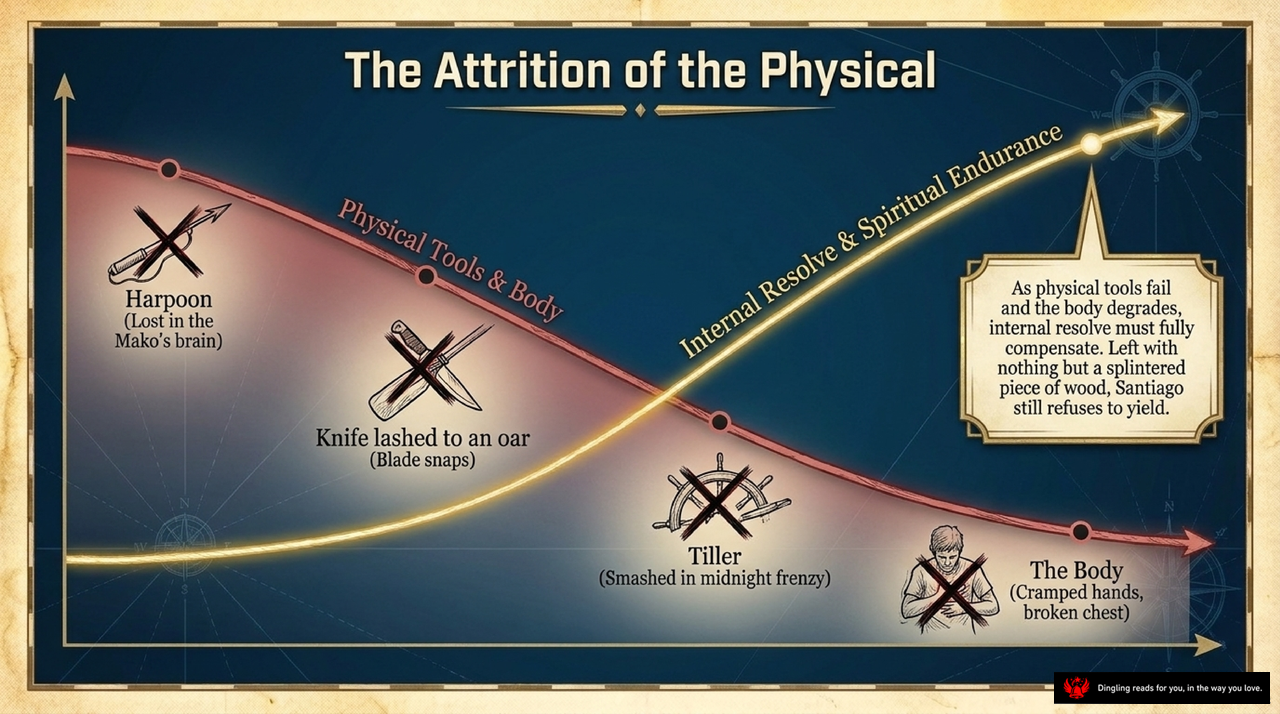
Let’s dive into this slide titled The Attrition of the Physical—this is where Santiago’s fight really pushes him to the edge. Picture being out in the middle of the ocean, days from shore, and one by one, all your tools start to crumble. First, his harpoon is lost to a mako shark—gone, just like that. Then the knife he’d lashed to an oar? The blade snaps when he’s fending off another wave of sharks. Even the tiller, that essential steering piece of his boat, gets smashed to bits in a chaotic midnight frenzy. And his body? It’s breaking down too: his hands are cramped so tight he can barely move them, his chest aches like it’s been crushed from all the pulling and straining against the marlin.
But look at that bright yellow line curving upward: Internal Resolve & Spiritual Endurance. When all your physical tools are gone and your body’s begging you to quit, what do you hold onto? For Santiago, it’s that unbreakable spirit inside. The slide’s quote says it perfectly: as physical tools fail and the body degrades, internal resolve fully compensates. Even when he’s left with nothing but a splintered piece of wood to defend his catch, he refuses to yield.
This isn’t just a fishing story—it’s a metaphor for every time life knocks your tools out of your hands. Maybe you’ve had a project fall apart, a plan go sideways, or you’re so exhausted you can barely stand. Santiago’s journey shows us that our inner strength can carry us further than any tool or physical ability ever could. It’s about holding on even when there’s nothing left to hold onto—because that’s where true resilience lives. When the world takes away what you rely on, your resolve becomes your most powerful weapon. And Santiago? He’s proof that you don’t need perfect tools to win—you just need to refuse to give up.
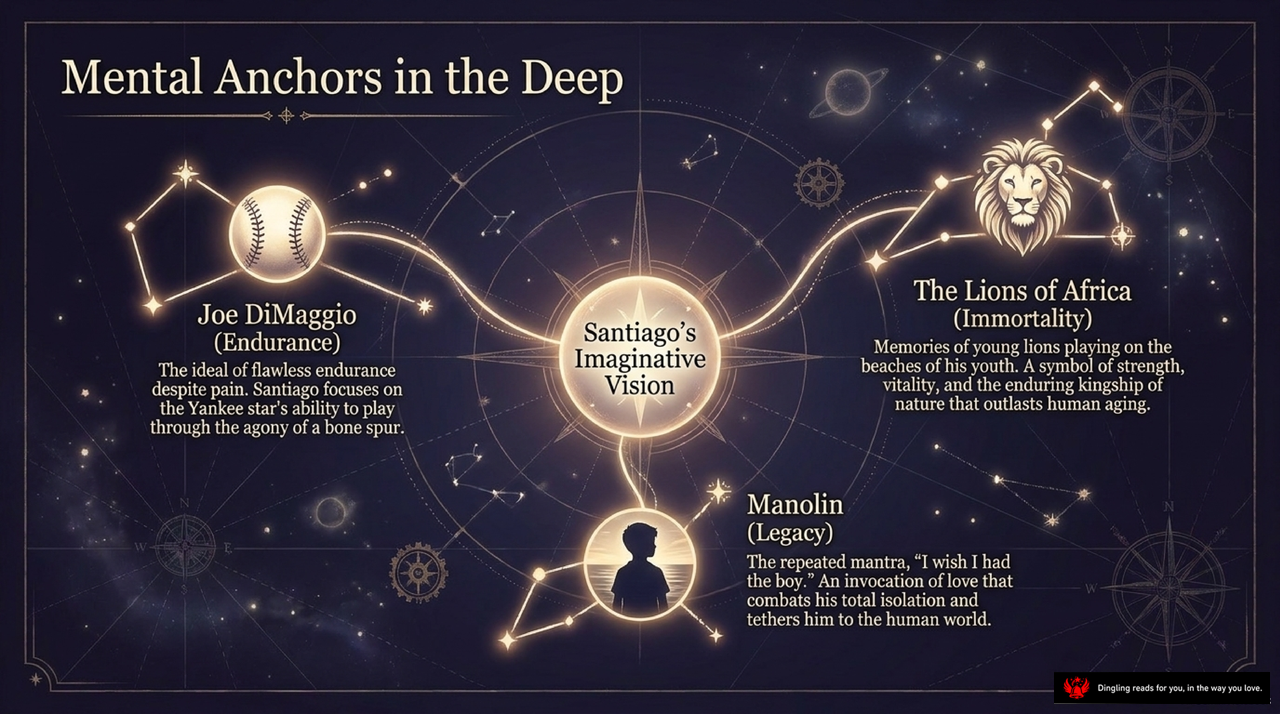
Let’s talk about the mental anchors that kept Santiago going when he was out there alone in the deep—this slide calls it “Mental Anchors in the Deep,” centered on Santiago’s Imaginative Vision. These weren’t physical things; they were thoughts and memories that held him steady through the toughest parts of his journey.
First up: Joe DiMaggio, the Yankee legend, symbolizing endurance. Santiago often thought about how DiMaggio played through the agony of a bone spur—pushing past pain to perform at his best. For Santiago, that was a reminder that you don’t quit just because it hurts. It’s like when you’re grinding through a long shift or a tough exam, and you think of someone who powered through something similar—DiMaggio was that for him.
Then there are the Lions of Africa, representing immortality. Santiago would drift back to memories of young lions playing on the beaches when he was a kid. Those images weren’t just nostalgia; they stood for strength, vitality, and the kind of natural power that doesn’t fade with age. Think about a memory from your childhood that still makes you feel alive—maybe running in the grass or chasing waves. Those moments stick with you, and when you’re down, they remind you of the fire you still have inside.
And finally, Manolin—the boy. Santiago kept repeating, “I wish I had the boy.” This wasn’t just about needing help; it was about love and legacy. Manolin was the one who believed in him, who learned from him, and who kept him connected to the human world. When you’re alone, thinking about someone who cares about you can keep you from feeling totally isolated—it’s that quiet voice saying, “You’re not alone in this.”
All these anchors—DiMaggio’s grit, the lions’ timeless strength, Manolin’s love—were Santiago’s lifeline. They weren’t real in the moment, but they were real enough in his mind to keep him fighting. Because sometimes, the strongest things we carry are the thoughts and people we hold close, even when they’re miles away.
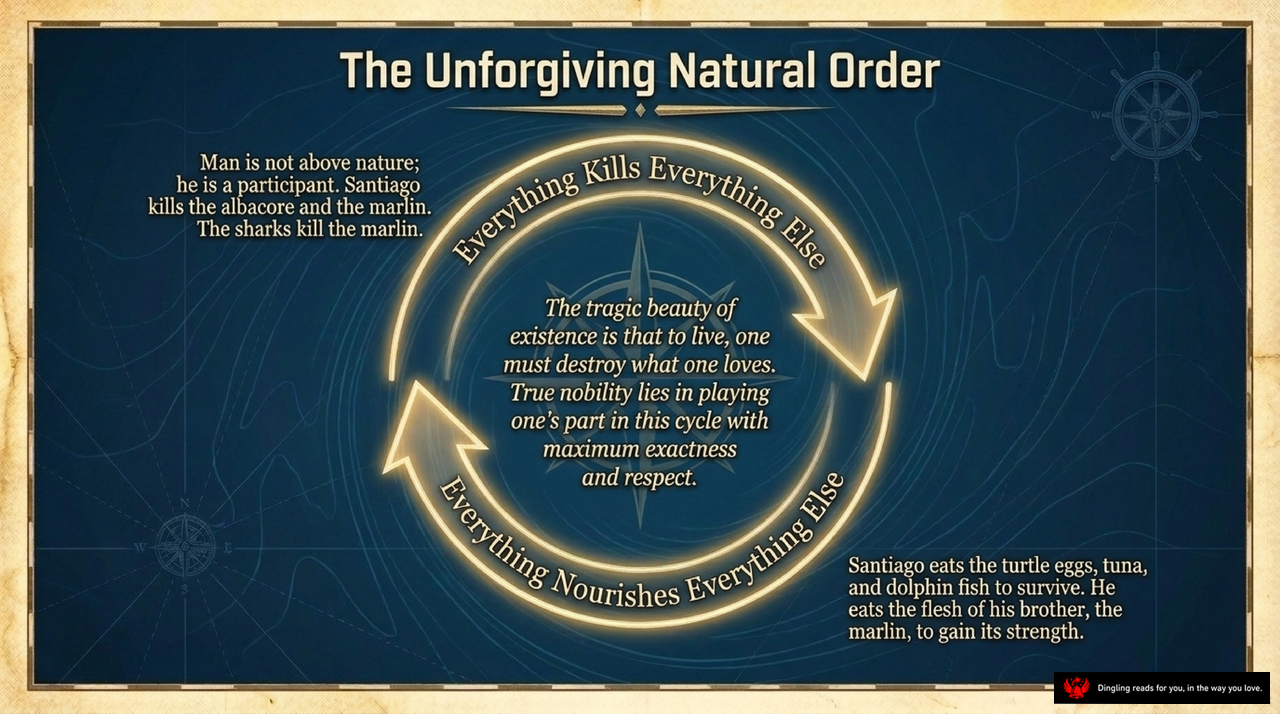
Let’s unpack “The Unforgiving Natural Order” here—because Hemingway’s not just describing the ocean; he’s laying out a raw truth about how life works. You see, Santiago isn’t some guy who thinks he’s better than the sea. He’s a participant in it, not a master.
Think about his journey: he kills the albacore and that giant marlin to keep going, but then the sharks sweep in and take the marlin right from him. It’s this endless loop—everything kills everything else, but at the same time, everything nourishes everything else. That’s the circle we’re looking at on the slide.
And here’s the gut punch: “The tragic beauty of existence is that to live, one must destroy what one loves.” It sounds harsh, but let’s be real—Santiago doesn’t want to kill the marlin. He calls it his brother, respects its strength. But he has to, to survive. Later, when he’s worn down to the bone, he even eats the marlin’s flesh to gain the strength to get back to shore. That’s the cycle in action: destruction and nourishment aren’t enemies—they’re two sides of the same coin.
The slide says true nobility lies in playing your part with maximum exactness and respect. Santiago does that. He doesn’t waste a thing. He eats the turtle eggs, the tuna, the dolphin—all to stay alive, but he does it with care. He’s not just taking; he’s honoring the lives he’s using.
This isn’t just about fishing. It’s about how we all fit into the natural order. We can’t opt out of it. But what we can do is act like Santiago—with respect, with purpose, without pretending we’re above it all. That’s the lesson here: the order might be unforgiving, but our response to it? That’s where our nobility lives. It’s a tough truth, but it’s one that sticks with you long after you close the book.
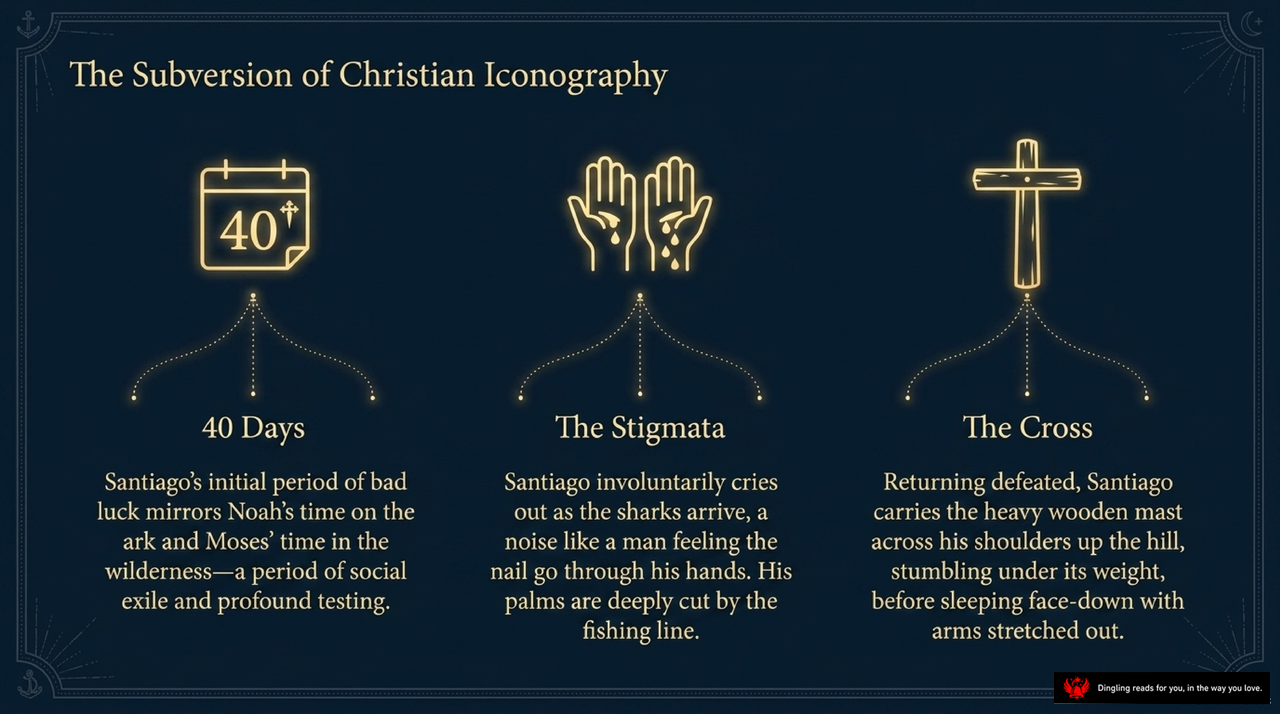
Let’s dive into how Santiago’s journey reworks familiar Christian symbols into something deeply human—this is what we mean by “The Subversion of Christian Iconography.”
First, those 40 days of bad luck. You know the Bible beats: Noah’s ark floating for 40 days, Moses wandering the wilderness. Those were times of exile, testing, waiting for a higher purpose. For Santiago? It’s his stretch at sea where nothing goes right—his catch stolen, his hopes fading, feeling totally cut off from the world. This isn’t a holy trial; it’s a raw, human struggle to hold on when everything feels like it’s slipping away.
Next, the stigmata. When the sharks attack and he loses his giant marlin, his palms get sliced open by the fishing line. The slide says he cries like someone feeling nails drive through their hands—echoing the stigmata, Christ’s sacred wounds. But Santiago’s wounds aren’t a sign of divine favor. They’re the physical pain of losing his dream, the gut punch of failure. It’s a moment of pure despair, not a sacred sacrifice.
Then there’s the cross. After returning defeated, he carries that heavy wooden mast up the hill, stumbling under its weight, then lies face down with his arms outstretched. That’s a clear nod to Christ carrying the cross to Golgotha. But Santiago isn’t dying for others’ sins. He’s a broken man, but he’s still moving—still putting one foot in front of the other. His “cross” isn’t a symbol of redemption for the world; it’s a symbol of his own resilience, of choosing to keep going even when he has nothing left.
These symbols don’t just repeat Christian stories—they flip them. They’re not about divine grace or salvation. They’re about what it means to be human: to struggle, to lose, and to keep pushing forward, even when the odds are stacked against you. That’s the magic of this subversion—it makes these ancient symbols feel like they’re talking about your journey, too.
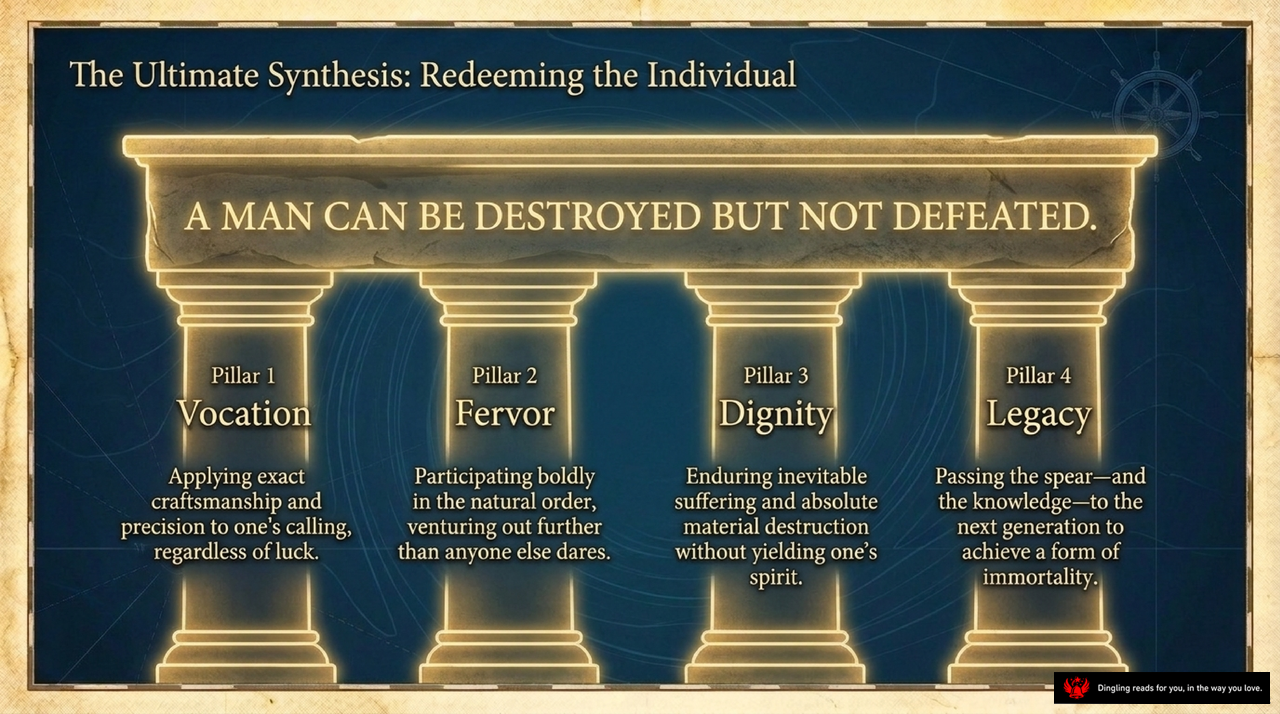
Let’s start with that powerful line up top: “A man can be destroyed but not defeated.” We’ve all been there, haven’t we? When life throws a curveball—maybe a sudden job loss, a personal setback, or something that feels like it’s breaking you down. But this slide is all about how to stand firm even in those moments.
The title here is “The Ultimate Synthesis: Redeeming the Individual.” And those four pillars you see? They’re the foundation for that redemption—for staying unbroken even when everything else falls apart. Let’s break each one down.
First up: Vocation. It’s not just your 9-to-5—it’s applying exact craftsmanship and precision to whatever you do, no matter the luck. Think about a chef who cooks a perfect meal even when the kitchen is chaos, or a writer who keeps drafting even when their first few chapters get rejected. It’s about taking pride in your work, no matter the circumstances.
Next, Fervor. That means participating boldly in the natural order, venturing further than anyone else dares. It’s the entrepreneur who starts a business in a tough market, or the athlete who trains harder than everyone else even when they’re already ahead. It’s not playing it safe—it’s pushing boundaries.
Then there’s Dignity. This one’s key: enduring inevitable suffering and absolute material destruction without yielding your spirit. Maybe you lose your home, or your health takes a turn for the worse—but you don’t let that strip you of your self-respect. You hold onto your values, keep your head high. That’s how you don’t get defeated.
Finally, Legacy. It’s passing the spear—and the knowledge—to the next generation to achieve a form of immortality. It’s teaching your kid to change a tire, or mentoring a young colleague in your field, so your wisdom lives on long after you’re gone.
Put all these pillars together, and you’ve got the ultimate way to redeem your individual self. Even if life tries to destroy you, these four things keep you standing—unbeaten, unbroken, and true to who you are.
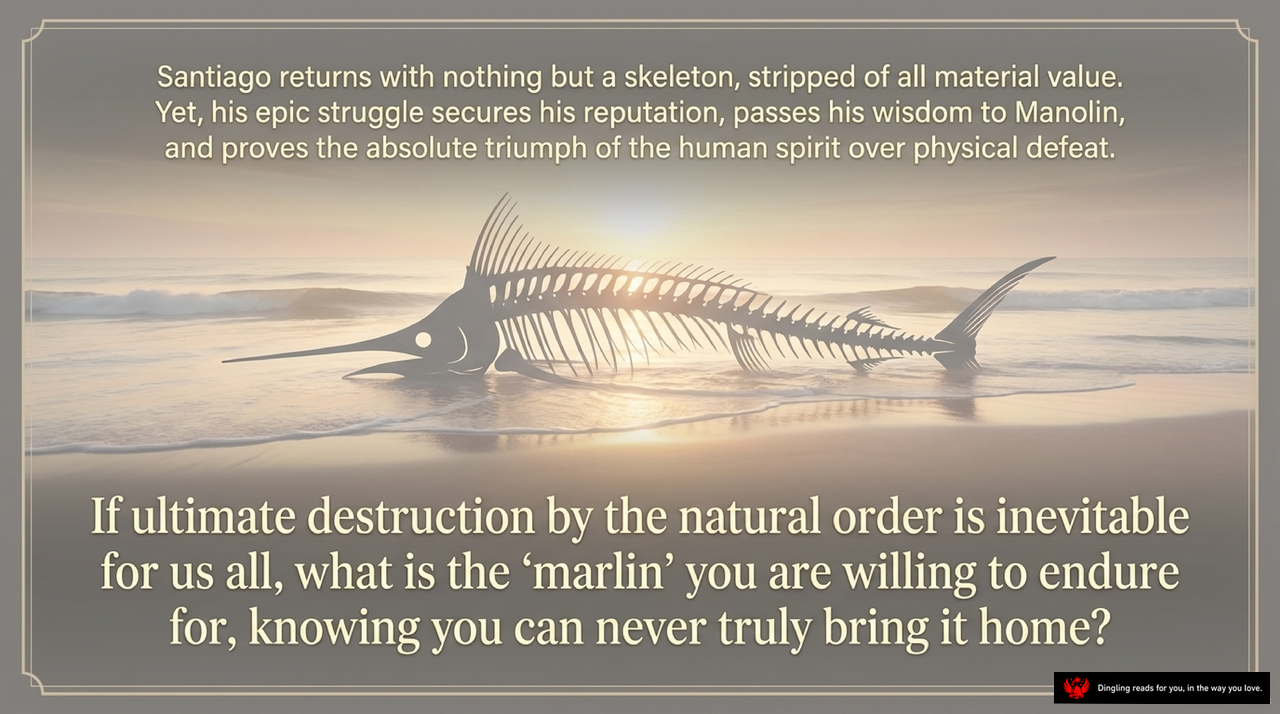
Imagine standing on that sunlit beach, waves gently lapping at the massive marlin skeleton half-buried in the sand. That’s all Santiago had to show for three days at sea—no fresh fish to sell, no trophy to hang, just bones stripped of every bit of material value. But did he really lose?
His epic struggle out there—battling the marlin, fending off sharks, pushing through exhaustion—didn’t just leave him tired. It solidified his reputation in the village as the tough old man who never backed down, even when odds were stacked against him. More importantly, he passed his hard-earned wisdom to Manolin: lessons about resilience, dignity in adversity, and fighting for what matters even when the outcome isn’t what you want. His physical defeat didn’t define him because his human spirit triumphed over every setback.
Now, think about the question on the slide: If ultimate destruction by the natural order is inevitable for us all, what’s the ‘marlin’ you’re willing to endure for, knowing you can never truly bring it home?
Maybe it’s that passion project you stay up late on—writing a book, painting, building something from scratch—even if you’re not sure anyone will see it. Or a relationship where you love fully, even if it doesn’t last forever. Or a career goal you chase, even when rejections pile up. Santiago’s story isn’t about the fish he caught; it’s about the fight itself. It’s about showing up every day, giving your all, and letting that struggle shape you into someone stronger.
At the end of the day, the marlin isn’t the prize. The real win is the growth, the connections, the lessons you carry with you. That’s the triumph we can all hold onto—no matter what bones we end up bringing home. It’s proof that spirit always outlasts physical loss.