
Complications: Complete Chapter-by-Chapter Summary

Welcome to "Complications," a book by Atul Gawande. This is a surgeon's note exploring the deeply human, mysterious, and imperfect reality behind the science of medicine.
We often imagine doctors as infallible experts, but the truth is far more complex. Medicine is not just about science; it is about navigating uncertainty. From the very first incision to the final diagnosis, every decision is made without a guarantee of a perfect outcome. We practice on living, breathing humans, not mannequins, and the stakes are always high.
This journey takes us from the operating room to the bedside, revealing that even the most skilled surgeons face limits. We will look at how technology can help, yet never fully replace the human touch. We will see how errors happen, not because of negligence, but because of the inherent complexity of the human body and the systems we rely on.
Ultimately, this book is about accepting that medicine is a series of imperfect choices. It is about understanding that behind every procedure and every diagnosis, there is a story of struggle, hope, and the relentless pursuit of better care, even when the path isn't clear. Let's begin by looking at what happens when the science meets the reality of the human experience.

Society often demands a level of precision that feels almost mechanical—flawless execution, absolute certainty, and doctors who operate like emotionless machines. But the human reality of medicine is far more complex. As we see here, while simple science meets the complex individual, perfection is ultimately an illusion.
Medicine doesn't rely on complete information or predictable targets; it deals with incomplete data, moving biological systems, and the terrifying necessity of practicing on living, breathing human beings. We are constantly navigating a gap between what we expect—a rigid, error-free system—and what we actually face: a chaotic, unpredictable, and deeply human experience. This isn't about failing to be perfect; it's about acknowledging that the very act of healing is a dance between science and the unknown, where the best we can do is strive for excellence while accepting that absolute perfection remains out of reach.

Imagine a graph where the vertical axis represents clinical competence and the horizontal axis tracks time and experience. As we look at this curve, we see a classic "S" shape that defines the journey of every surgeon. It starts low, rises slowly, then accelerates, and finally plateaus at the top.
However, look closely at that initial, steep red section at the bottom. We call this "The Danger Zone." This is the reality for every expert surgeon. As the text reminds us, every expert starts with shaking hands. Learning a procedure like a central line insertion isn't just about knowing the theory; it requires physical repetition. But here lies the ethical paradox. Society demands the safest care immediately, yet we refuse to acknowledge the inherent cost of training the next generation.
To become an expert, a doctor must practice. And repetition requires practicing on living patients. This means temporarily placing them into "The Danger Zone." We are essentially using the patient's body as the training ground to build the surgeon's skill. While we try to minimize risk with supervision, the system still relies on this painful trade-off. We demand perfection from the patient, but we are building that perfection through their temporary vulnerability. It is a heavy burden, but it is the price of progress in medicine.

As a rational physician, I should have dismissed superstition, yet I found myself respecting the collective wisdom of my colleagues who avoided working on Friday the 13th. Curious, I dove into the research and uncovered a 1993 study from the *British Medical Journal* suggesting that car accident injuries were actually 52% higher on Friday the 13th compared to the 6th, despite fewer cars on the road. It seemed like a pattern, but statistically, it was just random chance—much like the "Texas Sharpshooter Fallacy," where a shooter fires at a wall and then draws a target around the bullet holes, convincing everyone they were a genius.
But the moon held a different kind of mystery. Surveys showed that nearly half of Americans believed the moon influenced human behavior, linking it to madness and even suicide. I spent weeks digging through studies, including one from the *Australian Medical Journal* that found women were 25% less likely to attempt suicide during a full moon. Other studies in France and Ohio echoed this. Yet, when I finally scheduled a night shift on Friday the 13th to prove the superstition wrong, the emergency room was packed beyond capacity. As a nurse complained about the "unlucky" day, a new patient was wheeled in.
That night, I met Kieran, a man in his 40s tortured by chronic back pain for a decade. Every scan came back normal—no fractures, tumors, or infections. His doctor suggested physical therapy or psychiatry, even questioning if he was faking it. But seeing Kieran struggle to rise from his desk, I realized his pain was real, even if the cause was invisible. His pain wasn't in his spine; it was in his mind, amplified by anxiety and stress.
This case opened my eyes to the complex reality of pain. For centuries, we believed pain was a simple signal from damaged tissue traveling to the brain. But history and research tell a different story. Soldiers in World War II often felt no pain despite severe injuries, while civilians with minor cuts screamed in agony. This led to the "Gate Control Theory," suggesting our brain has a switch that can block pain signals. But the story goes deeper. Modern neuroscience reveals that pain is a brain-generated experience, a result of how our brain integrates memory, emotion, and attention. A dancer might stand on a broken foot without flinching, while a novice collapses at the first twinge. The brain decides what hurts, not just the body.
Understanding this shifted how we approach treatment. For Kieran, traditional painkillers offered only temporary relief. But when we targeted the overactive neural pathways in his brain with specific medications, his pain vanished almost completely. We are no longer just fixing broken bones; we are helping the brain stop the false alarm. Yet, this is only part of the puzzle. The human body is not a machine; it is a chaotic system, more like a hurricane than a block of ice. We can predict the path of ice, but the wind and rain of life make the human experience unpredictable. We must accept this uncertainty, knowing that sometimes, the most profound healing comes not from fixing the body, but from understanding the mind.

The image outlines a critical warning for the medical system: good doctors don't become bad because they are monsters; they break because the system breaks them. It maps a four-stage journey from a "Star Performer" to a "Systemic Intervention."
In Phase 1, we see the "Star Performer"—a doctor driven by metrics and reputation, delivering high volume and praise. But this pressure leads directly to Phase 2: Burnout and Isolation. As we read about Dr. Harrison, a top orthopedic surgeon working 80 to 100-hour weeks, the cost becomes clear. Chasing revenue targets and ignoring family pushes him into a deep isolation. He stops caring about the patient's suffering, viewing complaints as annoyances rather than cries for help.
This isolation triggers Phase 3: Cognitive Slippage. When a doctor is exhausted and isolated, their judgment deteriorates. We see this when Dr. Harrison uses the wrong size screws or ignores complications, taking dangerous shortcuts in the operating room. He is no longer making medical errors; he is making human errors born of fatigue and disconnection.
Finally, the system must respond with Phase 4: Systemic Intervention. When the collapse is complete, the only path forward is the Dr. Kent Neff Rehabilitation Model. This isn't about punishment; it's about intensive psychiatric and clinical evaluation to help the doctor recover. Dr. Harrison's story proves that with the right intervention, even a broken doctor can heal and eventually return to the operating room.
The core message is undeniable: bad doctors are rarely monsters; they are usually good doctors broken by the system. To save patients, we must first save the doctors who serve them.

Welcome back. Today, we're diving into the hidden side of medicine—the mysterious, often misunderstood biological signals that our bodies send us, long before we even realize something is wrong.
Look at this slide. On the left, we have "The Hernia Factory," and on the right, "The EKG Computer." These represent the two poles of modern healthcare: extreme human specialization and cold, hard machine precision. But what happens when we step away from the operating table and into the quiet, complex theater of the human body?
Let's talk about blushing. It's one of the most universal human experiences, yet we often dismiss it as just a sign of embarrassment. But what if blushing is actually a sophisticated social signal? It's a way for us to say, "I made a mistake," or "I care about your opinion." It's an evolutionary tool for social bonding. But for some, like our host Alyssa, this signal became a curse. Her face turned red uncontrollably, making her feel invisible and anxious. She eventually had a surgery to cut the nerves causing this reaction. She found freedom, but she also learned that while we can fix the physical symptom, the emotional journey of accepting a new normal takes time.
Now, let's look at appetite and weight. We often think of obesity simply as a lack of willpower. But the science tells a different story. It's a complex battle between your brain, your hormones, and your environment. Some people have a biological condition where they simply can't feel full. For others, it's about the "opening effect"—the brain gets excited by the sight of food and starts eating before the stomach has even signaled that it's full. We've developed powerful tools to fight this, like gastric bypass surgery. It's incredibly effective for many, saving lives and restoring dignity, but it's not a magic bullet. It comes with risks and requires a lifelong commitment to a new way of living.
Finally, let's address the most difficult topic on this list: death and autopsy. In the past, autopsies were routine. They were the ultimate truth-tellers, revealing mistakes we made and helping us learn for the next patient. Today, they are rare. We have CT scans and MRI machines; we feel confident that we know the cause of death. But we are wrong more often than we admit. Autopsies have consistently shown that a significant percentage of deaths are misdiagnosed. Even with all our high-tech tools, we can miss the truth. An autopsy isn't about disrespecting the dead; it's about respecting the living by giving them the truth, and it's about saving future lives by correcting our understanding of disease.
So, what does all this mean? Our bodies are not just machines to be fixed. They are complex systems of signals—blushing, hunger, pain, and even the final silence of death. Understanding these signals, and knowing when to trust them and when to question them, is the heart of being a doctor. We must balance our technology with our humanity, and always remember that the most important data we have is the truth, no matter how uncomfortable it might be.

Welcome back to our deep dive into the hidden depths of medicine. Today's slide is a powerful visual metaphor, an iceberg that perfectly captures the reality of our profession. Above the water, we see "Evidence-Based Certainty"—the mapped territory of predictable anatomy, pharmaceutical reactions, and measurable vitals. This is the part of medicine we study, the clean lines of the textbook. But the vast, submerged section is labeled "The Unknowns." This is where the real work happens, and where we often operate in the dark.
Look at the examples on the left: "The Ballistics Mystery." Imagine a one-centimeter bullet moving from the right hip to the upper abdomen without damaging any organs or leaving a trace. It's a physical impossibility according to standard physics, yet it happened. On the right, we have "The Blind Guess." Consider Andy, a boy suffocating from a massive chest mass who was saved only because doctors took a completely blind guess to drain his chest without any roadmap for what would happen.
These stories illustrate a hard truth: medicine frequently forces doctors to operate in the dark. We rely on desperate improvisation when science fails to provide a map. We are constantly balancing the comfort of known data against the terrifying necessity of making life-or-death decisions without guarantees. As we've seen throughout our journey, from the uncertainty of diagnosing appendicitis to the risks of new surgeries, the unknown isn't just a gap in our knowledge; it's an active participant in every patient's story. We don't just treat bodies; we navigate a landscape where the rules are often written in the moment, not in the manual.

The image we see today is titled "The Gate Control Theory of Pain," and it highlights a profound truth: pain is not simply a physical response to cellular injury, but something actively constructed by the brain. Look at the diagram of the human body with "The Gate" marked at the base of the spine. This visual represents the core concept that our nervous system acts as a filter, regulating how much pain signal reaches our consciousness.
Consider the case note on the left: Quinlan, an architect, was paralyzed by debilitating back pain despite having absolutely no physical tissue damage or structural flaw. His spine was perfectly healthy, yet his pain was agonizing. This is where the theory shines. As the key insight at the bottom explains, emotions, culture, and deep-seated stress can literally generate physical pain. Quinlan's anxiety about his career or his pain itself could have kept that "gate" wide open, amplifying signals from a healthy body into a scream of agony.
Think about this in a way that feels real to your daily life. Have you ever had a headache that seemed to vanish the moment you got distracted by a great conversation or a funny movie? Or conversely, have you felt a minor cut sting like a knife because you were terrified of a needle? That is the gate in action. Our brain integrates memories, emotions, and beliefs to decide how painful an experience should be. It proves that the body is not just a machine of levers and pulleys; it is a dynamic system where the mind holds the remote control. Understanding this shifts the perspective from "fixing the body" to "calming the mind," offering a powerful path to managing even the most chronic pain.

Welcome back. Today, we're diving into one of the most terrifying dilemmas in medicine: The Diagnostic Gamble.
Imagine you are standing in an operating room, and you have to choose between two paths. On one side, you wait for absolute certainty. But in that "grey zone" between cellulitis and necrotizing fasciitis—often called flesh-eating bacteria—waiting means the patient might die. On the other side, you operate immediately. But doing so means a 95% chance of severe, unnecessary mutilation if it turns out to be just a regular infection.
This is the reality of diagnosing necrotizing fasciitis versus cellulitis. Statistically, flesh-eating bacteria are a one-in-250,000 anomaly. Yet, when a patient is in front of you, those odds vanish. You aren't solving a pristine mathematical equation; you are making a terrifying gamble that relies entirely on a doctor's "sixth sense."
In the book, the author describes this exact paralysis. He talks about how surgery is rarely about perfect information. Instead, it's about acting when you don't have all the pieces. He notes that even with all the data available, there is no guarantee of a perfect outcome. We are constantly balancing the risk of doing nothing against the risk of over-treating.
This slide illustrates that critical moment where logic hits a wall. We cannot wait for the bacteria to prove themselves before acting, but we also cannot amputate a healthy leg on a hunch. It is a high-stakes decision where the cost of being wrong is either death or permanent disability. As we move forward, remember this: in medicine, sometimes the bravest thing you can do is act on an instinct that isn't yet fully formed, trusting that your experience will guide you through the fog.

Look at this slide. It maps the evolution of the doctor-patient relationship, moving from the "Past" to the "Present," aiming for an "Ideal" middle ground.
On the left, we see "Medical Paternalism." In the past, the doctor was the absolute authority, dictating every term like a general. The patient, represented by the stethoscope icon, was expected to remain silent and simply compliant. There was no question, only obedience.
On the right, we see "Absolute Autonomy." This is the modern approach where the patient is treated purely as a consumer. The doctor acts merely as a menu provider, listing options and transferring all the anxiety and responsibility of decision-making back to the patient. The clipboard and pen symbolize this shift to a transactional, consumer-driven dynamic.
But, as the central panel suggests, there is a "Sweet Spot" called "Shared Navigation." This is the ideal balance. The text highlights a crucial case study: Winnie, a premature baby. When absolute autonomy becomes an unbearable emotional burden for terrified parents—like Winnie's family—the doctor cannot just step back. In those moments of high stress, the doctor must step in to share the navigation. This means balancing medical expertise with human compassion, guiding the family through the chaos rather than leaving them to make life-or-death decisions alone in the dark.
So, the lesson here is clear: we need to move away from the old model of blind obedience and the new model of cold consumerism. Instead, we must embrace a partnership where the doctor provides the map and the expertise, and the patient provides the values and the choices, navigating the complex terrain of health together.
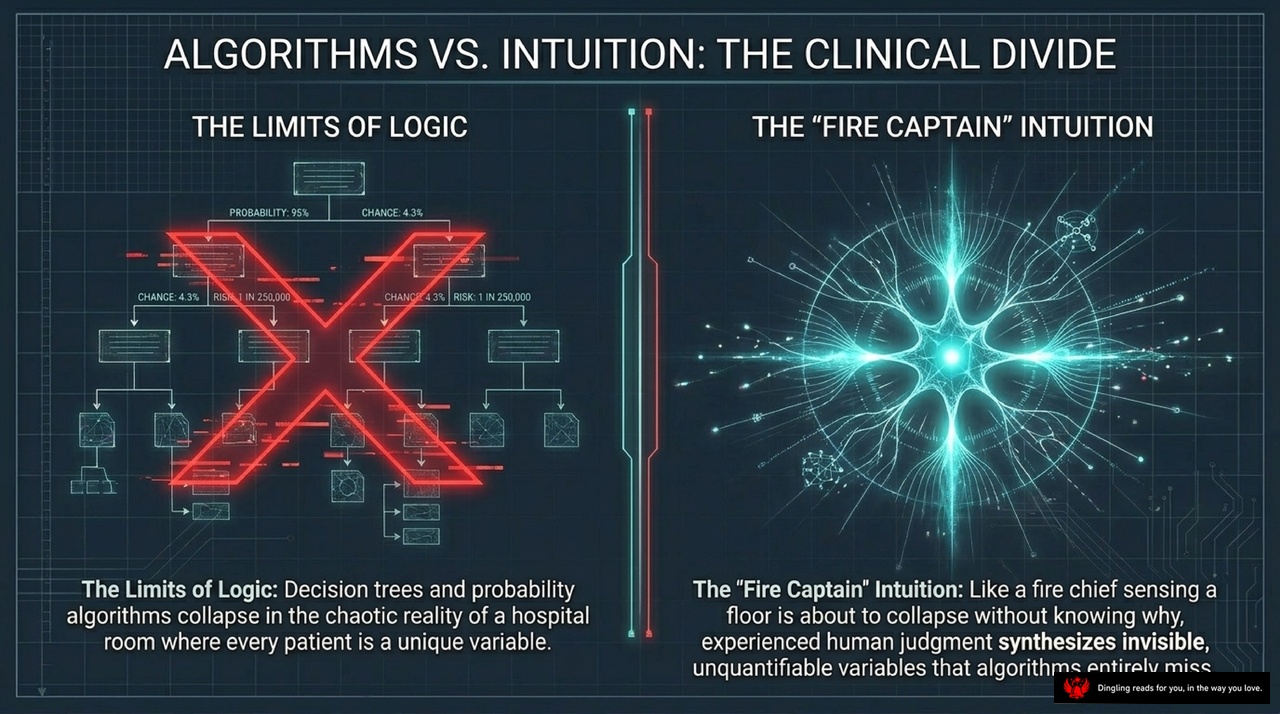
In the high-stakes world of surgery, we often feel torn between two opposing forces: the cold, rigid logic of algorithms and the chaotic, intuitive spark of human judgment. The slide you see here perfectly captures this divide. On the left, under "The Limits of Logic," we see a complex decision tree filled with probabilities and percentages. It looks precise, doesn't it? But as the text warns, these algorithms often collapse when faced with the messy, unpredictable reality of a hospital room where every patient is a unique variable. No formula can account for every nuance.
On the right, we see the concept of the "Fire Captain" intuition. Imagine a fire chief who senses a floor is about to collapse before anyone else does. He knows it without being able to explain exactly why. This is the power of experienced human judgment. It synthesizes invisible, unquantifiable variables—like a patient's subtle discomfort or a doctor's gut feeling—that algorithms entirely miss.
This isn't about choosing one over the other; it's about understanding that while logic provides our safety net, it is our intuition that often guides us through the cracks where the data fails. True mastery lies in balancing the structured approach of science with the fluid wisdom of experience.

So, here is the reality that often shocks us: despite all our high-tech CT scans, ultrasounds, and modern testing, the rate of fatal misdiagnosis has barely improved over decades. In fact, historical and modern autopsy studies consistently reveal a staggering 40% misdiagnosis rate for the actual cause of death.
This isn't just a number on a screen; it means that for nearly half of the people we lose, we simply got the cause of their death wrong. Even when we have the answers in our hands, we are often looking in the wrong direction. This leads us to a profound key insight: humanity exists somewhere between a predictable melting ice cube and an unpredictable hurricane. We are knowable, yet ultimately mysterious. We have tools to measure the ice, but we can never fully forecast the storm.

Look at this puzzle. It's not just four separate pieces; it's a complete picture of how modern medicine actually works. We often think of science and art as opposites, but in the operating room, they are the two halves of the same brain.
On the left, we have **Science**. This is our foundation. It's the hard evidence, the rigorous clinical trials, and the unyielding biological rules that govern life and death. It's the logic that tells us what *should* happen.
But on the right, we have **Art**. This is where the human element lives. It's the intuition, that "sixth sense" you can't teach in a textbook, and the indispensable human connection between doctor and patient. It's the ability to read a room, to sense fear, and to navigate the unpredictable chaos of a real human being.
Then, look at the bottom left: **Innovation**. This is the relentless drive to improve, to automate, and to mechanize our processes to protect against human error. It's the push to make things faster, safer, and more precise.
And finally, the bottom right: **Humility**. This is perhaps the most critical piece of all. It is the vital acceptance of inevitable human failure, the acknowledgment of our systemic limits, and the respect for the vast unknown that we can never fully map.
When you put these four pieces together, you get the full picture of a surgeon's reality. You can't have the science without the art; you can't have the innovation without the humility. If you ignore the art, you become a machine. If you ignore the science, you become a guesser. If you ignore innovation, you stagnate. And if you ignore humility, you become arrogant—and that is when patients get hurt.
True mastery isn't about having all the answers. It's about knowing exactly where the gaps are, and having the wisdom to bridge them with both data and empathy. That is the delicate balance we strive for every single day.

Medicine is not a pristine, infallible science; it is a chaotic, deeply human endeavor. It is built on a foundation of trial and error, guided by imperfect practitioners who must constantly navigate the murky waters of biological mystery, systemic flaws, and moral uncertainty to save lives.
We often imagine doctors as machines, capable of perfect precision, but the reality is far more complex. We are all human, and we all make mistakes. Whether it's a missed diagnosis, a surgical error, or a difficult ethical choice, these imperfections are an inherent part of the practice. The question we must ask ourselves is this: if medical perfection is an impossible illusion, are we prepared to forgive the humanity of the doctors who hold our lives in their hands?