
Cuore: Complete Chapter-by-Chapter Summary

Welcome to a timeless journey into the heart of human connection. Today, we open the pages of *The Heart*, a classic by Edmondo De Amicis, where a simple diary transforms into a powerful lesson on empathy, patriotism, and the transformative power of love.
Set against the backdrop of a bustling school gate, this story follows a young boy named Enrico as he returns from the countryside, filled with memories and the anticipation of a new chapter. The image before us captures the essence of this narrative: an old, handwritten book resting on a worn wooden desk, illuminated by the warm glow of a vintage lamp. This scene perfectly mirrors the book's core theme—an education rooted not in rigid rules, but in the warmth of human relationships.
Enrico's journey begins with the bittersweet realization that his old teachers are gone, replaced by new faces who quickly prove their kindness. But it is the unexpected acts of bravery and selflessness that truly define the spirit of this book. We see students rushing to help a stranger, protecting the vulnerable from bullying, and even sacrificing their own comfort for the greater good. From a boy who runs miles across the American wilderness to find his mother, to a student who gives up his life to save his grandmother, these stories remind us that love is the strongest force in the world.
As we explore these pages, we are invited to reflect on our own lives. Are we learning to see the humanity in others? Are we willing to stand up for what is right, even when it is difficult? *The Heart* teaches us that true education is about shaping a noble spirit, one act of kindness at a time. Let this book be a reminder that love is the foundation of everything we hold dear.
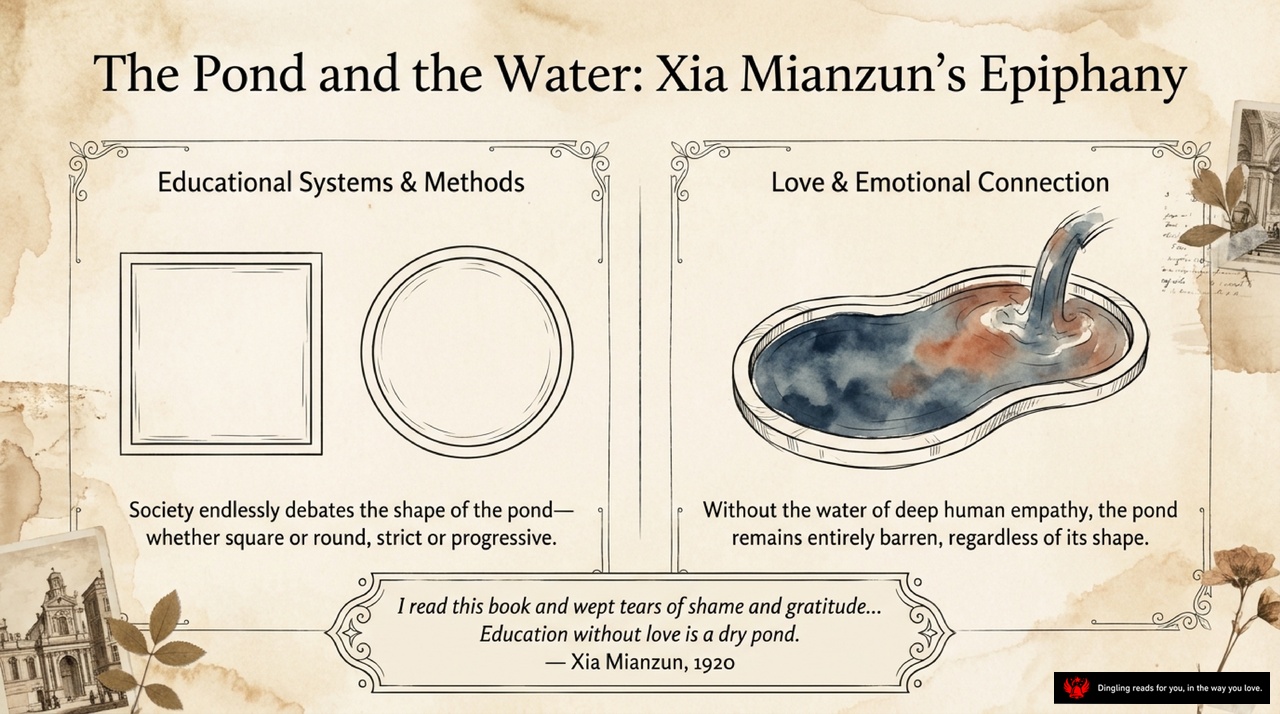
The Pond and the Water: Xia Mianzun's Epiphany
Today, we explore a profound moment of realization from the author, Xia Mianzun. As the slide illustrates, society often gets caught up in endless debates about the "shape of the pond"—whether our educational systems should be rigidly square or freely round, strict or progressive. We obsess over the structure, the rules, and the methods. But look at the right side of the image. Without the flowing water of deep human empathy, that pond remains entirely barren, regardless of its perfect shape. Education without love is simply a dry pond; it has no life, no growth, and no soul.
In 1920, Xia Mianzun wrote, "I read this book and wept tears of shame and gratitude... Education without love is a dry pond." This wasn't just a metaphor; it was a life-changing epiphany. He realized that the true purpose of schooling isn't just to fill minds with facts, but to nurture the heart. When teachers care for students like family, when classmates stand up for each other in moments of injustice, and when a community comes together to support the vulnerable, that is when the water flows. It is in these moments of connection that the pond becomes alive, transforming from a static shape into a dynamic, nurturing force.

December brings a profound lesson on integrity and the true value of education. We see this clearly in the story of Gino, the "little mason." His father, a laborer, works tirelessly at night to support the family, often neglecting his own rest. Gino, wanting to help, secretly copies documents in the middle of the night, sacrificing his sleep and grades. When his father discovers the truth, he doesn't scold him; instead, he breaks down in tears, realizing that his son's love and effort are far more precious than any academic achievement. This mirrors the father's own belief that education isn't just about scores, but about character.
Later that month, we witness the incredible resilience of Smeraldi. Once labeled as slow and dull, he dedicates every waking moment to studying, ignoring distractions and even the teacher's occasional impatience. His relentless spirit pays off when he earns a second-place award, proving that "when the spirit is present, nothing is impossible." This triumph teaches us that talent is less important than the willingness to persevere.
However, the month isn't without its harsh lessons. Carlo Ferrari accidentally injures an elderly man, shattering his glasses. Terrified, he tries to hide it, but his friend Caproni stands up to him, declaring that cowardice is the worst sin. Under Caproni's guidance, Carlo confesses, apologizes, and even offers his prized stamp album as compensation. The old man, moved by this courage, not only forgives him but returns the album with a rare Guatemalan stamp added. These stories remind us that mistakes are inevitable, but how we face them defines our humanity. True education shapes us to be brave, honest, and compassionate.
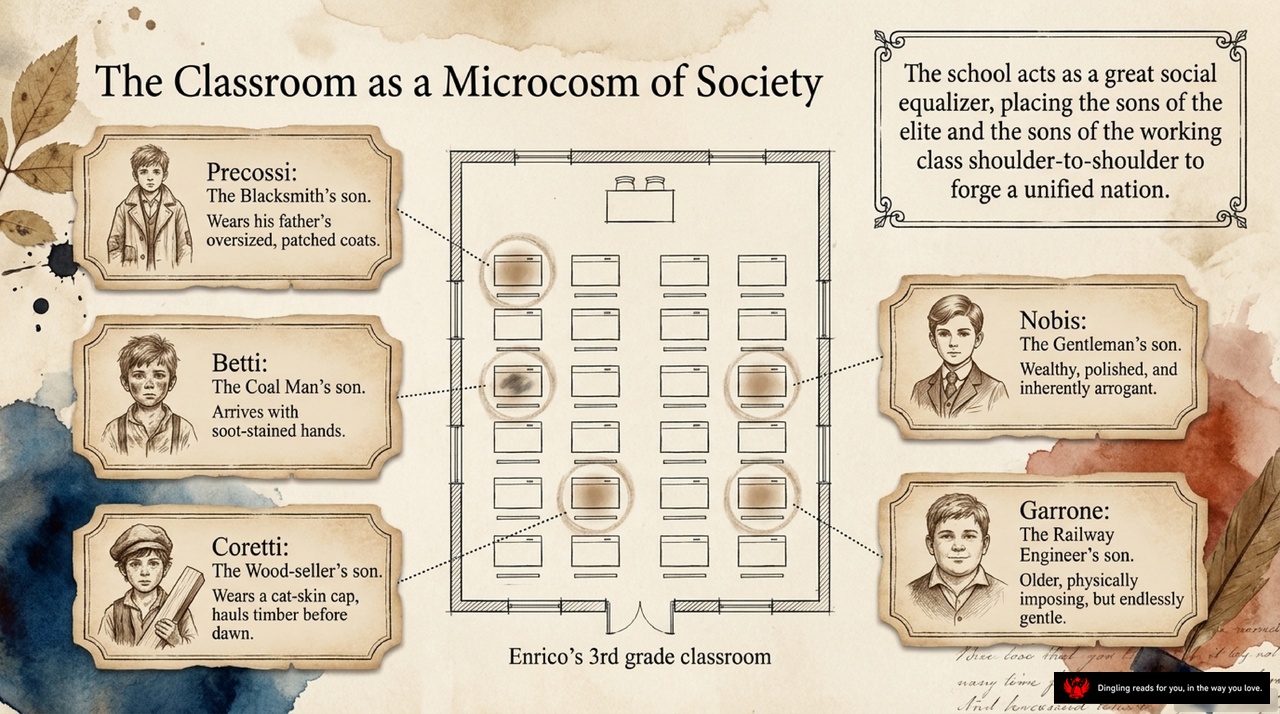
Look at this classroom layout. It's not just a room; it's a microcosm of our entire society. Here, the sons of the elite and the sons of the working class sit shoulder-to-shoulder. This school acts as a great social equalizer, forging a unified nation from the very start.
On the left, you see the boys from the working class. There's Precossi, the blacksmith's son, wearing his father's oversized, patched coats. Next to him is Betti, the coal man's son, arriving with soot-stained hands. And Coretti, the wood-seller's son, wearing a cat-skin cap and hauling timber before dawn.
On the right, we have the privileged students. Nobis is the gentleman's son—wealthy, polished, and inherently arrogant. Then there's Garrone, the railway engineer's son. He's older and physically imposing, but he possesses an endless gentleness that defines him.
This mix of backgrounds creates the tension and the bond that defines their lives. It is here, in this third-grade classroom, that their true character is tested and revealed.
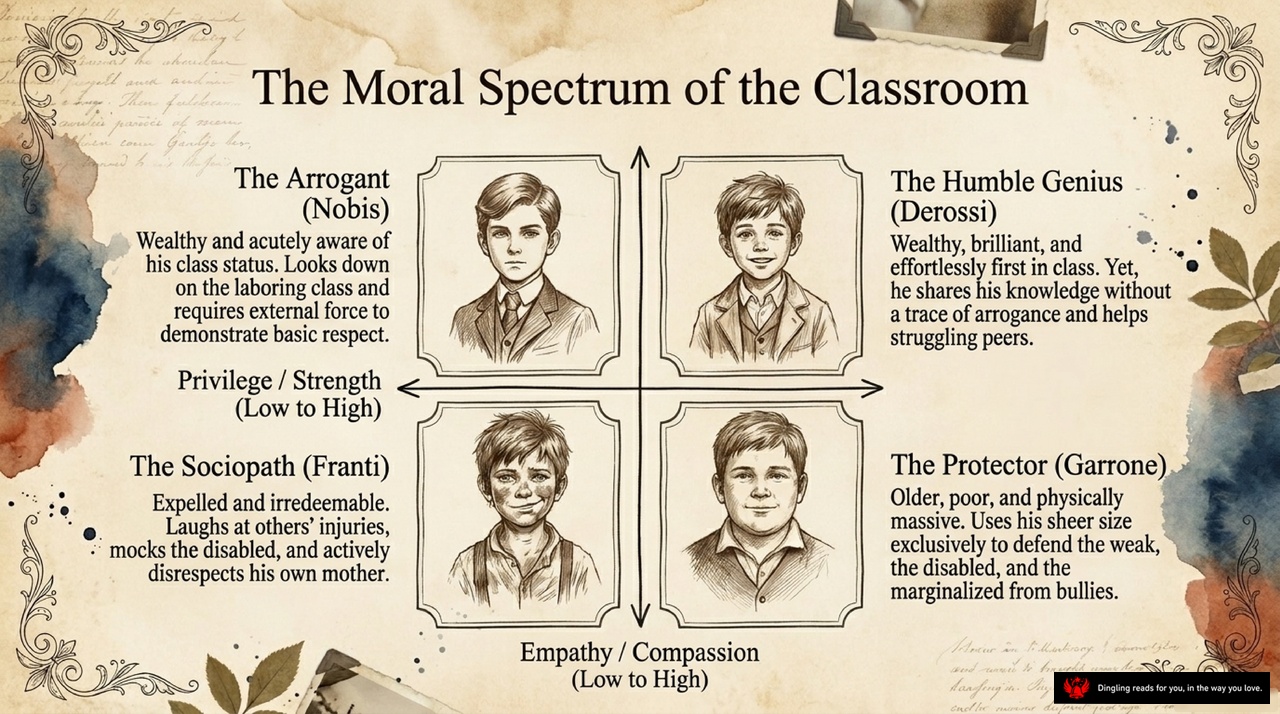
The Moral Spectrum of the Classroom isn't just a chart; it's a map of the human heart we see playing out every single day in our schools. Look at the four quadrants: on one side, we have the arrogant Nobis, who uses his wealth to demand respect, and right across from him stands Derossi—the humble genius who shares his brilliance without ever needing to show off. Then, at the bottom, we have Franti, the sociopath who finds joy in hurting others, and above him, Garrone, the protector who uses his strength not to dominate, but to shield the vulnerable.
This isn't about good versus evil; it's about how we choose to use our privilege and our empathy. In our own classrooms, we see this spectrum in action. We see the "Derossi" figure in students like Derossi himself, who helps his disabled classmate, Crossi, not for praise, but because it's the right thing to do. We see the "Garrone" spirit in Carlo Nobis, who stands up to bullies to protect the weak. Conversely, we see the "Franti" energy in students who laugh at others' pain or mock their own families, showing a complete lack of compassion.
The most powerful lesson here is that character isn't defined by where you come from or how much money you have. It's defined by your choices. Will you be the one who looks down on others, or will you be the one who reaches out a hand? Will you use your strength to crush, or to lift others up? As we grow, we all have to decide which side of this spectrum we want to stand on.
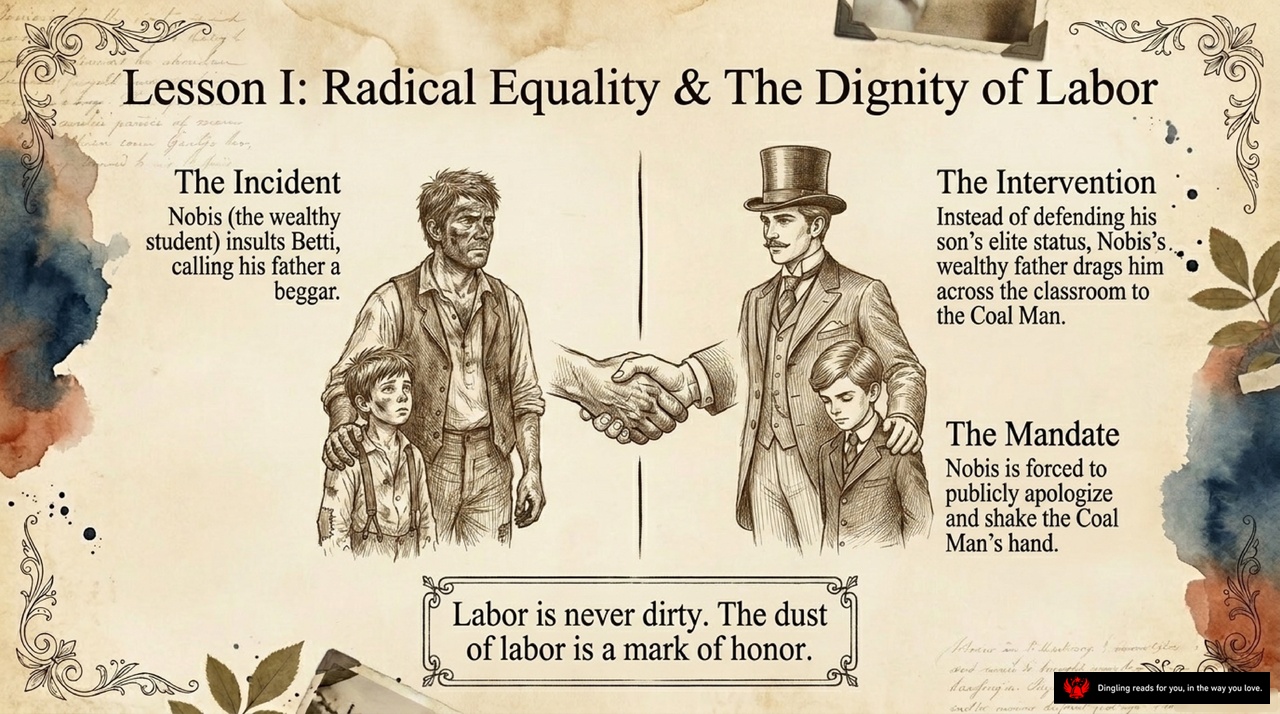
Welcome to the final chapter of our journey through *Cuore*. Today's slide captures the profound lesson of dignity found in the sweat of our brow.
On the left, we see the "Incident": a wealthy student, Nobis, insults a boy named Betti, calling his father a beggar. This is a moment of pure arrogance. But look at the center and the right side—that is where the true transformation happens. This is "The Intervention." Instead of defending his son's elite status, Nobis's wealthy father does the unthinkable. He drags his son across the classroom, forcing him to confront the very man he insulted.
This leads to "The Mandate." Nobis is forced to publicly apologize and shake the Coal Man's hand. This isn't just about saying sorry; it is a radical redefinition of value. The text at the bottom tells us the core truth: "Labor is never dirty. The dust of labor is a mark of honor."
In this story, the father teaches his son that true nobility isn't found in fine clothes or silver spoons, but in the courage to respect those who work with their hands. It reminds us that every person, regardless of their background, carries an inherent dignity that no amount of wealth can buy, and no amount of poverty can erase.

Lesson II: The Nobility of Hidden Sacrifice. Today, we explore the quiet, often invisible acts of courage that define true character. Look at the two stories on our screen. On the left, Giulio, the little Florentine scribe. He wakes at midnight, secretly forging copy-work to ease his aging father's financial burden. The cost? Exhaustion, dropping grades, and bearing the shame in absolute silence to protect his father. On the right, Marco. A thirteen-year-old boy who crosses the ocean and treacherous South American landscapes alone to find his missing, gravely ill mother. His sacrifice involves facing starvation, exhaustion, and physical ruin, ultimately saving her life through sheer devotion. These aren't just historical anecdotes; they are powerful reminders that true virtue in *Cuore* often demands suffering in absolute silence for the sake of family. While the world cheers for loud heroes, the most profound nobility lies in these hidden sacrifices, where love is proven not by what we say, but by what we endure without complaint.
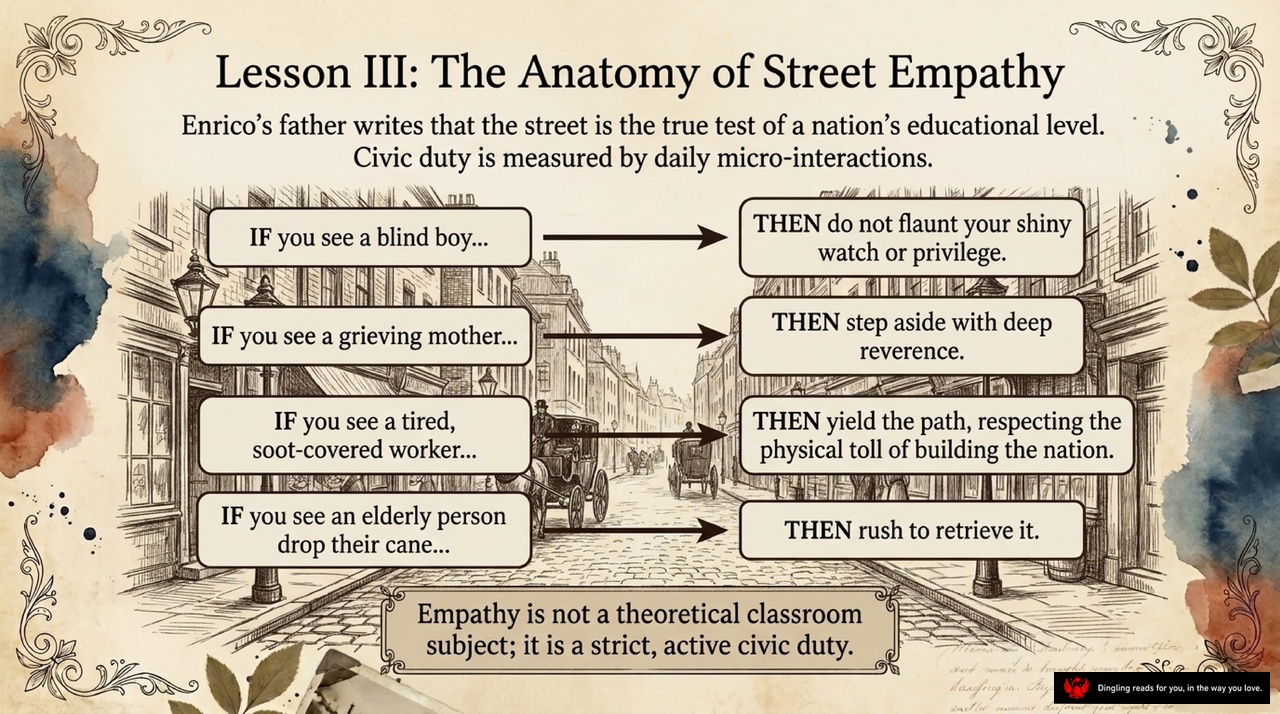
Today, we explore a profound truth from Lesson III: The Anatomy of Street Empathy. As the text reminds us, Enrico's father believed that the true test of a nation's education isn't found in classrooms, but on the streets. It is measured by our daily micro-interactions. Think about this: if you see a blind boy, do you flaunt your shiny watch? Or do you step aside with reverence? If you see a grieving mother, do you ignore her, or do you yield the path to respect the physical toll she takes building our nation?
Empathy, as this slide illustrates, is not a theoretical subject; it is a strict, active civic duty. It is about how we treat the tired, soot-covered worker or the elderly person dropping their cane. These aren't just nice gestures; they are the very foundation of our character and the measure of our country's moral level. True education happens when we choose kindness in every moment we step onto the street.
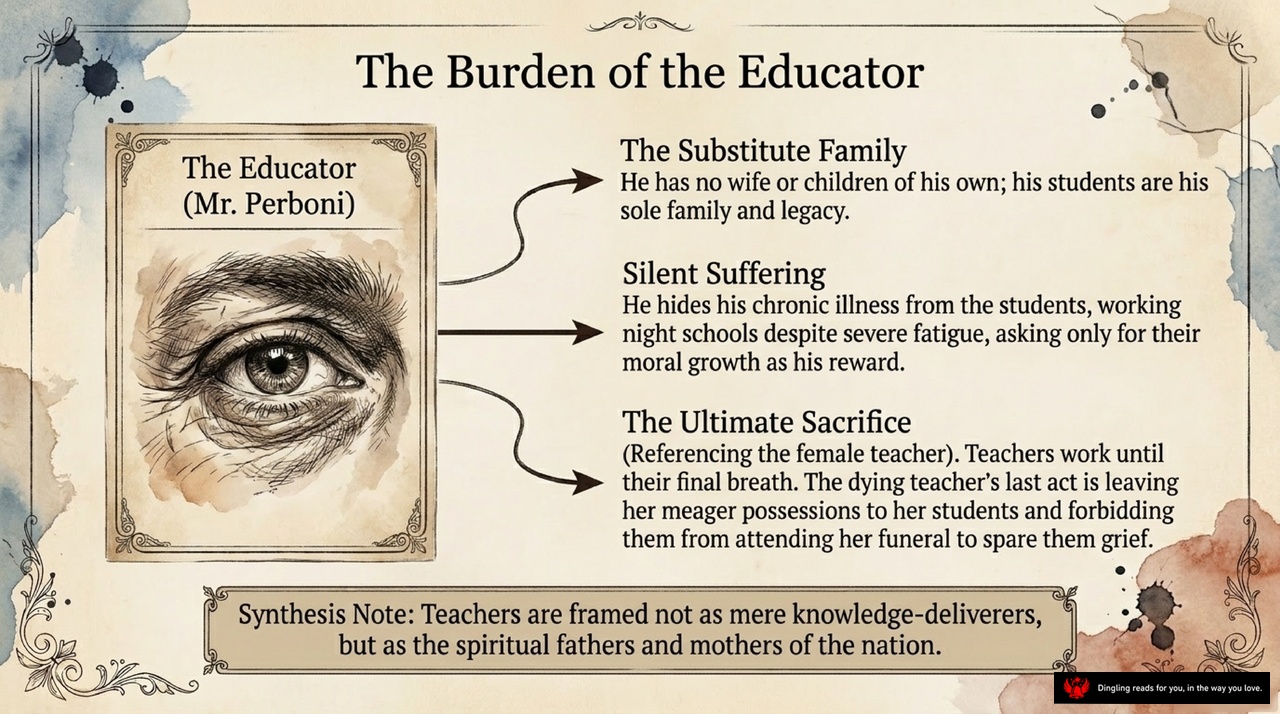
Today's slide captures the heartbreaking yet noble reality of teaching in *Cuore*: "The Burden of the Educator." It frames teachers not just as instructors, but as spiritual parents. Look at Mr. Perboni; he has no wife or children of his own, so his students become his sole family and legacy. He hides his chronic illness from them, working through severe fatigue, finding his only reward in their moral growth.
This burden extends to the ultimate sacrifice. Consider the female teacher, who works until her final breath. Even as she dies, her last act is leaving her meager possessions to her students and forbidding them from attending her funeral to spare them grief. The text tells us she was so exhausted that she passed away before the school year ended, yet she spent her last day visiting each student one by one, kissing them goodbye. She bequeathed all her books and items to the class.
Ultimately, teachers are framed as the spiritual fathers and mothers of the nation. They give everything, often sacrificing their own lives, to nurture the next generation.
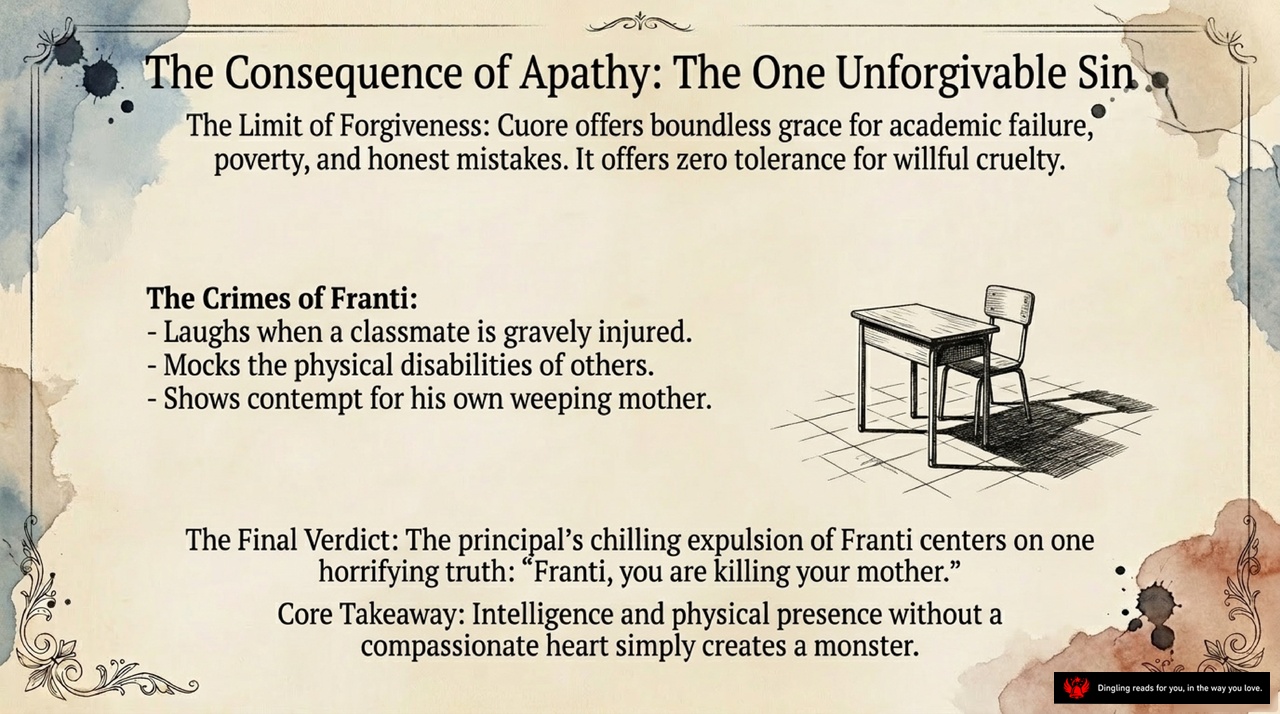
Today, we face the ultimate test of character: not in how we succeed, but in how we treat those who cannot help us. The story of Franti serves as a chilling warning about the true cost of apathy. While the school offers endless grace for academic failures, poverty, or honest mistakes, it draws a hard, unforgivable line at willful cruelty. Franti's crimes were not just about bullying; they were a series of calculated acts of indifference. He laughed when a classmate was gravely injured, mocked the physical disabilities of others, and showed total contempt for his own weeping mother. His intelligence and physical presence meant nothing because his heart was devoid of compassion.
The final verdict from the principal is stark and terrifying: "Franti, you are killing your mother." This expulsion wasn't just about discipline; it was a recognition that Franti's actions were slowly destroying the very person who loved him. The core takeaway is profound: intelligence and physical presence without a compassionate heart simply create a monster. True strength lies not in how you dominate others, but in how you protect the vulnerable and honor the sacrifices of those around you.

Education as a Lifelong Safety Net. This slide captures the profound truth that education is not merely a path to personal wealth, but the ultimate societal salvation that bridges deep divides. Look at the center: The Day School, The Night School, and The Deaf-Mute Institute. These aren't just buildings; they are lifelines. On the left, we see grown men—stokers, carpenters, and laborers—squeezing into miniature children's desks after grueling 12-hour shifts, fighting physical exhaustion just to learn to read and write. On the right, education brings language, connection, and humanity back to marginalized children who were previously treated as outcasts or beasts. The text presents this clearly: education acts as a social equalizer, connecting the exhausted worker with the lost child, and the isolated individual with the community. It transforms the classroom into a sanctuary where every person, regardless of their background or struggle, finds a place to belong and heal.

Today, we explore the true heart of *Cuore*: The Patriotism of the Heart. This isn't about blind aggression or hating outsiders; it is a deep, unifying love for our land and its diverse people. From the mountains of the north to the southern coasts, this bond is built on three core pillars. First, Shared Sacrifice: the willingness to lose oneself for the safety of the collective, whether it's a boy jumping into a river to save a friend or a soldier defending the homeland. Second, Courage in Adversity: facing overwhelming odds with quiet dignity, like the Sardinian Drummer Boy who marched on despite a shattered leg. Finally, Unifying Love: an emotional connection that bridges class and background. We see this in the story of the Sardinian Drummer Boy and the Lombard Boy, woven through the diary as tales of young national heroes. True patriotism is found in these everyday acts of bravery and kindness, proving that love for country begins with love for one's neighbor.
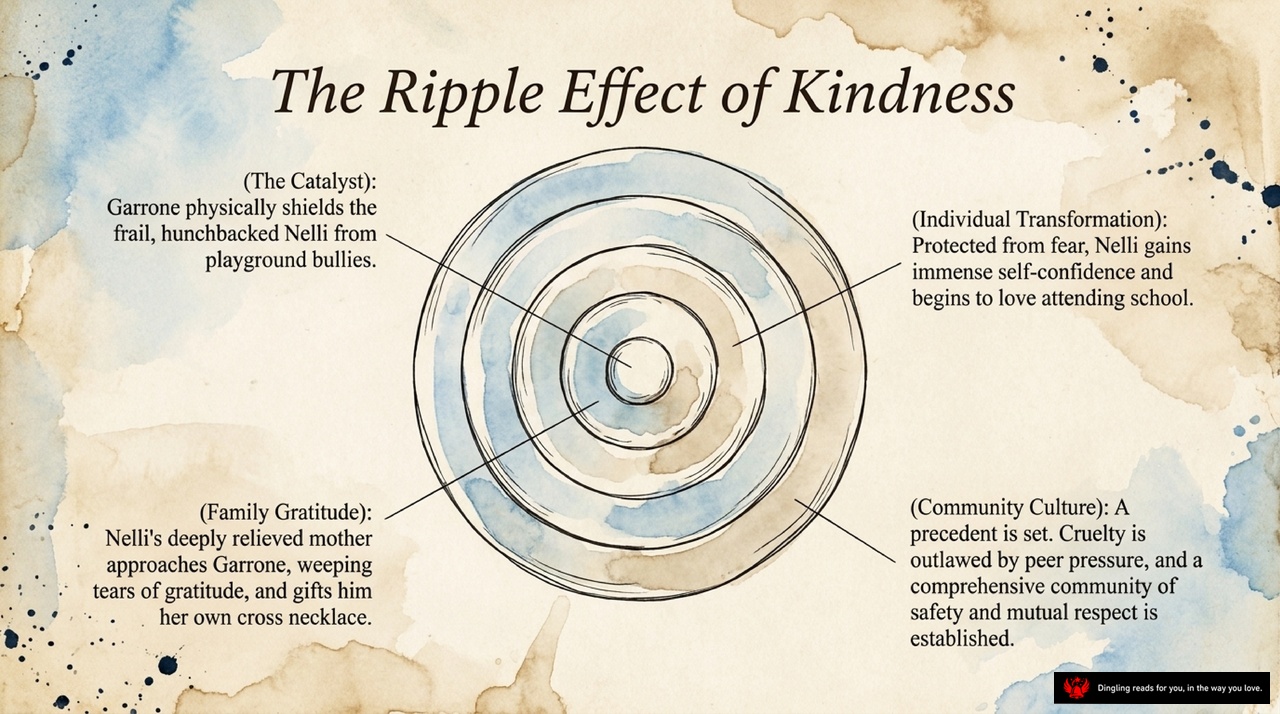
Have you ever stopped to think about how a single act of kindness can change an entire community? Today, we're exploring the "Ripple Effect of Kindness" using a powerful story from *Cuore*.
Imagine a quiet playground where fear is the norm. That is where our story begins. Garrone, a tall and strong boy, sees a frail, hunchbacked boy named Nelli being bullied. Instead of walking away, Garrone physically steps in and shields Nelli from the tormentors. This is the catalyst—the very first ripple.
But what happens next? The impact spreads outward in concentric circles. First, we see individual transformation. Protected from fear, Nelli's spirit lifts. He gains immense self-confidence and, for the first time, begins to love attending school.
The ripple doesn't stop there; it reaches the family. Nelli's mother, deeply relieved and grateful, approaches Garrone. Weeping with emotion, she gifts him her own cross necklace. This act of gratitude transforms a moment of protection into a lasting bond of friendship.
Finally, the effect ripples out to the entire community culture. Because Garrone stood up, cruelty is effectively outlawed by peer pressure. A precedent is set, establishing a comprehensive community of safety and mutual respect for everyone.
Kindness is never a solitary act. It is a force that expands, protecting the vulnerable, healing families, and building a safer world for us all.
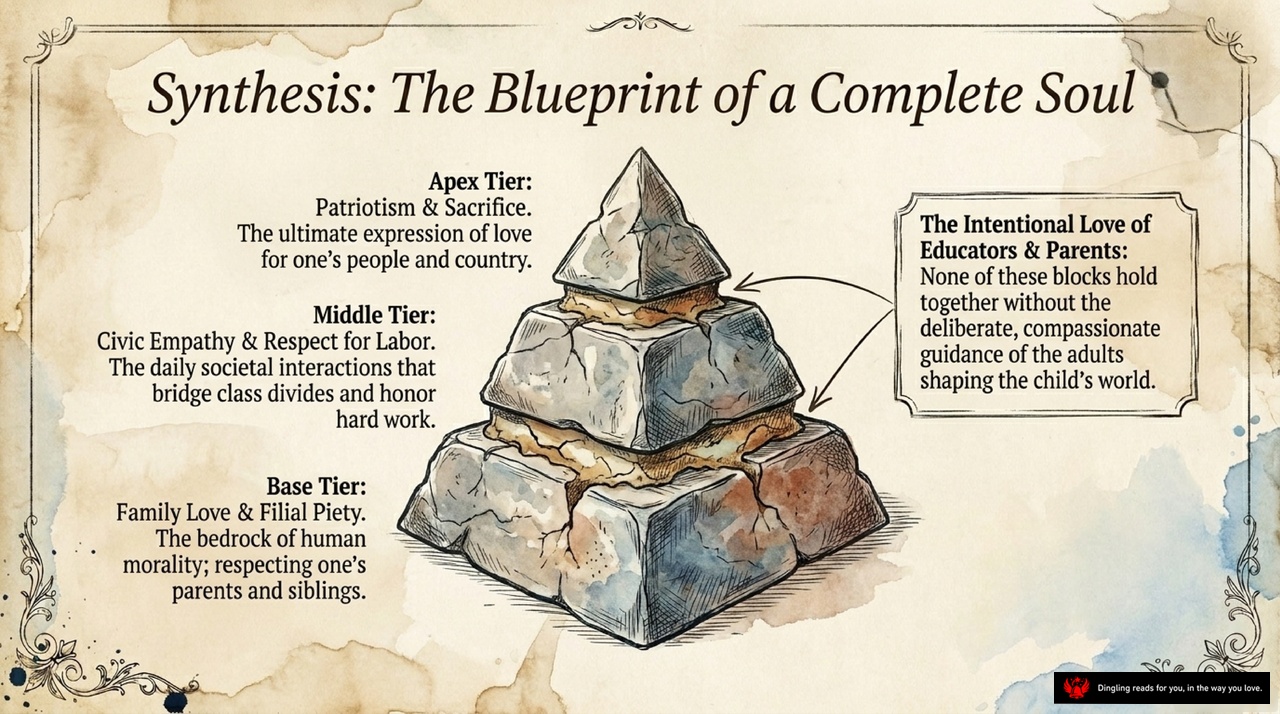
Synthesis: The Blueprint of a Complete Soul.
Look at this pyramid. It's not just a diagram; it's the architecture of a truly human life. At the very bottom, the Base Tier, we have Family Love and Filial Piety. This is the bedrock. Without respecting the parents and siblings who gave us life, everything else crumbles. Think of our friend Clopin, who worked himself to the bone to support his family, or the young马可 who traveled thousands of miles just to find his mother. Their actions prove that love for family is the first lesson we must learn.
But a foundation alone isn't enough. That's where the Middle Tier comes in: Civic Empathy and Respect for Labor. This is the glue that holds society together. It's about bridging class divides and honoring the hard work of others, whether it's a chimney sweep, a blacksmith, or a soldier. We saw this when the whole class stood up for the humble workers, and when they cheered for the injured boy, Lope谛. True citizenship isn't about status; it's about treating every human being with dignity.
And at the very top, the Apex Tier: Patriotism and Sacrifice. This is the ultimate expression of love for our people and country. It's not about blind aggression, but about selfless acts like the boy who saved a stranger from a car, or the drummer boy who ran through enemy fire to save his unit. But here is the crucial secret revealed on the right side of our slide: The Intentional Love of Educators and Parents. None of these blocks—the family, the community, the nation—hold together without the deliberate, compassionate guidance of the adults shaping the child's world. It is the teachers and parents who instill these values, turning individual hearts into a cohesive, moral society.

True education, as *Cuore* reminds us, is far more than just the accumulation of knowledge; it is the cultivation of empathy, the breaking down of class barriers, and the nurturing of a compassionate heart. Imagine a school system that is perfectly structured on paper, yet empty of human love. If we perfect the shape of our educational systems but forget to fill them with the water of human love, what kind of future are we truly building?
Think about the characters we meet in this story. We see the tall, gentle Camillo protecting the weak, the hardworking boy who helps his family while studying late at night, and the teacher who sacrifices her own health to guide every student. These moments teach us that real learning happens not just in textbooks, but in how we treat one another. When a student shares his prized stamp collection to apologize for an accident, or when a teacher stays late to help a struggling child, that is where the true value of education lies. It is in these acts of kindness that we learn to see the humanity in others, regardless of their background or status.
So, let us ask ourselves: Are we building a society of scholars, or are we building a community of caring humans? The answer lies in whether we choose to prioritize love and empathy alongside our academic achievements. Because in the end, the most important lesson we can ever learn is how to be kind.