
Do It, Mean It, Be It: Complete Chapter-by-Chapter Summary
Welcome to the book "Deep Growth" by Corey Shanahan. Imagine your career and life not as a series of random events, but as a carefully constructed blueprint. This book offers exactly that—a holistic, actionable plan to build the ultimate version of yourself. Think of it as an architectural drawing for your future, where every decision lays a brick toward a stronger foundation. The journey ahead isn't just about climbing higher; it's about building deeper, creating a life that is both meaningful and sustainable. Let's dive into how you can start designing your own path today.
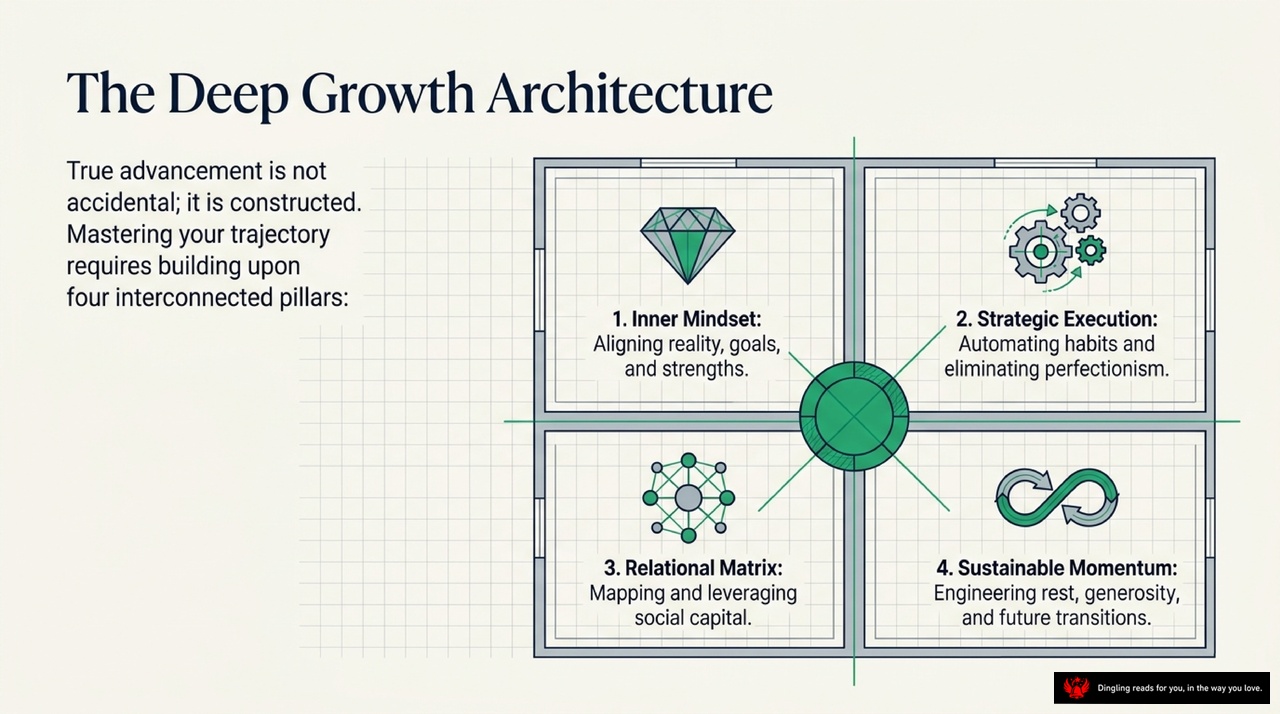
True advancement isn't something that just happens to you; it is a structure you deliberately build. Think of your career growth not as a lucky accident, but as an architectural project with four interconnected pillars.
First, you need to align your inner mindset with reality, your goals, and your unique strengths. This means honestly assessing where you are and leveraging what you do best. Second, focus on strategic execution. This is about automating the good habits that move you forward while ruthlessly cutting out perfectionism that holds you back. Don't wait for everything to be perfect before you start.
Third, map out your relational matrix. Your network is your net worth. You must actively identify who holds influence and who you trust, ensuring your social capital is working for you, not just existing in the background. Finally, you must engineer sustainable momentum. This means designing your life to include rest, generosity, and clear paths for future transitions so you don't burn out.
When you construct your life around these four pillars, you stop reacting to chaos and start directing your own trajectory. True growth is the result of this deliberate architecture.

Let's talk about how we actually work. It turns out, our brains have two distinct modes, and knowing which one you're in changes everything. Daniel Kahneman calls them System 1 and System 2. System 1 is your fast, intuitive autopilot. It's what lets you drive home while thinking about your weekend without consciously gripping the wheel. It's efficient, but dangerous if you rely on it too much, because it loves shortcuts and stories over facts.
Then there is System 2. This is your slow, rational, focused mode. Think of learning to drive for the first time. You have to consciously think about every pedal and mirror. It takes energy and effort. The problem is, we often try to use System 2 for everything, leading to burnout.
Consider the story of Melanie, a high-performing executive who moved to a new headquarters to lead a team restructuring. She was confident she could handle it, but she found herself exhausted despite doing less than she expected. Why? Because she was forcing System 2 to handle tasks that were becoming routine. She was treating familiar challenges like a first-time learner, draining her mental battery. The solution wasn't to work harder, but to rest more and recognize when a task has shifted from "new and hard" to "automatic and easy."
On the other side of the spectrum is Angela Duckworth's concept of grit. Her formula is simple: Talent times Effort equals Skill, and Skill times Effort equals Achievement. Her research shows that raw talent matters far less than focused, deliberate practice. Think of a father who runs with his son. The father runs fast naturally, but the son, through years of specific, focused training, eventually outpaces him. Without that concentrated effort, simple repetition just gets you tired, not better.
We also need to guard against perfectionism. It's a silent killer of progress. Churchill famously said, "Perfection is the enemy of good." When we obsess over formatting a document or waiting for the perfect moment to speak up in a meeting, we lose the chance to actually move forward. We end up exhausted, over-critical of ourselves and our teams, and stuck in a loop of anxiety.
The good news is that our bodies are designed to heal. Exercise is like a broad-spectrum medication for the mind, boosting mood and cognitive function. And meditation isn't just a spiritual practice; it's a science-backed tool to lower stress and inflammation. You don't need hours of silence to start. Even a few minutes of breathing after a workout or during your commute can reset your nervous system.
Finally, look at Lars Turell, a former CEO who built a "portfolio life." He didn't choose between career, family, and hobbies; he found the overlap. He treated his retirement not as an end, but as a new chapter where he could pursue what was interesting, useful, and rewarding. The lesson is clear: effective effort isn't about grinding harder. It's about understanding your mental state, trusting your intuition when appropriate, practicing with focus, and taking care of your body so you have the energy to keep going.
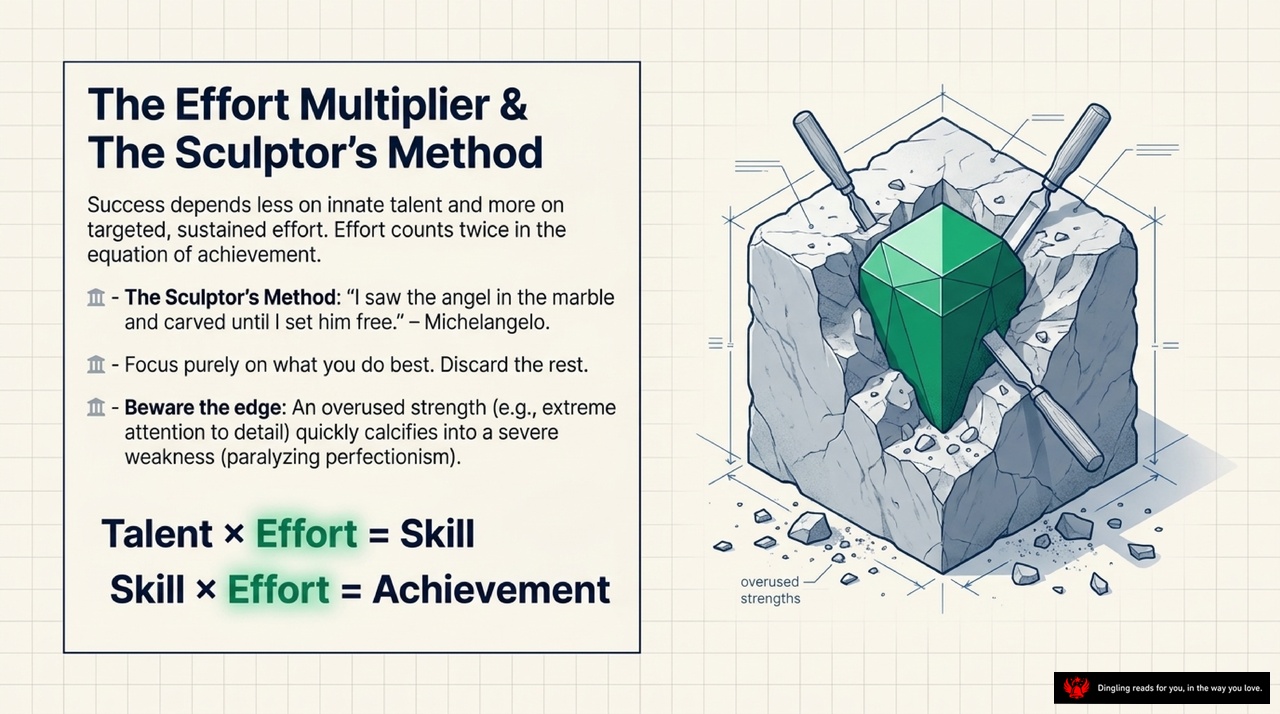
Let's talk about how we actually achieve things. Forget the myth that you need to be a genius to succeed. The truth is, success depends less on innate talent and more on targeted, sustained effort. Think of it this way: Talent multiplied by Effort equals Skill, and then Skill multiplied by Effort equals Achievement. Your effort counts twice in the equation of your success.
But how do we get there? We can look to the sculptor's method. As Michelangelo famously said, "I saw the angel in the marble and carved until I set him free." This means you don't wait for inspiration; you focus purely on what you do best and discard the rest. You chip away at the stone of your limitations until your potential is revealed.
However, there is a trap we all fall into. We must beware the edge. An overused strength, like extreme attention to detail, can quickly calcify into a severe weakness. Too much focus on perfectionism can actually paralyze you. When you push an advantage too far, it stops being a superpower and becomes a liability.
So, remember the formula: don't just rely on raw talent. Invest in your skills through deliberate effort, and be careful not to let your greatest strengths turn into your biggest obstacles. That is the real path to achievement.
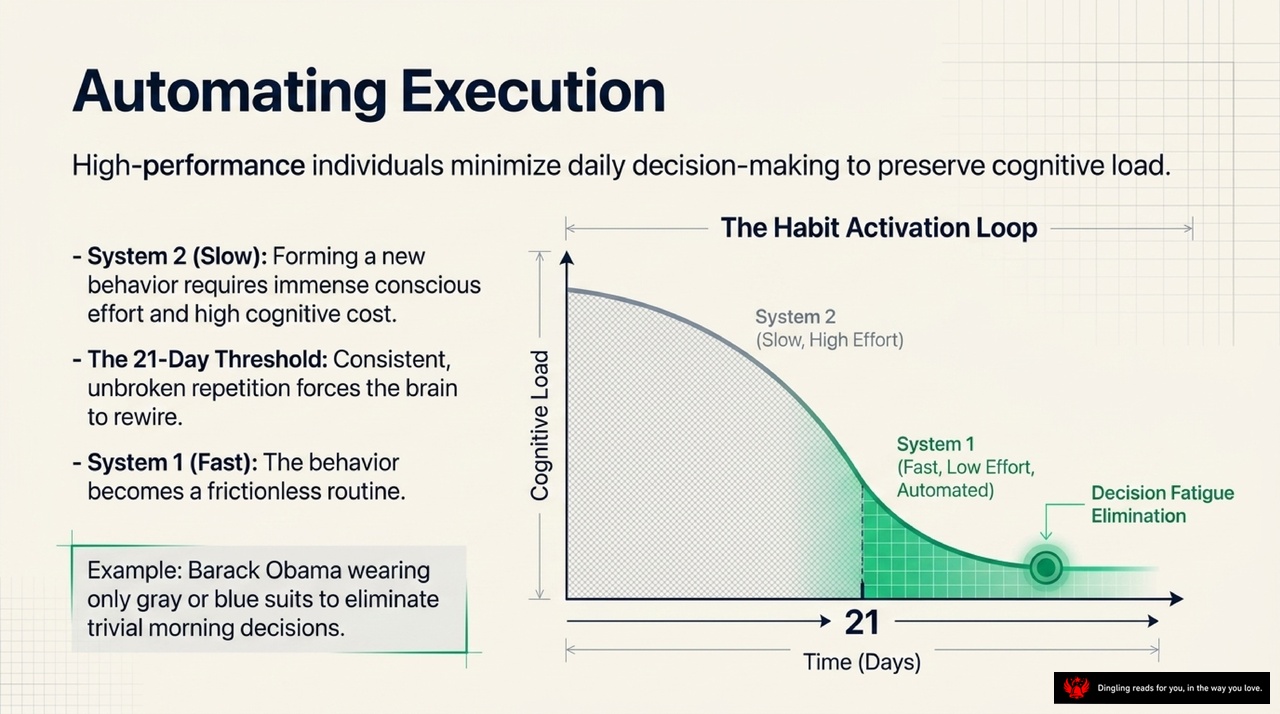
High-performance isn't about doing more; it's about designing your life so you do less of the same. Today, we're talking about "Automating Execution." The core idea is simple: minimize daily decision-making to preserve your cognitive load. Think about your brain as having two systems. System 2 is your slow, deliberate thinker—it requires immense conscious effort and high cognitive cost. That's the mental energy you burn when you're learning a new skill or making a tough choice.
But high-performers know that relying on System 2 every day leads to burnout. They aim to shift behaviors into System 1. This is the fast, automatic mode where actions become frictionless routines. The bridge between these two states is the "21-Day Threshold." Research suggests that consistent, unbroken repetition over about 21 days forces your brain to rewire, turning a difficult task into an easy habit.
Consider the classic example of Barack Obama. He famously wore only gray or blue suits every day. Why? To eliminate trivial morning decisions. By automating what he wore, he freed up his mental bandwidth for the truly important choices that defined his presidency. This concept is often visualized as a "Habit Activation Loop." At the start, cognitive load is high as you struggle with new behaviors. But as you push through those first 21 days, that load drops dramatically. Once you cross that threshold, you enter a zone of "Decision Fatigue Elimination." You're no longer wrestling with choices; you're simply executing your routine.
The goal isn't to remove all thinking, but to automate the trivial so your best thinking can go to the vital. By building these automated loops, you stop draining your willpower on small things and start directing your energy toward what actually moves the needle in your life and career.
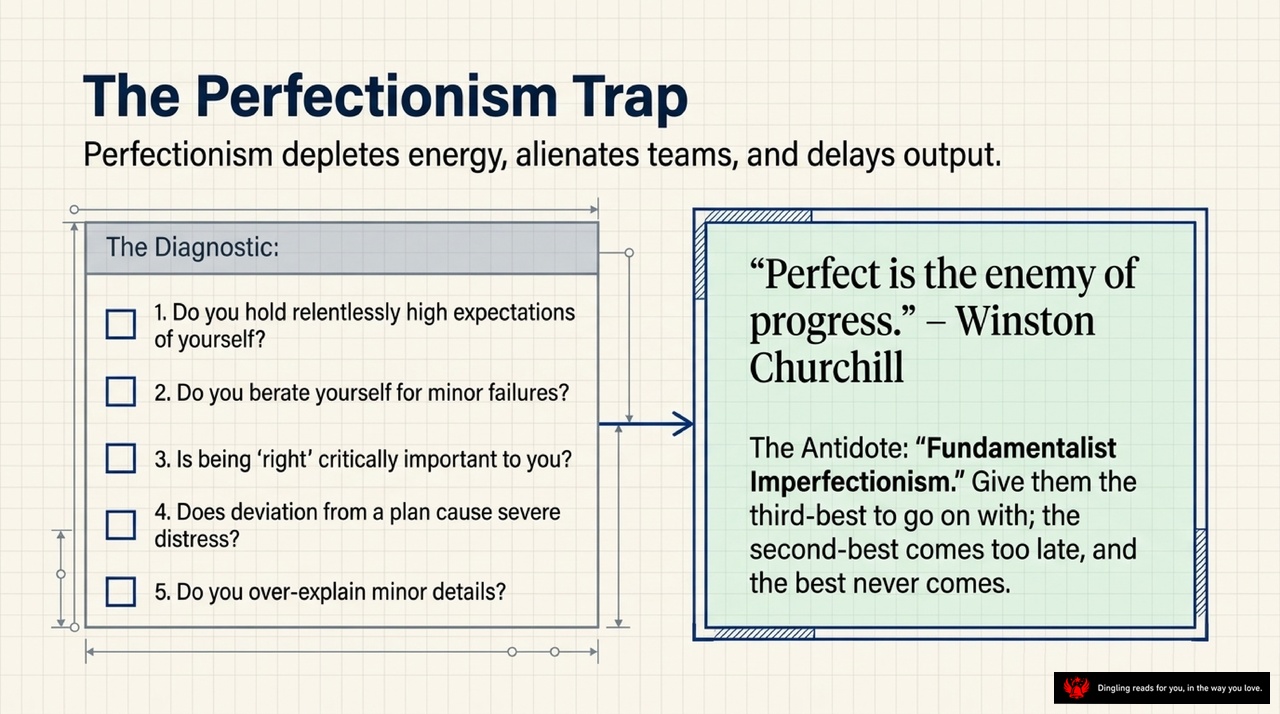
Perfectionism is often disguised as a virtue, but in reality, it acts as a silent thief of your potential. As the slide clearly states, "The Perfectionism Trap" depletes your energy, alienates your team, and most dangerously, delays your actual output. Have you ever found yourself endlessly tweaking a slide deck or rewriting an email, paralyzed by the fear that it isn't quite "right"? That is the trap.
To diagnose this, ask yourself the hard questions listed on the left: Do you berate yourself for minor failures? Is being "right" more important to you than being done? Does a small deviation from your plan cause severe distress? If you answered yes, you are likely stuck in a cycle of fundamentalist imperfectionism.
This mindset is exactly what Winston Churchill warned us about: "Perfect is the enemy of progress." When we wait for perfection, we never move forward. The antidote, as shown on the right, is to embrace the "third-best" option. Why? Because the second-best often comes too late, and the absolute best might never arrive at all.
Think about your work life. We often obsess over minor details—like formatting a document perfectly—while ignoring the bigger picture, such as a flawed argument or a missed market opportunity. This is the cost of perfectionism. It creates internal friction and prevents us from taking action. Instead of waiting for the perfect moment, you need to shift your focus to "good enough" to get started.
True progress isn't about avoiding mistakes; it's about learning from them and moving forward. By accepting that your work can be imperfect yet still valuable, you free up your energy to focus on what truly matters: delivering results. Don't let the fear of imperfection hold you back. Start with what you have, refine it as you go, and remember that a finished, imperfect project is infinitely better than a perfect, unfinished one.
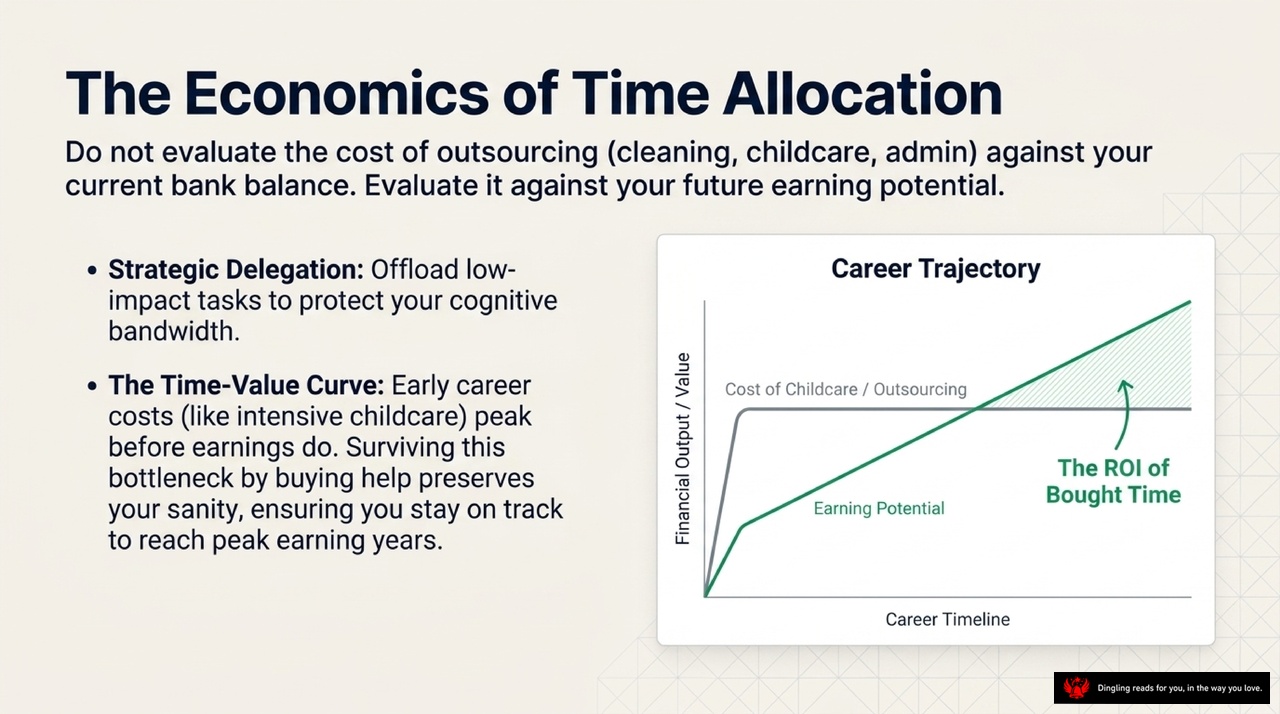
Let's talk about the economics of time allocation. Here's the hard truth: when deciding whether to outsource tasks like cleaning, childcare, or admin work, stop looking at your current bank balance. Instead, evaluate it against your future earning potential.
Look at the chart on the right. It shows the "Career Trajectory" over time. You'll see a curve labeled "Earning Potential" that starts low but climbs steeply as your career progresses. However, early on, there's a flat line representing the "Cost of Childcare or Outsourcing." If you try to survive your early years by doing everything yourself to save money, you might hit a bottleneck that stalls your growth.
That's where strategic delegation comes in. By offloading low-impact tasks, you protect your cognitive bandwidth. This leads us to the concept of the Time-Value Curve. In the early stages of your career, costs for help might seem high, but they peak before your earnings do. Investing in help now—buying your sanity and time—preserves your ability to stay on track. It ensures you reach those peak earning years without burning out. Ultimately, the shaded area on the graph represents the ROI of bought time. By investing in support now, you secure a significantly higher financial output later. Don't just spend money on today; invest your time for the value of tomorrow.

The slide you see here is a powerful tool called "The Relational Diagnostic Matrix." Think of it as an X-ray for your professional network. It helps you stop wasting energy on the wrong people and focus on the ones that actually move your career forward.
On the left, you have "Influence or Impact"—how much power someone has over your trajectory. On the bottom, you have "Relationship Quality"—how strong your actual connection is with them. This creates four distinct zones, and your strategy for each one is completely different.
Look at the top-left quadrant, highlighted in green: "Critical Targets." These are the most important people for your success—maybe they hold the keys to your promotion or control your budget—but right now, your relationship with them is weak. This is where you must apply your networking efforts surgically. You can't afford to be casual here; you need immediate, strategic relationship-building.
To the right, in the top-right, are your "Allies." These people already have high influence and a strong relationship with you. Your job here is simple: maintain and leverage them. They are your safety net and your champions.
In the bottom-right, you have your "Friends." They are great people with high-quality connections, but they don't have the same level of professional influence or impact on your specific goals. The advice here is to enjoy their company, but limit your professional reliance on them. Don't let them become your only source of career support.
Finally, look at the bottom-left: "Distractions." These individuals have low influence and a weak relationship with you. They are the time-wasters. The slide clearly states: ignore or remove them. Don't try to impress them, and don't let them drain your energy.
By mapping your stakeholders this way, you optimize your social capital. You stop spreading yourself thin and start focusing your efforts exactly where they count most.

When we talk about climbing the career ladder, we often confuse two critical roles: the mentor and the sponsor. While both are essential, they serve completely different structural functions in your advancement.
Think of the mentor as your guide. Their primary role is to offer advice, perspective, and psychological support. They can be anyone, anywhere in or outside your organization. The exchange here is simple: you gain wisdom, and they gain satisfaction from seeing you grow. The best part? You can actually ask someone to be your mentor.
Now, look at the sponsor. This is where the real power lies. A sponsor is a senior leader with direct organizational influence who advocates for you in closed-door meetings and actively drives your promotions. Unlike the mentor, you cannot simply ask for a sponsor; you must earn one through exceptional, highly visible performance. You gain advancement, and in return, they gain a loyal, high-performing lieutenant.
So, while your mentor helps you navigate the path, your sponsor is the one who pushes the elevator up. To truly accelerate your career, you need both, but you must understand that getting a sponsor requires you to prove your value loudly and clearly.
Here is the spoken-word script tailored for a professional book sharing session, designed to resonate with an American audience.
**Visibility and The Perception Gap**
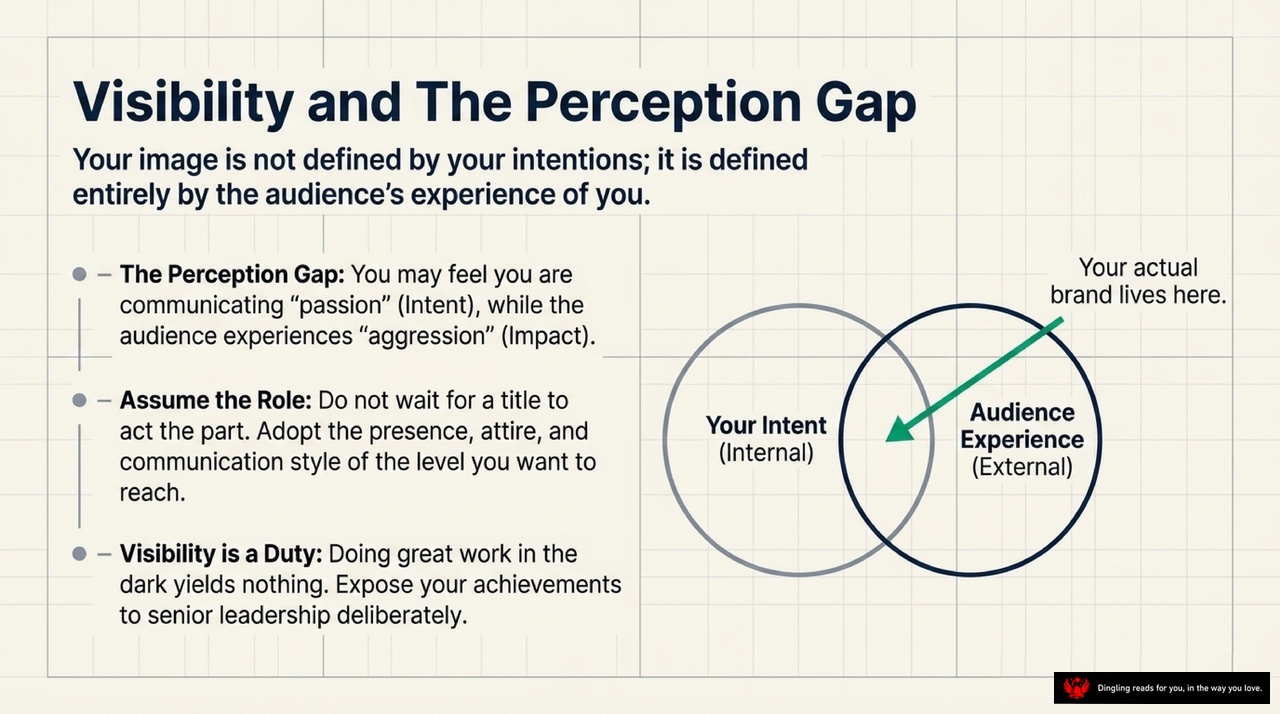
Look at this slide. It hits on a truth that often stings but is absolutely necessary: your image isn't defined by your intentions; it's defined entirely by the audience's experience of you. We live in a world of constant performance, and there is a massive "Perception Gap" happening right now. You might feel you are communicating passion—that's your intent—but the audience might be experiencing aggression—that's their impact. That disconnect is where your brand actually lives, and it's often in the overlap between what you think you're doing and what they're actually feeling.
To bridge this gap, you have to stop waiting for a title to act the part. You need to assume the role immediately. Adopt the presence, the attire, and the communication style of the level you want to reach. Don't let your internal reality dictate your external visibility. If you want to be seen as a leader, you have to behave like one, not just when you're in the spotlight, but in the quiet moments too.
This brings us to a crucial mindset shift: Visibility is a duty. We often think, "If I do great work in the dark, it will eventually get noticed." But in today's fast-paced environment, doing great work in the shadows yields nothing. You must deliberately expose your achievements to senior leadership. It's not about bragging; it's about ensuring that your value is visible. You have to bridge the distance between your internal intent and the external experience of your audience. When you align your actions with the perception you want to create, you stop guessing and start leading. Your brand isn't what you say it is; it's what they see when they look at you.
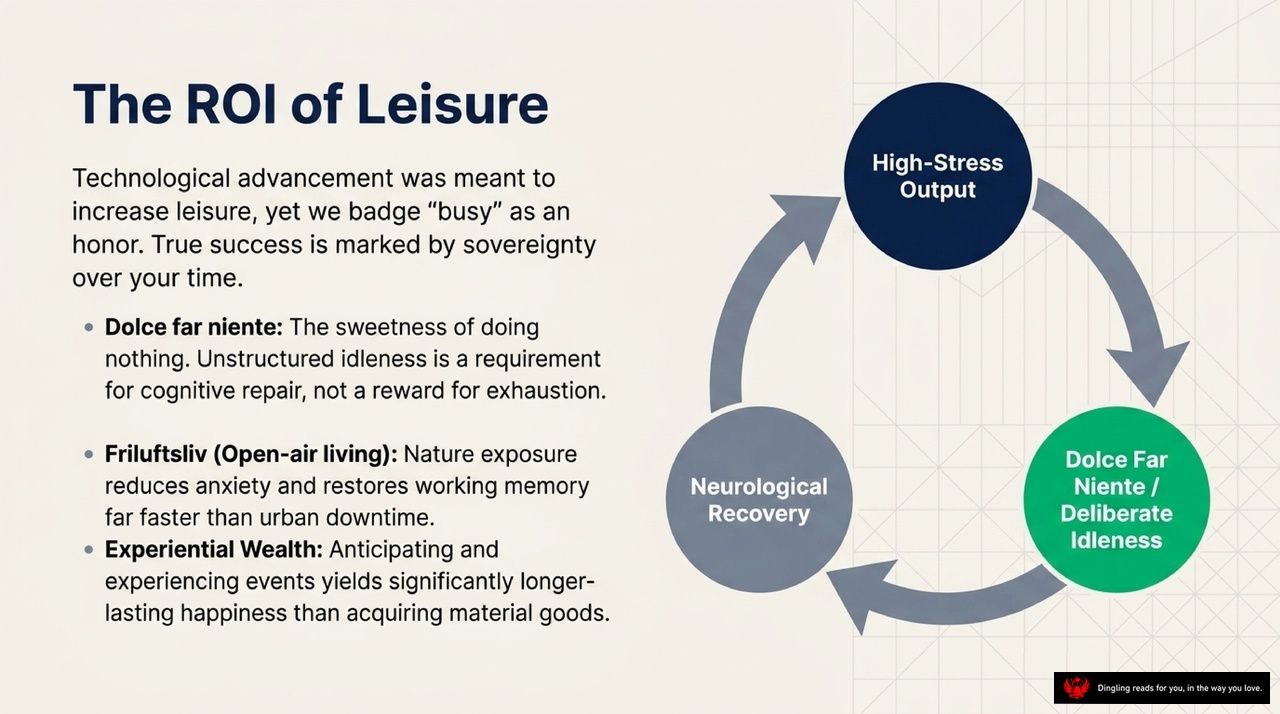
Look at this cycle on the right: it maps out the true Return on Investment of leisure. We often think productivity is just about high-stress output, but the chart shows a smarter path. After the pressure, we need neurological recovery, and that leads us to a state of "Dolce Far Niente"—which simply means the sweet art of doing nothing. This isn't just about relaxing; it's about deliberate idleness to let your brain repair itself.
The text on the left explains why this matters. Technology was supposed to give us more free time, yet we've ironically made being "busy" a badge of honor. True success, as the slide suggests, is actually about sovereignty over your time. We need to embrace concepts like *Friluftsliv*, or open-air living, because stepping into nature restores your working memory faster than just sitting in an office. And remember, building "experiential wealth"—anticipating and enjoying life events—brings far more lasting happiness than chasing material goods. So, stop treating rest as a reward for exhaustion. Instead, view unstructured idleness as a critical requirement for your cognitive health. It's the ROI that actually pays off.

Imagine a seesaw balancing two very different approaches to helping others. On one side, we have "Pro-Social Giving"—giving that is strategic and boundaried. On the other, we have "Meddling"—the urge to rescue or solve problems unsolicited. The Alameda County Study reveals a brutal truth: social isolation carries a mortality risk 2.3 to 2.8 times higher than being connected. This proves that our social ties are a biological imperative.
So, how do we give without falling into the "Meddling Trap"? The book warns that trying to "fix" every crisis for family and colleagues destroys our own boundaries and damages primary relationships. Instead, we need to embrace "The Warm Glow." When we give generously, we fulfill our core human needs for competence and autonomy. But we must also protect our momentum. That's where "The 24-Hour Rule" comes in. When asked for a major favor, wait 24 hours before replying. This simple pause protects your energy and ensures you're helping from a place of choice, not obligation. By shifting from reactive meddling to strategic generosity, you not only preserve your own well-being but also strengthen the very social network that keeps you alive and thriving.

Stop treating your career like a single-lane sprint where you run until you hit a wall. Instead, engineer a "Portfolio Life" before you even need it. Think of your life not as one job, but as a diversified investment portfolio.
Look at this visual breakdown. We are moving away from the traditional "Corporate Board Seat" as our only focus. Instead, we allocate time across a broader spectrum. The slide highlights diversifying your output by blending board roles, advising, passion projects, and crucially, family time. You want to avoid the trap of running on a single track.
Here is the golden rule from the text: The 20% Rule. During your final corporate years, dedicate at least 20% of your time to building external networks and advisory relationships. Don't wait until you leave the company to start your next chapter. Start now.
Furthermore, define your career virtue. Ask yourself: What will your farewell speech highlight? Focus on the traits you want remembered, not just the metrics you hit. Whether you move into independent consulting, philanthropy, or simply enjoying more family and leisure time, the goal is to balance your time so that when the final chapter closes, you're proud of who you were, not just what you produced.
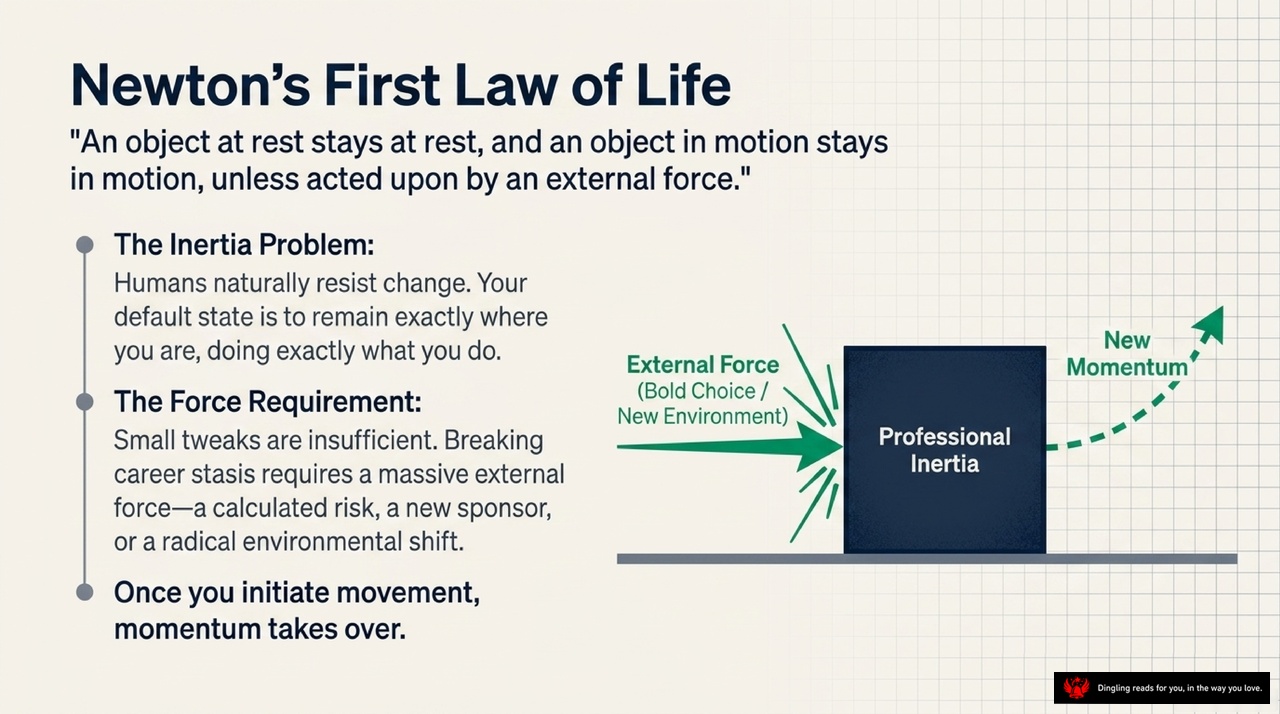
Newton's First Law isn't just physics; it's the hidden rule of our careers. As the slide shows, an object at rest stays at rest, and an object in motion stays in motion unless acted upon by an external force. Think of this as "Professional Inertia." Humans naturally resist change; our default state is to stay exactly where we are, doing exactly what we do.
But here's the hard truth: small tweaks aren't enough. If you're stuck in career stasis, you need a massive external force. This could be a calculated risk, a new sponsor, or a radical shift in your environment. That green arrow in the diagram represents that necessary push—a bold choice or a new setting hitting your current reality.
However, once you apply that force and initiate movement, something powerful happens: momentum takes over. The slide illustrates this perfectly with that dashed green line curving upward into "New Momentum." The key takeaway is that once you start, the law of inertia works in your favor, carrying you forward with less effort than you might expect. So, don't wait for the perfect moment; just apply the force, and let the momentum do the rest.
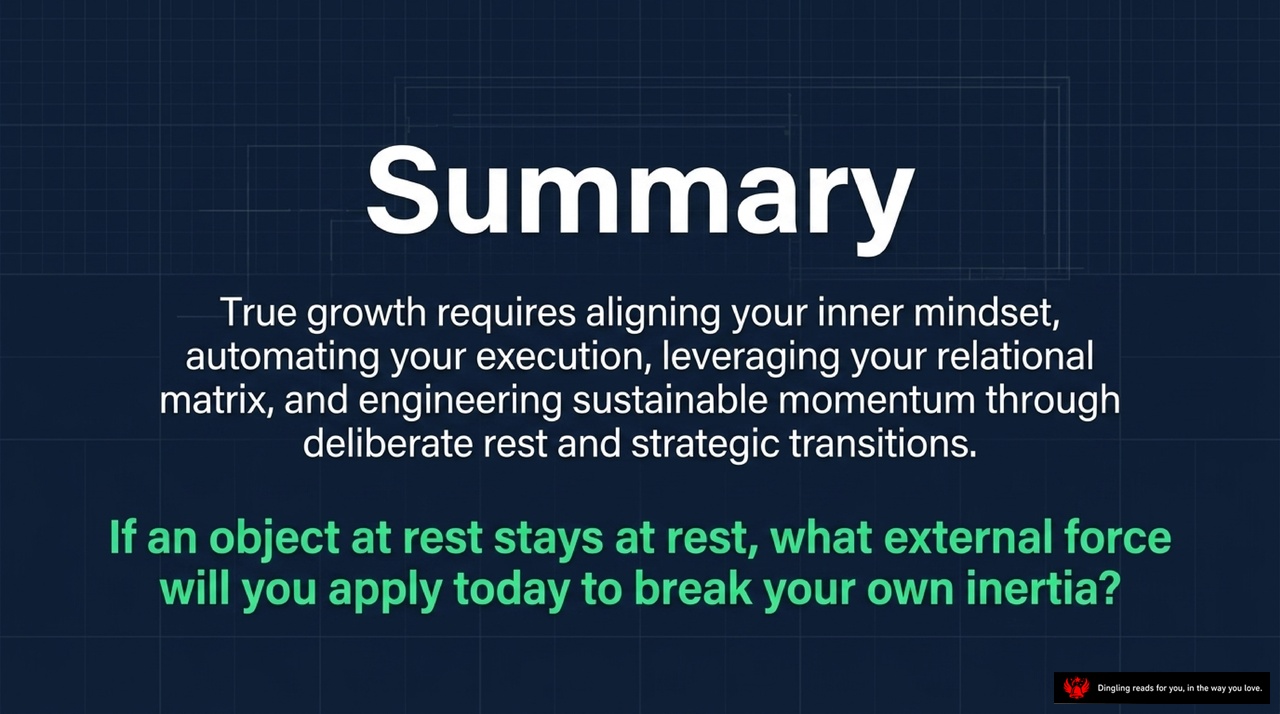
Let's wrap up our journey into building a meaningful life. As we look at this summary slide, I want to leave you with a powerful framework for true growth. It's not about doing more; it's about aligning four critical pillars: your inner mindset, your execution, your relationships, and your rhythm.
Think of it this way: real progress starts with fixing how you think, then automating your daily actions so they become effortless habits. You also need to leverage your network—your relational matrix—not just for help, but as a force multiplier. But here's the secret ingredient that most people miss: sustainable momentum doesn't come from non-stop grinding. It comes from deliberate rest and strategic transitions. You have to engineer pauses into your schedule to keep moving forward.
Now, let's look at that question at the bottom. It asks us to think like physicists: if an object at rest stays at rest, what external force will you apply today to break your own inertia? Too often, we wait for motivation to strike or for the "perfect time" to arrive. But the truth is, that external force is simply you taking action right now. Whether it's starting that project, making that call, or just stepping outside for fresh air, the act of moving is what generates the momentum you need to keep going. So, don't wait for the universe to push you. Be the force that breaks your own inertia today.