
Deep Learning: Complete Chapter-by-Chapter Summary

Welcome to Deep Learning, the definitive blueprint for how computers learn complicated concepts by building them out of simpler ones. Today, we're diving into the book by Ian Goodfellow, Yoshua Bengio, and Aaron Courville.
Think of deep learning as the core engine of modern AI. Instead of relying on humans to manually engineer features, these systems automatically learn complex patterns from data. They start with simple raw inputs—like the edges and textures in an image—and progressively transform them into high-level abstract concepts, such as recognizing an entire object or understanding a sentence.
This book is designed for two main groups. If you're a student, it provides a complete knowledge system from basic math to cutting-edge techniques. If you're an engineer, it offers the practical details and engineering guidance you need to apply these technologies to real-world problems immediately.
The journey begins with the history. We'll explore the three major waves of deep learning, from the early neural networks of the 1940s to the modern revolution sparked by AlexNet in 2012. We'll see how breakthroughs in algorithms, combined with massive data and powerful hardware like GPUs, transformed theory into the powerful tools we use today.
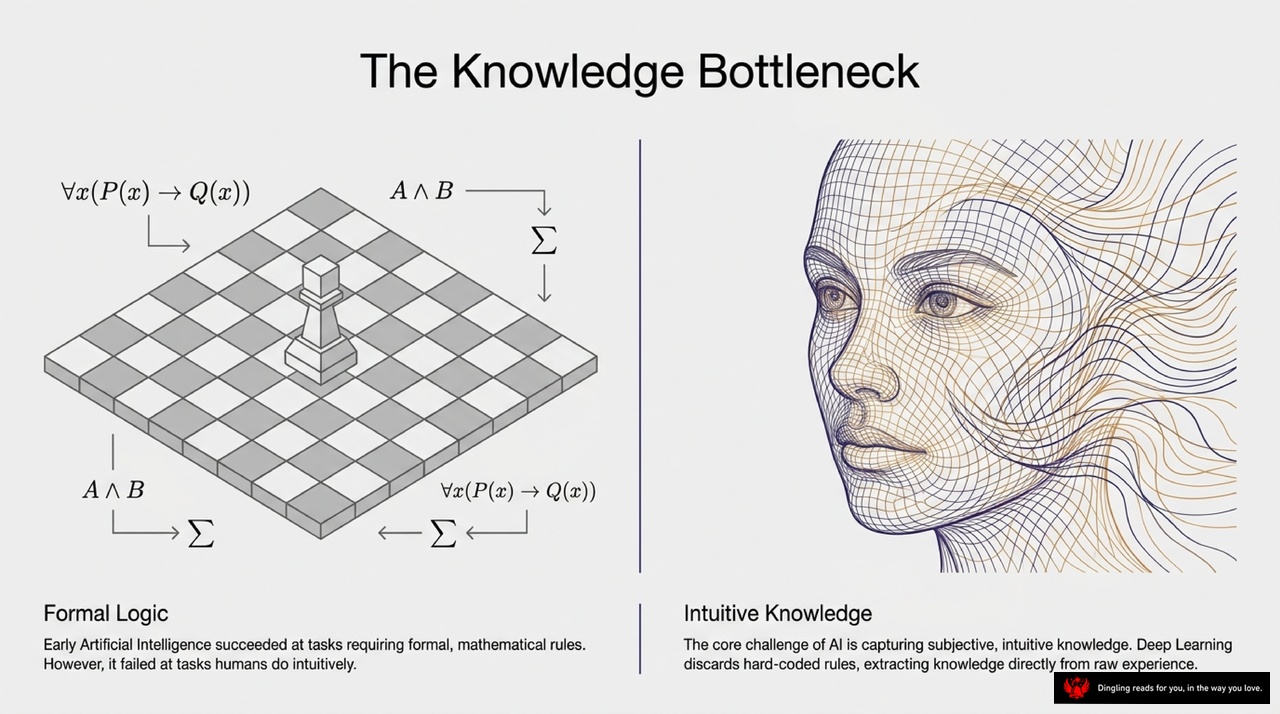
Welcome to the next chapter, where we tackle the "Knowledge Bottleneck"—the single biggest hurdle standing between today's AI and true human-like intelligence.
Look at the split on this slide. On the left, we have Formal Logic. This represents the early days of Artificial Intelligence. Think of it like a chessboard governed by strict, mathematical rules. Back then, AI excelled at tasks requiring rigid, formal logic, like solving equations or playing chess. However, as the text notes, this approach hit a wall when it came to the messy, intuitive tasks humans do effortlessly every day.
On the right, we see Intuitive Knowledge, symbolized by this wireframe face. This is the core challenge of modern Deep Learning. Unlike the old days of hard-coding rules, today's AI learns directly from raw experience. It discards those rigid constraints and instead captures subjective, intuitive knowledge—like how you instantly recognize a face or understand a joke without consciously analyzing the math behind it.
The bottleneck we face is this: How do we bridge the gap between the precision of formal logic and the fluidity of human intuition? Deep Learning is our answer. By extracting patterns directly from data rather than relying on pre-written rules, we are finally beginning to solve the problem of capturing that elusive, intuitive knowledge that defines the human experience.

Let's break down this diagram, which maps out the actual family tree of intelligence. It's easy to assume that "Artificial Intelligence" and "Deep Learning" are the same thing, but as you can see, they sit at very different levels of this hierarchy.
Think of Artificial Intelligence as the broadest circle here. It's the big umbrella covering everything from old-school rule-based systems and knowledge bases to modern learning algorithms. It's the general goal of making machines smart.
Moving inward, we hit Machine Learning. This is a specialized subset of AI. Instead of hard-coding rules, these systems learn patterns directly from data. That's a huge shift, but it's still just the outer layer of the evolution.
Then we get to Representation Learning. This is where things get interesting. Traditional machine learning often required humans to manually engineer features—like telling a computer exactly what an "edge" or a "texture" looks like. Representation Learning changes that game. It automatically discovers these features for you. The system figures out what matters on its own.
Finally, at the very core, is Deep Learning. This is the most specialized evolution of all. It doesn't just discover features; it builds hierarchical representations. It learns low-level things like edges and colors, and then combines them to understand complex objects and concepts.
So, remember this key takeaway: Deep Learning is not synonymous with AI. It is a highly specialized tool within the machine learning family, designed specifically to solve problems where we need to automatically learn complex, layered structures from raw data.

Overcoming the Curse of Dimensionality: How Deep Learning Changes the Game.
Think about the old way of doing machine learning. It felt like trying to build a skyscraper with a single brick. You, the human engineer, had to manually inspect raw data, pick out the most important features, and then try to map them directly to an answer in one shallow step. This approach hits a wall fast. As soon as you add more variables, you run into the "Curse of Dimensionality." Traditional algorithms just can't handle the complexity; they struggle with high-dimensional data and fail to capture the real patterns hiding in the noise.
But then comes Deep Learning, and it completely breaks this barrier. Instead of you manually designing features, the network automatically discovers the optimal ones from raw data. It's like giving the computer a microscope that gets smarter at every layer. It scales exceptionally well with complex, multi-dimensional inputs that would have paralyzed traditional models.
Here is the real magic: Deep Learning doesn't just map data in one step. It maps data through multiple nested functions, building exponential complexity. Imagine peeling an onion, but each layer reveals a deeper, more abstract understanding. It goes from simple edges and textures to recognizing entire objects and concepts. This hierarchical representation allows the model to handle massive amounts of variables without getting lost. While traditional methods fail as the number of variables grows, Deep Learning thrives. It transforms a seemingly impossible problem into something solvable, paving the way for the breakthroughs we see in image recognition, natural language processing, and beyond.

So, how does a computer actually "see" a car? It doesn't just stare at a photo like we do. Instead, deep learning breaks down that complex image into a series of nested, simple steps. Think of it as a hierarchy of concepts, moving from raw pixels all the way to a full object identity.
Look at this flow. It starts with the Visible Layer, which is just raw pixel data—a grid of numbers. The network then feeds this into Hidden Layer 1, where it learns to spot basic edges. Suddenly, those random numbers start forming lines.
Next, in Hidden Layer 2, the model connects those edges to recognize corners and contours. It's starting to see shapes. Then, Hidden Layer 3 takes it further, assembling those shapes into recognizable object parts, like a wheel or a door panel. Finally, the Output Layer combines all these parts to form the final identity: a complete car.
This is the magic of deep learning. It dissects complex mappings into a series of simple, nested ones. By stacking these layers, the system builds up an understanding of the world, transforming meaningless pixels into meaningful objects, one step at a time.

When we talk about building deep learning systems, we often get stuck on the math or the code. But before you write a single line of Python, you need to understand the optimization landscape you're walking into. Think of training a neural network not just as fitting a curve, but as navigating a complex, high-dimensional terrain where the goal is to find the lowest valley.
Here is the reality of that journey. Unlike traditional optimization where you know the shape of the function, deep learning deals with non-convex loss landscapes. This means your algorithm can easily get trapped in local minima—valleys that look like the bottom but aren't the global optimum. Even worse, you often face saddle points, which are flat spots where the gradient is zero, but you're not at a minimum at all. It's like being stuck on a plateau with no clear direction to go down.
You might also encounter the "vanishing gradient" problem, especially in deep networks. As information flows backward through layers, the gradients can shrink to near zero, effectively stopping learning in the earlier layers. Conversely, in some architectures, gradients can explode, causing the model to overshoot and diverge completely. These challenges make the learning rate a tricky parameter to tune; too high, and you bounce around wildly; too low, and you crawl for days.
To solve this, we rely on powerful optimization algorithms. Stochastic Gradient Descent, or SGD, is the workhorse. Instead of calculating the gradient over the entire dataset, which is computationally expensive, SGD updates the model using small batches of data. This adds some noise to the process, which actually helps escape local minima. We also use momentum to build up speed in the right direction, smoothing out the rough patches. And for adaptive learning rates, algorithms like Adam have become the standard. They automatically adjust the step size for each parameter, making the training process much more stable and efficient.
Mastering these optimization techniques is what separates a model that just memorizes data from one that truly learns.
So, let's talk about the unsupervised side of things—how machines learn from data without any labels. Think of it as discovering hidden patterns on your own.
First up, we have Linear Factor Models. Imagine you have a huge, messy dataset. These models try to break it down into a few simpler, underlying factors. It's like peeling back the layers to see what's really driving the data.
Then there are Autoencoders. Picture a neural network that acts like a compression algorithm. It takes your input, squeezes it into a smaller "bottleneck" representation, and then tries to rebuild the original from that tiny summary. If it can do this well, it means the model has learned the most important features of your data.
But here's where it gets interesting. We can make these autoencoders smarter by adding rules. For instance, a Denoising Autoencoder doesn't try to copy your input perfectly; instead, it's trained on noisy, corrupted versions of your data. This forces the model to learn robust features that survive even when things go wrong.
Finally, we have Deep Generative Models. These are the heavy hitters. They don't just learn features; they learn to create new data. Models like VAEs and GANs can generate entirely new images, sounds, or text that look incredibly real. It's the technology behind the AI art you see everywhere today.
These unsupervised techniques are the secret sauce that allows deep learning to understand the structure of reality, paving the way for everything from image generation to advanced data analysis.

Today, we're diving into the heart of generative AI with a look at energy-based models, specifically the Boltzmann Machine family. Think of these models as systems where probability is tied directly to energy: the lower the energy of a state, the higher its likelihood of occurring. It's a powerful way to define complex probability distributions.
At the foundation lies the basic Boltzmann Machine, which models binary vectors. By introducing hidden latent variables, these machines can capture high-order interactions between visible variables, effectively acting as universal approximators for discrete distributions. However, learning them is tricky because calculating the partition function—the sum of all possible energies—is computationally impossible for anything but the simplest cases.
To solve this, we turn to the Restricted Boltzmann Machine, or RBM. By restricting connections so that visible and hidden layers form a bipartite graph with no internal connections, RBMs make sampling and inference much more efficient. This structure allows us to use approximate training techniques like Contrastive Divergence, making them practical for real-world tasks.
Building on this, we have the Deep Belief Network, or DBN. It stacks multiple layers of these restricted machines. Training happens greedily, layer by layer: first capturing low-level features in the bottom layer, then using those to learn higher-level abstractions in subsequent layers. Once trained, a DBN can generate new data or serve as a smart pre-trained initializer for classification networks.
Finally, we move to the Deep Boltzmann Machine, a fully undirected model where every layer interacts with every other. While powerful, training these deep undirected models is even harder, often requiring complex variational methods.
As the field evolved, these energy-based approaches paved the way for the modern giants we know today: Variational Autoencoders and Generative Adversarial Networks. These newer models ditched the need for explicit energy functions and hard-to-calculate partition sums, offering faster, more stable training. But understanding the Boltzmann Machine family is crucial—it's the historical engine that drove the entire concept of deep generative modeling forward.

Imagine you're trying to train a deep neural network, but instead of a smooth hill, you're navigating a rugged, high-dimensional mathematical terrain. This is what we call the "Optimization Landscape." The ultimate goal is simple yet daunting: find the lowest possible error in this complex environment.
But this landscape is full of traps. Look at the "Local Minima"—these are valleys that look low, but they aren't the absolute lowest point. If your algorithm gets stuck here, it thinks it has found the best solution, but it's actually just a local optimum, missing the true global minimum.
Then there are the "Cliffs." These represent sudden drops that threaten numerical stability. In practice, hitting a cliff can cause your model to crash or produce wildly unstable results, making the training process fragile and unpredictable.
Perhaps the most insidious challenge is the "Saddle Points." These are flat regions where the gradient simply vanishes. Your learning algorithm stops moving because it sees no direction to go, effectively slowing learning to a crawl. This is a common reason why deep networks struggle to converge, even when the path to the solution is clear.
Navigating this landscape requires smart optimization algorithms that can push through these flat spots, avoid getting trapped in shallow valleys, and stay stable when facing sudden drops. Mastering this terrain is the key to unlocking the full potential of deep learning models.
Imagine a world where computers don't just memorize data, but actually understand the underlying structure of reality. This is the power of deep generative models, the final frontier we're exploring today.
Think of these models as sophisticated artists that can recreate entire universes from a single brushstroke of data. We've journeyed from the basics of spatial scanning with Convolutional Networks, which taught us how to efficiently process grid-like data like images, to the rhythmic patterns of Recurrent Networks for sequences. But now, we take a leap forward into creation itself.
The core idea here is energy-based modeling. Picture a landscape where every possible image or sound corresponds to a specific point, and the "height" of that point represents its energy. In these models, lower energy states are more probable—nature prefers the path of least resistance. The Boltzmann Machine family, particularly the Restricted Boltzmann Machine or RBM, acts as a simplified version of this, using a visible layer for input and a hidden layer to capture those complex, abstract patterns.
But the real revolution comes with Deep Belief Networks and their fully connected cousins, Deep Boltzmann Machines. By stacking these layers, we can learn hierarchical representations, moving from simple edges to complex objects, all without needing labeled data. It's unsupervised learning at its finest, letting the model discover the "grammar" of your data on its own.
Then, we arrive at the two giants that have reshaped the industry: Variational Autoencoders and Generative Adversarial Networks. VAEs combine the efficiency of neural networks with probability theory, using a clever trick called variational inference to approximate complex distributions. They are like a student trying to sketch a masterpiece while being gently corrected by a teacher, balancing reconstruction accuracy with a clean, organized latent space.
On the other side, we have GANs, which operate on a completely different principle: competition. Imagine a forger trying to create fake paintings while an expert art critic tries to spot the fakes. The forger gets better at deception, and the critic gets better at detection. Eventually, they reach a perfect stalemate where the forger's creations are indistinguishable from reality. This adversarial dance has produced the most photorealistic images and 3D avatars we've ever seen.
From Boltzmann Machines to VAEs and GANs, these models prove that deep learning isn't just about recognizing the world; it's about inventing new ones. Whether it's generating new faces, composing music, or designing molecules, these generative engines are the key to unlocking the future of creativity and discovery.

To process sequential data, a network simply can't rely on looking at each input in isolation; it needs a memory of what came before. This is the core idea behind Recurrent Networks, or RNNs. Think of it this way: instead of just processing a single snapshot, an RNN feeds its own output directly back into its input for the next step. We call this a "folded state," where the loop creates a continuous connection between the past and the present.
But visualizing a loop can be tricky. That's why we often "unroll" the network over time. Imagine laying that loop flat along a timeline. Suddenly, time transforms into depth. You see the network at time t-1, then t, then t+1. Each step takes the hidden state from the immediate past and contextualizes the current input. This unrolled view shows how the model builds up a history, allowing it to understand sequences like sentences or stock prices by effectively looking at the immediate past to make sense of the present.

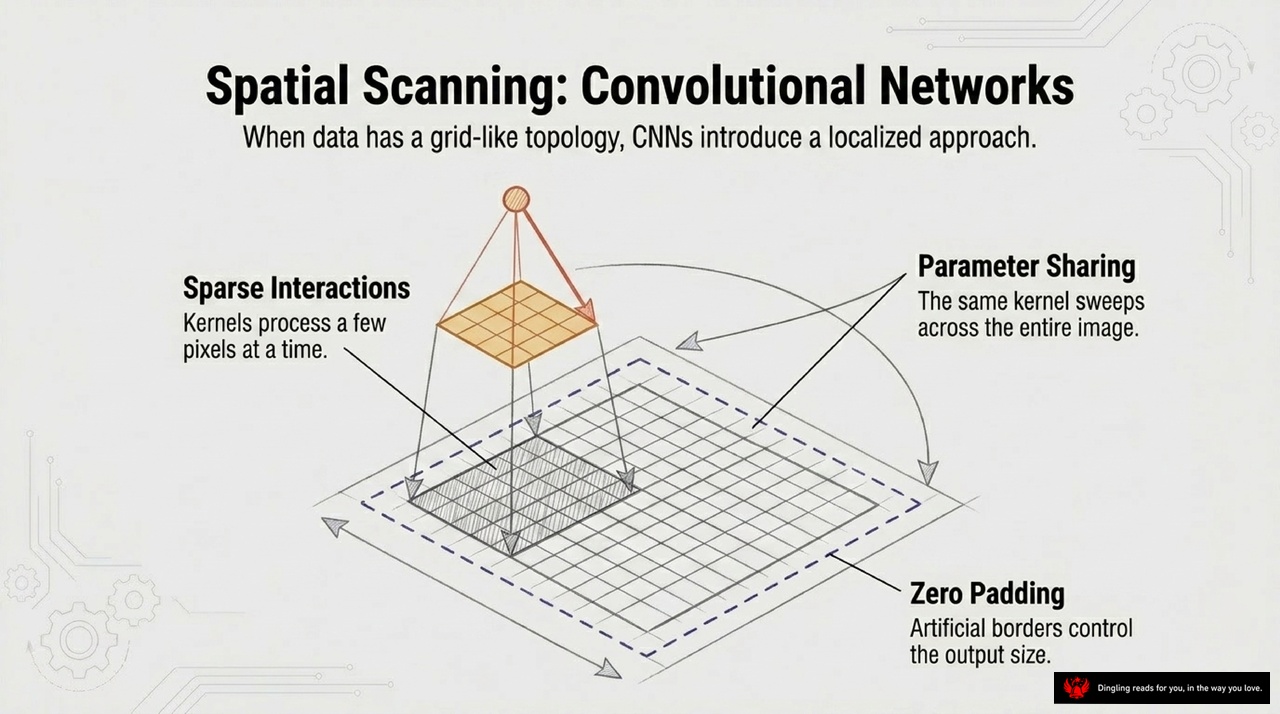
So, how do we actually build these powerful models? The answer lies in a specific neural architecture designed for grid-like data, like images or time series. This is the Convolutional Neural Network, or CNN.
Instead of treating every pixel as an independent variable, a CNN uses a core operation called convolution. Think of it as sliding a small filter, or kernel, across your image. At every position, it multiplies the overlapping values and sums them up to create a feature map. This simple math does something magical: it captures local patterns efficiently.
Why is this better than standard networks? Because of three key principles. First, sparse interaction. The filter only looks at a small local region, drastically reducing the number of parameters needed. Second, parameter sharing. The exact same filter is used across the entire image. This means the network learns that an edge is an edge, regardless of where it appears. Third, translation equivariance. If you shift the image slightly, the output shifts by the same amount, preserving the spatial structure.
Once the convolution happens, we add pooling layers. These take a small patch of the feature map and summarize it—usually by taking the maximum value. Pooling gives the model translation invariance. It doesn't matter if a cat's ear is shifted a few pixels to the left; the network still recognizes it as a cat. It also shrinks the data, making the network faster and helping it handle inputs of different sizes.
CNNs are also incredibly flexible. They can handle multiple channels to extract different types of features simultaneously. We can adjust the stride of our filters to control resolution, or add padding to keep the image size constant as we process it. Even for tasks like image segmentation or generation, we use a technique called transposed convolution to upscale features back into a full image.
This architecture, built on these efficient and robust principles, is why CNNs became the dominant force in computer vision, allowing machines to see and understand the world with remarkable accuracy.

Deep Generative Models are all about building machines that don't just memorize data, but understand it well enough to hallucinate entirely new, realistic realities. Think of it as teaching a computer the underlying rules of the world so it can invent fresh scenes, never seen before, that still feel perfectly real.
Unlike traditional models that might just learn the boundaries between categories, generative models dig deeper. They learn the complex, hidden causes driving the data. In our visual, you see this split into two layers: the Visible Units at the bottom represent the observable reality—the pixels, the sounds, the things we can actually measure. Above that are the Hidden Units, which model the complex, hidden causes behind those observations.
The magic happens in the connections between them. Instead of just classifying what exists, these models learn the underlying joint probability distribution. They figure out how likely different combinations of hidden causes and visible realities are to occur together. Once they master this statistical map, they can sample from it to generate brand new samples. It's a shift from analysis to creation, allowing AI to not just see the world, but to imagine new versions of it.

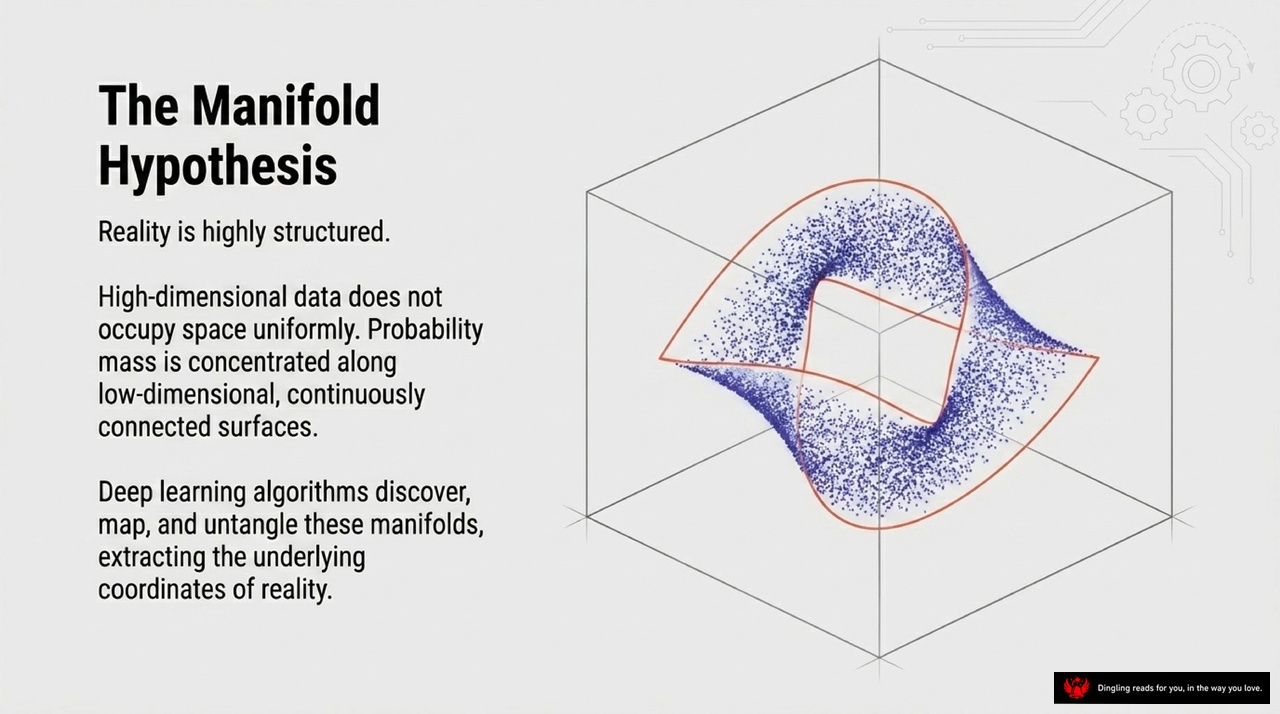
Imagine the complex, interwoven geometry on your screen not just as art, but as a map of how machines actually think. We've moved far beyond programming computers with rigid, step-by-step logic. Today, we build architectures that learn the manifold of reality on their own. By stacking simple mathematical transformations, we allow machines to map raw, chaotic experience into structured, intuitive understanding.
Think about it: we used to tell computers exactly what to look for. Now, we teach them to extract the hidden laws of reality from raw data. But here's the big question that keeps researchers up at night: if we can build machines that successfully pull these fundamental patterns out of the noise, are they merely approximating human intuition, or are they discovering a deeper, more fundamental geometry of intelligence that we haven't seen before? This shift from manual engineering to self-learning architectures is the true revolution of deep learning.