
Demian: Complete Chapter-by-Chapter Summary

Welcome to a profound journey into the depths of the human soul. Tonight, we explore *Demian: The Story of Emil Sinclair's Youth* by Hermann Hesse.
Imagine a golden eagle breaking free from a dark, shattered shell, soaring toward the light. This image captures the very heart of the book: a quest to shatter the illusions of the world and discover the true, unified self.
Sinclair grows up believing life is split into two worlds. One is a warm, orderly sanctuary of love and rules, where his parents live. The other is a chaotic, dangerous alleyway filled with sin and mystery. He spends his childhood torn between these two, fearing the dark side while being irresistibly drawn to it. But as he meets a mysterious boy named Demian, who challenges his understanding of good and evil, Sinclair realizes that the truth lies not in choosing one side, but in embracing the whole. It is a story about the courage to break your own shell and become who you truly are.

Look at this split path. On one side, there's a path of light leading to a grand, orderly temple, representing the "Light World" of safety and rules. On the other, a dark, tangled forest symbolizes the "Dark World" of chaos and truth. Standing right in the middle is a single figure, caught between these two realities. This image perfectly captures the core theme of "The Universal Struggle."
As the book tells us, "Every human life is a path toward the self. Most never truly arrive; they remain frogs, lizards, or echoes of the herd." This is the psychological map of one who dared to become human. We all start by trying to live in accord with the promptings which came from our true self, but it is so very difficult. Why? Because our true nature often feels like it belongs to that dark, wild forest, while society demands we walk the straight, paved road toward the temple.
The struggle isn't just about choosing between good and evil; it's about choosing between safety and authenticity. Most people stay in the herd, hiding their true selves behind the mask of conformity. But the journey to becoming fully human requires the courage to step out of the light, to acknowledge the darkness within, and to embrace the unknown. Only by walking both paths can we finally arrive at ourselves.

Look at this split screen. On the left, we have the Realm of Light: the parents' house, defined by order, duty, and a clear path to the future. It's a place of clean hands, morning hymns, and an atmosphere of safety and artificial innocence. But on the right, we see the Realm of Darkness: the outside world, where chaos, instinct, and unpredictable dangers rule. Here, the air smells of slaughterhouses and drunkards, and the psychological state is one of raw vitality mixed with fear.
This isn't just a simple division; it's the illusion of two worlds that actually intertwine. The text describes how these two realms constantly overlap. A maid might pray in the living room while carrying the smell of kitchen smoke, or a student reading Latin textbooks while hearing craftsmen shouting in the alley. This tension creates a powerful psychological state for the narrator: a deep desire for the safety of the light, yet an irresistible pull toward the unknown and the raw truth of the dark.
The narrator realizes that the "light" is often a fragile construct, while the "darkness," though terrifying, feels more real and alive. This childhood binary sets the stage for a lifelong journey where the individual must eventually integrate both sides—the order of the parents and the chaos of the street—to find their true self.

The slide before us maps out a dark and pivotal turning point in Franz Kromer's life, titled "The Inevitable Fall." It breaks down his descent into three distinct stages: The Lie, The Trap, and The Realization.
First, we see **The Lie**. Kromer, a boy from a notorious family, spots a younger, impressionable Sinclair. To impress Kromer and the "Dark World," Sinclair invents a story about stealing apples from a garden. He swears an oath on God and happiness, making the lie absolute.
This leads directly to **The Trap**. Kromer uses this fabricated story as a weapon. He blackmails Sinclair, demanding money and his silver watch. When Sinclair offers the watch, Kromer rejects it, demanding cash. This extortion forces Sinclair into a corner, trapping him in a cycle of fear and guilt that he cannot escape.
Finally, we arrive at **The Realization**. The slide poignantly notes that the parents' "Light World" can no longer protect him. Kromer now harbors a secret, guilty shadow. He has tasted the bitter flavor of spiritual death and understands the necessity of rebirth. The image of the pocket watch hanging in a webbed tunnel perfectly symbolizes how time and sin have ensnared him, pulling him away from innocence and into a complex, darker reality where he must eventually face the consequences of his choices.

Welcome to the world of Abraxas. In this chapter, we leave behind the rigid duality of good and evil that the herd has forced upon us. The traditional view tells us that God is only light, and the devil is only darkness, a false separation that blinds us to the truth. But Demian introduces us to a higher, more complete god: Abraxas. This deity embodies both the divine and the demonic, the light and the dark, the good and the bad. To truly know Abraxas, we must accept the whole of existence, not just the sanitized version our parents taught us.
The journey to this realization begins with a dream. In the dream, I see a half-man, half-woman lover, a figure that represents the terrifying yet beautiful union of opposites within ourselves. My friend Pistorius, who became my guide in this dark and enlightening phase, tells me that we must not fear our inner thoughts. The desire to kill or do something wicked isn't about the external object; it is a projection of our own nature. We hate the part of ourselves that we have repressed and projected onto others.
Pistorius also teaches us about the power of flight. He explains that the urge to fly is an ancient, innate instinct in all of us, a connection to a higher power. Most people choose to walk on the ground because they are afraid, but true individuals learn to control their ascent and descent, rising above the limitations of the herd. He shows me illustrations of ancient fish, reminding me that our evolutionary functions never truly disappear; they just wait to be awakened.
This philosophy leads us to a profound truth: everything we see in the outside world already exists within us. The world is not something separate from us; it is a reflection of our own soul. When we stop pretending to be just the "good" part of humanity and embrace the full spectrum of our nature, we finally understand that we are part of the eternal creation of the world. We are the bridge between the divine and the demonic, and in that unity, we find our true humanity.

This slide captures the pivotal moment where the protagonist, Sinclair, finds his true home. The image shows him standing before a painting of the golden eagle—a symbol he has chased for years—hanging above the door of a humble cottage in the countryside. This isn't just a house; it's the realization that the "wilderness of the soul" is where he belongs.
On the right, the text highlights the "Paradox of Rebellion." It reminds us that acting out isn't true freedom; it's often just another way of submitting to the collective shadow. Sinclair spent his youth rebelling against his parents' orderly world, drinking, and lying, thinking he was free. But as the text suggests, that rebellion was just a form of submission to a chaotic, destructive world. True freedom comes not from running away, but from finding an inner compass.
At the bottom, we see "Self-Destruction" described as embracing the dark world through cynicism and tavern life. This was Sinclair's path before he met Max Demian and the woman he calls "Mrs. Eva." He thought the dark world offered answers, but it only led to despair.
The image of the woman standing in the doorway represents the resolution to this conflict. She is the embodiment of the "Eva" from his dreams—the mother and lover he couldn't find in his own mind. By welcoming him, she bridges the gap between the light world of his childhood and the dark world of his adolescence. She tells him, "You are home."
In this moment, Sinclair stops fighting the duality within himself. He realizes that the golden eagle, the mark of Cain, and his own soul are all part of one whole. He no longer needs to destroy himself to feel alive or hide in the shadows to feel free. He has found a place where both light and dark are accepted. This is the end of his wandering and the true beginning of his life.

The image we see here captures the very essence of Sinclair's transformation. It's titled "Beatrice and the False Dawn," and that split portrait on the easel tells a powerful story. On one side, we have the golden-haired Beatrice, the artificial ideal Sinclair created to escape his own destruction and build a self-made Light World. But look at the other side—the face morphs into something darker, something real. It's not Beatrice anymore; it's Demian, and ultimately, a reflection of Sinclair's own soul.
This visual perfectly illustrates the lesson Sinclair learns: Fate and temperament are just two words for the same concept. You cannot escape into external purity; you must face the inner self. Sinclair tries to hide behind the mask of Beatrice, projecting a world of light onto a canvas, but the truth bleeds through. The revelation is that the ideal he worshipped was a lie, a false dawn that only served to delay his confrontation with reality. The lesson is stark and necessary: true freedom isn't found in constructing a perfect external world, but in accepting the chaos, the darkness, and the authentic self within. That is the only way to break the shell and let the true bird fly.

Look at this image titled "The Price of Birth." It captures a powerful moment of transformation: a golden eagle, the symbol of the soul, breaking free from a cracked shell that represents our old world. This visual perfectly illustrates the core philosophy of Hermann Hesse's *Demian*.
The text on the left tells us, "The bird fights its way out of the egg." This isn't just about physical birth; it's the awakening of our will. It's the painful but necessary struggle to shed the constraints of childhood and the expectations of society. The shell represents the "world" we were born into—the safe, but ultimately limiting, structures of our upbringing.
The quote at the bottom left hits the hardest: "Who would be born must first destroy a world." To become your true self, you have to dismantle the old world that defined you. It's a necessary pain of individuation. You cannot grow without breaking the container that held you.
On the right, the text reveals the destination of this journey. "The bird flies to God. That God's name is Abraxas." This is the ultimate lesson of the book. Abraxas is a deity that combines both light and darkness, the divine and the demonic. It represents the unified self—the realization that there is no conflict between good and evil, only a complete, whole existence.
Finally, the eagle is shown emerging from a globe, symbolizing that this personal rebirth is part of a larger cosmic truth. As the protagonist Sinclair learns, the old world is rotting, and only through this violent, beautiful destruction can we be reborn into something new and authentic. This is the price of birth, and the only way to truly live.

Welcome to the ultimate synthesis. Look at this image: the light and the dark, the divine and the demonic, fused into one entity—Abraxas. In our culture, we often split the world into good and evil, light and shadow, believing that to be holy, we must reject the dark. But today, we are exploring a radically different truth: true wholeness comes from embracing both sides.
As the text reminds us, to live fully, one cannot worship only the light and repress the dark. Our instincts, our sexuality, our primal nature—these are not monsters to be exorcised; they are essential parts of the human experience. Abraxas demands the reverence of the entire world, not just the sanitized, polite version we present to society. True individuation requires integrating the shadow, rather than running from it.
Think about your own life. How many times have you hidden parts of yourself because they didn't fit the "good" narrative? We've been taught that the dark side is dangerous, that it needs to be controlled. But what if the dark is just as sacred as the light? What if the chaos, the passion, and the raw power we fear are actually the very things that make us alive?
This concept challenges the very foundation of our moral framework. It suggests that by accepting the demon within, we actually liberate the divine. We stop fighting our own nature and start honoring the complete spectrum of who we are. It's a terrifying yet liberating idea: that the path to becoming whole isn't about polishing away the rough edges, but about weaving the light and the dark together into a single, powerful tapestry. This is the power of Abraxas.

Picture content + matched book text:
The slide highlights "Fire-Gazing & The Collective Soul," introducing Pistorius as a mentor who teaches Sinclair to listen to nature's primal forces. It emphasizes that we are not isolated individuals but part of a collective soul, where the history of the world lives within us. Gazing into fire connects us to the universal will.
In the book, Pistorius explains that we often define our individuality too narrowly, forgetting we are part of the world's spectrum. Our souls contain both divine and demonic potentials. He tells Sinclair that possessing knowledge isn't enough; one must know it deeply to be truly human. Many live like animals, unaware of their fate, while true humans create their destiny.
So, when we stare into the fire, we aren't just watching flames. We are seeing the collective soul at work—the god, the demon, the evolutionary leap all living inside us as potential. The fire reveals the universal will, showing us that we are never alone. By recognizing the world inside ourselves, we connect with everything that has ever been. This is the insight: to gaze into the fire is to awaken the collective soul within.

Frau Eva: The Archetype of Fulfillment. This isn't just a story about finding a woman; it's about discovering the divine within ourselves. Sinclair finally encounters the physical manifestation of his deepest dream—a figure who is simultaneously mother, lover, and goddess, representing his own realized destiny. But true love, as the philosophy here suggests, is never about begging or demanding. Love is a force of gravity. When the soul is entirely focused on its true destiny, it naturally and effortlessly draws its desires toward it. Frau Eva isn't an external savior; she is the mirror of Sinclair's own awakening. She represents the moment when the chaotic inner self aligns with the outer world, proving that fulfillment comes not from escaping reality, but from embracing the full spectrum of light and shadow within.

Picture this: a fractured mirror reflecting a starry sky, where two distinct constellations emerge from the chaos. On one side, there's "The Herd"—groups formed out of panic, bound together by shared anxieties and a terrified refusal to look inward. On the other, "The Marked"—individuals bearing the Mark of Cain, isolated in society yet deeply connected by a shared readiness to embrace fate, evolution, and the terrifying birth of new humanity.
This slide captures the very core of our journey. It's about the invisible community that exists beyond the visible world. The Herd clings to obsolete rules and the safety of the herd, while the Marked are the pioneers, the ones willing to step into the unknown. They are the ones who understand that true connection isn't about following the crowd, but about recognizing the same fire burning within us all. As we've seen, from Cain's story to the breaking of the egg, this invisible bond is what drives us forward, even when the path ahead is dark and uncertain.
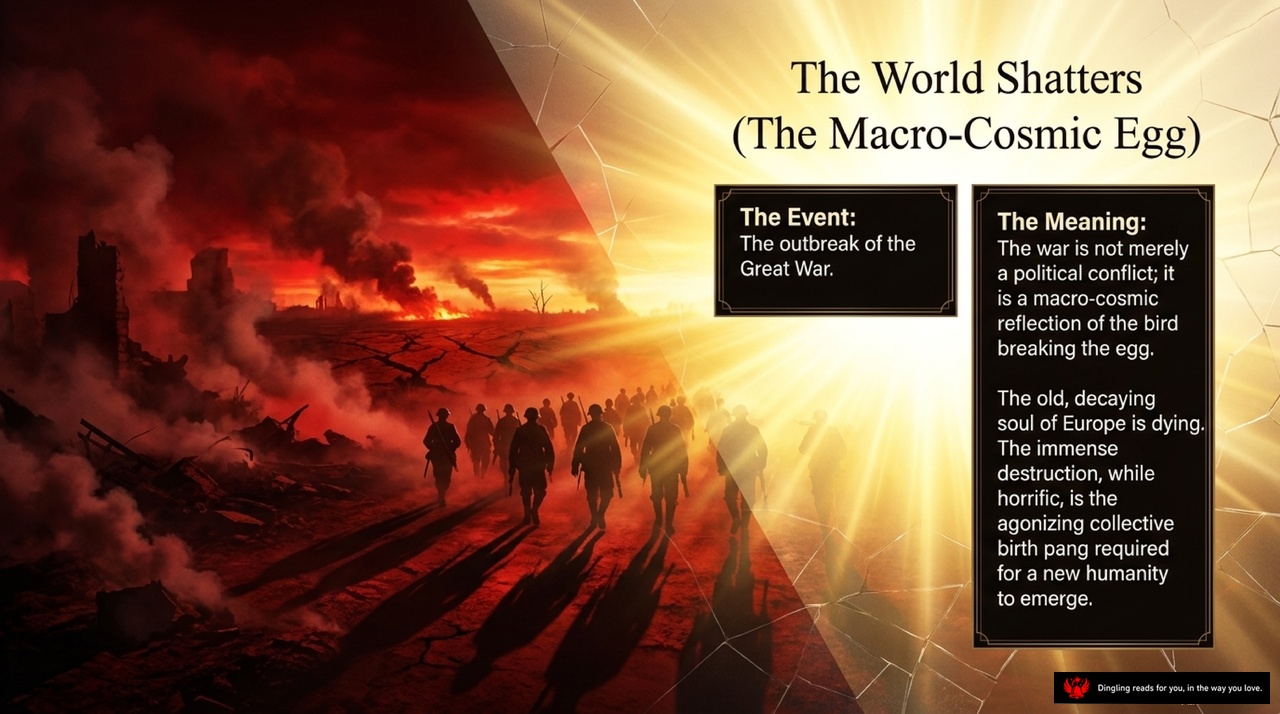
The world is not just a place we live in; it is an egg, fragile and ancient, waiting to break. Look at this image: on the left, a landscape of total annihilation. Fire consumes the cities, the sky turns a bruised red, and soldiers march blindly into a future that looks like the end of everything. This is "The World Shatters." But on the right, piercing through the cracks of this destruction, is a blinding, golden light. This is the "Macro-Cosmic Egg" breaking open.
The slide tells us the event is the outbreak of the Great War. But the meaning is far deeper than just a political conflict or a clash of nations. As the text reminds us, this war is a macro-cosmic reflection of a bird breaking its egg. The immense destruction we see in the red chaos is horrific, yes, but it is also an agonizing collective birth pang. The old, decaying soul of Europe is dying, and that death is the necessary price for a new humanity to emerge.
Think about it. We often fear destruction, but what if destruction is actually the only way to be born? The soldiers walking into the fire are not just dying; they are the shell being shattered so that something new can fly out. The light breaking through the cracks represents that new consciousness, that new humanity rising from the ashes. We cannot have the new without destroying the old. The world shatters so that we can finally begin to truly live.

Look at this shattered mirror. It's the perfect symbol for Sinclair's final transformation. On the left, we see his face split in two—one half young and innocent, the other dark and mature. This visual split represents the internal conflict that has defined his entire life.
On the right, the slide breaks this down into two critical moments: "The Farewell" and "The Arrival."
First, the Farewell. Sinclair finally says goodbye to Demian in the hospital. But it's not just a goodbye to his friend; it's a goodbye to the external guide he has relied on for so long. In that final moment, he receives a symbolic kiss from Frau Eva. This isn't just about romance; it represents the union of his inner guides—the wisdom of Demian and the nurturing love of Eva—coming together to complete him.
Then comes the Arrival. This is the most profound part. Sinclair realizes he no longer needs to summon Demian from the outside. The guide, the friend, and the master are now permanently integrated within him. He has stopped looking outward for answers and started looking inward.
By staring into the "dark mirror" of his own soul, he finally sees his own face. And here is the key realization: that face is identical to Demian's. The "Evil" side, the Cain side, is no longer a separate monster to be feared or exorcised. It is his true, unified self. The mirror is no longer showing him a stranger; it is showing him his whole truth. He has accepted the shadow, and in doing so, he has become whole.

The image before us captures a profound moment of transformation: a shattered eggshell lying on cracked earth, with a golden eagle soaring toward a blinding sunrise. This visual perfectly mirrors the core realization of Emil Sinclair's journey—the understanding that the true self is not found by conforming to artificial realms of light and dark, but by daring to integrate the shadow, heed the inner voice, and embrace the painful, beautiful process of psychological rebirth.
Sinclair describes his life as an egg trapped within a world. If the egg is your world, what must you shatter today to finally be born as your true self? For Sinclair, the shell was the rigid duality of his upbringing—the "light" of his orderly, loving home versus the "dark" of the chaotic, tempting streets. He spent years trying to fit into the shell, fearing the darkness outside while feeling suffocated by the safety inside. But true growth only began when he realized that light and shadow are not enemies; they are two sides of the same coin.
The eagle rising in the image symbolizes this ultimate liberation. It represents the moment when one stops fighting the internal conflict and instead embraces the whole self, including the parts society deems "evil" or "dark." This isn't about destruction for destruction's sake; it is about breaking the constraints that keep us small. As Sinclair learned, the pain of breaking the shell is the price of admission to a more authentic life. Only by shattering the artificial boundaries we build around ourselves can we allow the inner light to shine through, unfiltered and whole. The journey ends not with a new world, but with the realization that the world you knew was never the real one anyway.