
Democracy and Education: Complete Chapter-by-Chapter Summary
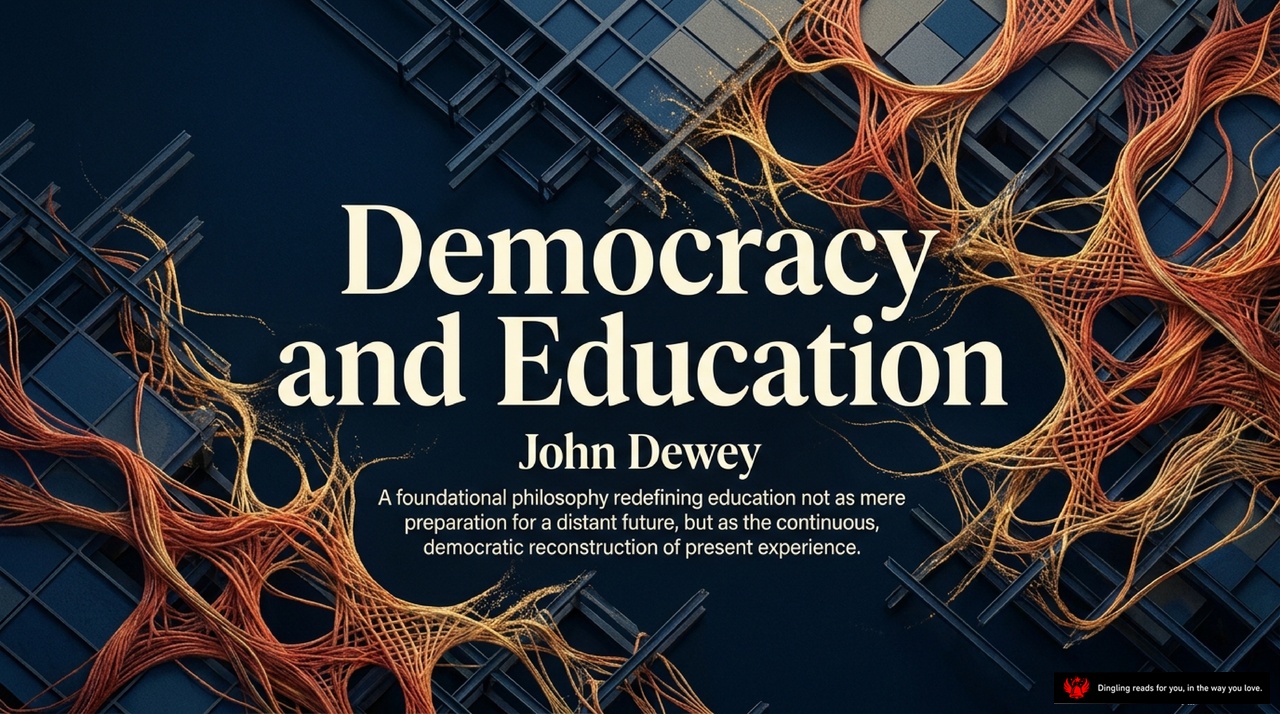
Welcome to our exploration of *Democracy and Education* by John Dewey. This slide sets the stage for everything we'll discuss today.
Dewey presents a foundational philosophy that completely redefines what education actually is. He argues against the old idea that school is just preparation for a distant, unknown future. Instead, he sees education as the continuous, democratic reconstruction of our present experience.
Think of it this way: life isn't just about surviving; it's about constantly updating and renewing our experiences. For a society to survive, it must pass on its knowledge, habits, and values to the next generation. But it can't just be a simple transfer of facts. True education happens through shared understanding and active participation in life together.
Dewey believes that a democratic society depends on an education that breaks down barriers between people. It's not about training students to fit into a rigid system, but about helping them grow into capable, creative individuals who can contribute to a better world. Education and democracy, he shows us, are two sides of the same coin—one cannot truly exist without the other.

Imagine education not as a distant preparation for some future life, but as the very lifeblood keeping society alive—much like nutrition is essential for biological existence. As the slide illustrates, this connection runs deep through two powerful concepts: the Law of Renewal and the Social Equivalent. Just as living things must constantly renew themselves to survive, stopping that process means the end of life, societies face the same fate. If we stop transmitting our ideas, hopes, and practices to the next generation, the group simply vanishes.
This is where education steps in as the bridging mechanism. It is the essential medium that connects the immature newborn to the mature custodian of our culture. Without this bridge, the gap between generations widens until the social fabric tears apart. As the quote on your screen reminds us, society doesn't just exist *by* transmission and communication; it actually exists *in* them. Every interaction, every shared understanding, and every act of learning is a thread that holds our community together. Education isn't just about filling minds with facts; it's about ensuring that the wisdom of today becomes the foundation for tomorrow, allowing our shared ideals and practices to flourish rather than fade away.
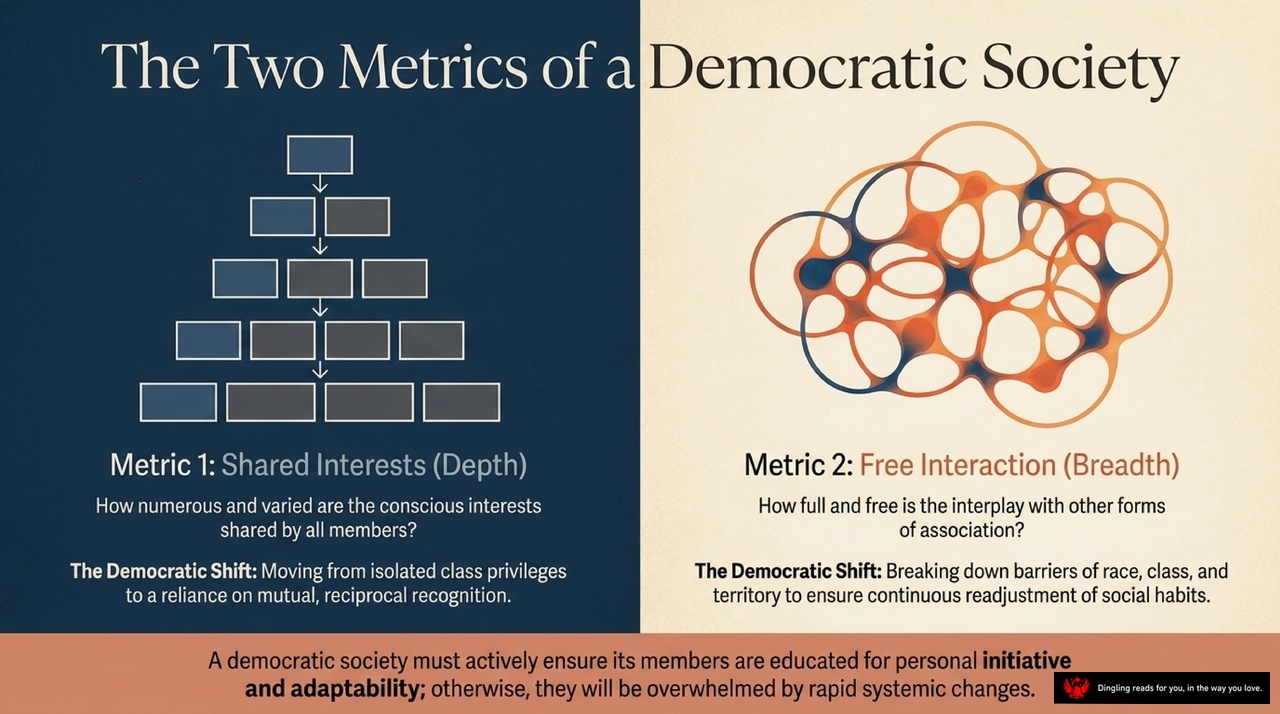
Today's slide breaks down the two essential metrics we use to measure the health of any democratic society. On the left, you see a pyramid representing "Metric 1: Shared Interests," which we call Depth. This asks a crucial question: how many varied and conscious interests do all members actually share? In a non-democratic setup, interests are often isolated or limited to a specific class. But in a true democracy, we shift from these narrow privileges to a reliance on mutual, reciprocal recognition. We want everyone to care about the same big things, creating a deep sense of community.
On the right, we have "Metric 2: Free Interaction," representing Breadth. The graphic here looks like a complex, interconnected web. This visualizes how full and free the interplay is between different forms of association. A democratic society must break down barriers of race, class, and territory. This allows for continuous readjustment of social habits, ensuring that no group is isolated.
The bottom line, highlighted in orange, is that a democratic society must actively ensure its members are educated for personal initiative and adaptability. Without this, people will be overwhelmed by rapid systemic changes. So, our goal isn't just to teach facts, but to cultivate individuals who can connect deeply with shared interests and move freely across social boundaries.

Look at this crumbling wall. It's a powerful metaphor for the artificial chasms we've built into traditional learning. The image highlights three major fractures that have long divided our education system.
First, on the left, we see the gap between Labor and Leisure, often called the Greek Error. This stems from an ancient divide where manual work was seen as base, while intellectual culture was reserved for the elite. Today, this still manifests as a split between vocational training and "noble" academic pursuits, leaving us with a society where doing and thinking are treated as separate lives.
In the center, the wall breaks down the false belief that Mind and Body are enemies. Traditional education often treats the body as a mere distraction or a mechanical tool, assuming the mind learns independently of our physical experience. But the truth is, our thoughts and actions are deeply rooted in our bodily engagement with the world.
Finally, on the right, we face the illusion of Individual versus World. This is the idea that the learner's mind is a private, isolated island that passively receives facts from the outside. This view completely misses the reality that we learn by actively interacting with and shaping our environment.
The core message at the bottom is clear: these dualisms aren't laws of nature. They are simply inherited scars from historical class divisions and social inequities. It's time to stop maintaining these cracks and start rebuilding a unified education that connects work with thought, body with mind, and the individual with the world.

Look at this slide. It's a powerful comparison between two very different ways of setting goals in education. On the left, we have "External or Imposed Aims"—goals handed down by authority, rigid and fixed, treating the learner as a passive recipient who must simply comply, often sacrificing the present moment for a distant, uncertain future. On the right, we see "Organic or Educational Aims." These emerge naturally from the learner's current activities. They are highly adaptable, treating the learner as an active participant who uses their own innate capacities. Crucially, this side values the immediate present, recognizing that the process itself is the goal, not just a stepping stone to somewhere else.
The text at the bottom drives this home: "Education as such has no aims. Only persons, parents, and teachers have aims." This is a vital distinction. We often try to force a grand, abstract purpose onto education from the outside, but true aims must emerge from within the learner's experience. The purpose of education isn't a final destination we impose; it is simply the capacity for further education. It's about keeping the process alive, flexible, and meaningful right now, rather than locking students into a rigid path designed by someone else.
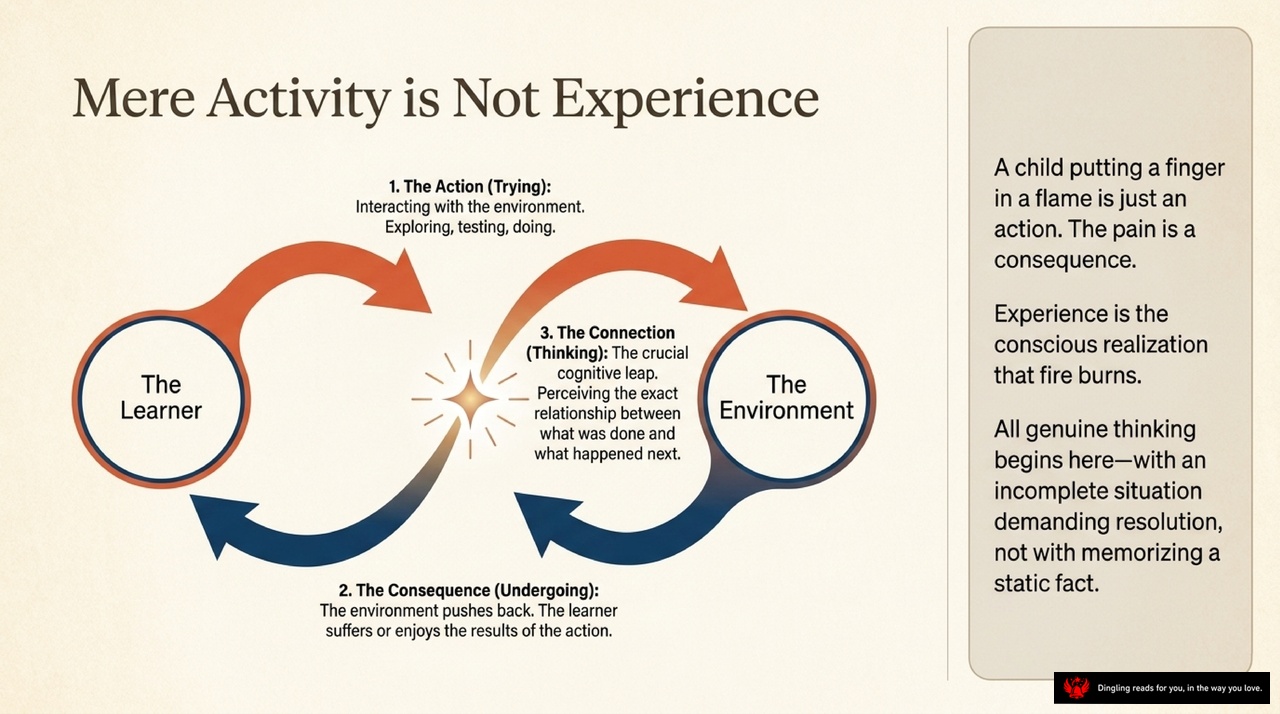
Most of us have a fundamental misunderstanding about how we learn. We often think that simply doing something—just putting our hands to the work—is enough to call it "experience." But as the slide clearly reminds us, **mere activity is not experience**.
Look at the cycle on the left. It starts with **The Action**, or trying. A child reaches out to touch a flame. That is just an action. It's interacting with the environment, exploring, and testing. But at that exact moment, the child hasn't learned anything yet. They haven't formed an experience.
The real learning happens in the next step, labeled **The Consequence**, or undergoing. The environment pushes back. The child feels the heat and suffers the pain. If the child just walks away without thinking, they are still just reacting to a stimulus. They haven't connected the dots.
True experience only emerges at the center of this cycle: **The Connection**, or thinking. This is the crucial cognitive leap. It is the moment the learner perceives the exact relationship between what they did and what happened next. As the text on the right beautifully illustrates, putting a finger in a flame is just an action; the pain is just a consequence. But the **experience** is the conscious realization that "fire burns."
This is where all genuine thinking begins. It doesn't start with memorizing a static fact or being told what to do. It starts with an incomplete situation that demands resolution. The learner must actively bridge the gap between their action and the result. Without this reflective connection, we are just going through the motions. We are busy, but we aren't learning. Real education requires us to pause in that middle space, to reflect on our actions, and to understand the cause and effect of our world.

Subject Matter is the Crystallization of Human Effort. Look at this funnel: it represents the Capitalized Experience of the Human Race. Too often, we fall into a trap by treating history, geography, and science as isolated facts to be memorized, stripping them of their vital human context. But the truth is far more dynamic. Geography and science aren't just trivia; they are the story of how humans understand, navigate, and utilize the earth. History isn't just a chronicle of kings; it's an industrial and intellectual record of humanity learning to control natural energies for social ends. When educators truly master this subject matter, they see it not as static data, but as the fuel that allows them to foresee the potential in a student's raw, blind impulses and guide them toward meaningful social outcomes. It's about transforming the collective wisdom of our species into a living, breathing tool for every learner.
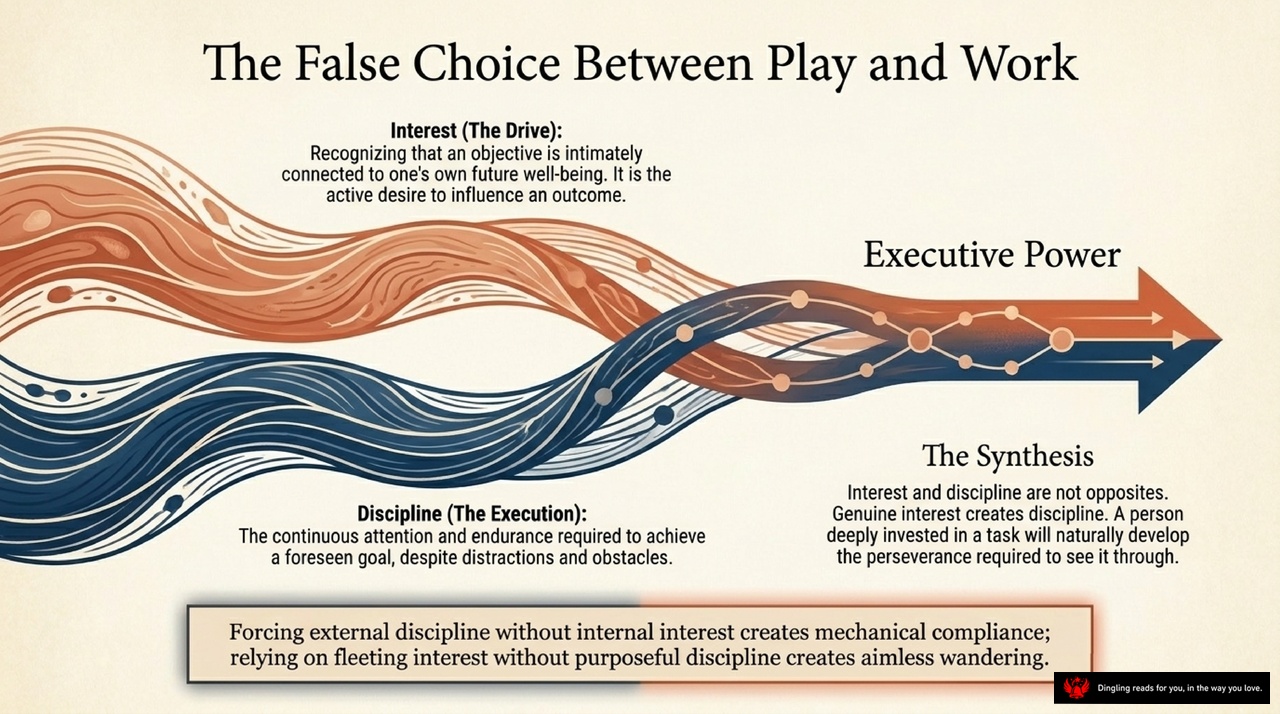
We often face a false choice between play and work, believing we must pick one or the other. But as this diagram illustrates, this is a trap. True growth happens when we synthesize these forces. Look at the top: "Interest," or what the book calls "The Drive." This isn't just about having fun; it's recognizing that an objective is deeply connected to your future well-being. It is the active desire to influence an outcome. Without this internal spark, effort feels forced.
Now look at the bottom: "Discipline," or "The Execution." This is the continuous attention and endurance required to reach a goal, even when distractions pull you away. Too much discipline without interest creates mechanical compliance—just following orders without understanding. But without discipline, fleeting interest leads to aimless wandering.
The magic happens when these two streams merge into "Executive Power." The diagram shows them intertwining to create "The Synthesis." Here, the book makes a crucial point: interest and discipline are not opposites. Genuine interest actually creates the discipline you need. When you are deeply invested in a task, you naturally develop the perseverance to see it through.
The takeaway is clear at the bottom: forcing external discipline without internal interest fails, but relying on fleeting interest without purposeful discipline also fails. We need both. By aligning our personal drive with the execution required to succeed, we transform work into a meaningful, sustainable part of our lives.
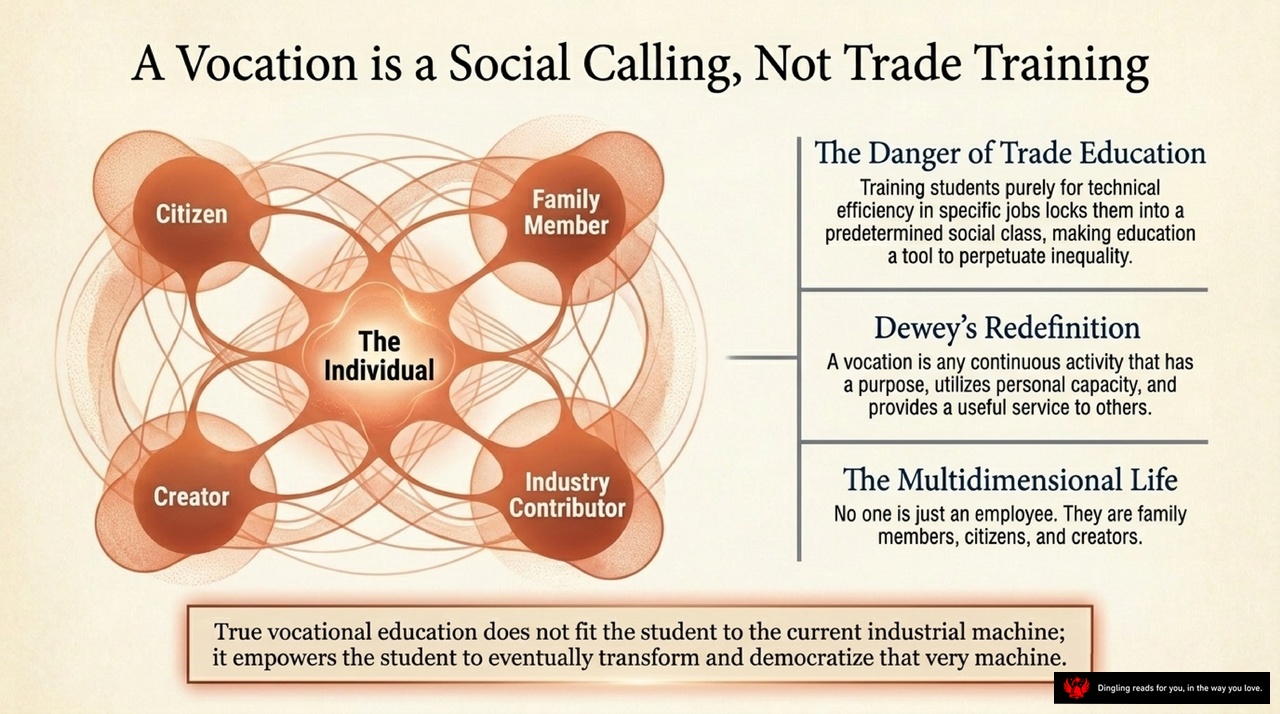
Today's slide makes a bold distinction: a vocation is a social calling, not just trade training. Look at the diagram on the left. At the center is the individual, but notice how they are connected to four vital roles: Citizen, Family Member, Creator, and Industry Contributor. This visual tells us that a true vocation isn't a single job title; it's the integration of all these identities.
On the right, we see why focusing solely on trade education is dangerous. When we train students purely for technical efficiency in specific jobs, we lock them into a predetermined social class. This turns education into a tool that perpetuates inequality rather than liberating it. John Dewey redefined the concept to counter this. He argued that a vocation is any continuous activity that has a purpose, utilizes personal capacity, and provides a useful service to others. It's about being multidimensional. No one is just an employee; we are family members, citizens, and creators.
The core message at the bottom is crucial. True vocational education does not fit the student to the current industrial machine. Instead, it empowers the student to eventually transform and democratize that very machine. We must move away from molding workers into cogs and start nurturing whole individuals who can shape their world.
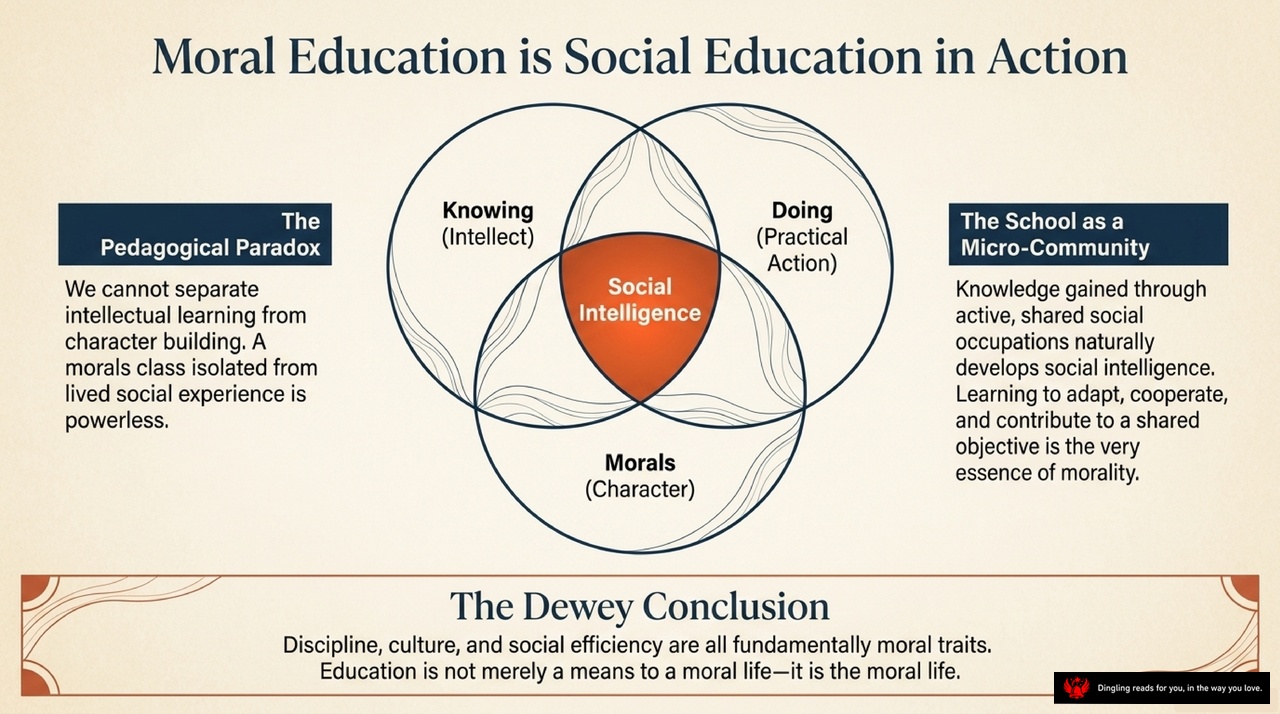
Moral education isn't just about teaching right and wrong; it's social education in action. Look at this diagram: it shows that true social intelligence lives at the intersection of Knowing, Doing, and Morals. You can't separate intellectual learning from character building. A morals class that floats above real life is powerless.
Think about your school as a micro-community. When you actively share social occupations, knowledge naturally develops into social intelligence. Learning to adapt, cooperate, and contribute to a shared objective—that is the very essence of morality.
Dewey's conclusion is clear here: discipline, culture, and social efficiency are all fundamentally moral traits. Education isn't merely a means to a moral life; it *is* the moral life itself. We must stop treating these as separate subjects and start living them together.
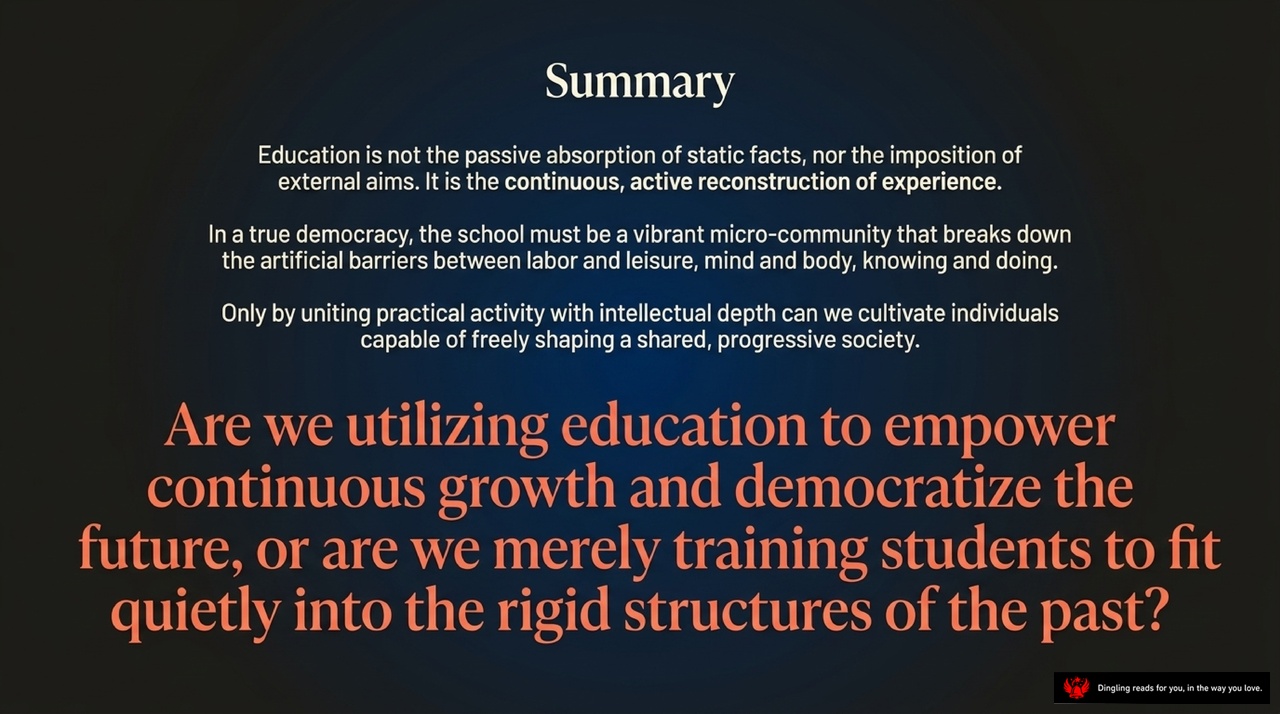
So, where does this all lead us? As we wrap up our journey through these chapters, let's take a moment to reflect on the big picture.
Education, at its core, is not about passively absorbing static facts or simply preparing for a distant future. It is the continuous, active reconstruction of experience. In a true democracy, our schools must evolve into vibrant micro-communities that break down the artificial barriers between labor and leisure, mind and body, knowing and doing. We can't just train students to fit quietly into the rigid structures of the past; we must utilize education to empower continuous growth and democratize the future.
The real question we face is this: Are we uniting practical activity with intellectual depth to cultivate individuals capable of freely shaping a shared, progressive society? Or are we merely creating a system where the mind and body are separated, where culture is the privilege of a few, and where work is just a means to survive?
The chapters we've covered—from the nature of experience to the unity of method and curriculum, from the value of subjects to the philosophy of the individual—all point to one conclusion. True education happens when we stop treating these things as separate battles and start seeing them as a unified whole. It's about helping every student find their unique place in the social world, not by forcing them into a mold, but by providing the tools for them to build their own future.
So, as we leave this summary, I want you to carry this thought forward: Education is a living thing. It belongs to everyone, right now, not just in some idealized future. It is the bridge that connects our personal growth to the health of our entire society. Let's make sure we are building bridges, not walls.