
Designing Your Life: Complete Chapter-by-Chapter Summary

Welcome to *Designing Your Life* by Bill Burnett and Dave Evans. Think of your life not as something that just happens to you, but as a blueprint waiting to be drawn. This book offers a practical, step-by-step playbook that applies the creative principles of design thinking to build a well-lived, joyful, and meaningful life.
Instead of waiting for the perfect moment or hoping for a magical solution, you learn to take control. The authors guide you through a process of prototyping your future—testing different versions of your life to see what truly resonates. Whether you're feeling stuck in a career, unsure about your relationships, or just searching for more purpose, this book gives you the tools to design your own path.
It's about shifting from a fixed mindset to a creative one, understanding that you have the power to shape your reality. So, grab your pencil, open your mind, and let's start designing the life you've always imagined.
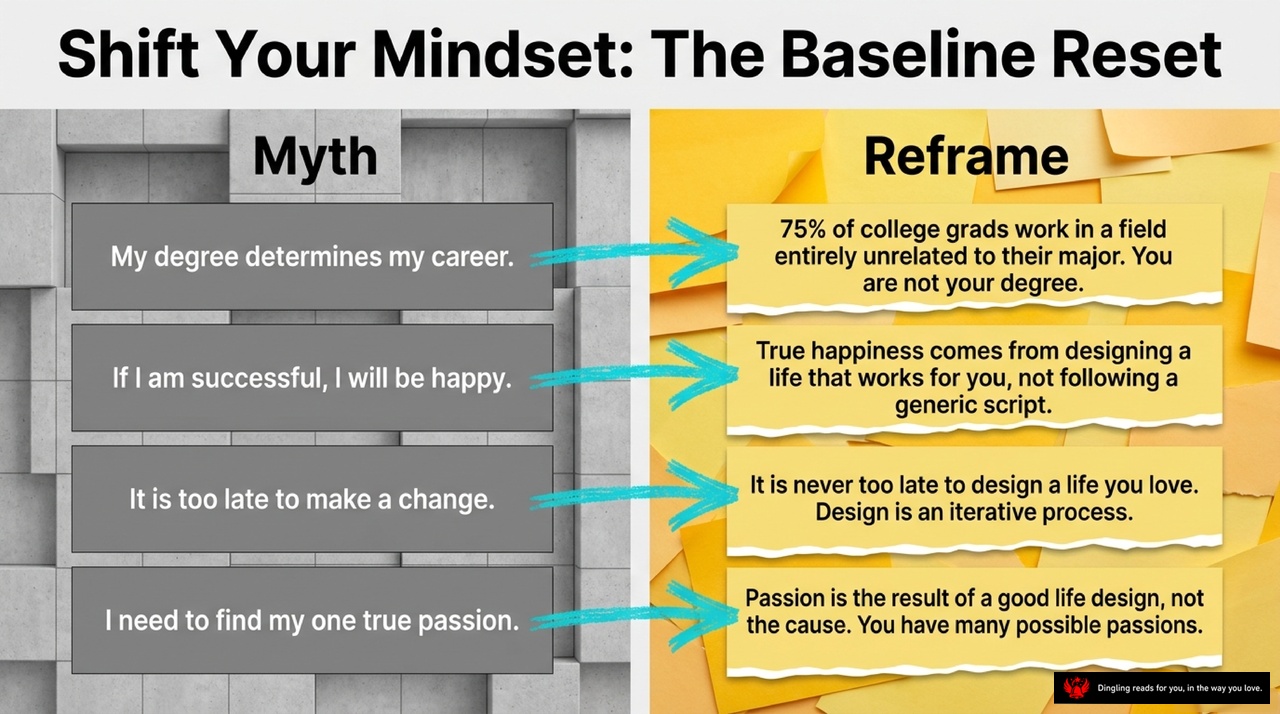
So, let's talk about the mental traps that are silently holding you back from designing the life you actually want. Look at this slide: "Shift Your Mindset: The Baseline Reset." It's all about breaking four common myths that keep us stuck.
First, the myth that "My degree determines my career." The reality? Seventy-five percent of college grads work in a field entirely unrelated to their major. You are not your degree; your degree is just a tool, not your entire identity.
Second, the belief that "If I am successful, I will be happy." This is a trap. True happiness doesn't come from following a generic script or hitting a status symbol; it comes from designing a life that actually works for *you*.
Third, the fear that "It is too late to make a change." The truth is, it is never too late. Life design is an iterative process. You can start reshaping your path right now, no matter where you are today.
Finally, the pressure to find "my one true passion." Here's the game-changer: passion is the result of a good life design, not the cause. You don't need to find one single thing you love; you have many possible passions waiting to emerge once you start building a life you enjoy.
Stop fighting these myths and start reframing your reality. Your best life isn't a destination you find; it's a design you create.

Diagnose Your Resistance: The Problem Taxonomy
Imagine you're stuck in a situation that feels impossible to fix. Today, we're breaking down exactly what kind of problem you're facing using a simple but powerful framework: The Problem Taxonomy.
Look at the three categories on the screen. First, we have **Gravity Problems**, represented by that anvil. These are unsolvable realities—things like gravity itself, or the fact that poets rarely make millions. As the slide says, these are circumstances, not problems. If something isn't actionable, don't fight it. Accept it and route around it. Fighting gravity just exhausts you.
Next, in the center, we have **Anchor Problems**, symbolized by that heavy anchor. This is where most of us get stuck. You are fixating on a single, failed solution. Like Dave, who spent five years trying to build a "perfect" garage workshop because he refused to consider any other option. The trap is believing there is only one way to succeed. The fix? Reframe and prototype new, smaller solutions. Stop chasing perfection and start experimenting with alternatives.
Finally, on the right, we have **Design Problems**, shown by those interlocking gears. These are actionable challenges without a single right answer. This is where the real work happens. You can ideate and build prototypes here. These are the opportunities waiting for you to get creative.
So, how do you tell them apart? Ask yourself: Is there any space to move? If you are stuck on one specific method that isn't working, it's an Anchor Problem. If the reality itself is unchangeable, it's a Gravity Problem. But if you can take action to create something new, you are in the Design zone. Stop wrestling with the unchangeable, stop clinging to one broken idea, and start designing your way forward.

Look at this dashboard. It's called the "You Are Here" dashboard, and honestly, it's the most honest reflection of your life you'll ever see. The slide makes one crucial point right away: work-life balance is a myth. You can't just wish for it. Instead, we need to measure our health. Think of it like a car's dashboard; if you don't know your starting coordinates, you can't chart a course.
Let's look at the four gauges. First, Health. This is your foundational gauge, covering physical, emotional, and mental wellbeing. In the image, it's full and green—that's the ideal state. But look at the other three. Work is at three-quarters full, which is okay, but we need to check levels regularly. Play is completely depleted. Remember, play isn't about winning or advancing; it's about doing something purely for the joy of it. When that runs empty, you lose your spark. Finally, Love is at half capacity. This is the flow of connection—who loves you, who you love, and how you share it. The image clearly marks this as needing attention.
The text warns us that you cannot chart a course without knowing your current state. Some of us might be like the entrepreneur Fred, where health and play are blank, leaving only work and love. That imbalance creates a crisis. Or consider someone like Debby, who thought quitting her job would hurt her "work" gauge, only to realize that caring for her family is actually high-value work. This dashboard isn't about forcing a perfect 25/25/25/25 split. It's about spotting the red flags before they become emergencies. If your play gauge is empty, you aren't just tired; you're running on empty. If your love gauge is low, you're losing your sense of meaning. Use this dashboard to assess where you are right now, not where you think you should be. That honest assessment is the only true starting point for redesigning your life.
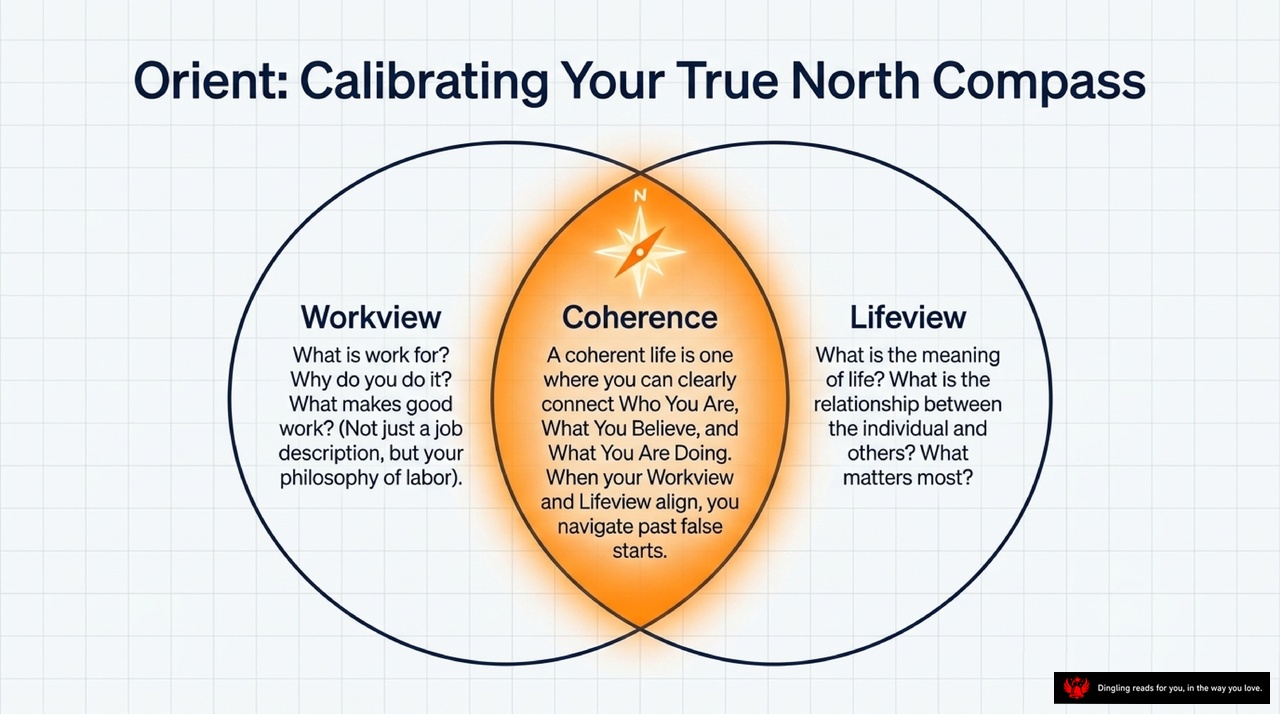
Today's slide focuses on "Orient: Calibrating Your True North Compass." Think of this as aligning your internal GPS so you never get lost. The diagram shows two circles overlapping: "Workview" and "Lifeview."
On the left, your Workview asks the hard questions: What is work actually for? Why do you do it? And crucially, what makes good work? Is it just about your job title, or is it about your deeper philosophy of labor? On the right, your Lifeview explores the bigger picture: What is the meaning of life? How do you relate to others? And what truly matters most to you?
Where these two circles intersect is the golden zone labeled "Coherence." This is where a coherent life happens. It's the sweet spot where you can clearly connect who you are, what you believe, and what you are actually doing. The text reminds us that when your Workview and Lifeview align, you stop spinning your wheels and navigate past false starts.
If your work philosophy clashes with your life values, you feel torn. But when they sync up, you move with purpose. So, before you take your next career step, ask yourself: Does my daily work reflect who I am and what I believe? If not, it's time to recalibrate your compass.

Imagine your life as a dynamic energy map, where every hour spent either drains your battery or charges it up. The goal isn't just to work harder, but to identify what creates that electric "Flow Zone"—those moments of total immersion and joy—versus the "Drain Zone" where you feel depleted.
To unlock this, we use a powerful diagnostic tool called the AEIOU method. Think of it as a camera zooming in on your peak experiences. When you hit that high-energy Flow state, ask yourself five specific questions: What exactly were you doing? Where were you, and how did the space feel? Who were you interacting with, and was it formal or casual? What devices or tools were you using? And finally, who else was there, and what was their role?
By analyzing these details, you stop guessing and start engineering your ideal day. You can replicate the environment and activities that trigger your flow, while ruthlessly cutting out the tasks that leave you exhausted. It's about shifting your energy allocation so you spend your time in the blue zone, building a life that feels less like a grind and more like a series of engaging adventures.
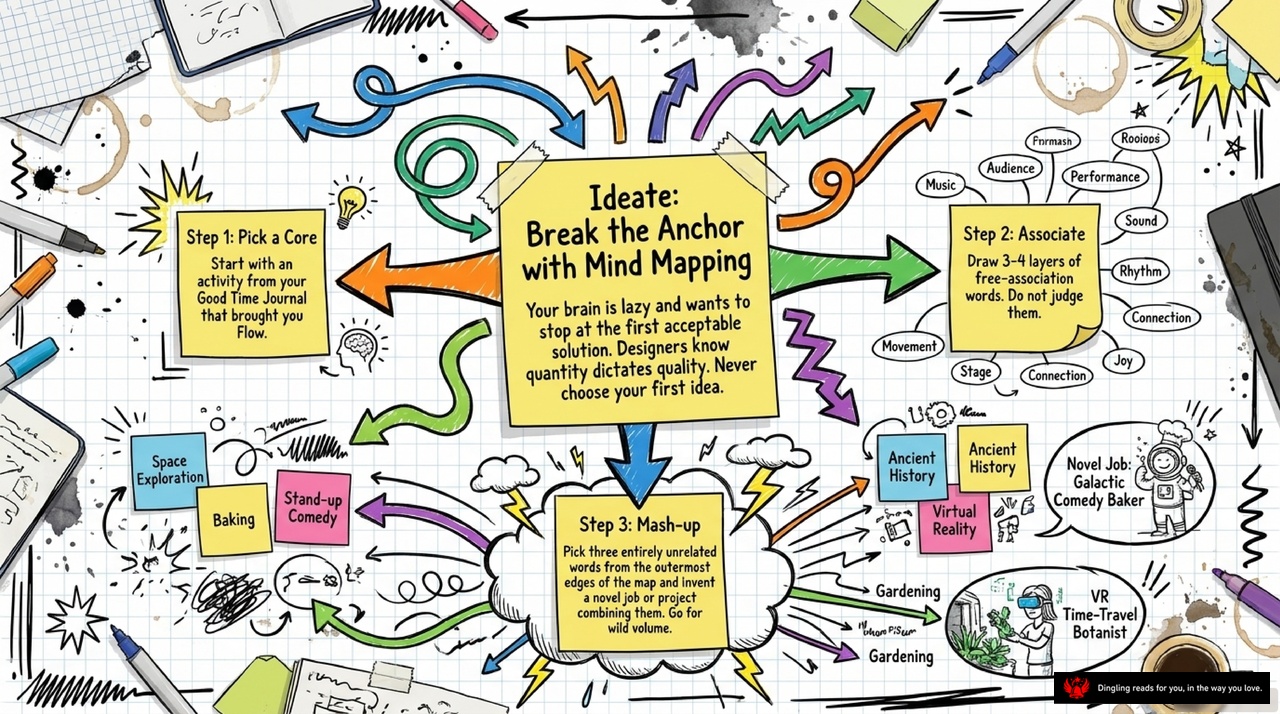
So, let's talk about how to actually break free from being stuck. We've all been there: staring at a wall, convinced there's only one way out, and it's a dead end. In the book, this is called an "Anchor Problem." Think of it like a ship's anchor dragging on the ocean floor, keeping you from moving forward no matter how hard you row.
The classic example is Dave. He dreamed of opening the perfect auto repair shop just like his father. But after moving, he realized his garage was too small. Instead of adapting, he stayed stuck in that one idea for five years. He promised to clean it up every year but never did, leaving his car out in the rain. He wasn't fighting a lack of resources; he was fighting a single, flawed plan.
The fix? Use a Mind Map to break that anchor. It's a simple three-step process. First, pick a core word representing your goal—like Dave's "perfect shop." Second, let your brain go wild. Write down anything that comes to mind, no matter how silly or unrelated. Don't judge your ideas; just let the connections flow. Third, take those random outer words and mash them together. You might end up with wild combinations, but that's the point. You're forcing your brain to see paths it never considered before.
By shifting from "How do I make this one idea work?" to "What are all the possible ways to reach my goal?", you stop fighting the anchor and start sailing toward new horizons. It's about expanding your options so you can finally move forward.
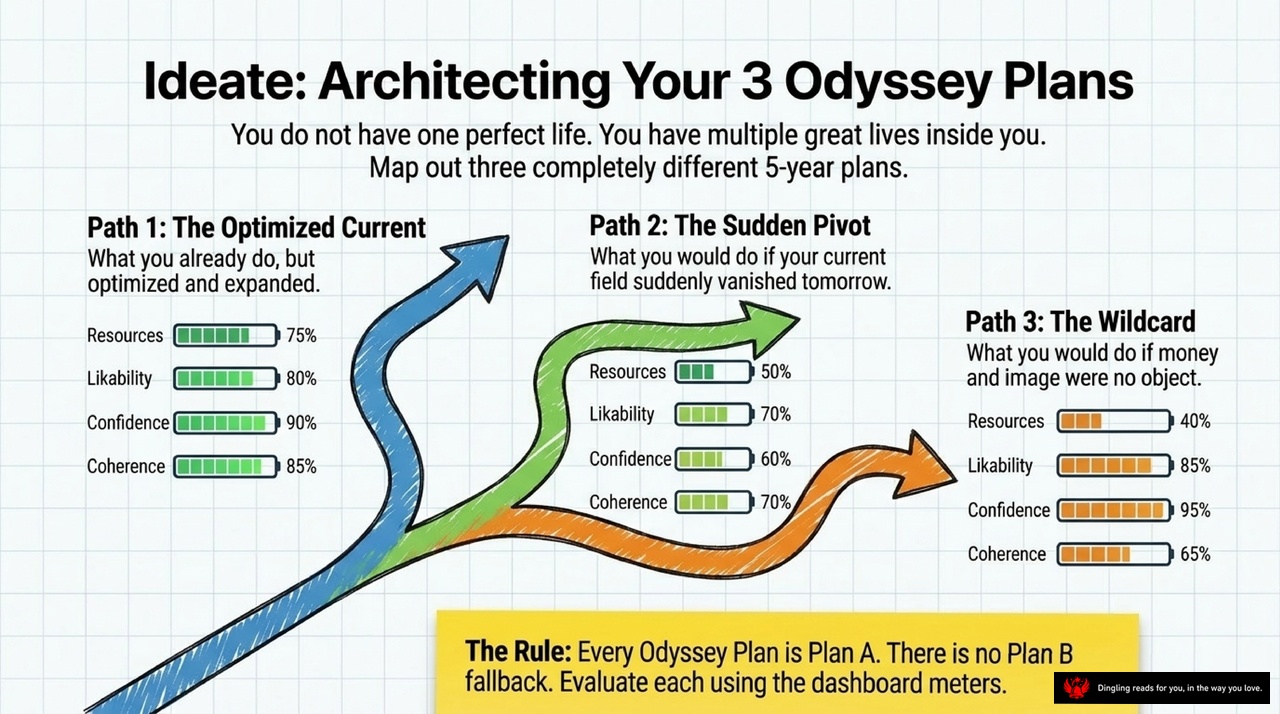
Imagine you don't have just one perfect life. In fact, you probably have three completely different great lives waiting inside you. That's the core idea of the Odyssey Plan: instead of obsessing over a single "right" path, you map out three distinct five-year scenarios. Think of them all as Plan A. There is no Plan B fallback.
The first path is "The Optimized Current." This is simply what you are doing now, but taken to the next level. You take your existing resources, likability, and confidence and expand them. It's the safe, logical choice, but is it truly exciting?
The second path is "The Sudden Pivot." Imagine your current field vanished tomorrow. What would you do? Maybe you'd take a risk with fewer resources but higher confidence, or perhaps you'd lean into a role where likability matters more than stability. This forces you to dig up hidden skills you've been ignoring.
The third path is "The Wildcard." This is the most liberating option. What would you do if money and image were no object? This path often has lower resources but sky-high confidence and likability. It reveals your deepest, most authentic desires without the pressure of the real world.
The rule is simple: treat every one of these plans as equally valid. Use your dashboard meters—resources, likability, confidence, and coherence—to evaluate each. By visualizing these three diverging arrows, you stop fearing the unknown and start seeing the vast landscape of possibilities available to you.
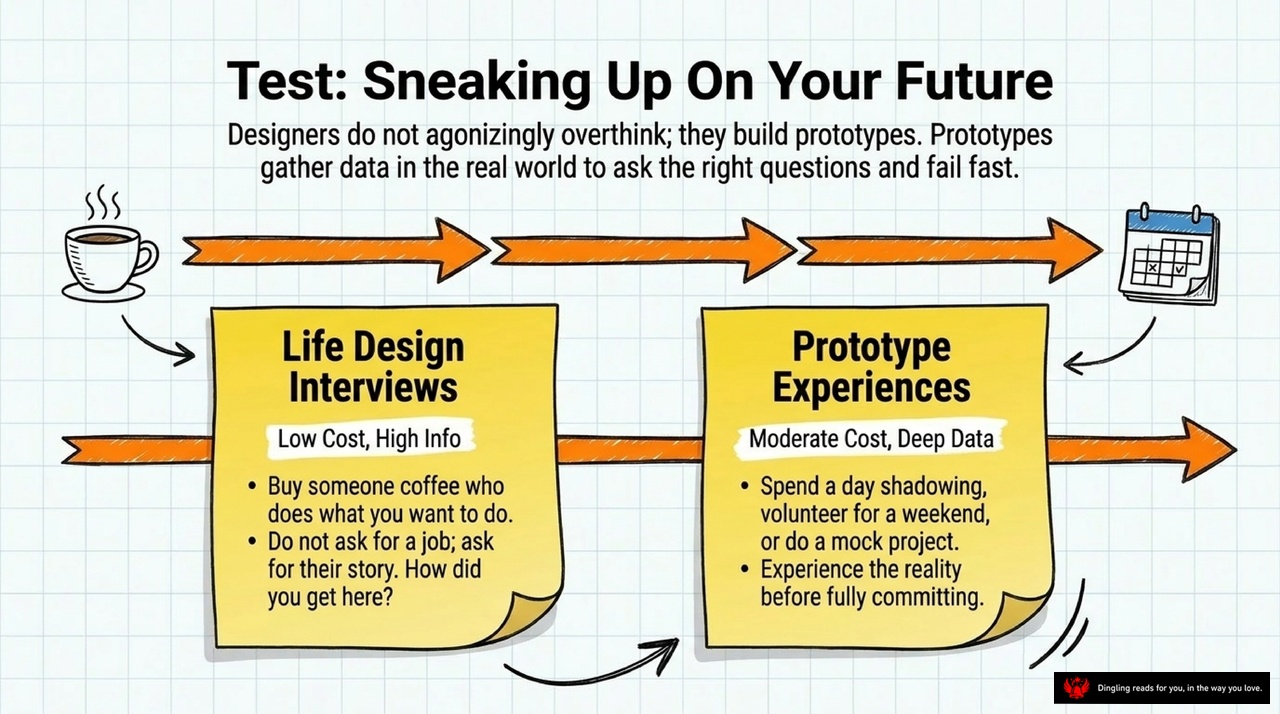
So, let's talk about how to stop overthinking your future and start actually testing it. The slide here breaks down a powerful strategy called "Sneaking Up On Your Future." It's based on a simple but brilliant idea: designers don't agonize over the perfect plan before they start. Instead, they build prototypes. They gather real-world data, ask the right questions, and fail fast. This approach is your best friend when you're trying to figure out your next career move or life direction.
The slide outlines two main ways to do this testing. First, we have "Life Design Interviews." Think of this as a low-cost, high-information way to learn. The advice here is to buy someone coffee who does the job you want. But here's the catch: do not ask for a job. Instead, ask for their story. Ask them, "How did you get here?" Listen to their real experiences, the highs and the lows, and you'll gain insights that no job description could ever give you.
Once you've gathered that intel, you move to the second box: "Prototype Experiences." This is where you go from low cost to moderate cost, but you get deep data. This means actually stepping into the reality you're curious about. You could spend a day shadowing someone, volunteer for a weekend, or even do a mock project. The goal is to experience the reality before you fully commit your life to it.
By combining these interviews with hands-on prototypes, you stop guessing and start knowing. You're no longer stuck in the hypothetical; you're gathering real evidence about what works for you, allowing you to design a future that actually fits your life.
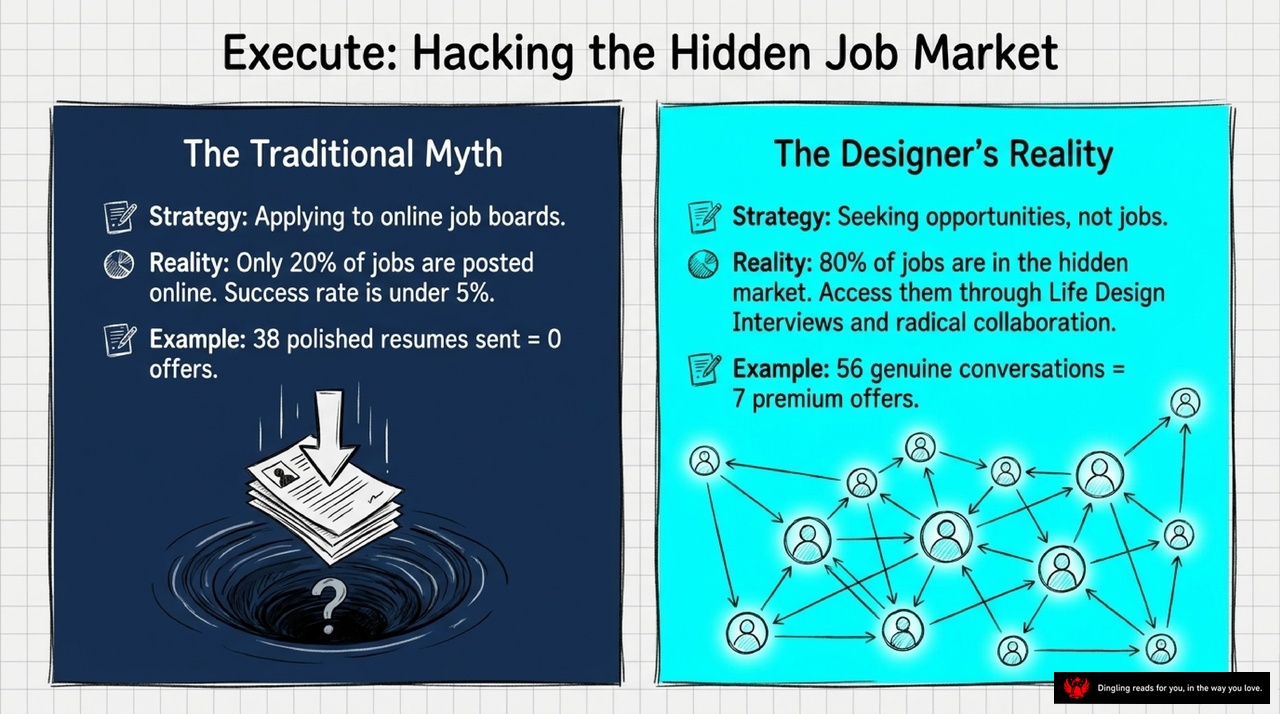
Today's slide contrasts two very different realities for job seekers: the traditional myth versus the designer's reality. On the left, we see the trap of relying solely on online job boards. The data is stark—only 20% of jobs are actually posted online, and the success rate for that approach is under 5%. We've all been there: sending out dozens of polished resumes into a digital void, only to get zero responses. It feels like throwing papers into a black hole.
But look at the right side. This is where the real opportunity lies. The designer's reality isn't about applying to jobs; it's about seeking opportunities. Here, 80% of jobs exist in the hidden market, never publicly listed. You access them not by uploading a file, but through life design interviews and radical collaboration. The example on the slide is powerful: instead of sending resumes, Kurt engaged in 56 genuine conversations. That human connection led to seven premium job offers.
The lesson is clear. Stop trying to hack a broken system by spamming applications. Instead, shift your mindset from "finding a job" to "finding work opportunities." Build a network of genuine curiosity and conversation. That's how you unlock the hidden market and turn your career search into a dynamic exploration rather than a desperate plea.
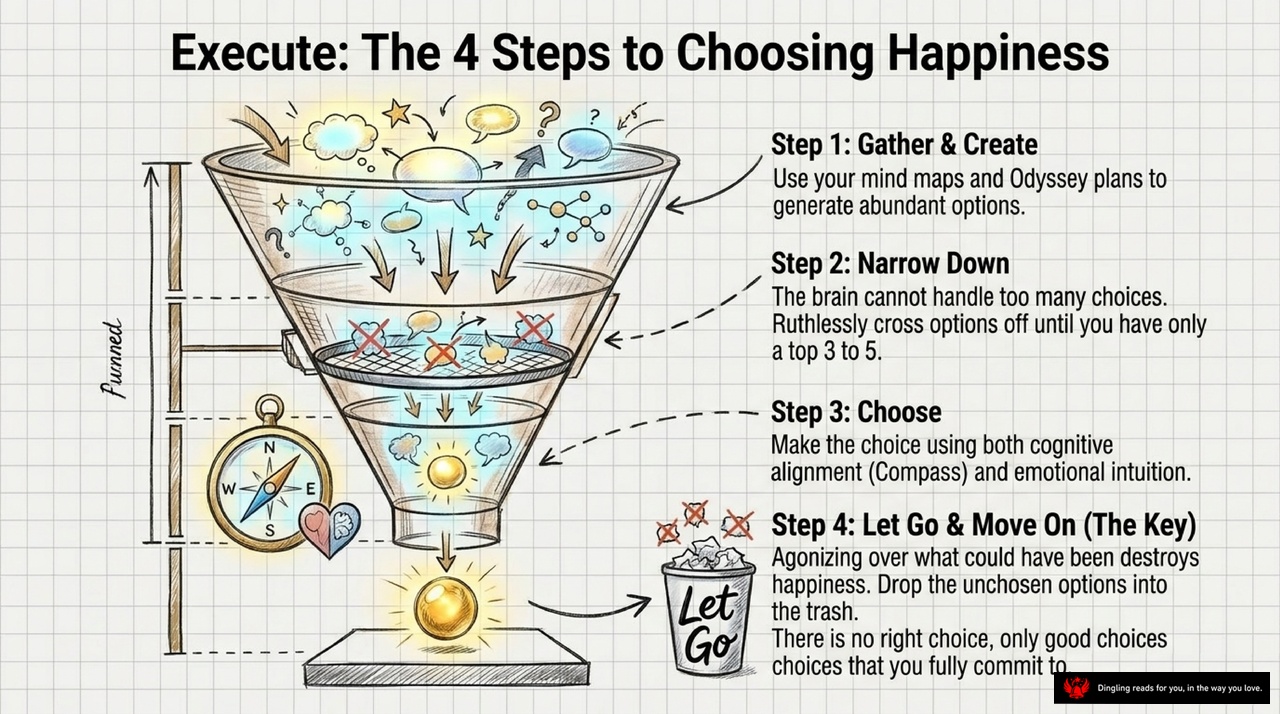
Imagine you are standing at the top of a giant funnel, ready to engineer your own happiness. This isn't about luck; it's about a deliberate four-step process.
First, you **Gather & Create**. Dump everything into the top of the funnel. Use your mind maps and Odyssey plans to generate an abundance of options. Don't hold back yet; let your mind go wild.
Next, you **Narrow Down**. Here is the hard truth: your brain simply cannot handle too many choices. If you leave it cluttered, you'll freeze. So, ruthlessly cross options off until you are left with just your top three to five.
Then, you **Choose**. This is where you align your head and your heart. Use your cognitive compass to check the logic, but also trust your emotional intuition. Make the decision using both.
Finally, and this is the key, you must **Let Go & Move On**. The moment you agonize over the paths you didn't take, you destroy your own happiness. There is no single "right" choice, only the good choices you fully commit to. So, take those unchosen options, throw them in the trash bin labeled "Let Go," and step forward into the light.

Synthesis: Achieving Failure Immunity
On this slide, we're looking at the core philosophy of designing a life that can't be broken. The graphic contrasts two worlds: the Finite Game and the Infinite Game. On the right, you see the "Finite Game" crossed out in red. This is the traditional view where life is just about winning or losing, with a clear finish line and a fear of failure. But on the left, we have "The Infinite Game," a cycle of Build, Test, Grow, and Learn. This is the mindset we need to adopt.
The text at the bottom explains the secret to this: "Failure Immunity." It tells us that when you prototype your life, you simply cannot fail. Why? Because you aren't trying to create a perfect final product; you are just gathering data. If an experiment works, great—you expand it. If it fails, you learn from it and iterate. You are a process, not a result.
Think about it this way: In a finite game, one mistake can end everything. But in an infinite game, every stumble is just a lesson that helps you build the next version of yourself. The goal isn't to avoid failure; it's to keep playing the game long enough to grow until you die. By shifting from a "win/lose" mentality to a "learn and iterate" mindset, you stop fearing the outcome and start embracing the journey. That is how you achieve true freedom in your life design.
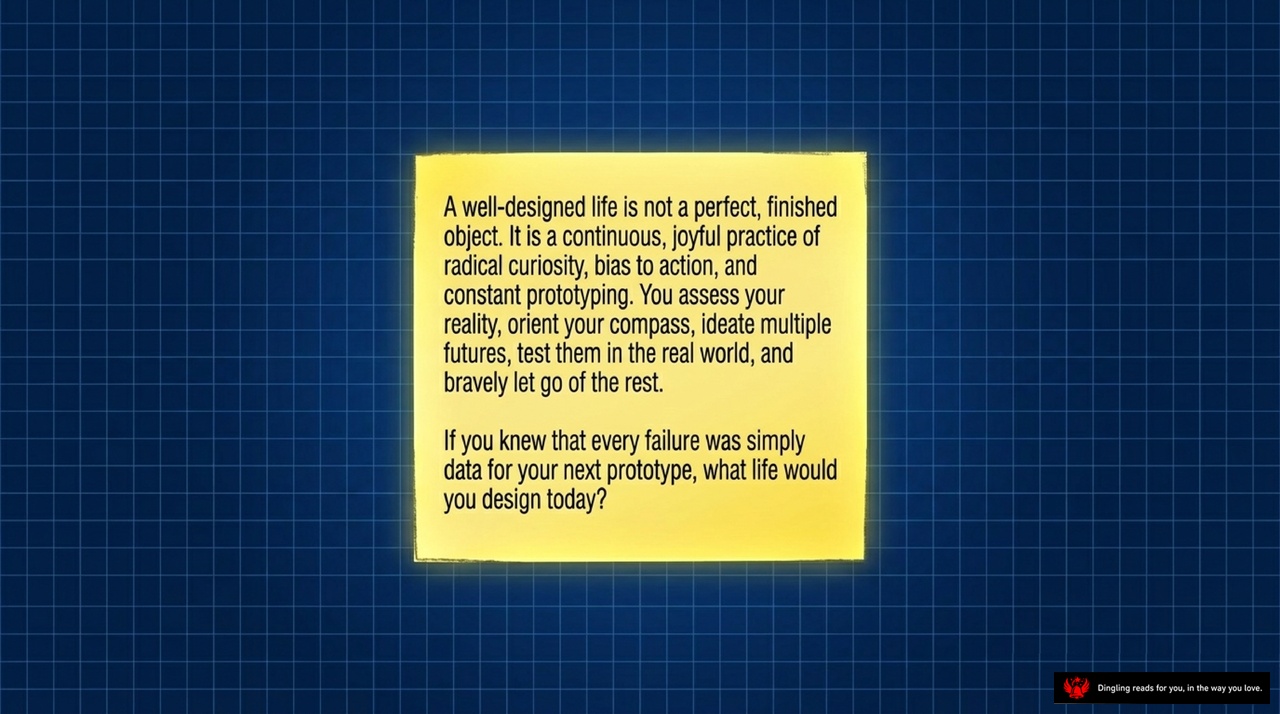
Imagine your life not as a finished masterpiece, but as a living design project. The core of this philosophy is a shift in how you view failure. If you knew that every stumble was simply data for your next prototype, what life would you design today?
This mindset transforms the entire experience of living. A well-designed life isn't about perfection; it's a continuous, joyful practice of radical curiosity and constant prototyping. Instead of fearing mistakes, you assess your reality, orient your compass, ideate multiple futures, test them in the real world, and bravely let go of what doesn't work.
Think of your failures not as dead ends, but as valuable information that helps you refine your next iteration. By embracing this approach, you stop waiting for the perfect moment and start building your life through action. So, stop worrying about getting it right the first time. Start designing.