
Different Seasons: Complete Chapter-by-Chapter Summary
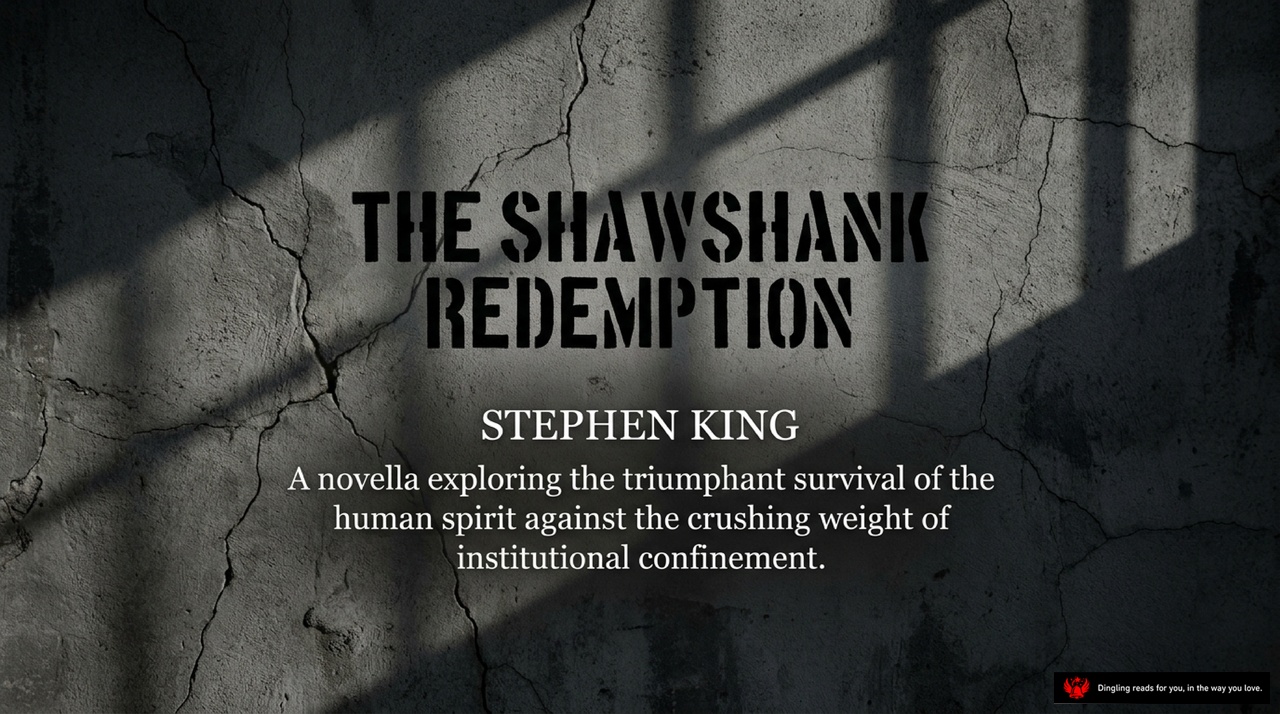
Hello everyone, welcome to today's session. We're diving into one of the most powerful stories in American literature, *The Shawshank Redemption* by Stephen King. As you can see on this slide, the title stands against a cracked wall with the shadows of prison bars stretching across it—a perfect visual metaphor for the story's core theme. This novella isn't just about a man behind bars; it's a profound exploration of how the human spirit can triumph even when crushed by the heaviest weight of institutional confinement. It's a story about hope, resilience, and the relentless pursuit of freedom. We'll walk through Andy's journey, from his wrongful imprisonment to his ultimate escape, and see how he redefines what it means to be truly free. Let's get started.
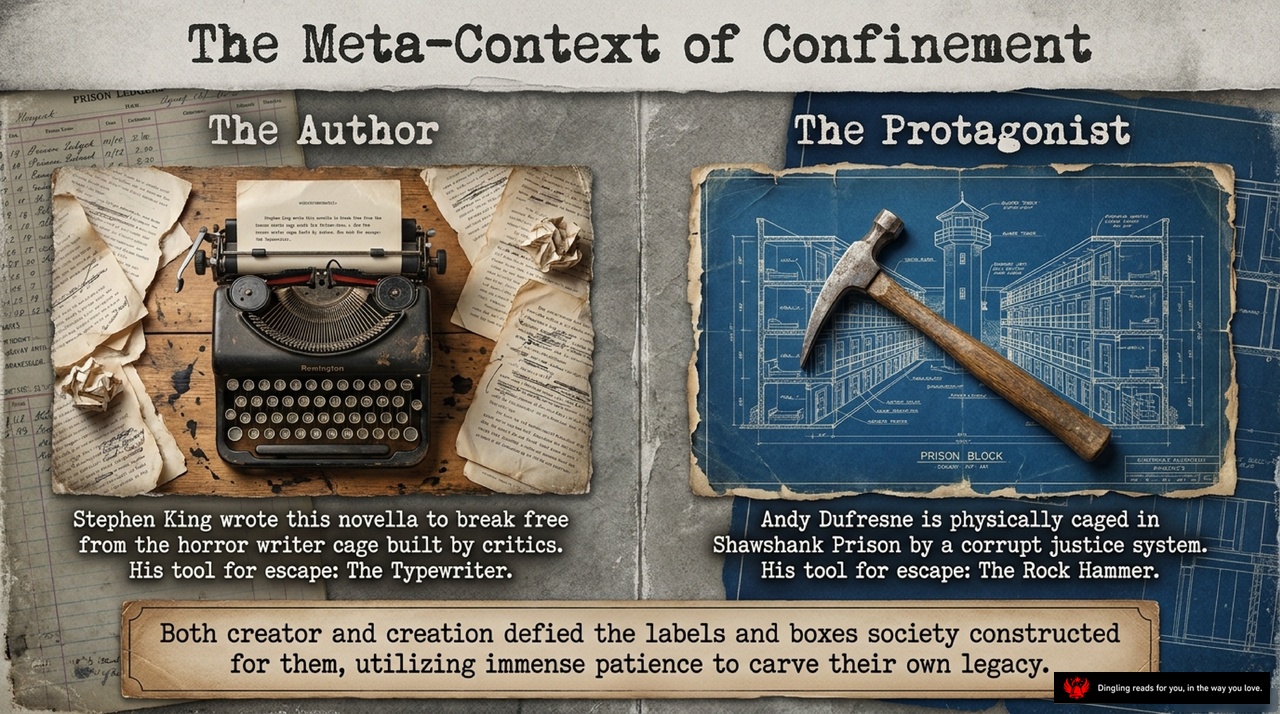
Look at this split screen. On the left, we see the author, Stephen King, and his weapon: the typewriter. He wrote this novella not just to tell a story, but to break free from the "horror writer" cage critics had built for him. On the right, we see the protagonist, Andy Dufresne, trapped in Shawshank Prison by a corrupt justice system. His tool for escape? A simple rock hammer.
Both the creator and the creation faced the same problem: society trying to box them in. King needed to escape the label of a horror writer; Andy needed to escape the label of a convicted murderer. But both of them did something extraordinary. They utilized immense patience to carve their own legacy. They refused to accept the boxes society constructed for them. Whether it's writing a masterpiece from a prison cell or digging a tunnel through a concrete wall, the message is the same: true freedom comes from the inside out, and it takes time, grit, and an unshakeable belief that you can define your own life.

The system is designed to crush the spirit. This slide illustrates the terrifying reality of institutionalization through the diverging paths of two men: Red and Andy. Look at the graph. It tracks their psychological state over decades. Red, who adapts to survive, follows a downward curve. He moves from rebellion to acceptance, and finally into total dependency. He trades his inner freedom for physical safety, believing that "they send you here for life, and that's exactly what they take."
But look at Andy's line. He starts with inner freedom and, despite the system's attempts to break him, he maintains a horizontal line of independence until he eventually breaks free. While Red fears the outside world, Andy manipulates the system to transcend it. This curve explains why Red ends up terrified of the world outside the walls, while Andy prepares for it. As we've seen with the brutal "sisters" and the warden Norton, the system wants to turn you into a dependent creature. But Andy proves that while the prison can control your body, it cannot easily steal your soul if you refuse to let it.

On the left, behind a rusted chain-link fence, stands "The Observer," Ellis Boyd "Red" Redding. He is the ultimate adapter, the man who can get anything. As a smuggler serving three life sentences, he became the heartbeat of the black market inside Shawshank, bringing in everything from cigarettes to contraband books. But on the right, illuminated by the golden glow of raw quartz, is "The Architect," Andy Dufresne. Once a former bank VP, he is the unlikely prisoner who actually walked out alive. While serving two life sentences, he wasn't just surviving; he was meticulously planning his escape.
Red describes himself as the guy who could get you anything, from St. Patrick's Day milkshakes to yellow literature, while Andy remained a quiet anomaly, finding inner peace in a violent world. The contrast is stark: one man adapted to the system to survive, while the other used his meticulous nature to dismantle it entirely. Red was the heart of the underground economy, whereas Andy was the master planner who turned a small rock hammer into the key to his freedom. This slide captures the two most distinct forces in the prison: the chaotic adaptability of Red and the calculated precision of Andy.

In 1962, a new warden named Sam Norton took over, promising reform but secretly running a corrupt "road gang" that exploited prison labor. He needed a reliable money launderer, and Andy stepped right into that role, trading his freedom for financial safety. But this arrangement was a fragile truce. The balance shifted when a young thief named Tommy Williams was sent to Shawshank. Tommy, trying to turn his life around in the library, accidentally stumbled upon the truth: the real killer was a man named Ellis Boyd "Birdie" Brady, who had confessed to Andy's crime years ago in another prison.
When Andy learned the truth, he saw his only path to freedom. He rushed to Warden Norton, demanding a hearing and the release of Tommy to verify the evidence. But Norton wasn't interested in justice; he was interested in survival. He knew that if Andy went free, his own secret—hiding millions in illegal accounts—would be exposed. So, he didn't just refuse Andy's request; he destroyed the witness. He transferred Tommy to a prison with better education but no hope of escape, effectively silencing the only person who could clear Andy's name.
Faced with this brutal reality, Andy made a chilling choice. He realized that legal appeal was impossible in a system controlled by greed. Instead of fighting a losing battle, he swallowed his pride and agreed to continue laundering Norton's money. He retreated into silence, pretending to be content while secretly continuing his excavation behind the poster of Linda Hamilton. To Norton, Andy was finally tamed, a tool that never questioned him. But Andy had already dug a tunnel through the walls, not just of the prison, but through the warden's control. He traded his innocence for the time he needed to escape, knowing that true freedom would come not from the law, but from the earth beneath his cell.
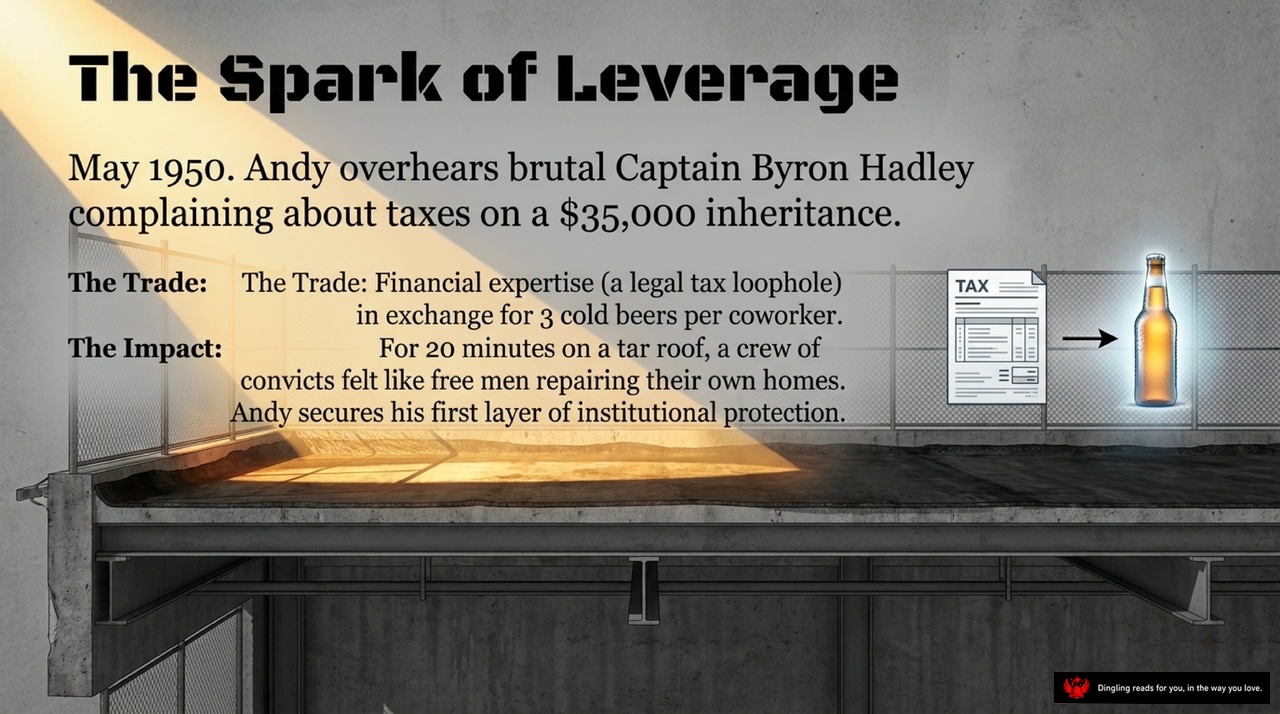
In the quiet corners of Shawshank, hope often feels like a distant dream, but for Andy, it was a concrete plan. He spoke of a small town in Mexico called Zihuatanejo, a place where the Pacific Ocean has no memory, where the sun is eternal, and where life could be simple and free. He envisioned a modest inn by the sea, a place where couples could watch the sunrise without looking over their shoulders. To make this dream real, Andy had been working for decades. Before his imprisonment, he used a legal loophole to create a fake identity, "Peter Stephen," and secretly invested his savings, allowing them to grow into nearly $370,000 by 1975. He hid the key to this fortune in a stone wall in Baxter Springs, a secret he guarded with the patience of a geologist. While others tried to escape by force or luck, Andy's strategy was different. He didn't rely on breaking out; he relied on time and precision. Every day, he chipped away at the wall, hiding the debris in his pockets, all while maintaining the calm demeanor of a man who had accepted his fate. His goal wasn't just to leave the prison, but to rebuild his life with dignity, proving that even behind the highest walls, the human spirit can find a way to the light.

In 1975, Andy finally pulled the trigger on his twenty-seven-year plan. That rainy night, the storm masked his every move as he crawled through the sewage pipe, leaving behind only a torn poster of Linda Lonsdale. When the warden Norton discovered the tunnel, the realization hit him hard: some birds are not meant to be caged.
But the escape wasn't just about Andy. It was a calculated sacrifice for the others. Andy knew he couldn't leave everything behind. He had hidden his fortune under the name "Peter Shaffer" and left a letter for Red in the rock beneath the stone wall in Buxton. That letter carried a message: "Hope is a good thing, maybe the best of things, and good things never die."
Red, after serving his own thirty-eight years, was released. But freedom outside felt different—lonely and confusing. He struggled to adapt, even tempted by the familiar safety of prison. Yet, holding Andy's letter and the twenty thousand dollars inside, he made the choice to leave. He drove to Mexico, heading toward the small town of El Tovar, ready to help build the hotel Andy had dreamed of. For Red, finding that letter wasn't just about money; it was the proof that hope could indeed set a man free, even after the walls had tried to break him.

Imagine a place where the walls feel like they're breathing on you, where time doesn't just pass—it grinds you down into dust. That's life inside Shawshank. After thirty-eight years, Red finally gets his parole. But walking out that gate, he doesn't feel free; he feels like a ghost in a world moving too fast. The bright sunlight is blinding, the cars are screaming, and the people don't look at him like a human being, just another piece of furniture to be ignored.
He tries to adapt, but his instincts are still wired for prison. He's used to asking guards for permission to use the bathroom, to knowing exactly where the power is. Outside, there's no one to tell him what to do, and that silence is terrifying. He almost gives in to the old life, thinking about stealing a can of soup just to feel like he belongs somewhere again. But then he remembers Andy. He remembers Andy's voice, that quiet, steady belief that "hope is a good thing, maybe the best of things."
That memory pulls him forward. He starts visiting Baxter, the town where Andy hid his secret. He walks the same dusty roads, searching for that black volcanic glass under the stone wall. It's a desperate search, a gamble with his freedom, but it's the only way out. When he finally finds it, holding that small, sealed envelope, something inside him snaps. The letter from Andy, the cash, the promise of El Paso and Monterey—these aren't just words anymore. They are a lifeline. Red realizes that staying in prison is a choice, and he chooses the hard path. He buys a ticket, leaves his past behind, and heads toward the Pacific, chasing the only thing that truly matters: the chance to be free.

Warden Norton looks like a saint on the outside—pious, Bible-quoting, preaching discipline with a straight face. But inside? He's a monster. Corrupt, murderous, and running illegal slave labor contracts under the guise of "Inside-Out." The scale on this slide shows the truth: his side is weighed down by stacks of cash and a fake medal that reads "Christ is my Savior," while the innocent side, representing Andy, holds only a single, glowing gem. It's a brutal reminder that in this prison, the most dangerous man isn't the one behind bars, but the one holding the keys.
Andy, on the other hand, is legally guilty but spiritually pure. He operates on an unyielding moral code, even when the system tries to crush him. While Norton profits from the suffering of others, Andy secretly carves out a future for himself and others. This isn't just a battle of good versus evil; it's a clash between two ways of being. Norton thinks he owns everything because he controls the rules. But Andy knows that true freedom isn't about following the rules—it's about rewriting them. And soon, he's going to show Norton exactly what happens when a man who refuses to be broken finally breaks the walls themselves.

In 1963, the facade of hope in Shawshank finally cracked. An inmate named Tommy Williams, a thief serving time for stealing from a jewelry store, revealed a shocking truth: the real killer behind Andy's conviction was a man named Elmo Blatch. Blatch had confessed to murdering the golf coach, Green Quinton, and his lover, Linda—the very crimes for which Andy had spent decades in prison.
But hope, in the hands of power, can be a dangerous weapon. Warden Norton, whose empire was built on money laundering and corruption, saw this revelation as an existential threat. To protect his "slave" and his ill-gotten gains, Norton buried the truth. He transferred Tommy to another prison and, in a brutal act of silencing, threw Andy into the hole for twenty days. The calendar on the floor of this slide isn't just counting days; it's counting the days Andy was forced to disappear, his voice stolen, his innocence buried under the warden's lies.
The result was a breaking point. The illusion of civility within the prison walls collapsed completely. Andy realized that coexistence with a system designed to crush the innocent was impossible. He understood that as long as he was tied to this corrupt institution, he would never be free. The betrayal by his friends and the cruelty of the warden forced a hard, unyielding conclusion: he had to destroy his ties to Shawshank entirely. The golden shards in the image represent the shattered illusion of justice, while the calendar marks the twenty days of silence that ignited the fire of his ultimate escape.

The image captures a profound truth about Andy's escape: it wasn't a matter of strength, but of patience and geology. As the slide states, "Geology is the study of pressure and time." Andy realized that the massive ten-foot concrete wall wasn't an impenetrable barrier, but a layer of rock waiting to be worn down. By applying the laws of geology to his confinement, he turned an impossible task into a slow, steady process.
Over twenty-seven years, Andy applied constant pressure. Every night, he chipped away tiny fragments of concrete. During his daily yard walks, he would discreetly disperse the dust from his pockets, turning the wall into a pile of microscopic gravel. He understood that while others saw a wall, he saw time itself. He knew that if he kept digging, even a few inches a day would eventually lead him to freedom. This wasn't about rushing; it was about trusting the process. In the end, it was the relentless combination of pressure and time that allowed him to break through the wall and reclaim his life.

Picture this: a simple rock hammer, a few decades of patience, and a wall of concrete that seemed unbreakable. In the story of *Shawshank Redemption*, these aren't just plot points; they are the blueprint for ultimate freedom. The slide breaks down "The Anatomy of an Escape" into three powerful ingredients.
First, we have "Geological Time." It wasn't just about waiting; it was about 27 years of absolute silence and routine. For Andy, time wasn't something that passed; it was a tool he used to his advantage. He turned every boring, repetitive day into a step toward the future.
Next, "Minimal Tools." Think about that. Just one rock hammer and some old pin-up posters. Andy didn't need a complex machine or a team of engineers. He used what was available, hiding the hammer behind a poster of Rita Hayworth, then Marilyn Monroe, then Raquel Welch. These weren't just decorations; they were the perfect camouflage for his most ambitious project.
Finally, "Concrete Vulnerability." Andy knew the prison walls were built with WPA-era limestone. He understood that the concrete, weakened by moisture over decades, was far softer than it looked. He didn't attack the wall with force; he attacked it with patience, chipping away tiny pieces every single night until the impossible became possible.
This wasn't a heist in the traditional sense; it was a methodical dismantling of physical and psychological cages. What started as a scratch in 1948 became a tunnel that led to freedom. As Andy famously realized, some birds are not meant to be caged. And for Andy, freedom wasn't just about leaving the prison; it was about reclaiming his life, his dignity, and his future.

Breaking the wall was only the prelude. The final toll for freedom was a 500-yard crawl through a suffocating, rat-infested sewage pipe. The pipe is the ultimate metaphor for redemption. To transcend the corruption of Shawshank, Andy had to physically crawl through the concentrated filth of the institution itself to reach the purifying rain.
This grueling journey, spanning five football fields, represents the ultimate test of endurance. It wasn't just about escaping the physical walls of the prison; it was about shedding the psychological chains that had held him captive for nearly half a century. Every inch of that dark, wet tunnel was a step away from the identity of a convict and a step toward becoming a man again.
As he emerged into the stormy night, the rain washing over him wasn't just water—it was the cleansing agent that finally stripped away the grime of Shawshank. In that moment, under the flash of lightning, Andy realized that true freedom wasn't about where you were, but about what you were willing to endure to get there. He had crawled through hell to find heaven, proving that even the darkest places can lead to the light if you have the courage to keep moving forward.
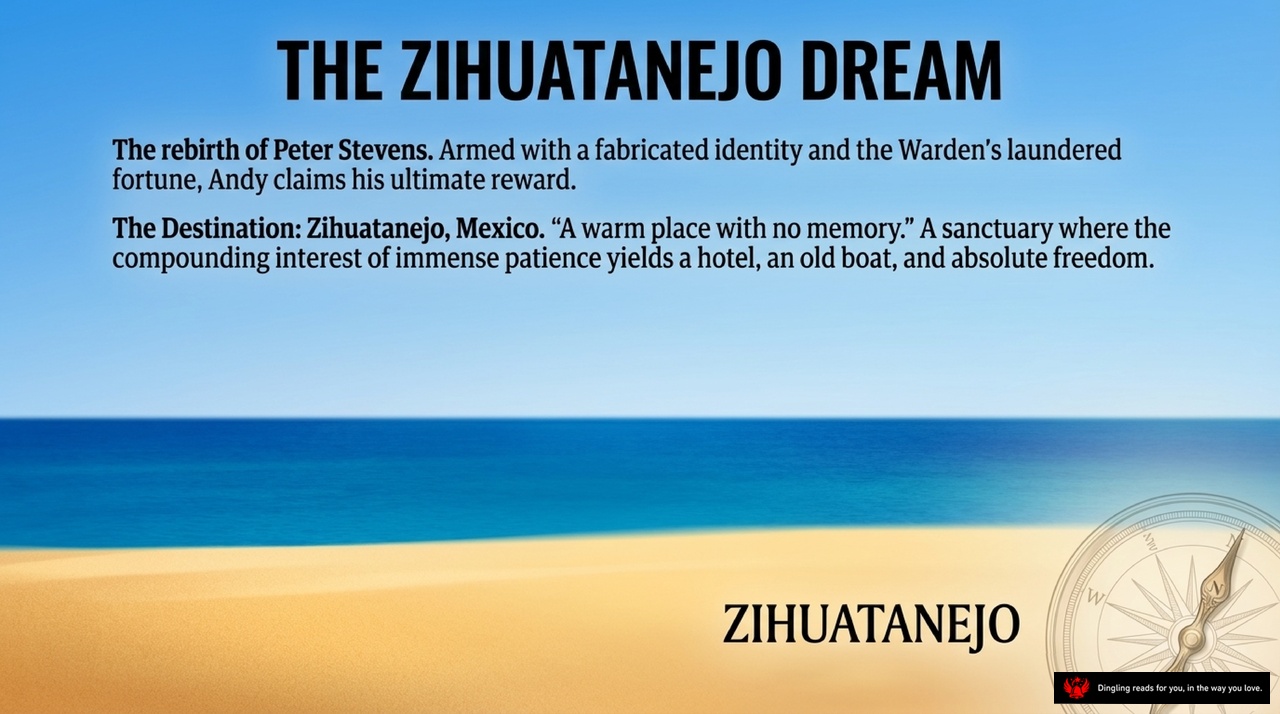
The Zihuatanejo Dream isn't just a place on a map; it's the ultimate reinvention. For Peter Stevens—formerly Andy Dufresne—this is the moment he claims his ultimate reward. Armed with a fabricated identity and the Warden's laundered fortune, he steps out of the past into a sanctuary where the compounding interest of immense patience yields a hotel, an old boat, and absolute freedom.
The destination is Zihuatanejo, Mexico. Think of it as a warm place with no memory, a coastal town where the Pacific Ocean washes away every scar and secret you've ever carried. It's a sanctuary built on the belief that freedom isn't about escaping the walls, but about finding a life where you don't have to look over your shoulder.
For Andy, this dream was always about more than just money; it was about reclaiming his humanity. He wanted to sleep in a room with an open window, to swim in the ocean without fear, and to live a life where he wasn't defined by a crime he didn't commit. With a little help from Red, who finally decides to leave the life behind, this dream becomes a reality. They buy a small hotel, restore an old boat, and set off on a journey that proves one thing: even after thirty-eight years in a cage, hope is the only thing that can truly set you free.

Hope is the ultimate tool of survival. In *The Shawshank Redemption*, we see that while institutions can cage the body, they cannot conquer a mind armed with patience, intellect, and an unbreakable sense of self-worth. Andy Dufresne proves this daily. He builds prisons out of our routines, our fears, and our circumstances, but he also shows us how to break them. When you look at the walls surrounding your own life, are you busy living, or are you busy dying? Andy chooses to live. He digs a tunnel behind a poster, hides money in a fake identity, and waits twenty-seven years for the perfect storm. He doesn't just survive; he thrives. And when he finally walks out into the rain, he leaves behind the man who told him hope is a good thing. That hope, my friends, is the only thing that truly sets us free.