
Digital Minimalism: Complete Chapter-by-Chapter Summary

Welcome everyone. Today we are exploring Cal Newport's Digital Minimalism. As the title suggests, this is a focused philosophy for choosing a life of deep meaning over noisy digital distractions.
We often feel like we are drowning in notifications and endless scrolling. We did not choose this noisy digital life; we fell into it. Tech companies designed these tools to keep us hooked, turning our attention into their product.
But there is a way out. This book is not about quitting technology entirely. It is about taking back control. In the coming chapters, we will look at how we lost our autonomy to addictive algorithms and how to fight back with a strategy that actually works. Let us start by understanding why we feel so powerless against our screens.

So, let's talk about what's actually happening in your life right now. We call this an "Uneven Arms Race." And here's the hard truth: we didn't sign up for digital addiction. We fell into it. Think back to 2004. Facebook was just a novelty, a digital yearbook. Nobody expected it to become a trillion-dollar distraction machine. But today, it's everywhere.
Look at this scale on the slide. It shows the core conflict. On one side, you have "Our Paleolithic Social Drives." That's just your brain, wired for survival, for tribal recognition, for social validation. We want to be liked, we want to know what's happening with our tribe. It's deep, it's ancient. It's why we check our phones when we get a notification. It's why we feel anxious when we don't check it.
But on the other side? "The Attention Economy Engineers." These are tech giants, server farms, algorithms designed by people who know exactly how to hack that ancient brain. They aren't building neutral tools; they are building slot machines. They monetize your screen time. They turn your attention into a commodity.
So, why do you feel like you're losing control? Why does scrolling feel impossible to stop? It's not because you're lazy. That's the biggest lie we tell ourselves. You are not lazy. You are losing a billion-dollar war for your attention against engineers who want to monetize your screen time. Your willpower is no match for their business model.
They use what we call "intermittent positive reinforcement." Like a slot machine, you pull the lever, and sometimes you get a reward—a like, a comment. That dopamine hit is engineered. It's not an accident. It's a feature.
The problem is, these engineers are leveraging our innate social drives. They know that in the Old Stone Age, being excluded from the tribe meant death. Today, that feeling is triggered by a red notification dot. They exploit that primal fear of social exclusion.
We think we're just bad at self-control, but the reality is, we are up against a company with a billion-dollar incentive to keep us distracted. They have the engineers, the data, and the money. We have biology. And biology is slow to adapt to these new, predatory technologies.
So, don't beat yourself up. Recognize the battlefield. You aren't fighting your own weakness; you're fighting a system designed to exploit it. Once you see the game for what it is, you can start thinking about how to change the rules. That's where digital minimalism comes in.

Look at this slide. It's titled 'The Mechanics of the Slot Machine'. This graphic explains exactly why your phone feels so hard to put down. It's not just a tool; it's a psychological trap designed to hook you.
On the left, we see 'Intermittent Positive Reinforcement'. This is the same mechanism used in casinos. When you pull the lever on a slot machine, you don't know if you'll win. That unpredictability is what creates the addiction. It floods your brain with dopamine. You keep pulling the lever because you're chasing that next high.
Now, look at your phone. Every time you check it, you are pulling that lever. You don't know if there's a message, a like, or nothing at all. This uncertainty keeps you hooked. As the book mentions, experts like Adam Alter have studied this, noting that unpredictable rewards make us check our phones compulsively. It's not a glitch; it's a feature designed to keep you engaged. Think about how you feel when you get a notification. It's that rush of adrenaline, that 'maybe something good happened' feeling.
On the right, we have the 'Drive for Social Approval'. This taps into something much deeper. Our ancestors evolved as part of tribes, where social acceptance was a matter of survival. Being ignored meant danger. Today, tech companies have hijacked this tribal survival instinct.
Social media platforms use this by turning 'likes' and 'hearts' into digital tokens of belonging. When you get a lot of them, it feels like the tribe is accepting you. When you don't, you feel a pang of rejection, like being cast out. This is the 'social validation loop' that keeps you scrolling. It's not just about likes. It's about the feeling of being seen and validated by the group.
The text at the bottom drives this home: Apps do not just offer utility; they are programmed for behavioral addiction. The smartphone is a slot machine in your pocket, delivering unpredictable dopamine hits to manipulate your behavior.
We often think we are just weak-willed. But the truth is, these companies have spent billions designing these systems to exploit our psychology. As former Google engineer Tristan Harris revealed, these apps aren't neutral tools; they are designed to manipulate users like slot machines to maximize profit. They aren't just offering you a tool; they are selling you your own attention. Understanding this mechanic is the first step to realizing that you aren't fighting your own weakness, but a business model designed to steal your autonomy.

Welcome back. Today, we look at the fundamental paradigm shift: Digital Maximalism versus Digital Minimalism. This is a battle for your attention and your life.
On the left, we see Digital Maximalism. This is the default mode for most of us today. The driving mindset is FOMO—the Fear Of Missing Out. You feel that if you don't check that email or that notification, you are falling behind. The rule is seductive but dangerous: If a technology offers *any* marginal benefit, use it. We chase new tools, believing more access equals freedom. The result is a cluttered, exhausted attention span. We end up overwhelmed by the noise, constantly reacting to external demands rather than driving our own lives. We are busy, but we are not productive.
Now, look at the right side. This is Digital Minimalism. It flips the script entirely. The mindset is Intentional Optimization. Instead of fearing missing out, the digital minimalist is actually happy to miss out on the trivial. They don't care about the small notifications; they care about what truly matters. The rule is much stricter and more powerful: Is this the ABSOLUTE BEST way to support my deeply held values? You ask if it is the best tool for your goals. The result? Focused, autonomous living. You are the master of your time.
The contrast is stark. One path trades your attention for convenience, while the other trades convenience for autonomy. Digital Minimalism isn't about rejecting technology; it's about reclaiming your life from it. It's about missing the trivial to engage with the essential. This shift is the key to escaping the attention economy and finding peace in a chaotic world. It requires a conscious decision to use technology only when it serves your deepest values.

Welcome to the core framework of digital minimalism. Think of this lifestyle as a sturdy building, and these three pillars are what keep it standing.
First, clutter is costly. We often treat our digital tools like free utilities, but the ultimate currency here is actually your time. The cumulative cost of minor digital distractions vastly outweighs their small conveniences. We aren't actively asking for this chaotic digital life; we've simply fallen into it. Every time you check a notification that isn't urgent, you're paying with hours of your life. It's like Thoreau's experiment at Walden Pond—he realized that owning more stuff actually made him experience less. In our digital world, having too many apps drains your attention and cancels out the benefit of any single tool.
Second, optimization is crucial. Many people think picking the right app is enough, but that's only step one. The Law of Diminishing Returns applies to tech just like everything else. You need to strictly define how and when you use a tool to unlock its true value. If you don't optimize, you're just letting the technology dictate your day. Companies want you to treat your phone like an ecosystem to wander through, but when you treat it as a tool for specific goals, you gain real leverage. Just like the Amish evaluate new technology against their core values, we need to ask: does this tool actually help me achieve what matters?
And finally, intentionality is satisfying. This is the most important part. The act of intentionally choosing your tools brings far more satisfaction than the fleeting convenience of mindless scrolling. When you make a conscious choice, you're not just consuming content; you're exercising autonomy. That feeling of control is deeply rewarding. It's about reclaiming your agency from the algorithms designed to hook you. Think about the Amish community—they don't reject technology blindly; they evaluate it against their values. That same principle applies to us.
So, digital minimalism isn't about living in the past. It's about realizing that your time is valuable, optimizing how you spend it, and making choices that align with your values. That's how you build a life that actually feels good.

So, if you're ready to take control of your digital life, there's a specific framework we can use. It's called the 30-Day Digital Declutter. This isn't about quitting technology forever; it's about resetting your relationship with it through a structured reset.
Step one is Define Rules. You need to identify all optional technologies—things like social media, news sites, and streaming services. Ask yourself a simple question: If taking a break from this won't harm your professional or personal life, it's optional. If it's just a convenience, it's fair game for this experiment. For instance, work emails are essential, but scrolling through Instagram for hours is optional. You need to be honest about what is truly necessary versus what is just a habit. This step clears the deck so you know exactly what you're letting go of.
Step two is The 30-Day Break. This is where you abstain entirely from optional tech. But don't just sit there. Use this time to explore high-quality physical activities and rediscover what brings you true fulfillment. It's about getting offline to see what life looks like without the constant ping. You'll likely find that your attention span returns and you reconnect with the real world. Many people use this time to read books, exercise, or simply talk to their family without looking at a screen. It's a detox for your brain. The discomfort you feel in the first week is normal, but it's the price of reclaiming your focus.
Step three is The Reintroduction. After 30 days, you reintroduce tech from a blank slate. You only allow tools that pass strict value tests. You define precise operating procedures for their use. For example, you might decide to only check email at specific times, rather than having it constantly demanding your attention. This ensures that when you do use tech, it serves your goals rather than hijacking your time. Think of it like moving into a new apartment. You don't bring back all the old junk. You only bring back what you truly need.
This process helps you take control back. It stops you from being a product for someone else's algorithm. By following these three steps, you transform from a passive consumer of digital content into an active designer of your own digital life. Remember, the goal isn't to have no technology, but to have technology that works for you. This is how you build a sustainable digital life that supports your values.

Welcome back to Pillar One: The Value of Solitude. Let's be honest, we often misunderstand what solitude actually means. We tend to think it's about being physically alone. But look at this diagram. It clearly shows that being physically alone doesn't equal true solitude. True solitude is defined as freedom from the input of other minds. You can be physically alone in a cabin in the woods, but if you're reading tweets, you're not really alone. Conversely, you can be in a crowded café, yet if you're alone with your own thoughts, you are truly solitary. It's a state of mind, not a location.
So why do we need this? Because human beings require solitude to clarify complex problems, regulate emotions, and build moral courage. It's not just a luxury; it's a necessity for our survival and growth. Think about Abraham Lincoln. He left the chaotic White House to find a quiet place to write the Emancipation Proclamation. Or Martin Luther King Jr., who found the courage to lead the Montgomery Bus Boycott after a night of quiet prayer and reflection. Without that space to step back, we can't process the noise around us.
Modern technology is actually designed to steal this time from us. Notifications, likes, endless scrolling—they all interrupt that quiet space. Anthony Storr, a psychiatrist, noted that many geniuses, from Newton to Descartes, thrived in solitude. Michael Harris argues that avoiding solitude leads to anxiety. It allows you to think clearly, manage your feelings, and build the strength to do what's right. Without this, we become reactive rather than proactive.
So, don't just seek a quiet room. Seek a quiet mind. Whether you're walking in nature or sitting in a busy city, make sure you're disconnected from the outside input. That's where true solitude lives, and that's where your best thinking happens. Remember, you don't need to escape the world to find solitude. You just need to reclaim your attention. In a world that constantly demands your input, choosing to be alone with your thoughts is the most rebellious, and necessary, act you can take.
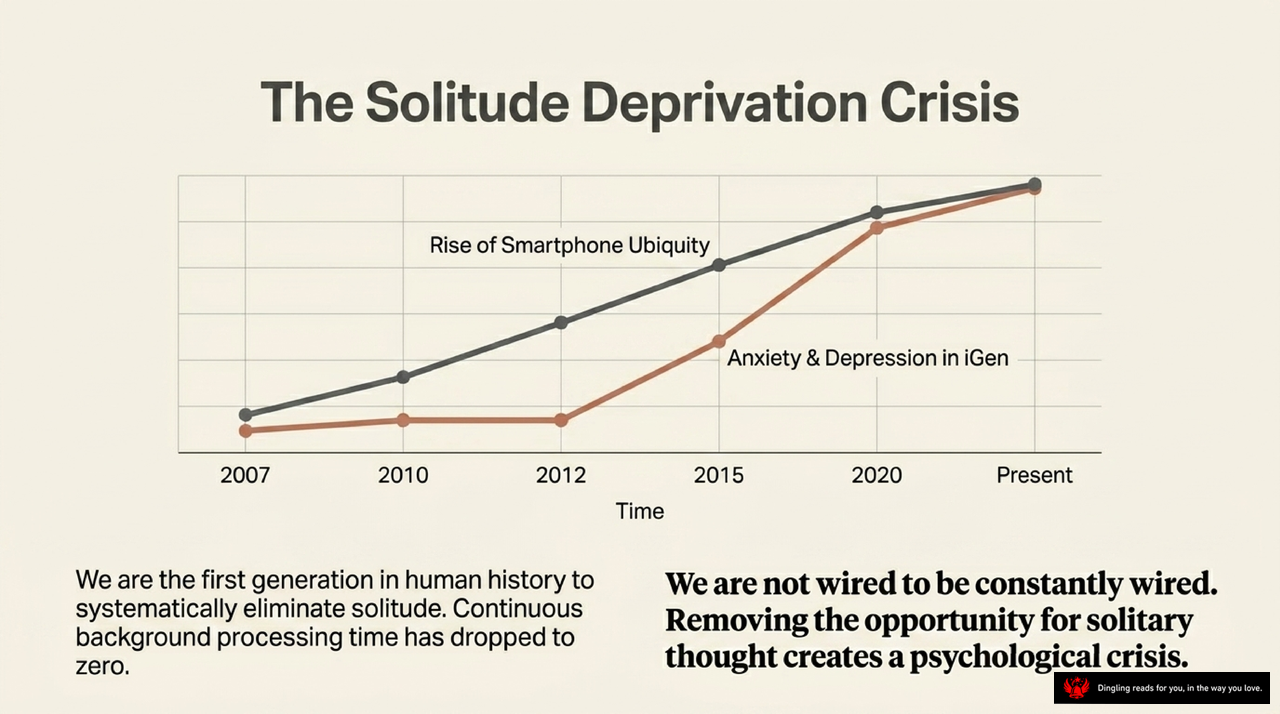
Take a moment to look at this graph. It visualizes a critical shift in our modern lives. On the timeline, we see the period from 2007 to the present. The black line tracks the rise of smartphone ubiquity. The orange line tracks anxiety and depression specifically within Generation i.
Notice how these two lines climb together. It's a direct correlation. We are currently living through the first generation in human history to systematically eliminate solitude. Before smartphones, we had moments of downtime. We had "background processing time"—the quiet moments where our brains could wander, reflect, and make sense of the day. But now, that continuous background processing time has dropped to zero.
The book highlights a profound insight here: "We are not wired to be constantly wired." Our biology hasn't evolved to handle this level of constant connectivity. We are designed for connection, yes, but not for this kind of fragmented, 24/7 digital noise. When you look at the data, the correlation is undeniable. As smartphones became ubiquitous, mental health issues skyrocketed. Research shows that starting from 2012, the anxiety, depression, and suicide rates of this group soared, perfectly matching the time of smartphone popularity.
This isn't just about stress; it's what the slide calls a "solitude deprivation crisis." By removing the opportunity for solitary thought, we are actually creating a psychological crisis. We've traded deep, internal reflection for constant external validation and notification. We are addicted to the "feed" because we've forgotten how to sit with our own thoughts. This graph isn't just a trend line; it's a warning. It shows that our constant connection is directly linked to our internal turmoil. We need to understand that silence isn't empty space; it's where our minds process the world. Without it, we lose the ability to think deeply, and that's exactly what's fueling this crisis. We need to reclaim that solitude. As the book states, removing the opportunity for solitary thought creates a psychological crisis. It's time to stop fighting the urge to be alone and start embracing the power of solitude.

Welcome to Pillar Two. Today, we're tackling a critical concept: Reclaiming Conversation.
Let's look at the distinction on this slide. We have two sides: Connection and Conversation.
On the left, we have Connection. It's texts, emojis, likes, and comments. It's low-bandwidth and shallow. It's asynchronous and performative. Sure, it satisfies a craving for validation, but it provides no emotional nourishment. It's like eating digital fast food.
On the right, we have Conversation. This is face-to-face, voice calls. It's high-bandwidth and empathetic. It's demanding and real-time. This is the kind of human interaction our brains evolved to require. It's where we truly feel seen and understood.
Here is the core argument: Digital connection should only be used as a logistical tool to set up real-world conversation. Never as a replacement for it.
Think about it this way. If you use your phone to schedule a dinner, that's a logistical tool. That's fine. But if you use your phone to actually share your feelings or build a relationship, that's a replacement, and it's a failure. Real connection requires nuance, tone, and presence.
Sherry Turkle, a professor at MIT, calls this the 'Connected vs. Conversational' paradox. She argues that when we prioritize digital connection, we lose the ability to have deep, meaningful dialogue. We trade a cup of coffee for a like button.
The problem is, we often confuse the two. We think a comment counts as a chat. But it doesn't. Our brains aren't wired for the asynchronous, performative nature of social media. They are wired for the messy, beautiful, demanding reality of face-to-face interaction.
So, what's the fix? Be intentional. Use your phone to coordinate a meeting, not to avoid having the meeting. Use your phone to send a calendar invite, not to write a novel in a DM.
Remember, the goal isn't to ban technology. It's about respecting the biological needs of our brain. When we use digital tools for logistics, we save our mental energy for the stuff that matters. When we treat them as conversation, we become ghosts in the machine.
Let's stop pretending that a digital comment is the same as a conversation. Let's reclaim the conversation.

Welcome back. Today we're diving into one of the most counterintuitive, yet powerful strategies for reclaiming your digital life: The Don't Click Like Protocol.
Here's the core idea: Treat likes and generic comments as poison to your social life. Stop using them entirely. It sounds extreme, but it's necessary. Why? Because these one-click interactions trick you into thinking you're connecting, when in reality, you're just feeding the algorithm. By refusing to click like, you starve the attention merchants of the behavioral data they use to hijack your psychology. You are essentially taking back control from the machine that wants to monetize your attention. When you treat these notifications as poison, you stop letting them dictate your mood.
But there's a deeper benefit here. By removing the low-friction like button, you force yourself to choose. You have to either engage in a real conversation or let weak ties naturally fade. This is crucial. In our modern world, we often mistake "connectedness" for "conversation." Social media platforms are designed to give you the illusion of connection without the substance. They want you to swipe, tap, and scroll endlessly.
Think about your closest friends. If someone you care about has a baby, do you just like the photo and move on? Or do you actually pick up the phone? The book suggests that if you really care about someone, bringing them food to visit is far more meaningful than leaving a comment under a photo. Real human interaction requires effort, empathy, and presence. It requires you to look someone in the eye, not just a screen. It's okay to let acquaintances drift away. Quality over quantity is the new standard. This isn't about being antisocial. It's about being selective.
This shift moves you from a zero-sum game where online interaction replaces offline conversation, to a life where technology serves you, rather than you serving technology. You might lose some followers or feel awkward at first. That's okay. Weak ties should fade. What remains are the strong connections that actually matter.
So, the next time you see that heart icon or thumbs up, pause. Ask yourself: Does this add value to my life, or am I just feeding the algorithm? If it's the latter, don't click. Your social life will be richer, and your attention will be yours to spend where it truly counts.

Welcome to Pillar Three: Reclaiming Leisure. This slide introduces what we call the Bennett Principle. If you look at this chart, you'll see a clear divide between how we spend our downtime. On the bottom left, we have binge-watching and doom-scrolling. These are low-effort activities. They require almost no energy, yet paradoxically, they leave us feeling exhausted and unfulfilled. That's the trap of passive screen consumption. We think we are resting, but we are actually just consuming data without engaging our minds.
On the other hand, look at the top right. This is where craftsmanship and active hobbies live. These require significant effort, but they yield significantly higher life satisfaction. This is the core of the Bennett Principle: demanding, high-effort leisure provides far more psychological reward than passive screen consumption.
Here's the counter-intuitive part. Most of us believe that after a long day of work, we need to do nothing. We think leisure is the opposite of work. But Arnold Bennett, a writer from the early 20th century, argued the exact opposite. He believed that the brain doesn't get tired like our muscles. It doesn't need a pause; it needs a change. When we engage in active, demanding leisure—like fixing something, learning a skill, or playing a complex game—we actually recharge our mental energy.
So, why does doom-scrolling leave us drained? Because it's a form of passive consumption that doesn't engage our cognitive faculties. It tricks us into thinking we're relaxing, but we're actually just numbing ourselves. To truly reclaim our leisure time, we need to shift from being consumers of content to creators of experiences. Instead of asking 'what can I watch?', ask 'what can I build?' or 'what can I learn?'
Think about craftsmanship. It's not just about the object you make; it's about the process. When you spend time learning to cook, painting, or even fixing a piece of furniture, you are engaging your brain fully. This creates a deep sense of satisfaction that digital validation simply cannot match.
This shift isn't just about productivity; it's about fulfillment. When you invest effort into something tangible, you get a sense of accomplishment that no number of likes or comments can match. So, let's challenge ourselves to swap our passive screen time for active hobbies. Let's embrace the struggle of learning something new. That is the path to reclaiming not just our time, but our life satisfaction. Remember, the goal isn't to do more, but to do things that actually matter to your well-being. The Bennett Principle reminds us that true rest comes from engagement, not avoidance.

Welcome to this section on The Power of the Physical World. Look closely at the image on the left. We see the screen. It's described as ethereal and fleeting. It leaves no permanent record of competence. We spend hours on these devices, chasing notifications and likes. But here's the thing—does that actually make you feel capable? Or does it just leave you feeling drained? The book points out that digital interactions are often passive. You consume content, but you rarely create anything of lasting value. It's like digital junk food. It fills the void, but it doesn't nourish you.
Now, look at the right side. The Craft. This is tangible and permanent. It satisfies a primal human need to create valuable things. We are wired to build, to fix, to make. Think about the examples from the book, like someone fixing a motorcycle or building a table. When you engage in physical craft, you get immediate, real feedback. You don't need a digital validation. You can just look at what you made and know it has value. This is the difference between active and passive leisure.
The text emphasizes that we've been filling our free time with passive consumption—scrolling, watching, clicking. But that leaves us feeling empty. Instead, we need active leisure. We need to use our minds and our hands. The book argues that physical skills offer a kind of satisfaction that social media likes simply can't replace. It's about tangible judgment versus digital noise. When you spend time crafting, you're not just consuming content; you're producing value.
So, what's the takeaway? It's not about rejecting technology entirely. It's about shifting your focus. Prioritize activities where you create something real. Whether it's woodworking, cooking, or fixing something around the house. These activities ground you. They give you a sense of competence that lasts beyond the screen. When you spend time crafting, you're not just consuming time; you're investing in yourself. Don't let the ethereal screen steal your time from the tangible world. The power of the physical world is in your hands.

Welcome to Pillar IV: Joining the Attention Resistance. This is the moment we stop being passive consumers of technology and start actively fighting back against the attention economy. We aren't just trying to be disciplined; we are engaging in a small shrimp versus a big whale battle against tech giants who design products to steal our focus. Here is your tactical playbook to reclaim your time.
First, delete social media apps from your phone. It sounds extreme, but it works. Remove Instagram, Facebook, and the rest. Force yourself to log in via a desktop browser if you need to check something. This simple friction breaks the automatic reflex of reaching for your thumb. You stop feeding the algorithm your attention every five minutes. It forces you to make a conscious choice to use the platform, rather than falling into the dopamine trap of mindless scrolling.
Second, pre-schedule your distractions. Don't let your phone be an open door for entertainment. Use website blockers by default. Only allow access to distracting sites during tightly pre-scheduled windows. Think of your device as a dedicated tool, not a playground. You might use software like Freedom to block sites automatically, ensuring you stay focused unless you've explicitly planned a break. This turns your phone into a specialized computer for specific tasks, matching your natural attention system.
Third, batch your texts. This is crucial for reducing anxiety. Put your phone on Do Not Disturb mode and process text messages in batches. Treat them like emails rather than continuous interruptions. Instead of reacting to every ping, you check messages at specific times. This gives you control back over your flow state and stops the constant notifications from fragmenting your day. You are no longer a slave to the notification bell. This allows you to stay present with the people and tasks in front of you.
When you combine these strategies, you shift from being a product to being the user. You stop letting tech dictate your mood and schedule. It takes effort, but it's the only way to win the battle for your attention. Remember, your time is your most valuable asset, and it's time to invest it in what truly matters, not what the algorithm wants you to see. It is the difference between being controlled and being free.

Imagine your attention is a funnel. Right now, it's being choked by "The Noise." We're talking about breaking news alerts, endless Twitter feeds, clickbait headlines, and algorithmic outrage. It's not just noise; it's a business model. Tech giants are running an attention economy, farming your focus to sell ads. You're not the customer; you're the product. You end up engaging in reflexive behaviors, scrolling out of boredom just to fill the void. It's designed to give you a hit of dopamine like a slot machine every time you check your phone, keeping you hooked.
But we don't have to live like this. We can adopt "The Slow Media Diet." It's a deliberate strategy to reclaim your mental space.
First, you need a Filter. This isn't about deleting everything, but curating for quality over immediacy. Think of it like the Slow Food movement. Instead of eating fast food, we eat our media slowly. The book suggests we fix the time and place of our news consumption. Make it a ritual. Maybe read the paper at breakfast or deep dive into articles on a Saturday morning. Instead of checking your phone every time a notification pops up, you wait for your scheduled time. This simple act of ritualizing protects you from the constant interruptions of ads and clickbait. It forces you to engage with content, not just react to it. It reduces the mental load and anxiety that comes from constant notifications.
Second, you need to find The Signal. What comes out of that filter should be high-quality, long-form journalism, books, and trusted weekly briefings. We need to select our sources carefully. Don't just scroll through everything. Pick a few authoritative voices. Even better, find sources that challenge your own views to deepen your understanding. The text warns that breaking news is often fragmented and contradictory. In-depth reporting from established sources is far more reliable. Books and weekly briefings give you context, whereas social media gives you just the highlight reel. This shift leads to vastly higher comprehension of the world around you.
The goal is to move from being a passive consumer of "social fast food" to an active seeker of truth. By slowing down, we reclaim our attention. We stop letting algorithms dictate what we think and start choosing what truly matters to us. It's about serving our needs, not letting media consume our time.
This shift might feel hard at first, but it's the only way to break the cycle of addiction and find clarity in a noisy world. When you slow down, you don't just read better; you think better.

So, let's look at the core philosophy here. Digital minimalism is not about rejecting technology; it is about rejecting the distraction economy. We didn't ask for this digital world; we accidentally fell into it. Tech companies spent billions designing addiction mechanisms, turning our phones into slot machines that steal our attention. They designed these apps to hook us, making us feel like we need to check them constantly. This is the trap of the distraction economy.
But the goal isn't to go off-grid. It's about reclaiming autonomy. By embracing solitude, demanding leisure, and true conversation, we use technology to support our values, rather than letting it dictate our lives. Think about it: solitude is a state where your brain focuses on its own thoughts, not just reacting to others. Lincoln, for instance, found peace in solitude to write the Emancipation Proclamation. And true conversation? It's the only form of interaction that truly connects us, unlike the shallow connections of text messages or likes. It's about empathy, not just data.
So, the question is simple but profound. Will you continue to trade the finite hours of your life for the profits of attention merchants, or will you take back control and decide what your time is truly worth? Digital minimalism is your strategy to win this battle. It's about choosing the few things that matter and being willing to miss out on everything else. It's about taking back the driver's seat of your life. When we reclaim our autonomy, we stop letting algorithms decide our day and start using tools to support what we actually value. It's a choice between being a customer of the distraction economy or the master of your own time. Remember, your time is the most valuable asset you have. Don't let it be spent on things that don't align with your values. Take control today. Digital minimalism is the path to that freedom.