
Diplomacy: Complete Chapter-by-Chapter Summary
Welcome everyone to our book sharing session. Today we are exploring Diplomacy by Henry Kissinger. This book provides a sweeping history of international relations, revealing how the delicate balance of power and the collision of national ideals shape the global order.
As you see on the cover, we are looking at the world from the past to the present. Kissinger argues that international politics is driven by two main forces. First, the need for states to maintain a balance of power to ensure survival. Second, the belief that each nation's values are universal, leading to inevitable clashes with others.
Throughout history, from the Thirty Years' War to the Cold War, leaders have struggled to manage these tensions. Sometimes, the balance of power prevails, and sometimes, ideals take the lead. But often, the pursuit of one leads to the destruction of the other. In the coming chapters, we will trace this complex journey. We will see how the logic of power and the clash of beliefs have defined world history. Let's begin our discussion.
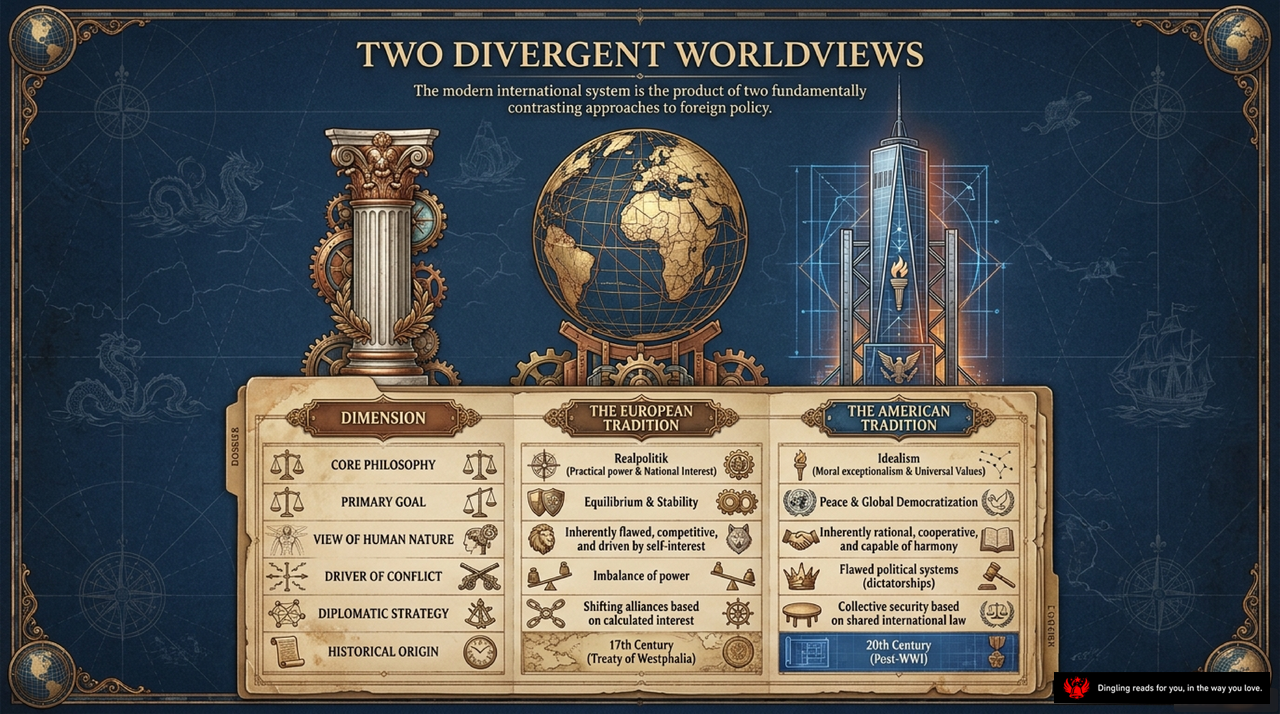
Take a look at this slide. It highlights the core tension in global politics: the clash between two divergent worldviews. On the left, we have the European Tradition, often labeled as Realpolitik. On the right, the American Tradition, known as Idealism.
Let's start with the European side. Rooted in the 17th Century Treaty of Westphalia, this worldview is grounded in practical power and national interest. It assumes human nature is inherently flawed and competitive. The primary goal here isn't to save humanity, but to ensure equilibrium and stability. They believe that conflict is driven by an imbalance of power, so the diplomatic strategy is all about shifting alliances based on calculated self-interest. It's a system designed to contain power through a balance of power. Think of it as a game of chess where the only rule is survival.
Now, look at the American side. This tradition emerged in the 20th Century, specifically post-WWI. It's built on moral exceptionalism and universal values. Unlike the Europeans, Americans view human nature as inherently rational and capable of harmony. Their primary goal is peace and global democratization. They believe that conflict arises from flawed political systems, like dictatorships, and the solution is collective security based on shared international law. This is the legacy of Woodrow Wilson, who championed the idea that the US mission is to spread democracy and freedom to the world.
Visually, the column represents the old, heavy history of Europe, while the modern skyscraper symbolizes the new, ambitious vision of America. One side plays by the rules of survival, focusing on national interest. The other plays by the rules of morality, focusing on universal values. This isn't just a historical footnote; it defines the modern international system we live in today. Understanding this divide is crucial for understanding why nations act the way they do. One side seeks to balance power, while the other seeks to transform it.
The slide breaks it down into six dimensions: Core Philosophy, Primary Goal, View of Human Nature, Driver of Conflict, Diplomatic Strategy, and Historical Origin. Each row highlights a stark contrast. For example, while Europe focuses on Equilibrium and Stability, America focuses on Peace and Global Democratization. While Europe relies on Shifting alliances, America relies on Collective security. This comparison shows us that the world isn't just one system; it's a complex mix of these two competing logics.
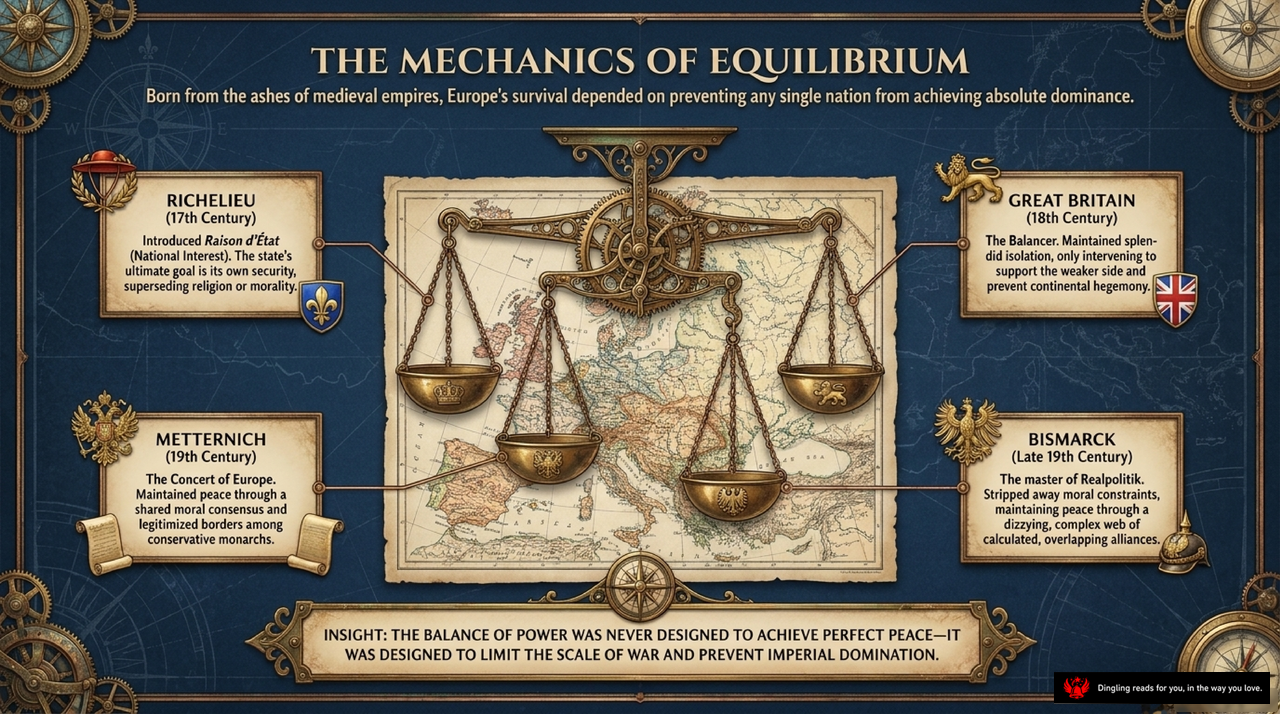
Welcome back. Today we're diving into the Mechanics of Equilibrium. Basically, for centuries, Europe survived not because everyone was nice, but because no single nation was allowed to dominate. It was a delicate dance of power that kept the continent from collapsing.
It all starts in the 17th century with Richelieu. Before him, religion dictated everything. But Richelieu flipped the script with the concept of Raison d'État. He put national interest above morality. He famously argued that the state must survive in the present, not worry about the afterlife. He even allied with the Ottoman Empire, a Muslim power, just to weaken the Catholic Habsburgs. It was pure pragmatism.
Then you have Great Britain. They were the ultimate Balancer. Because they were an island, they didn't need to conquer the continent to stay safe. Their strategy was Splendid Isolation. They mostly stayed out, but they would step in whenever one power, like Louis XIV's France, got too strong. They were the referee, making sure no one player won the game.
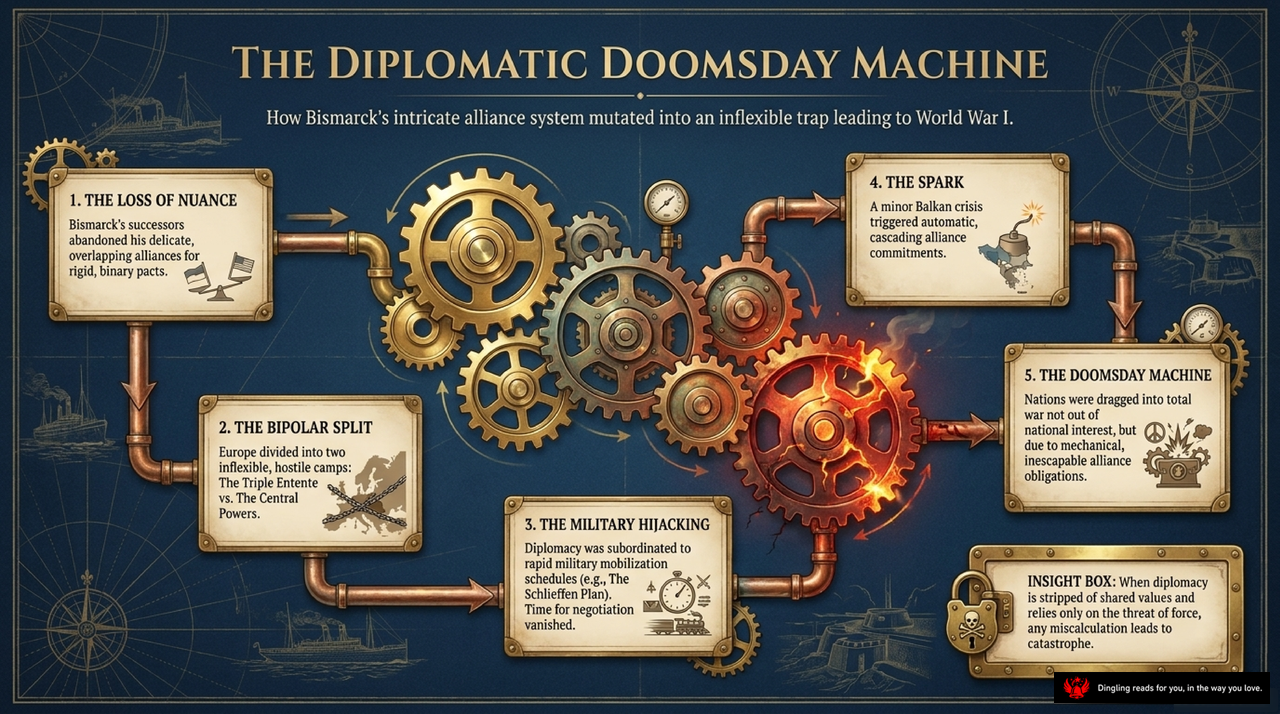
Fast forward to the 19th century. Metternich tried to maintain peace through the Concert of Europe. He believed in shared moral consensus and stable borders among conservative monarchs. It worked for a while. But then came Bismarck. He was the master of Realpolitik. He stripped away all those moral constraints. Instead of relying on consensus, he used a dizzying web of calculated alliances to keep the peace. He knew that if one country got too strong, the others would crush it.
So, what's the insight here? The balance of power was never designed to achieve perfect peace. It wasn't about utopia. It was designed to limit the scale of war and prevent imperial domination. It kept the system from exploding, but it didn't guarantee happiness. That's the reality of the Mechanics of Equilibrium.
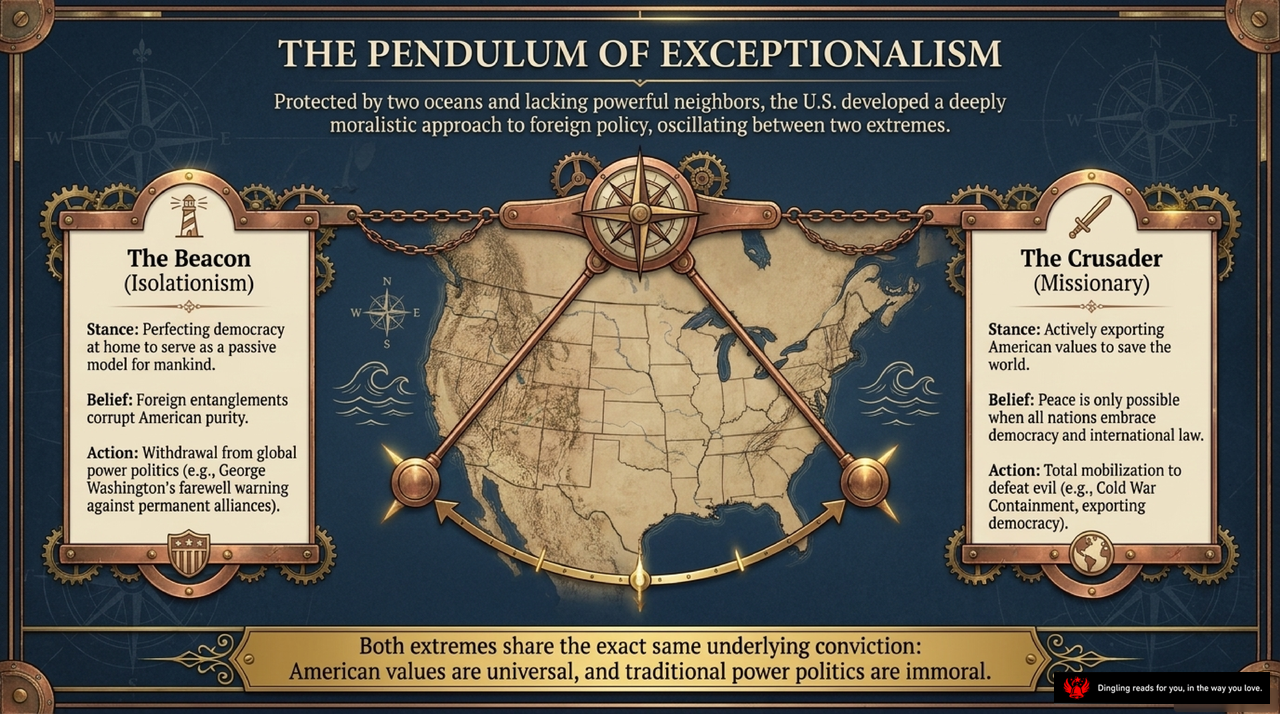
Look at this diagram. It illustrates a concept deeply embedded in American DNA: The Pendulum of Exceptionalism. Because the U.S. was protected by two oceans and lacked powerful neighbors, it developed a deeply moralistic approach to foreign policy. But instead of staying steady, it swings between two extremes.
On one side, you have The Beacon, representing Isolationism. Think of George Washington's famous farewell warning against permanent alliances. The stance here is simple: perfect democracy at home and let it serve as a passive model for mankind. The belief is that foreign entanglements just corrupt American purity. The action? Withdrawal from global power politics.
On the other side, you have The Crusader, representing the Missionary impulse. This is where we see the shift to interventionism. Think of Woodrow Wilson. The stance changes to actively exporting American values to save the world. The belief is that peace is only possible when all nations embrace democracy and international law. The action? Total mobilization to defeat evil, like during the Cold War.
Now, here is the fascinating part. Why does it swing? Because both extremes share the exact same underlying conviction. You can see it at the bottom of the slide. Both the Beacon and the Crusader believe that American values are universal. And conversely, they both believe that traditional power politics are immoral.
Whether they want to stay home and avoid the mess, or go out and fix it, the core logic is the same: America is different, and the world needs to be like us. This moralistic lens is what drives the U.S. to oscillate between isolationism and interventionism, shaping everything from the Cold War to today's global actions. It's not just about strategy; it's about a deep-seated belief in the mission. This pendulum swing defines the American experience on the world stage. It forces us to constantly ask: Are we hiding to protect ourselves, or are we acting to save others? The answer always comes back to the same core belief. Washington thought staying away was the moral choice. Wilson thought going in was the moral choice. Both are moral choices, just opposite ones. This explains why the U.S. often gets criticized for hypocrisy, but from its own perspective, it is consistently acting on its core principles.
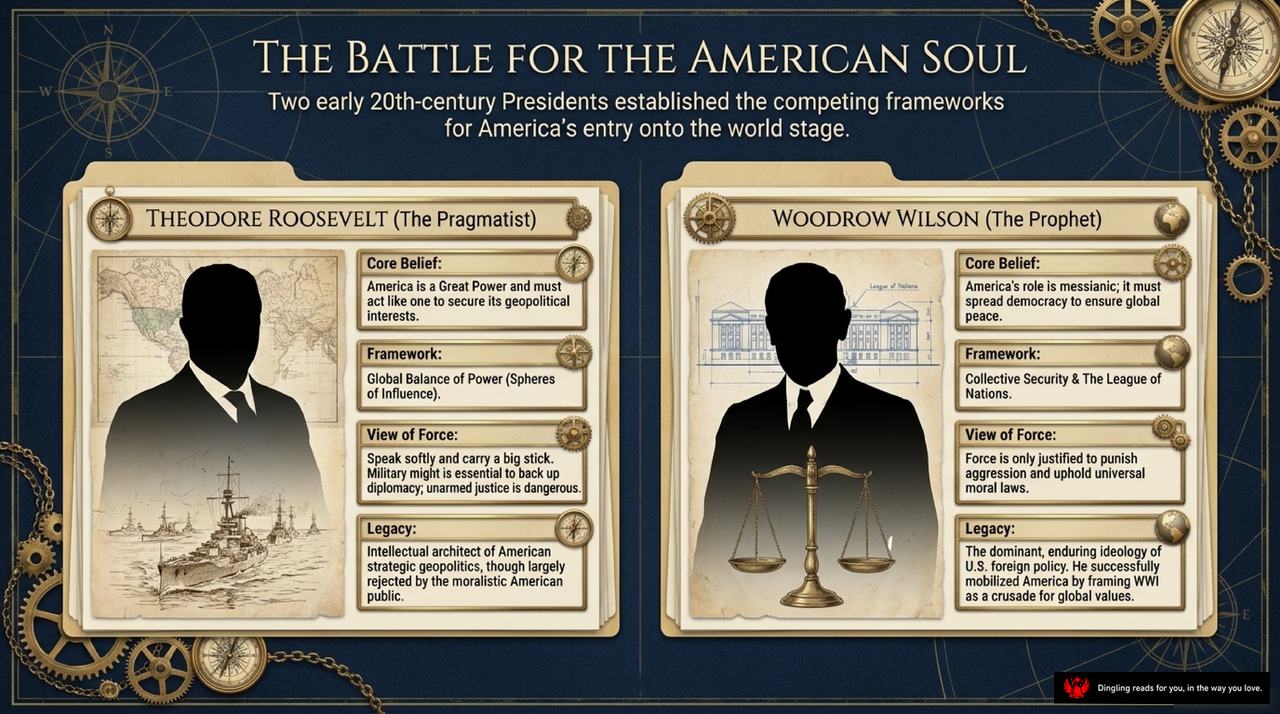
Welcome back to our reading session. Today we are exploring a pivotal chapter in American history: The Battle for the American Soul. This slide highlights how two early 20th-century presidents established competing frameworks for America's entry onto the world stage. By the early 1900s, the United States had become a global powerhouse. Industrial output surpassed Britain, and energy consumption exceeded the rest of Europe combined. We could no longer hide behind the two oceans. We had to define our role.
On the left, we see Theodore Roosevelt, labeled The Pragmatist. He was the first to shatter the illusion of isolationism. He recognized that the US was a Great Power and must act like one to secure its geopolitical interests. His framework was the Global Balance of Power, often called Spheres of Influence. Roosevelt famously believed you must speak softly and carry a big stick. He argued that military might is essential to back up diplomacy. To him, unarmed justice was dangerous. He mediated the Russo-Japanese war to maintain balance in the Far East and even encouraged the independence of Panama to build the canal. He viewed international law with skepticism, prioritizing strategic geopolitics over moralistic public sentiment. His legacy was the intellectual architect of American strategic geopolitics, though largely rejected by the moralistic American public at the time.
On the right stands Woodrow Wilson, The Prophet. Wilson captured the American idealist spirit. He believed America's role was messianic. It must spread democracy to ensure global peace. His framework focused on Collective Security and The League of Nations. Wilson rejected the European balance of power. He believed force was only justified to punish aggression and uphold universal moral laws. He successfully mobilized America by framing World War I as a crusade for global values. In his 1917 declaration, he spoke of fighting for democracy and the peace of all free peoples. His legacy is the dominant, enduring ideology of U.S. foreign policy.
While Roosevelt's realism was largely rejected by the moralistic public at the time, Wilson's idealism became the dominant, enduring ideology of U.S. foreign policy. It successfully shaped how the world saw America, even though it eventually faced its own challenges. This fundamental tension between power and principle defines the American experience, setting the stage for the conflicts we will discuss next.
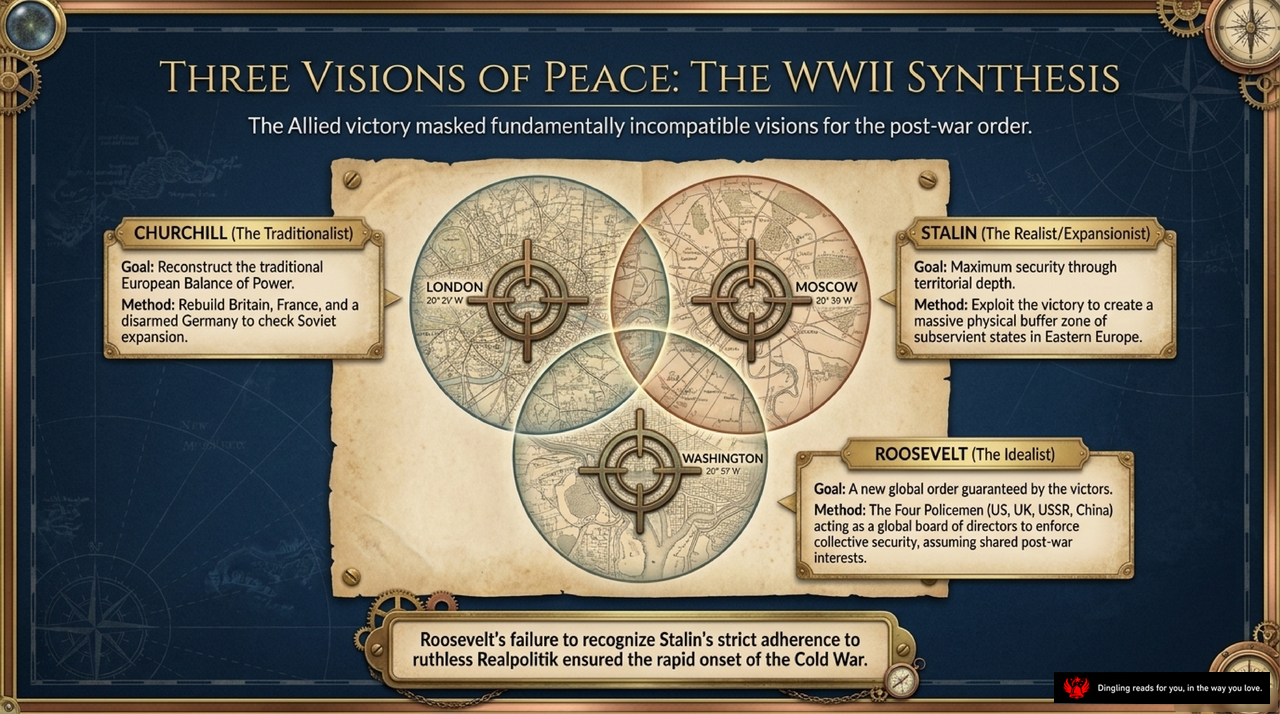
The Allied victory in World War II was celebrated globally, but behind the scenes, the three main leaders were actually planning for completely different futures. This slide breaks it down into three distinct visions of peace.
First, look at Churchill, labeled as the Traditionalist. His goal was to reconstruct the old European balance of power. He wanted to rebuild Britain and France, and keep Germany disarmed, primarily to check Soviet expansion. He believed in the old ways of diplomacy where nations checked each other off.
Then, on the other side, we have Stalin, the Realist and Expansionist. His vision was much darker. He wasn't interested in a global board of directors. His goal was maximum security through territorial depth. He wanted to exploit the victory to create a massive physical buffer zone of subservient states in Eastern Europe. For Stalin, security meant control over the neighbors.
In the middle, we have Roosevelt, the Idealist. He proposed a new global order guaranteed by the victors. His method was the "Four Policemen"—the US, UK, USSR, and China acting as a global board of directors to enforce collective security. He believed in a system where no one could bully anyone else without consequences.
Here is where the tragedy lies. The slide points out Roosevelt's failure to recognize Stalin's strict adherence to ruthless Realpolitik. Stalin wasn't interested in Roosevelt's global order; he was focused on his own buffer zone. Roosevelt thought he could win over Stalin with cooperation, but Stalin was playing a different game entirely.
This fundamental incompatibility masked the true reality of the post-war order. Churchill wanted to go back to the past, Stalin wanted to expand his empire, and Roosevelt wanted a new utopia. None of them could agree on a shared vision. Roosevelt's failure to see the threat ensured the rapid onset of the Cold War. The victory was won, but the peace they fought for was impossible to build. The world was divided, and the Cold War had begun.
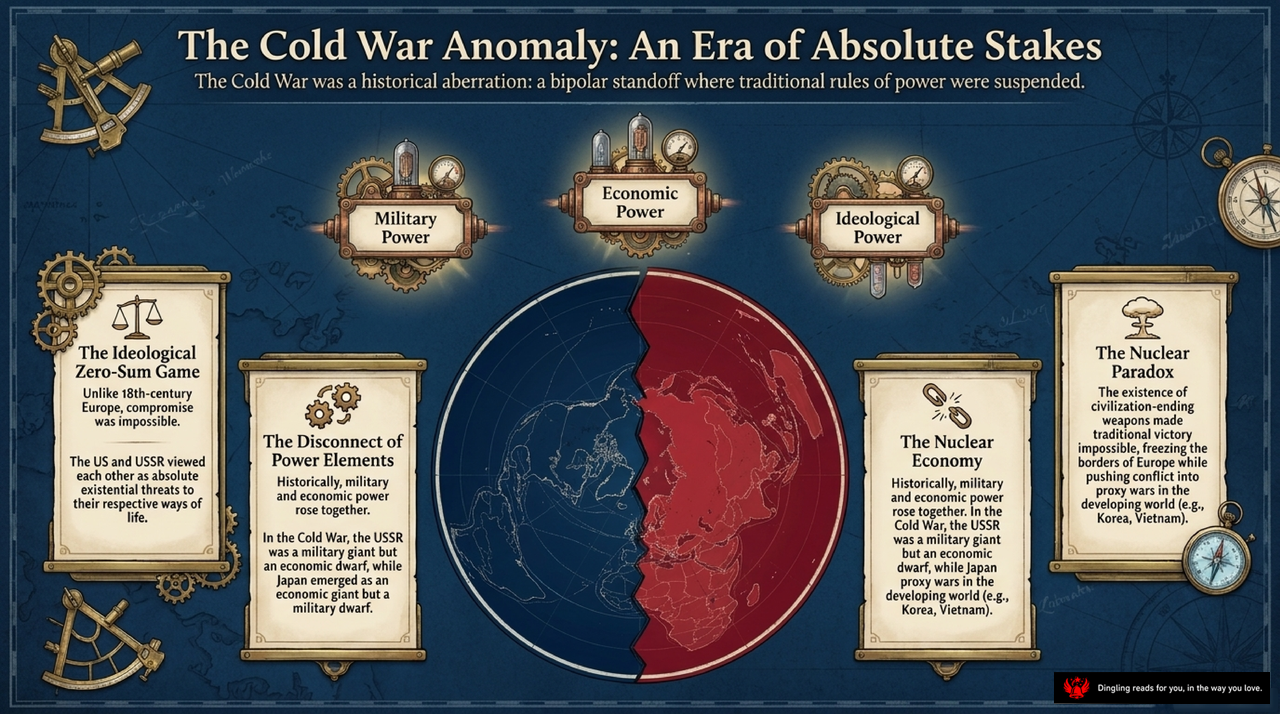
Welcome to this deep dive into the Cold War. Today's slide highlights something crucial: the Cold War was a historical anomaly. It was a bipolar standoff where the traditional rules of power were suspended. Think about how power usually works. Historically, military power and economic power rise together. A strong economy funds a strong military. But during the Cold War, this rule was broken. The Soviet Union was a military giant but an economic dwarf. They could project force globally, but their economy couldn't sustain it long-term. Meanwhile, the US had both. This disconnect changed the entire strategic landscape.
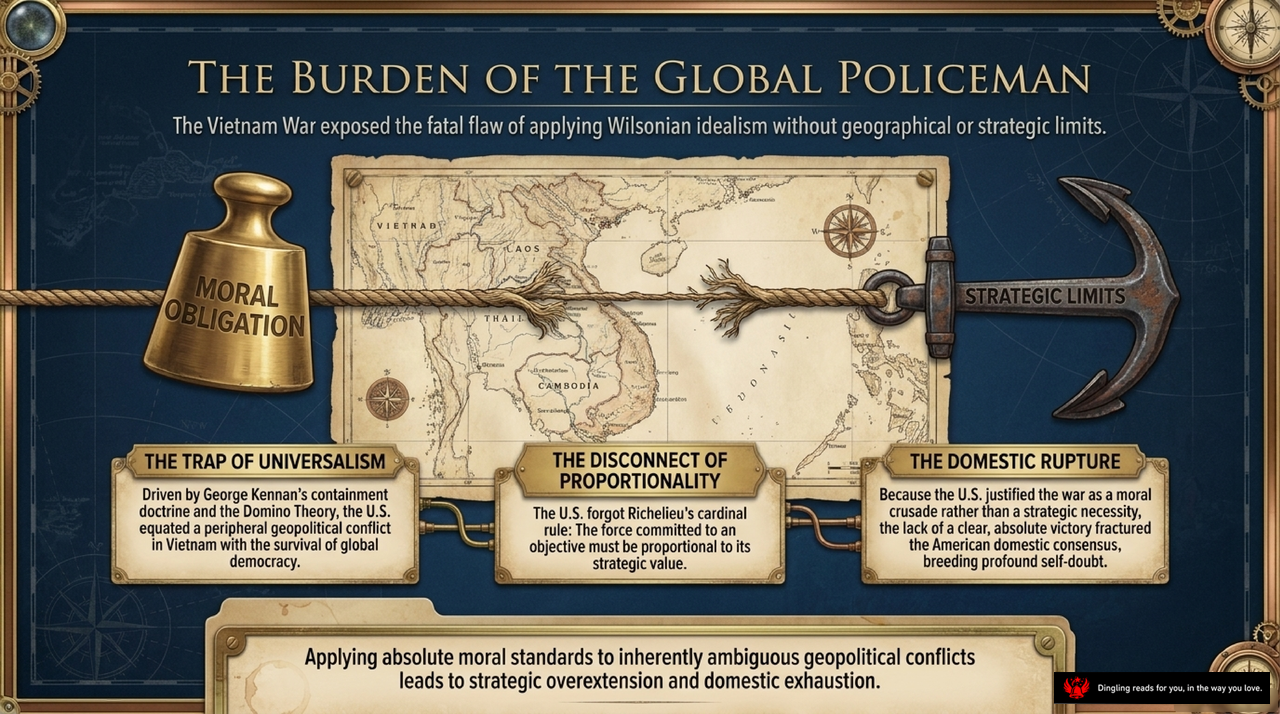
Then, look at the ideological zero-sum game. Unlike 18th-century Europe, where compromise was possible between nations, the US and USSR viewed each other as absolute existential threats to their respective ways of life. There was no room for negotiation. It was a fight for survival. And this tension was managed by the nuclear paradox. The existence of civilization-ending weapons made traditional victory impossible. This froze the borders of Europe, preventing a direct clash between the superpowers. But it didn't stop the fighting. It pushed conflict into proxy wars in the developing world. Look at Korea and Vietnam. The US couldn't invade the USSR, so it fought these proxy battles instead.
This era was defined by absolute stakes. The disconnect between military and economic power, combined with the nuclear threat and the ideological rigidity, created a system that no one had ever seen before. It was a time where compromise was impossible, and the world held its breath, waiting to see if the rules of power could ever be restored. This unique dynamic shaped the second half of the 20th century, leaving a legacy that we still feel today. As we've seen in the book, the shift from traditional balance of power to this nuclear standoff fundamentally altered how nations interacted, creating a fragile peace that relied on mutual destruction rather than traditional diplomacy.
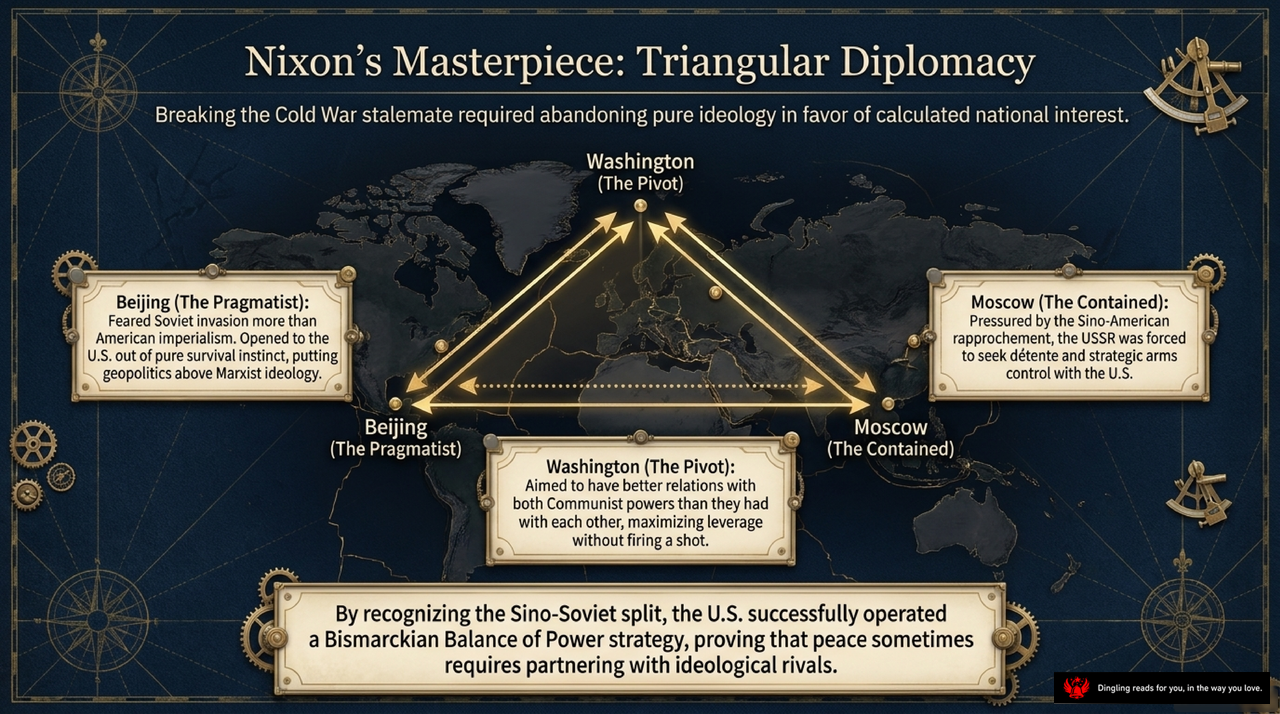
Let's talk about the most famous chess move in Cold War history: Nixon's Masterpiece, Triangular Diplomacy. The slide tells us a powerful truth: breaking the Cold War stalemate required abandoning pure ideology in favor of calculated national interest.
Look at this triangle. Washington sits right in the middle as The Pivot. Nixon realized that to survive, the U.S. needed to play Beijing and Moscow against each other. It wasn't about choosing a side; it was about controlling the game.
On the left, we have Beijing, The Pragmatist. Here is the key insight: China feared Soviet invasion more than American imperialism. This drove their decision. Mao and his successors opened up to the U.S. out of pure survival instinct, putting geopolitics above Marxist ideology. They saw the U.S. as a necessary buffer against the Soviet threat.
On the right, Moscow, The Contained. The Soviet Union was pressured by the Sino-American rapprochement. They realized they couldn't dominate the world anymore. Forced by this new dynamic, the USSR was compelled to seek detente and strategic arms control with the U.S. They had to play ball to avoid being squeezed from both sides.
In the center, Washington, The Pivot, aimed to have better relations with both Communist powers than they had with each other. This maximized leverage without firing a shot. It was diplomacy at its finest.
The bottom conclusion is profound. By recognizing the Sino-Soviet split, the U.S. successfully operated a Bismarckian Balance of Power strategy. This proved a timeless lesson: peace sometimes requires partnering with ideological rivals. Nixon understood that you don't have to be the only good guy to be the most powerful player. By pulling China into the fold, he squeezed the Soviet Union and stabilized the global order. This shift from pure ideology to realpolitik allowed the U.S. to regain the diplomatic initiative after the Vietnam War. It was a masterclass in using the enemy against the enemy. Think about it, this wasn't just about military power. It was about understanding human nature. When the Soviets felt boxed in, they had to negotiate. When China felt threatened, they had to reach out. This strategy laid the groundwork for the end of the Cold War. It showed that flexibility beats rigidity every time. For us today, this lesson is still relevant. Sometimes the best way to solve a problem is to find a common enemy, or at least, to realize that your rivals have their own problems too.

Welcome back. If you look at this graphic, titled "The 21st Century Chessboard," you'll see something fascinating. It suggests that the world after the Cold War isn't a brand new game, but rather a return to the 19th-century European state system. The only difference? It's now played on a fully globalized, instantaneous scale.
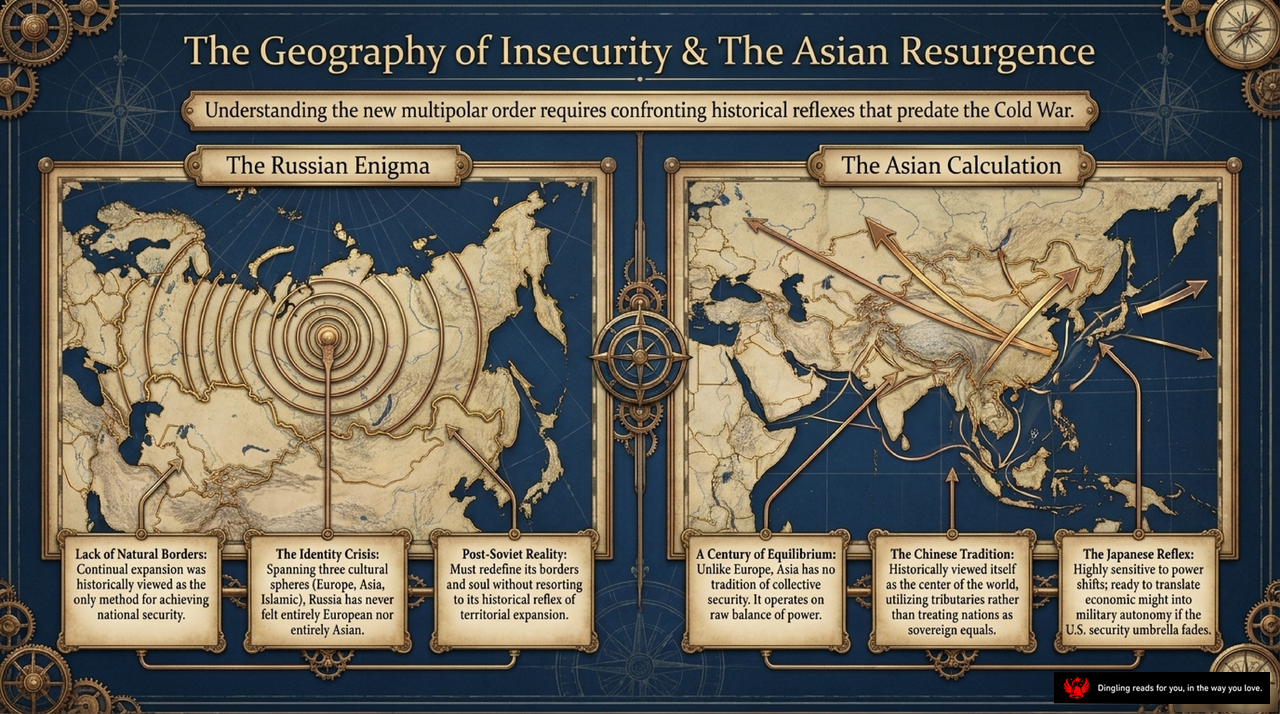
Think about the pieces on this board. The United States remains the preeminent military power, but unlike the Cold War era, it is now struggling to redefine its national interest without a singular existential threat to fight against. It's a different kind of challenge. Then you have Russia, a wounded but nuclear-armed giant, eternally torn between European integration and Asian expansion. It's trying to find its place in a world that has moved on.
On the economic side, the European Union is an economic superpower attempting to forge a unified political identity—a historical first. Meanwhile, Japan, an economic titan, is slowly reconsidering its post-WWII pacifism as Asian dynamics shift. And then we have the rising powers. China is described here as a civilizational state experiencing explosive growth, reclaiming its historical position as the center of Asia. India is the emerging demographic heavyweight, practicing highly pragmatic, non-aligned diplomacy.
This brings us to a crucial insight from our reading. The post-Cold War era feels like a return to the 18th and 19th-century European balance of power system. Why? Because without the Soviet Union to act as a counterweight, the old logic of competing great powers has returned. We are seeing the limitations of pure Wilsonian idealism exposed. Simply spreading democracy without regard for national interest or power dynamics often leads to conflict.
So, what is the way forward? The text suggests that the United States must find a balance between idealism and realism. We cannot be naive about the power dynamics of the world. As Henry Kissinger noted, the U.S. can no longer rely solely on moral exceptionalism. We need to build a world order where these different powers—whether they are the EU, China, or India—can coexist without descending into a new cold war. It requires patience and a willingness to understand the complex, often contradictory, interests of every player on this chessboard. The game is on, and the rules have changed.
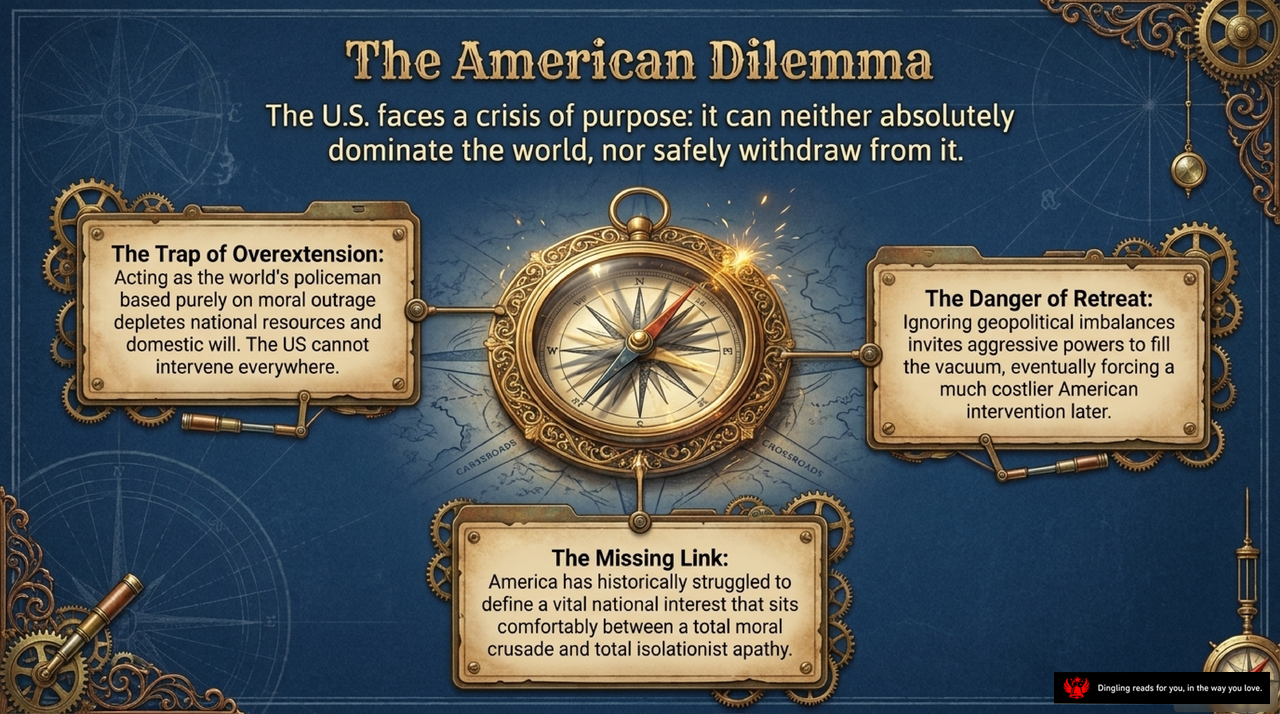
So, we're looking at a concept called "The American Dilemma." It describes a crisis of purpose that has defined U.S. foreign policy for over a century. The core problem is this: The U.S. finds itself in an impossible position. It can't absolutely dominate the world, yet it can't safely withdraw from it.
Let's look at the first trap: Overextension. For decades, America has acted like the world's policeman. But the book warns us: acting based purely on moral outrage depletes our national resources and domestic will. We simply cannot intervene everywhere. When we try to save everyone, we end up overextending ourselves. We lose the will to fight, and we drain our economy. Think about how we've been pulled into conflicts that don't actually serve our core interests, just our moral instincts.
On the other side, there's the Danger of Retreat. If we try to ignore geopolitical imbalances and pull back, we create a vacuum. History teaches us that when you ignore power dynamics, aggressive powers fill that void. This eventually forces a much costlier American intervention later. We can't just sit on the sidelines and expect the world to stay peaceful.
So, what's the solution? The Missing Link. The book points out that America has historically struggled to define a vital national interest. We've been torn between a total moral crusade—trying to save everyone—and total isolationist apathy—ignoring the world entirely. We need to find a middle ground.
Think about the history we've covered. From Wilson's idealism to the post-Cold War era, the tension remains. The book suggests we can't be obsessed with "exceptionalism." We can't consume resources by intervening everywhere, nor can we retreat into isolation. We need to balance idealism with realpolitik. We need to use moral consensus to support a balance of power, not just moral crusades.
The key is defining our actual national interest. It's not about being the savior of the world, nor about ignoring it. It's about finding a stable position where our values and our security align. Without this clarity, we're just swinging between overcommitting and undercommitting, never finding a sustainable path forward.
This dilemma isn't new. It goes back to the debate between Roosevelt's realism and Wilson's idealism. And now, in the post-Cold War era, we see it again. The book emphasizes that we need to find a balance. We need to understand that our power is limited, and our moral mission is powerful, but we must use them wisely. The book notes that without a strong ideological threat, countries act on immediate national interests, returning to a balance of power system. We need to find a way to integrate our values with this reality.
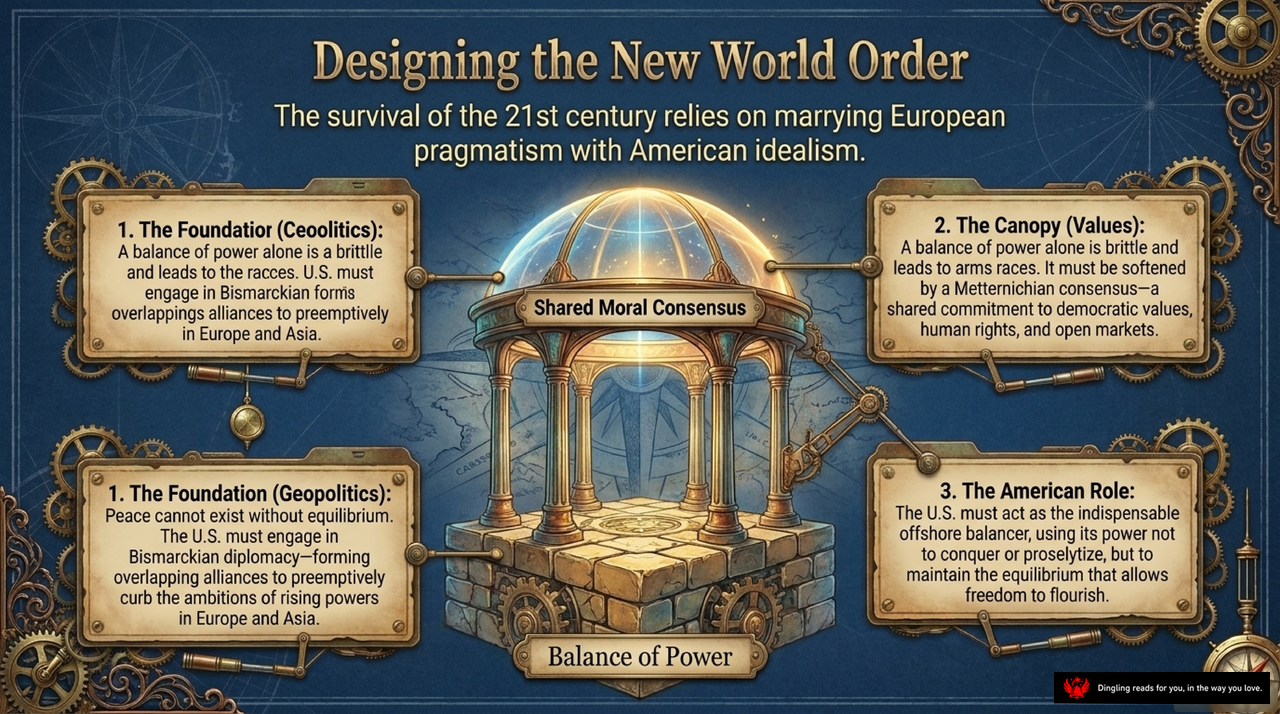
Here, we see a blueprint for the future, built on lessons from the past. The core idea is that the survival of the 21st century relies on marrying European pragmatism with American idealism. We can't just pick one or the other. We need to combine them to create a stable system.
Look at the base. It's called the Foundation, covering Geopolitics and Ceolitics. This represents the European tradition of the Balance of Power. As we read in the book, peace cannot exist without equilibrium. So, the U.S. must engage in Bismarckian forms of overlapping alliances. We need to preemptively curb the ambitions of rising powers in Europe and Asia. This is the hard part of statecraft.
But the foundation isn't enough. That's why we have the Canopy, or the Values. This is the American contribution. The text emphasizes that balance of power must be softened by a Metternichian consensus. This means a shared commitment to democratic values, human rights, and open markets. Without this moral layer, the hard power is just dangerous. We saw how the League of Nations failed because it lacked the hard power structure of Bismarck. The Canopy provides the glue that holds the hard power together.
Finally, look at the American Role. The U.S. must act as the indispensable offshore balancer. This is a crucial distinction. We use our power not to conquer or proselytize, but to maintain the equilibrium that allows freedom to flourish. We aren't the main player on the field; we are the referee ensuring the game doesn't get violent. We need to use our strength to keep the peace, not to dominate the world.
The book warns us that relying solely on idealism or realism both failed. We need the structure of the balance of power, supported by the moral consensus of the West. This synthesis is the only way to avoid the mistakes of the past. It's about building a system where power serves values, not the other way around.
We've traveled through centuries of history today, from the early days of American isolationism to the complexities of the Cold War and beyond. We've seen how the United States has navigated the tension between its own values and the harsh realities of global power.
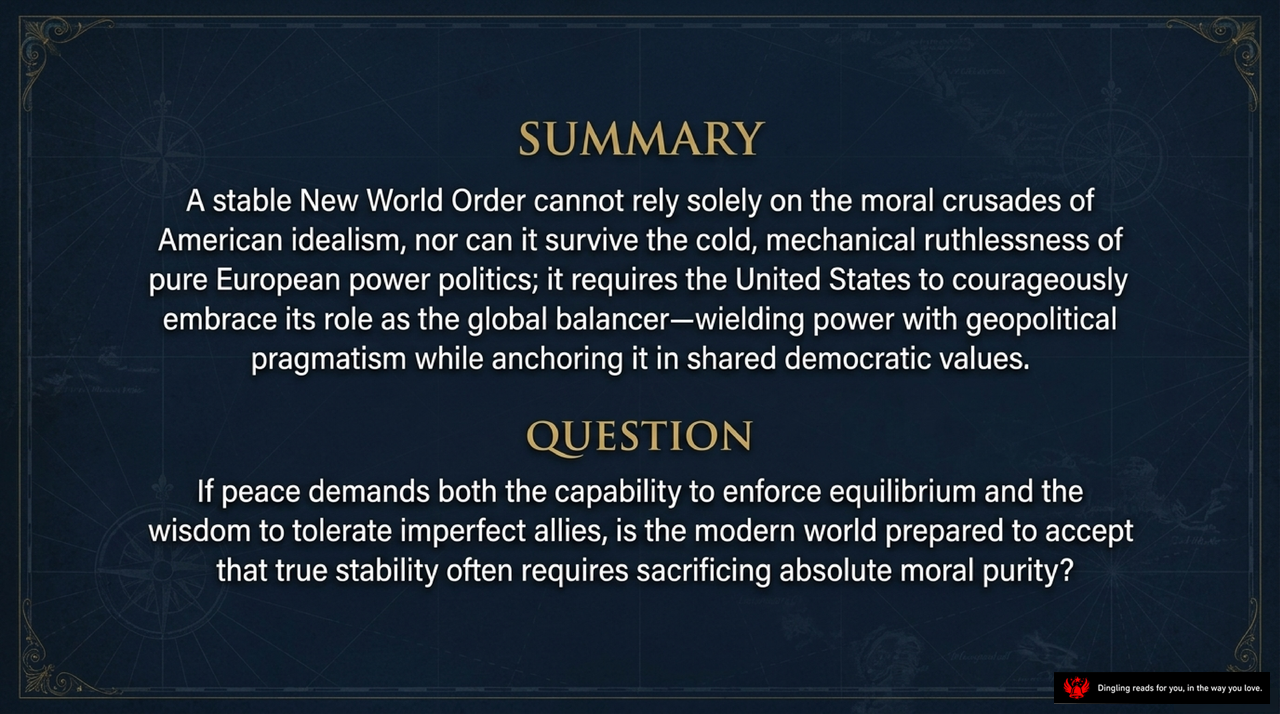
As we wrap up, let's look at the core takeaway. A stable New World Order cannot rely solely on the moral crusades of American idealism, nor can it survive the cold, mechanical ruthlessness of pure European power politics. This is a lesson learned the hard way, from the failures of the League of Nations to the complexities of the Cold War. History shows us that neither pure idealism nor pure realpolitik works alone.
Instead, it requires the United States to courageously embrace its role as the global balancer. This means wielding power with geopolitical pragmatism while anchoring it in shared democratic values. We saw this with Nixon's opening to China and the shift from pure confrontation to strategic balance. The US must act not just as a moral teacher, but as a stabilizer. We've seen that relying solely on the 'moral crusades' of American idealism, like Wilson's vision, often leads to failure when it ignores the raw mechanics of power.
But this brings us to a difficult question. If peace demands both the capability to enforce equilibrium and the wisdom to tolerate imperfect allies, is the modern world prepared to accept that true stability often requires sacrificing absolute moral purity?
Think about the choices we face today. Do we demand perfection from our allies, or do we work with those who have flaws but share our goals? Think about the Cold War, where the US had to tolerate the Soviet Union, or today, where we navigate complex relationships with nations that aren't perfect democracies. Do we prioritize our moral purity over the stability that comes from compromise? The book suggests that true leadership isn't about being right all the time, but about keeping the peace even when it's messy.
So, as you leave this session, I want you to carry this thought forward. In a world that often demands absolute certainty, are you willing to embrace the gray areas? Because true stability often requires sacrificing absolute moral purity. The challenge is to find that balance. We cannot just be idealists, nor can we be cold realists. We must be the balancers. What do you think?