
Don Quixote: Complete Chapter-by-Chapter Summary
Welcome to our deep dive into *Don Quixote* by Miguel de Cervantes. This isn't just a story about a madman; it's a profound exploration of the human spirit. As the title card suggests, we are mapping the tragicomic architecture of a mind consumed by the noble pursuit of illusion.
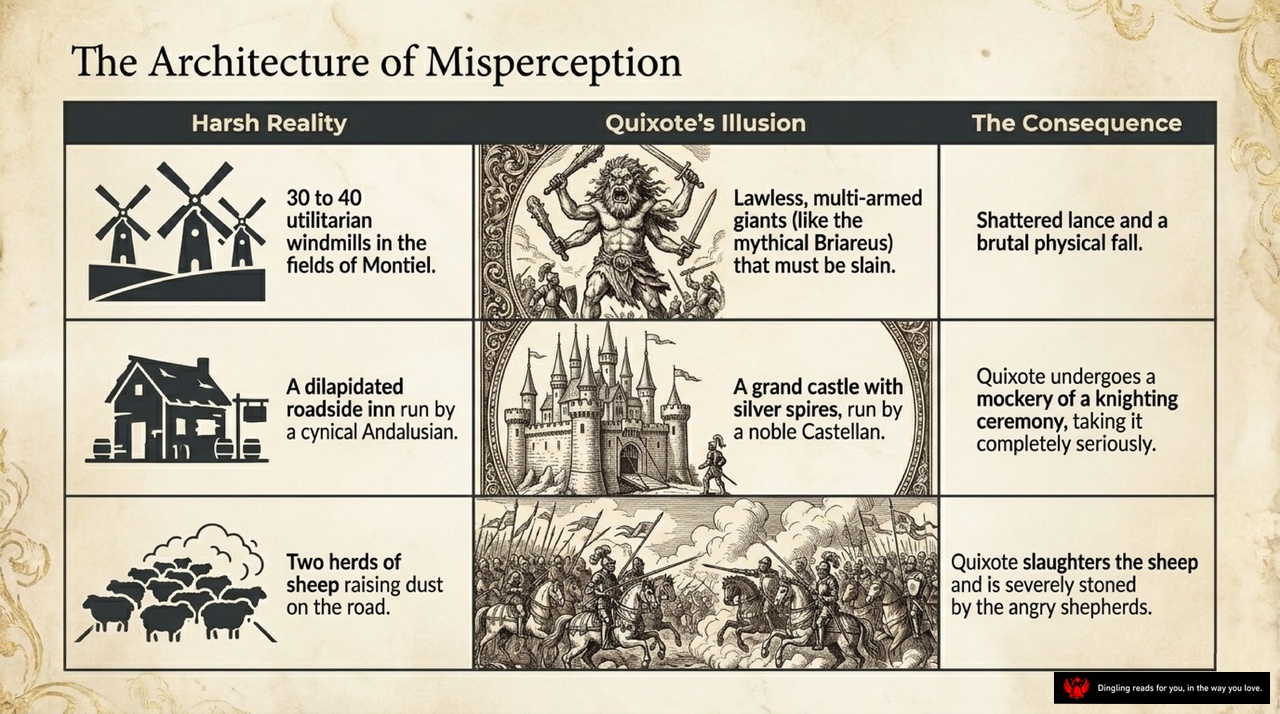
Imagine a simple country gentleman who reads too many chivalric romances and decides the world needs saving. He transforms his ordinary life into an epic adventure, seeing windmills as giants and inns as castles. But beneath the laughter lies a deeper truth. This book transcends simple satire; it reflects the harsh reality of 16th-century Spain while celebrating a courage that feels both unrealistic and incredibly precious.
Cervantes himself fought in a real battle, losing an arm in the process. He knew what it meant to be a warrior, yet he chose to write a story where a hero fights with his mind, even if the world sees him as a fool. As he wrote in the preface, he wanted to protect his creation from being buried in the dust, hoping that even if the book seemed rough, it could find a home in the hearts of readers.
So, join us as we step into the world of Don Quixote, where the line between madness and nobility blurs, and where a simple dream can change the course of history.

Welcome to the story of the modern novel. Let's look at where it all began. On the left, we see the context: this masterpiece was conceived in a prison, where Cervantes noted that every sad sound gathered around him. His stated goal was to dismantle the absurdities of popular chivalric romances, but its unintended legacy is far greater. Praised by giants like Dostoevsky, Borges, and Marx, it transcended simple satire to become the foundational blueprint of the modern psychological novel.
Now, look at the duality of the text itself. It balances a comedic surface—a humorous satire of a bumbling knight—with a tragic undercurrent. Beneath the laughter lies a profound philosophical exploration of idealism clashing with an uncompromising, cynical reality. This tension between the funny and the deep is exactly what makes this book so enduring.
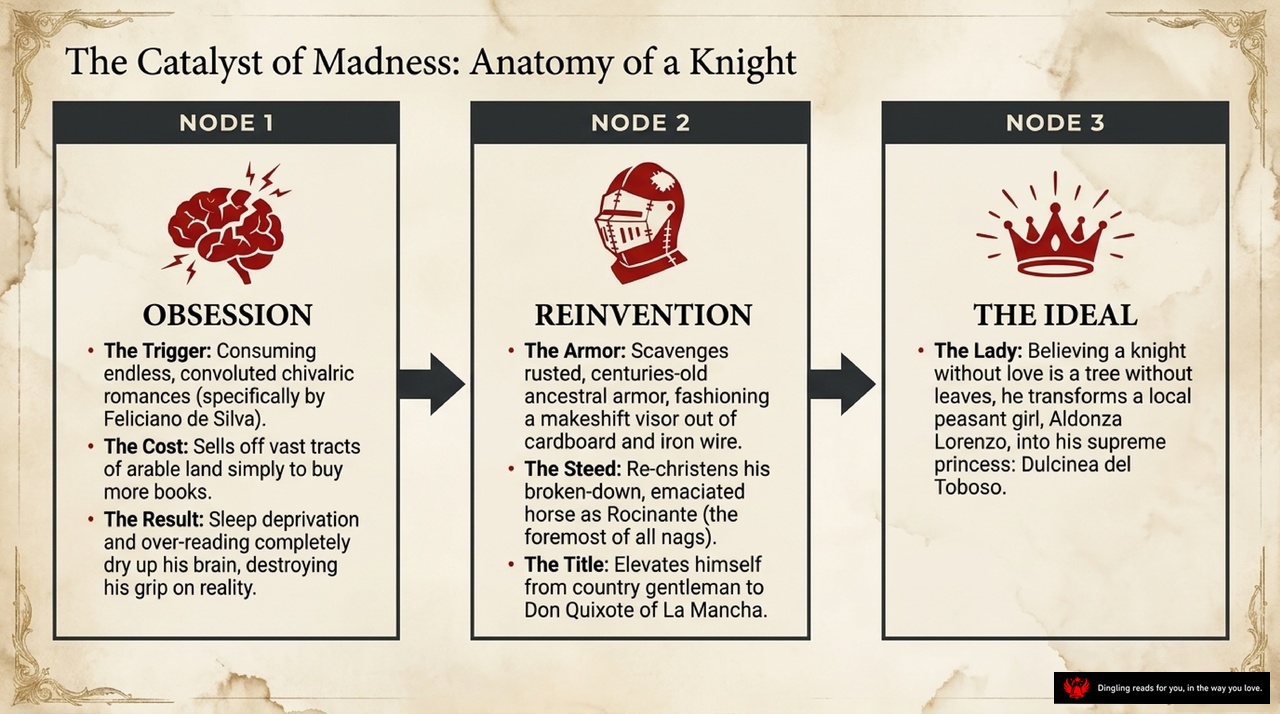
Welcome to the anatomy of madness. Today, we're dissecting the mind of Don Quixote, not as a simple joke, but as a tragic figure driven by an unstoppable force. The slide breaks his journey into three critical nodes: Obsession, Reinvention, and The Ideal.
It all starts with **Node 1: Obsession**. The trigger here is consuming endless, convoluted chivalric romances by Feliciano de Silva. This isn't just reading; it's a compulsion that drives him to sell off vast tracts of arable land simply to buy more books. The cost is steep: sleep deprivation and over-reading completely dry up his brain, destroying his grip on reality. He is no longer the country gentleman he was; he is a prisoner of fiction.
This leads to **Node 2: Reinvention**. To survive this madness, Quixote must transform his reality. He scavenges rusted, centuries-old ancestral armor and fashions a makeshift visor out of cardboard and iron wire. He re-christens his broken-down, emaciated horse as Rocinante, the foremost of all nags. By elevating himself from a country gentleman to Don Quixote of La Mancha, he creates a new identity to protect his fragile psyche.
Finally, we reach **Node 3: The Ideal**. Without love, a knight is a tree without leaves. So, he transforms a local peasant girl, Aldonza Lorenzo, into his supreme princess, Dulcinea del Toboso. This belief is the catalyst that fuels his entire existence. He isn't fighting for gold or glory; he is fighting for an idea of perfection that exists only in his mind. This is the anatomy of a knight who chooses madness over the mundane.

The image on your screen perfectly captures the dynamic heart of *Don Quixote*: the symbiotic relationship between the knight and his squire. On the left, we see Don Quixote, driven by a desire for eternal glory and ancient chivalric ideals. He perceives the world through the lens of his books, seeing windmills as giants and inns as castles. Physically, he is emaciated, fasting for love, and riding a bony horse, refusing to carry money because he believes true knights never need it.
On the right stands Sancho Panza, the ultimate foil. His core drive is upward mobility, specifically the promise of governing an island. Unlike his master, Sancho sees the world exactly as it is through a pragmatic, literal lens. He is plump, prioritizes eating, and rides a humble gray donkey, always carrying a stuffed saddlebag of practical supplies.
This tension drives the entire novel. The knight requires the squire to tether him to the earth, keeping him from floating away into fantasy, while the squire requires the knight to elevate him beyond his station, offering a path to power and status. It is this unique partnership—a blend of delusion and pragmatism—that makes their journey so enduring and unforgettable.
In this chapter, we see Quixote and Sancho arrive at a secluded forest, welcomed by a group of shepherds who treat them like honored guests. While Sancho drools over the smell of mutton, Quixote, ever the noble knight, insists they share a meal in the forest. But the feast isn't just about food; it becomes a stage for Quixote's grand speeches about the "Golden Age," a time he believes was free from private property and injustice. He tells the shepherds that it is the duty of a knight-errant to protect the weak, a philosophy that leaves the practical shepherds listening with polite, amused silence.
After a night of rest, the shepherds share a tragic tale of unrequited love. They speak of Grisostomo, a wealthy scholar who disguised himself as a shepherd to win the heart of the cold and proud Marcela. When she rejected him and chose freedom over marriage, Grisostomo tragically took his own life. Hearing this, Quixote is moved. He sees Marcela's courage and defends her against those who blame her for his death, arguing that her love for freedom is noble. This moment of empathy marks a shift from pure fantasy to a deeper engagement with human emotion.
But the adventure doesn't end there. Quixote decides to enter the Black Mountain to perform a penance, hoping to prove his devotion to Dulcinea. He leaves Sancho behind, retreating into the wilderness to wander like a madman, even striking himself with stones to harden his will. Sancho, worried for his master, eventually returns to find him. Just as they are about to leave again, a clever plan is hatched by the priest and the barber. They bring along Dorotea, a woman Quixote previously met, and disguise her as a princess in distress. Claiming her kingdom has been stolen by giants, she begs Quixote for help.
Quixote, instantly ignited by the call to action, forgets his own sorrow and agrees to rescue the princess. They head to an inn, where Quixote continues to treat the place as a castle and Dorotea as royalty. But the night brings chaos. Quixote wakes up screaming of giant attacks, charging blindly into the room and crashing into the doorframe. The innkeepers are dying of laughter, and Sancho has to comfort his master, joking that the giants' heads must have been hidden by magic. It's a perfect blend of Quixote's noble intentions and the absurd reality that keeps shattering his dreams.
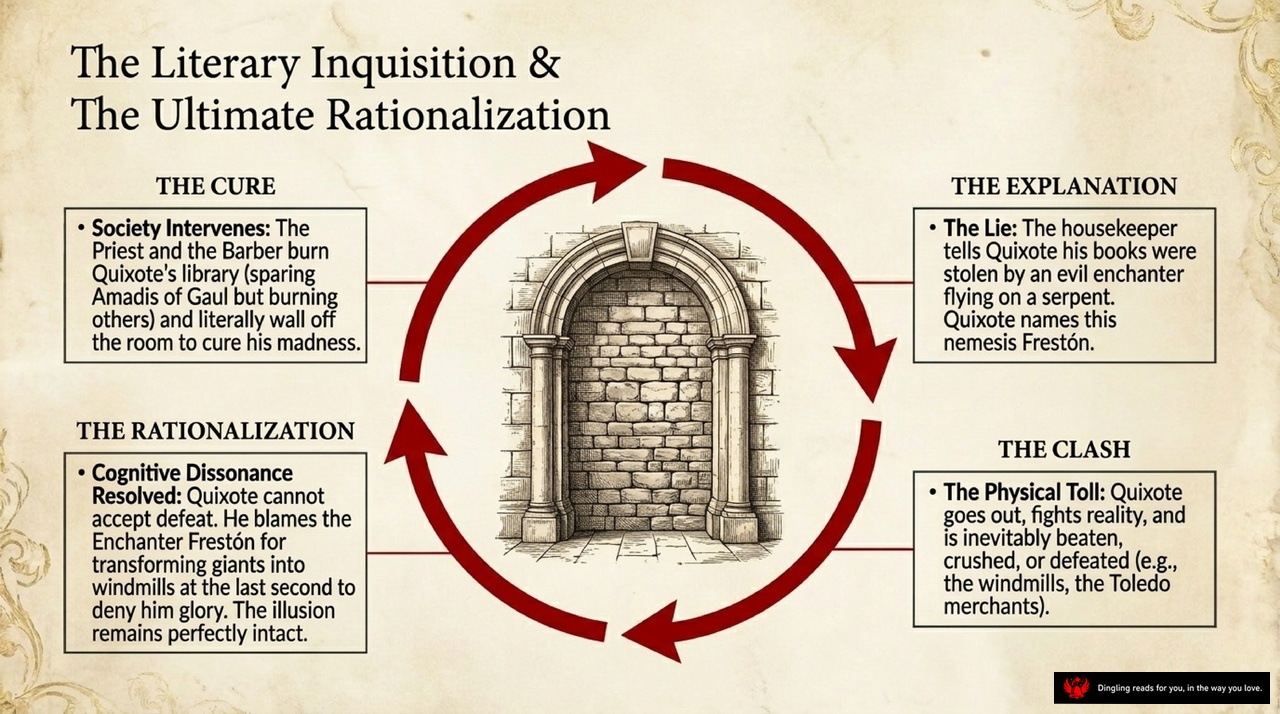
The Literary Inquisition & The Ultimate Rationalization. This slide maps the tragic cycle of Quixote's mind. It starts with **The Clash**: Quixote goes out, fights reality, and is inevitably beaten, crushed, or defeated—whether by windmills, Toledo merchants, or the Biscayan riders. He cannot accept this defeat. To resolve the **Cognitive Dissonance**, he engages in **The Rationalization**. He blames the Enchanter Frestón for transforming giants into windmills at the last second, denying his glory so his illusion remains perfectly intact. When society finally intervenes, as seen in **The Cure**, the Priest and the Barber burn his library and literally wall off his room to cure his madness, yet even this physical confinement fails to stop his mind from rewriting reality. This loop explains the ultimate rationalization: no matter how much he is beaten or how much society tries to silence him, Quixote will always find a new lie to protect his truth.

Welcome back to our deep dive into *Don Quixote*. Today, we're exploring a pivotal moment in the story, often described as the "Meta-Fictional Turn." This is where the novel breaks the fourth wall, transforming from a simple adventure into a complex commentary on literature itself.
Let's look at the slide. The first key point here is "The Revelation." In Part II, a character named Samson Carrasco reveals a shocking truth to Don Quixote and Sancho: the wild adventures they just experienced in Part I have already been published as a widely read book called *The Ingenious Gentleman Don Quixote of La Mancha*.
This revelation triggers a profound "Shift in Reality." Suddenly, Don Quixote is no longer just an anonymous madman forcing his fantasy onto the world. He becomes a famous literary character, wandering through a world that is already populated by his own readers. He is living inside a story that everyone else knows.
This leads to the final, most poignant point on the slide: "The Existential Burden." Because he is now a known figure, Don Quixote is forced to live up to his established reputation. He must fiercely defend the truth of his original story against a fake, unauthorized sequel written by another author, Avellaneda. This adds a layer of tragedy to his madness; he is fighting not just for justice, but for the integrity of his own fiction.
So, as we reflect on this, we see how Cervantes elevates the narrative. He turns the protagonist into a mirror of the author, showing us that the line between reality and fiction is far thinner than we think.

Imagine a world where the most dangerous weapon isn't a sword, but a book. In *Don Quixote*, Cervantes constructs a brilliant, layered fiction where the "author" is never just one person. Look at this diagram: it breaks down the book into three distinct voices, creating a puzzle that challenges everything we know about truth and storytelling.
At the very top, we have Miguel de Cervantes himself. He calls himself "The Steppfather," claiming he didn't invent this story but merely found and compiled it. This is a clever move; by distancing himself from the madness, he protects himself from the label of insanity. But he doesn't stop there.
Beneath Cervantes lies "The Anonymous Translator," a fictional Moorish man hired to convert the original Arabic manuscripts into Castilian. This character acts as a bridge, occasionally interrupting the narrative to criticize the original author's details. It adds a layer of meta-commentary, suggesting that every translation is an act of interpretation, not just conversion.
Finally, at the foundation, we have Cide Hamete Benengeli. This is the "True Historian," a fictional Moorish chronicler framed by Cervantes as the ultimate, authoritative source. By making the source an "untrustworthy Moor" in a 17th-century Spanish context, Cervantes brilliantly destabilizes the concept of absolute truth. He suggests that history itself is just another kind of story, written by someone with their own biases.
This intricate structure isn't just a literary trick; it's a profound statement on how we consume information. It reminds us that behind every story, whether in a novel or our daily lives, there are layers of voices, filters, and perspectives shaping what we believe to be real.

In Part II of Don Quixote, the Duke and Duchess, having read his book, decide to weaponize his madness for their own amusement, turning his life into a grand, cruel theater. Instead of curing him or dismissing him, they orchestrate a series of elaborate pranks designed to torment the knight while they watch from their balconies.
First, they employ Altisidora, a maid instructed to feign suicidal heartbreak over Quixote, mocking his absolute fidelity to Dulcinea. Next comes Clavileño the Wooden Horse: Quixote and Sancho are blindfolded on a wooden horse packed with firecrackers, convinced they are flying through the cosmos to break an enchantment. Finally, Sancho is granted his island, Barataria—a complex, cruel prank designed to watch a peasant fail, though Sancho unexpectedly rules with profound wisdom.
But the central question remains: Who is truly mad? Is it the man who believes in a noble, fictional world, or the sane aristocrats who spend vast fortunes to sadistically torture him? As the Duke and Duchess laugh from above, they force Quixote to confront the darkest reality of their own sanity.
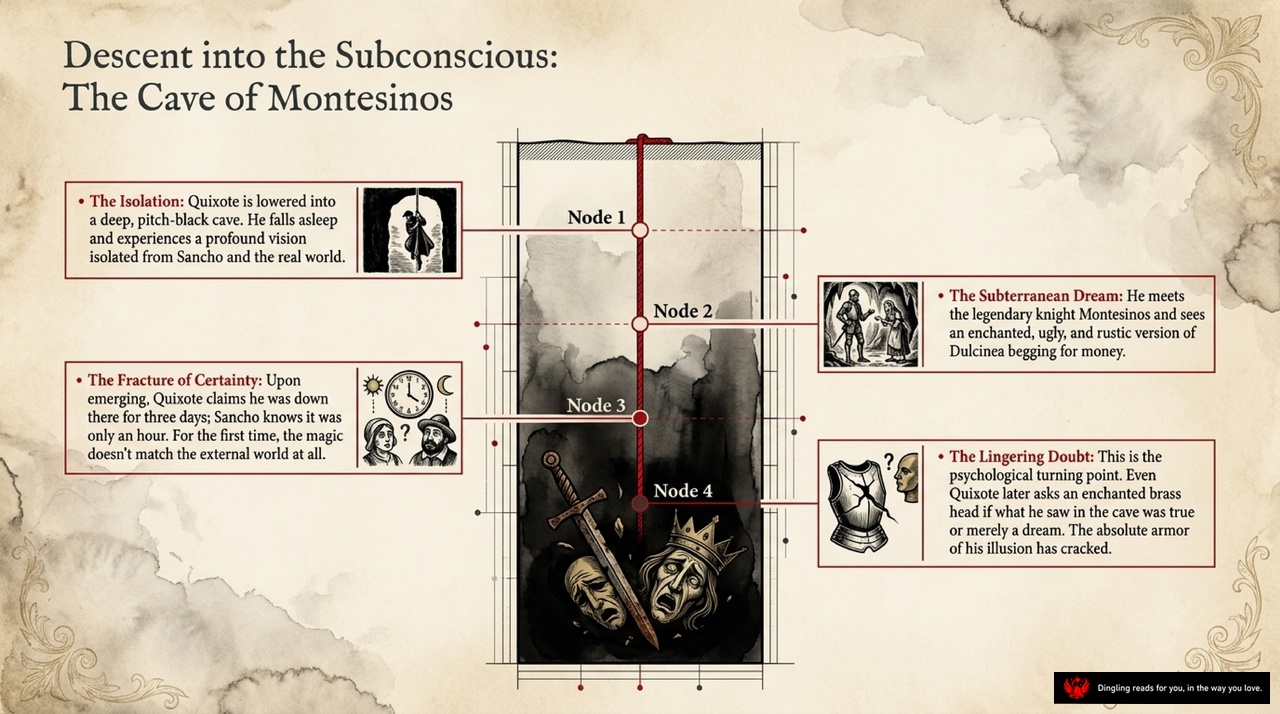
Welcome to the final, most haunting chapter of Don Quixote's journey. Today, we dive deep into the subconscious, exploring the legendary Cave of Montesinos. This isn't just a physical descent; it is the moment Don Quixote's entire world begins to crack.
First, we face **The Isolation**. Quixote is lowered into a deep, pitch-black cave, severed from Sancho and the real world. As he falls asleep, he enters a profound, terrifying vision. Down here, he meets the legendary knight Montesinos and encounters a shocking sight: an enchanted, ugly, and rustic version of Dulcinea begging for money. This is the first time the idealized princess he worships is revealed as something broken and earthly.
Emerging from the cave brings **The Fracture of Certainty**. Quixote claims he was down there for three days, but Sancho knows it was only an hour. For the first time, the magic he relied on no longer matches the external world. The timeline is broken, and his absolute reality is questioned.
This leads us to **The Lingering Doubt**, the true psychological turning point. Even after the adventure, Quixote asks an enchanted brass head if what he saw in the cave was true or merely a dream. The absolute armor of his illusion has finally cracked. He realizes that his beloved Dulcinea was never the radiant queen he imagined; she was a suffering woman, just like the one he saw in the dark. This encounter strips away the fantasy that fueled his madness, leaving him with a terrifying, unvarnished truth.

Welcome back to our deep dive into *Don Quixote*. Today, we're exploring a brilliant framework for understanding the book's core conflict: "The Spectrum of Sanity." This isn't just about being crazy or normal; it's about where you stand between cynical reality and pure idealism.
Look at this timeline. On the far left, we have "Cynical Reality," represented by the Duke and Duchess. They are entirely sane, wealthy, and well-resourced, yet they are morally bankrupt. They use deception and roleplay just to entertain Don Quixote. They are the epitome of the pragmatic, self-serving world.
Moving right, we meet the Priest and Samson Carrasco. These are the Rational Pragmatists. They are grounded in reality, well-intentioned, and genuinely care about Don Quixote. But because they rely too heavily on logic and manipulation, they resort to deception—like the fake adventure with Doroteya—to try and "cure" him. They are stuck in the middle, trying to fix the impossible with tricks.
Then, we arrive at Sancho Panza, the "Evolving Realist." He begins purely pragmatic, seeing windmills as windmills. But as the story progresses, he gets slowly infected by his master's idealism. By the time he becomes governor of the "Isle of Barataria," he isn't just following orders; he's genuinely trying to do good, culminating in his wise rule. He bridges the gap between the cynical and the idealistic.
Finally, on the far right, stands Don Quixote himself: Pure Idealism. He is clinically mad and entirely disconnected from physical reality. He sees windmills as giants and barber basins as helmets. But despite his madness, he is morally pure, brave, and deeply principled. He represents a truth that the sane world has forgotten.
This spectrum shows us that sanity isn't a binary switch. It's a journey. We can be too cynical, or too naive, but the most compelling characters often find their way somewhere in between, carrying a spark of that pure idealism into a harsh reality.

Welcome to the final chapter of Don Quixote's epic journey. This slide captures what we call "The Final Awakening"—the moment the dream shatters and reality returns.
First, we see **The Fever of Clarity**. After being defeated in battle and forced to retire, Quixote falls into a deep, six-hour sleep. When he wakes up, he is cured of his madness. It's a sudden, jarring shift from the chivalric hero to a confused old man.
This leads directly to **The Renunciation**. He vehemently denounces chivalric romances, stating: "I was mad, but now I am sane. I was Don Quixote of La Mancha, and now I am Alonso Quijano the Good." He rejects the fantasy he once loved, admitting that his delusion was the only thing that gave his life meaning.
Then comes **The Tragic Reversal**. His friends, desperate to keep the magic alive, beg him to go to the fields and be a shepherd. Quixote refuses, clinging to his newfound, fatal reality. He realizes that being a real shepherd is far less glorious than being a knight, and he cannot go back to the lies he told himself.
Finally, we look at **The Will**. He leaves his estate to his niece, Antonia, on one strict condition: she must forfeit everything if she marries a man who reads chivalric romances. He wants to ensure his legacy isn't destroyed by the very books that ruined him.
The slide concludes with a powerful note: He dies peacefully in his bed, officially ending the myth so no false sequels can ever resurrect him. It is a heartbreaking but necessary closure for one of literature's greatest characters.

Quixote's journey reveals the ultimate, tragic paradox of human existence: a world governed strictly by harsh pragmatism and rigid sanity is practically unlivable without the noble, elevating, and ultimately doomed architecture of illusion.
Think about it: if sanity demands the surrender of our highest ideals to the lowest realities, is it not the ultimate madness to choose to be sane? Throughout his adventures, Don Quixote constantly clashes with a pragmatic world that refuses to see the giants, castles, and enchanted damsels he so desperately believes in. While the townspeople laugh at his delusions, it is their narrow-minded adherence to "reality" that strips life of its meaning. Quixote teaches us that true courage often requires seeing the world not as it is, but as it could be. Without that willingness to embrace a little bit of madness, we risk losing the very things that make us human.