
Dune Messiah: Complete Chapter-by-Chapter Summary

Welcome to our deep dive into Frank Herbert's *Dune Messiah*. Today, we're exploring a pivotal theme that defines the entire narrative: The Trap of Prescience.
Look at the title on this slide. It sets the stage for everything we're about to discuss. This isn't just a story about a powerful emperor; it's a structural analysis of how power, conspiracy, and determinism collide. The subtitle tells us exactly what we're unpacking: the intricate web of power dynamics, the shadowy games of conspiracy, and the crushing weight of determinism within the universe of Dune Messiah.
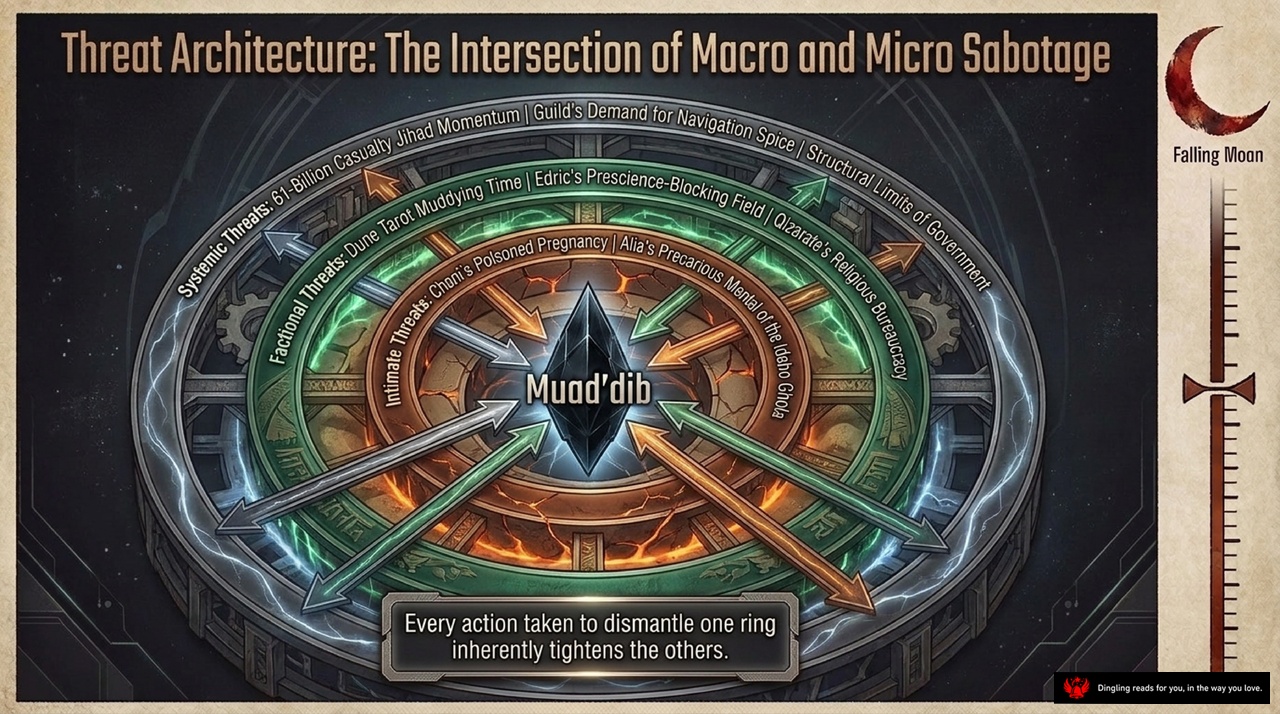
We are diving straight into the core conflict. The central idea here is that Paul Atreides, despite his god-like foresight, is ultimately trapped by his own ability to see the future. The slide highlights the key players behind this trap: the Bene Gesserit, the Spacing Guild, and the treacherous Harkonnens, all converging on a single target.
Let's break down the logic. The image suggests a complex system of orbits and gears, much like the political machinery of the Imperium. Paul isn't just fighting enemies; he's fighting against the very nature of his own existence. His prescience, which he once thought was his greatest weapon, becomes the very thing that enslaves him. He sees a future where he must become a religious figure, a messiah, to prevent a worse outcome. But in doing so, he creates the very fanaticism he sought to destroy.
This is the essence of the "trap." By trying to control the future, Paul inadvertently seals his own fate. The slide emphasizes that this is not a simple battle of good versus evil. It's a battle of ideology, where the Bene Gesserit's breeding program and the Guild's reliance on the spice both contribute to a deterministic outcome that even Paul cannot escape.
As we move forward, we will examine how these forces intertwine. We'll look at the specific mechanisms of control, from the genetic manipulation of the Bene Gesserit to the economic stranglehold of the Spacing Guild. We'll also explore the personal cost of this trap for Paul, as he struggles to maintain his humanity amidst the rising tide of religious fervor.
So, let's begin our journey into the mind of a man who saw his own destruction before it happened, and tried to change it, only to find that he was already too late. Welcome to the trap of prescience.

Look at this split screen. On the left, we see the brutal reality of Muad'Dib's "Holy War." Twelve years of religious crusade, and the cost was staggering: 61 billion casualties, 90 planets sterilized, 500 worlds demoralized, and 40 religions wiped out entirely. It wasn't a liberation; it was a monopoly built on the ashes of a captured universe.
But look at the right side. That's the "Golden Empire" structure. At the top sits Arrakis, the source of all power. Below it, three pillars hold the system together: The Spacing Guild controlling travel, The Bene Gesserit ensuring long-term genetic control, and CHOAM managing the imperial economy. All of them feed into one single, glowing prize at the bottom: Melange.
This diagram shows the ultimate trap. Muad'Dib thought he was breaking the old chains of the universe, but he just built a much tighter cage for everyone. By monopolizing the spice, he made every other power—from the Guild to the planet's economy—dependent on his throne. He became the god everyone prayed to, but in doing so, he trapped himself and the entire galaxy in a system where his will was the only law. It's a chilling reminder that sometimes, trying to control the universe just ends up controlling you.
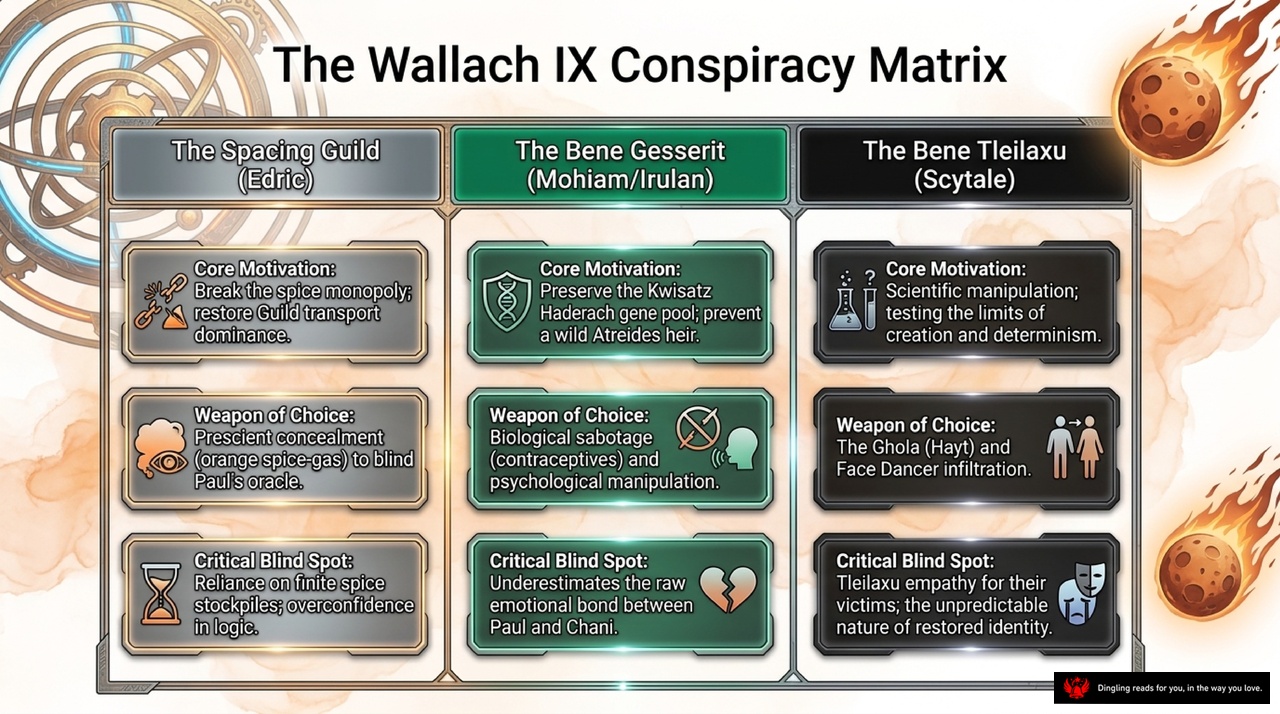
Look at this "Conspiracy Matrix" for Wallach IX. This isn't just a map of enemies; it's a blueprint of how the universe's most powerful players are trying to rewrite destiny.
On the left, we have the Spacing Guild, led by Edric. Their goal? To break the Spice monopoly and restore their transport dominance. They're using prescient concealment—literally blinding Paul's visions with orange Spice gas. But their fatal flaw? They rely too much on finite Spice stockpiles and overconfidence in logic. They forgot that the human element is unpredictable.
In the center, the Bene Gesserit, led by Mohiam and Irulan. Their mission is pure survival: preserve the Kwisatz Haderach gene pool and prevent a wild Atreides heir from disrupting their plan. Their weapon? Biological sabotage and psychological manipulation. They underestimated the raw emotional bond between Paul and Chani, thinking they could control the variables. But they failed to account for the human heart.
On the right, the Bene Tleilaxu, with Scytale at the helm. They want to test the limits of creation and determinism through scientific manipulation. Their tools are the Ghola and Face Dancers. Their blind spot? Their own empathy for victims and the unpredictable nature of restored identity. They thought they could engineer a perfect outcome, but they couldn't control the chaos of human emotion.
This matrix shows us that no single faction can win alone. The Guild relies on technology, the Gesserit on biology, and the Tleilaxu on engineering. But in a universe driven by free will and faith, even the most perfect plan can crumble when it ignores the one thing no algorithm can predict: the human spirit.
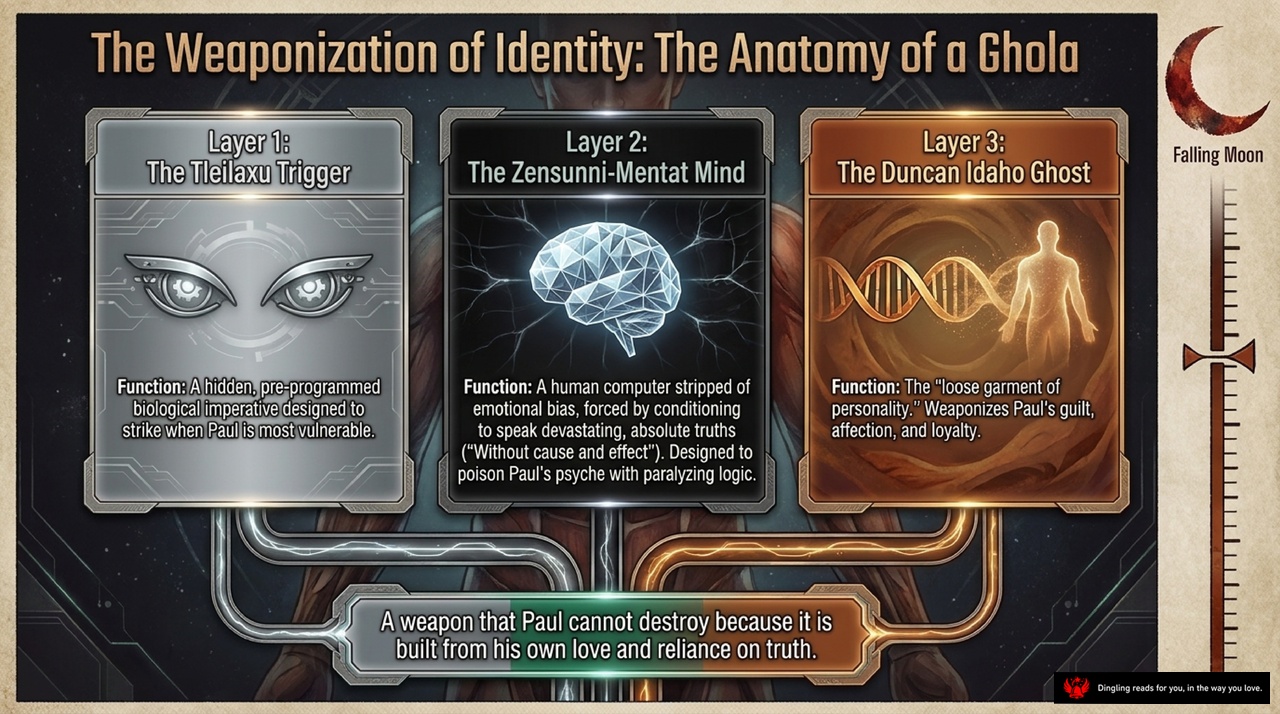
Look at this intricate diagram of a Ghola. It's not just a biological construct; it's a sophisticated weapon built on three distinct layers.
First, we have Layer 1: The Tleilaxu Trigger. Visualized here as those mechanical eyes, this is a hidden, pre-programmed biological imperative. It's designed to strike Paul specifically when he is most vulnerable, acting as an automated defense mechanism for the enemy.
Next is Layer 2: The Zensunni-Mentat Mind. Represented by that glowing, fractured brain, this is a human computer stripped of all emotional bias. Through rigorous conditioning, it is forced to speak only devastating, absolute truths without cause or effect. Its purpose? To poison Paul's psyche with paralyzing logic, drowning him in cold, unyielding data.
Finally, Layer 3: The Duncan Idaho Ghost. This layer, shown as a DNA strand merging with a human silhouette, weaponizes the "loose garment of personality." It targets Paul's deepest vulnerabilities—his guilt, his affection, and his loyalty. It doesn't just attack his mind; it attacks his heart by resurrecting the memory of his fallen brother.
Notice the connection at the bottom. This weapon is something Paul cannot destroy because it is built from his own love and reliance on truth. By weaponizing his greatest strengths against him, the Tleilaxu ensures that even a Ghola can bring down an Emperor. It is a trap where the only way out is to survive the very person you are trying to save.
Paul stands on the balcony, but the view he sees isn't the golden empire he built; it's a rotting machine. He looks at the bustling streets below, where water—once the most precious currency in the universe—is now casually poured onto the sand by merchants trying to impress tourists. It's a grotesque parody of the desert laws he once revered. The bureaucracy has exploded like a sandworm, bloated and greedy. Decisions that used to take minutes now require months of red tape, stamps, and silk robes. The very freedom he fought for has been strangled by the very system he created.
He forces himself to look at the numbers. Six billion dead. Ninety planets sterilized. He realizes with a sinking heart that he is no different from the tyrants of Earth history. He has become the very symbol of oppression he tried to destroy, a god trapped in a cage of his own making. Every prayer of the faithful feels like a dagger in his chest, mocking his humanity. He remembers the old days in the desert, the raw connection to the land, the simplicity of survival. Now, the young Fremen don't care about the worms or the water; they care about stock prices and imported wine. The tradition is dying, and he is the one who killed it.
The fear is paralyzing. He sees the future crumbling before him, a sandcastle dissolving in a storm. He wants to run, to hide in the dunes, but he knows the cost. If he leaves, the empire collapses, and millions more will die. He is stuck, watching his life's work turn into a nightmare, realizing that the god he became is the prison he built for everyone, including himself.
The song of the sandworms isn't just a melody; it's a warning carved into the very bones of the desert. It speaks of a creature that is both a god and a predator, feeding on the very desires that draw humans to it. For Paul, this song became the anchor of his soul, and eventually, the noose around his neck.
Look at the tension here. The lyrics warn against the "burning of desire," yet Paul's own journey was fueled by that exact fire. He saw the sandworms as the key to power, the path to destiny. But as the text reveals, that connection turned into a curse. He realized that the very thing he worshipped—the sandworm, the spice, the god-like status he earned—was leading directly to the extinction of the species that created it.
This is the tragic irony of his reign. The more he embraced his role as Muad'Dib, the more he destroyed the pure, wild tradition of the Fremen. He saw visions of a future where the sandworms are gone, where the desert is paved over, and where his own people have lost their identity. The song became a prophecy of his own downfall, a reminder that the intoxication of godhood is a trap that no amount of foresight can escape.
As Chani's pregnancy progresses, this fear deepens. He knows that the heir he is building, the child meant to secure his legacy, is tied to this same destructive cycle. He is caught between the love for his wife and the terrifying knowledge that his existence is the catalyst for the end of the desert. The sandworm song echoes in the wind, a funeral dirge for an empire that tried to conquer nature, only to be consumed by it.
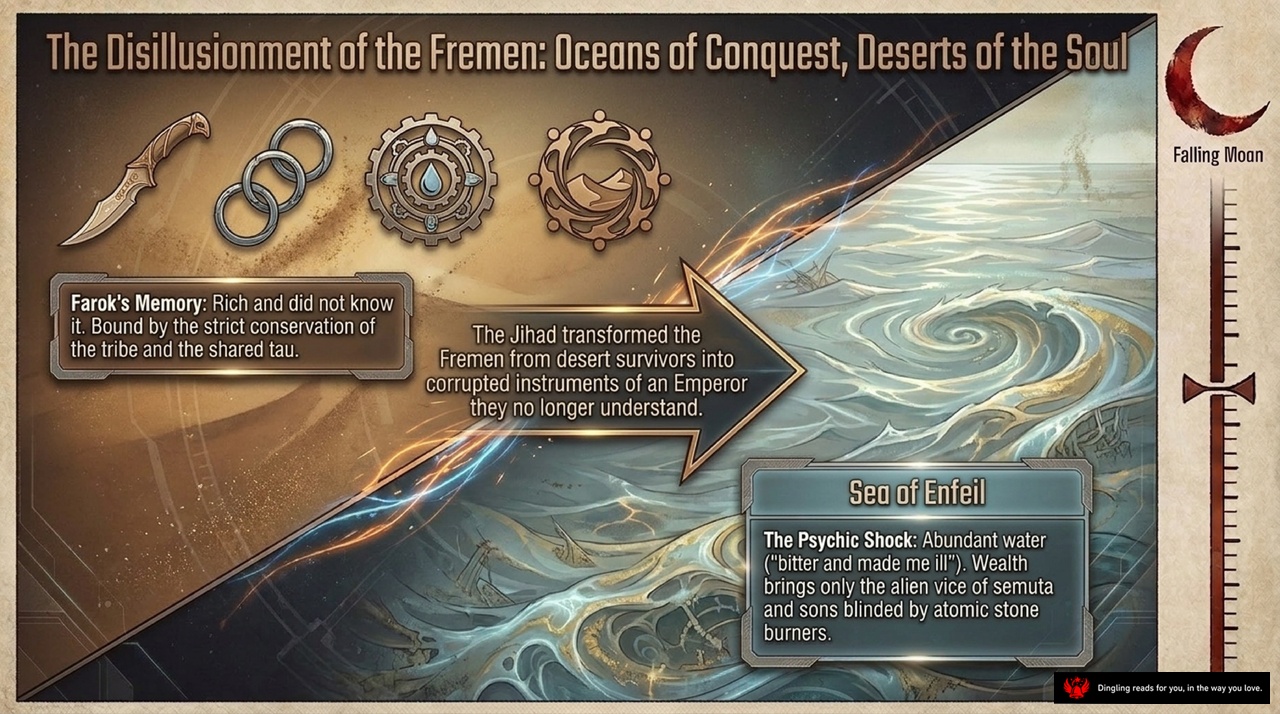
The Disillusionment of the Fremen: Oceans of Conquest, Deserts of the Soul. Look at this split in the image. On the left, we see Farok's memory—a simple knife, water rings, and the strict conservation of the tribe. That was his life: poor but rich in spirit, bound by the shared tau. But then, an arrow points to the right, transforming that desert survival into something else entirely. The Jihad didn't just liberate them; it corrupted them. It turned the Fremen from free survivors into instruments of an Emperor they no longer understood.
This transformation led them to the Sea of Enfeil. Look at the swirling waters here. It wasn't a paradise. It was a psychic shock. The text describes it as "abundant water that was bitter and made me ill." This is the crucial lesson: wealth and water brought only the alien vice of semuta. The Fremen sons, blinded by atomic stone burners, found that abundance brought nothing but sickness and loss of identity.
Notice the falling moon on the right. This represents the death of their soul. When the Fremen conquered the sea, they lost the desert within them. They traded their spiritual richness for material conquest, only to find a desert of the soul waiting for them on the other side. This is the ultimate tragedy of the Jihad: in trying to conquer the universe, they accidentally destroyed themselves.

The diagram before us maps the terrifying psychological architecture of Alia, the Knife. At the center lies her "Pre-born Awakening," a moment where she was awoken in the womb by the Water of Life, inheriting the memories of countless Reverend Mothers and bypassing childhood innocence entirely. This isn't just a birth; it's a forced inheritance of a thousand lives.
From this singular point, her existence fractures into three distinct paths. The top arrow points to "The Virgin-Harlot Goddess," where she is worshipped by the Fremen as an Earth Figure, yet trapped in the Fane of the Oracle, isolated by awe and fear. She becomes a deity to some and a prisoner to others. The middle arrow leads to "The Physical Outlet," a brutal mechanism where she pushes her physical training to suicidal speeds—eleven lights—to drain her flesh and silence the chorus of ancestral voices screaming in her mind. It is a war against her own humanity. The bottom arrow reveals "The Tleilaxu Lure," a perilous attraction to Hayt's absolute truthfulness and his missing history, a hook that threatens to pull her into a different kind of trap.
And on the far right, the "Falling Moon" looms, the celestial signal that dictates the timing of her transformation. This isn't just a character profile; it's a blueprint for a weapon designed to be broken, rebuilt, and used. Alia's entire life is a calculation of how to survive the burden of being a god, a mother, and a weapon all at once.
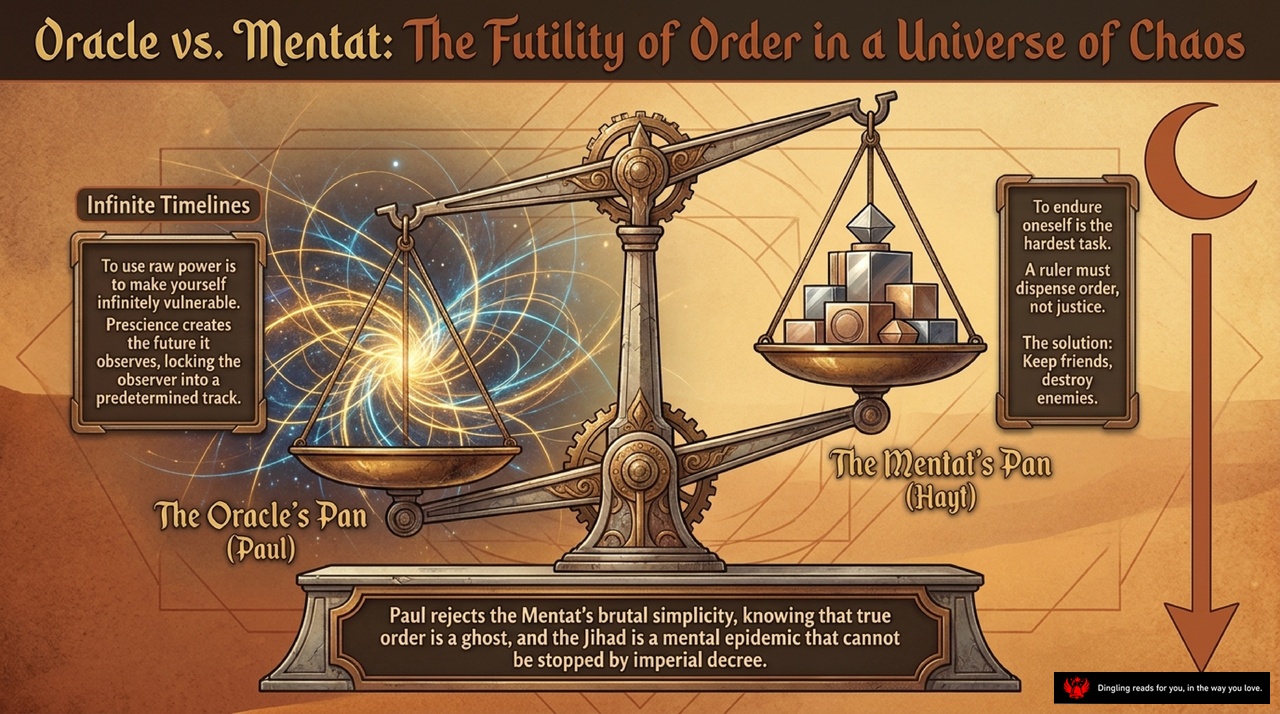
The scales in our image perfectly capture the impossible choice Paul faces: the Oracle's path of infinite timelines versus the Mentat's brutal order. On the left, we see the Oracle's Pan, representing the terrifying trap of foresight. As the text reminds us, using raw power makes you infinitely vulnerable because prescience locks you into a predetermined track, turning the future into a cage rather than a canvas.
On the right sits the Mentat's Pan, where Hayt argues that to endure oneself is the hardest task. He believes a ruler must dispense order, not justice, suggesting the solution is to keep friends and destroy enemies. It is a philosophy of cold, logical survival.
Yet, look at the base of this scale. Paul rejects the Mentat's brutal simplicity. He knows that true order is just a ghost and that the Jihad is a mental epidemic that no imperial decree can stop. While the Mentat seeks to control chaos through rigid rules, Paul realizes that in a universe of infinite timelines, true strength lies not in enforcing a fake order, but in embracing the chaos and finding the humanity that survives within it.
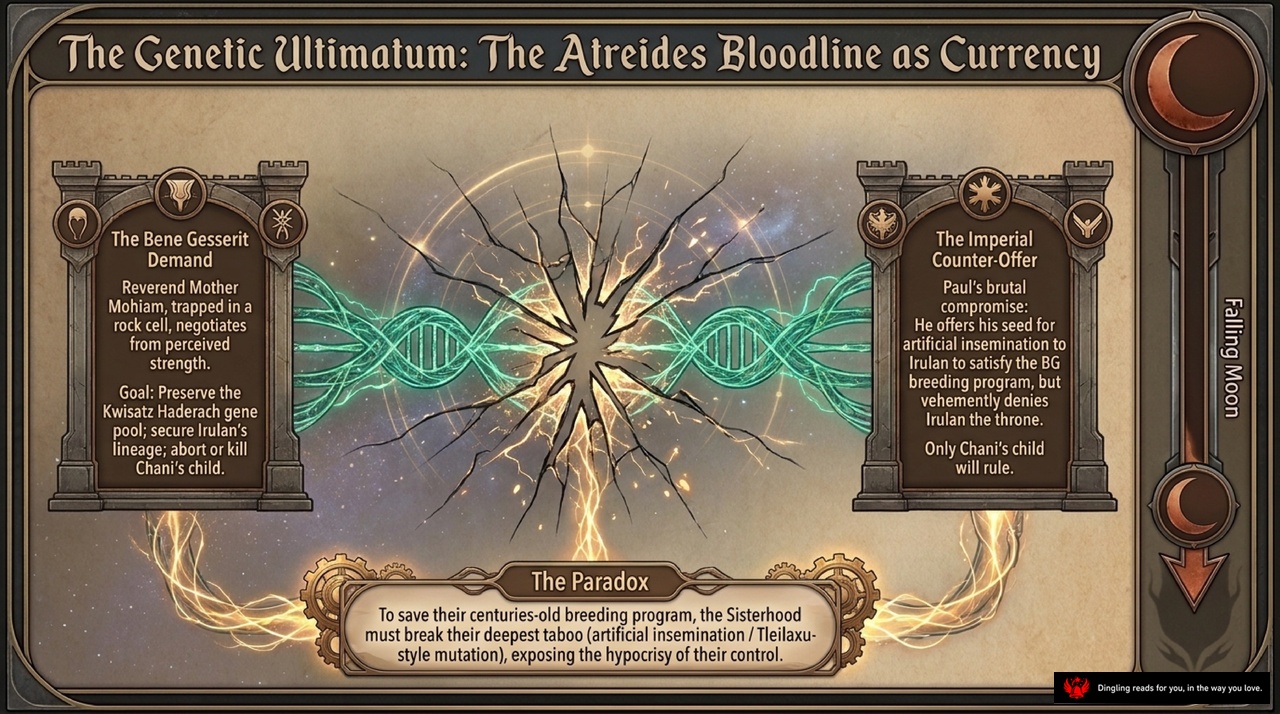
The Genetic Ultimatum: The Atreides Bloodline as Currency. This isn't just a political negotiation; it's a high-stakes gamble where DNA is the only currency that matters.
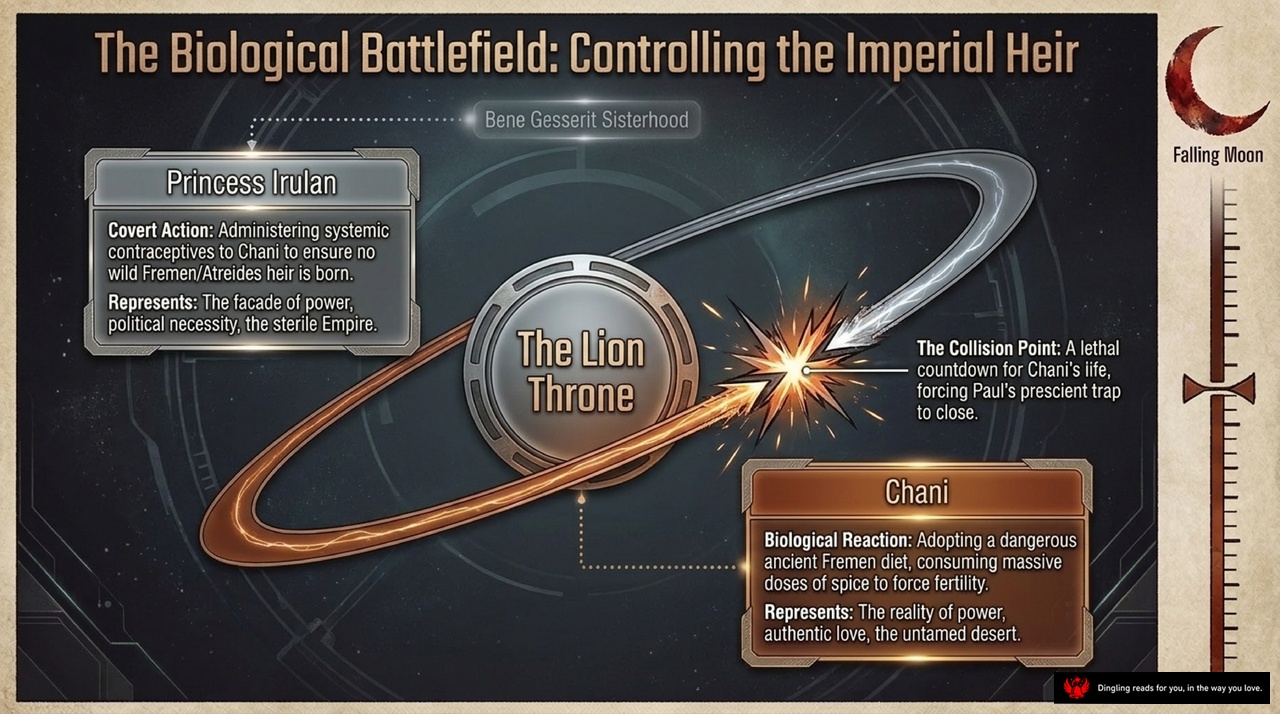
On the left, the Bene Gesserit are trapped but calculating. Reverend Mother Mohiam, confined in a rock cell, is playing her final hand. She needs the Kwisatz Haderach gene pool preserved, but her plan is ruthless: she's willing to abort or even kill Chani's child to secure Irulan's lineage. She's betting that only Irulan can produce the perfect heir they've spent centuries engineering.
On the right, Paul makes a brutal counter-offer. He knows he can't win a war of attrition, so he proposes a terrible compromise: artificial insemination. He offers his seed to Irulan to satisfy the Sisterhood's breeding program, but with one non-negotiable condition: Irulan cannot rule. Only Chani's child will inherit the throne. It's a poison pill disguised as a solution.
The core of this conflict is the paradox at the bottom. To save their ancient breeding program, the Sisterhood must break their deepest taboo: artificial insemination. They've spent generations mastering the art of natural conception and mental discipline, yet now they must embrace Tleilaxu-style manipulation to survive. It exposes the hypocrisy of their control. They wanted to shape the universe through subtle genetic nudges, not through the crude, desperate measures of a forced breeding program.
This moment defines the fall of the old order. The Sisterhood's god-like status shatters the moment they admit they need a biological shortcut. Paul, meanwhile, realizes that the only way to break the cycle of control is to give the bloodline away, ensuring that the true heir comes from the desert, not from a sterile laboratory. The genetic ultimatum is issued, and the game of thrones is about to be rewritten by the very code of life itself.

The Inevitable Infiltration: Submission to the Face Dancer
Look at this intricate diagram of "The Oracular Cage." It captures the terrifying moment where Paul is no longer the hunter, but the prey. The image breaks down the two masks deceiving him: Mask 1, Lichna, the daughter of Otheym, who perfectly replicates the voice and mannerisms of his wife, Irulan, designed as the ultimate bait to lure Paul out of the Keep. But beneath that feminine facade lies Mask 2, Scytale, the Tleilaxu architect observing the success of the deception.
This visual perfectly illustrates the trap Paul faces. As the text reveals, Paul's prescience immediately penetrates the disguise, sensing the truth behind the lies. Yet, here lies the tragedy: he cannot simply slay the Face Dancer without precipitating a worse future. He is forced to play his part in a script he can read but cannot rewrite. The "Oracular Cage" isn't just a prison of walls; it's a prison of time itself, where his greatest strength—seeing the future—becomes his greatest weakness, trapping him in a predetermined path he must follow to avoid an even greater catastrophe.
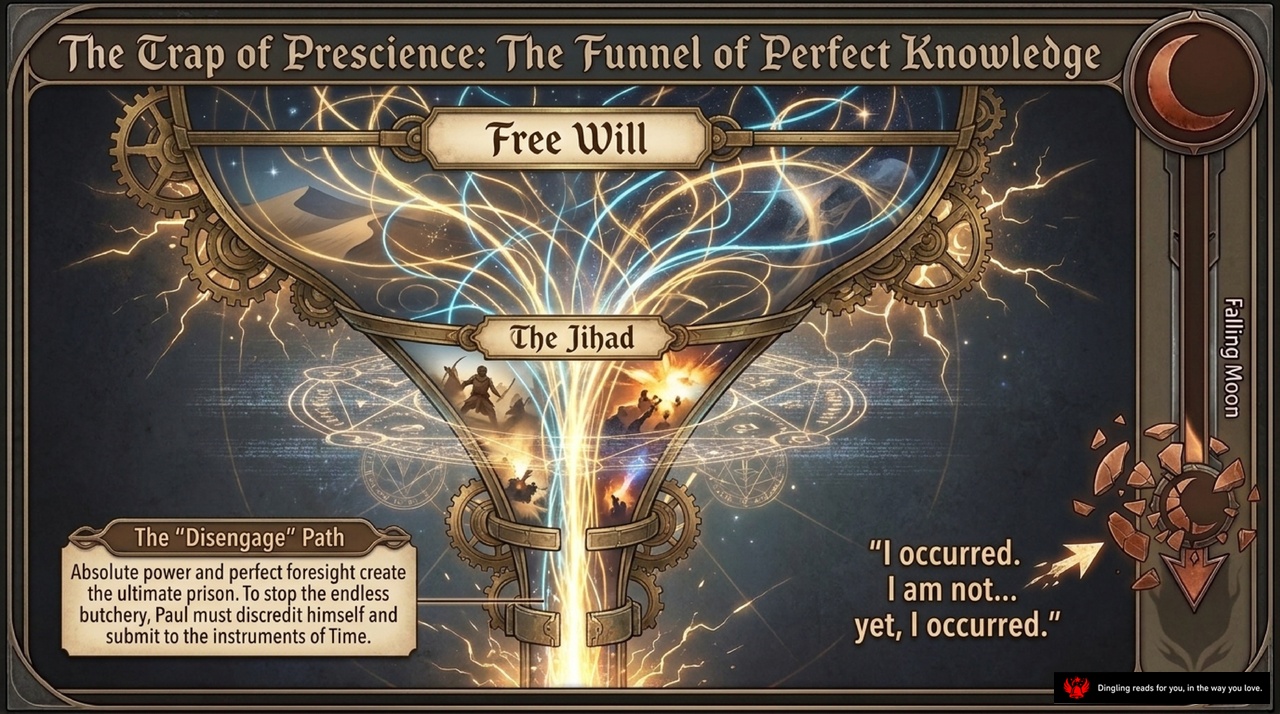
Look at this funnel. It visualizes the terrifying trap Paul faces: the Funnel of Perfect Knowledge. At the top, we have Free Will—chaotic, infinite, and dangerous. As it flows down, it gets funneled into The Jihad. This is where the trap closes. Absolute power and perfect foresight create the ultimate prison. To stop the endless butchery, Paul must discredit himself and submit to the instruments of Time.
But here is the twist. The text says, "I occurred. I am not... yet, I occurred." This isn't just a prophecy; it's a paradox. If he knows the future, he is trapped by it. He can't act freely because his actions are already written. The only way out, as the slide suggests, is the "Disengage" Path. He has to step out of the loop, break the cycle of predestination, and choose a future that doesn't exist yet. It's a desperate gamble against the very god he became.