
Eat That Frog!: Complete Chapter-by-Chapter Summary

Welcome to the definitive blueprint for stopping procrastination. Today, we're diving into Brian Tracy's classic, *Eat That Frog!*.
Look at that striking hourglass inside the target on the cover. It represents a simple but powerful truth: time is running out, and you need to act now. The core idea is straightforward—tackle your most important and challenging tasks first thing in the morning.
Why does this matter? Because most people waste their day on low-value activities, leaving their biggest goals untouched until it's too late. By identifying and completing that one critical task early, you gain momentum, confidence, and the freedom to handle the rest of your day with ease. It's not about doing everything; it's about doing what truly matters. Let's learn how to master your day and eat that frog before it eats you.

Welcome back. Today, we're diving into the heart of productivity with a powerful concept known as "Eating the Frog."
Look at this glowing green frog in the center of our screen. This isn't just a cute animal; it's a metaphor for your life. Your "Frog" represents your single biggest, most important task—the one thing you are most likely to procrastinate on, but also the one that will have the greatest positive impact on your results.
So, how do we tackle it? The book introduces two fundamental laws. First, the Law of Two Frogs: If you have to eat two frogs, always eat the ugliest one first. This means you should start with the hardest, most vital task immediately, rather than saving it for later. Second, the Law of the Live Frog: If you have to eat a live frog, do not sit there and look at it for a very long time. Action is the only cure for procrastination. The longer you stare at that difficult task, the more intimidating it becomes.
The secret isn't about waiting for motivation; it's about taking immediate action. By focusing your energy on that one critical "frog" right at the start of your day, you clear the path for the rest of your tasks to fall into place effortlessly. Don't wait to feel ready—just start eating.

Today, we're breaking down the engine that drives true productivity: a simple, powerful three-phase blueprint. Think of it as a machine where every gear must turn in the right order to generate momentum.
Phase one is all about finding the frog. This isn't just about making a to-do list; it's about ruthless prioritization. You need to define your exact goals in writing and apply the 80/20 rule to isolate the vital few tasks from the trivial many. Most people waste their days on the 80% of low-value activities, but the top performers know that 20% of their efforts drive 80% of their results. So, before you move forward, you must identify that one high-impact task—the biggest, ugliest frog—and decide that it is the only thing that matters right now.
Once you've identified your target, Phase two is where you prepare the table. This is your setup phase. You need to upgrade your skills, eliminate internal bottlenecks, and detox from reactive technology that steals your focus. It's about optimizing your physical energy and creating an environment where success is inevitable. Don't start working until your workspace, your mindset, and your tools are perfectly aligned. If you skip this preparation, you're just setting yourself up for failure.
Finally, Phase three is the moment of truth: eat the frog. This is execution. You break the massive task down into isolated time blocks and generate urgency. You utilize single-handling, meaning you focus on one thing until it is 100% complete before moving to the next. No multitasking, no switching contexts. You commit to that single task with total intensity until it's done. This creates a powerful momentum that carries you through the rest of your day.
By moving through these three phases—prioritizing, preparing, and executing—you transform chaos into control. You stop being busy and start being productive. Now, let's put this blueprint into action and see what you can accomplish.

Let's dive into the blueprint for high leverage, starting with Phase 1: The 80/20 Value Funnel. Look at this diagram—it visualizes a powerful truth about time management: 20% of your activities account for 80% of your results. Think about your own day. Are you spending your prime energy on the few tasks that actually move the needle, or are you busy clearing out the inbox and answering trivial emails? That's the trap of the trivial. Most people procrastinate on the top 20% of high-value items, instead of busying themselves with the 80% of tasks that yield almost no return. It feels productive, but it's not. The rule here is simple yet hard to follow: resist the temptation to clear up small things first. The hardest tasks take the same amount of time as the trivial ones, but they yield entirely different emotional and professional returns. So, ask yourself: what are those critical 20%? And then, make sure you're investing your time there, not getting lost in the noise.

Look at this flowchart here. This is the ABCDE Triage Flowchart, and it's the secret weapon for anyone who wants to stop feeling overwhelmed by their to-do list. Instead of just dumping everything into a pile, you need to assign a letter to every single task before your day even begins.
Let's break down what each letter actually means. First, you have your 'A' tasks. These are your 'Must Do's.' If you leave these undone, the consequences are serious. If you have multiple A tasks, you simply rank them A-1, A-2, and so on. That top priority, A-1, is your 'Frog'—the biggest, most important thing you must tackle first.
Next up are your 'B' tasks. These are things you 'Should Do,' but the consequences if you skip them are mild. Here is the golden rule: never do a B task if you have an A task left undone. You simply cannot let the important things slide just to get to the easy stuff.
Then you have 'C' tasks. These are the 'Nice to Do's.' There are no professional consequences if you don't do them. Think of these as having coffee with a coworker or chatting with a friend. They feel good, but they don't move the needle on your success.
'D' stands for 'Delegate.' These are tasks that anyone else can do. By handing these off, you free up your own time to focus on those critical 'A' tasks that only you can handle.
Finally, you have 'E' tasks. These are the ones you need to 'Eliminate.' These might be old habits or tasks from the past that no longer add any value to your life. Just say no to them.
The real power of this chart is in the order. You start with your A-1, eat that frog, and only then do you move down the line. Master this sorting system, and you'll instantly take control of your day.

Today's slide, "The Blueprint of High Leverage," reveals the secret to mastering your day. It all comes down to "The Rule of Three." Here's the hard truth: out of everything you do, just three core activities actually drive 90% of your value. The rest? Often just noise.
So, stop trying to be a superhero who does everything. Instead, identify those three critical tasks that define your success. These are your "Value Core." Once you find them, dedicate your prime working hours exclusively to them. By maximizing output on these few things, you actually buy back the time you need for the ultimate goal: maintaining quality time at home.
Look at the balance scale on the right. It illustrates a crucial distinction: in the office, the quality of your time matters most. You need deep focus. But at home, the quantity of time matters most. You need presence. If you scatter your energy on low-value tasks during the day, you rob yourself of both high-quality work and real life.
The path to freedom isn't working harder; it's ruthlessly focusing on what actually moves the needle. Identify your three high-leverage tasks, protect them fiercely, and let the rest fall away. That's how you win at work and win at life.

Phase 2 is all about identifying the hidden brakes on your success and upgrading your skills to remove them. Look at this diagram: your input flow and output flow are connected by a narrow point—the bottleneck. That's your constraint. Often, this bottleneck isn't external; the 80/20 rule tells us that 80% of what holds you back are internal factors like your own skills, habits, or lack of discipline. Only 20% are external. So, stop blaming the market or your boss. Your weakest key skill sets the strict ceiling on your success. You will unconsciously procrastinate on tasks where you feel incompetent.
The solution is a three-step mastery plan. First, commit to reading one hour daily in your field. Second, invest in specialized courses to fill those gaps. And third, utilize your commute by listening to audio programs. Since the average person drives 500 to 1000 hours a year, that's a massive amount of free learning time you're currently ignoring. By reading, taking courses, and listening to audio, you directly upgrade that bottleneck capacity, widening the gap between your input and output. Stop waiting for perfect conditions; upgrade your skills today, and watch your success ceiling rise.

The Blueprint of High Leverage is all about taking control of your digital life so it serves you, rather than dictating your attention. As the slide illustrates, the constant urge to check devices creates psychological exhaustion that destroys your ability to focus on what truly matters.
Most of us live as "Reactive Slaves." We check our inbox the moment we wake up, react instantly to every notification, and believe that every incoming message demands an immediate response. This reactive cycle leaves us running on empty, constantly distracted by the trivial.
But you have the power to become a "Proactive Master." Start your day by leaving your devices off until your daily planning is complete. Ruthlessly delete 80% of useless emails and batch the rest. Most importantly, create blocks of silent, disconnected time dedicated solely to your high-impact "A" tasks. When you master this Technology Detox Matrix, you stop being a slave to the algorithm and start leveraging technology to accelerate your communication and achieve your goals.

Look at this curve: the Daily Energy Level Arc. It shows something most of us ignore until we're burning out. Your energy isn't static; it's a wave that peaks in the morning and crashes by the night.
Think of your mind and body as a battery. You simply cannot output high-quality work on a depleted one. Your physical, mental, and emotional energy dictates your productivity. If you try to force a masterpiece at 10 PM when your battery is dead, you'll just make mistakes. That's what we call the Fatigue Tax. Working long hours while exhausted drastically increases error rates and kills your output. Rest isn't downtime; it's actually a productivity multiplier. When your battery hits zero, the only smart move is to stop and sleep.
So, how do you win? You have to match your hardest task to your Peak Window. The average person operates at peak cognitive capacity right after a full night's rest. This is your biological sweet spot. That's when you need to eat the A-1 Frog—the biggest, most difficult task of the day. Don't save your best energy for the easy stuff. Use your morning peak to conquer the mountain, and let the afternoon dip handle the lighter work. Manage your energy, not just your time, and you'll never feel as drained again.

Phase 3 is all about tackling the Behemoth—those massive tasks that make us freeze in fear. The real enemy here isn't the work itself; it's the psychological dread that comes from looking at the whole mountain at once. When a task feels overwhelmingly large, our brains shut down. But you can defeat this fear by breaking the task down into manageable pieces.
Look at these two powerful strategies. First, we have the Salami Slice Method. Imagine your big project as a giant log. Instead of trying to chop it all at once, you simply commit to cutting one thin slice right now. You lay out the sequence and focus entirely on that first, tiny step. By doing just one slice, you bypass the overwhelm and build momentum naturally.
Second, try the Swiss Cheese Method. This is perfect if you're stuck or procrastinating. You don't need to finish the whole project to make progress. Just punch a hole in the cheese—commit to a tiny block of time, like five or ten minutes, and do a little bit of work. Then, stop. This short burst is often enough to trigger your brain's natural reward system. Completing even a small step releases endorphins, creating a compulsion to close the loop and take the next bite.
The psychology behind both methods is simple but profound: they hack your brain's need for closure. By completing a small step, you chemically drive yourself to tackle the next one. So, stop staring at the behemoth. Pick a slice or punch a hole, and start moving.
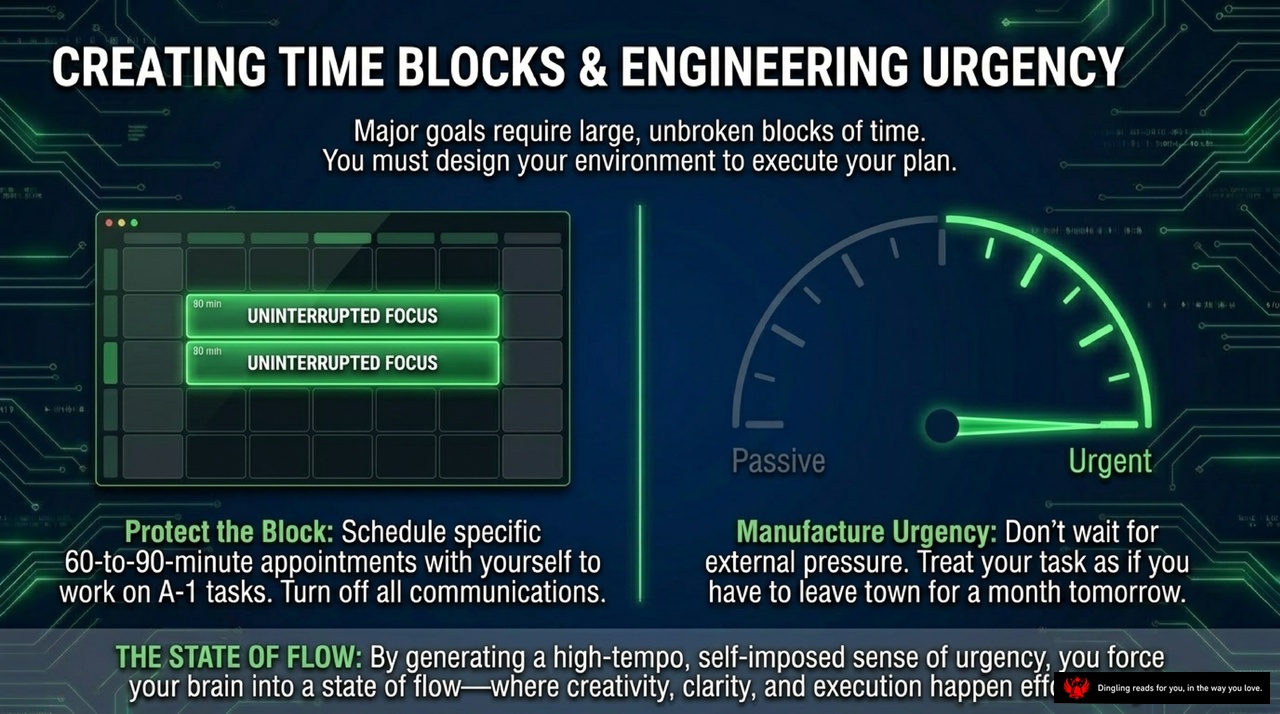
Creating time blocks and engineering urgency is the secret to unlocking your highest potential. As the slide illustrates, major goals demand large, unbroken blocks of time. You cannot rely on the scattered moments of a chaotic day; you must design your environment to execute your plan.
Look at the calendar on the left. The key is to "Protect the Block." Schedule specific 60-to-90-minute appointments with yourself to tackle your A-1 tasks—the most critical work. During this time, turn off all communications. No emails, no calls, just pure, uninterrupted focus. This isn't just about finding time; it's about creating a sacred space where your brain can dive deep.
Now, look at the gauge on the right. We need to "Manufacture Urgency." Don't wait for external pressure to push you. Instead, treat your task as if you have to leave town for a month tomorrow. By generating a high-tempo, self-imposed sense of urgency, you force your brain into a state of flow. In this state, creativity, clarity, and execution happen effortlessly. When you combine protected time blocks with manufactured urgency, you stop waiting for the perfect moment and start producing results that matter.
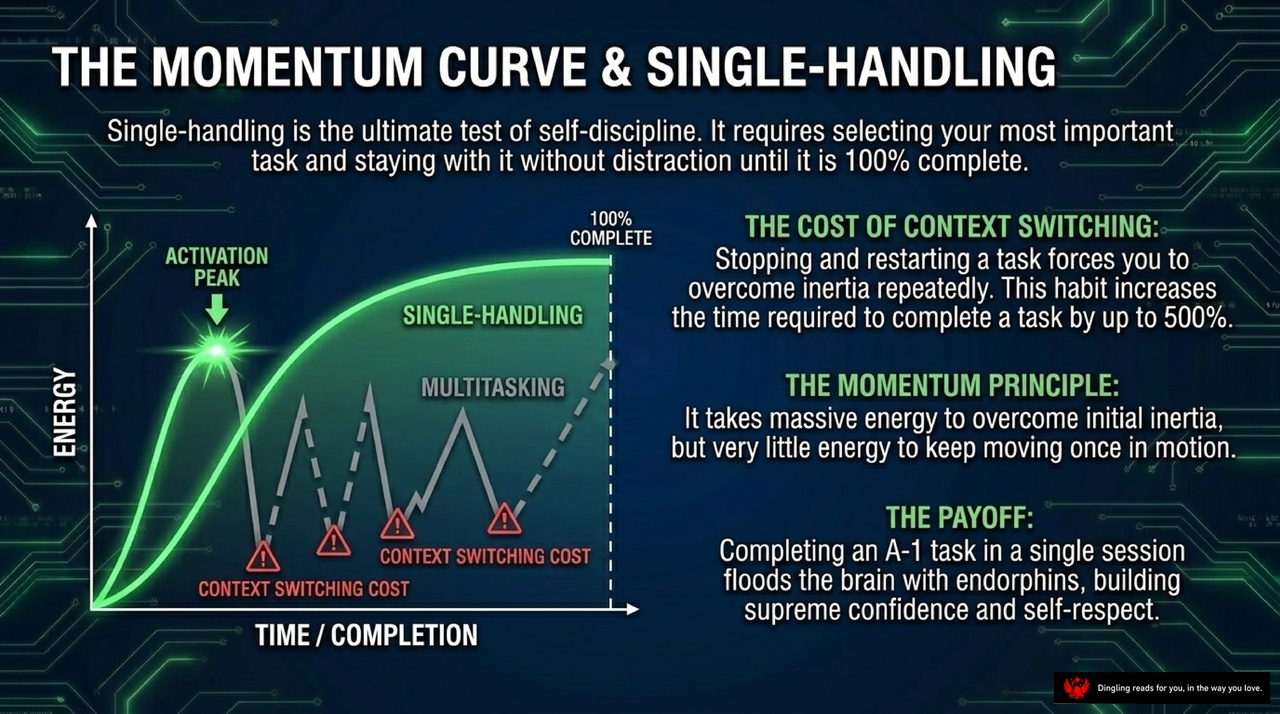
Look at this curve. It perfectly illustrates the battle between single-handling and multitasking. On the left, you see the "Momentum Principle." It takes massive energy to overcome that initial inertia—that activation peak—but once you're moving, very little energy is required to keep going. That's the power of single-handling.
Now, look at the jagged line labeled "Multitasking." Every time you switch tasks, you hit that red "Context Switching Cost." You have to stop, overcome inertia again, and restart. The slide tells us this habit can increase the time required to complete a task by up to 500%. That's the cost of constantly starting and stopping.
But here is the payoff of single-handling. By staying focused on your most important task until it is 100% complete, you don't just finish faster; you flood your brain with endorphins. This builds supreme confidence and self-respect. So, stop jumping between tasks. Pick your one big "frog," commit to the momentum, and ride that energy curve all the way to the finish line.

Let's synthesize everything we've discussed into one powerful blueprint for your life. Stop clearing out the trivial stuff first. Instead, define your exact goals in writing and ruthlessly prioritize using the ABCDE method. Dedicate your peak energy to that vital 20% of tasks that actually yield 80% of your results. Break massive projects into manageable slices, disconnect from reactive technology, and discipline yourself to single-handle your most critical task until it is 100% complete. Now, ask yourself the hard question: If you could only accomplish one task today that would radically transform your future, what is your frog, and why aren't you eating it right now?