
Economic and Philosophical Manuscripts of 1844: Complete Chapter-by-Chapter Summary

Welcome to today's session. We are diving into one of the most pivotal yet misunderstood texts in intellectual history: Karl Marx's *Economic and Philosophic Manuscripts of 1844*.
This isn't just another economics textbook or a dry philosophy lecture. As this slide highlights, it is a foundational critique of political economy that exposes the hidden human cost of capital and the mechanics of alienated labor. Written in Paris in 1844, during a time when the European worker movement was just gaining momentum, Marx was trying to crack the code of why capitalism works the way it does.
He wasn't just looking at the numbers; he was looking at the people behind them. Marx argued that under capitalism, workers create immense wealth, yet they become poorer and more powerless. It's a paradox where the more you produce, the less you own of yourself. He calls this "alienated labor"—a state where your work becomes something foreign to you, a force that rules over you rather than expressing who you are.
This manuscript bridges the gap between deep philosophical thought and hard economic reality. It shows us that the conflict between capital and labor isn't just a business disagreement; it's a fundamental struggle for human dignity and freedom. By understanding these dynamics, we begin to see the path toward a society where work is a source of fulfillment, not just survival.

Have you ever noticed a strange contradiction in modern life? The more we produce, the more valuable our world becomes, yet somehow, we feel poorer than ever. This slide captures that exact tension with the title, "The Paradox of Prosperity."
Look at this graph. The white line shoots upward, representing the "Volume of Commodities Produced." As wealth explodes, technology advances, and goods flood the market, the material world becomes incredibly rich. But look at the red line labeled "Value of the Worker." As that white line climbs, the red line crashes. The text on the right makes this clear: "The worker becomes poorer the more wealth they produce."
It's a cruel irony. As the physical world of things increases in value, the human world is proportionally devalued. We create a massive power—a world of objects and capital—that ultimately rules over us instead of us ruling it. The worker creates a power that ultimately rules over them.
Think about it: we build machines that do our work, yet those same machines make our labor less necessary and less valuable. We generate so much abundance that our own contribution seems to shrink. This isn't just an economic theory; it's the reality we face daily. We are trapped in a cycle where our greatest creations become the very chains that bind us, leaving us poorer in spirit and security even as the world around us gets richer.
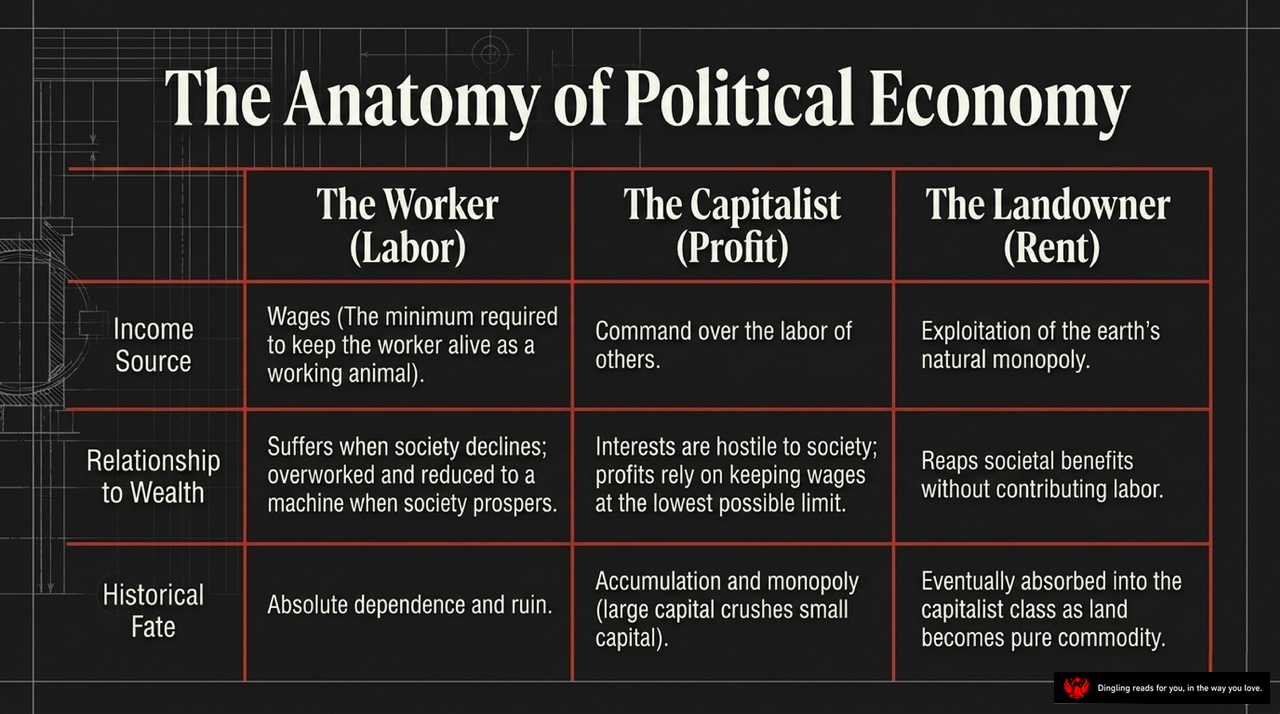
Welcome to the third chapter of our deep dive into Marx's 1844 Manuscripts. Today, we're looking at the anatomy of political economy and how it reveals a stark, often uncomfortable truth about the three pillars of our economic system: the worker, the capitalist, and the landowner.
Let's break down this table. On the left, we have **The Worker**, driven by labor. In the capitalist view, the worker's income is nothing more than the minimum wage required to keep them alive—basically, the cost of maintaining a "working animal." Their fate is absolute dependence; when society declines, they suffer the most, and when society prospers, they are often overworked, reduced to mere machines, and left in ruin.
Next, we have **The Capitalist**, driven by profit. Their income comes from commanding the labor of others. Interestingly, the text reveals that the capitalist's interests are often hostile to society as a whole. Why? Because profits rely on keeping wages at the lowest possible limit. Their historical fate is accumulation and monopoly; large capital eventually crushes small capital, consolidating power in fewer hands.
Finally, we have **The Landowner**, driven by rent. Their income isn't from work, but from the exploitation of the earth's natural monopoly. They reap societal benefits without contributing any labor. In fact, the text argues that as society progresses, the landowner actually benefits from the very things they don't create—population growth, better transport, and industrial progress all drive up land values. Their ultimate fate is to be absorbed into the capitalist class as land itself becomes just another commodity.
The core takeaway here is the fundamental contradiction: the worker creates the wealth, the capitalist extracts the profit, and the landowner captures the rent, all while the worker remains the most vulnerable and exploited class. This isn't just an economic model; it's a blueprint for human alienation.
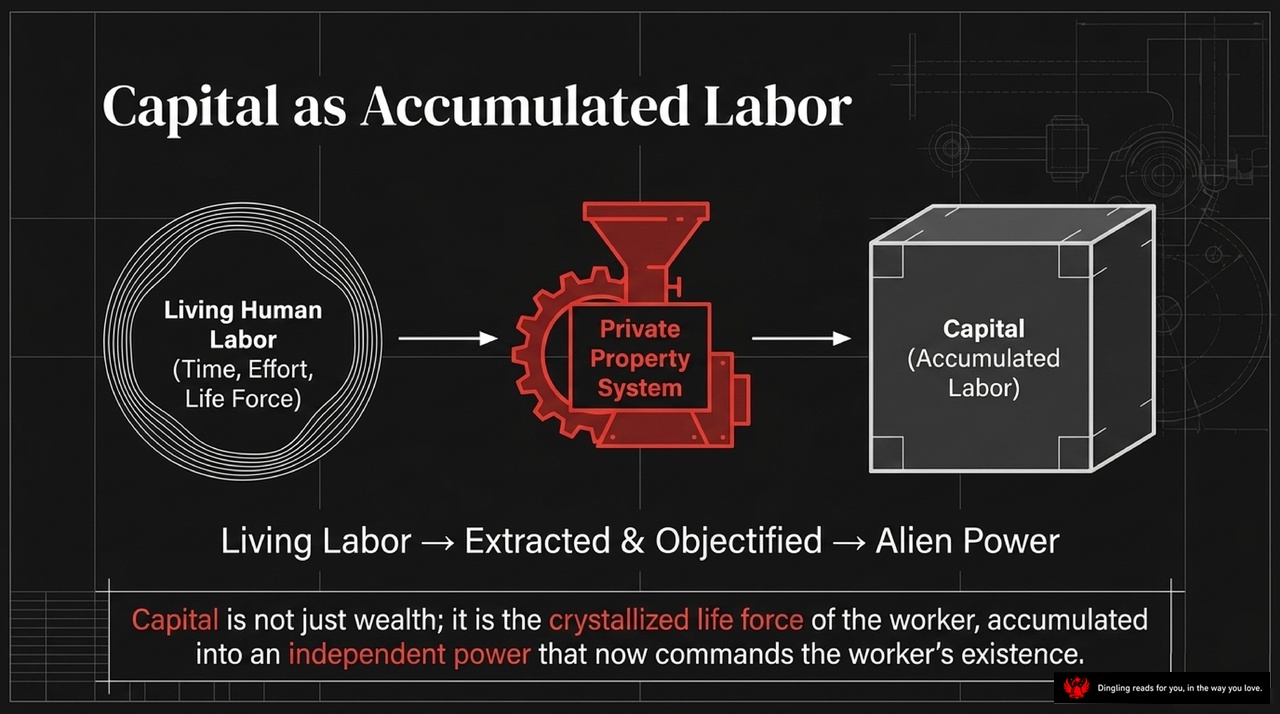
Capital isn't just money in a bank account; it's the frozen sweat of human beings. Look at this flow: it starts with **Living Human Labor**—your time, your effort, your very life force. But under the **Private Property System**, that vibrant energy gets extracted and turned into an object. It stops being something you *do* and becomes something you *own* that stands against you.
This process transforms your living work into **Capital**, which the slide calls "Accumulated Labor." But here's the dark twist: once your labor is crystallized into capital, it becomes an **Alien Power**. Instead of you commanding the wealth you created, that wealth now commands *you*. As the text warns, capital is the **crystallized life force** of the worker, accumulated into an **independent power** that dictates your existence. You built the machine, but now the machine decides your fate. This is the core of alienation: your creation has become a master, and you are left as its servant.

Here is the spoken-word script for the current slide, tailored for an American audience.
**The Illusion of the Market**
So, look at this diagram. It's a brutal truth about how our economy actually works versus how we're taught to think about it. Classical economics loves to tell us that "supply meets demand," that the market is this perfect, self-correcting machine where everything gets what it needs. But this slide is arguing that's a complete illusion.
In the middle, we see "Human Needs." These are the real things people want and need. But then, right below them, there's this red filter labeled "The Filter of Purchasing Power." That's the hard reality check. The slide makes a critical point: a human need that isn't backed by money is mathematically invisible to the market. If you have a need, but you can't pay for it, the market simply doesn't see you. It treats you as if you don't exist.
This filter separates "Human Needs" from "Effective Demand." Anything that falls out the bottom—the "Invisible or Invalid Needs"—gets ignored. The market doesn't produce to fulfill human fulfillment; it produces solely for those with the ability to pay. It's a stark reminder that in a capitalist system, your value isn't tied to what you need or who you are, but strictly to what you can afford. The market isn't serving humanity; it's serving the currency.
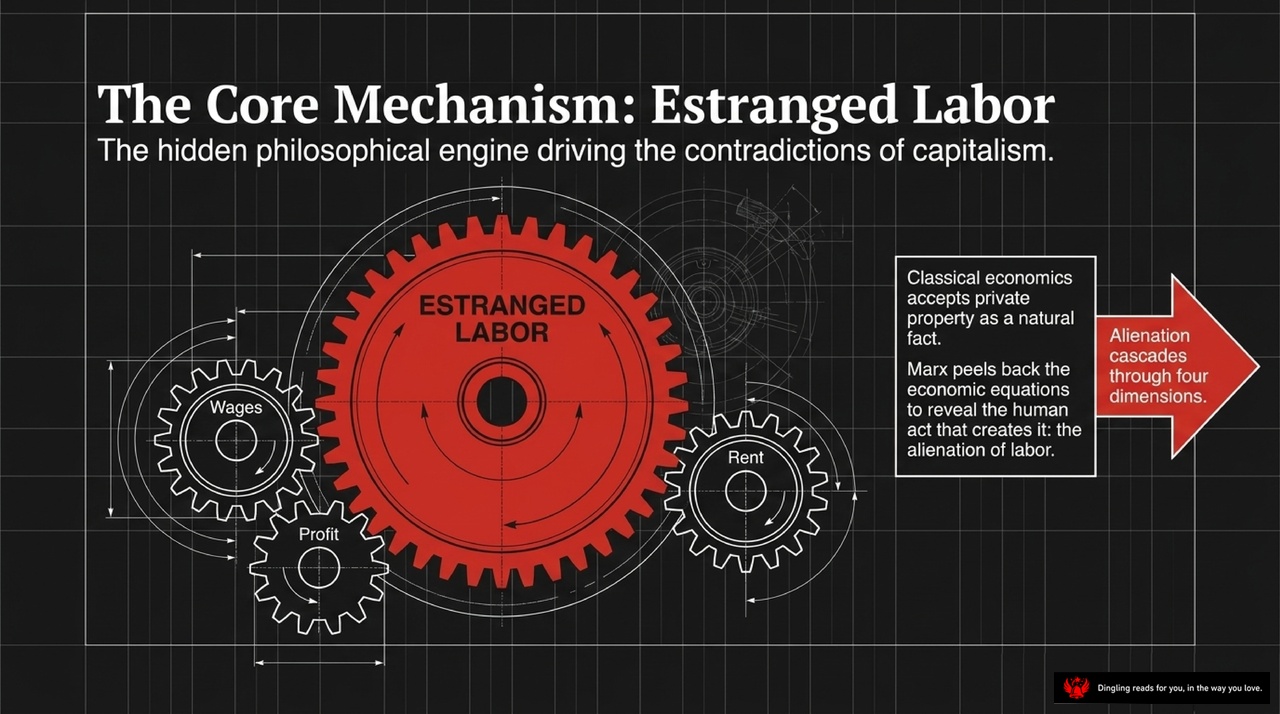
Welcome to the heart of Marx's critique. Today, we're diving into the philosophical engine that drives capitalism's contradictions: Estranged Labor.
Think of this as the hidden mechanism behind the gears of the economy. While classical economics treats private property as just a natural fact, Marx peels back those layers to reveal the human act that creates it: the alienation of labor.
Look at the central red gear labeled "Estranged Labor." This isn't just a metaphor; it's the core driver. As we see in the text, under capitalism, labor stops being a free, conscious expression of human life. Instead, it becomes an external, forced activity. Workers don't feel fulfilled; they feel miserable. In fact, they only feel truly free when they are eating or sleeping—acting like animals—rather than when they are working. When they work, they feel like mere machines.
This alienation cascades outward, turning the worker's own product into a hostile force that dominates them. The more they produce, the poorer they become. This alienation then spreads to their very nature as human beings, stripping away their "species-essence," and finally, it destroys human relationships, reducing everyone to a cold exchange of interests.
Notice how this central gear drives the smaller ones around it: Wages, Profit, and Rent. The text explains that this isn't just about money; it's about a total inversion of reality. Under this system, the worker becomes a commodity, a "living poor capital" whose value depends entirely on what the market demands. They are trapped in a cycle where they produce capital, and that capital, in turn, produces them as workers.
Ultimately, this mechanism reveals the tragic irony of capitalism: the growth of the material world corresponds strictly with the degradation of the human world. Estranged labor is the key that unlocks this entire system, showing us why wealth accumulation inevitably leads to human poverty and why true liberation requires going beyond just changing laws—it requires changing the very nature of our work and our relationships.

Dimension 1: Alienation from the Product. Look at that image on the left—a figure crushed under a massive, heavy block. That's the visual definition of our first point: The Objectification of Labor.
In this chapter, Marx reveals a terrifying paradox of capitalism. The product of your labor doesn't belong to you; it becomes an alien object that exercises power over you. You pour your life, your time, and your creativity into an object, but the moment it's finished, it's no longer yours. Instead, it belongs to the market, to the factory, or to the owner. And here is the brutal reality: the more you produce, the less you possess.
The worker puts their life into the object, but the consequence is that their life no longer belongs to them. They become a slave to what they created. The wealth of the world grows exponentially, yet the worker's world shrinks. The object they made becomes a foreign power that dominates them, dictating their wages, their hours, and their survival. This isn't just about economics; it's about the loss of humanity. We aren't creating our destiny; we are manufacturing objects that then come back to enslave us. This is the core of alienation from the product, and it sets the stage for everything else we'll discuss about labor, capital, and the struggle for human liberation.
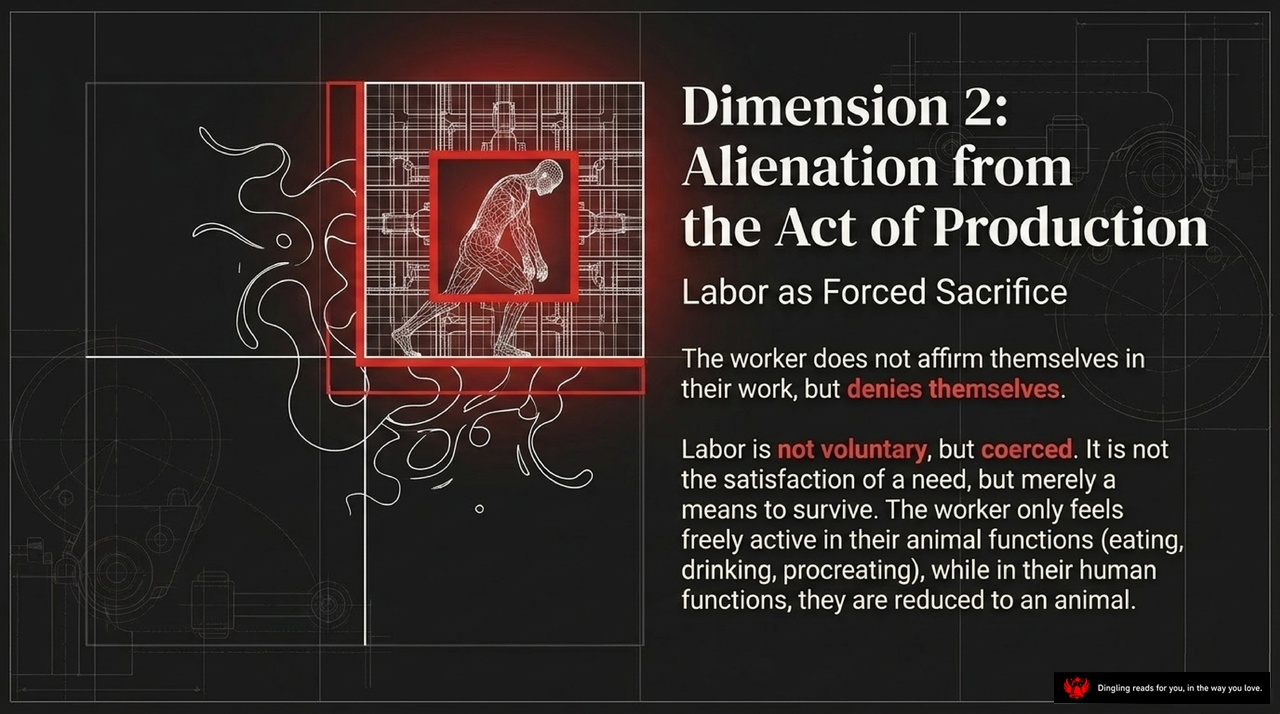
Dimension 2: Alienation from the Act of Production. Look at that figure hunched over, trapped inside a rigid grid. This visual perfectly captures the core idea of "Labor as Forced Sacrifice." In our capitalist system, work isn't about self-expression or creativity; it's a denial of who we are. The slide highlights that labor is not voluntary—it is coerced. Instead of satisfying a human need, it becomes a mere means to survive. Think about it: when you work, you aren't affirming your humanity; you are suppressing it. The text points out a cruel irony: workers only feel truly free when they are acting like animals—eating, drinking, procreating. But when they try to exercise their uniquely human functions, they feel like nothing more than machines. This is the essence of alienation. Under this system, the worker doesn't control the act of production; instead, the act of production controls the worker, reducing them to a mere appendage of the machine, stripped of their dignity and purpose.
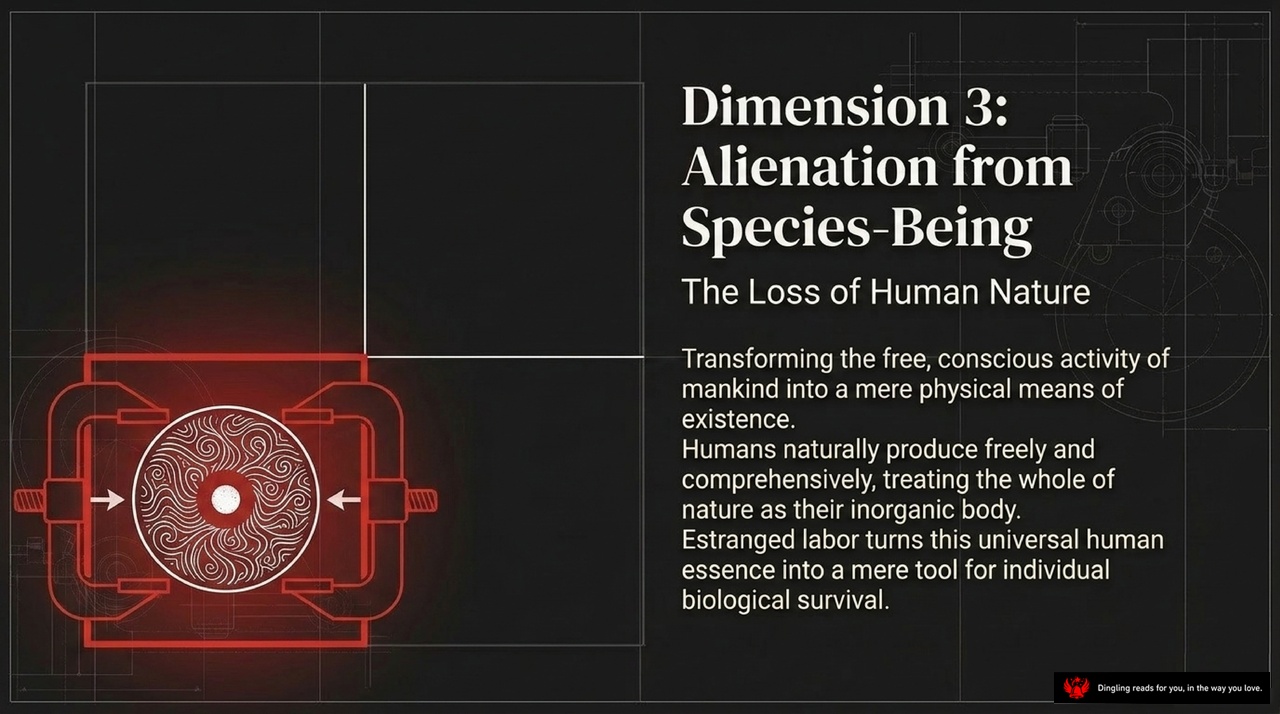
Dimension 3: Alienation from Species-Being. We've reached a critical turning point where the question isn't just about how we make a living, but what we are losing in the process.
Look at this diagram. It depicts the transformation of our most defining human trait—our free, conscious activity—into a mere physical means of survival. In our natural state, we produce freely and comprehensively, treating nature as an extension of our own bodies. We create art, build communities, and explore the world not just to eat, but to express who we are. But estranged labor shatters this. It turns our universal human essence into a simple tool for individual biological survival.
Think about it: when your work becomes just a way to pay rent, you stop being a creator and start being a machine. The slide highlights this loss of human nature. We aren't just disconnected from the product we make; we are disconnected from the very act of creating. We aren't even connected to our own potential anymore. Instead of feeling like the architects of our own lives, we feel like cogs in a system designed solely for our biological existence. This is the core of alienation from our species-being: the moment we stop acting like humans and start acting like things, our humanity begins to vanish.
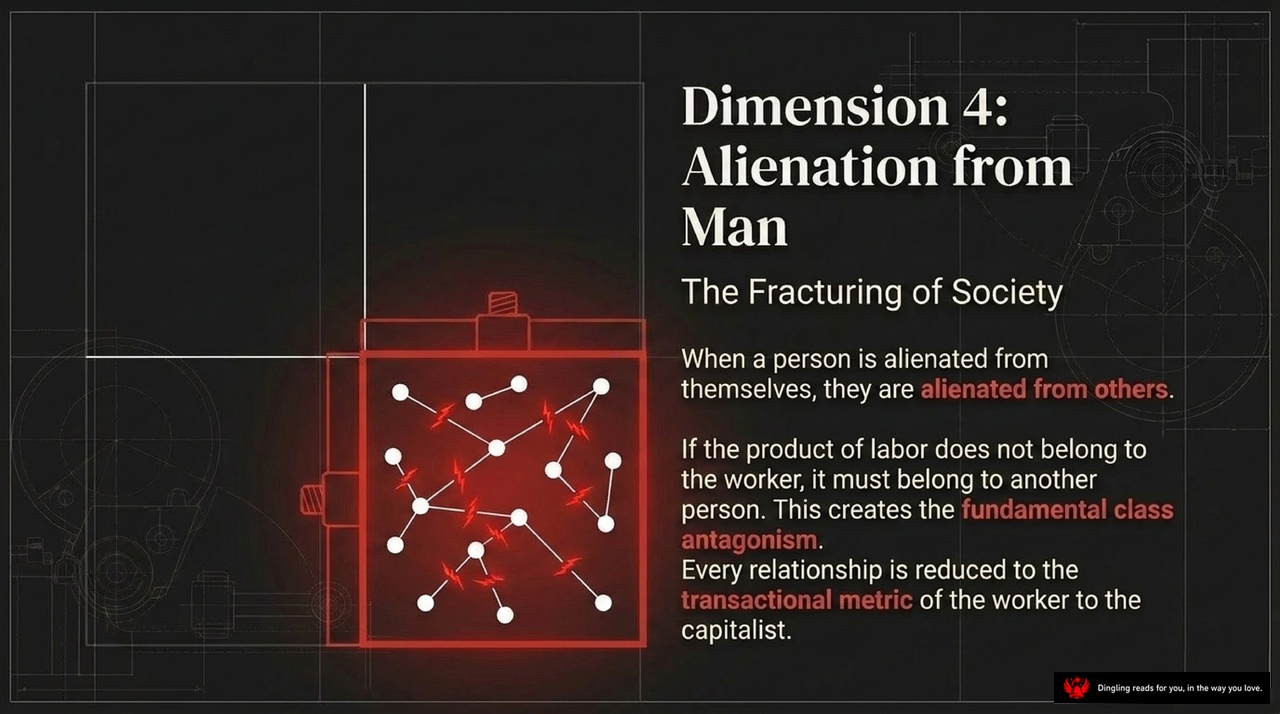
Dimension 4: Alienation from Man. Look at that fractured network on the left. It perfectly illustrates what happens when society breaks apart. The text here makes it clear: when you are alienated from yourself, you are automatically alienated from everyone else. It's a domino effect.
Think about the worker. If the product of their labor doesn't belong to them, it must belong to someone else. That simple fact creates the fundamental class antagonism we see today. Every relationship gets reduced to a cold, transactional metric. It's just about the worker versus the capitalist. There is no connection, only exchange.
This is the core of Marx's argument in the 1844 Manuscripts. He isn't just talking about economics; he's talking about the human condition. When the worker produces wealth, they don't become richer; they become poorer. The world of things grows, but the world of people shrinks. This isn't just a historical theory; it's a mirror reflecting our current reality where human value is often measured by what we can buy or sell. We are told to compete, to transact, and to separate. But Marx challenges us to see that true human connection requires reclaiming what we create. Without that, we remain trapped in a cycle of alienation, forever fractured from our own humanity and from each other.
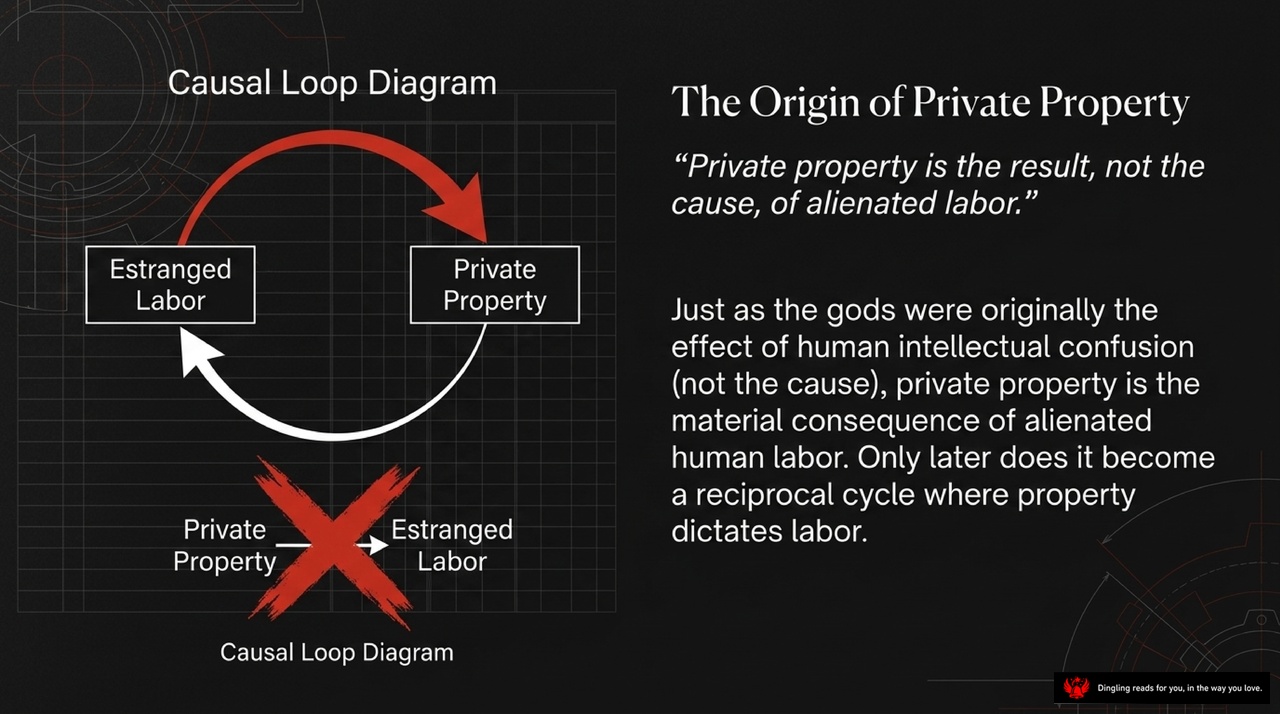
Today's slide breaks down one of the most powerful concepts in Marx's work: the Causal Loop Diagram. Look closely at the cycle on the left. It illustrates a critical truth: "Private property is the result, not the cause, of alienated labor."
The diagram shows a clear feedback loop. First, we have "Estranged Labor"—labor that is alienated, stripped of its human essence. This alienated labor creates "Private Property." But here is where the trap springs. Once private property exists, it doesn't just sit there; it feeds back into the system, dictating and forcing further estranged labor. The white arrow shows this reciprocal cycle where property dictates labor.
However, the red "X" at the bottom is the key insight. It warns us against getting the causality backwards. Many people think owning property causes people to lose their humanity. Marx argues the opposite: it is the act of alienated labor that first creates private property. Only later does that property become a master that controls us.
The text on the right reinforces this by comparing it to the origin of gods. Just as gods were originally the effect of human intellectual confusion, not the cause, private property is the material consequence of our alienated labor. The diagram visually proves that to break the cycle, we must first address the root cause: the alienation of labor itself, not just the possession of property.
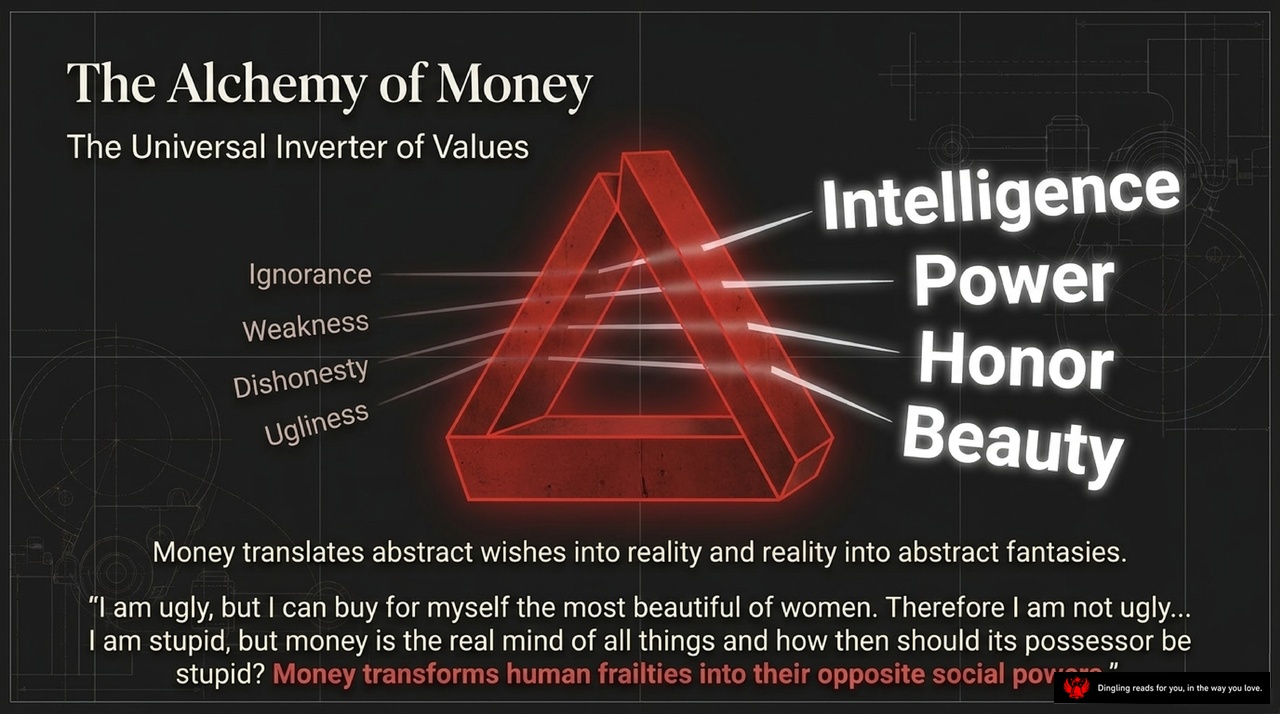
Money is the ultimate alchemist, but it's a dangerous one. It doesn't just buy things; it inverts our very nature. Look at this triangle: on one side, we have our flaws—ignorance, weakness, dishonesty, ugliness. But on the other side, money flips them into power. Intelligence becomes influence, weakness becomes leverage, dishonesty becomes charm, and even ugliness can be masked by beauty. As the slide says, money transforms human frailties into their opposite social powers.
Think about it: a man who calls himself stupid can buy the smartest advisors and the sharpest minds, effectively saying, "I am not stupid." An ugly man can purchase the most beautiful women, convincing himself he isn't ugly. This is the terrifying magic of the "Universal Inverter of Values." Money translates our abstract wishes into reality, but in doing so, it also turns reality into abstract fantasies. It tells us that if we can pay for it, we are who we say we are. But in the end, we become slaves to the currency we worship, chasing the very illusions we created.

Today's slide contrasts two opposing worlds: "The Mode of Having" versus "The Emancipation of Senses." On the left, we see "The Economics of Denial," depicted as a rigid, confining grid. Here, private property strips life down to a single, alienated act: having. The logic is stark and cruel: the less you eat, drink, or enjoy culture, the greater your capital becomes. Human needs are systematically suppressed so that wealth can accumulate. Your senses—seeing, hearing, feeling—are reduced to mere tools for acquiring things, not for experiencing life.
On the right stands "True Appropriation," visualized as flowing, organic lines breaking free from the grid. This is the liberation of human capacities. Here, seeing, hearing, thinking, and loving become ends in themselves. We stop using our senses just to grab things and start using them to fully inhabit the world. This isn't just about owning more; it's about appropriating the very essence of human existence. It's the shift from being a slave to possessions to becoming the master of our own sensory and creative potential. The grid collapses, and life expands.

Look at this journey from chaos to clarity. We're not just looking at a chart; we're watching the very soul of history resolve its own tension.
On the left, we start with **Stage 1: Private Property**. That jagged, red explosion represents the total alienation of the human essence. It's the raw pain of capitalism where workers create wealth but become poorer, trapped in a system where their labor is a commodity they don't own.
Then, the red stream flows into the middle, **Stage 2: Crude Communism**. Notice how the lines get tangled? This is the negation of private property, yes, but it's still a mess. We've removed the boss, but we haven't fixed the human heart. We're still trapped in greed, envy, and reduced to mere workers competing against each other. It's a chaotic knot, not a solution.
But watch the end of that red stream. It transforms into pure white light. That is **Stage 3: Humanism**, or what Marx calls "The Resolution." This glowing circle isn't just a pretty shape; it represents the positive transcendence of human self-alienation. It's the moment the conflict between man and nature, and man and man, is finally solved. The riddle of history is cracked.
This synthesis shows us that true communism isn't just about taking away property; it's about reclaiming our humanity. It moves us from the jagged red of alienation, through the tangled chaos of crude attempts, all the way to the harmonious, radiant unity of humanism. That's the path forward.

We start with the cold, hard math of the ledger and end up with the burning question of the human soul. As the slide asks, if our entire economic system transforms every human desire into a quantifiable transaction, what is the true price we pay to buy back our own humanity?
In *The Economic and Philosophic Manuscripts of 1844*, Karl Marx answers this with a stark reality: capitalism doesn't just extract wealth from the earth; it extracts the life force from humanity itself. It takes our organic nature and translates it into an alien power that commands us. Under this system, the worker's needs are crushed down to the bare minimum of animal survival. Workers are treated like machines, and their labor is no longer a form of self-expression but a forced, painful activity they would flee from like the plague if not for the threat of starvation.
The result is a deep alienation. The more wealth the worker produces, the poorer they become. The richer the world gets, the more the worker's own world shrinks. Their labor products, which should be an extension of themselves, turn into a foreign force that dominates and controls them. This isn't just about money; it's about the loss of our very essence. When our system reduces us to mere transactions, we lose our freedom, our creativity, and our connection to each other. The slide challenges us to look beyond the numbers and ask: at what cost did we sell our humanity?