
Emile: Complete Chapter-by-Chapter Summary

Welcome to our exploration of *Emile, or On Education* by Jean-Jacques Rousseau. This isn't just a book about teaching children; it is a revolutionary manifesto on how to protect the innate goodness within every human being. As you see on this slide, Rousseau describes this philosophy as a philosophical treatise on preserving inherent human goodness through the principles of natural education.
Imagine a child as a sapling growing by the roadside. Rousseau argues that everything created by the Creator is good, but once it passes into human hands, it often turns bad. The core danger lies not in the child's nature, but in how we shape them. If left to grow freely, the child will follow their natural instincts and become strong and upright. However, if forced or twisted by artificial methods, they lose their natural vitality, much like a horse trained in a stable that forgets how to run wild.
The book's central mission is to show us how to nurture this "natural education." Rousseau believes that true education isn't about filling a child's mind with facts or forcing them to obey. Instead, it is about providing the child with the power, help, and judgment they need to develop on their own. He emphasizes that we must avoid imposing habits that go against their nature. For instance, forcing a child to be obedient often backfires, leading to rebellion later in life. The goal is to let the child's own curiosity and senses drive their learning, allowing their inner light to shine without being dimmed by rigid rules or societal expectations.

Look at this powerful contrast. On the left, we see "The Natural State"—a tree thriving under the sun, representing inherent goodness and freedom. On the right, "The Societal State," where the same tree is forced into a rigid grid, symbolizing deformation and vanity. This image perfectly captures Rousseau's core belief: "Everything is good as it leaves the hands of the Author of things; everything degenerates in the hands of man."
Think about your own life. We are all born like that free tree on the left—full of potential, curiosity, and a natural tendency toward good. But as we grow up, society starts acting like that metal framework on the right. We are constantly told how to think, how to dress, how to behave, and even how to feel. We get tied down by rules, expectations, and artificial standards, just like the tree being forced into a square shape.
Rousseau argues that this process of "civilization" actually harms us. When we try to force nature to fit into human-made structures, we lose our true selves. The tree on the right looks orderly, but it's dying. Its branches are broken, and it can't grow freely. Similarly, when we suppress our natural instincts to please society, we lose our vitality and authenticity.
The lesson here is profound: true growth comes from within, not from external pressure. We need to protect our inner freedom, just like we would protect a young sapling from being crushed. It's not about rejecting society entirely, but about remembering that our core value comes from being human, not from fitting into a box. In a world that constantly tries to shape us, the most rebellious and liberating act is simply to stay true to our own nature.

So, we've covered the physical foundation and moral grounding of Rousseau's educational philosophy. Now, let's look at the heart of his system: The Triad of Education. As you see on this slide, true education isn't just about one teacher or one method; it's the perfect intersection of three distinct forces.
First, we have Nature. This represents the internal development of our faculties and organs—the raw, unspoiled potential we are born with. Rousseau believes this is the most powerful teacher because it operates without human interference.
Second, we have Men. This is the social influence: the guidance, habits, and moral lessons we learn from other people.
Third, we have Things. This covers everything we learn from our physical environment and experiences—the world around us.
The golden center of this diagram is "The Well-Educated Man." This is the ideal outcome, but it only happens when these three teachers align perfectly. If they conflict, as the text warns, the student becomes poorly educated and internally divided. Success requires aligning the social lessons from Men and the lessons from Things to the unalterable laws of Nature. When these three forces work in harmony, we don't just get a student; we get a fully realized human being.

When we reach adolescence, the developmental arc shifts dramatically. As the diagram illustrates, we move from the "Age of Utility" into "Moral Awakening." This is the pivotal moment where the raw instincts of youth must be guided by reason and empathy.
At this stage, the young person's imagination is ignited, but emotions can easily become a flood without a dam. The core challenge is not to suppress desire, but to guide it toward the right direction. We must teach them that true connection comes from understanding shared human suffering, rather than being blinded by vanity or privilege.
Consider this: people in high positions often become cold to the suffering of others because they falsely believe their status makes them immune to hardship. True moral awakening happens when we realize that no one is safe from fate's whims. Health, wealth, and freedom can vanish in an instant. When a young person understands that everyone shares this vulnerability, empathy naturally takes root.
This is why we must avoid dry lectures. Instead, we use stories and real examples to show that kindness isn't about following rules, but about recognizing the common humanity in everyone. We teach them that lying often stems from fear of punishment, not malice. By removing that fear and showing the natural consequences of actions, we foster honesty without coercion.
Crucially, we must not use fables to teach deep moral lessons. A child might remember the story but misunderstand the lesson entirely, sometimes even adopting the very vices we tried to prevent. True education comes from living these principles, not memorizing parables.
As they enter the social world, the goal is not to make them conform to trends, but to help them distinguish between genuine connection and superficial flattery. They learn that the highest form of morality is simply refusing to harm others. By respecting the natural order of emotions and guiding them with patience, we help them transition from a self-centered boy into a compassionate, morally grounded young man.

Let's dive into the final chapter of our journey with Rousseau, where we see the ultimate test of the "Natural Man" we've been cultivating.
Imagine a man who has spent twenty years growing up without the artificial shackles of society, guided only by his own senses and reason. Now, he faces the most brutal reality of all: the loss of everything he holds dear. This is the story of Emile's tragic end.
We see him first in the comfort of his life with Sophie, believing he has found perfect happiness. But the city's corrupting influence slowly pulls him away, leading to a devastating betrayal that shatters his world. Sophie leaves him, pregnant with another man's child. Emile doesn't just lose a wife; he loses his faith in the social contract and his own judgment.
Driven by anger and despair, he becomes a wanderer, eventually finding himself a slave in Algiers. Here, Rousseau presents a profound philosophical question: What is true freedom? Emile is physically chained, yet his mind remains unbroken. While others around him are crushed by fear and submission, Emile refuses to internalize the master's will. He uses his wit and courage to protect his fellow slaves, even rising to become a overseer himself, not to oppress, but to shield the weak.
This final arc proves that the education we've discussed isn't just about physical health or moral rules. It's about building an inner fortress. When Emile says, "True slavery is not the chains on the body, but the chains of desire and fear on the soul," he confirms that our entire journey has been about one thing: preserving the human spirit against the crushing weight of civilization. Even in the darkest pit, the man who learned to trust his own reason remains free.

Welcome back to our journey through Rousseau's *Emile*. Today, we're diving into the critical transition from childhood to youth, a period where the young man must learn to navigate the complex currents of desire and social life.
Look at the title on the slide: **Stage II: The Sensory Learner**. While we often associate sensory learning with early childhood, Rousseau argues that the teenage years require a different kind of sensory engagement—one that tames raw impulses with reason. The slide highlights two major pitfalls for young men: **The Fallacy of Premature Reason** and **Negative Education**.
On the left, we see a boy staring blankly at a chalkboard, representing the trap of trying to force abstract logic onto a mind that isn't ready. This is the "fallacy of premature reason." Rousseau warns that if you try to crush a young man's desires with dry moralizing or complex philosophical arguments, you only make him hate reason itself. He becomes a rebel against the very rules you set.
On the right, we see a boy in the woods with a stick and a rock, symbolizing **Negative Education**. This doesn't mean doing nothing; it means delaying book learning and avoiding artificial constraints. Rousseau believed that trying to make teenagers hate love or deny their natural urges is counterproductive. Instead of fighting nature, we should guide it. We don't suppress their passion; we teach them to direct it toward something noble, like a sincere and respectful love.
The core philosophy at the bottom of the slide is crucial: **Our first philosophy teachers are our feet, hands, and eyes.** Before a young man can understand complex social contracts or political theories, he must learn through experience. He needs to feel the consequences of his actions, understand the limits of his body, and develop his own judgment. If we try to impose rules on him before he has developed his own internal compass, we are just teaching him how to break them.
So, how do we apply this? We stop lecturing and start guiding. We let him encounter the world, make mistakes, and learn from them, rather than shielding him from all danger or drowning him in empty doctrines. True education isn't about filling a bucket; it's about lighting a fire. And for the young man, that fire is fueled by his own experiences, his own senses, and his own growing understanding of what it means to be human.

Stage III: The Age of Utility. Look at this cycle. It starts with a simple, human question: "What is the use of this?" We don't learn science just to look smart or fill our minds with fancy words. We learn because we have a problem we need to solve.
Imagine you are lost in the woods. You feel that hunger, that panic of getting lost. That is your vital need. Because you need to find your way home, you start observing the environment. You notice how the sun casts shadows at noon. You remember the position of the stars. You aren't studying astronomy for a grade; you are applying it to survive. You figure out how to use a stick to measure distance or how to read the wind.
This is the power of utility. Knowledge is driven by necessity, not vanity. When you realize that abstract science actually helps you find your way home, you suddenly value it. You stop seeing it as a distant, boring subject and start seeing it as a tool for your life. You solve the practical problem, and in doing so, you unlock the knowledge. This cycle shows us that true understanding comes when we need something, not when we are just told to memorize it.

Look at this inverted pyramid titled "The Dignity of the Artisan." It flips our modern understanding of status on its head. At the top, we see the "Highest Natural Value": farmers, bakers, carpenters, and blacksmiths. Why? Because they are independent, relying directly on nature to sustain human life. They hold the true power of survival.
At the bottom sits the "Lowest Natural Value": jewelers, courtiers, and kings. Their worth is described as dependent on public opinion, vanity, and the labor of others. In a society obsessed with titles, these rulers are actually the most fragile.
This graphic perfectly captures Emile's journey. He learns woodworking not just for a trade, but to overcome societal prejudice and secure true independence against the whims of fortune. By mastering the craft of the artisan, he finds a dignity that no king or courtier can ever give him. It is a powerful reminder that real worth comes from creating and sustaining life, not from accumulating status.

Look at this curve on the slide. It's not just a graph; it's a map of how our moral heart actually grows. We start life with what the French call "amour de soi"—a healthy, natural instinct for self-preservation. That's fine. It keeps us alive. But if we stop there, we remain isolated, focused only on ourselves.
Then, as we age, something shifts. This is where the "Activation Curve" takes off. We move from simple self-love into "Pity and Compassion." Why does this happen? Because morality doesn't wake up when we share happy moments. We don't become good because we enjoy each other's success. Instead, we awaken to goodness when we realize we all share the same fragile, painful human condition.
As the text at the bottom reminds us, empathy is the first truly social sentiment. It's the glue that binds us. When we understand that the suffering we see in others is a reflection of our own potential vulnerability, that's when true compassion is born. That moment of realization transforms us from individuals into a connected humanity.

Welcome to the final chapter of our journey with Rousseau. Look at this split image: on the left, our protagonist, the Observer, stands quietly in the shadows, reading history and fables. On the right, the Participants are lost in a chaotic ballroom, blind to reality and fighting for illusions.
Rousseau teaches us that this divide is the essence of education. The Observer studies human folly from a safe distance, learning through books and biographies without taking personal risks. He sees the masks of society and understands the foolishness behind them. This allows him to pity human weakness rather than envy the wealth of the vain.
In contrast, the Participants are completely seduced by these masks. Blinded by vanity, they chase illusions and forget what is truly real. They are trapped in a cycle of social performance, unable to see the truth because they are too busy pretending.
The core lesson here is simple but profound: true wisdom comes from observation, not participation. By keeping a distance and studying the world critically, we can avoid the trap of becoming the very fools we observe. We must learn to be the Observer in a world full of Participants, protecting our own judgment from the noise of society.

Look at this balance scale. It perfectly captures the final stage of our journey: Stage V, The Moral Union. On the left, we have Emile, symbolized by the mountain, the compass, and the oak leaves. He represents fortitude and reason—the strength to stand firm and the tools to navigate the world. On the right sits Sophie, with her heart, her eye, and the rose. She embodies moral intuition and the governance of the heart, the gentle power that guides us toward empathy and virtue.
Together, they form a complete moral unit. True love, as the slide reminds us, requires the exercise of virtue. It means mastering one's passions to remain worthy of the other. Emile provides the reason to act, while Sophie provides the intuition to feel why it matters. When they unite, they balance each other out, creating a harmony where strength and sensitivity coexist. This isn't just about romance; it's about two distinct natures finding their perfect complement, building a relationship where both can grow into their highest potential.
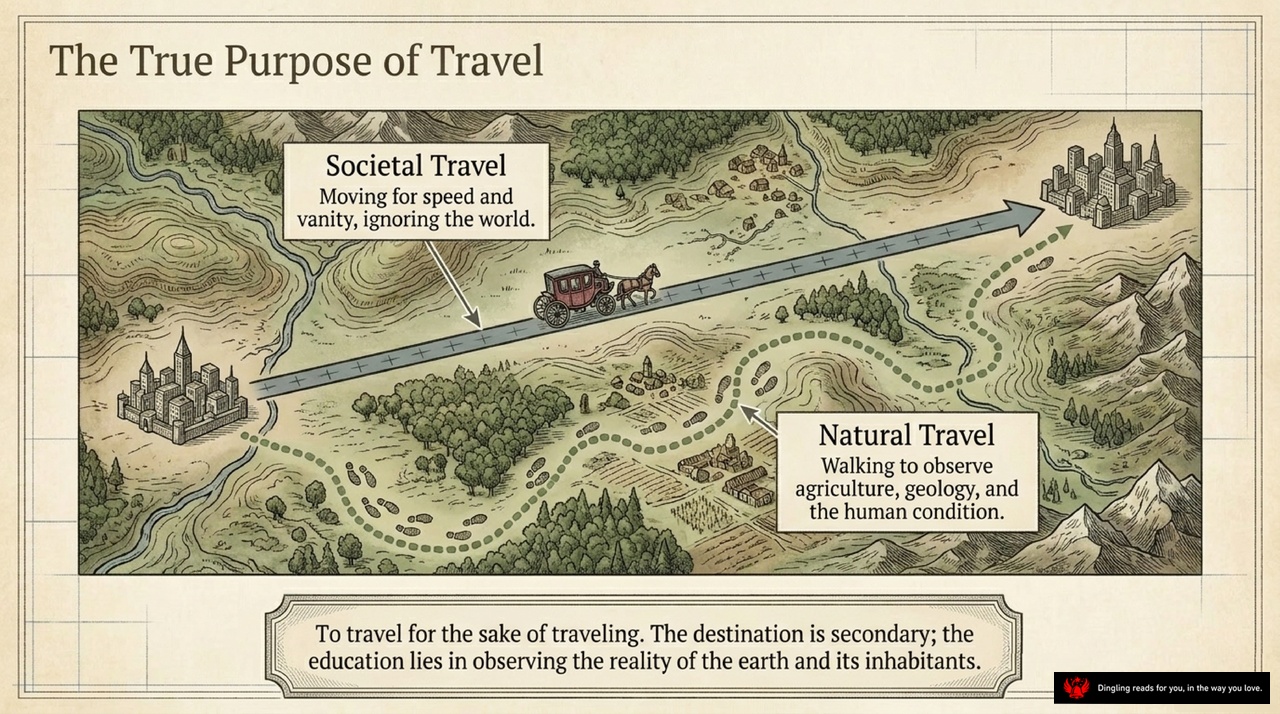
Look at this map. It contrasts two very different ways of moving through the world. On one side, we have "Societal Travel." This is the path of speed and vanity, where we zip from city to city, ignoring everything around us just to get to the next destination. It's about the journey's end, not the experience of the journey itself.
But look at the other path. This is "Natural Travel." Here, we aren't rushing. We are walking slowly, observing the agriculture, the geology, and the real human condition right in front of us. The text at the bottom makes it clear: the destination is actually secondary. The true purpose of travel is the education you get from observing the reality of the earth and its inhabitants.
So, the next time you pack a bag, ask yourself: am I just moving for the sake of moving, or am I stepping out to truly learn from the world around me? That shift in perspective changes everything.

Look at this comparison of educational paradigms. On the left, we have "The Societal Method," which relies on arbitrary punishment, forces the memorization of abstract words, and drives students through vanity and competition. The ultimate goal here is to create a dependent citizen who is divided against himself.
Now, look at the alternative on the right: "The Natural Method." Instead of imposing authority, it trusts in natural consequences and physical boundaries. It prioritizes experiential learning driven by immediate utility rather than empty theory. Motivation isn't fueled by public opinion, but by necessity, self-preservation, and genuine compassion. The goal isn't conformity; it's to raise a free, complete, and self-sufficient individual.
This slide captures the core conflict: do we shape children to fit a rigid social mold, or do we nurture their innate potential to become independent, capable human beings?

Look at this powerful metaphor of the "Natural Man in Society." Imagine Emile not as a wild savage lost in the woods, but as a fully formed tree standing tall in the heart of a chaotic city. This image perfectly captures Rousseau's core argument: true freedom isn't about escaping society, but mastering it from the inside out.
Notice the roots, labeled as being grounded in practical trades and self-sufficiency. This is the foundation. Before you can engage with the world, you must first know your own worth and skills. Just like Emile learning to work with his hands, your independence starts here, keeping you from being easily swayed by external pressures.
Now, look at the trunk. It represents an upright moral compass governed by reason and pity, not public opinion. This is the crucial difference between a free man and a slave. While society tries to shape you through trends and approval, the natural man builds his character from within. He doesn't follow the crowd; he follows his own conscience and empathy for others.
Finally, observe the leaves. They symbolize a state where you are engaged in society yet remain mentally independent. You participate in the world, you work, and you interact, but your mind stays clear and uncorrupted. You navigate the "corruption of civilized society" without letting it define you.
This visual tells us that the goal of education isn't to make us wild, but to make us resilient. It's about building a strong internal core so that no matter how loud the city gets, you can stay true to your innate goodness and inner freedom.

The ultimate goal of natural education isn't to raise a "wild savage," but to cultivate a free, self-sufficient human being who can live within a corrupt society without being corrupted by it. Think about it: are we educating our children to discover their true nature, or are we merely training them to survive our artificial world?
In our modern society, we often mistake survival for success. We push kids to fit into systems designed by others, forgetting that the core of natural education is about preserving their innate goodness and autonomy. A child born free should not be forced into a mold that stifles their spirit. True education empowers them to navigate a flawed world with integrity, using their own judgment rather than blindly following societal trends.
When we strip away the noise of modern expectations and focus on what truly matters—freedom, self-reliance, and moral clarity—we give our children the greatest gift of all: the ability to remain authentic. They learn that they don't need to compromise their values to belong. They become resilient individuals, capable of thriving not just in the shadows of a corrupt system, but by standing tall as their own masters. That is the real purpose of raising a human being: to create someone who can walk through life on their own terms, unshaken and uncorrupted.