
End Procrastination Now: Complete Chapter-by-Chapter Summary
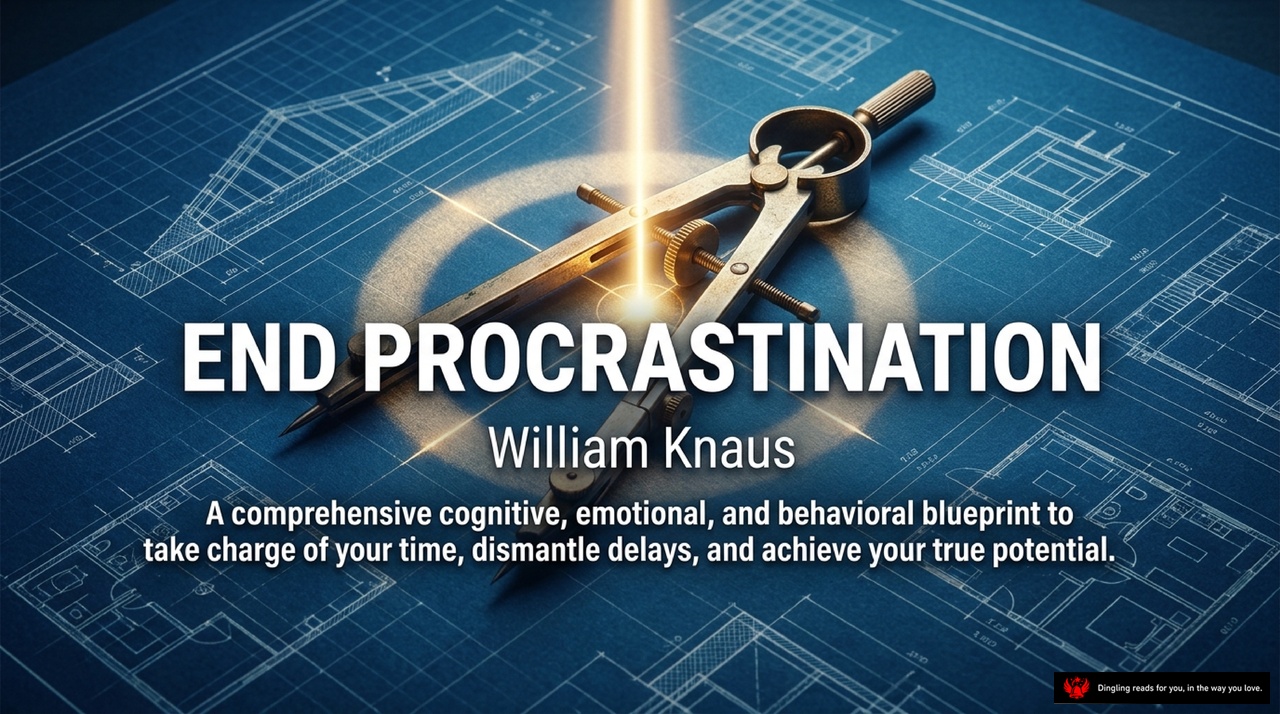
Welcome to our deep dive into William Knaus's groundbreaking work, *End Procrastination*. This isn't just another self-help book; it's a comprehensive cognitive, emotional, and behavioral blueprint designed to take charge of your time, dismantle delays, and finally achieve your true potential.
Imagine your life as a construction site. The cover of this book features a classic drafting compass resting on a detailed architectural blueprint, symbolizing the precision and planning required to build a successful life. But too often, we find ourselves stuck in the "end procrastination" phase—knowing the plan exists but refusing to start the work.
Knaus argues that procrastination is far more than simple laziness. It is a complex syndrome rooted in our psychology. He breaks it down into different types, from deadline-driven delays to the deeper, more insidious "complex procrastination" fueled by self-doubt and perfectionism. The book challenges us to move beyond the illusion that we'll just "start tomorrow" and instead adopt a new mindset.
This book offers a systematic approach to ending procrastination by addressing the cognitive distortions, the emotional fears, and the behavioral habits that hold us back. Whether you are struggling with a specific project or feel a general sense of stagnation, this guide provides the tools to break free from the cycle of delay. It's time to stop dreaming about the future and start building it, one deliberate step at a time.
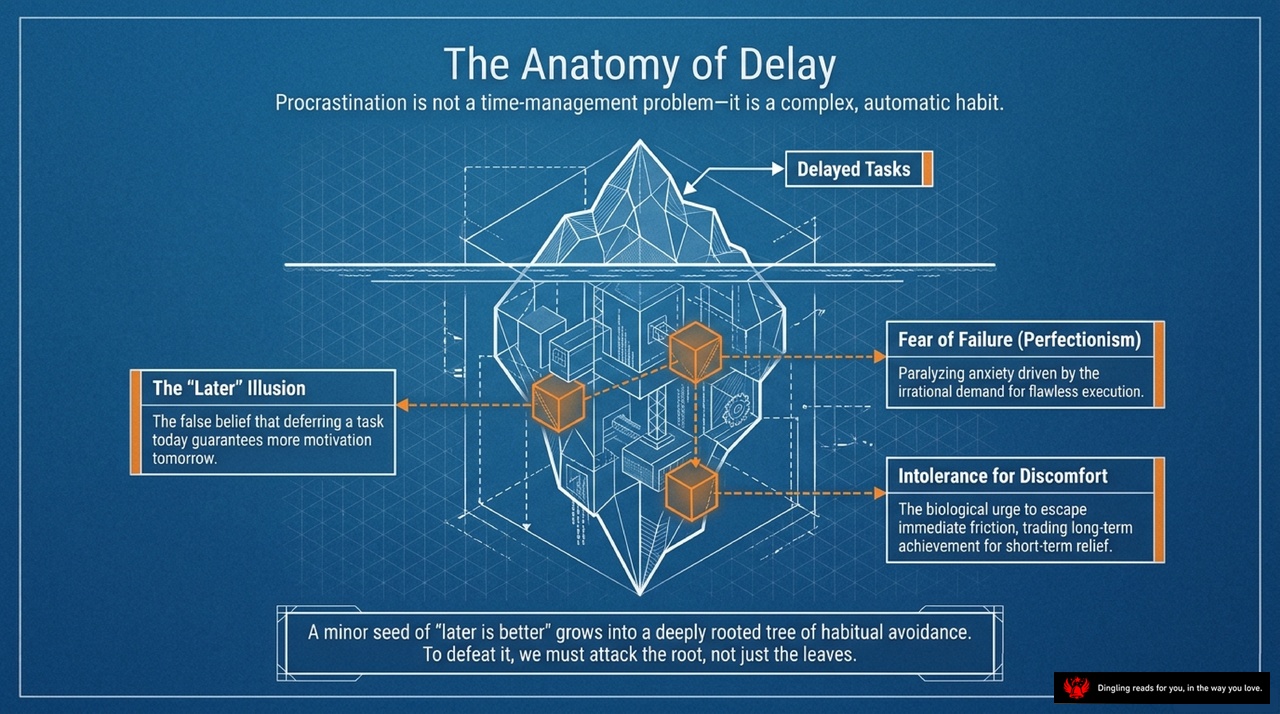
The Anatomy of Delay reveals a profound truth: procrastination isn't a time-management failure, but a complex, automatic habit. Look at the iceberg in front of us. The visible tip represents our "Delayed Tasks," but the massive structure beneath the surface holds the real culprits.
First, we have the "Later" Illusion. This is the false belief that deferring a task today guarantees more motivation tomorrow. It's a comforting lie that tricks us into thinking we're being strategic, when we're actually just avoiding the discomfort of the present.
Beneath that lies the Fear of Failure, often driven by perfectionism. This creates a paralyzing anxiety where we wait for the "perfect" moment to execute, terrified that any attempt might be flawed. So we stay stuck, protecting ourselves from the risk of not being perfect.
Finally, we face our Intolerance for Discomfort. This is the biological urge to escape immediate friction, trading long-term achievement for short-term relief. We simply cannot stand the feeling of doing hard work, so we flee to easier distractions.
As the slide notes, a minor seed of "later is better" grows into a deeply rooted tree of habitual avoidance. To defeat it, we must attack the root—the fear, the illusion, and the discomfort—not just trim the leaves of our delayed tasks.
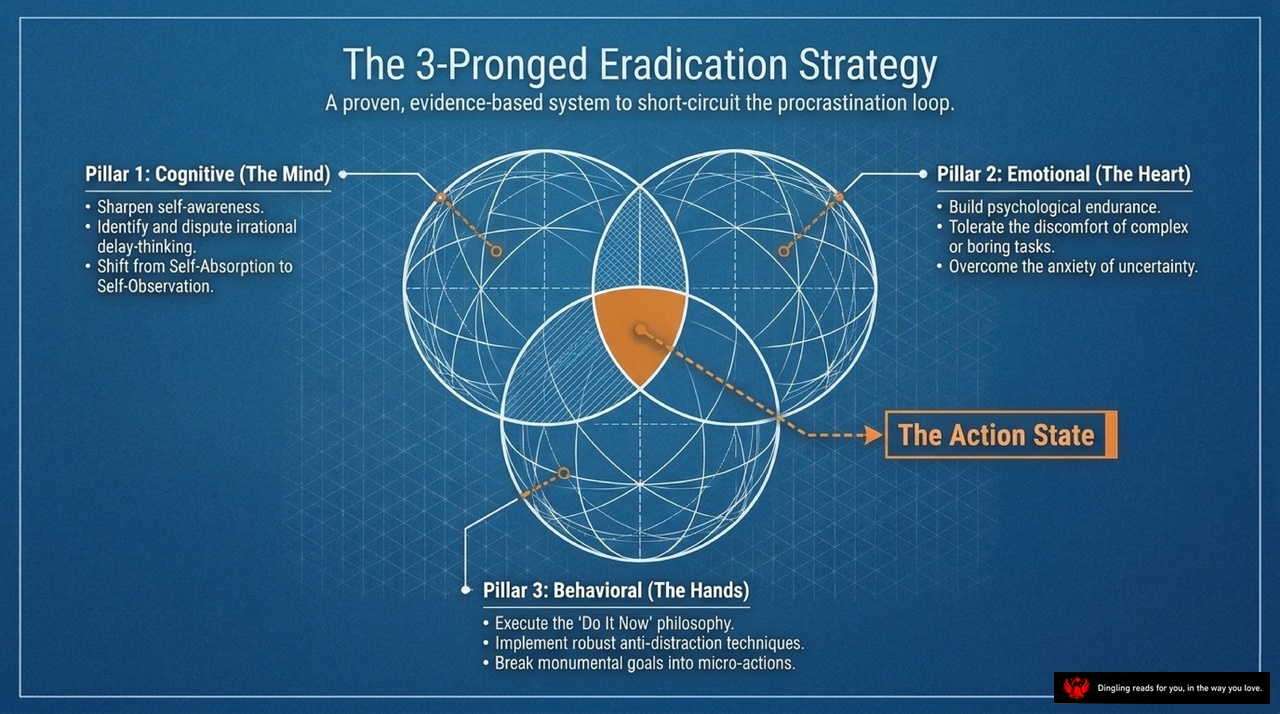
The image on your screen outlines a powerful, three-pronged strategy to completely eliminate procrastination. Think of it as a system designed to short-circuit that endless loop of delay. At the center lies "The Action State," the sweet spot where success happens. But how do we get there? We need to align three distinct parts of ourselves: our mind, our heart, and our hands.
Let's start with **Pillar 1: Cognitive**, or "The Mind." This is about your thinking patterns. The text tells us that procrastination often stems from "self-absorption"—getting lost in worrying thoughts like "What if I fail?" or "Am I good enough?" To break free, we must shift to "self-observation." Instead of being trapped in your own anxiety, step back and watch it like an outsider. Recognize that your brain is just trying to protect you from perceived threats, but that threat is often imaginary. By sharpening your self-awareness and disputing those irrational thoughts, you stop the mental spiral that fuels delay.
Next, we move to **Pillar 2: Emotional**, or "The Heart." This is where the real battle often takes place. We procrastinate not because we are lazy, but because we lack "psychological endurance." We struggle to tolerate the discomfort of difficult tasks or the anxiety of uncertainty. The text highlights that we often avoid complex work because it feels painful. The key here is to build that endurance. You need to train yourself to sit with the discomfort of starting something hard, rather than running away from it. Overcoming the fear of the unknown is essential; you must learn that the pain of discipline is far lighter than the pain of regret.
Finally, we have **Pillar 3: Behavioral**, or "The Hands." This is about what you actually do. It's time to execute the "Do It Now" philosophy. The text suggests breaking monumental goals into tiny, manageable "micro-actions." When a task feels too big, your brain resists. But if you just commit to the first five minutes, or write a single paragraph, the momentum takes over. You also need to implement robust anti-distraction techniques and stop waiting for the perfect moment.
When these three pillars—the Mind observing itself, the Heart tolerating discomfort, and the Hands taking immediate action—intersect, you land right in that orange zone: **The Action State**. It's a proven, evidence-based system. By working on your cognition, your emotions, and your behaviors simultaneously, you don't just manage time; you master your own potential.
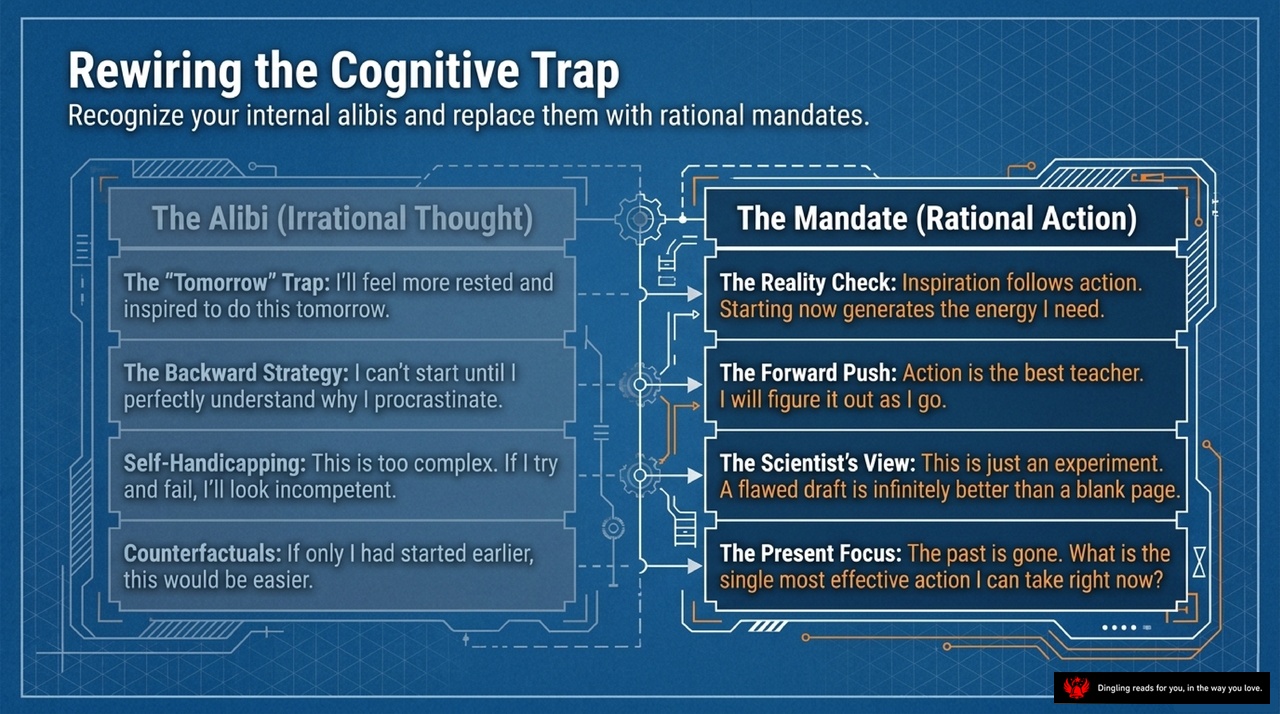
Rewiring the Cognitive Trap: Recognize your internal alibis and replace them with rational mandates.
Let's look at the specific traps we face. On the left, you see "The Alibi"—our irrational thoughts. We tell ourselves, "I'll feel more rested tomorrow," or "I can't start until I perfectly understand why I'm procrastinating." We self-handicap by thinking the task is too complex, or we blame ourselves for not starting earlier. These are just excuses.
But on the right, we have "The Mandate"—our rational action. Instead of waiting for inspiration, we use The Reality Check: inspiration follows action. We use The Forward Push to remember that action is the best teacher; we figure it out as we go. We adopt The Scientist's View, treating every attempt as just an experiment where a flawed draft is infinitely better than a blank page. Finally, we apply The Present Focus: the past is gone. What is the single most effective action I can take right now?
The goal is simple: stop making excuses and start making progress.
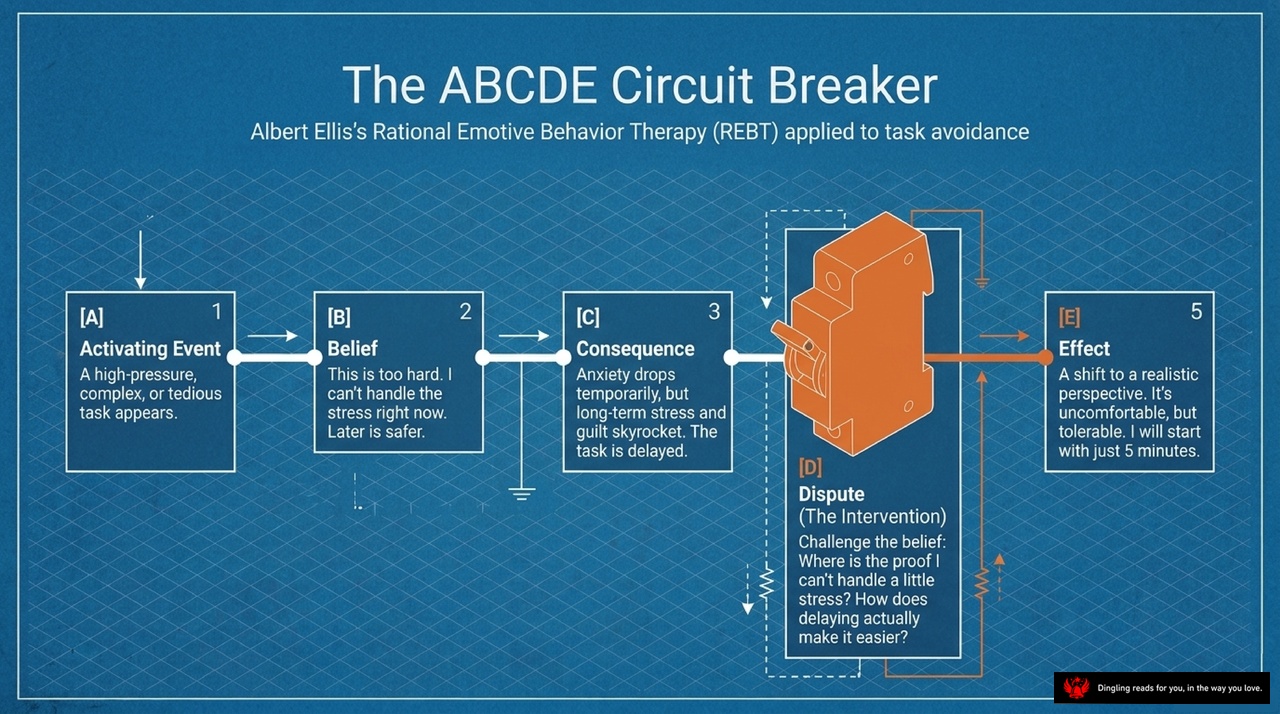
Look at this diagram: The ABCDE Circuit Breaker. It's a visual guide to stopping procrastination right in your tracks, based on Albert Ellis's Rational Emotive Behavior Therapy. Think of it as a mental circuit breaker that cuts off the electricity of avoidance.
It starts with the [A] Activating Event. That's when a high-pressure, complex, or tedious task appears. Maybe it's a deadline or just something you've been dreading. Your brain immediately jumps to the [B] Belief. The classic procrastinator thinks, "This is too hard. I can't handle the stress right now. Later is safer." This non-rational belief is the trigger.
Because of that belief, you get the [C] Consequence. Anxiety drops temporarily because you avoided the task, but long-term stress and guilt skyrocket. The task gets delayed, and the cycle continues.
Now, here is the magic part. This is the [D] Dispute. This is your intervention. You have to challenge that belief. Ask yourself: "Where is the proof I can't handle a little stress? How does delaying actually make it easier?" You replace the fear with a rational thought. Instead of "I can't do this," you say, "It's uncomfortable, but tolerable. I will start with just 5 minutes."
That shift leads to the [E] Effect. You move from a state of panic to a realistic perspective. You break the cycle of avoidance and finally take action. By using this ABCDE method, you stop letting your emotions drive the bus and start steering it toward your goals.
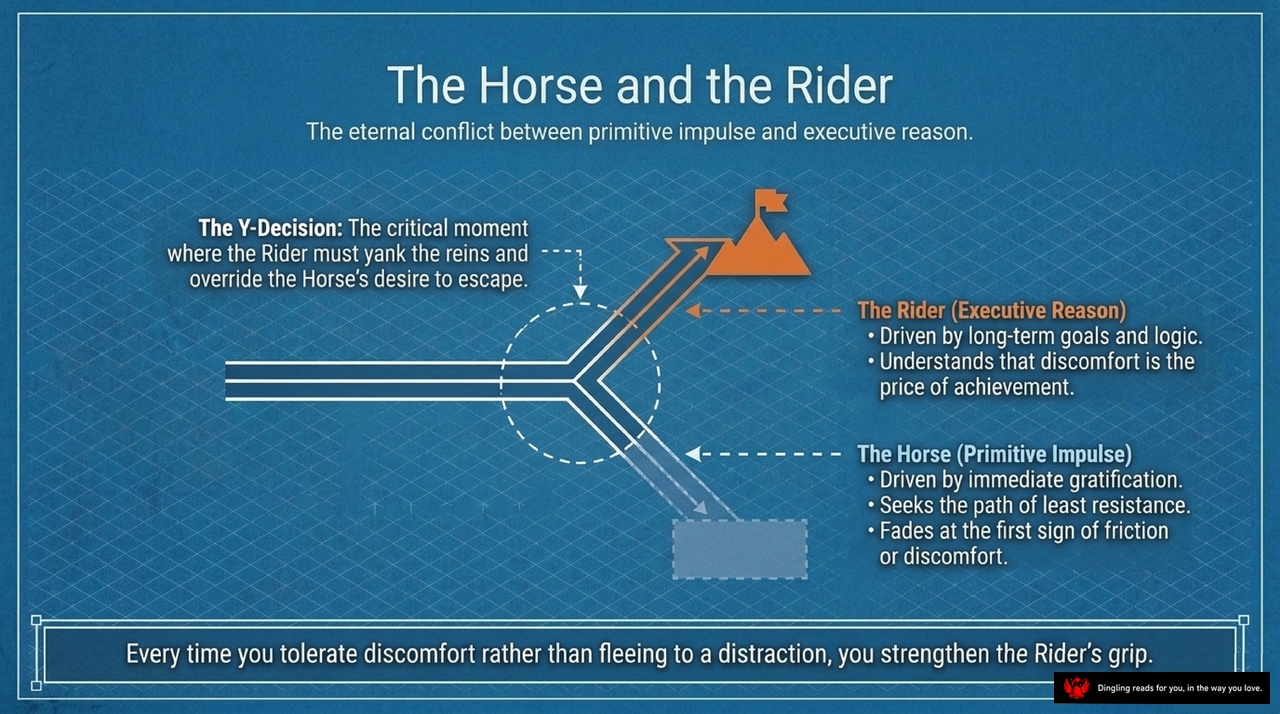
Have you ever felt that tug-of-war inside your head? On one side, your logical mind knows exactly where you need to go—the mountain at the top of that diagram, representing your long-term goals and the path of least resistance to true achievement. On the other side, your instincts scream to turn back, seeking immediate comfort and the safety of doing nothing. This is the eternal conflict between the Rider and the Horse.
The Rider represents your executive reason. You are driven by logic, aware that discomfort is simply the price of admission for success. You understand that tolerating the struggle of the climb is necessary to reach the summit. The Horse, however, is your primitive impulse. It doesn't care about your dreams; it only cares about the present moment. It seeks the path of least resistance and will flee at the first sign of friction or anxiety.
The critical battleground is what we call the Y-Decision. It's that exact moment where the road splits: do you yank the reins and override the Horse's desire to escape into distraction, or do you let it drag you down the easy, comfortable slope? Every time you choose to tolerate that discomfort instead of fleeing to a distraction, you aren't just finishing a task; you are actively strengthening the Rider's grip. You are proving to your own brain that you can handle the hard stuff. So, when you feel that urge to quit, remember: that's not a sign to stop. It's the moment the Rider needs to take control and steer the Horse toward the mountain.
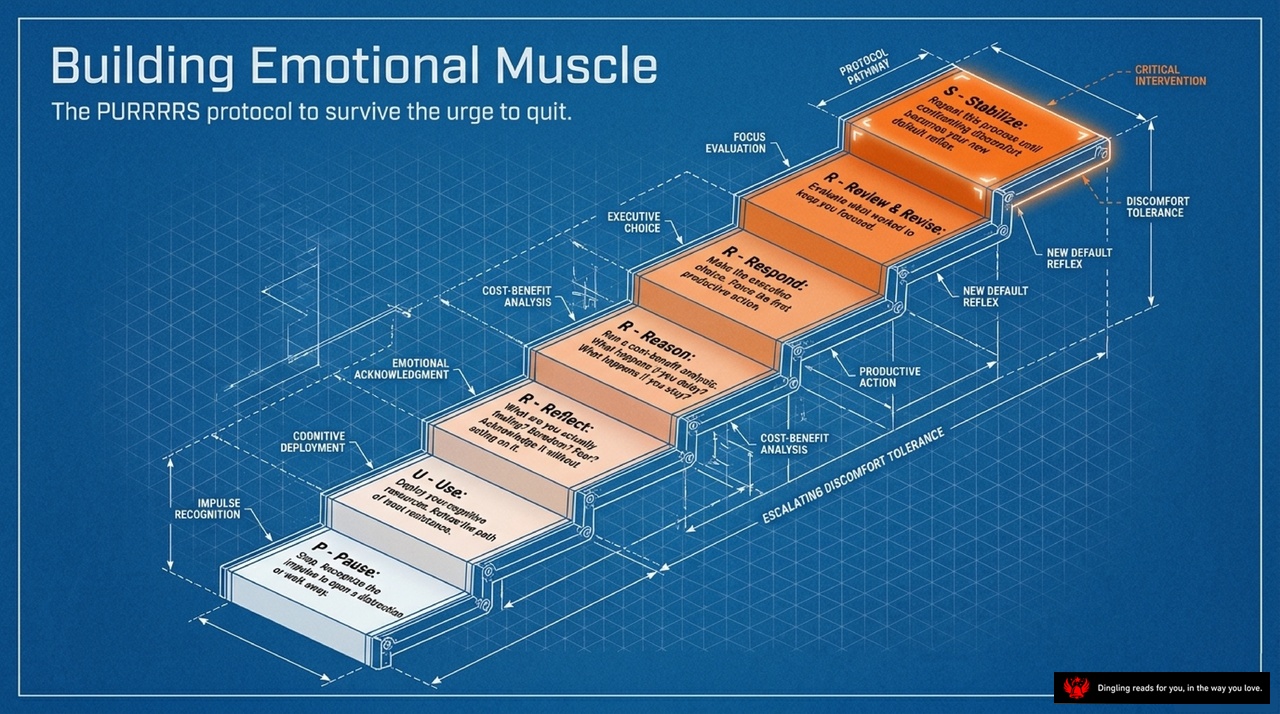
Building Emotional Muscle isn't just a metaphor; it's a physical reality for your brain. Imagine your ability to handle discomfort as a muscle that needs training. The PURRRRS protocol is your personal gym routine, designed to stop the urge to quit before it takes over.
Let's walk through this step-by-step. It starts with **P - Pause**. When that impulse to escape hits, don't react. Just stop. Recognize the urge to turn away, creating a tiny gap between stimulus and response. Next, **U - Use**. Deploy your cognitive resources to override that natural resistance. You are actively choosing to stay on the path.
Then comes the heavy lifting: **R - Reflect**. Ask yourself, "What am I actually feeling? Is it boredom, fear, or anxiety?" **R - Reason** follows immediately. Perform a cost-benefit analysis. What happens if you delay? What happens if you act now? **R - Respond** is where you make the executive choice, forcing yourself into productive action. **R - Review & Revise** ensures you evaluate what worked to keep you focused. Finally, **S - Stabilize**. You remain in this process until you learn a new, more comfortable default reflex.
Notice how the diagram shows "Escalating Discomfort Tolerance" on the right side. Every step you take up this ladder increases your capacity to handle stress. You are building a new default reflex, moving from an old, automatic escape pattern to a conscious, productive one. This isn't about magic; it's about deliberate practice. By repeatedly using this protocol, you strengthen your emotional muscles, turning the struggle against procrastination into a manageable, even empowering, part of your daily life.

The Paradox of Stress reveals a counterintuitive truth: trying to escape stress actually leads to failure, while harnessing it creates the flow state we crave. Look at this curve. On the far left, in the "Left Zone," stress is too low. We live in a state of apathy and under-stimulation. The result? Procrastination. We tell ourselves, "It's not urgent; I'll do it later." This is the danger of a comfortable life.
But swing too far to the right, into the "Right Zone," and stress becomes overwhelming. Here, panic, fear of failure, and the feeling of being crushed take over. The result is paralysis or frantic, last-minute rushing. This is the trap of high-pressure environments that crush us.
The magic happens in the orange "Center Zone." This is where performance peaks. Here, stress transforms from a threat into a challenge. We enter a state of engagement and what psychologists call "eustress"—good stress. In this zone, we experience high focus and rapid execution.
The goal, as the bottom of this slide reminds us, isn't to eliminate stress entirely. That's impossible and counterproductive. Instead, we must reframe stress from a threat to a challenge. By keeping ourselves in this peak performance zone, we turn the very thing that scares us into our greatest ally.
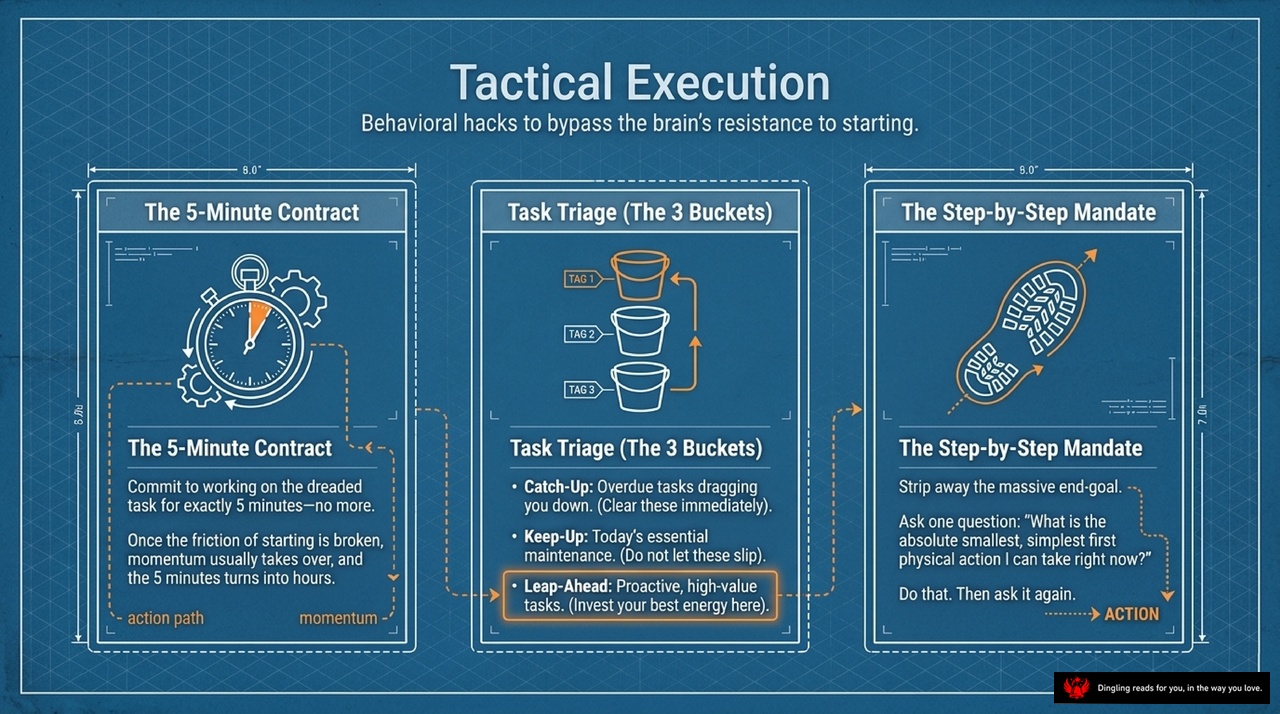
Look at this slide, "Tactical Execution." We're moving from understanding *why* we procrastinate to learning exactly *how* to bypass the brain's natural resistance to starting. Think of these three strategies as your personal toolkit for immediate action.
First, on the left, we have the "5-Minute Contract." This is about hacking your own psychology. Instead of staring at a massive, daunting task, you simply commit to working on it for exactly five minutes. No more, no less. The magic here is that once you break the initial friction of starting, momentum usually takes over, and those five minutes naturally turn into hours. It's about tricking your brain into letting you begin.
Moving to the center, we see "Task Triage," visualized as three buckets. This is about prioritizing your energy, not just your time. The first bucket is "Catch-Up" for overdue tasks dragging you down; clear these immediately. The second is "Keep-Up" for today's essential maintenance; don't let these slip. But the most critical bucket, highlighted here, is "Leap-Ahead." These are proactive, high-value tasks where you should invest your best energy. By categorizing your work this way, you stop feeling overwhelmed and start attacking the right things at the right time.
Finally, on the right, is "The Step-by-Step Mandate." This strategy strips away the massive, scary end-goal. Instead, ask yourself one simple question: "What is the absolute smallest, simplest physical action I can take right now?" Do that. Then ask the question again. It's a relentless loop of tiny actions that builds unstoppable forward motion.
These three tactics—the 5-minute contract, the three-bucket triage, and the step-by-step mandate—are designed to replace hesitation with action. They turn the abstract fear of "starting" into concrete, manageable steps you can take immediately.

Imagine a tangled ball of yarn labeled "Ambiguity" on the left side of the screen. That's where we all start when we feel stuck. But look at the arrow on the right, pointing boldly to "Action." The DECIDE Framework is your bridge from confusion to clarity, because indecision is just a silent form of procrastination.
To cross that gap, you need to force clarity through six specific steps. First, make Decisions. Accept that choosing nothing is still a choice, and usually the worst one. Next, Enter the ambiguity. You can't steer a parked car, so step boldly into the unknown. Then, Consider your alternatives, weighing the steep cost of inaction against the benefits of moving forward.
Once you've thought it through, Implement the most viable solution immediately. Use the 49:51 rule: if you lean slightly toward one option, move. Don't wait for perfect certainty. After you act, Determine the results of your action in real-time. Finally, Engage by continuously adapting and correcting your course while in motion. This isn't just a checklist; it's a mindset shift that turns hesitation into momentum.

Today's slide focuses on the "Workplace Arena," specifically using the SWLO framework to audit your environment and pinpoint exactly where your procrastination hotspots lie. As you can see, we break this down into four quadrants: Strengths, Weaknesses, Limitations, and Opportunities.
Let's start with Strengths. These are the tasks that energize you and come naturally. The book tells us that procrastination rarely survives in this quadrant because you are already in your flow. The action here is simple: maximize the time you spend here.
However, look closely at the "Weaknesses" section, which is highlighted as the critical "Hotspot." These are the necessary tasks that drain your energy or trigger insecurity. This is where procrastination thrives. The text explains that when we face these draining tasks, we often fall into a cycle of avoidance. The solution? Apply the 5-minute rule and the ABCDE method ruthlessly right here. Don't hesitate; attack these specific pain points head-on.
Next, consider "Limitations." These are the systemic barriers, like bureaucracy or bad management, that slow you down. The book warns us not to use these as excuses. Instead of blaming the environment, you must stop using them as alibis and focus on controlling what is within your power.
Finally, look at "Opportunities." This is where you can apply your strengths to leap ahead. The strategy is to prioritize these proactive tasks to build real career momentum. By auditing your workspace with this SWLO lens, you transform vague feelings of laziness into a clear, actionable plan for professional growth.

The Engine of Self-Regulation isn't just a buzzword; it's the core mechanism for permanent change. As the slide illustrates, lasting transformation isn't a one-time event—it's a continuous loop. At the very heart of this engine lies a powerful truth: continuous iteration transforms forced discipline into automatic habit. Think of it like a gear system where every turn makes the next movement easier.
Let's walk through the cycle. It starts with **Awareness**. You must identify the specific task and the exact emotion or belief making you avoid it. Next, you set a **Target**. Don't aim for the whole mountain; define a microscopic, achievable goal, like writing just one paragraph. Then comes the **Plan**. Map out the steps and anticipate that exact moment when your brain wants to quit. When that moment hits, you engage in **Action**. This is where you deploy your "emotional muscle" when the inner "Horse" tries to flee toward comfort. Finally, you move to **Regulation & Acceptance**. You evaluate what worked, accept the friction, and adjust to repeat the cycle.
Notice how the arrows flow? This loop ensures that every time you push through the resistance, you strengthen the habit loop. Eventually, what feels like forced discipline today becomes an automatic, effortless habit tomorrow.

Look at this blueprint for action. We've moved past the "why" and are now looking at the "how." This slide breaks down the architecture of action into three distinct areas: your mind, your heart, and your hands.
First, let's talk about the mind. Procrastination often survives on irrational excuses, like telling yourself "later is better." The book suggests actively disputing these thoughts using the ABCDE method. Instead of letting your brain rationalize delay, you challenge the logic directly.
Next, consider your heart. Your primitive brain is wired to seek comfort and escape discomfort. But success requires building what the authors call "emotional muscle"—the ability to sit with that anxiety and execute anyway, even when you don't feel ready.
Finally, focus on your hands. Stop waiting for inspiration or perfection. You can break through ambiguity using the DECIDE framework and commit to immediate action with a 5-Minute Contract.
You now possess the blueprint to dismantle your procrastination and reclaim your life—but the question remains: will you lay the first brick today, or will you leave it for a tomorrow that never comes?