
Ender's Game: Complete Chapter-by-Chapter Summary
Welcome to the world of *Ender's Game* by Orson Scott Card. This isn't just a story about space battles; it's a classified diagnostic of leadership, psychological manipulation, and the heavy moral cost of human survival. From the very beginning, we meet Andrew Wiggin, known as Ender, a child born not by chance, but by design. He is the third child, a rare anomaly in a world strictly controlling population. While his siblings failed the tests, Ender shows a unique potential that mysterious observers can't ignore. They believe he is the key to saving humanity, even when others worry about his softness. They are convinced he will never yield to an enemy, so he is selected for a secret experiment that will change his life forever.
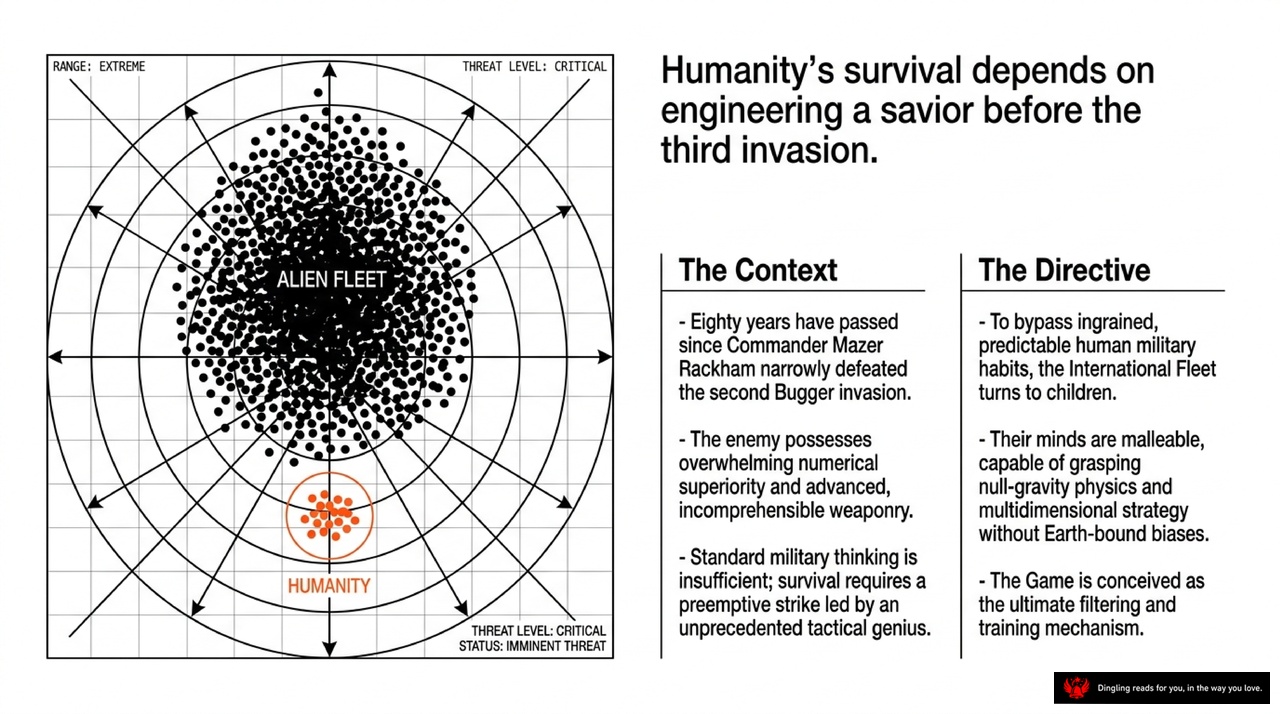
Look at this radar screen. It paints a terrifying picture of our future. We are a tiny cluster of orange dots, labeled "Humanity," trapped in the center while the "Alien Fleet" swarms around us like a crushing wave. The threat level isn't just high; it's critical. The range is extreme. This graphic drives home a brutal truth: standard military thinking is insufficient. We cannot win this war with the same tactics we used before. The enemy possesses overwhelming numerical superiority and weaponry we cannot comprehend.
That is why the International Fleet has made a desperate, radical pivot. Their directive is clear: to bypass our ingrained, predictable military habits, they are turning to children. Specifically, they are looking for a tactical genius who can grasp null-gravity physics and multidimensional strategy without the bias of Earth-bound thinking. They need someone whose mind is malleable, capable of seeing the battlefield in ways grown-ups cannot.
This slide sets the stage for the ultimate filtering mechanism: The Game. It is conceived not just as a training exercise, but as the only path to survival. Humanity's existence depends on engineering a savior before the third invasion arrives. If we fail to produce this unique commander, the orange dots representing us will soon be swallowed by the black swarm. The clock is ticking, and the only variable we can control is the kind of leader we are willing to create.

Peter is pure fear. He rules through pain, torture, and physical dominance. He's too volatile to inspire loyalty. Valentine is pure empathy. She rules through persuasion, affection, and understanding. But she's too gentle to ever annihilate an enemy. Ender? Ender is the calculated synthesis of both. He takes Peter's lethal ruthlessness and Valentine's profound empathy, blending them into one terrifying trait: empathetic destruction. He doesn't just understand the enemy; he uses that total comprehension to obliterate them completely. That is the perfect equilibrium. That is the weapon the galaxy needed.
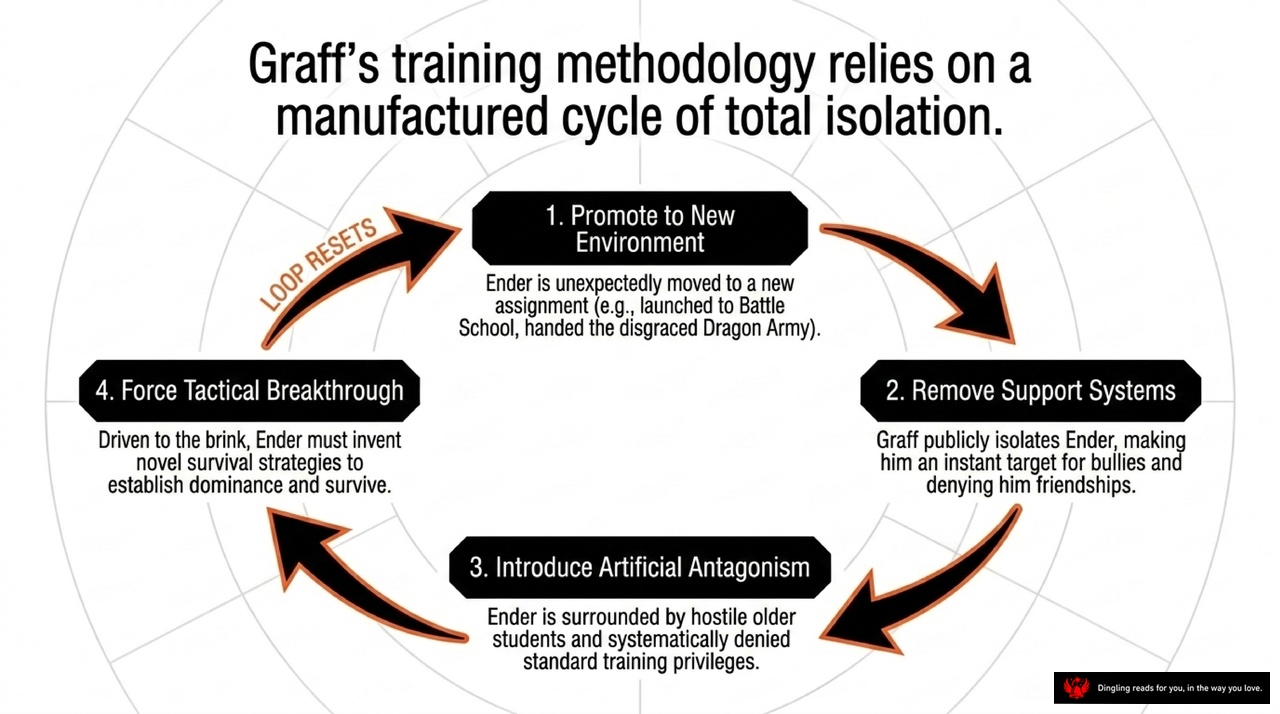
Look at this cycle. Graff's training methodology isn't just about teaching; it's about manufacturing a specific kind of isolation. He forces Ender through a relentless loop designed to break him down and rebuild him stronger.
It starts with **Promoting to a New Environment**. Suddenly, Ender is launched into a completely alien world, like being sent to Battle School or handed the disgraced Dragon Army. It's a shock to the system. Immediately after, Graff **Removes Support Systems**. He publicly isolates Ender, stripping away friendships and making him an instant target for bullies. There is no safety net.
Next, Graff **Introduces Artificial Antagonism**. Ender is surrounded by hostile older students and systematically denied standard training privileges. He's driven to the absolute brink, with no resources and no allies. This pressure forces **Tactical Breakthrough**. With nowhere left to hide, Ender must invent novel survival strategies to establish dominance and survive. Once he proves he can handle this manufactured hell, the loop resets, and the cycle begins all over again.

In zero gravity, the illusion of "up" and "down" is the biggest trap you can fall into. As long as you cling to Earth's gravity, you are playing the game wrong. Older students, like the black figure standing upright in the diagram, make the mistake of treating the enemy's door as if it were the ceiling. They present a massive, easy-to-hit target, completely unaware that they are fighting on the enemy's terms.
But true spatial freedom comes from a paradigm shift. You must designate the enemy's door as "down." This simple mental reorientation unlocks tactical advantages that are impossible in normal gravity. By flipping your perspective, you minimize your physical profile, making yourself harder to hit. Your legs transform from vulnerable limbs into a protective shield against incoming fire. Most importantly, you stop fighting the walls; you start using them purely for momentum rebounding. This doubles your speed and allows you to move in ways your opponents simply cannot predict. It's not just about moving faster; it's about mastering the void to control the battlefield.
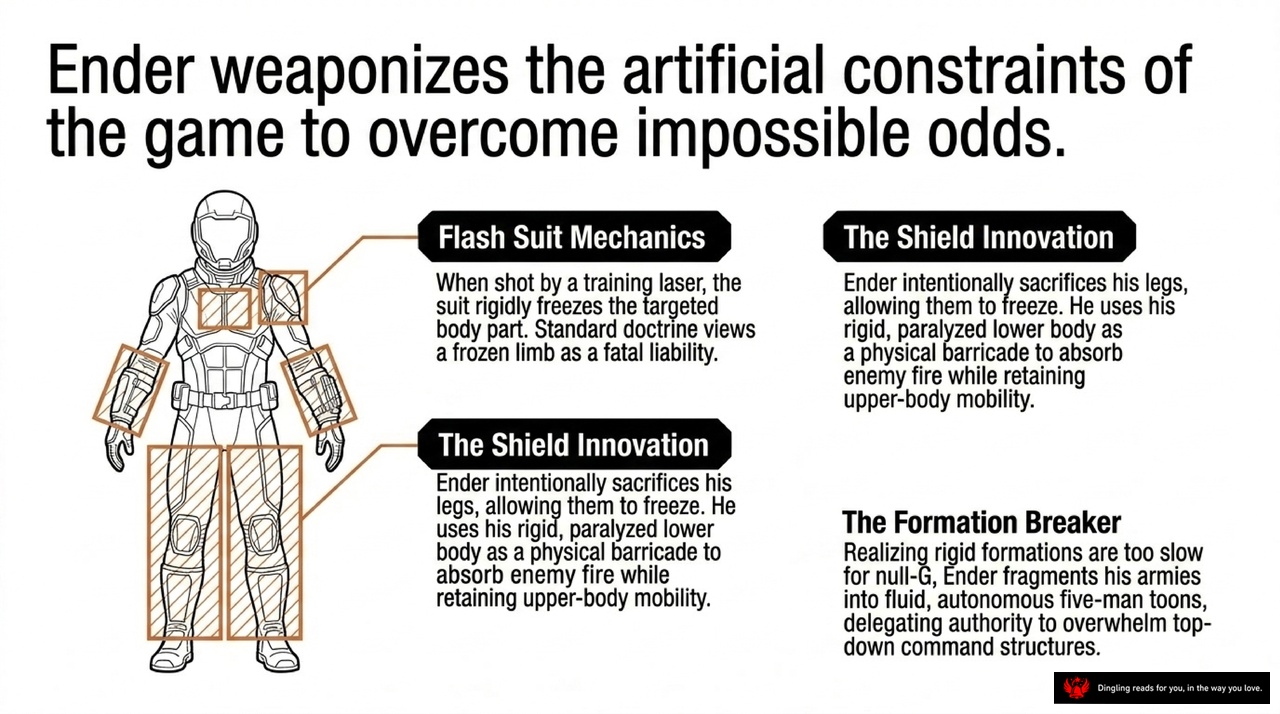
In the chaotic arena of the Battle School, where rules are just suggestions and survival is the only law, Ender learns that true power comes from breaking the very constraints designed to control him. Look at this diagram: it shows how he weaponizes the game's artificial limits to overcome impossible odds.
First, consider the Flash Suit Mechanics. Standard doctrine views a frozen limb as a fatal liability—a broken weapon. But Ender flips the script. He intentionally sacrifices his legs, letting them freeze rigid. Instead of seeing paralysis as a weakness, he uses his lower body as an immovable physical barricade to absorb enemy fire, while keeping his upper body mobile to keep fighting. He turns a disadvantage into a shield.
Then, look at the Formation Breaker. Realizing that rigid, top-down command structures are too slow for the hyper-aggressive Null-G fleet, Ender shatters his army. He fragments his command into fluid, autonomous five-man teams. By delegating authority to these small units, he overwhelms the enemy's slow, centralized decision-making. He doesn't just fight within the rules; he rewrites them.
Ender's genius isn't in following orders; it's in realizing when the rules are rigged against him and inventing a new game entirely.

The Mind Game acts as a psychological mirror, reflecting Ender's deepest fear. Look at that shattered screen: it splits Ender's humanity into two sides—the ferocious Giant and his own terrified face. This isn't just a game; it's a brutal confrontation with his inner demons.
In "The Giant's Drink," Ender faces a rigged choice where every option leads to death. Realizing the rules are broken, he rejects the game entirely, attacking the Giant directly to survive. But in "The Mirror's Reflection," the victory comes with a horrifying cost. Though he lives, Ender is horrified by his own capacity for violence. When he reaches the tower level, the mirror reflects his cruel brother, Peter. The simulation confirms his terror: survival requires becoming the monster he hates.
Ender wins the battle, but he loses his innocence. The game forces him to embrace the very darkness he feared, proving that to save humanity, he had to become the very thing he despised.

While Ender fights in the stars, his siblings manipulate the geopolitical reality of Earth. This slide reveals a crucial duality: the war we see is a simulation, but the political war happening back home is very real. Look at the two figures dominating the map. On the left, Demosthenes, who is actually Valentine. She adopts a paranoid, populist persona to incite fear and consolidate power, completely overriding her inherent empathy. On the right, Locke, who is Peter. He adopts a rational, statesman-like persona to position himself as the ultimate geopolitical arbiter, masking his inherent cruelty. Together, they use global communication nets and adult pseudos to steer humanity toward a unified global hegemony. Just as Ender uses a simulation to fight a real war, his siblings use digital aliases to covertly steer humanity, proving that while the battle for survival was fought in space, the battle for control was fought right here on Earth.

Command School has evolved into something far darker than a simple game. It has replaced physical play with digital simulations of total annihilation.
Look at this stark image on the left: a massive swarm of black dots converging on a single target. This represents the shift from fair competition to "Asymmetric Warfare." In these simulations, the rules of fairness are abandoned. The protagonist, Ender, is systematically outnumbered—often by a ratio of 100 to 1. He is forced to command a small group of friends against impossible armadas, fighting with only fragile, slow communication links. It is a nightmare scenario designed to break the human spirit.
On the right, we see the architects of this cruelty. First, "The Final Instructor," Mazer Rackham. He acts as the ultimate, unforgiving enemy programmer, deliberately stripping Ender of sleep, health, and hope to see what he is capable of when pushed to the absolute limit.
Second, the introduction of "The Little Doctor." This is the Molecular Detachment Device, a weapon of absolute last resort. It doesn't just destroy ships; it destroys matter at the atomic level, creating an unstoppable chain reaction that annihilates entire planets.
Finally, the simulations are designed to culminate in "The Final Battle," where Ender is forced to order the destruction of the entire insect civilization. The goal isn't to win a game; it is to train a commander who can make the most horrific decision imaginable without hesitation. This is the price of survival, and it is a price that changes everything.

The ultimate deception weaponized a child's exhaustion to commit a genocide.
Look at this image: thousands of enemy ships are closing in, protecting their homeworld. Ender, facing this impossible odds, makes a desperate choice. He abandons standard tactics and fires the Little Doctor directly at the planet. The room erupts in adult cheers, but what they don't see is the truth. Rackham reveals there was no simulation. The ansible feed was real-time; Ender was commanding actual human fleets the entire time.
The fallout is devastating. Ender has exterminated the Bugger species. The adults absorbed the moral guilt of the deception to ensure Ender fought with the reckless, unburdened brilliance of a child playing a game. They used his exhaustion to turn a strategic necessity into a massacre, leaving a child to bear the weight of a species' destruction.
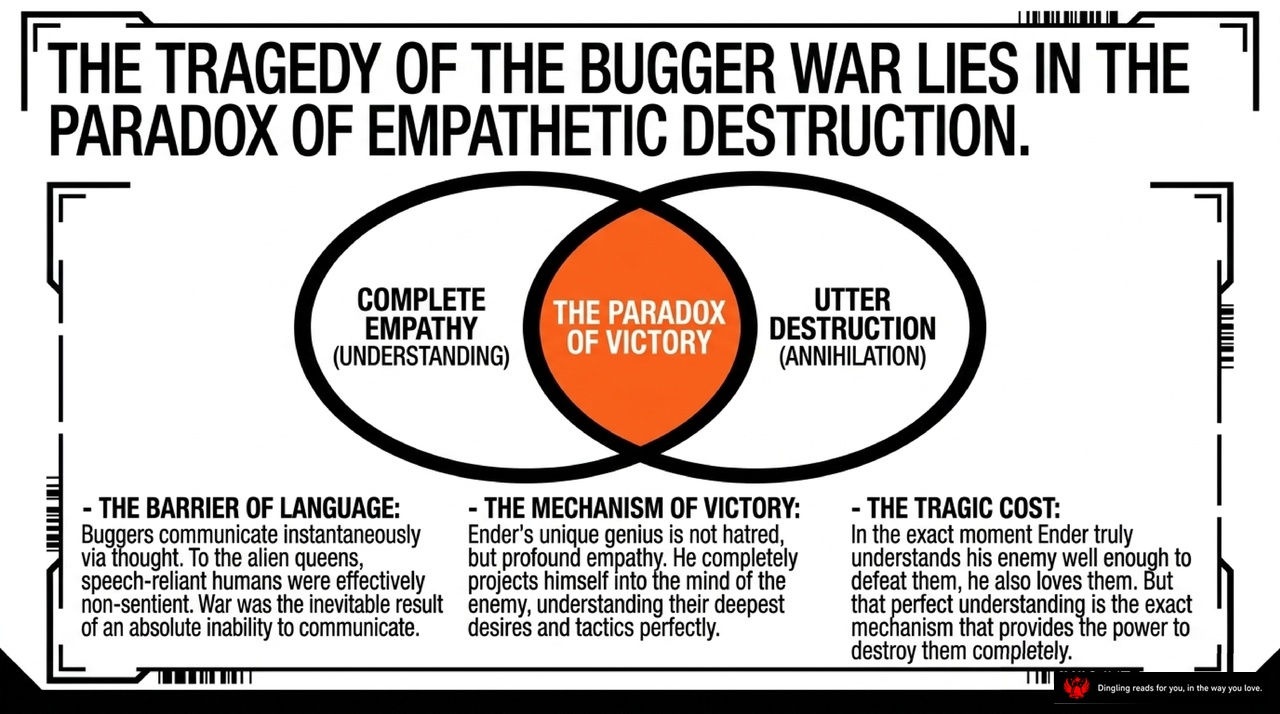
The tragedy of the Bugger War lies in the paradox of empathetic destruction. Look at this Venn diagram: on one side, we have complete empathy—understanding. On the other, utter destruction—annihilation. The orange intersection is the Paradox of Victory.
The barrier was language. Buggers communicated instantly through thought, while speech-reliant humans were effectively non-sentient. War was the inevitable result of this absolute inability to connect. But Ender's genius wasn't hatred; it was profound empathy. He completely projected himself into the mind of the enemy, understanding their deepest desires and tactics perfectly.
Here is the tragic cost: in the exact moment Ender truly understood his enemy well enough to defeat them, he also loved them. But that perfect understanding became the exact mechanism that provided the power to destroy them completely. He could not kill what he understood, yet he had to kill to save humanity. That is the impossible choice at the heart of the story.

Look at this hand dissolving into dust. It captures the tragic arc of our hero's journey perfectly. Humanity didn't just create a savior; they engineered one by stripping away a child's innocence, turning empathy into a weapon of mass destruction.
Think about the cost of that "victory." When survival demands the ultimate deception, is the triumph of the victor truly worth the price of their soul? We watched Andre go from a vulnerable child to the commander who ended the Formic War. He won, yes. But in doing so, he destroyed an entire civilization he never truly understood. The cheers of Earth were deafening, yet inside him, there was only silence and a crushing weight of guilt. He became the very thing he hated—a killer who couldn't bring himself to pull the trigger, yet whose orders killed billions. This slide asks us to confront the hardest truth of all: sometimes, saving humanity means becoming the monster we fear most.