
Enlightenment Now: Complete Chapter-by-Chapter Summary

Welcome to our book club session on "Enlightenment Now" by Steven Pinker. Imagine standing here, looking out at the curve of our planet, bathed in the golden light of a rising sun. This image perfectly captures the book's core promise: that the future is not a dark abyss, but a horizon we can actively illuminate.
Pinker defines this journey as "Enlightenment Now"—a defense of reason, science, humanism, and progress as the ultimate tools to advance human flourishing. It's a call to move beyond fear and superstition, trusting instead in the power of human understanding to solve our greatest problems.
The book argues that we are living in the most peaceful, safe, and prosperous era in human history. By embracing these four pillars, we don't just survive; we thrive. We have the capacity to improve our world, to heal our planet, and to create a future where every person can flourish. Let's dive into how these simple, powerful ideas are reshaping our reality.

Look at this stark contrast. On the left, we see a collage of headlines screaming "Global Collapse," "Economic Crash," and "System Failure." It's the classic pessimistic narrative we're fed daily. But look at the graph on the right. It shows a steady, upward trajectory labeled "Human Progress." This slide captures a crucial concept: "The Pessimistic Illusion."
Why do we feel like the world is ending when the data says we're thriving? The answer lies in how our brains process information. News is designed to report on things that happen—disasters, conflicts, and crises. It rarely reports on things that *don't* happen, like the fact that global famine is virtually extinct or that murder rates are plummeting.
This creates a cognitive trap known as the "availability heuristic." Because we constantly consume negative news, our brains mistake frequency of coverage for frequency of reality. We overestimate the risk of war and underestimate the success of medicine and economics. We are blind to the quiet miracle of human progress simply because it doesn't make for a dramatic headline.
So, how do we break free from this illusion? We have to shift from relying on our gut feelings to trusting objective data. When you look at the numbers—longer life spans, cleaner air, greater equality—you'll see a different story. The headlines are trying to sell you fear, but the statistics are telling you the truth: humanity is not collapsing; it is advancing.

Welcome back to our journey through the history of human thought. Today, we are looking at the very foundation of the Enlightenment: The Enlightenment Toolkit.
Imagine a four-part system that changed everything about how we live. First, we have Reason. This isn't just about being smart; it's about submitting our beliefs to objective standards. It means admitting that our gut feelings and emotions are often flawed and easily hijacked, and choosing to think clearly instead.
Next is Science. This is where we refine reason to actually understand the world. It's about using skepticism, open debate, and real-world testing to build reliable knowledge, moving us away from superstition and into clarity.
Then, we have Humanism. This is the heart of the movement. It means prioritizing the flourishing of individual, conscious beings over the glory of tribes, nations, or religious dogmas. It's about putting human well-being at the center of our moral compass.
Finally, we have Progress. The Enlightenment believed that if we apply reason and sympathy to the institutions that govern us, improvement is inevitable. It's the idea that we don't have to accept our current suffering; we can actively build a better future.
These four pillars—Reason, Science, Humanism, and Progress—form the toolkit that allowed humanity to escape its "immaturity" and start designing a better world for everyone.

Look at this diagram: The Canvas of Reality. It breaks down the forces shaping our world into three distinct spheres. On the left, we have Entropy. As the slide explains, the universe naturally moves toward disorder and decay. Poverty and disease aren't engineered by malice; they are simply the default state of a closed system. If we don't act, everything tends to fall apart.
On the right, we see Evolution. Nature is a brutal, zero-sum competition for survival and energy. It embeds humanity with tribalism, aggression, and blind spots. This is the harsh reality we inherited.
But in the center, bridging these two destructive forces, is Information. This is the organizing force. It is the precise arrangement of matter and energy—from DNA sequences to neural networks—that allows life to compute solutions and build order. Information is the antidote to chaos. It is the tool we use to fight entropy and navigate the harshness of evolution.
The book tells us that while we are born into a world defined by these grim laws, we are not trapped. By harnessing information through reason and science, we can create pockets of order. We can build systems, technologies, and societies that defy the natural pull toward disorder. This tension between the entropy of the universe, the cruelty of evolution, and the power of information is the fundamental story of human progress. We are the species that learned how to write code for reality itself.

Look at this diagram: "The Engine of Human Flourishing." It maps out the very logic of our progress. On the left, we face "The Problem": Entropy and Evolution. The universe naturally drifts toward disorder, and evolution often feels hostile to us. But we aren't stuck. In the center is "The Tool": Information and Science. This is the deliberate application of knowledge to reverse that entropy. Guiding this entire process is "The Compass"—Reason and Humanism. And finally, on the right, we see "The Result": Progress.
The slide makes one thing crystal clear at the bottom: Progress is not magic. It is the deliberate application of information to reverse entropy. Think about what this means in real life. When we developed vaccines, we used information to stop diseases that once killed millions. When we invented the Haber-Bosch process for fertilizer, we used science to feed billions who would otherwise have starved. These aren't accidents; they are victories over the natural tendency toward chaos.
However, this progress isn't automatic. It requires the compass of Reason and Humanism. Without reason, we might fall into superstition or fear. Without humanism, we might ignore the suffering of others. That's why we see such a dramatic drop in global poverty, why life expectancy has doubled, and why we live in the safest era in human history. We are actively fighting the universe's tendency to decay, using our minds and our tools to build a better future. That is the engine of human flourishing.

Look at this dashboard titled "The Great Escape." It visualizes the most profound story of our species: the dramatic shift from a world defined by suffering to one defined by progress.
On the left, you see the line for Life Expectancy. It shows a steady climb from a historical baseline of just 30 years to a global average of over 70 years today. This isn't just a number; it's a testament to our victory over disease and hunger.
In the middle, the graph for Extreme Poverty tells a similar story of triumph. It depicts the fall from a historical default of universal destitution down to single-digit global percentages. We have engineered an escape from the trap that held humanity for 99% of history.
On the right, the line for Child Mortality shows how we replaced the horrors of 19th-century epidemics with a trajectory toward global health convergence. We are no longer living in a world where early death was the default setting.
As the bottom banner states, we engineered this escape. For centuries, poverty and early death were the rules. But through science, public health, and economic growth, we have rewritten the rules. We have built a world where living longer, healthier, and wealthier is no longer a privilege for the few, but a reality for the many.

Look at this dashboard titled "The Moral Arc." It paints a powerful picture of how humanism is actually working. On the left, we see Violence & War, highlighting a steep historical decline in homicides and the virtual disappearance of great power conflicts since 1945. On the right, Human Rights shows the systematic abolition of barbaric practices like slavery and public torture. At the bottom, Emancipation captures the rapid global rise in democratization, women's rights, and the decriminalization of homosexuality.
This data proves a simple but profound truth found at the very bottom of the screen: Humanism works. Expanding the circle of sympathy directly correlates with the expansion of knowledge. As we've seen throughout our journey, from the eradication of deadly diseases to the dramatic drop in poverty and the rise of global education, our ability to understand the world has allowed us to reduce suffering and increase freedom. We are not just surviving; we are actively improving our shared future by applying reason and empathy to solve the problems that once seemed unsolvable.

Look at this dashboard. It's titled "The Expansion of Mind," and it paints a picture of our species literally upgrading its operating system.
First, notice the data on literacy. We've gone from a time when reading was an elite privilege held by just 12% of people in the 19th century to today, where over 83% of the global population can read. This isn't just a statistic; it's a revolution in how we process information.
Then, look at the Flynn Effect. This is fascinating because it shows that our collective IQ has actually risen by about 30 points over the last century. That's two standard deviations—meaning we are genuinely smarter than our ancestors. Why? Because of better nutrition, improved education, and the ability to think more abstractly.
The bottom line here is powerful: education and literacy are the ultimate anti-entropy mechanisms. While the universe naturally tends toward chaos, our ability to learn, read, and reason creates order and meaning. As a species, we are literally getting smarter, expanding our mental horizons, and building a future that our ancestors could only dream of.

Look at these three pillars blocking our path forward: Romantic Heroism, Authoritarian Populism, and Eco-Pessimism. These aren't just abstract concepts; they are the modern enemies of reason, actively working to dismantle the very progress we've built over centuries.
First, Romantic Heroism. This ideology glorifies struggle and dominance, rooted in the idea that blood and soil matter more than peaceful problem-solving. It tells us that incremental progress is weak, and that only the strong struggle can define us.
Next, Authoritarian Populism. This movement rejects expertise and cosmopolitanism entirely. It thrives on zero-sum tribalism, demonizing anyone who is different, and empowers strongmen who promise to restore a mythical golden age that never existed. It's a call to abandon facts for emotion and unity for division.
Finally, Eco-Pessimism. This is the belief that modernity itself is a disease and that humanity is a parasite destined to cause catastrophic collapse. It suggests that technological advancement and science are not solutions, but the very causes of our doom, leaving us with no choice but to accept inevitable destruction.
Together, these three forces form a powerful wall against reason. They convince us that the world is either too chaotic to fix, too divided to unite, or too doomed to save. But as we've seen, history proves that through knowledge, cooperation, and a commitment to evidence, we can overcome these illusions and continue our journey toward a better future.

Look at this comparison chart titled "The Ideological Diagnostic." It lays out the fundamental clash between two opposing worldviews: Enlightenment and Counter-Enlightenment. On the left, under Enlightenment, we see a belief in a positive-sum game where cooperation actually creates wealth. Morality is rooted in the flourishing of the individual and universal human rights, not the glory of a tribe or nation. Knowledge comes from science, data, and testable hypotheses, not from unshakeable authority or dogma. The future outlook here is realistic yet hopeful: yes, problems are inevitable, but they are solvable.
Contrast that with the Counter-Enlightenment column on the right. This perspective views life as a zero-sum game, believing that for me to win, you must lose. It prioritizes national, tribal, or religious glory over individual human rights. Instead of relying on science and data, it leans on intuition, dogma, and unquestionable authority. Its future outlook is one of inevitable doom and societal collapse, suggesting that progress is an illusion and decline is the only destiny. This visual perfectly captures the battle between a mindset that believes in solving problems through reason and cooperation, versus one that believes in survival through conflict and fatalism.
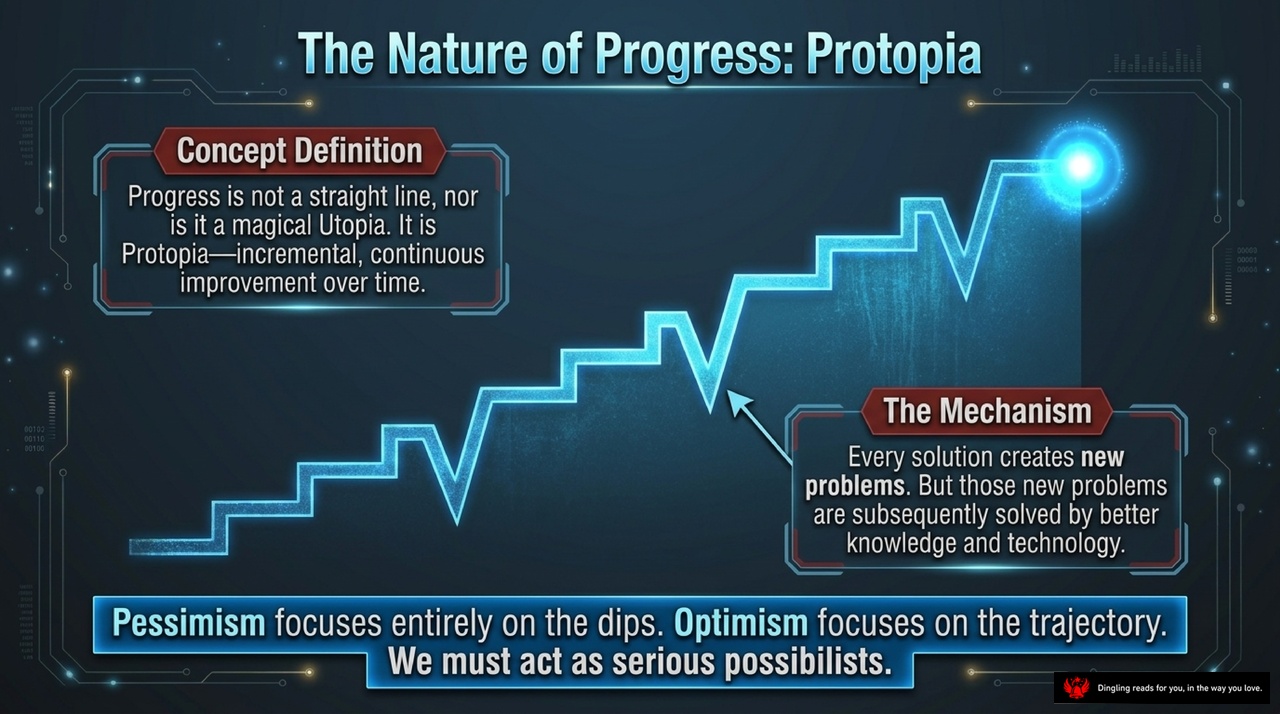
Have you ever looked at a jagged line on a chart and felt like the world is falling apart? That's exactly where pessimism lives. It fixates entirely on the dips—the bad news, the disasters, the moments when things go wrong. But true progress isn't a straight line, nor is it a magical utopia waiting to be reached. As we see here, progress is actually "Protopia"—a concept of incremental, continuous improvement over time.
Think about the mechanism driving this. Every single solution we create inevitably creates new problems. Yes, that dip you're worried about? It's just the next step. Those new challenges are subsequently solved by better knowledge and technology. It's a cycle of rising and falling, but the overall trajectory is upward.
So, how do we navigate this? The slide makes it clear: pessimism focuses on the dips, but optimism focuses on the trajectory. We need to stop getting stuck in the momentary struggles and start looking at the long-term path. We must act as serious possibilists. This means acknowledging the risks without letting them paralyze us, and believing that through reason and cooperation, we can always solve the next problem to move forward. That is the nature of our progress.

Look at this slide titled "A Meaningful Universe (Without Magic)." It presents a powerful vision: we are highly improbable arrangements of matter and energy, temporarily resisting entropy. We are equipped with a neural network capable of love, art, empathy, and understanding. On the right, it states that maximizing flourishing for all conscious beings and reducing their suffering is the highest possible purpose. We do not need cosmic magic to justify human compassion.
This aligns perfectly with the book's argument that we don't need supernatural explanations to find meaning. Instead, our very biology—our DNA and our brains—gives us the tools to create a meaningful life. The universe might be indifferent, but we have the unique ability to care. By focusing on reducing suffering and increasing happiness for every conscious being, we fulfill our highest purpose. This isn't about grand cosmic forces; it's about the tangible, human power of compassion. We are the universe experiencing itself, and through our empathy, we can build a better future right here, without any magic required.

Look at this spotlight against the darkness. It captures the book's central argument perfectly: we are not living in the end times. Despite the noise around us, humanity has systematically pushed back the darkness of entropy, disease, and violence to engineer the most prosperous era in history.
Think about the tools we hold today. We have reason, science, and humanism. These aren't just abstract concepts; they are the exact tools required to engineer our own salvation. Look at the data: we've eradicated smallpox, driven malaria deaths down by 60%, and lifted billions out of poverty. We've made the world safer, with murder rates dropping and peace becoming the norm. We have the knowledge to fix our problems.
So, here is the question the slide asks, and it's one we need to answer honestly: If we possess the exact tools required to engineer our own salvation, why are we so desperate to believe we are doomed? We often ignore the progress right in front of us, letting fear and bad news shape our reality. But the evidence is clear. We have the power to create a better future. The choice is no longer about whether we can save ourselves, but whether we have the courage to believe that we can.