
Ernest Hemingway: A Life Story: Complete Chapter-by-Chapter Summary

Welcome to today's session on Ernest Hemingway. We are diving into Carlos Baker's definitive biography, a deep exploration of the triumphs, traumas, and the iceberg-deep genius of America's most influential literary titan.
Look at this image of the iceberg. It perfectly captures the essence of Hemingway's life and work. Just as an iceberg shows only a small tip above the water, Hemingway's writing often appears simple and direct, yet beneath the surface lies a vast, hidden world of complex emotions, war, love, and loss. This book peels back those layers, taking us from his humble beginnings in a doctor's family in Illinois to the front lines of the Spanish Civil War and the brutal trenches of World War II. We will trace his journey from a curious boy who could name 73 bird species to a hardened writer who shaped modern literature. Get ready to uncover the full story behind the myth.

Born of Two Worlds: The Oak Park Duality. Ernest Hemingway didn't just write stories; he lived a life split between two opposing forces, a friction that forged his legendary voice. On one side stood his father, Clarence "Ed," a man of science, nature, and raw action. He dragged young Ernest into the Michigan woods, teaching him to hunt, dissect anatomy, and survive the wild. This influence built the foundation of Hemingway's hyper-masculine subjects, his obsession with precise naturalist detail, and the rugged courage seen in his characters.
On the other side was his mother, Grace Hall, a former opera singer who championed arts, music, and culture. She insisted on music lessons, nurtured his creativity, and even designed a dedicated music room in their home. This side shaped the rhythm of his prose, the musicality of his sentences, and that deep, inescapable drive to create art and perform for an audience.
Hemingway's distinct voice emerged from the clash between these passions. He wasn't just a boy from a doctor's house; he was a hybrid of the hunter and the artist, carrying the rifle and the violin in his soul. This Oak Park duality became the blueprint for everything he would ever write.

The shattered illusion of immortality. This slide captures the pivotal moment when a young Ernest Hemingway, eager for adventure, was forced to confront the brutal reality of war.
Look at the timeline here. It starts with "The Volunteer." Hemingway, rejected from the US Army due to poor eyesight, joined the Red Cross as an ambulance driver in Italy. He was young, romantic, and unprepared for what lay ahead. But then, the path leads to "The Shock." In Fossalta, while distributing chocolate to Italian troops, he was severely wounded by a mortar shell. It wasn't a heroic movie scene; it was chaos.
This trauma triggered "The Paradigm Shift." As the graphic notes, he realized that words like "sacred," "glorious," and "sacrifice" were just empty lies. War wasn't an adventure; it was a slaughterhouse. That early encounter with death stripped away his adolescent romanticism forever. Instead of a dreamer, he became a scarred realist. And that shift—the permanent obsession with mortality and the concept of maintaining grace under pressure—became the foundation for everything he would write.

Forging a Style in Paris: Where the Lost Generation Found Its Voice.
Picture this: a battered typewriter in the center of Paris, the heartbeat of a new literary revolution. This slide captures the exact moment Ernest Hemingway stopped being just a war reporter and started becoming a literary giant. The caption says it all—he learned to strip language down to its absolute essence. But how did that happen? It wasn't magic; it was mentorship.
Look at the left. That's Gertrude Stein. She didn't just teach him; she named him. She coined the term "Lost Generation," forcing him to abandon all that journalistic fluff and aim for pure, distilled narrative. On the right stands Ezra Pound, the strict editor who taught him the power of absolute precision. Pound demanded economy of words and ruthless editing, pushing Hemingway to cut every unnecessary syllable until only the truth remained.
But it wasn't just about technique; it was about the atmosphere. The bottom right corner shows us the ethos of the 1920s: aimless drinking, expatriates masking deep post-war despair with superficial hedonism. This was the crucible. Paris served as the place where Hemingway fused his journalistic brevity with towering literary ambition. He took the pain of the trenches and the chaos of the city and forged a style that is still sharp today.

The Theory of Omission. Have you ever noticed how an iceberg looks so small on the surface, yet hides a massive weight beneath? Hemingway's writing is exactly like that. Only one-eighth is visible above the water—sparse dialogue, crisp physical action, and stark facts. But the other seven-eighths? That's the heavy, unspoken emotion: deep psychological trauma, existential dread, and rich symbolism that forces the reader to feel it all themselves.
This isn't about what is explicitly written; it's about the power of what is left unsaid. Think about the characters in his stories. They rarely talk about their pain, their grief, or their fears. They just act, they fight, they survive. But underneath that calm exterior, there's a storm. A history of war, lost loves, and shattered dreams that they refuse to articulate.
This technique, often called "Iceberg Theory," demands something active from the reader. You have to fill in the blanks. You have to connect the dots between a character's silence and their inner turmoil. It creates a profound intimacy because we aren't just being told what they feel; we are discovering it alongside them.
From the battlefield of Spain to the quiet depths of his later novels, Hemingway mastered this art. He trusted his readers to understand the weight of the silence. And that is why his work feels so real, so timeless, and so deeply human.

Picture this: Ernest Hemingway taking the chaotic, messy reality of the 1920s and turning it into the most iconic book of his generation. *The Sun Also Rises*, published in 1926, didn't just tell a story; it weaponized his own experiences in Paris and Pamplona to define a whole era.
Look at the first block here. We call this "Raw Reality." It's all about the real-life expats, the endless drinking, and the brutal violence of Spanish bullfighting. Hemingway didn't sugarcoat it. He took the disillusionment of the post-war generation—the "Lost Generation"—and put it on the page.
Now, move to the middle. This is "The Translation." Here's where Hemingway's genius shines. He stripped away the heavy philosophizing that was common at the time. Instead, he presented a generation that was physically intact but spiritually castrated by the war. He showed them as tough on the outside, yet broken on the inside.
Finally, look at the third block: "The Impact." This book resonated perfectly with disillusioned post-war youth. It made Hemingway an overnight literary superstar. He wasn't just writing fiction anymore; he was giving a voice to everyone who felt lost in the aftermath of the Great War. This is how you become the defining voice of an era.

Welcome to the heart of Hemingway's masterpiece. Today, we're looking at how *A Farewell to Arms* transformed personal pain into a universal tragedy. This slide breaks down the book's core tension: fusing romance with disillusionment.
On the left, we see "The Reality of War." This isn't just about battles; it's the biological and mechanical slaughter of the Italian front—a universe that remains totally indifferent to human suffering. It's the cold truth that nature and machinery don't care if you live or die.
On the right, we have "The Tragedy of Romance." This is the story of an English nurse and an ambulance driver trying to build a private, idyllic haven of love amidst the chaos. They want to escape the world, to create something pure and lasting.
But look at the center. That's the masterpiece itself: the collision of the two. The central message is stark and brutal: Love cannot protect against a broken world. No matter how hard they try to build their paradise, the war outside keeps tearing it apart.
This book was written while Hemingway was navigating his father's tragic suicide and his own evolving personal life. These personal losses cemented his belief that "the world breaks everyone." He took his own trauma and elevated it, showing us that even the strongest love is fragile when the world itself is falling apart.

Look at this triangle. It's not just a graphic; it's the blueprint of Ernest Hemingway's entire public life. The slide breaks down the "Tough Guy" myth he so carefully built, showing us three distinct roles: the Hunter, the Boxer, and the Fisherman.
First, we see the Hunter, represented by that rifle, linked to Africa and Wyoming. For Hemingway, hunting wasn't just about sport; it was a ritualistic way to conquer nature and silence the deep, underlying fear of death. By mastering the kill, he felt he could master his own mortality.
Then, move to the bottom left: The Boxer. This connects him to Paris and Key West. Here, life itself was viewed as a combat sport. He believed in physical dominance and the necessity to "go the distance," treating literature and existence as a fight where only the strongest survive.
Finally, on the right, we have The Fisherman, tied to Cuba and the Gulf Stream. This is the image of the solitary man, testing his will against the ancient, indifferent forces of the sea. It's about patience and endurance, a quiet battle against the unknown.
Hemingway actively constructed this hyper-masculine persona to shield his private sensitivities. He trapped the vulnerable artist inside this armor of toughness. But as the bottom of the slide warns, this meticulously crafted myth eventually became a cage, trapping the very sensitive artist it was designed to protect.
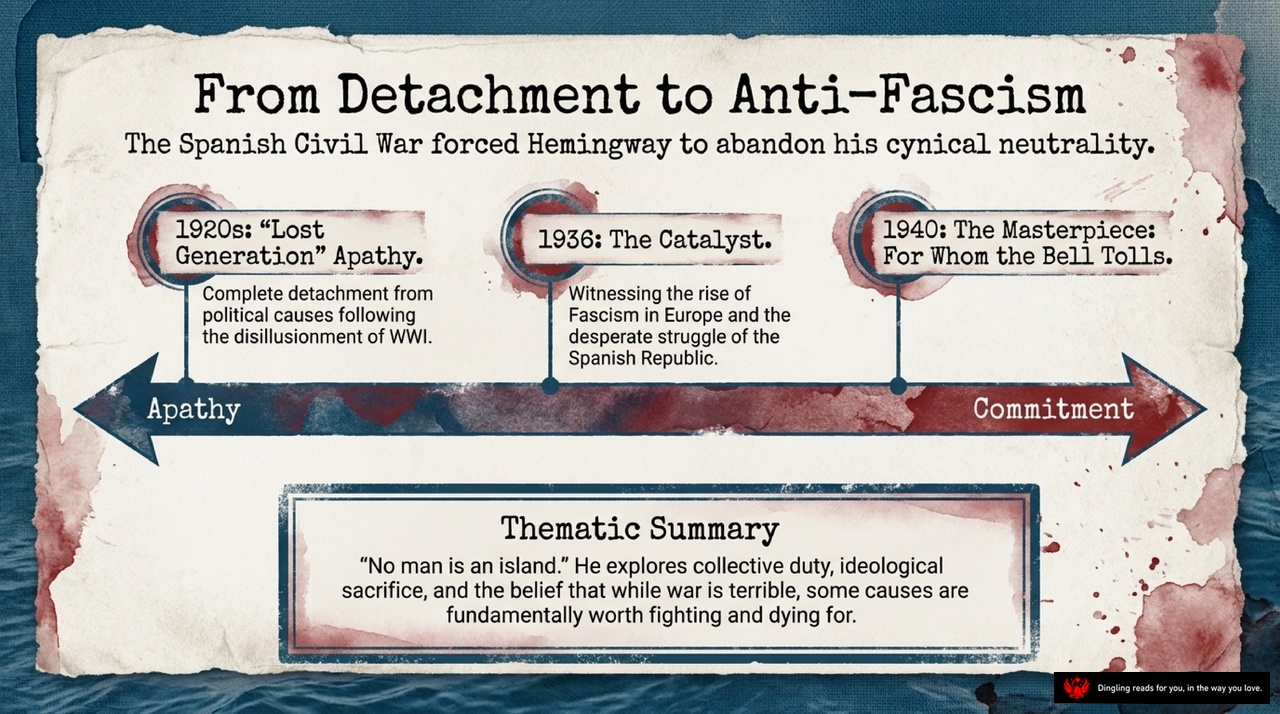
From Detachment to Anti-Fascism: The Spanish Civil War forced Hemingway to abandon his cynical neutrality.
Let's look at this timeline. In the 1920s, Hemingway was part of the "Lost Generation," characterized by a complete detachment from political causes following the disillusionment of WWI. He had retreated into apathy, believing that no man was an island and that war was simply chaos to be observed from a distance.
But everything changed in 1936. This was the catalyst. Witnessing the rise of Fascism in Europe and the desperate struggle of the Spanish Republic shattered his worldview. He could no longer stand on the sidelines. This shift led directly to 1940, his masterpiece, *For Whom the Bell Tolls*.
In this novel, he explores collective duty and ideological sacrifice. He moves beyond the idea that "no man is an island" to the terrifying realization that while war is terrible, some causes are fundamentally worth fighting and dying for. He traded his old cynicism for a fierce commitment, proving that true courage isn't just about surviving the battle, but about choosing which side you stand on.

Today's slide captures the heart of Hemingway's masterpiece, *The Old Man and the Sea*. It outlines a journey that is less about winning and more about the sheer act of fighting.
The cycle begins with **The Quest**: an old Cuban fisherman sets out alone, driven by a need to prove his worth. This leads to **The Catch**, where he hooks a giant marlin after an epic struggle of endurance. It is a battle against the ocean itself, a test of his will against the indifferent universe.
But the story takes a tragic turn with **The Loss**. Despite his victory, the fish is relentlessly devoured by sharks before reaching the shore. He comes back empty-handed, physically exhausted and spiritually stripped. Yet, this brings us to **The Spiritual Victory**. By finding ultimate dignity in the struggle itself, Hemingway delivers his final triumph of spirit.
As the slide notes, this novella was the result of a 16-year gestation. Stripped of cynicism, it stands as an ode to human dignity. It won him the Pulitzer and the 1954 Nobel Prize, cementing the idea that a man can be destroyed but not defeated.

The cracks in the armor. That's the reality of a life lived at the absolute edge. Ernest Hemingway built his entire literary persona on the myth of "grace under pressure"—the idea that a man could remain cool, composed, and elegant even when the world was trying to break him. But as this slide reveals, that armor was far more fragile than he let on.
Look at the physical toll. Two devastating plane crashes in Africa, countless concussions, severe internal organ damage, and shrapnel wounds that never fully left him. It wasn't just about the glory of the hunt; it was about surviving the chaos, the blood, and the sheer unpredictability of nature and war.
Then, look at the mental anguish. Chronic depression, severe paranoia, insomnia, and the haunting, inescapable legacy of his father's suicide. The pressure to maintain that perfect public image while battling a crumbling internal reality created a final paradox. A man whose entire ethos was built on maintaining grace under pressure found himself physically and mentally unable to write or maintain the myth. The weight of the silence became too heavy to carry. When the cracks in the armor finally became unbridgeable, the only way out led to his suicide in 1961. It wasn't a failure of courage, but the tragic collapse of a man who could no longer distinguish between the performance of strength and the reality of his pain.

Imagine a single sheet of paper, illuminated by a spotlight against the dark void, holding the essence of a life lived with reckless intensity. This isn't just about Ernest Hemingway; it's about the paradox of the modern artist: the need to strip language down to its bare, truthful bones to reveal the human condition.
The slide tells us that Hemingway revolutionized literature not by adding ornamentation, but by removing it. He lived a life of relentless intensity—chasing wars, hunting beasts, and cultivating an invincible public persona. But beneath that rugged exterior lay a deeply sensitive artist who profoundly understood human fragility. This duality is the core of his genius. He used his famous 'Iceberg Theory' to translate his own physical and emotional scars into universal masterpieces of courage, love, and ultimate endurance.
The slide poses a haunting question that lingers long after the reading ends: If a creator must constantly confront death and suffering to capture the ultimate truth of life, does the pursuit of creating immortal art inevitably demand the destruction of the artist? We see this in Hemingway's journey, from the trenches of WWI to the Spanish Civil War, and finally to the battlefields of WWII. Every scar he bore became ink; every loss became a story. He didn't just observe the chaos of the world; he stepped right into the middle of it, refusing to look away.
This slide challenges us to consider the cost of authenticity. In our own lives, we often seek to hide our vulnerabilities, to build walls around our emotions. But Hemingway teaches us that true strength comes from acknowledging our fragility. He took the pain of a broken leg, the grief of lost loves, and the terror of war, and he forged them into something beautiful and enduring.
So, as we look at this image, ask yourself: What are you hiding? And more importantly, what masterpiece might you create if you were brave enough to let it all out? The pursuit of truth is never easy, but it is the only path to something that truly matters.