
Essential Thinking: Complete Chapter-by-Chapter Summary

Welcome to Essential Thinking by Soichi Yonezawa. This isn't just another book about "thinking harder"; it's a systematic playbook designed to help you deconstruct the cognitive traps that hold you back and build the mental architecture you actually need to solve fundamental problems.
In a world where speed often trumps substance, we find ourselves stuck on the surface, repeating old mistakes or blindly following trends. This book offers the clarity you need to break free from those invisible barriers. Whether you're facing a complex business challenge or a personal dilemma, the goal is the same: move beyond the noise to find the core truth.
By mastering the tools inside, you'll stop reacting to symptoms and start addressing the root causes. You'll learn how to spot your own blind spots, challenge your assumptions, and make decisions that actually work. This is your chance to upgrade your thinking from a habit to a superpower. Let's dive in and start building a sharper, more effective mind.

Diagnosing the Approach: Surface vs. Essential. This slide breaks down three common triggers that stop us from solving real problems.
First, look at Project Delays. The Surface Thinker sees a bottleneck and simply adds more manpower, ignoring the actual workflow. But the Essential Thinker investigates the process itself, discovering that a specific procurement error caused the four-week delay. By fixing the root cause, the workflow gets optimized.
Second, consider Competitor Success. A Surface Thinker sees a rival's "free-flowing style" and copies it by removing their own service manuals, thinking that's the secret. The Essential Thinker digs deeper, realizing the competitor actually invests 80 hours in rigorous baseline training before letting go of manuals. Without that invisible foundation, copying the visible symptom just creates trash.
Finally, Data Correlation. A Surface Thinker sees that piano students often get into top universities and concludes that piano lessons increase IQ. The Essential Thinker recognizes the underlying variable: affluent, education-focused households enable both piano lessons and university prep. Piano isn't the cause; it's just correlated with the real driver.
The lesson is clear: don't just treat symptoms. When you see a delay, a competitor's style, or a data trend, always ask, "What is the invisible foundation or underlying variable driving this?" Only then can you move from surface-level guessing to essential, effective solutions.

Have you ever wondered why two people can have the exact same conversation and end up with completely different understandings? It's not just a lack of effort; it's a biological reality.
This slide illustrates what I call the "4-Layer Language Filter Funnel." It shows how much precision we lose simply by trying to put our thoughts into words.
Let's break down these four invisible filters. First, we have **Sensory Perception**. Your brain doesn't see the world exactly as it is; it filters visual, auditory, and tactile data through your unique biological acuity. You literally see a different world than your neighbor does.
Next comes **Internal Language Translation**. Your brain forces those complex sensory details into the closest vocabulary it has available. It's a massive simplification. Then, **Outward Expression** happens. We simplify our internal thoughts even further just to make them speakable. Finally, there's **Contextual Adjustment**, or TPO. We tweak our message based on the Time, Place, and Occasion—like softening a harsh truth when talking to a boss.
By the time a message leaves your mouth, it has passed through all four layers. The original thought is significantly altered. This is why relying on words alone is dangerous.
The key takeaway here is clear: Do not rely on words alone. To overcome this information loss, you must integrate visual diagrams, physical prototypes, and rigorous, unambiguous questioning. If you want to be truly understood, you have to speak in more than just words.

Think of your brain not as a static computer waiting for a final answer, but as a dynamic engine that runs on a continuous loop. This slide visualizes that engine perfectly. At the very center, we have "Essential Thought & Rapid Action." This is the core: thinking and doing aren't opposites; they are partners that feed each other.
The cycle starts with Phase 1: Rapid Prototyping. This isn't about rushing blindly; it's about pushing your raw, unpolished idea into the real world to see what actually happens. The goal here isn't perfection—it's friction. You need that real-world push to get honest data.
That leads us to Phase 2: Data Extraction. Once your idea is out there, you harvest the feedback. This is where you find the accurate market signals, uncover risks you didn't see, and understand real user behaviors. This is the critical input your thinking engine needs.
Next is Phase 3: Essential Alignment. Here, you compare the data you just gathered against your original hypothesis. Did the market react as you predicted? If not, why? This step forces you to refine your thinking based on evidence, not just assumptions.
Finally, Phase 4: Directional Correction. You adjust your framework and launch the next iteration. You don't stop; you evolve. As the slide notes, blind action is dangerous, but this specific cycle—where action is designed to feed accurate data back into your thinking—is the ultimate problem-solving method. By constantly looping through these phases, you stop guessing and start building solutions that actually work.

Welcome back. Today, we're diving into the darker side of problem-solving: the "Pathology of Problem-Solving," specifically the Self-Deception Spectrum.
Imagine your brain as a machine with three critical nodes that can fail, leading us from mild deception all the way to severe deception.
First, we have **Node 1: Cognitive Distortion**. This is where **Defensive Ego** takes over. We rewrite reality just to protect ourselves. A classic symptom? Claiming a missed sales target was just a "fluke" while ignoring the fact that your entire team is failing systematically. You aren't looking at the data; you're curating a narrative that makes you feel safe.
Moving to the center, we hit **Node 2: Blind Spots**. This is **Stress-Induced**. When urgency kicks in, your brain hyper-focuses on immediate threats—like a looming deadline—and completely ignores structural decay. It's like ignoring a slow leak in the roof because you're too busy fighting the rain right now. You solve the symptom, but you let the foundation rot.
Finally, at the far right, we reach **Node 3: Lack of Responsibility**, or **Severe Deception**. Here, we see **Learned Helplessness**. It's a complete abandonment of thought. The symptom is clear: following disastrous orders blindly just to avoid personal risk. You operate on a "not my job" mentality, hiding behind the fear of failure rather than taking ownership.
The core issue here is that when we stop thinking critically, we stop solving problems. We just perform the motions of work while drifting further away from the truth. Recognizing where you are on this spectrum is the first step to breaking the cycle.

Imagine a complex machine in the background, representing the intricate workings of our daily operations. Now, look closely at the magnifying glass in the foreground. It's zoomed in on a single gear, showing a frustrated employee hitting a button, completely blind to the massive, broken machinery humming behind them. This visual perfectly captures the "Blind Spot Lens," a trap where stress and urgency artificially narrow our field of vision.
When we feel the pressure of immediate deadlines, our brains prioritize quick symptom relief over long-term survival. This leads to "Whac-A-Mole management," where we exhaust our teams by constantly rewriting customer service scripts to handle a massive influx of complaints. We are treating the symptoms, but what about the unseen reality? The complaints are merely the exhaust fumes of a defective product line or a broken supply chain. By forcing our lens wider, we stop asking how to handle complaints faster and start asking what systemic failure is generating them in the first place.

Look at this anchor dropping right in the middle of our path. This slide is about a silent killer of progress: Mental Inertia, often disguised as the "Gravity of Success."
We live in a world where the environment is constantly shifting—technology, culture, and market demands are all moving up that arrow on the left. But our brains? They are stubborn. We love to assume that a solution that worked perfectly yesterday will work perfectly today. This is the illusion.
But here is the reality: the ecosystem has moved. You are often applying the right answer to a question that no longer exists. Think about it—how many times have you relied on standard industry best practices without checking if they actually fit your current context? Or forced a massive project into a framework built for small-scale wins? We end up demanding more effort as our mismatched strategy begins to fail, simply because we're too comfortable with the old way.
The anchor in the image represents this mental inertia. It pulls us back down, keeping us stuck in the past. To escape this trap, you need to follow one golden rule: A strategy must continually justify its existence against the *current* environment, never its past accolades. Your past success is not a guarantee for your future. If the ground has changed, your footing must change too. Don't let your history become your prison.

Look at this diagram. We call this "Repeated Tracing," or the RCA Iceberg. It's a powerful visual for finding the root cause of any problem.
On the surface, you see the symptom. In our example, it's a 20% turnover rate among young employees. Everyone sees this and feels the pain, but if we stop here, we're just treating the fever, not curing the illness.
Let's dive deeper. Layer one asks "Why?" The answer is severe interpersonal issues with direct managers. Layer two digs further: managers are using aggressive, outdated communication styles. Layer three reveals that managers are overwhelmed by administrative burdens and lack leadership training.
But here is the critical part. Layer four exposes a systemic flaw: the company promotes people based solely on individual technical output, ignoring management capability. And finally, at the core, we find the essential problem: the entire incentive and promotion architecture is misaligned with the company's actual human capital needs.
This is the power of this method. Most people stay stuck at the surface, blaming the symptom. But by repeatedly tracing the "why," we move from a reactive crisis to a proactive solution. We stop fixing the wrong thing and finally address the root cause that drives the entire system.

Today, we're moving from identifying the traps to actually escaping them. Think of this as your diagnostic toolkit. When you spot a symptom—like saying, "We've always done it this way and it worked"—your immediate antidote is **Formatting**. This means stripping away historical authority and rebuilding the logic from zero. Don't just follow the blueprint; redraw it.
If you find yourself hiding bad metrics or blaming bad luck, you're falling into **Cognitive Distortion**. The fix? **Peeling Layers**. Isolate your objective data from your personal ego and the politics of your stakeholders. Look at the raw numbers, not the story you want to tell.
Are you fixing the same localized crisis every month without real results? That's **Isolation & Blind Spots**. You need **Double-Layer Thinking**. Constantly check if your local fix is actively creating a new failure elsewhere in the system. Solve the root cause, not just the symptom.
Finally, if you're adopting a "not my job" attitude to avoid failure, you've hit **Lack of Responsibility**. The solution is **Contrast Analysis**. Dig into the cultural fear of failure and rebuild psychological safety. Stop comparing your effort to a fragile structure; start comparing it to a person who stands tall.
These four methods aren't just theory; they are the practical levers you need to pull to break free from mental inertia and start solving problems at their source.

Imagine a target with three concentric rings: the innermost core is "Personal Authority," the middle ring is "Organizational Capability," and the outermost ring represents "The Actual Problem." An arrow pierces right through the center, aiming at the problem. This visual illustrates a powerful method for escaping local limits: stop trying to solve massive problems with the tiny resources you currently control.
Look at the first box on the right, labeled "The Trap of Free." It highlights a common mistake: attempting to solve a massive data problem with a free software tool just because it requires no budget approval. While it feels smart to avoid spending money, the ultimate cost of system failures and workarounds dwarfs the price of the correct, premium tool. You are essentially paying more in the long run by cutting corners now.
The solution lies in "The Architect's Shift," detailed in the bottom box. Instead of starting with the question, "What can I do with the resources I control?" you must flip the script. Start with, "What is the absolute best solution to this problem?" Once you identify the ideal solution, your job is to design a strategy to acquire the necessary authority, budget, or executive sponsorship to execute it. Your role isn't to stay quietly within your paygrade or organizational capability; it is to solve the problem, no matter what boundaries you currently face. By shifting your focus from your limitations to the problem's requirements, you unlock the ability to cross boundaries and achieve true results.

Imagine a simple, everyday scenario: you place a full coffee cup right next to your laptop. On the surface, it seems harmless. In the best-case scenario, you enjoy your caffeine while working seamlessly, boosting your productivity. But let's look at the worst-case scenario. A slip of the hand sends that coffee crashing onto your hard drive. The result? You wipe out an unbacked-up project, lose a major client, and potentially cause a localized electrical short that disrupts the entire office.
This is the power of "Limit Testing." Before committing to any routine action, you must explicitly define the extreme limits of the outcome. By forcing your brain to calculate this genuine asymmetrical risk—the difference between minor convenience and catastrophic failure—you automatically alter your behavior. You realize the risk isn't worth it, so you simply move the cup.
This exercise isn't just about coffee. It's a mental framework for high-stakes decisions. By applying this exact limit-testing logic to million-dollar project deployments, you can avoid blind spots that lead to disaster. Don't rely on autopilot; always ask yourself what happens when things go wrong.

Imagine you are trying to explain a pull-up to a group of coaches. You might be surprised to learn that ten different coaches would use ten completely different sets of words to describe the exact same movement. If you just follow the instructions, you'll end up confused, and worse, you'll fail. This is the "Gymnastics Paradox." It highlights a critical truth: complex systems simply cannot be communicated entirely through prose.
Look at the diagram on the right. It shows the "Physical Truth" behind that movement. The core requirement isn't about pulling harder; it's about shifting the body's center of gravity closer to the bar. The visual makes the physics undeniable, bypassing the verbal confusion that plagues us every day.
This lesson applies directly to your work and life. When a process, strategy, or architecture is failing to translate across your team, stop writing memos. Instead, map the physics of the problem visually. By using diagrams, sketches, or models, you cut through the noise of language and align everyone on the actual reality of the situation, ensuring that your team isn't just talking past each other, but actually solving the problem together.
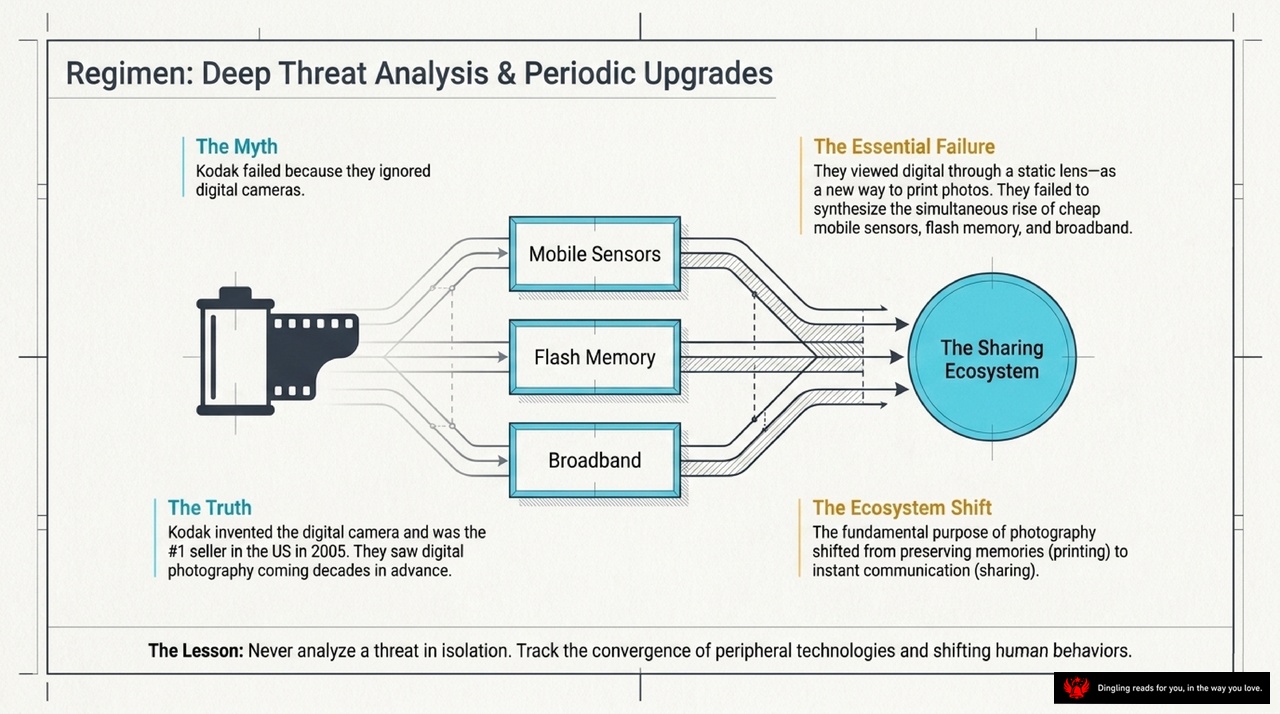
Kodak didn't fail because they didn't invent the digital camera. In fact, they invented it in 1975 and were the top seller in the US by 2005. So what went wrong? The real killer wasn't the camera itself, but a shift in the entire ecosystem.
Look at the diagram. It shows three converging forces: mobile sensors, flash memory, and broadband. Individually, none of these would have killed Kodak. But together, they created a "Sharing Ecosystem." Suddenly, photography wasn't just about printing photos to preserve memories anymore; it became about instant communication and sharing.
Kodak's fatal mistake was viewing digital cameras through a static lens, simply seeing them as a new way to print photos. They failed to synthesize how these three technologies combined to change human behavior. The lesson here is clear: never analyze a threat in isolation. You have to track the convergence of peripheral technologies and shifting human behaviors. If you only look at the product and ignore the ecosystem, you'll miss the real disruption until it's too late.

Essential thinking isn't magic; it's a designed architecture you build and maintain. Look at this diagram: at the very center lies the "Essential Thinking Engine." But what powers it? It relies on three critical layers surrounding that core. First, we have "Radical Objectivity." This means stripping away the ego's defense mechanisms and refusing to let past successes blind us to new realities. Second, we need "Ecosystem Awareness." You must see the invisible systemic failures lurking beneath the surface—ask yourself, if the problem I'm solving today vanished tomorrow, what hidden flaw would remain to destroy my next project? Finally, we apply "Continuous Tracing," often called the "5 Whys," to drill down from visible symptoms straight to the structural root.
This synthesis creates a powerful feedback loop. It requires piercing through the blur of ambiguous language and rejecting the gravity of old habits. As the text reminds us, essential thinking is about tracing every symptom to its source. When you master this engine, you stop reacting to surface noise and start solving the actual problem.