
Essentialism: Complete Chapter-by-Chapter Summary

Essentialism: The Disciplined Pursuit of Less. Welcome to a completely different way of thinking about work and life.
Today, we're diving into Greg McKeown's masterpiece. As the slide beautifully illustrates, this isn't about doing more; it's about a systematic methodology to discern what is absolutely essential, eliminate everything that is not, and make the execution of the vital few effortless.
Imagine a beam of light cutting through the darkness. That is the essence of Essentialism. It teaches us that true freedom comes from the courage to say "no" to the good so we can say "yes" to the great. It's about shifting from a mindset of "I must do this" to "I choose to do this."
By embracing the principle of "Less, but Better," we stop being controlled by others' agendas and start designing a life of purpose. Whether you are a leader, a parent, or an individual striving for your peak contribution, the disciplined pursuit of less is the ultimate path to achieving more.

Success often feels like the ultimate goal, but as this diagram illustrates, the relentless pursuit of it can ironically become the very catalyst for our failure. Look at the cycle: we start with Clarity, which leads to successful outcomes. That success builds our reputation as the "go-to person," creating a flood of new Options and opportunities. But here lies the trap. Instead of stopping to reflect, we fall into Diffused Effort. We try to grab every new opportunity, spreading ourselves too thin and undermining the original clarity that actually led us to success in the first place.
This creates a vicious loop where more activity equals less effectiveness. The key insight here is that true success isn't about doing everything or chasing every option. It's about protecting that initial clarity. By resisting the urge to diffuse our effort across a dozen new demands, we break the cycle. We stop letting success distract us from what truly matters. Instead of blindly taking on more, we choose to focus deeply on what we've already identified as important. It's a counterintuitive truth: sometimes, the best way to move forward is to stop, filter out the noise, and ensure our next step is driven by our original vision, not by the chaos of new options.

Imagine a world where your energy is scattered like a chaotic explosion of arrows pointing in a million directions. That is the trap of fractionated energy: you move a millimeter forward in a thousand different places, yet end up nowhere. Now, picture the opposite. Imagine a single, powerful arrow cutting through the noise, pushing you a full mile in one specific direction. This is essentialist energy.
The core difference isn't about working harder; it's about working with intent. Fractionated energy is the result of trying to do everything, believing that every opportunity is a must-have. But essentialism teaches us that true progress comes from the courage to do fewer things, but better. When you stop chasing every arrow and commit to one strong direction, you stop wasting your life on trivialities and start making a real impact. It's the shift from being busy to being effective, from being scattered to being focused. By embracing this singular direction, you unlock the power to achieve what truly matters.

Weniger aber besser—Less, but better. This isn't just a catchy phrase; it's the fundamental shift from being a non-essentialist to an essentialist. Think about your mindset. Are you operating under the pressure of "I have to," believing everything matters? Or have you chosen to embrace the truth that only a few things truly matter?
Look at the difference in action. The non-essentialist is trapped in an undisciplined pursuit of more, constantly reacting to whatever feels most pressing in the moment. They are living a life that simply does not satisfy. In contrast, the essentialist practices a disciplined pursuit of less. They pause to discern what truly matters, creating the space to focus on the vital few.
The result of this shift is profound. Instead of a life of constant busyness and superficial achievement, you are living a life that really matters. By choosing to be the essentialist, you stop letting the world dictate your schedule and start designing a life of genuine contribution and satisfaction.

Think of your life as a closet you've been filling for years. You have clothes hanging there that you thought were essential, but do you really wear them? Do you actually love them? Or are you just holding onto things out of habit or the fear of losing them?
The first step to mastering Essentialism is to stop blindly accepting every item in your life. You need to explore and discern the vital few from the trivial many. Ask yourself a hard question: "If I didn't own this, how much would I pay to acquire it?" If the answer is nothing, it's time to let it go.
But getting rid of the non-essential is only half the battle. You must actively cut the noise. Many of us struggle to say "no" because we fear missing out or hurting relationships. Yet, if you don't say "no" to the unimportant, you are effectively saying "yes" to everything else, which dilutes your impact.
Once you've cleared the clutter, the final step is to execute by organizing. Don't just work harder; build a system that makes doing the vital few effortless. Imagine a bookshelf where only your most important books are placed, ready to be grabbed instantly. By differentiating the vital from the trivial, cutting the non-essential, and building a streamlined system, you stop being a slave to your tasks and start being the master of your time. This is how you achieve peak personal contribution with less, but better.

Think about the last time you made a big decision—whether it was accepting a new job, launching a project, or even choosing a partner. How often did you hesitate because you weren't 100% sure? You worried about missing out on something "good enough," fearing that saying no meant losing potential. But what if I told you that the path to true success isn't about finding the perfect middle ground, but about setting a brutal standard for yourself?
This is the core of the 90% Filter. As the slide clearly illustrates, if an opportunity doesn't score a clear yes above the 90% mark, it is a definitive no. It's not about being arrogant or exclusive; it's about protecting your most valuable asset: your time and attention.
Consider the criteria on the right. Does this opportunity inspire me? Am I uniquely talented at this? Does it meet a significant, unmet need in the world? If the answer to these questions isn't a resounding yes, then it doesn't belong in your life. We often get trapped by the fear of rejection, worrying that we're turning down something great. But let's be honest: most things that seem "good" are actually just distractions. They are the noise that drowns out the signal.
Look at that scale. From 0 to 80, everything is gray—uninspiring, average, or merely adequate. But once you cross that 90% threshold, the landscape changes. You enter the zone of excellence. This is where the magic happens. When you raise your standards to this level, you stop competing for the mediocre and start creating the extraordinary. You stop trying to please everyone and start serving your specific purpose.
Think about the cost of lowering your bar. Every time you accept something that only scores an 80 or an 85, you are essentially saying yes to mediocrity. You are diluting your focus, draining your energy on tasks that don't align with your peak contribution. Over time, these small compromises add up to a life of regret, filled with "what ifs" and unfinished projects.
The 90% Filter is a powerful tool for reclaiming your agency. It forces you to be honest with yourself. Instead of asking, "Can I do this?" you ask, "Is this worth everything I have to give?" It's about the courage to walk away from the "nice" opportunities so you can fully commit to the "great" ones. Remember, life is short. You cannot afford to spend your limited days on things that don't ignite your passion or solve real problems.
So, the next time an opportunity comes your way, don't rush to say yes out of fear or habit. Take a step back and measure it against this filter. If it doesn't light you up and score a 90 or higher, let it go. Say no with conviction. Because when you stop settling for good, you make space for the truly exceptional. That is how you live a life of impact, not just activity.

Protect the Asset. The most valuable thing you own isn't your car, your house, or your portfolio—it is you. Your mind, your energy, and your cognitive capacity are the only assets that can never be bought back once spent. To treat yourself like a premium asset, you must actively guard it against the wear and tear of modern life.
Look at this diagram. It highlights three critical pillars for protecting your mental capital: Sleep, Play, and Space.
First, Sleep. Think of sleep not as a break from work, but as the essential maintenance time for your brain. It recharges your cognitive discernment. Without it, your decision-making crumbles. We've seen leaders crash hard because they treated rest as a luxury. But true asset protection means prioritizing 8 hours of sleep to ensure your brain is sharp enough to make the right choices.
Second, Play. We often mistake play for wasting time, but science tells us otherwise. Play sparks neuroplasticity and creates the state of flow. It's the moment your brain makes new connections, turning chaos into creativity. Einstein and Newton both found their greatest breakthroughs while playing or relaxing. So, don't suppress your childhood joy; let it fuel your innovation.
Finally, Space. This is about creating a deliberate black box environment with zero distractions. In a world of constant notifications, deep synthesis is impossible without silence. You need a mental and physical space where you can think deeply, process information, and truly understand the world around you.
By rigorously protecting these three areas, you stop being a reactive worker and start being a strategic thinker. You aren't just surviving the day; you are investing in your future self.

The Invisible Art of Editing isn't just about fixing mistakes; it's about the disciplined courage to cut. As we see here, Michael Kahn, an eight-time Oscar nominee, proves that winning isn't about what you keep, but what you dare to remove. His philosophy is simple yet profound: subtract the merely good to make room for the great, condense your steps to achieve the same outcome with less effort, and constantly correct your actions to align with your core intent.
Think of your life as this film strip. Too many of us are terrified of hitting the scissors. We hold onto every "nice" opportunity, every extra meeting, every side project, believing that doing more equals success. But the truth is, if you don't say no to the good, you are saying yes to the mediocre. The quote at the bottom reminds us of the pain of this process: "Cut till it hurts." It hurts because you are letting go of parts of yourself that you've invested in. But that pain is the price of clarity. By ruthlessly editing out the noise, you create space for what truly matters, allowing your most important work to shine without competition.

Imagine a scale balancing two competing forces: on one side, the fleeting allure of short-term popularity, and on the other, the enduring weight of long-term respect. In the world of Essentialism, the scale clearly tips toward respect. We often feel pressured to say "yes" to every request to stay liked, but true leadership isn't about being everyone's favorite; it's about earning everyone's trust by having the courage to say "no."
To make this shift, we need a tactical toolkit. First, separate the decision from the relationship. A polite "no" doesn't mean you dislike the person; it simply means you are prioritizing your own values. Second, utilize the awkward pause. When a request comes in, count to three before responding. That brief moment allows you to choose your words with intention rather than reacting out of obligation. Third, master the "No, but..." technique. Decline the primary request, but immediately offer a low-friction alternative that aligns with your actual capacity.
Consider the story of Paul Rand, the legendary designer who rejected Steve Jobs' request for multiple logo options. Rand insisted on providing only one definitive solution, prioritizing professional respect over the desire to please. Jobs eventually realized that Rand's discipline was exactly what he needed. This is the power of the graceful no. It frees us from the trap of trying to do everything, allowing us to focus our energy on what truly matters. By embracing this balance, we stop chasing temporary applause and start building a legacy of genuine respect.

Imagine a sprinkler positioned right on the border between two properties. If you don't define that boundary clearly, the water meant for your own garden will inevitably drift over, drowning your neighbor's lawn while your own grass dies from thirst. This is the essence of "The Boundary Sprinkler." Without clear boundaries, you end up solving your neighbor's problems instead of tending to your own.
We often fall into the trap of thinking we can do it all, that we can handle everyone else's crises alongside our own responsibilities. But the reality is, if you don't establish a social contract upfront, their problem becomes your problem. You become the one watering the wrong lawn.
The solution is simple but powerful: define your limits early. Don't let the chaos of other people's expectations dictate your life. By setting these boundaries, you protect your own grass from drying out. You stop being a passive bystander in your neighbor's crisis and become the master of your own garden. It's about realizing that true freedom comes from knowing exactly where your responsibility ends and where someone else's begins. So, before you water anything else, make sure you've drawn the line.
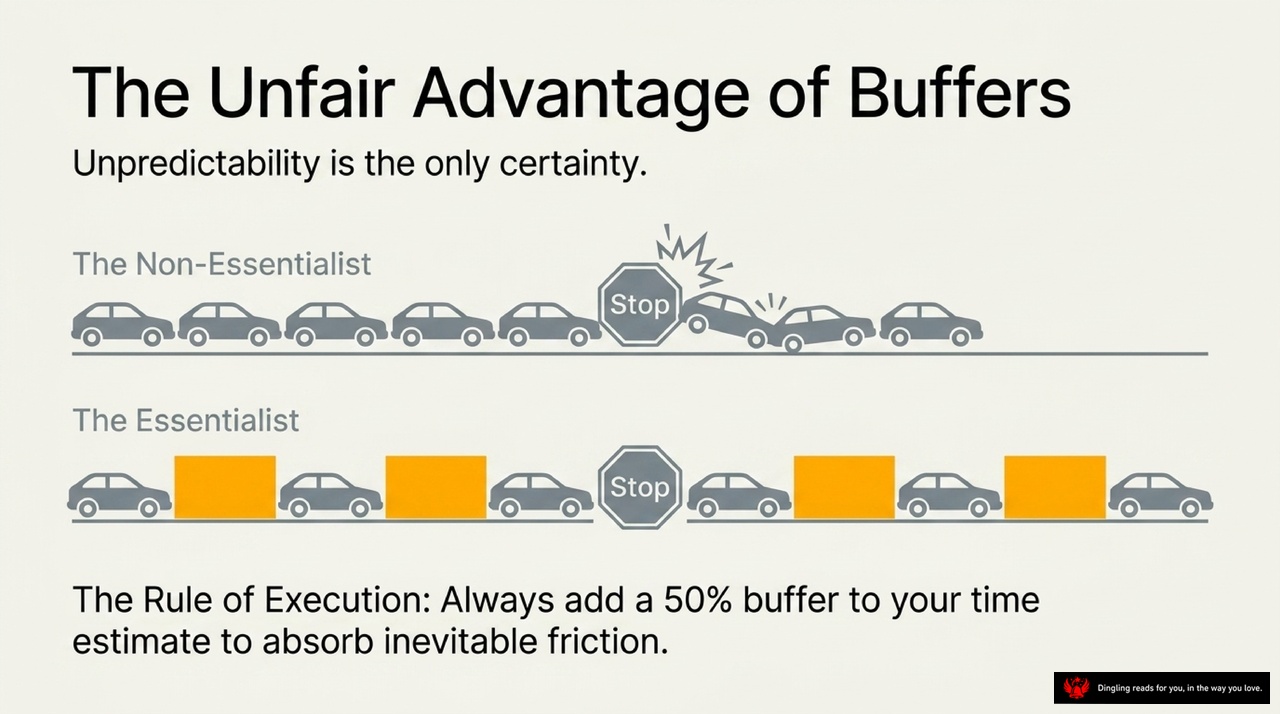
Think about how you plan your day. You probably tell yourself, "That meeting only takes 5 minutes," or "I'll finish this report by Friday." But here's the hard truth: you are consistently underestimating the time it takes. This is known as the "planning fallacy." When unexpected friction hits—like a sudden email or a technical glitch—you're left scrambling, often working late or delivering half-baked results.
This slide introduces a simple but powerful rule to fix that: The Rule of Execution. It states that you should always add a 50% buffer to your time estimates. Why? Because unpredictability is the only certainty in life.
Look at the top section, labeled "The Non-Essentialist." Imagine a line of cars driving straight toward a stop sign with no space between them. When the sign appears, they crash into each other. That's what happens when you pack your schedule too tight. There is no room for error, and one small delay brings everything to a standstill.
Now look at the bottom section, "The Essentialist." Notice the orange blocks between the cars. These are your buffers. By adding that extra 50% of time, you create a safety zone. When the stop sign appears, you can brake smoothly instead of crashing. You absorb the inevitable friction of daily life without letting it derail your entire plan.
So, the next time you estimate how long a task will take, don't just guess the best-case scenario. Double down slightly. Add that buffer. It's not about being lazy; it's about giving yourself the unfair advantage of calm, control, and the ability to actually finish what you start.

Imagine a hiking team where the entire group's speed is dictated by the slowest member. If one hiker is overloaded with a heavy pack, the whole line grinds to a halt. Instead of forcing the faster hikers to slow down or adding more energy to the system, the smartest move is to remove the weight from that specific person. This is the essence of "Subtracting the Bottleneck."
The process starts with **Identify**. You must locate the slowest hiker—let's call him Herbie—who is dictating the pace of the entire system. Often, we don't see this until we stop and look. Next, we **Re-order**. Move that bottleneck to the front of the line. By placing the constraint where it is most visible, the true capacity of the team becomes clear. Finally, we **Subtract Weight**. Do not force the system to work harder; instead, remove the weight from the bottleneck.
The core message here is powerful: instead of adding more effort or resources to a broken process, isolate and remove the specific obstacle slowing you down. True efficiency isn't about working harder; it's about clearing the path so the system can flow naturally.

The genius of routine lies in its ability to turn effort into ease. As the slide illustrates, when we rely on our prefrontal cortex for every decision, mental effort is sky-high. But by building automated routines, we shift the burden to the basal ganglia, dramatically lowering the cognitive load required to execute tasks. This isn't about being lazy; it's about engineering your brain for efficiency. When routine handles the basics, it frees up your mental space for the high-level creative thinking that actually drives breakthroughs.
Think of Olympic champion Michael Phelps. His pre-race routine was so deeply ingrained that winning became simply the final step of a subconscious program. He didn't have to decide what to do; he just had to do what he had practiced thousands of times. This is the power of automation: it removes the friction of choice. Instead of wasting energy on "what's next," your brain runs on autopilot, allowing you to focus entirely on the moment and the mission. By designing these systems, you stop fighting your own brain and start working with it, making execution effortless and your best work inevitable.

Imagine you are standing in the center of a target, with a bright orange dot right in the middle labeled "Focus Amber." Surrounding this core are concentric circles representing "The Kairos Moment"—that perfect, fleeting opportunity where time and purpose align. But look to your left and right: on one side, you have "Past Regrets," and on the other, "Future Anxieties." These are the forces that constantly try to pull you away from the center, dragging you into the noise of yesterday's mistakes and tomorrow's fears.
The core message here is simple yet profound: you cannot simultaneously focus on two things. Multitasking is just an illusion; true focus only exists in the absolute present. To find your "Focus Amber," you must learn to ignore the distractions of the past and future and commit entirely to what is important right now. This is the essence of W.I.N.—What's Important Now. By anchoring yourself in this single point, you stop spinning in circles and start making real progress. It's about choosing one thing, doing it perfectly, and letting everything else fade into the background.

Essentialism isn't about doing more; it's about doing the right things. It is a systematic discipline of pausing to discern the vital few and eliminating the trivial many, designing a life where execution becomes effortless. But here is a profound truth: the most successful people often seem to do the least. Think of Michael Phelps, the Olympic legend who won eight gold medals. He didn't rely on brute force or working harder than everyone else. Instead, he built a rigorous routine. Every day, he rehearsed his perfect performance in his mind before sleep and upon waking. By automating his preparation, he freed his conscious mind to focus entirely on the moment of execution. This is the power of routine: it reduces decision fatigue, allowing your brain to conserve energy for what truly matters.
However, routine alone isn't enough. You must also master the art of being fully present. Many of us suffer from a "success paradox" where achieving our goals only distracts us with new, trivial choices, trapping us in a cycle of busywork. The antidote is focusing on the "Kairos moment"—the quality of the present moment itself. Imagine a sushi master like Jiro Ono, who has spent decades perfecting his craft. His secret isn't multitasking; it's immersing himself completely in the current task, ignoring the past and the future. True execution happens when you stop trying to do everything and instead ask, "What is most important right now?"
This shift in mindset transforms your life. When you stop chasing every opportunity and instead design a system where the right things happen automatically, you gain immense freedom. You stop being a slave to your to-do list and start becoming the master of your time. By combining the discipline of routine with the presence of the moment, you create a life where less actually yields more, and your execution becomes not just efficient, but effortless.