
Ethics: Complete Chapter-by-Chapter Summary
Welcome to our deep dive into one of the most profound works in Western philosophy: *Ethics* by Baruch de Spinoza. This isn't just a book about rules; it's a geometric deduction of the entire universe, designed to show us that God and Nature are one and the same. Spinoza argues that true human freedom isn't about doing whatever we want, but rather lies in our rational understanding of our own necessity.
On this opening slide, you see the core thesis: God is Nature. Spinoza invites us to move away from the idea of a distant, judgmental deity and instead see the universe as a single, infinite substance. He teaches that by understanding the logical order of nature, we stop feeling like helpless victims of fate and start seeing ourselves as active participants in the fabric of reality. This shift in perspective is the very foundation of the freedom and happiness we are going to explore throughout this course. Let's begin this journey into the geometry of the soul.

Imagine philosophy not as a collection of abstract opinions, but as the precise engineering of reality itself. Just as an architect relies on unshakeable foundations to build a skyscraper, Spinoza argues that we must start with self-evident definitions and axioms to construct a system of absolute truth.
Look at the blueprint on your screen. The foundation consists of **Definitions and Axioms**—the irreducible starting points of reality. From these, we derive **Propositions**, which are ironclad logical deductions. Finally, we arrive at **Scholiums and Corollaries**, the practical implications that guide our lives.
Spinoza's genius lies in treating human thoughts, emotions, and desires exactly like points, lines, and planes in geometry. By removing subjective moral judgments, he uncovers an objective, universal truth. In this mathematical view of the universe, everything flows inevitably from the nature of God or Substance. There is no room for chance or free will in the traditional sense; everything is determined by the laws of nature.
This shift changes everything. If we understand our emotions not as random impulses, but as necessary consequences of physical causes, we stop being victims of our feelings. We gain the power to analyze them, understand them, and ultimately master them. This is the path from being a slave to our passions to becoming free.

Imagine reality not as a stage where God sits apart, directing the show, but as a single, indivisible substance that *is* everything. This is Spinoza's radical vision: God and Nature are one and the same. When we strip away the illusion of duality, we see that there is only one self-caused, infinite reality. Within this unity, we find two expressions: *Natura Naturans*, the active, eternal laws of physics and existence that create the universe, and *Natura Naturata*, the finite things we perceive—the specific modes and objects that fill the cosmos, including us.
Spinoza shatters the idea that we are separate from the divine. Instead of a creator standing outside the universe, God is the universe itself. Every thought, every stone, every emotion is simply a mode of this single substance. We are not distinct from nature; we are nature thinking itself. This means that to understand ourselves, we must understand the universal laws that govern all of reality. There is no external force pulling us, only the internal logic of the one substance unfolding through time. By embracing this unity, we move from seeing ourselves as isolated victims of fate to recognizing our essential connection to the whole.

Imagine the mind and the body not as two separate entities locked in a battle for control, but rather as two sides of the exact same coin. This is the core of Spinoza's "Parallelism of Existence." As the slide illustrates, the mind and the body do not command each other; instead, they are identical modes of the same infinite substance, expressed in two different languages of reality. Every physical action you take has an exact, corresponding mental idea. They act in absolute unison because they are simply the same event viewed from different angles—one through the attribute of extension (the body) and the other through the attribute of thought (the mind).
Spinoza captures this perfectly in Proposition 7: "The order and connection of ideas is the same as the order and connection of things." This means there is no gap between your thoughts and your actions; they are perfectly synchronized. If you feel a surge of anger, it is not because your mind forced your body to react, but because the very same causal chain that produced the physical state of your body simultaneously produced the mental state of anger. We are not two things fighting for dominance; we are one thing experiencing itself in two ways. Understanding this parallelism dissolves the illusion of a master mind controlling a slave body, revealing instead a unified, coherent reality where thought and matter move in perfect harmony.

The Engine of Human Life is the central theme of this slide, and it points directly to a concept Spinoza calls "Conatus." Look at that golden, radiant core in the middle. It represents the fundamental drive of every single thing in existence: the relentless effort to persist in its own being. Spinoza argues that this striving isn't just a human trait; it is the very essence of reality itself.
Now, let's break down how this drive manifests. On the left, you see the definition: every individual thing endeavors to persist as far as it can. But how do we experience this internally? The slide explains the "Manifestation of Striving." When this drive exists purely in the mind, we call it **Will**. When it involves both the mind and the body working together, it becomes **Appetite**. And finally, when we become conscious of that appetite, it transforms into **Desire**. This distinction is crucial because it moves us from abstract philosophy into the tangible human experience of wanting things.
However, the most profound insight here challenges our everyday logic. Look at the text at the bottom: "We do not desire things because we judge them to be good; we call them good entirely because we desire them." This flips the script on how we think. We don't look at an object, decide it's good, and then want it. Instead, our internal drive pushes us toward something, and *because* we are drawn to it, we label it "good." Our desire precedes our judgment. This means our actions are driven by an internal necessity, not by a free choice to pick what is objectively best. Understanding this engine of human life helps us realize that our desires are not random; they are the direct expression of our essence striving to exist and flourish.

Have you ever felt like your emotions were running on a chaotic, unpredictable script? We often think feelings like love or hate are mysterious forces that just happen to us. But Spinoza offers a radical, almost mathematical way to see them.
Look at this slide: "The Calculus of Human Emotion." Spinoza argues that if we strip away the drama, human emotion follows a strict logic. He identifies three primary affects that drive everything: Desire, Joy, and Sorrow. Desire is simply our striving to exist. Joy is the transition to a greater state of perfection or power. Conversely, Sorrow is the shift toward a lesser state.
Now, here is where it gets fascinating. Spinoza creates "Emotional Equations." He suggests that complex emotions are just these primary drives reacting to the external world. For example, when you feel Joy combined with the idea of an external cause, the result is Love. You love something because it increases your power. On the flip side, if Sorrow meets the idea of an external cause, the result is Hate. You hate something because it diminishes your power.
As the slide notes, even emotions like jealousy, pride, or anger are just mathematical variations of these three core drives. Spinoza isn't trying to dampen your feelings; he wants to show us that by understanding the equation behind our emotions, we stop being passive victims of them. When you realize that your anger is just a reaction to a perceived loss of power, you gain the ability to calculate a better response. This is the first step toward true freedom—moving from being ruled by blind impulses to understanding the logic that drives them.
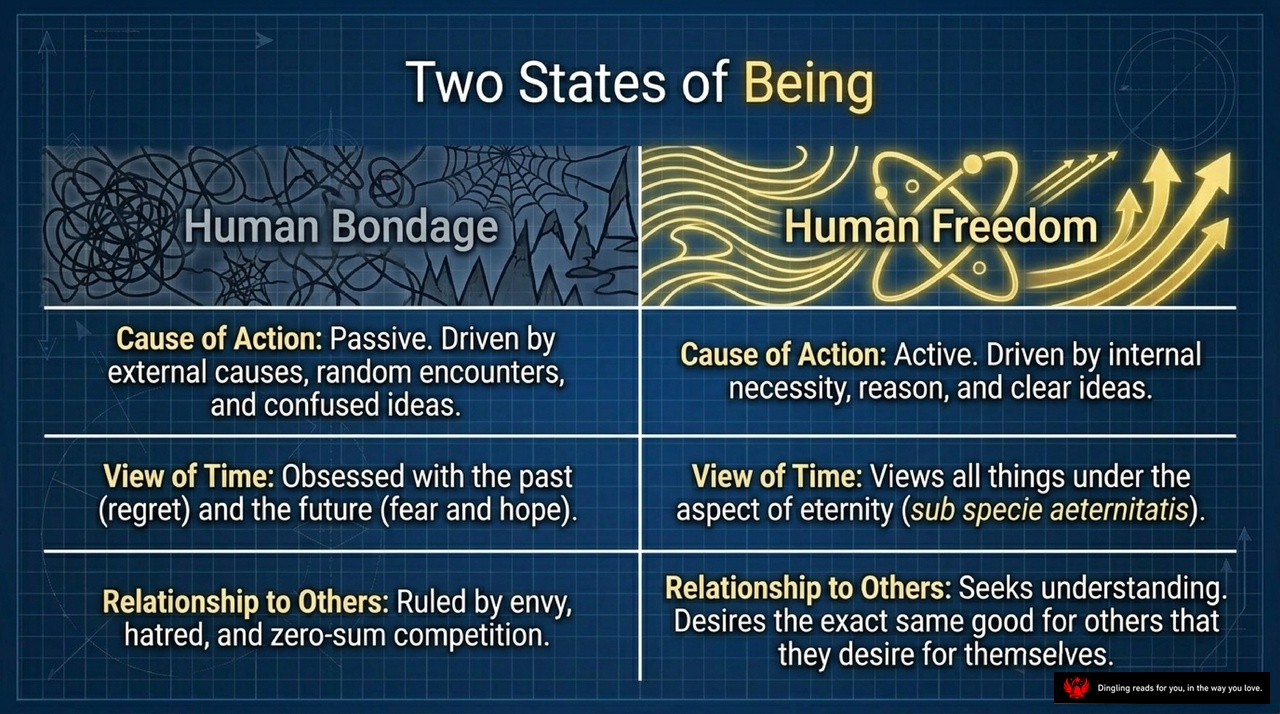
Imagine you are living in two completely different worlds at the same time. On one side, you are trapped in a tangled web of chaos, reacting to every random event, obsessed with the past and terrified of the future, and constantly competing with others out of envy. This is the state of **Human Bondage**. You feel passive, driven by forces you can't control, viewing time as a linear line of regret and fear, and seeing relationships as a zero-sum game where someone's gain is your loss.
But on the other side of that same life, there is a path to **Human Freedom**. Here, you are no longer a passive victim of external causes. Instead, you are active, driven by your own internal reason and clear ideas. You stop obsessing over what happened or what might happen, and instead view everything through the lens of eternity—seeing the eternal necessity behind all things. Your relationships transform from a battlefield into a space of understanding; you begin to desire the exact same good for others that you desire for yourself.
The core difference isn't about magic or escaping reality; it's about shifting your perspective. When you move from being ruled by confused emotions to being guided by rational understanding, you break the chains of bondage. You stop being a slave to the wind and start becoming the wind itself, finding true peace and freedom not by changing the world, but by finally understanding it.

Imagine you are a stone flying through the air. If you suddenly became conscious mid-flight, you would instinctively believe that you are moving entirely by your own free will. But here is the hard truth: you are just as much a stone as that rock. You are intensely aware of your actions and desires, yet you remain completely ignorant of the invisible chain of causes that actually determines them.
This is what Spinoza calls "The Mirage of Human Agency." We live under the illusion that we are the authors of our own lives, when in reality, we are simply the effects of prior causes. True freedom, therefore, is not the impossible ability to act without a cause. Instead, true freedom is the power to rationally understand the causes that compel us. When we stop pretending we are the masters of the universe and start understanding the forces that move us, we finally find our liberty.
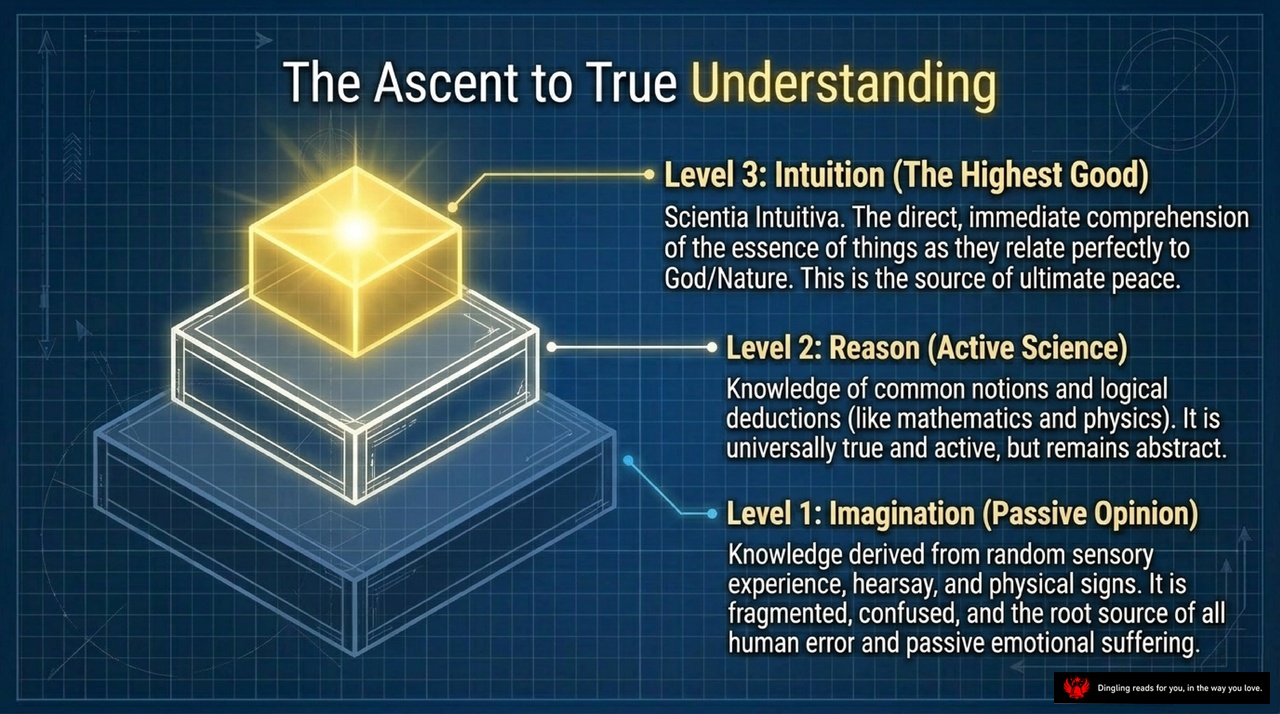
Imagine knowledge not as a flat collection of facts, but as a ladder leading to a higher state of being. Today, we are climbing that ladder.
At the very bottom, we find Level 1: Imagination, or what Spinoza calls "Passive Opinion." This is the realm of random sensory experiences, hearsay, and fragmented physical signs. It's where we see the sun as a small disk just above the horizon, or where we confuse our own fleeting desires with the nature of the universe. This level is the root of human error and passive suffering because it deals with confusion and incomplete understanding.
Moving up to Level 2, we reach Reason, or "Active Science." Here, knowledge becomes universally true and active. It relies on common notions and logical deductions, much like the certainty found in mathematics or physics. While this is a massive leap forward, Spinoza notes that it remains somewhat abstract. It helps us navigate the world logically, but it hasn't yet grasped the ultimate essence of things.
Finally, at the summit, lies Level 3: Intuition, which Spinoza defines as "The Highest Good." This is *Scientia Intuitiva*—the direct, immediate comprehension of the essence of things as they relate perfectly to God or Nature. Unlike the step-by-step logic of Reason, Intuition allows us to see the whole picture instantly. It is the source of ultimate peace and the only form of knowledge that truly liberates us from the confusion of the lower levels.
The journey from fragmented opinion to intuitive understanding is the path to true freedom.

Imagine a universe where everything is perfectly connected, a grand web where nothing happens by chance, but rather by an unbreakable law. In this view, the ultimate goal of human life isn't to change the world, but to finally understand our exact place within it. When we grasp this truth, a profound shift occurs: our passive suffering ends.
This is what Spinoza calls *Amor Dei Intellectualis*, or the Intellectual Love of God. It's not about worshipping a distant deity or hoping for a reward in the afterlife. Instead, it is the pinnacle of human existence, achieved when our minds align perfectly with the universe. By understanding the laws of nature, we stop seeing ourselves as victims of fate and start recognizing the divine order within reality itself.
Spinoza teaches us that to understand God or Nature is simply to love it. And this love is eternal—it is the exact same love with which God loves Himself. We aren't creating something new; we are simply becoming aware of what has always been true. As he famously states, "Blessedness is not the reward of virtue, but virtue itself." Happiness isn't something you earn later; it is the very act of understanding and living in harmony with the eternal.

So, where do we stand? We've journeyed from the absolute nature of God to the mechanics of the human mind, and now we arrive at the heart of Spinoza's ethics: the nature of our emotions and the path to freedom.
The slide asks us to summarize our findings. True freedom, Spinoza insists, isn't about escaping necessity—that's an illusion. Instead, true freedom is the conscious understanding of necessity. By transforming our confused passions into clear ideas, we align our minds with the eternal laws of Nature, achieving a state of active joy and unshakeable peace.
But how do we get there? The challenge we face is this: If your actions are entirely determined by the natural laws of the universe, how will you use your reason today to transform passive endurance into active, intellectual joy?
We've seen that emotions are just changes in our power of acting. When we are passive, driven by external causes, we suffer. But when we use reason to understand the causes of our emotions, those emotions lose their power to enslave us. We move from being victims of circumstance to active participants in our own lives. This shift—from confusion to clarity, from passive suffering to active understanding—is the very essence of the life Spinoza advocates. It's not about denying our feelings, but about understanding them deeply enough that they become part of our wisdom rather than our chains.