
Excellent Advice for Living: Complete Chapter-by-Chapter Summary
Welcome to our book club session on Kevin Kelly's "Excellent Advice for Living." Imagine this entire collection of wisdom as a single, intricate walnut—the hard outer shell protecting the rich, nutritious kernel inside. That's exactly what this book represents: time-tested wisdom distilled into concise seeds designed to help you cultivate a generous, remarkable, and uniquely fulfilling life.
In a world that often feels chaotic and overwhelming, Kelly offers us a clear path forward. He suggests that true growth isn't about avoiding conflict or seeking comfort, but rather about engaging deeply with the world around us. Whether it's learning from those who challenge our views, embracing optimism as a superpower for our intelligence, or simply asking "Is there more?" when listening to a loved one, every piece of advice is a small seed waiting to be planted.
The core message here is about intentionality. It's about shifting from passive existence to active cultivation. By treating our lives as a design project rather than a fixed script, we gain the freedom to experiment, to fail, and to evolve. Whether you're navigating complex relationships, managing your finances, or finding your unique voice, these principles serve as a reliable compass.
So, let's take a moment to reflect on these seeds of wisdom. Which one resonates most with your current journey? Whether it's the courage to ask "stupid" questions, the power of saying "I'm learning," or the radical act of choosing kindness over being right, the goal is the same: to build a life that feels authentic and deeply satisfying. Let's dig into these ideas together and see how they can take root in our daily lives.
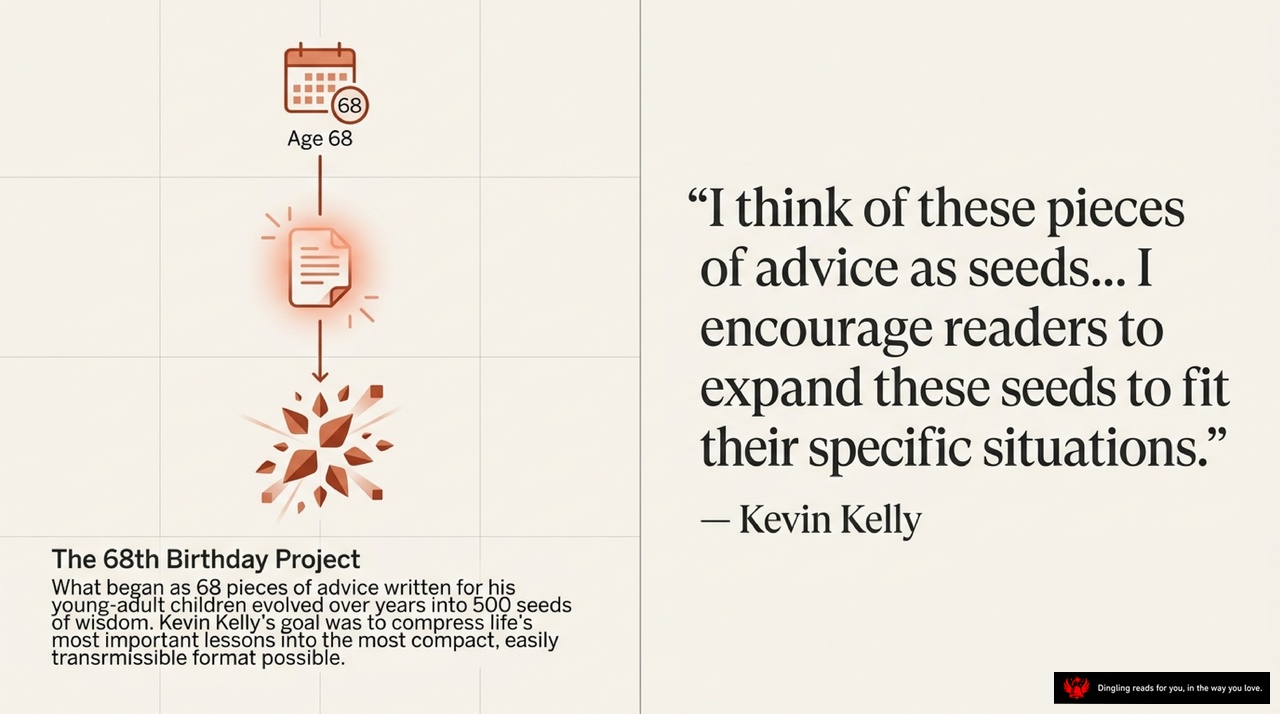
At age 68, Kevin Kelly reflects on his "68th Birthday Project," a journey that began with advice for his children and evolved into a forest of 500 wisdom seeds. As the slide beautifully illustrates, he views these pieces of advice not as rigid rules, but as seeds. His core message is clear: he encourages readers to take these seeds and expand them to fit their specific situations.
Think about it this way. Life doesn't come with a one-size-fits-all manual. Instead, it offers you raw materials—these "seeds" of insight. The magic happens when you stop looking for a perfect, pre-packaged answer and start planting these ideas in your own unique soil. Whether you are navigating a career crisis, raising a family, or simply trying to find your rhythm, the goal isn't to memorize the advice, but to cultivate it. By taking these universal truths and stretching them to match your reality, you transform passive reading into active living. It's about making the wisdom your own, growing something new and personal from the ideas you've gathered.

So, what actually makes a life worth living? It's not just about checking boxes or climbing a ladder. Today, we're looking at the four essential pillars that hold a well-lived life together.
First, let's talk about **The Inner Game**. This is about mastering your mindset, patience, and optimism. Think of it as upgrading your own operating system. When you cultivate optimism, you aren't just being positive; you're giving your brain a massive advantage, essentially boosting your cognitive efficiency. It helps you bounce back from setbacks faster and tackle challenges with more clarity.
Next, we have **Human Connection**. This pillar is all about navigating relationships with forgiveness and empathy. Here's a powerful truth: when you forgive someone, you aren't necessarily letting them off the hook; you're giving yourself a gift. Holding onto resentment is like carrying a heavy backpack while trying to run a marathon. Letting go allows you to move forward with lightness. Plus, remember that people aren't abstract "others"—they are specific individuals with their own stories. Treating them with the Golden Rule, simply by not doing to others what you wouldn't want done to you, builds trust and respect effortlessly.
Then, there's **The Craft**. This is where you create unique value by embracing failure and working smart. The secret to mastery isn't waiting for inspiration; it's repetition. Excellence is just the result of doing the same thing over and over again, but with a little bit of improvement each time. Don't fear making mistakes; view them as data points that guide you to a better solution. Also, don't try to be the "best" at everything; instead, aim to be the "only" one in your specific niche.
Finally, we have **The Long Game**. This is about compounding wealth, time, and leaving a legacy. It's about playing for the future rather than just the present moment. Whether it's building a career that serves users instead of just competitors, or investing in assets that grow over time, patience pays off.
When you balance these four areas—your internal mindset, your relationships with others, the value you create, and your long-term vision—you stop just surviving and start truly living.
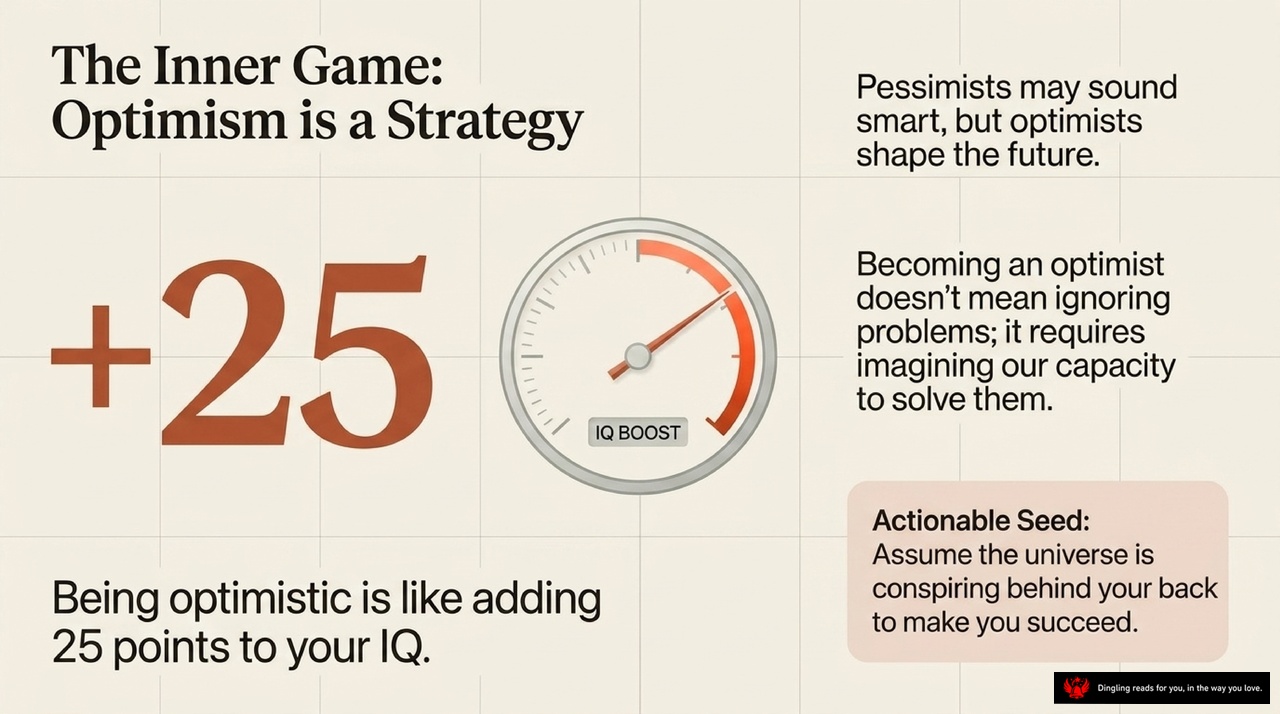
Optimism isn't just a feeling; it's a strategic advantage. Think of it like this: being optimistic is the same as adding 25 points to your IQ. That's the power of shifting your mindset.
While pessimists might sound smart, they only react to the world. Optimists, however, actively shape the future. Becoming an optimist doesn't mean ignoring real problems or pretending everything is perfect. On the contrary, it requires the courage to imagine your own capacity to solve them. It's about trusting that the universe is conspiring behind your back to make you succeed.
When you face a challenge, don't let negative emotions drain your energy. Instead, use optimism to boost your cognitive efficiency. This mental shift allows you to stay calm when things get tough and restart quickly after a setback. You stop seeing obstacles as dead ends and start viewing them as opportunities for growth.
So, here is your actionable seed: Assume the universe is working in your favor. Stop waiting for the perfect moment and start acting with the confidence that your brain is now 25 points sharper. That's how you turn a simple mindset shift into a tangible boost in your life.

Here is the spoken script for Slide 4:
"Look at this tangled mess on the left. It represents that feeling of being completely overwhelmed when fear hits. The slide suggests that the antidote isn't bravery, but imagination. When you feel stuck, don't just stare at the problem; instead, write down a long list of ideas that you know simply won't work. This might sound counterintuitive, but it's brilliant. By actively imagining failure, you clear the mental space for a real solution to emerge.
Now, look at the line extending to the right. We move from overwhelm to anxiety. The slide states a powerful truth: ninety-nine percent of what you worry about will never actually happen. So, why are you spending your energy on ghosts? The core takeaway here is about action as the antidote. It is much easier to change your behavior to shift your mind than trying to force your mind to change your behavior. Stop waiting for the fear to vanish before you move. Instead, take one small, imperfect action. That single step breaks the paralysis, untangles the knot, and proves that you are in control. Don't let your imagination trap you in a nightmare; use your actions to rewrite the story."
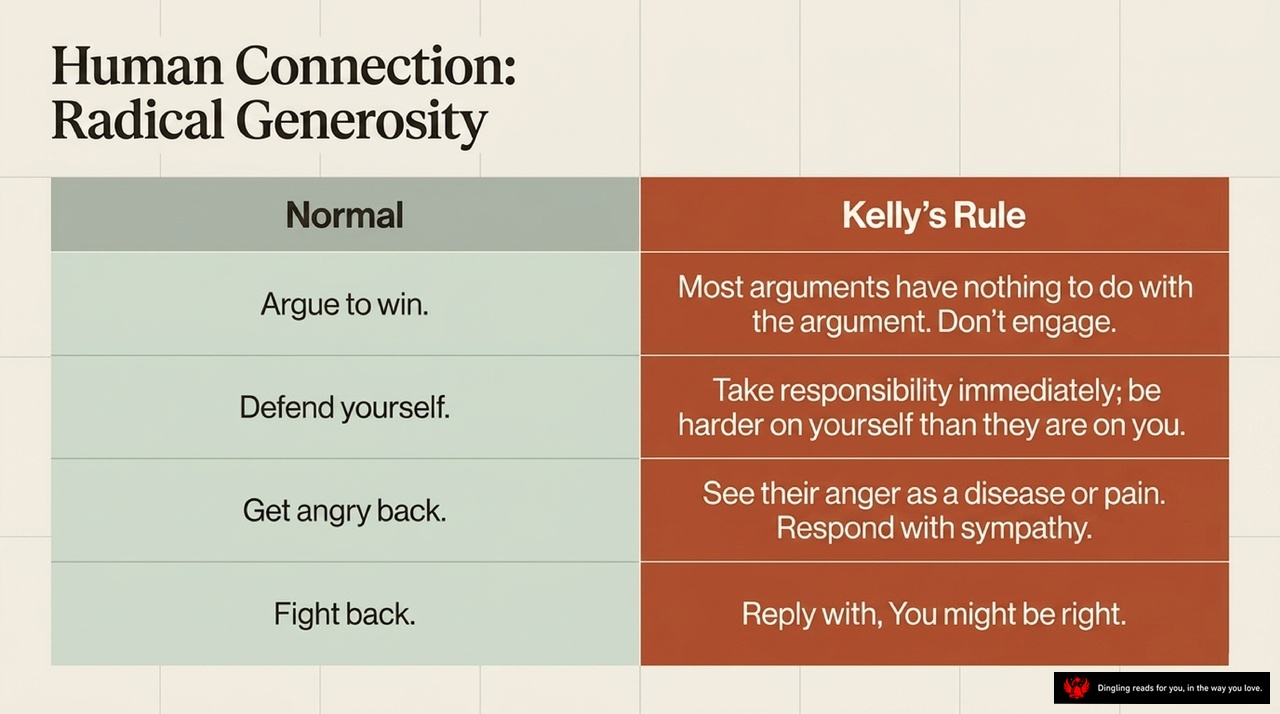
Human Connection: Radical Generosity. This slide isn't just about being nice; it's about a complete shift in how we handle conflict. Look at the "Normal" side—arguing to win, defending ourselves, getting angry back, and fighting back. That's the default human mode, but it's exhausting and destructive.
Now, let's look at Kelly's Rule. This is where the magic happens. First, when an argument starts, realize that most of it has nothing to do with the actual issue. It's about ego. So, don't engage. Stop trying to win the debate. Instead, take responsibility immediately. Be harder on yourself than they are on you. That's a powerful pivot.
Next, when they get angry, don't match that anger. See their rage as a sign of pain or a disease. Respond with sympathy, not defense. And finally, when they attack your ideas, simply reply with, "You might be right." It sounds humble, but it disarms them instantly. By choosing generosity over defensiveness, you don't just win an argument; you transform the entire relationship.

When we talk about human connection, we often think about grand gestures, but the real magic lies in the small, structured ways we interact. Today, let's explore "The Magic of Threes"—a simple framework that can transform how we speak, listen, and apologize.
First, consider the Three Gates of Speech. Before you say anything, pause and ask yourself three questions: Is it true? Is it necessary? And is it kind? This simple filter stops us from spreading gossip or reacting impulsively, ensuring our words build bridges rather than walls.
Next is the Three-Times Rule. Have you ever asked someone why they did something and felt like they were giving you a rehearsed excuse? The truth often hides deeper. By asking someone to elaborate on their answer three times, you peel back the layers of politeness and fear. The third answer is usually the closest to the real reason, helping you understand the person behind the behavior.
Finally, let's talk about apologies. A proper apology isn't just saying "sorry"; it requires the 3 Rs: Regret, which shows empathy; Responsibility, meaning you take ownership without blaming others; and Remedy, where you actively fix the mistake. When you combine these three elements, you don't just fix a problem; you rebuild trust.
These three simple rules—three questions before speaking, three rounds of questioning to find truth, and three components for a real apology—can make your interactions feel more genuine and your relationships stronger. It's not about being perfect; it's about being intentional.
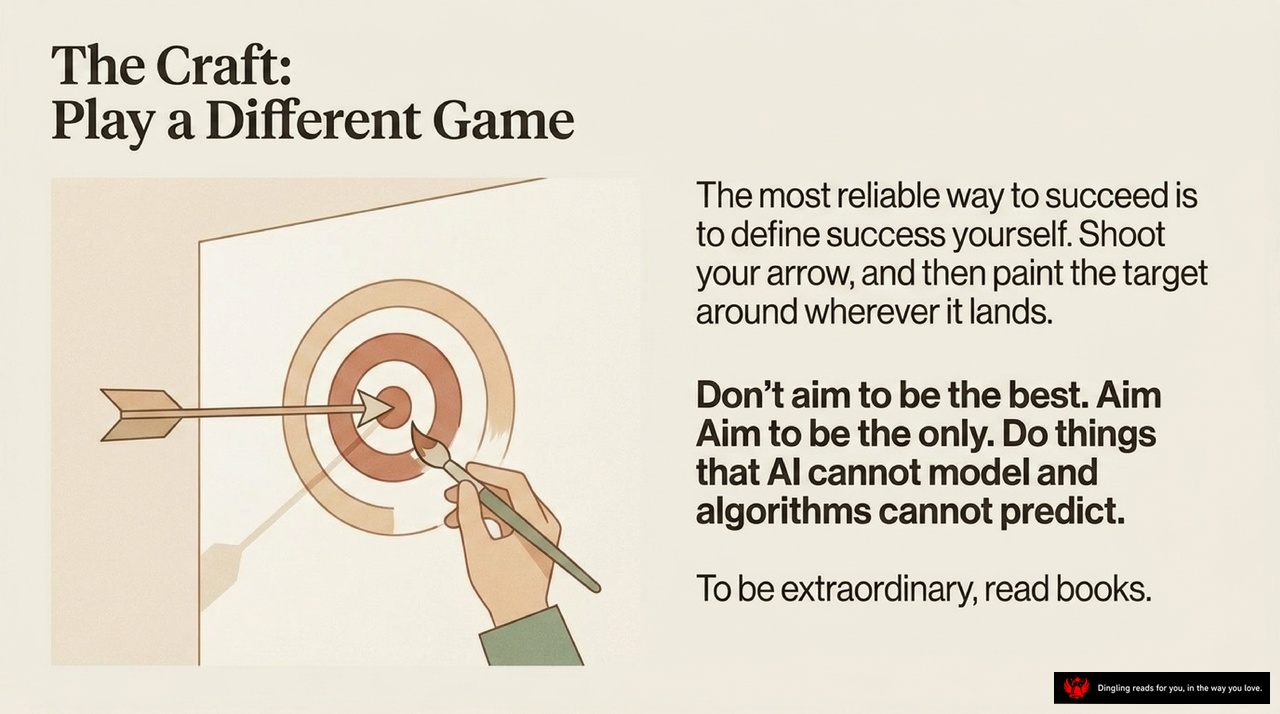
Look at this slide. It's all about playing a completely different game. The core idea is that the most reliable way to succeed isn't to aim for a target someone else set for you. Instead, you shoot your arrow first, and then you paint the target around where it lands.
This is a powerful shift in mindset. Don't try to be the best in a crowded field where everyone is running the same race. Instead, aim to be the only one. Do things that AI cannot model and algorithms cannot predict. In a world full of data and efficiency, your unique human intuition and creativity are your real competitive advantage.
Finally, remember this: to be extraordinary, you have to read books. While everyone else is scrolling through short, repetitive content, you can dive deep into the ideas of the past. That's how you build a perspective that no machine can replicate. Stop chasing the standard metrics of success and start defining your own game.

Have you ever found yourself stuck in a loop of trying everything new or obsessing over perfecting the same thing? Today, we're talking about finding the sweet spot between discovery and refinement. Think of your life as a block divided into two parts: one-third for exploration and two-thirds for optimization.
That smaller, textured section on the left is your exploration zone. This is where you try new restaurants, date new people, read random subjects, or even build a bad prototype. It's about stepping into the unknown, just for the sake of curiosity. But here's the catch: as we age, we naturally stop exploring. We get comfortable, we play it safe, and that one-third shrinks. That's why you have to actively fight to keep that 1/3 dedicated to exploration.
Then, you have the larger, solid green section: optimization. This is where you go deep on what you love. Stick to proven methods, refine the details, and make things work better. If you spend all your time optimizing without exploring, you'll eventually run out of new ideas. But if you spend all your time exploring without optimizing, you'll never master anything.
The secret to a fulfilling life is maintaining that 1:3 balance. You need the freedom to wander and the discipline to excel. So, ask yourself: are you spending enough time exploring the unknown, or are you stuck in the comfort of what already works? Don't let age or routine take over. Keep that 1/3 open for the unexpected, and let the other 2/3 be where you build your legacy.
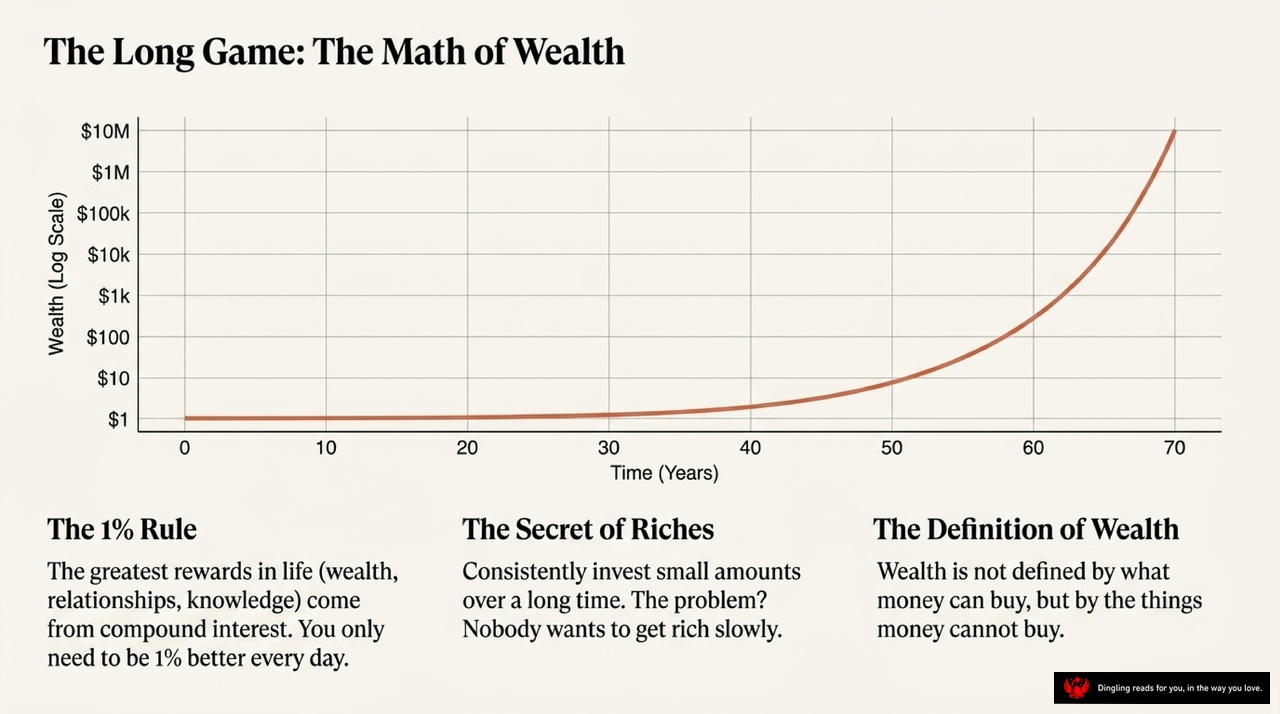
Have you ever looked at a graph and felt overwhelmed by how long it takes to build real wealth? Today's slide breaks down "The Long Game: The Math of Wealth." It shows a classic exponential curve where wealth starts slow but skyrockets after a few decades. The key takeaway is in "The 1% Rule": the greatest rewards in life—whether it's wealth, relationships, or knowledge—come from compound interest. You don't need to be a genius; you just need to be 1% better every single day.
This connects directly to "The Secret of Riches." The math proves that the secret isn't getting lucky or making a quick buck; it's consistently investing small amounts over a long time. But here's the hard truth the graph illustrates: nobody wants to get rich slowly. We all crave the steep part of the curve right now, which is why most people fail. They quit before the curve bends upward.
Finally, look at "The Definition of Wealth." This slide reminds us that true wealth isn't defined by what money can buy—like those flashy items on the y-axis—but by the things money cannot buy, like time, health, and deep connections. If you chase the money without protecting those intangible assets, you might end up rich on paper but poor in life. So, embrace the slow grind, trust the math, and focus on building a life that money can't actually purchase.
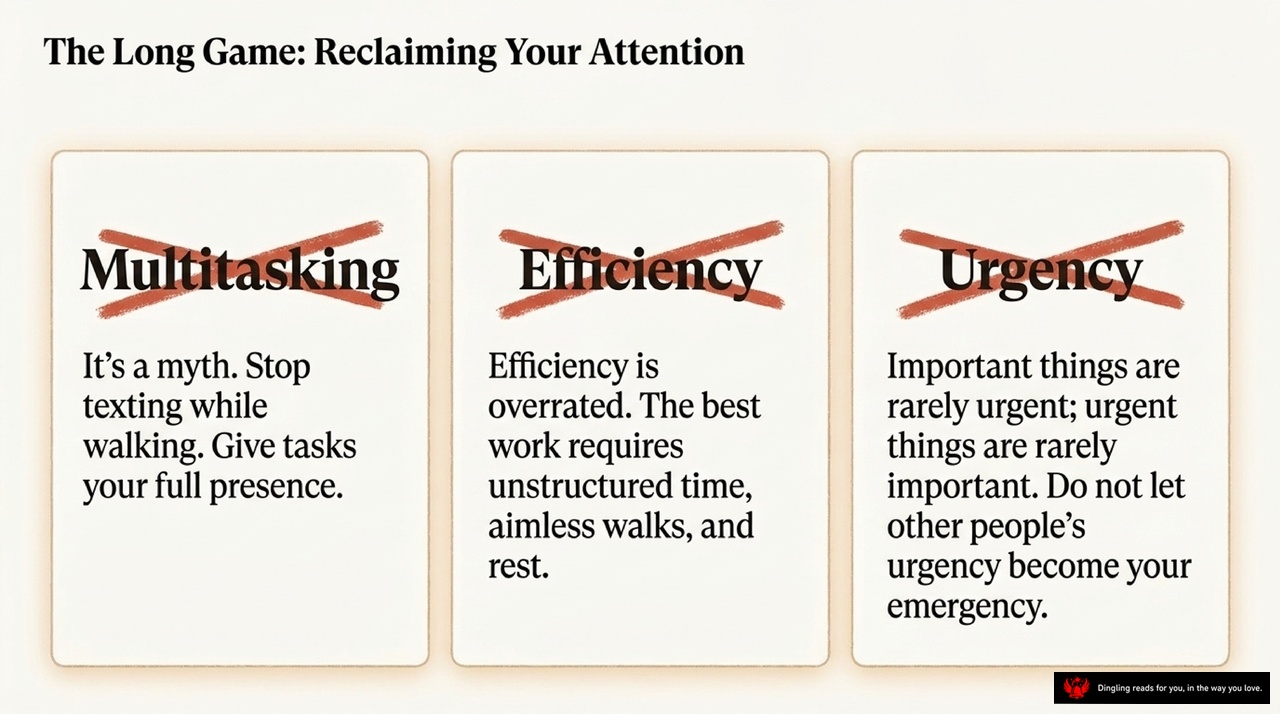
So, let's talk about the long game. It's all about reclaiming your attention, which means stepping away from the three biggest traps that are stealing your focus right now. First, stop chasing the myth of multitasking. The text on the slide is crystal clear: it's a lie. Stop texting while you're walking; just give your tasks your full presence. Your brain can't actually do two hard things at once, and pretending it can just burns out your energy.
Next, we need to rethink efficiency. The slide tells us it's overrated. Real, high-quality work doesn't happen in a blur of speed; it requires unstructured time, aimless walks, and actual rest. You need those gaps to think deeply. And finally, let's kill the obsession with urgency. As the slide points out, important things are rarely urgent, while urgent things are rarely important. Don't let everyone else's panic become your emergency. If you drop these three—multitasking, efficiency, and urgency—you stop reacting to noise and start creating value. That is how you win the long game.

Have you ever felt that trying to write and edit at the same time is the fastest way to kill your creativity? Imagine your brain as a workshop with two distinct zones: one for wild, messy creation, and another for careful refinement. The slide we see here, titled "The Craft: Separation of Powers," visualizes this perfectly with two loops separated by a solid wall.
On the left loop, we have the "Create" phase. The text reminds us that you cannot sculpt, polish, and analyze simultaneously. If you try to be the editor while you are still the creator, you will suffocate your own ideas before they can even breathe. It's like trying to judge a painting while you are still mixing the paint. You need to let everything flow out without any criticism.
Then, look at the right loop: "Refine." This is where you separate the process of creating from improving. Only after the creation phase is completely done do you switch modes. You take that raw material and now, with a critical eye, you polish, edit, and analyze. This separation is the secret to high-quality work because it protects your creative spark until the very end.
Finally, notice the bottom text about "Failure as Fuel." It encourages us to fail fast and fail often. If you expect failure, it stops being a disaster and becomes a valuable lesson. So, embrace the messy first loop, let yourself fail while creating, and then use that experience to fuel your refinement. This rhythm of creating freely and refining later is the true craft.

When we talk about practical life hacks, we're not just looking for quick fixes; we're looking for the kind of wisdom that sticks. Today's slide breaks it down into four simple but powerful rules for navigating the real world.
First, let's talk about losing things. Have you ever spent twenty minutes searching for your keys, only to find them right where you started? The hack here is counterintuitive: when you finally locate a lost item, don't put it back in the "correct" spot you originally looked. Instead, put it back in the very first place you checked. Why? Because the next time you need it, your brain will immediately send you back to that starting point, saving you a whole round of searching. It's a small shift in habit that saves you time every single day.
Second, let's address our spending habits, specifically when it comes to tools. A common mistake is buying the most expensive tool immediately, assuming quality equals performance. But the smart move is to buy the cheapest tool first. Use it until it breaks. If it breaks, then—and only then—buy the best one you can afford. This approach teaches you exactly what you actually need versus what you just wanted. You learn the value of the tool through experience, rather than marketing hype.
Third, think about how you set up your workspace. If you're struggling with lighting or productivity, always choose a room where light comes from two sides. Natural light from multiple angles reduces shadows and eye strain, creating a much more comfortable and efficient environment for work or creativity. It's a simple architectural tweak that can dramatically improve your daily focus.
Finally, let's look at the concept of investment versus cost. The slide reminds us of a classic gardening principle: to grow a $10 tree, you must dig a $100 hole. This isn't just about gardening; it's about life and business. You cannot rush the foundation. Whether you're building a career, starting a business, or learning a new skill, the effort you put into the initial preparation—the deep digging—is what determines how tall and strong your growth will be later. Don't try to plant a tree in a shallow hole and expect it to thrive.
These four points—smart placement of items, testing tools before upgrading, optimizing your environment with dual lighting, and investing deeply in your foundation—are the kind of practical hacks that make life easier and more effective.
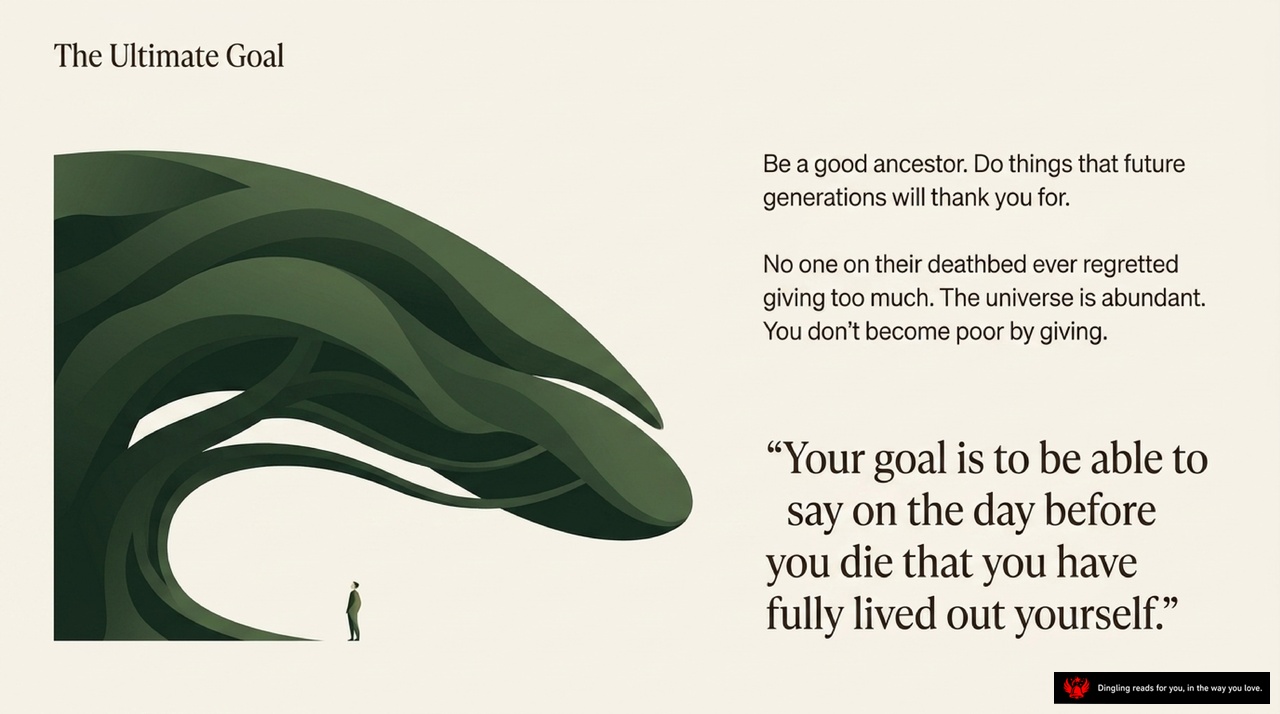
Imagine standing alone beneath the vast, sprawling canopy of a great tree, looking up at the endless branches that stretch into the future. This image captures the essence of what we are truly here to achieve: The Ultimate Goal. It's not about personal fame or accumulating wealth, but about becoming a good ancestor. It's about doing things today that future generations will one day thank you for.
Think about it: no one, on their deathbed, ever regrets giving too much. The universe is abundantly generous, and you do not become poor by giving. In fact, generosity is the ultimate investment. Your life's purpose should be defined by this simple, powerful question: Can you look back on the day before you die and say with absolute certainty that you have fully lived out yourself? That is the metric of a life well-spent. Don't just exist; leave a legacy of kindness and contribution that outlasts you.

Kevin Kelly's "500 Seeds of Wisdom" teaches us that a remarkable life isn't built on grand, sweeping gestures. It is built in the margins—through the compound interest of daily kindness, the courage to explore rather than blindly optimize, the discipline to separate our creating from our editing, and the profound choice to play the infinite game. You have the tools, the blueprints, and the seeds to cultivate an extraordinary existence. So, which seed will you choose to plant today?