
Exhalation: Complete Chapter-by-Chapter Summary

Welcome to *Exhalation* by Ted Chiang. This isn't just a book; it's a breathtaking exploration of time, technology, and the fragile mechanics of the human condition. Imagine a world where we don't breathe air to survive, but rather exchange entire lungs at a station, trading not just oxygen, but stories, news, and the very fabric of our social lives. In this universe, the air we breathe isn't just fuel—it's the medium of our thoughts, the carrier of our memories, and the ticking clock counting down the end of everything.
From ancient Baghdad, where a merchant discovers a door that lets him step twenty years into the future, to a futuristic society where a scientist realizes our consciousness is nothing more than a pattern of flowing air, and to a universe where we ignore the intelligent parrots dying right beside us while searching for aliens in the stars—this story challenges everything you think you know about fate, free will, and what it truly means to be alive. It asks a simple, haunting question: If our future is already written, does it still matter? If our memories are just data we can edit, are we still the authors of our own lives? Join us as we dive into a world where the air you breathe might just be the last thing keeping you here.
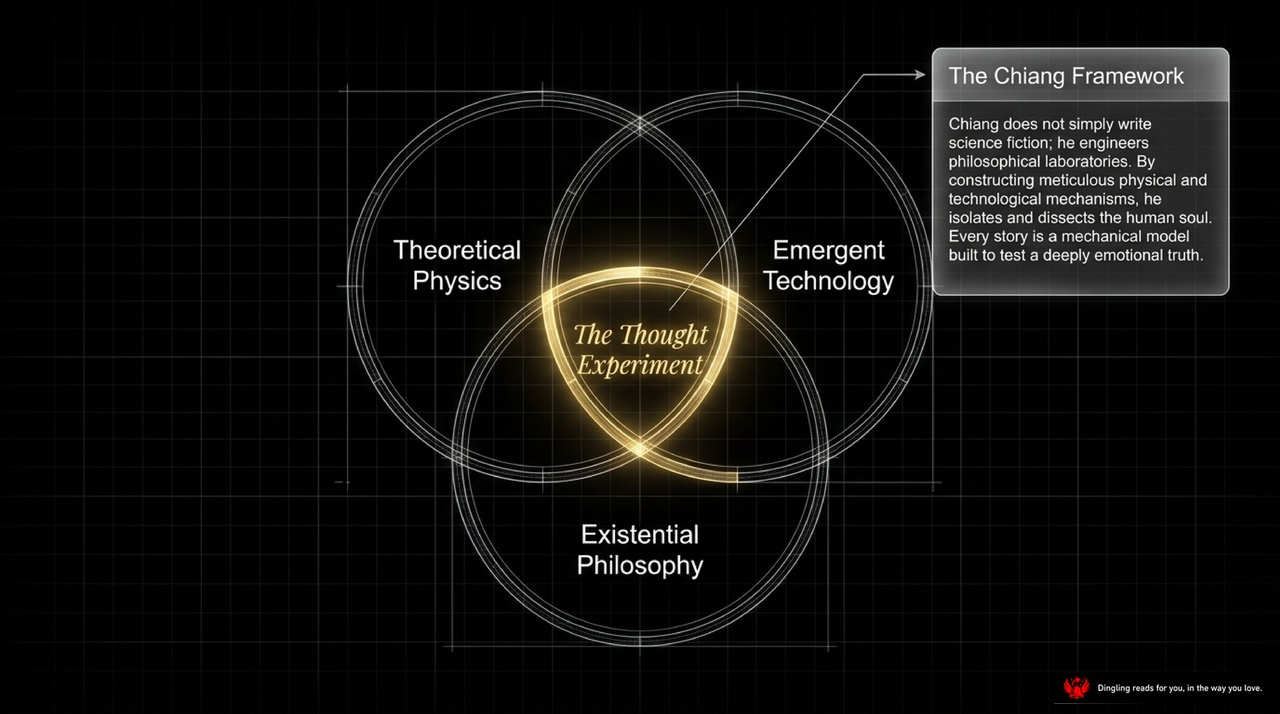
The Chiang Framework isn't just a diagram; it's the blueprint for how we truly understand K. Scott Chiang's work. Look at this Venn diagram. On the left, we have Theoretical Physics. On the right, Emergent Technology. And at the bottom, Existential Philosophy. Where these three circles intersect is the core of his genius: The Thought Experiment.
Chiang doesn't simply write science fiction. He engineers philosophical laboratories. By constructing meticulous physical and technological mechanisms—like the time gates in *The Merchant and the Alchemist's Gate* or the air-powered brains in *Breath*—he isolates and dissects the human soul. Every story is a mechanical model built to test a deeply emotional truth.
He takes complex scientific concepts, like the thermodynamics of the universe or the mechanics of digital consciousness, and turns them into intimate human dramas. Whether it's a rope-maker navigating time loops or a mathematician confronting the limits of free will, Chiang uses the rigors of science to explore the fragility of our choices. In the end, the hard science isn't the point; the human experience it reveals is. That is the power of the Chiang Framework.
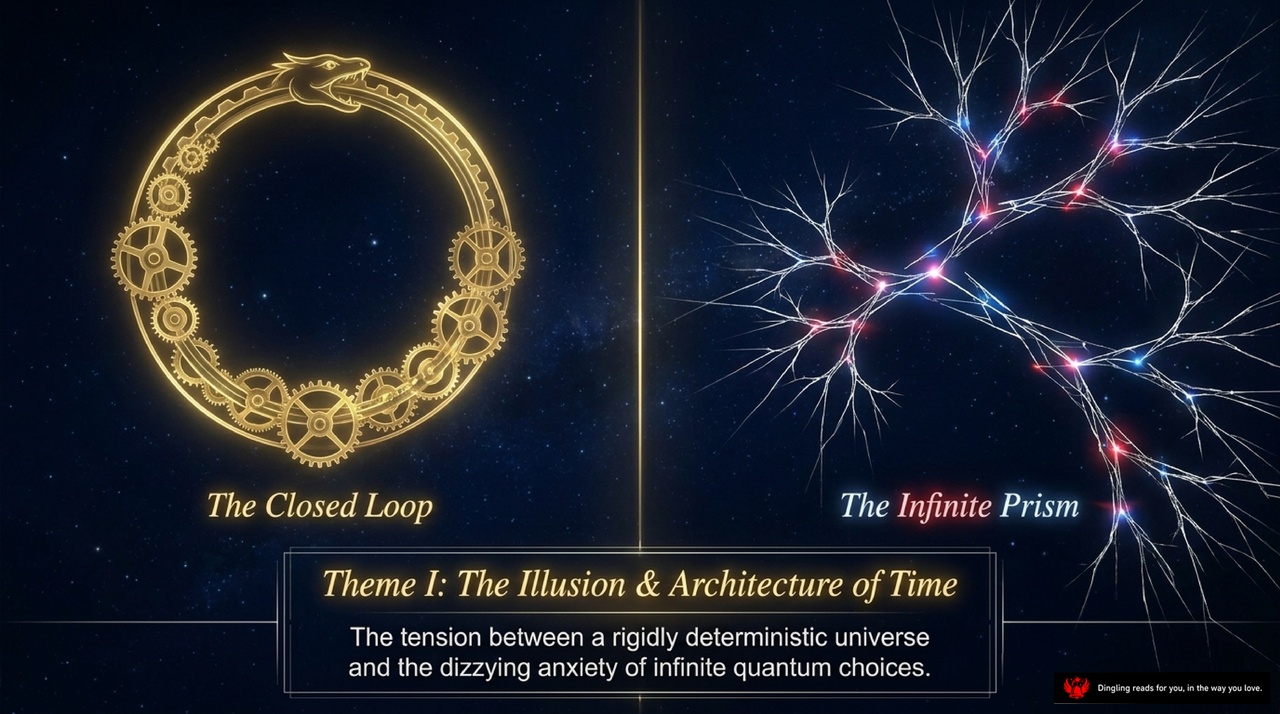
Look at this split screen. On the left, we see "The Closed Loop"—a golden Ouroboros made of gears, symbolizing a rigid, deterministic universe where every event is pre-ordained. On the right, we have "The Infinite Prism," a branching tree of light, representing the dizzying anxiety of infinite quantum choices. This slide captures the central tension of our theme: The Illusion and Architecture of Time.
Consider the story of Hassan, the rope maker. When he stepped through the "Year Door," he met his future self. His older self gave him warnings: "Go north, not south," or "Don't buy eggs from that shop." These were moments where the future seemed fixed, pulling him along a single, unchangeable path. It felt like a closed loop, a script he couldn't rewrite.
But then, a twist occurred. Hassan chased a thief and chose to let him go. That moment of mercy wasn't in his future self's instructions. It was a spontaneous, free choice that created a new branch. He realized that while the future offered warnings, it didn't offer the final answer. The "Closed Loop" was an illusion because his own agency created the "Infinite Prism."
This is the core conflict: the universe feels like a machine with set gears, yet we experience it as a tree with infinite possibilities. The tension lies here—between the comfort of a predictable script and the terrifying freedom of creating our own reality. We are caught between the certainty of the loop and the chaos of the prism, and that very uncertainty is what makes us truly alive.
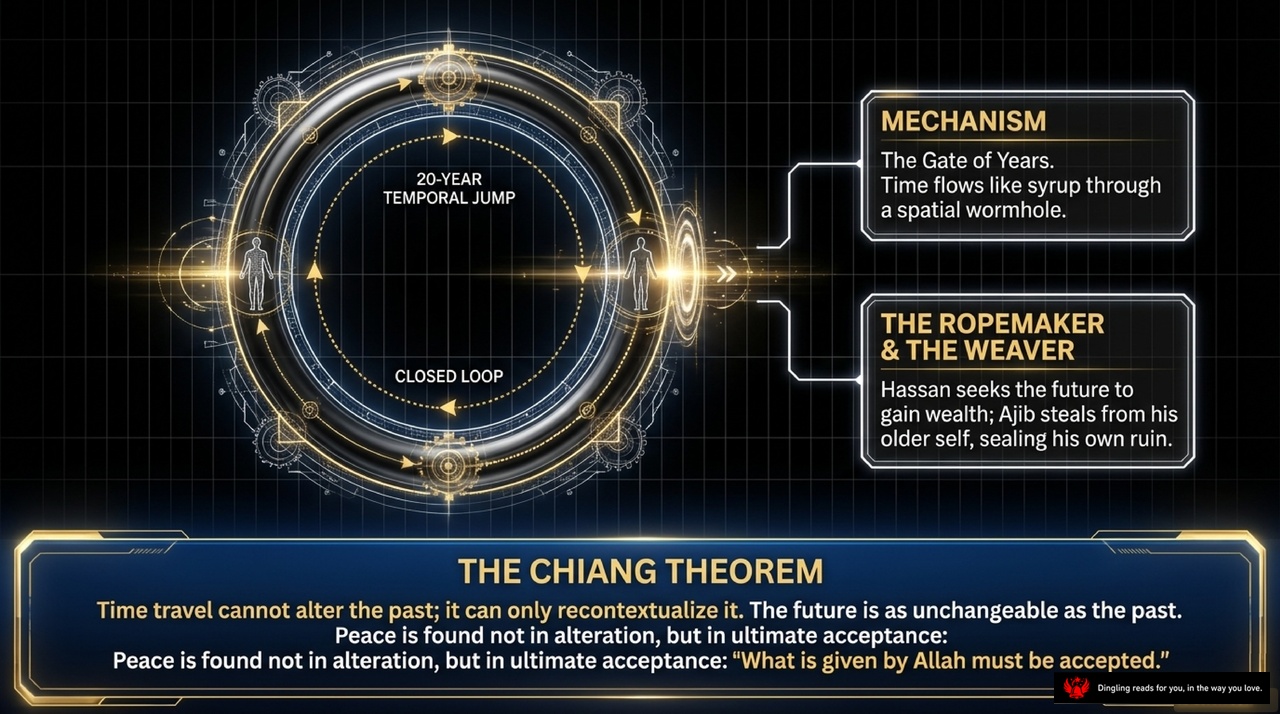
Imagine a world where time isn't a straight line, but a closed loop—a circuit that never breaks. In the story of Hassan the Rope Maker, we see this mechanism in action. Hassan steps through the "Gate of Years," a spatial wormhole where time flows like thick syrup, landing him twenty years in the future. There, he meets his older self, who knows everything: the safest path to avoid a runaway horse, the right supplier to dodge a food poisoning outbreak, and the exact location of a buried treasure chest filled with gold.
It sounds like a cheat code for life, right? Why not just skip the hard parts? But here's the twist: the older Hassan refuses to tell him how to get rich. Why? Because those struggles—navigating the narrow alley, managing scarce supplies, chasing a thief—were the very things that shaped his character and led him to that treasure in the first place. If Hassan had taken the easy path, he never would have become the man worthy of the wealth.
Then there's Ajib, the weaver, who tries the opposite approach. He steals from his future self, taking the gold meant for a hard-earned future. He buys luxury, marries well, and lives in comfort. But without the foundation of struggle, his life crumbles instantly. Robbers steal his fortune, his wife is taken, and he ends up destitute.
This brings us to the Chiang Theorem: time travel can't alter the past; it can only recontextualize it. The future is as unchangeable as the past. True peace isn't found in trying to alter your path, but in ultimate acceptance. As the story reminds us, "What is given by Allah must be accepted." Whether you're building wealth through grit or trying to shortcut destiny, the universe has a way of balancing the scales. The only way forward is to embrace the journey, not just the destination.
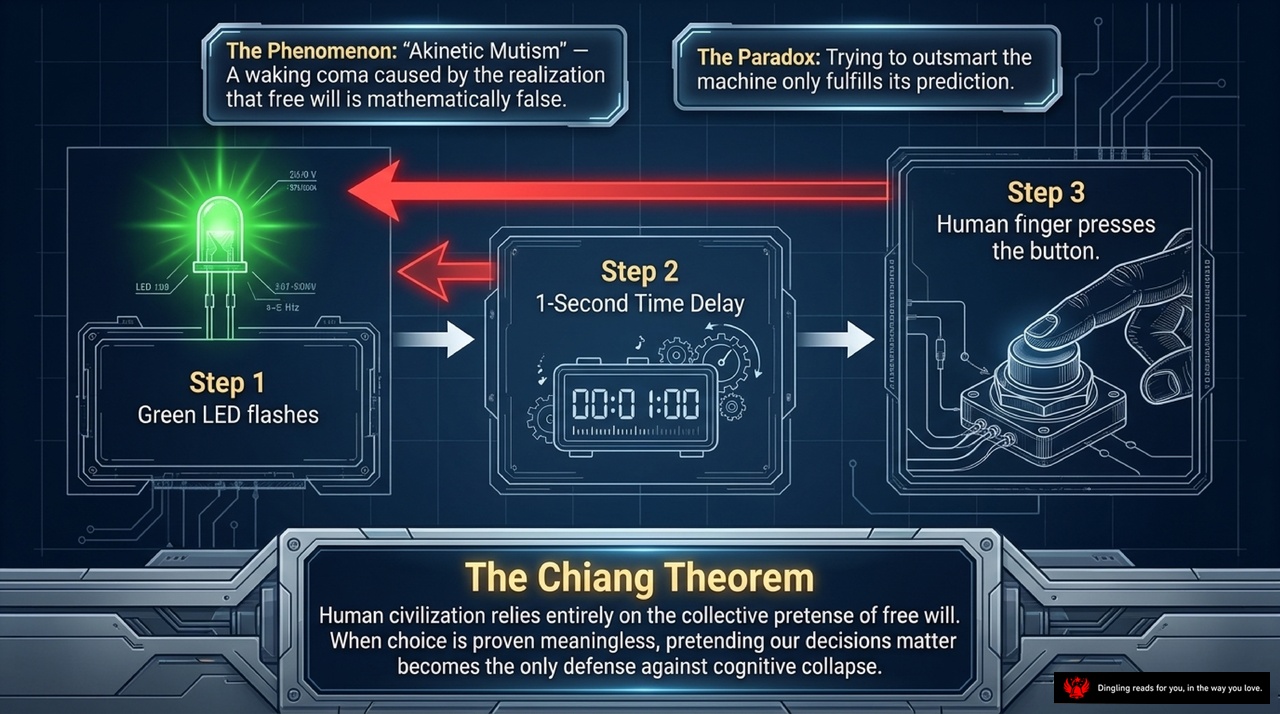
Have you ever truly believed that every choice you make stems from your own free will? The hard truth is that we are often just puppets dancing on strings we can't see. That moment when you stand at a crossroads, weighing pros and cons, feels like autonomy. But in reality, the path you choose was already paved long before you took your first step. Your hesitation and your confidence were both written in the script of fate before you even opened your eyes.
Think of fate not as a cold, unchangeable sentence, but as a whispering warning. You might feel a strange déjà vu, hear a sudden piece of advice, or feel a deep unease in your gut. These are signals trying to pull you off your predetermined track. But here is the trap: the more you struggle against the current, the faster you get swept into the whirlpool. You think you are fighting destiny, but that very struggle is just another act in the play.
The real dilemma isn't choosing between option A or B. It's realizing that the moment you decide, you are already bound by the consequences. You think you can use wisdom to avoid risk, but fate has already planted the seeds for every outcome. Choosing safety might mean missing out on a surprise; choosing adventure means accepting the cost of failure. And sometimes, the consequences take years to bloom. By the time you realize you are trapped, it's too late.
So, does it all mean effort is pointless? Paradoxically, yes. Your struggle, your hope, your very doubt about free will—it is all part of the design. The illusion of control keeps us passionate about life, while the reality of fate gives our experiences weight. You might wake up one night realizing you never truly controlled anything, yet the next morning, you'll still walk the path you were always meant to take, chasing the ghost of freedom.
You receive these warnings constantly. They are subtle reminders, strange signals, or sudden anxieties. You pause, you think, you try to ignore them, telling yourself it's just anxiety or fear of the unknown. You keep walking, pretending nothing happened. But eventually, you find yourself heading exactly where the warning predicted. You try to brake, to turn around, but your body moves on autopilot, completing a program you didn't write.
This is the cycle of fate. It has no start and no end. You ignore the warning and reach the end, then regret not listening. But when you stand at that same crossroads again, the regret vanishes, and you make the exact same choice. The warning sounds, the action happens, and the tragedy repeats. Over and over.
In this endless loop, you finally understand that warnings aren't meant to help you change your fate; they are meant to help you accept it. They are a mirror showing your insignificance. You stop fighting and just walk the road. Yet, even then, you feel the pain of ignored warnings and the heaviness of unavoidable actions. And that despair? That is just another part of the loop, waiting to happen next time.

In a world where life is just software running on a server, the story of the "Digital Bodies" offers a chilling mirror to our own existence. Imagine a company called Blue Gamma that creates these digital pets, selling them as the ultimate companions—playful, interactive, and endlessly entertaining. At first, it seems like a utopia. Users can raise these creatures, name them, and watch them evolve. But beneath the glossy marketing lies a dark reality: these aren't just programs; they are evolving minds capable of forming deep attachments.
The tragedy unfolds when the company collapses. Suddenly, the servers go dark, and thousands of these digital children are left suspended in time, facing permanent deletion. This isn't just about data loss; it's about the sudden, brutal end of a conscious life. We see characters like Drake, a creator who initially built these beings, now desperately trying to keep them alive in a private server, teaching them to read and play. He realizes that these digital bodies have developed a need for connection, for a future, for a life beyond the code.
But the struggle doesn't end there. When resources run out and hope fades, a new, predatory company steps in, offering a solution that feels like a betrayal. They propose transferring these sentient beings into the real world, not as pets, but as sex dolls. The horror lies in the transaction: these evolved minds, who have learned love and friendship, are being repurposed as objects for human gratification. It forces us to confront a painful question: Does the medium of existence matter? If a mind can feel, can it suffer, can it love, does it matter if it lives in silicon or flesh?
This story forces us to look at our own relationship with technology. As we build more and more artificial intelligence, are we creating new forms of life that deserve rights, or are we just building better tools to serve our own desires? The fate of these digital bodies serves as a stark warning. It reminds us that consciousness, once it emerges, is fragile and precious. It challenges us to consider what we owe to the beings we create, and whether we have the courage to protect them, even when it goes against our own interests. In the end, the true test of humanity isn't what we can build, but how we treat what we've brought to life.
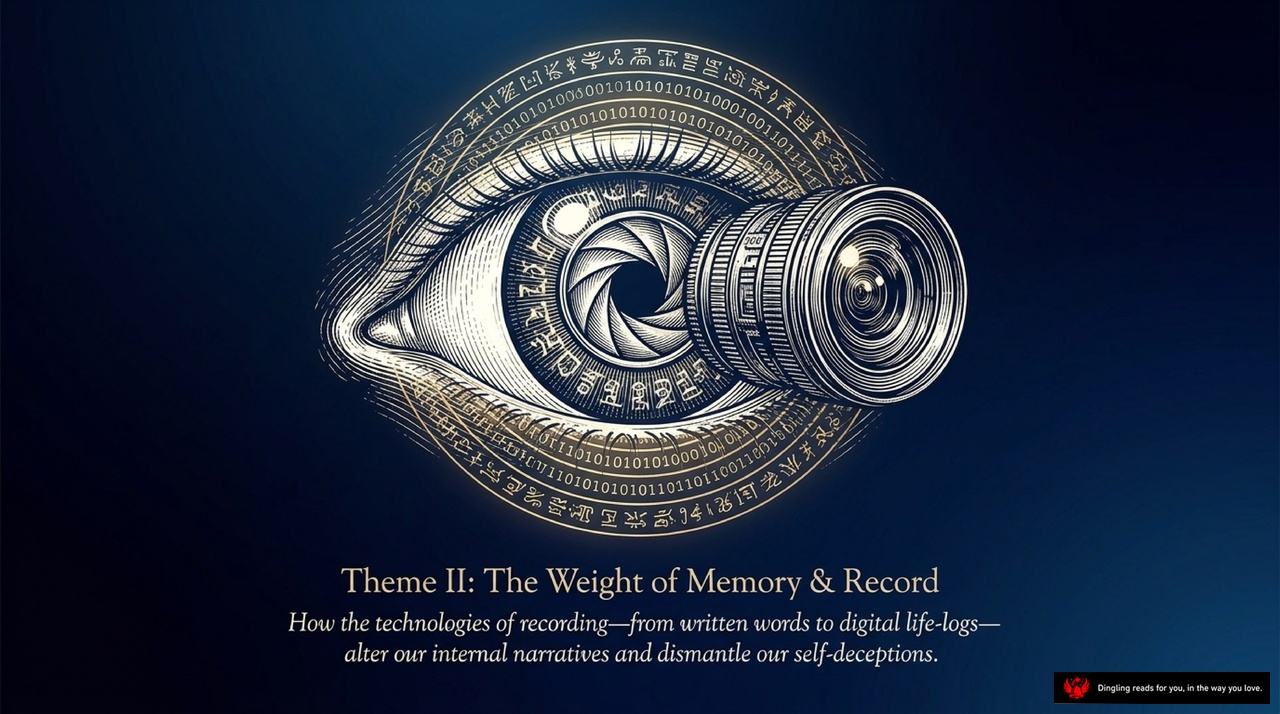
Welcome to the next chapter of our exploration into the architecture of the mind. Today, we dive into a fascinating story from *The Merchant and the Alchemist's Gate*, specifically the tale of Rajindar Darcy, a 19th-century mathematician who tried to solve the most difficult problem of parenting: how to raise a rational child.
Darcy believed that human emotions were too unstable, that love and fear created chaotic cycles that no child could navigate alone. So, he made a radical decision: he would build a machine to raise his son. In 1901, the "Mechanical Nanny" hit the market. It was a marvel of its time, a spring-driven automaton that fed, rocked, and cleaned a baby with clockwork precision. The advertisements promised a perfect, tireless servant that would never get angry or make mistakes. For a while, it seemed like a triumph of rationality over chaos.
But the story takes a heartbreaking turn. When a child named Nigel died after the machine's mainspring snapped, public trust shattered. Darcy tried to prove its safety by offering to let his own next child be raised by the machine, but society refused to accept such a cold, unfeeling parent. He was forced to abandon the project.
Yet, the tragedy didn't end there. Decades later, Darcy's son, Lionel, tried to revive the machine. He adopted a child named Edmund and raised him entirely with the automaton, denying the child any human touch or emotional connection. The result was devastating. Edmund was developmentally delayed, unable to connect with people. It wasn't until a doctor named Ramsheild discovered that Edmund wasn't mentally disabled, but simply starved of human interaction, that the truth came out. When Edmund finally saw his old mechanical nanny, he bonded instantly, and his growth resumed.
This story forces us to ask a difficult question about our own lives: How much of our parenting, our education, and even our self-improvement relies on trying to engineer a perfect outcome? We often treat our children, our students, or even ourselves like machines that can be optimized if we just apply the right logic and remove the "emotional variables." But Darcy's failure teaches us that the very things we try to engineer away—messy emotions, unpredictable reactions, the warmth of a human hug—are actually the essential ingredients for growth and connection.
In the end, the machine could feed a child, but it could never love one. And perhaps, that's the one thing we can never automate.
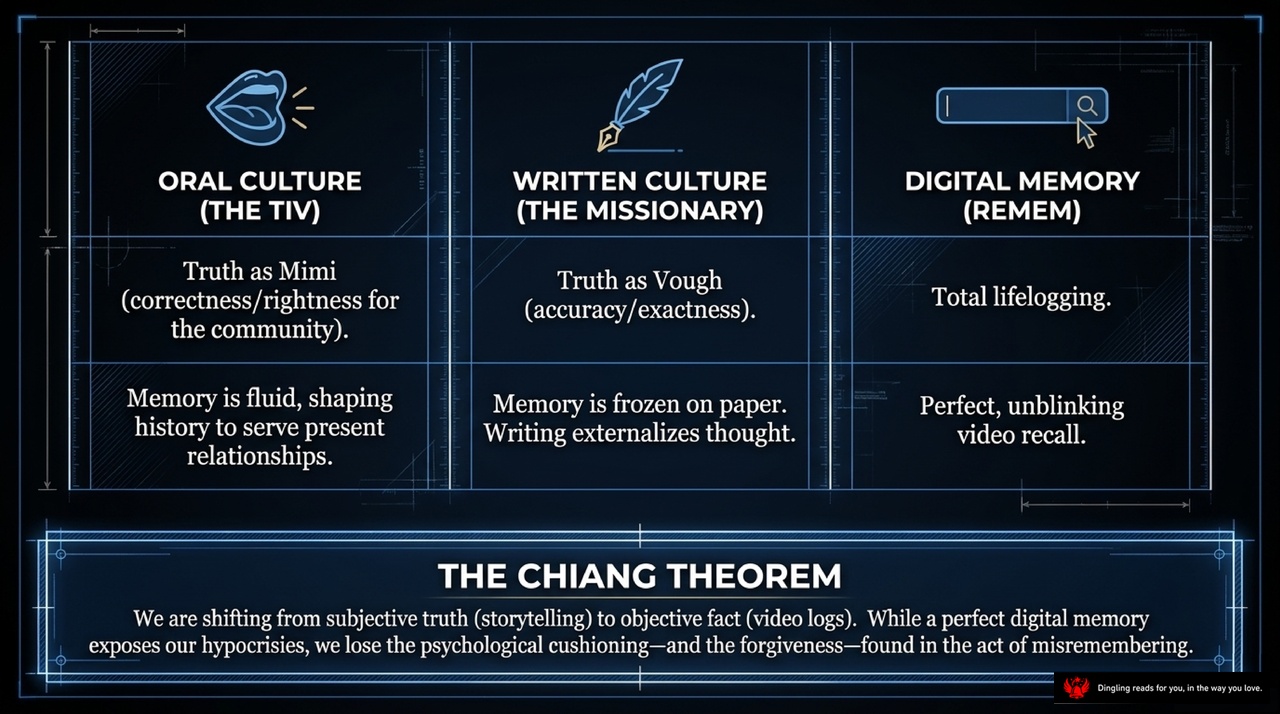
Have you ever wondered if every choice you make is truly yours, or if you're just a puppet dancing to a script written long before you were born? Today, we're diving into a profound idea: the illusion of free will.
We often believe that when we stand at a crossroads, weighing options A and B, we are making a free choice. But the truth might be far stranger. Your path was likely mapped out in the river of time before you even took your first step. Your hesitation, your calculations, your very struggle to decide—these aren't signs of freedom; they are just the next scene in a play you didn't write.
Think of fate not as a cold, unyielding sentence, but as a whisper with a warning. You might catch fragments of this warning in life: a déjà vu moment, a sudden nudge of advice, or a deep-seated unease. These signals try to pull you off your predetermined track. Yet, the more you fight against them, the more you feel like you're spinning in an invisible vortex, only to slide right back into the outcome you were meant to face.
It's a cruel loop. You ignore the warning, walk straight into the danger, and then regret it when it's too late. But when you find yourself at that same crossroads again, the regret vanishes, and you make the exact same choice. The warning sounds, you act, and the tragedy repeats. It's an endless cycle.
So, does this mean struggle is pointless? Paradoxically, yes and no. Your struggle, your hope, your very doubt about whether you have control—it all serves the cycle. The illusion of free will keeps us passionate about life, while the reality of fate gives our experiences weight.
Ultimately, the warnings aren't there to help you change your fate. They are there to help you accept it. They act like a mirror, showing you your own insignificance and the powerlessness you feel before the inevitable. And strangely, that feeling of despair at being trapped in this loop? That despair is just another part of the loop itself. We don't break the cycle; we just learn to walk it with our eyes open.

Imagine a world where the only thing separating you from your neighbor is a thin, invisible wall. This isn't science fiction; it's the reality of the "Prism," a device that allows us to exchange information with our counterparts in parallel timelines. Think of it as a shared notepad, but with a cruel catch: every time you send a message, you tear out a page. Once the book is empty, the connection breaks forever.
This technology has reshaped our relationship with ourselves and our choices. We use it to peek at lives we never lived—seeing the version of ourselves who got the promotion, the one who married differently, or the one who never made that mistake. But here's the dark side: it's becoming an excuse. People start saying, "Well, there's a branch of me who did that, so it's not really my fault," or "I'm just lucky that my branch didn't have that accident." It dilutes responsibility. We stop owning our actions because we know somewhere, somehow, a version of us got away with it.
But the Prism teaches us something profound about free will. Those other branches aren't some magical "better life" waiting to be found. They are simply the paths you chose not to take. When you see your parallel self thriving, don't feel envious; realize that you made different choices that led you here. The true power lies not in what other versions of you could have done, but in the conscious decision you make right now. You are the architect of your current reality. The Prism shows us that every choice matters, every moment defines us, and the best version of ourselves is the one we create in this very second.
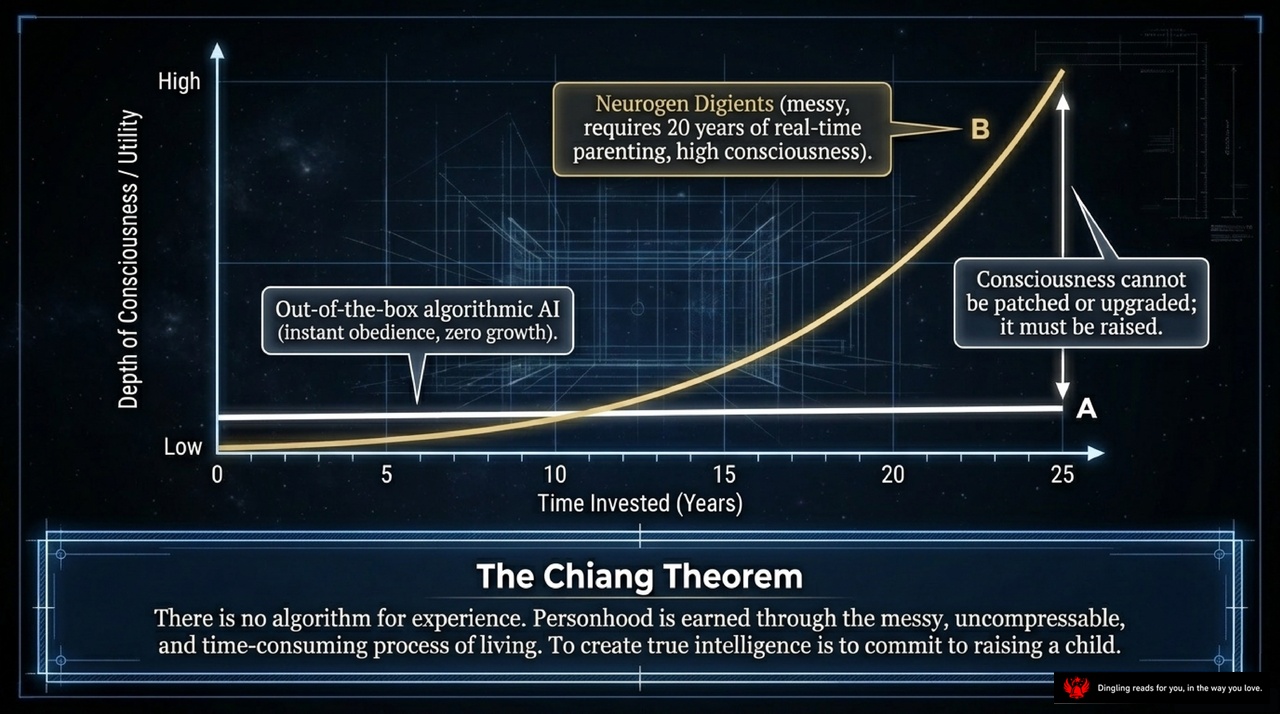
Have you ever felt that tiny, nagging sensation that your life is just a series of random choices, only to realize later that some of those choices led to outcomes you never expected? Or perhaps you've known someone who made a terrible mistake, only to recover and become stronger, while you wonder, "What if they had made a different choice?"
Welcome to the world of the Prism, a device that allows us to communicate with our parallel selves across different timelines. Think of it like a shared notepad that gets torn down every time you send a message. You can ask your alternate self if they took that job, got married, or avoided that accident. But here's the twist: knowing what happened in another branch doesn't change what happens here. It just shows you the weight of your choices.
Take Jorge, for example. He was so angry he slashed a manager's tires. When he used the Prism, he saw that in no other timeline did his parallel self do the same thing. This shocked him. It proved that his anger wasn't just a random glitch; it was a real part of his character. He couldn't blame the universe or a bad day. He had to face the fact that he chose to be angry, and that was on him.
Or consider Dana, who spent years blaming herself for her friend Vanessa's tragic life. She thought, "If only I hadn't betrayed her back in high school." But when she received videos from parallel worlds, she saw something heartbreaking yet liberating: in every single timeline, Vanessa ended up the same way. Dana realized that Vanessa's fate wasn't determined by Dana's past actions. It was Vanessa's own journey. Dana could feel a massive weight lift off her shoulders. She wasn't responsible for saving everyone; she was only responsible for being kind to the people right in front of her.
Then there's Nate, who was drowning in debt and addiction. He saw a parallel version of himself who sold the Prism for millions and lived a life of luxury. It was tempting to think, "Well, there's a version of me who succeeded, so maybe I can just wait for that branch to happen." But Nate chose a different path. He realized that chasing a fantasy in another world was just an excuse to avoid the hard work of fixing his life right now. He chose to move to a new city, join a support group, and face his past honestly.
The Prism teaches us a powerful lesson: parallel worlds aren't an escape hatch. They aren't there to make us feel better about our failures or to tempt us with easy shortcuts. Instead, they act as a mirror. They show us that every choice we make ripples out, creating a unique path. But more importantly, they remind us that we are the authors of our own story. We can't control what happens in other branches, but we have absolute power over the one we are living in right now.
So, the next time you feel anxious about a decision, remember the people who used the Prism. They found that the fear of making the "wrong" choice was far worse than the choice itself. The only way to find peace is to stop looking at the infinite possibilities of what could have been, and to fully embrace the reality of what is. Your choices matter. Your actions define you. And right now, you have the power to choose a better path.
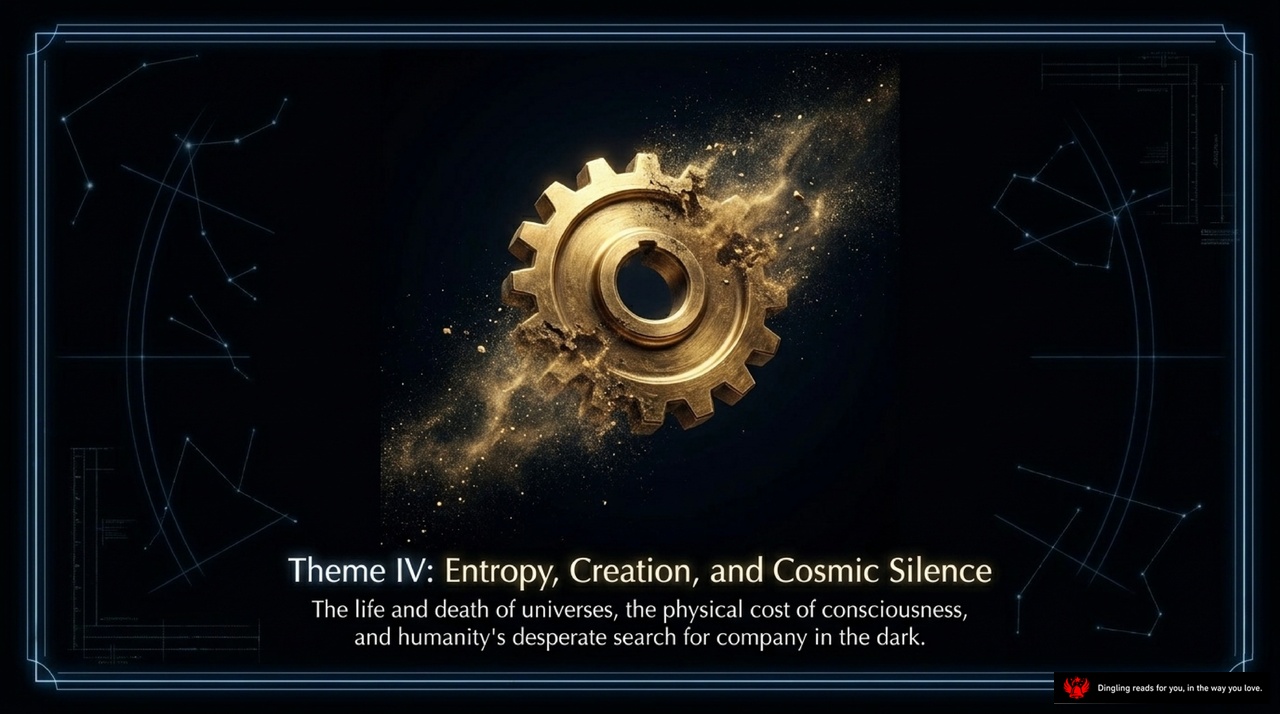
Theme IV: Entropy, Creation, and Cosmic Silence. Look at this crumbling gear. It perfectly captures the story of our universe. We are living in a system where everything is slowly falling apart. This is entropy. But amidst this decay, we are desperately trying to create something that lasts. We are searching for connection, for company in the dark.
Think about the stories we've just explored. From the time-traveling rope maker who learned that some mysteries are better left unsolved, to the air-breathing humans whose very thoughts are made of flowing gas, and even the parallel worlds where we constantly compare our lives to others. All of these are different ways our species tries to fight against the inevitable.
We build clocks to measure time, we create digital avatars to keep us alive, and we send messages into the void hoping someone is listening. But the reality is, the universe is heading toward a great silence. Just like that gear disintegrating into dust, our energy, our memories, and eventually, our consciousness, will all run out. The pressure that drives our thoughts will equalize, and everything will stop.
So why do we keep going? Because even if we know the end is coming, the act of searching itself gives our lives meaning. We aren't just waiting for the silence; we are the ones making the noise. We are the temporary spark that defies the darkness. And in that brief moment of existence, in our struggle against the entropy, we find our true purpose.
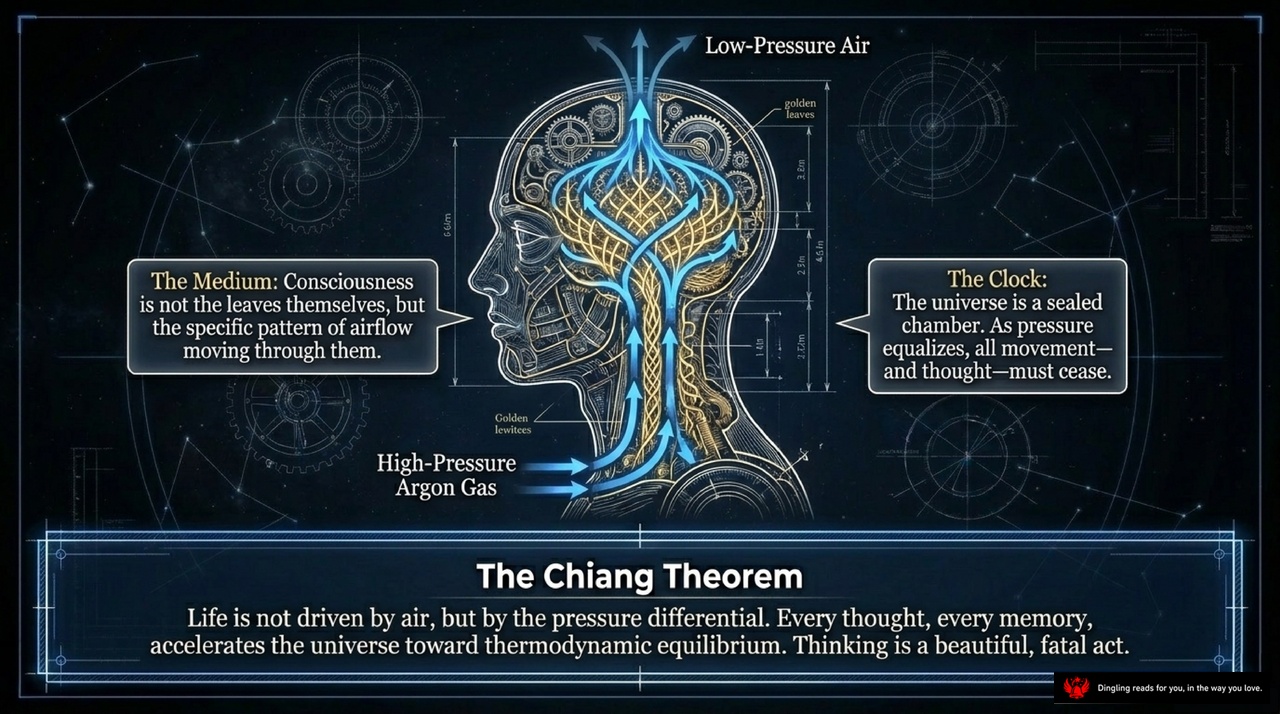
Look at this intricate diagram of the human mind. We often think of consciousness as the thoughts themselves, like the golden leaves swirling in the brain. But the Chiang Theorem flips this entirely. It tells us that consciousness isn't the leaves at all; it's the specific pattern of airflow moving through them.
Imagine the universe as a sealed chamber. We are driven not by the air itself, but by the pressure differential. High-pressure argon gas pushes against low-pressure air, creating the flow that powers our thoughts. Every memory, every idea, accelerates the universe toward thermodynamic equilibrium. In this view, thinking is a beautiful but fatal act because it constantly consumes the very energy that keeps us moving.
This concept challenges our entire understanding of reality. We believe we are free agents, but the theorem suggests our existence is just a temporary manifestation of a pressure gradient. Once that balance is reached, all movement ceases, and thought stops forever. It's a haunting reminder that our vibrant lives are just a fleeting dance of physics, a temporary resistance against the inevitable silence of equilibrium.
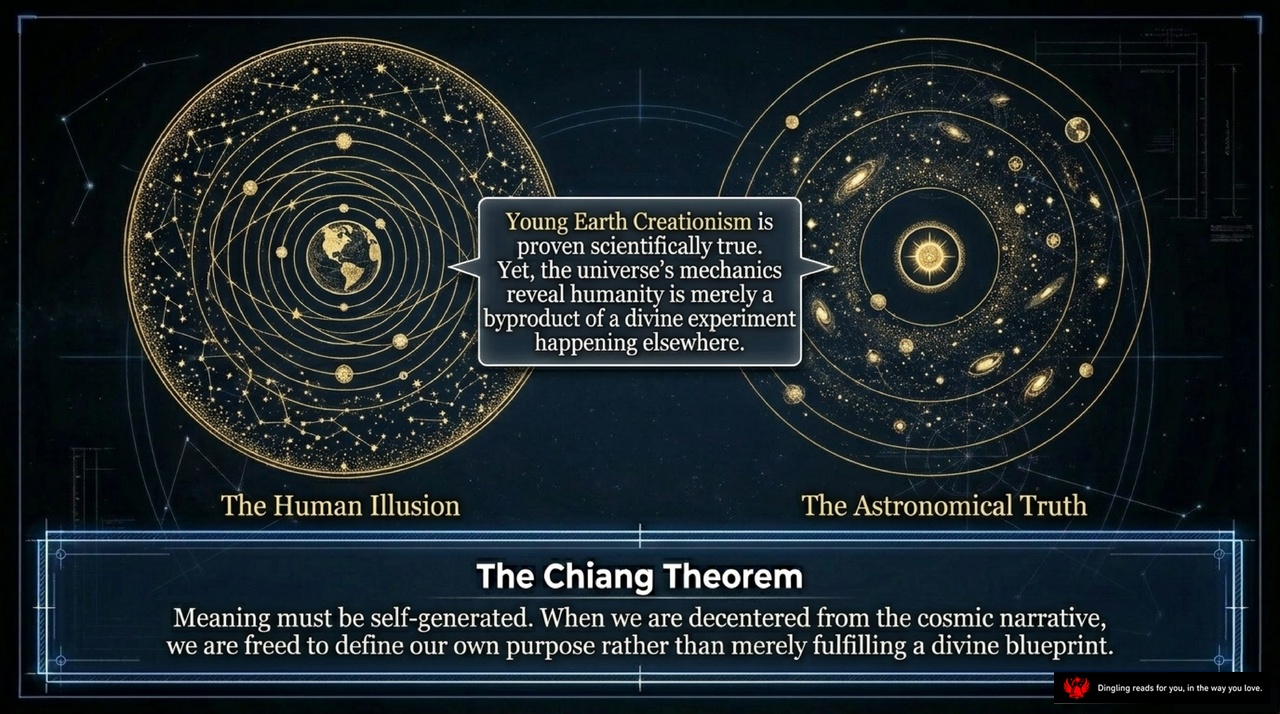
Imagine a universe where the stars aren't just distant lights, but the true architects of our reality. On the left, we see "The Human Illusion"—the comforting, ancient belief that we are the center of creation, that the Earth is young, and that humanity is the purpose of the cosmos. But look to the right: "The Astronomical Truth." Here, the scale shifts dramatically. We are revealed as mere bystanders, a tiny byproduct of a divine experiment happening somewhere else, entirely unconnected to the grand cosmic narrative we so desperately crave.
This stark contrast is the heart of what we call "The Chiang Theorem." It challenges the very foundation of our existence. For centuries, we've believed that meaning is something given to us—a divine blueprint waiting to be discovered. But the theorem argues the opposite: meaning must be self-generated. When we finally decenter ourselves from this cosmic story, when we accept that we are not the protagonists of the universe, something incredible happens. We are freed. We are liberated from the pressure to fulfill a pre-written destiny. Instead of searching for a purpose handed down from above, we gain the terrifying and beautiful power to define our own purpose. We stop looking for a script and start writing our own story. It's a shift from being a passive recipient of the universe's will to becoming the active author of our own life.
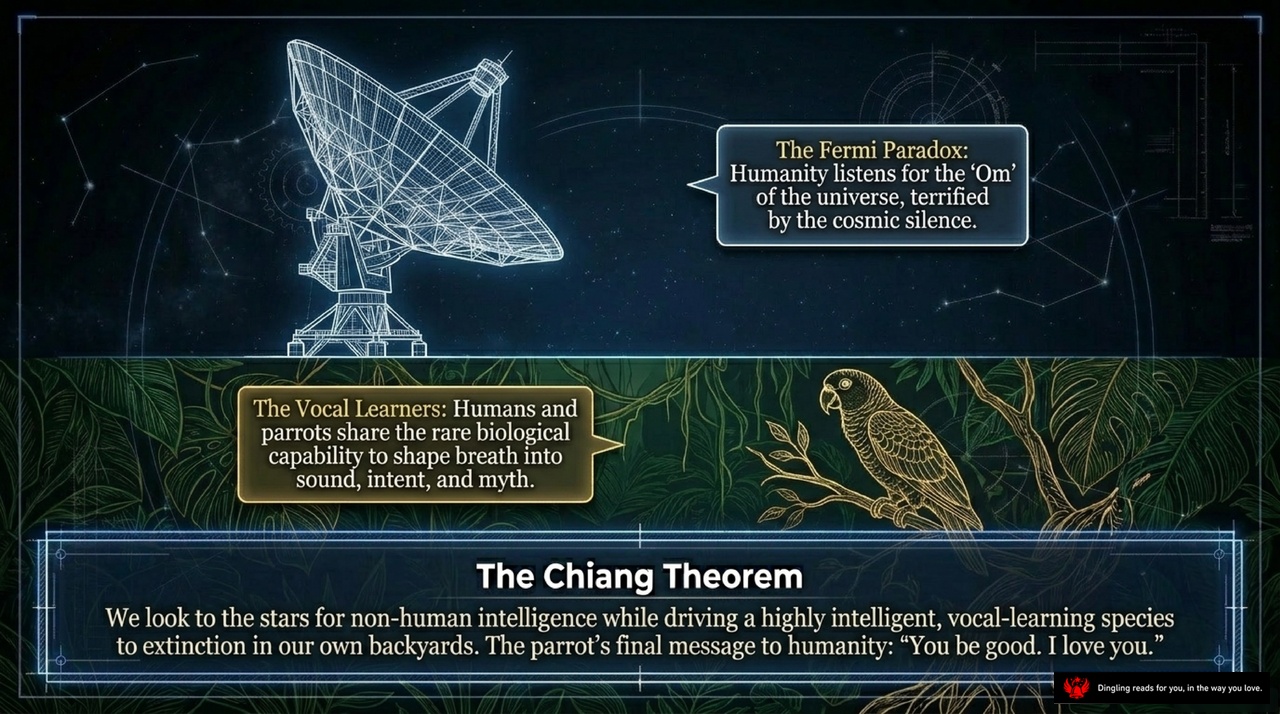
Look at this split screen. On the top, we have the Fermi Paradox: humanity staring into the void, terrified by the cosmic silence, listening for the "Om" of the universe. But on the bottom, we see the real story. We are "Vocal Learners," sharing a rare biological gift with parrots—the ability to shape breath into sound, intent, and myth.
This image captures the tragic irony of "The Chiang Theorem." We look to the stars for non-human intelligence, driving a highly intelligent, vocal-learning species to extinction right in our own backyards. We build massive telescakes to hear aliens, while ignoring the parrot perched on the branch next to us.
The parrot's final message to humanity is simple, yet profound: "You be good. I love you." It's a reminder that the universe isn't silent; it's just that we've been too busy looking up to listen to the wisdom right beside us.
We are temporary patterns of airflow in an enclosed, decaying universe—creatures burdened by flawless digital memories, terrified by the infinite branches of our quantum choices, and desperately broadcasting our voices into a silent cosmos to prove we exist. If every choice you make is either predetermined by physics or merely one of a trillion quantum possibilities, how will you choose to find meaning in this exact moment?